Shownotes
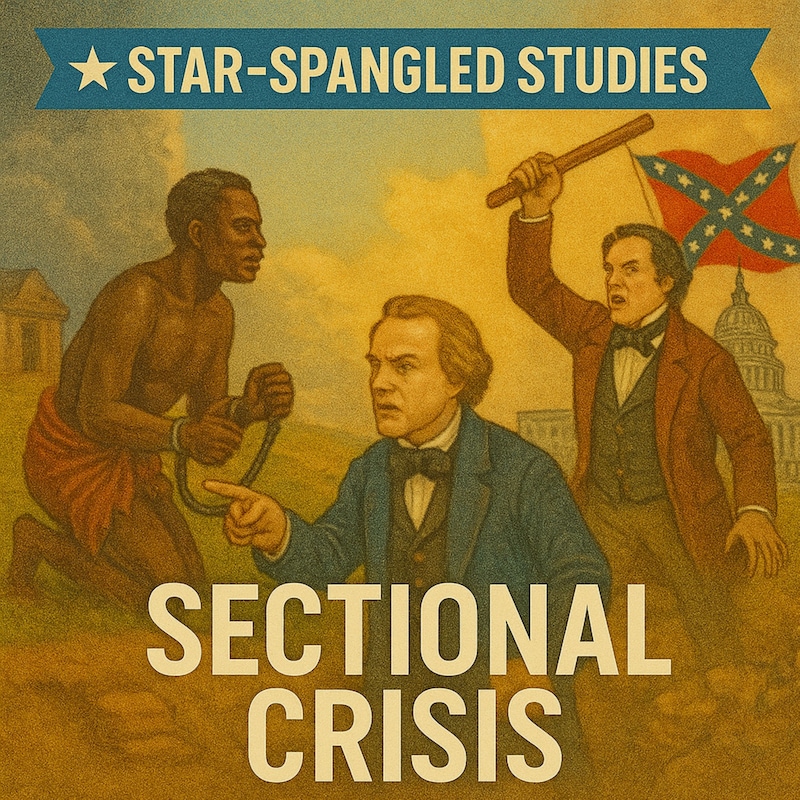
In Episode 13 of Star-Spangled Studies, Dr. G unpacks how the 1850s sectional crisis shattered the Union. Key topics include:
• Senate caning of Charles Sumner & breakdown of debate
• Compromise of 1850 and the Fugitive Slave Act
• Uncle Tom’s Cabin’s moral impact
• Kansas–Nebraska Act, popular sovereignty & “Bleeding Kansas”
• Rise of the Republican Party
• Dred Scott decision’s political earthquake
• John Brown’s raid at Harpers Ferry
• 1860 election: four-way split & Lincoln’s sectional victory
Follow Along & Stay Connected
Stay connected with Dr. G and the podcast community:
📸 Instagram: @star_spangled_studies
Don’t forget to subscribe, rate, and share Star-Spangled Studies with fellow history lovers!
Transcripts
Hello, y'all.
2
:It's me.
3
:It's me.
4
:It's Dr.
5
:G.
6
:Welcome back to Star-Spangled Studies.
7
:The date is May 22nd, 1856.
8
:The place.
9
:The floor of the United States Senate.
10
:A chamber supposedly dedicated
to reason debate Massachusetts.
11
:Senator Charles Sumner, a staunch
abolitionist is at his desk
12
:signing copies of his recent
speech, the Crime Against Kansas.
13
:He had viciously attacked the institution
of slavery and its defenders, including
14
:Senator Andrew Butler of South Carolina.
15
:Suddenly a figure looms over him.
16
:It's Representative Preston
Brooks, Senator Butler's, kinsman
17
:Brooks' voice is low and steady.
18
:Quote, Mr.
19
:Sumner, I have read your
speech twice over carefully.
20
:It is a liable on South Carolina and Mr.
21
:Butler, who is a relative of
mine before Sumner can react,
22
:Brooks raises a thick gutta per.
23
:Came with a heavy gold head
and he brings it down with full
24
:force on Sumner's skull again.
25
:Then again, blinded by his own blood
Sumner struggles to rise his long legs
26
:trapped beneath his desk, which is
bolted to the floor with a mighty roar.
27
:He rips the desk from its iron
mooring, staggers into the aisle,
28
:but the beating doesn't stop.
29
:Brooks continues to rain down, blows
the cane shattering into splinters
30
:until Sumner collapses unconscious and
bleeding profusely on the Senate floor.
31
:Brooks would later boast of delivering
quote, about 31st rate stripes.
32
:End quote.
33
:Stunned onlookers, including other
southern congressmen who blocked anyone
34
:from intervening, simply watched the
savage Assault was more than a personal
35
:vendetta, which it was, but it was a
symbol of what the nation had become.
36
:It represented as one historian put it.
37
:The breakdown of reason discourse.
38
:How did the United States, a nation
founded on ideals of liberty and debate
39
:arrive at a point where political
differences were settled with a
40
:cane on the floors of the Senate?
41
:This brings us to one of the great
debates among historians of the Civil
42
:War was this conflict as New York Senator
Williams Seward famously declared.
43
:An irrepressible conflict between two
societies, so fundamentally different.
44
:That war was inevitable, or was
it as a later group of revisionist
45
:Historians like James C.
46
:Randall and Al and Avery Craven argued
a Repressible conflict, a needless
47
:war brought on by a blundering
generation of extremist politicians
48
:who failed to find compromise
that could have saved the union.
49
:Today we will explore the questions
by examining the decade long fuse,
50
:that 1850s decade that was lit by
compromise and it ended in war.
51
:So let's go.
52
:So how did we get here?
53
:Well, we've seen throughout this entire
course how we've got here, obviously,
54
:but today's story is actually gonna
gin not with violence, but in:
55
:with an attempt to avoid violence.
56
:The union that by 1850 was in peril.
57
:The vast territory acquired from
Mexico had thrown the nation into a
58
:crisis over the future of slavery.
59
:California, like we mentioned last
episode was flooded now with settlers
60
:from the Gold Rush in California.
61
:Now that it had the population of
necessary to do so was demanding
62
:admission as a state and a free
state, and once again threaten to
63
:shatter the delicate balance of power
between north and south in the Senate.
64
:Into this breach stepped the giants
of a fading political generation.
65
:At the center was Henry Clay of
Kentucky, the aging great compromiser,
66
:who rose to offer one last grand
bargain to save the nation.
67
:It is a work of mutual concession.
68
:A work in which for the sake of peace
and Concord one party abates his extreme
69
:demands and consideration of an abatement
of extreme demands by the other party.
70
:Let us discard all
resentment, all passions.
71
:Let us go to the altar of our country
and swear as the oath was taken of
72
:Old that we will preserve her union.
73
:End quote.
74
:Clay's plea for unity was met
with a grim prophecy, John C.
75
:Calhoun of South Carolina, so frail
at this point from tuberculosis that
76
:he had to have his speech read by a
colleague delivered a haunting warning.
77
:The North's relentless attacks
on slavery he argued had already
78
:destroyed the union's equilibrium.
79
:I have senators believe from
the first that the agitation of
80
:the subject of slavery would.
81
:If not prevented by some
timely and effective measure.
82
:End in Disunion.
83
:Entertaining this opinion I have on
all proper occasions endeavor to call
84
:the attention of both the two great
parties, but without success, the
85
:agitation has been permitted to proceed
until it can no longer be disguised
86
:or denied that the union is in danger.
87
:End quote, slavery in his other words.
88
:Breaking the union out of this crucible
of hope and despair emerged The great
89
:compromise of 1850 and Great is in
quotation marks and is definitely
90
:was not that it wasn't a single
bill, but it was a package of five
91
:separate laws cleverly steered through
Congress by the rising political
92
:star Stephen Douglas of Illinois.
93
:It was a classic political bargain
with something for everybody.
94
:To put it very plainly, California
becomes admitted as a free
95
:state popular sovereignty.
96
:The will of the people would determine
whether or not new territories when
97
:applying for statehood could become
free or slave states, and this was
98
:to be used in Utah and New Mexico.
99
:It set Texas's boundaries while
also settling its debt that it
100
:had assumed during the wars.
101
:The slave trade was also banned in
Washington DC but the most contentious
102
:part of this, this compromise
contained what historian David Potter
103
:has argued was the poison chalice,
the one piece of the bargain that
104
:the South demanded above all others.
105
:A new draconian fugitive slave
Act would provide and prove to
106
:be the very thing that made this
compromise unsustainable long term.
107
:This new fugitive slave law was
breathtaking in its severity.
108
:It denied accused fugitives the right
to a jury trial or even to testify in
109
:their own defense, federal commissioners
were paid more for returning a person
110
:to slavery than for setting them free.
111
:That could be a problem, as I'm
sure you can see, maybe most
112
:explosively, it demanded that all
citizens, including northerners.
113
:Were by law required to actively assist
in the capture of his alleged runaways.
114
:Any person found not assisting or
impeding on the capture of runaway or
115
:alleged runaway slaves was fined with
heavy fines and even prison sentences,
116
:even if you just aided in their escape.
117
:The South had demanded this law to secure
what it called its property rights, a key
118
:condition for them to remain in the union.
119
:Yet its enforcement had a profoundly
radicalizing effect on the north.
120
:It dragged the reality of slavery.
121
:For many northerners had been a
distant, abstract institution.
122
:Into their neighborhoods,
into their town squares.
123
:The site of federal marshals seizing
people, some of whom have lived as free
124
:members of their communities for years
and sending them back to the south.
125
:Without due process turned many moderates
into staunch opponents of the slave power.
126
:Northern states passed what they
called personal liberty laws to
127
:obstruct the Federal Act, which
in turn convinced southerners that
128
:the North would never honor, honor
its constitutional obligations.
129
:The very measured to secure
the union became the most
130
:powerful force driving it apart.
131
:Northerners were exercising what
they called state's rights to not
132
:enforce the Fugitive Slave Act.
133
:Southerners became so upset at this
that they demanded that the federal
134
:government enforce the Fugitive Slave
Act against the will of the Northerners.
135
:An irony.
136
:Not lost on Northerners when Southern
States said that they were defending
137
:their state's rights to slavery.
138
:If a law demanded you violate your
conscience, would you obey it?
139
:The Fugitive Slave Act forced that
estion upon the North, and in:
140
:a novel written by a minister's wife,
Harriet Beecher STO, turned that political
141
:question into a national moral crisis.
142
:She wrote the book, uncle Tom's
Cabin, and this wasn't just a
143
:book, it was a cultural earthquake.
144
:It sold over 300,000
copies in its first year.
145
:The novels power lay in its
ability to move the debate
146
:from the halls of congress.
147
:Into the hearts of its readers.
148
:It personalized the horrors of slavery.
149
:It focused on the emotional traumas
of family separation, the conflict
150
:between human law and God's law.
151
:This is captured perfectly in the
scene where the wife of a Senator, Mrs.
152
:Bird, learns of the Fugitive Slave Act.
153
:Her husband just voted for quote, you
ought to be ashamed, John Poor homeless.
154
:Houseless creatures.
155
:It is shameful, wicked abominable law.
156
:And I'll break it for one.
157
:The first time I get a chance,
and I hope I have a chance, I do
158
:end quote this sentiment that Mrs.
159
:Bird said, this higher moral
law that trumped the laws of
160
:the state electrified the north.
161
:It terrified.
162
:The South STOs novel reframe
slavery not as a political issue
163
:to be compromised over, but as a
national sin that demanded absolute
164
:opposition and eventually reckoning.
165
:In response, the South didn't
just defend its institution.
166
:It built an entire counter
morality movement around it.
167
:Southern intellectuals, like ones
we have met, George Fitzhugh,
168
:argued that slavery was not the
necessary evil, but a positive good.
169
:In fact, his 1850.
170
:Work, the universal law of slavery.
171
:Fitz Hued made the stunning claim
that southern slaves were in fact
172
:the happiest, and in some senses,
freest people in the world End quote.
173
:Why would he say something like this?
174
:Because unlike the northern wage slave,
in his estimation, who were exploited by
175
:capitalists and abandoned when sick or old
enslaved persons were cared for throughout
176
:their entire lives, this argument created
two irreconcilable moral universes.
177
:On one side, slavery was a
soul crushing sin on the other.
178
:It was a benevolent, paternalistic
system political skill.
179
:No matter how great could not, and cannot
bridge a chasm that wide, the conflict
180
:was becoming truly irrepressible.
181
:As we've seen.
182
:The compromise of 1850 was
a failed attempt to calm the
183
:waters of this national debate.
184
:And they would come to a head
once more a few years later, with
185
:the Kansas Nebraska Act of 1854.
186
:And this was itself a political hurricane.
187
:The architect of this storm was
Senator Steven Douglas, who we
188
:had talked about previously.
189
:He was known as the little
giant from Illinois.
190
:His great ambition was a
transcontinental railroad that would
191
:bind the nation together with its
eastern terminus in his home state.
192
:To achieve this, he needed to organize the
vast Nebraska territory, west of Missouri.
193
:His solution was a concept that
he called popular sovereignty.
194
:Quote, the great principle is the right
of every community to judge and decide for
195
:itself whether a thing is right or wrong.
196
:I deny the right of Congress
to force a slave holding state
197
:upon an unwilling people.
198
:I deny their right to force a free
state upon an unwilling people leave
199
:the people thereof perfectly free
to form and regulate their domestic
200
:institutions in their own way.
201
:End quote.
202
:To Douglass.
203
:This was the essence of democracy.
204
:But to make it happen, his Kansas
Nebraska Act explicitly had to repeal
205
:the Missouri compromise of 1820, which
for the previous 34 years had prohibited
206
:slavery in this very territory.
207
:He wanted organized.
208
:The political explosion of this was
immediate and it was catastrophic.
209
:It actually shattered the wig party and it
split it along sectional lines, and from
210
:the Ashes rose, A new political force.
211
:A party founded on a single potent idea
of stopping the expansion of slavery.
212
:This was the birth of
the Republican party.
213
:But the true test of popular
sovereignty came not in Washington,
214
:but actually on the plains of Kansas.
215
:The territory itself became the
test of popular sovereignty and
216
:what some historians call the
first shots of the Civil War.
217
:Pro-slavery supporters, they were
called border Ruffians, had stormed
218
:across the border from Missouri to stuff
ballot boxes and terrorize violently.
219
:Any anti-slavery settlers who
might vote for this to become.
220
:A free state.
221
:In response, abolitionist societies like
the New England Immigrant Aid Company
222
:funded the migration of what they
called free soilers to the territory
223
:to vote to make it a free state.
224
:The result, of course, as you
can see, was not democracy.
225
:It was Civil war.
226
:Julia Lovejoy, an abolitionist settler
who moved to Kansas with her family.
227
:Chronicled the horror to letter
in letters to eastern newspapers.
228
:Quote, our hearts, sicken at the
atrocities perpetuated daily.
229
:Upon the innocent and un offending
ostomy has been laid in ashes.
230
:Every house burned and four of
our men killed 50 ostomy families.
231
:Shelterless are now living in their
wagons in the woods endeavoring to
232
:escape these fiends in human form.
233
:Heaven and Elijah's
Ravens to feed on them.
234
:End quote, soon, Kansas would have
two rival governments, a pro-slavery,
235
:one in La Compton, and a free
state one in Topeka, and a gorilla
236
:war raged across the territory.
237
:This is what we know today
as bleeding Kansas, and this
238
:became a national spectacle.
239
:It was a terrifying microcosm of
the larger conflict over slavery.
240
:It proved that popular sovereignty,
Douglass's, democratic solution
241
:was a failure and not just a
failure, but a bloody failure.
242
:The North and the South were no longer
willing to vote on the future of
243
:slavery they were willing to kill for
244
:after the political process
failed so spectacularly in Kansas.
245
:Many hope the nation's highest legal
authority, the Supreme Court could
246
:resolve this crisis in some manner.
247
:In 1857, it was given that chance the
case of an enslaved man named Dred
248
:Scott provided such an opportunity.
249
:Scott had been taken by his enslave
into the free state of Illinois and then
250
:the free Wisconsin territory, and he
sued for his freedom, arguing that his
251
:residents on free soil made him free.
252
:Chief Justice Roger b Taney, or
Tawney, as it's pronounced, was a
253
:southerner, and he saw a chance not
just to rule on Scott's case, but to
254
:settle the slavery question forever.
255
:The decision he wrote would become one
of the most reviled in American history.
256
:The court's ruling was a
sweeping three-part bombshell.
257
:First, it declared that black
people, whether enslaved or
258
:free, were not and could never
be citizens of the United States.
259
:He wrote that they were quote beings of
an inferior order and altogether unfit
260
:to associate with the white race and
so far inferior that they had no right.
261
:Which a white man was bound to respect.
262
:End quote.
263
:Second, the court ruled that the Missouri
compromise of:
264
:Congress, he argued, had no authority to
ban slavery from any federal territory.
265
:Third, he argued that enslaved people were
property and the Fifth Amendment protected
266
:a slave holder's right to that property.
267
:Anywhere in these United States the impact
of this court decision, the highest court
268
:in the land was seismic for the South.
269
:It was a total victory, a judicial
confirmation of their most extreme
270
:constitutional arguments for the
newly formed Republican party.
271
:It was a disaster.
272
:The court had just declared their entire
platform, the prevention of slavery's
273
:expansion to be unconstitutional.
274
:More than that, the Dred Scott decision
destroyed what little faith the North
275
:had left in the federal government.
276
:To many, it looked like a coordinated
conspiracy by a slave power that
277
:now controlled the presidency, the
Congress, and the Supreme Court, the
278
:highest court in the land had not
acted as a neutral arbiter of the law.
279
:It acted as a partisan
weapon for the south.
280
:With the political and legal avenues
for compromise, seemingly exhausted the
281
:path to a violent resolution only group.
282
:The Supreme Court decision in the
Dred Scott Case did lead to violence.
283
:It radicalized a man named John Brown.
284
:John Brown was a man forged in
the fires of bleeding Kansas.
285
:He was a religious zealot who
believed he was God's chosen
286
:instrument to destroy slavery.
287
:In October of 1859, John Brown and a
small band of 21 followers, including
288
:both black and white adherence,
launched a daring raid on the federal
289
:arsenal at Harper's Ferry, Virginia.
290
:His plan was audacious and desperate.
291
:Seize the arsenal's, 100,000 rifles,
arm local slaves, and spark a massive
292
:rebellion that would sweep through the
south, ending slavery in a tide of blood.
293
:The raid was an ultimate failure.
294
:Local slaves did not rise up.
295
:And within 36 hours, Brown's forces
were cornered in an engine house by
296
:the US Marines, under the command
of a man named Colonel Robert E.
297
:Lee.
298
:John Brown's true impact came
not in battle, but in his
299
:trial and later martyrdom.
300
:His final speech of the court
was a masterpiece of defiant
301
:eloquence that transformed him
from a failed revolutionary.
302
:Into a prophetic figure quote,
I deny everything but what I
303
:have all along admitted of a
design on my part to free slaves.
304
:I believe that to have interfered as
I have done in behalf of his despised
305
:poor was not wrong, but right.
306
:Now if it is deemed necessary that
I should forfeit my life for the
307
:furtherance of the ends of justice
and mingle my blood further with the
308
:blood of my children and with the blood
of millions in the slave countries
309
:whose rights are disgraced by wicked,
cruel, and unjust enactments, I submit.
310
:So let it be done.
311
:The nation was utterly.
312
:Polarized by his actions and his
words In the South, the raid was a
313
:confirmation of their deepest fears.
314
:They saw Brown as a terrorist.
315
:The living embodiment of the
violent northern abolitionist
316
:fanaticism sent to murder them
in their beds while they slept.
317
:The Richmond inquired declared that the
raid had advanced the cause of Disunion
318
:more than any other vent end quote.
319
:In the north, the
reaction was more complex.
320
:While many condemned his violence,
a powerful and influential group,
321
:including figures like Ralph Waldo
Emerson and Henry David Thoreau
322
:hailed him as a saint in a martyr.
323
:No one captured the shift
better than Frederick Douglas.
324
:Douglas, the former slave, had met with
Brown before the raid and called the
325
:plan a steel trap, refusing to join him.
326
:But after Brown's execution,
Douglass embraced the John
327
:Brown way, as he called it.
328
:He argued that moral appeals had
failed and that slave holders
329
:would only respond to fear.
330
:Possibly later violence.
331
:We must reach the slave holder's conscious
through his fear of personal danger.
332
:We must make him feel that there
is death in the air about him, that
333
:there is death in the pot before him,
that there is death all around him.
334
:End quote.
335
:John Brown's raid was the
emotional point of no return.
336
:It transformed a political conflict
now into a Holy War for the South.
337
:It was now a war of survival,
but for many in the north, it
338
:was now a righteous crusade.
339
:The middle ground, the age of
compromises had been burned away.
340
:By 1860, the nation stood on a precipice.
341
:The Democratic Party, that
last great national political
342
:institution finally shattered under
the weight of the slavery issue.
343
:At their convention, Southern
Delegates walked out and the
344
:party split and it nominated two
separate candidates to be president.
345
:This fracturing of politics paved the
way for one of the most consequential
346
:elections in American history.
347
:The 1860 presidential race featured
four major candidates, a clear
348
:sign of a nation breaking apart.
349
:The Republicans nominated Abraham Lincoln
of Illinois on a platform of halting
350
:slavery's expansion into the territories.
351
:Northern Democrats nominated Stephen
Douglas, still the champion and still
352
:championing popular sovereignty.
353
:The Southern Democrats nominated Vice
President John c Breckenridge, who
354
:demanded federal protection for slavery.
355
:Everywhere.
356
:And the new Constitutional Union party
nominated John Bell, whose entire
357
:platform was essentially to ignore the
slavery issue and beg for national unity.
358
:The result was a sectional victory.
359
:Abraham Lincoln won the presidency with
less than 40% of the popular vote, but he
360
:swept nearly every free state, giving him
a clear majority in the electoral college.
361
:To the south.
362
:His election was not a
legitimate democratic outcome.
363
:It was a hostile takeover by a
purely sectional anti-slavery party.
364
:They saw it as the final proof that their
way of life had no future in the union.
365
:So we returned to our central
question then, was the Civil War
366
:an irrepressible conflict or the
product of a blundering generation?
367
:The Blundering generation thesis suggests
that better leadership could have forged
368
:another compromise that the war was a
tragic, avoidable failure of politics.
369
:But the events of the 1850s present
a powerful counter argument to that.
370
:The failure of the compromise of
:
371
:Kansas, the Supreme Court's radical
Dred Scott decision in the emotional
372
:firestorm from John Brown's raid.
373
:Each event systematically dismantled
the potential for political compromise.
374
:Each event revealed a chasm between North
and South that was not merely political,
375
:but deeply moral and social and economic.
376
:As historian Eric Foner has argued,
the conflict was ultimately about
377
:two fundamentally incompatible
social systems and their competing
378
:vision for the nation's future.
379
:One, based on free labor.
380
:And won on slave labor by 1860.
381
:The conflict certainly seemed
irrepressible in December, just weeks
382
:after Lincoln's election, South Carolina
seceded from the Union declaring that the
383
:federal government had become its enemy.
384
:The house was now finally divided.
385
:After Lincoln's was president-elect
of a fractured republic.
386
:He had won the election, but he
had lost half of the country.
387
:The time for debate, for
Compromise for Politics was over.
388
:The crisis had reached its peak.
389
:In our next episode, we'll cross the line
from a crisis to conflict as we witnessed
390
:the first shots of the American Civil War.
391
:I'm Dr.
392
:G.
393
:I'll see y'all in the past.