Shownotes
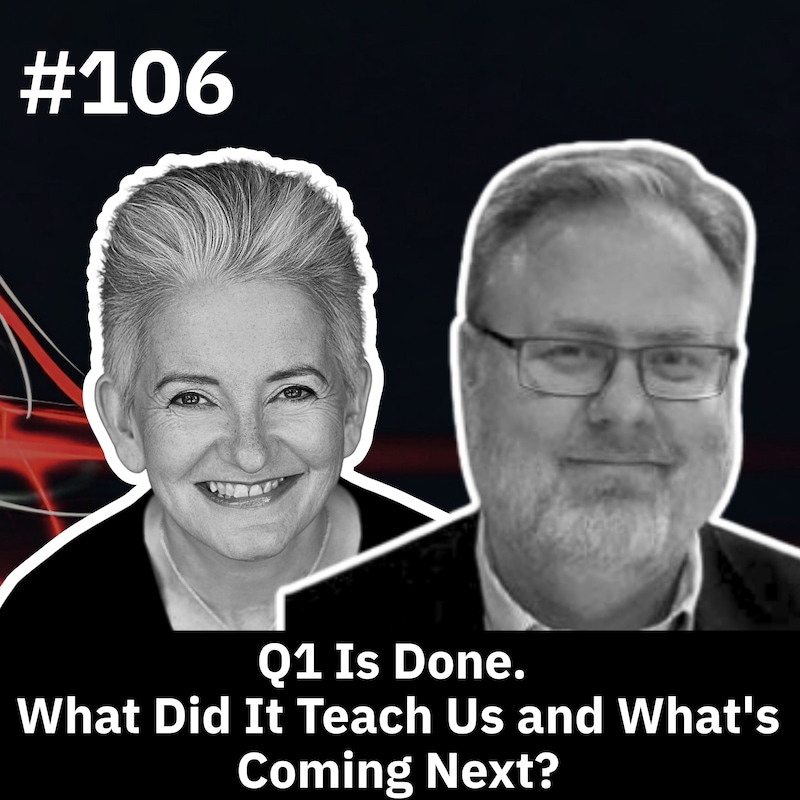
The rear view mirror exists for a reason. Q1 is done. Jan Griffiths and co-host Tom Roberts look back at what Q1 revealed and look ahead at what Q2 demands. Tariff volatility. AI embedded in every executive's day. The domain knowledge gap that's quietly killing AI ROI. And a Q2 lineup built to help automotive leaders stop reacting and start acting.
Over a year of tariff chaos has tested every supply chain in this industry. The companies that survived didn't just get lucky. They had data at their fingertips, not buried in spreadsheets or locked in someone's head. The ones still struggling? Still chasing Billy to find Susie's spreadsheet.
And then there's AI. It's no longer theoretical. It's in everyone's day. But domain knowledge is the gap nobody's talking about. Commodity codes, customer master records, plant-level data inconsistencies. AI doesn't figure that out on its own. The humans who know the business have to be in the loop.
In Q2, Jan and Tom are bringing in the guests who can help close those gaps. Cheryl Thompson on making AI practically useful for the average automotive professional. Klint Walker on the cybersecurity vulnerabilities hiding in plain sight on the shop floor. And a CIO whose entire focus is putting data in the hands of the people, and the culture shift that demands.
Themes Discussed in This Episode
- Surviving a year of tariff chaos and what it exposed
- Why "at your fingertips" data is the real competitive edge
- The volatility problem: it's not tariffs, it's the constant change
- Why the old automotive playbook no longer works
- Agentic AI: the promise, the pitfalls, and the domain knowledge gap
- Breaking down silos between function and IT for AI to drive value
- Q1 guest highlights: Marty Rathsburg, Dr. Bryan Reimer, Zack from RedZone
- Q2 preview: Cheryl Thompson on practical AI, Klint Walker on cybersecurity, and a CIO on a data-first journey
This podcast is powered by QAD RedZone.
About Your Hosts
Jan Griffiths
Jan is the host and producer of the Auto Supply Chain Champions Podcast and The Automotive Leaders Podcast. A former automotive manufacturing and supply chain executive, Jan is recognized as a Champion for Culture Change in the automotive industry. She brings direct, grounded conversations to leaders navigating execution, disruption, and transformation across the global automotive ecosystem.
Tom Roberts (Co-host)
Tom is Co-host of the Auto Supply Chain Champions Podcast and Vice President of Strategic Industry Development at QAD. He works closely with automotive and industrial manufacturers to close the gap between insight and execution, helping leaders move from visibility to systems of action that drive real operational outcomes.
Mentioned in the Episode:
- The Gap in the Gain by Dr. Benjamin Hardy
- Agentic AI Isn’t the Future. It’s the Line Between Winners and Laggards with Sanjay Brahmawar and Bryan Reimer
- The First 90 Days: How to Take Over a Purchasing Organization and Win with Marty Rathsburg
- Beyond Dashboards: Building a Connected Workforce with Zack Sosebee
Episode Highlights
[00:01:10] Q1 in Review: Stop and Look at the Gain: Jan frames the episode around Dr. Benjamin Hardy's concept of the Gap and the Gain. The industry rarely stops to measure what it's actually achieved.
[00:02:39] Data at Your Fingertips, or Not: Tariff disruption exposed the visibility gap. Tom describes the reality for most companies: chasing data across systems, people, and spreadsheets instead of having it ready when it matters.
[00:04:16] The Old Playbook Is Broken: The way automotive operates, in silos and reactively, isn't built for a world where tariffs, geopolitics, and disruption arrive simultaneously and without warning.
[00:08:11] Agentic AI: Not a Light Switch: Jan pushes back on the idea that AI eliminates headcount overnight. It requires intention, training, human-in-the-loop thinking, and a deliberate build-out of trust.
[00:08:45] Domain Knowledge Is the AI Gap No One Talks About: The real barrier to AI delivering value isn't the technology. It's understanding the data structures, commodity codes, and business logic the AI has to work with, and that requires people who know the domain.
[00:12:08] Q2 Preview: What's Coming: Cheryl Thompson on making AI practically useful. Klint Walker on cybersecurity blind spots in manufacturing. And a CIO focused on putting data in the hands of the people and the culture shift that requires.
[00:19:34] Systems of Record to Systems of Action: Jan and Tom land on the core challenge: automotive must change how it makes decisions, breaks down silos, and uses data, or the disruption will keep winning.
Top Quotes
[00:05:45] Jan Griffiths: "The world that we lived in before, it's gone. You might as well forget it. The key now is to adapt to the world that we're in."
[00:06:09] Tom Roberts: "Where you have your customs folks maybe buried in supply chain somewhere and they're kind of a, back, back, back, back office function. You can't do that. You can't do that with that process or the people, or the systems around it. They have to be tied to active data, real time data, because these things are changing every 150 days or 90 days, or whatever it might be."
[00:15:02] Tom Roberts: "Automotive is one of the toughest supply chains in the world. When a finished vehicle has 30,000 parts in it, however many different suppliers, it can be daunting."
[00:19:34] Jan Griffiths: "And I am gonna steal your tagline, Tom, working with these systems of record and not turning them into systems of action. We have got to do more of that and we've gotta change the culture behind it."
If this episode resonated, share it with a fellow automotive leader and subscribe to the Auto Supply Chain Champions Podcast, where we're closing the gap between insight and action across the global automotive supply chain.
Follow the Auto Supply Chain Champions Podcast for real conversations with leaders who are making hard choices, focusing their bets, and leading with intent.
🎧 Follow the podcast:
🔗 Learn more about QAD Redzone: https://www.qad.com/
Transcripts
[Transcript]
[:[00:00:30] Tom Roberts: Great to be here, Jan. What I see every day is simple: manufacturers don't have a data problem, they've got an execution problem. This show is about how artificial intelligence, systems of action, and empowered teams can help close that gap.
[:[00:01:01] Tom Roberts: Good, Jan. Great to see you. Great to be here today for this podcast. I'm excited to talk about what we've been doing over the last couple months, and who we've been interviewing, who we've been talking to.
[:So often, Tom, we get in the weeds of the day-to-day stuff and we don't take time to look back and look forward, and you've got to do that. In fact, there's a book by Dr. Benjamin Hardy called The Gap in the Gain, and too often we look at the gap and we don't look at the gain. We don't look at what we've actually achieved, and it's so true, don't you think?
[:[00:02:12] Jan Griffiths: Well, let's start off with a major accomplishment that we've all done. We've all completed in this industry, believe it or not, we have survived over a year of tariff chaos.
[:[00:02:39] Jan Griffiths: Now, the tariff situation tested all of us, but what I really like about the tariff situation, believe it or not, there are some upsides to this, is it really shone a spotlight on the need to have visibility into your supply chain and have the data at your fingertips, didn't it?
[:[00:03:32] Jan Griffiths: Yeah. Are you still dealing with a lot of those issues, Tom? Are you still seeing a lot of companies out there with spreadsheets?
[:[00:03:57] Jan Griffiths: Yes.
[:[00:04:12] Jan Griffiths: That's right.
[:[00:04:16] Jan Griffiths: It's exposed the gaps, hasn't it? The gaps in people, process, and technology. And yes, we've gone through a tremendous amount of pain, both in terms of just trying to figure it out and cost, and it's not going away, Tom. I mean, tariffs are here to stay. It's not going anywhere. We seem to be in a bit of a lull right now, but I am pretty sure that that will change, particularly after the president visits with XI in China. I would expect that there will be something happening after that. What do you think?
[:[00:05:25] Jan Griffiths: Yeah. Well, there's no doubt that the level of uncertainty that we're living in today is unprecedented, but it's not going to change, and I feel that sometimes we're waiting for the certainty to come. It's not coming.
[:[00:05:44] Jan Griffiths: The world.
[:[00:05:45] Jan Griffiths: The world that we lived in before, it's gone. It's gone. You might as well forget it. It's gone. The key now is to adapt to the world that we're in, and I honestly believe, Tom, that the systems and processes that we have in place right now, the way that we do business, which I like to term our playbook in automotive no longer works.
[:[00:06:38] Jan Griffiths: Yeah. Yeah, absolutely. And I love that we were able to get Dr. Bryan Reimer on the show with Sanjay.
[:[00:06:48] Jan Griffiths: That was an awesome discussion because we talk about data, that's important. Transparency, putting the data in the hands of the people. But we've also got to think about AI, because the first quarter of this year, AI was front and center for almost every person in the auto industry, right?
[:[00:07:51] Jan Griffiths: Yeah.
[:[00:08:11] Jan Griffiths: Yeah, you've gotta have the right mindset for it, and you've gotta use it the right way. Agentic AI is extremely powerful, but it's not something that you just flip a switch and you can eliminate a bunch of people and you're good to go. And I think that there is some of that thinking out there. I mean, it's a very deliberate, intentional, careful process. You have to train these agents, you have to have a human in the loop at the right time, and maybe you back out the human at some point in time. You've gotta build trust. There are so many things to consider, aren't there?
[:You might have somebody who's really smart and they're starting to create different things in AI, but having that domain knowledge just is very difficult to replace, to understand, well, how does automotive work and how does procurement work and these transactions and month end close and all the different things that you have to do. Domain knowledge is key in making sure that those things drive value and accuracy quickly.
[:[00:09:47] Tom Roberts: You sell yourself short.
[:[00:10:05] Tom Roberts: No, no, it's not. You still need people in the loop and you have to have, say that you have multiple different transactional systems as a foundation, and you know this from procurement. If you have commodity codes, primary and secondary commodity codes that don't match like you have, like you're not at steel isn't always the same thing in two different systems or cold rolled or whatever it might be.
If you're addressing those with different primary and secondary commodity constructs, the AI is not gonna necessarily figure that out, and it is not gonna necessarily figure that out when it's trying to return to you information or perform some function. There has to be a good data foundation or great cross-reference data and so forth to help map it for AI, 'cause AI just doesn't, out of the box, always figure all those things out.
So, again, not only those primary and secondary commodity code constructs, but everything, what is a customer number? Well, sometimes people have little smart customer numbers. They might have an abbreviation in there, or some kind of prefix or something that they put in there to code something. I don't always recommend that, but sometimes people do. And again, the AI needs to know that. So, you've gotta have somebody who has that knowledge, that domain knowledge, that can actually translate some of those things.
[:[00:11:24] Tom Roberts: Absolutely. You've grown by acquisition. How many automotive companies have we seen that grow through automation or acquisition, right? So, they see, they'll buy a plant here, they'll buy a plant there, they'll buy a piece of business from this supplier and a piece of business.
So, you know, at the end you might have 10 or 11 different ERP systems and you have different, everything is different, like your chart of accounts, how you create your supplier master records, everything. You know, item master, all different financial classifications, all those things are different.
So, AI is not gonna figure it all that out. At least, I'm not aware of any AI that figures all that out today. So, again, you've gotta have the domain knowledge and be the one to help map that and make it valuable.
[:[00:13:04] Tom Roberts: Yeah, absolutely, Jan. And again, I've spent a lot of my career, decades in IT, in different areas, and you have to approach it from the spirit of a learner.
[:[00:13:16] Tom Roberts: So, I am really excited about talking with her, because I can learn more. AI is, again, it's so new, there's so many moving parts. I don't know all the different tools. You know, I've got a number of tools that I use on a daily basis, but I'm sure there are ones that I could really benefit from. So, no, I'm really glad to have her on the show, to talk to her, and get some of that insight.
[:[00:13:43] Tom Roberts: We cannot. I'm excited.
[:[00:13:46] Tom Roberts: So, Klint Walker is gonna be on the show, and Klint is just this great resource of knowledge and history, and he'll have stories about cybersecurity, about ransom attacks, about something he's gonna talk about is how some of these things are affecting manufacturing systems on the shop floor.
I don't want to give away the whole thing that I think he's gonna talk about, but I think it's gonna be really eye-opening for our listeners, the ones that are out there now, automotive manufacturing, because I think they're things that they don't talk about, even CIOs that are out there now. I don't know if some of these things are really front of mind.
[:[00:14:35] Tom Roberts: Absolutely.
[:[00:14:49] Tom Roberts: Please.
[:[00:14:52] Tom Roberts: Yeah. We, I mean we don't know everything, and the more people that we have helping us contribute to our messaging, it just makes it more valuable.
[:[00:15:02] Tom Roberts: We are all in it together. And automotive, is one of the toughest supply chains in the world. I don't know. I don't know what could be tougher than automotive. When sometimes a finished vehicle has 30,000 parts in it and however many different suppliers, it can be daunting.
[:[00:15:58] Tom Roberts: It was great. He talked to everybody in the organization, right? What are your challenges? What are you facing every day? How do people think? What's important to them? I love the fact that he is trying to get his hands in the data, right? Show me the data. I gotta get in there, I gotta figure out what I'm looking at. Do I have that foundational element that I'm looking for in my transactional process to drive the reporting I'm looking at for consolidated spend and everything else that you're trying to do? No, it was just, it was great to hear that.
And again, Jan, I said this before, I always miss, I think I misunderstood procurement for a long time in my career. And again, free bids in a buy and head to happy hour. It is not like that. And I had the opportunity to learn from some great procurement leaders in one of my roles in the past, I was the IT liaison for some of our purchasing leadership at Johnson Controls and, Terry and Mike, and Kelly and Jim, just some awesome procurement leadership and I learned a lot. I mean, I learned a lot about the science of procurement. It is not just a feel good, kind of just go, let's go transact. There's a lot of thought, and a lot of science behind it.
[:[00:17:12] Tom Roberts: I saw the light. I mean, honestly, in automotive, how much of it is arbitrage of commodities, how much is based on the arbitrage of commodities? If you have 80% of your cost of goods sold is procured goods, so how important is procurement if that's the case? It's massively important because it's arbitrage, again, of those commodities you're trying to convert. Again, mind blowing.
[:[00:17:43] Tom Roberts: Well, I understand a little bit.
[:[00:17:45] Tom Roberts: But what I do understand, I certainly appreciate.
[:[00:18:44] Tom Roberts: Right. To contribute to the data, and I think that's the biggest thing is on the shop floor, you're at your work center and performing your function. If there's a non-conformity, if there's something going on, do you have a way to create data that helps solve those issues or contribute to the solution of those issues? And I really think that, like you mentioned, RedZone, I think, does a great job of that. Not only allowing somebody to see what data's going on, but to actually contribute to the data and show, hey, I've noticed this. Rather than just, I don't have any way to solve this, so I'm just gonna go about my daily work. Well, now they've got a voice and that gives them a voice to contribute to that data to make it better for the organization. So, yeah, that is the key is putting data in the hands of the people, but also the creation of data and giving them a voice, 'cause really that's what it is.
[:Now they're coming at us so fast that our playbook in the automotive industry will no longer work. The way that we're structured in silos, the way we make decisions. And I am gonna steal your tagline, Tom, working with these systems of record and not turning them into systems of action. We have got to do more of that and we've gotta change the culture behind it.
There's so many things that we have to do, and Tom and I are gonna be right here with you every step of the way, providing the content and the information that you need, but we would love to have your input, tell us what we can provide to help you. What do you think, Tom?
[:[00:21:22] Jan Griffiths: Yeah. Well, that's a wrap. That's a wrap for Q1. Let's launch into Q2 of the Auto Supply Chain Champions podcast.
We wanna hear from you, our listener. Tell us what are your challenges right now? What conversations do you want to hear across the airwaves on this podcast? Drop us a comment on our podcast website. The link is in the show notes.

