Shownotes
Most decisions in software teams don't fail because people disagreed. They fail because people thought they agreed — and nobody found out for weeks. You leave the meeting feeling good about where things landed, and three weeks later you're having the same conversation, wondering how you got back to the start.
Michael Joyce, a technical principal at Thoughtworks, joined Andrea and Andrew with a story from an unusual vantage point: he worked as a solution architect inside a New Zealand agriculture company, left for the UK, and then went back to the same company four years later. Long enough that his designs were still running, and nobody knew he'd made them. He got both barrels — "I don't know why it does this," which he could answer by pulling up a design document nobody had ever seen, and, from the ops team, the first long-term praise of his career: when things fell over, the services just restarted and recovered. The systems survived. The reasoning behind them didn't.
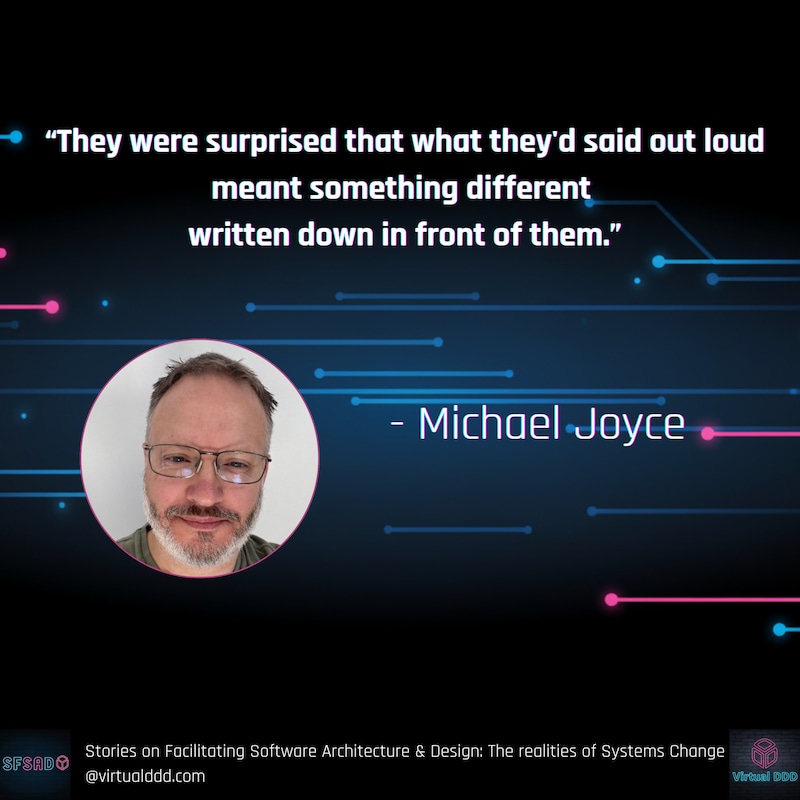
The turning point in the conversation is a whiteboard. Michael was locked in a circular argument with a vendor architect, both of them making points to win rather than to resolve. He stopped, walked to the board, and wrote down what the other person had just said. The vendor architect looked at it and said: "That's wrong." Not embarrassed — genuinely surprised that what he'd said out loud meant something different once it was visible. They stopped arguing at each other and started looking at the same thing. Michael's clients have hit the same effect at scale: three months of talking about a decision, then one day in a workshop run by someone with no knowledge of the subject, and it was done. "That's what alignment is. It's not about having a conversation. It's about externalising it."
The subtler trap he names is the one that shows up when things feel like they're going well: valuing harmony over precision. Agreement is a nice feeling, so you stop writing, stop clarifying — and what got documented was one person's version of the agreement. This conversation explores externalisation as a facilitation move rather than a paperwork exercise, why precision is usually plain language rather than intricacy, why saying what something doesn't do matters as much as what it does, and why an IKEA wardrobe explains most broken professional relationships.
Key Discussion Points
- [01:00] Becoming an Architect by Accident: From giving opinions in London to holding the title in New Zealand, and finding the word itself a little strange
- [02:00] Something at Stake: Defending designs against vendors when your colleagues, not your next client, have to live with the result
- [04:00] Going Back to Face Your Own Designs: Four years later, the systems are still running and nobody knows they're yours — "I've never seen that design before, so we just went and implemented it"
- [05:00] Design the Project, Not Just the System: Why the biggest lever an architect has is team interaction, learning, and how the work starts
- [09:00] A True Partnership: The product manager who presented P&L to the board, visited customers, and took support calls — and the product folks who didn't want developers near customers
- [13:00] Intent and Radical Empathy: The one thing Michael kept from Crucial Conversations, and the difference between "I don't understand the decision" and "I don't agree with it"
- [17:00] "That's Wrong": The whiteboard moment that ended a circular argument with a vendor architect — and changed the relationship
- [18:00] Three Months vs. One Day: Why alignment isn't conversation, it's externalisation
- [20:00] Valuing Harmony Over Precision: How the nice feeling of agreement stops you documenting, and leaves you in disagreement without knowing it
- [22:00] Positive and Negative Boundaries: Saying what a service will do — and what it will not — because the grey areas are where understandings quietly diverge
- [25:00] The IKEA Wardrobe: They supply the materials and the handbook. They don't come to your house and build it
Guest: Michael Joyce
Hosts: Andrea Magnorsky, Andrew Harmel-Law
Transcripts
Hello, and welcome to Stories of Facilitating
2
:Software Design and Architecture.
3
:I'm with my, usual co-conspirator,
Andrew, we're missing Kenny
4
:because he's on holidays.
5
:our guest today is Mike.
6
:do you wanna say hello?
7
:Michael Joyce: Hi, how's it going?
8
:Would you like me to tell
you a bit about myself?
9
:Yeah, okay.
10
:So I'm currently a technical
principal at Thoughtworks.
11
:I've worked at Thoughtworks for about five
years, across two different continents.
12
:And before that, I've worked
in a variety of organizations
13
:in a number of different roles.
14
:Enterprise architect, solution architect,
developer, those type of roles, yeah.
15
:Andrea Magnorsky: Cool.
16
:And so what is your story about today?
17
:Michael Joyce: So I'm currently
working for a technology organization,
18
:and I was looking b-back on my
career and I thought there was one
19
:role I had which was-- stood out.
20
:It was one where I was working for a
company that offered other types of
21
:services and had an in-house technology
team, including an architecture team.
22
:And I was reflecting on all
of the different types of
23
:experience I got from that.
24
:Actually being part of, of an
organization that's doing something
25
:other than technology and the challenges
that you face and how different they
26
:are, and sometimes how you get an
opportunity to do things differently.
27
:As well, try different things
because the people around you
28
:aren't part of our world as much.
29
:Andrea Magnorsky: Yeah, they're
thi- they think differently.
30
:Right.
31
:Okay.
32
:We are keen to hear your story
33
:Michael Joyce: Thank you.
34
:I'll start right off the bat by
finding it a little bit strange
35
:to call myself an architect.
36
:And the way I got into it was, I was
working in London, and I started having
37
:architects come up to me and ask for
my opinion on things, and I started to
38
:enjoy the conversation more and more, and
I thought, "This is a really easy job.
39
:I just get to give my opinion about
things, and, and, they go away and
40
:they thank me, and everything's great."
41
:And then I left the UK and I came
back to New Zealand, and I became an
42
:architect by title, and this is the
company that I was wanting to talk about.
43
:And I've worked for that company
twice, which also has informed
44
:some of my thinking around this.
45
:When I first started working there, I had
an entirely different domain to learn.
46
:It was a primary industry, an
agri-- agriculture-based industry.
47
:And growing up in New Zealand, I should
have known a bit about it, but I didn't.
48
:So I was one of two solution architects
in quite a large company, and I
49
:suddenly got thrown in the deep end.
50
:I had to actually start making decisions
about design and advocating for
51
:designs that I was putting forward.
52
:And there were some interesting
experiences there that I had with
53
:vendors trying to challenge my designs.
54
:And they were challenging them
because what I was putting forward
55
:was a little bit more modern
than they were wanting to build.
56
:They had their own capabilities,
and I was really challenging them.
57
:I was making it a little bit
difficult for them to deliver for us.
58
:I thought I was defending
the company at the time.
59
:When I look back on it, I was, you
know, I have questioned whether
60
:I was doing the right thing.
61
:and some of that questioning came
about from just being challenged.
62
:It was actually quite confronting
to, to have that for the first time
63
:with that type of responsibility.
64
:And I think it meant something different
because I was working for that company
65
:because there was something at stake.
66
:I wasn't just another vendor
going and selling something, doing
67
:some work, and then moving on.
68
:My colleagues around me were gonna be
relying on the solutions that we designed.
69
:I left that company and then
moved to the UK, met Andrew.
70
:I worked with Andrew for
a little bit in the UK.
71
:And then when I moved back to
New Zealand, I actually went back
72
:to work for the same company.
73
:And that kinda closed the loop for me
as an architect because I'm not sure I
74
:would recommend doing it to everyone.
75
:But joining a company you've worked at
before as an architect, I think it was
76
:approximately, oh, four years later.
77
:Four years is long enough that the things
that you designed are probably still
78
:there a-and the people there don't know
you and don't know you designed them
79
:and have quite free opinions about them.
80
:And it was great because
I got both sides of it.
81
:I got the, "I don't know why it
does this," and I could quite
82
:happily answer that and go, "It was
written down in the design here.
83
:Here it is."
84
:And they were like, "Oh, I've
never seen that design before.
85
:That does make some sense.
86
:I, I under-- Okay, I understand why you
designed it like that, but we didn't see
87
:that, so we just went and implemented it."
88
:And I also got the ops people going,
"Oh, it is a little bit of a challenge,
89
:this architecture, but you know what?
90
:It does recover.
91
:When things fall over, we just have
to t-restart the services, the queues,
92
:and it just-- it actually self-heals."
93
:And it was, oh, wow, that's
actually the first bit of long-term
94
:praise from an architecture I'd
ever received as an architect.
95
:It achieved something that
it was designed to achieve.
96
:And so if you th-- if you're brave
enough to go back to a company
97
:and see how you did, do it.
98
:I'm not sure I'll ever do it again.
99
:so that was that company.
100
:That taught me a lot about, being in
a company that you were designing for.
101
:the second part of going to a company
like that is you get to try new things.
102
:You get to do things differently
if you're not part of a technology
103
:organization, because in some ways
you are the expert in your company.
104
:You're not surrounded by opinions
that can potentially overwhelm you.
105
:People are more willing to listen to you
so we tried different things and, and I
106
:discovered my love for externalization
of decisions and developed that.
107
:And the love for, as an architect,
realizing that it's the biggest
108
:thing I could do to help a
project succeed was to design the
109
:project and not just the system.
110
:And by that, it was actually design
everything from, where-- how the team
111
:were gonna interact, whether or not
people were gonna be sitting together,
112
:what learning and development the entire
team needed, what sessions we were
113
:gonna have to kickstart the project.
114
:And so that was, that was a
bit of a revelation as well.
115
:So I got to talk to people about photons
and digital cameras and satellites
116
:and photosynthesis and all these types
of things just by being an architect.
117
:So yeah, go and work for a company
that is not a technology company.
118
:Be an architect or a
developer for that matter.
119
:Andrew Harmel-Law: That's
super interesting, Mike.
120
:Like I, I can…
121
:Obviously, you mentioned
we used to work together.
122
:What I think as a consultant,
one of the cool things is you get
123
:to move around and see different
domains and different clients and
124
:do different stuff, and the curse of
it is exactly what you said, right?
125
:Like, has happened once, I'm very aware
as a consultant, right, I can wave
126
:my hands around and tell people to do
stuff, and then I can disappear and,
127
:and like you never see the long-term
impacts of, of like positive or
128
:negative of what you've done, right?
129
:Or a mix probably, right?
130
:And I think it's very enlightening.
131
:And then way I approach things
fundamentally changed again when I was--
132
:I worked one place for four years, so
we were, we were shaking our fist and
133
:cursing various things, and we were
like, "Who, what idiot designed this?"
134
:And it turned out it was me or us
three years before when microservices
135
:first came on the scene, and we were
like, "This is amazing," and then we
136
:were running them four years later.
137
:but I think it is, it's
really interesting, right?
138
:And it's interesting that you
say that that then made you think
139
:more about building the team and
how the team works and like not
140
:just like a bunch of human beings
collaborating, but more explicitly…
141
:'Cause there is, there's a, like,
like when you realize that there's,
142
:there's a longer term impact and like
getting this knowledge into people's
143
:heads, not just in your head and then
writing it down, as you said, right?
144
:There's a power to that if they,
not just for the design of it, but
145
:also the running and operation and
maintenance and other things of it.
146
:Michael Joyce: Yeah, definitely.
147
:I-- On that piece of work that I was
talking about designing with photons
148
:and digital cameras, I got to see a
really, really junior developer go from
149
:being very shy and not really speaking
up in stand-ups to doing a company-wide
150
:presentation on how she'd use a
JavaScript-based GI-GIS tool, GIS library
151
:to take images and to cut them up and
do analysis on them for photosynthesis
152
:and just the confidence that you could
see this person gain and to be able to
153
:trace that back to the purposefulness
with which we saw that person and
154
:their place in the piece of work.
155
:That was, that type of
thing was really rewarding.
156
:Andrea Magnorsky: That
sounds, like quite a journey.
157
:And, uh, I kind of want on this,
158
:type of designing these
interactions and learnings and the
159
:kickstarts, how did you do that?
160
:Did you also do that, collaboratively?
161
:Or
162
:Michael Joyce: is
163
:Andrea Magnorsky: what was the…
164
:rewarding.
165
:we should do more than
design the system because
166
:Michael Joyce: Mm-hmm.
167
:Andrea Magnorsky: social"?
168
:Michael Joyce: Good question.
169
:Yeah, it was, it was working with
a really amazing product manager.
170
:I'd say one of the product managers
that represents it at its purest in
171
:that this person was, presenting to
the executive team, to the board on
172
:not just the roadmap, but also profit
and loss about a long-term strategic
173
:vision from, for the, for the product.
174
:They were also the person who would go
out and talk to customers in the field and
175
:who would also have the team that handled
support calls and they would be on the
176
:phones themselves listening to customers.
177
:And so this person came with all
the passion for the product and
178
:I realized that I had a really
great partner to work with.
179
:they didn't know my world and
I was learning about theirs.
180
:And so we agreed that we would
actually design this together.
181
:And they said, "I'll give
you whatever you need.
182
:I'll come and sit with the
team whenever you want.
183
:We'll get R&D to come and sit
with the team if, if that's
184
:what you're recommending."
185
:And it was just someone from
the beginning that it w-- it
186
:felt like a true partnership.
187
:And we were focusing on the outcome.
188
:We were focusing on working
software in the hands of, of
189
:customers from the very beginning.
190
:That was the thing that made it.
191
:Andrew Harmel-Law: interesting actually
'cause, um, yeah, I was looking for
192
:the heart emoji, but this, but this
recording tool doesn't have heart emoji.
193
:But I think you're right, Mike, right?
194
:Like, there is…
195
:The two things that have fundamentally
kind of changed how I design systems
196
:is running the systems that I designed
and like the second thing you've…
197
:And we didn't prepare this.
198
:The second thing is product management
and like understanding product managers
199
:and kind of, and, and that kind of thing.
200
:That's again, it's like building the
right thing, not building what you think
201
:is important, but building what actually
someone has guessed is gonna have a value,
202
:and then building it in a way that can…
203
:It, it does both things very much
transform how you see your designs and
204
:your software for the longer term, right?
205
:Is that kind of…
206
:Do you maybe wanna dig a bit
more into like how that's changed
207
:how you think about stuff?
208
:'Cause I think for me
anyway, that was a big, big
209
:Michael Joyce: Yeah.
210
:Yeah.
211
:The, it does come into the way I see
architecture in general is that I think
212
:we are the most privileged people ever.
213
:We get to delve into
every domain in the world.
214
:We get to learn about every
part of what humans do.
215
:this domain that I was in, I, I know more
about that domain now than most people
216
:on the planet, and I never would have
done so if I hadn't been an architect.
217
:Going and watching the product manager
have to do an update to the executive to
218
:go to a board showcase where we got to
show off the software, and then to also
219
:be able to go on visits to see customers,
take developers to see customers and
220
:just listen to the ideas, that was vital.
221
:It was an interesting one at that company
because there were also product folks
222
:that didn't want us near the customers.
223
:That they were a little bit worried
about whether or not we could represent
224
:the company well, I think, or that we
would cloud our things and actually
225
:affect their roadmap, and that we
would, you know, flip the table on it.
226
:it is those human interactions,
to answer your question, that have
227
:been the biggest thing that have
changed how I deliver software.
228
:Yeah.
229
:Without that, it wouldn't work.
230
:Andrea Magnorsky: it's funny, Also,
really nice to have a guest in New
231
:Zealand because there's no latency.
232
:So I actually finished hearing your
qu- hearing you, and I'm not talking on
233
:top of you, which doesn't happen often.
234
:But, so my, my question
here was, like, about…
235
:I, I think we all, like, I, I…
236
:We've all talked separately about
this quite a bit, but we never did
237
:it, or not so much here in, in this
forum, which is the building and
238
:the importance of trust, as, as a,
like, 'ca- 'cause with the, the…
239
:What you're talking about
with the product people going
240
:like, "Oh, I don't know if…"
241
:and can you tell us about your
framing for trust when you go into
242
:that project or, like, what is your
approach to, thinking about trust?
243
:Not really kind of doing something
about it, 'cause I think it's
244
:a framing first, isn't it?
245
:It's like a what are your beliefs
246
:Michael Joyce: I went on a course
once in London called Crucial
247
:Conversations, and I remember one
thing reasonably well from the course.
248
:Uh, sor- apologies to the
people who ran the course.
249
:But the thing I, the, the, the only
real thing I remember is intent.
250
:Is if you are having a conversation or
you're wanting to form a relationship,
251
:explaining what your intent is,
is the single most powerful thing.
252
:And for me, that goes along with empathy
The intent and empathy being broadcasting
253
:your intent and being empathetic.
254
:And so when I was having a difficult time
in that organization with some of the
255
:product managers, it was really, trying
to understand where they came from.
256
:And so I see a trap that some of our
colleagues fall into, developers to a
257
:degree, but also even BAs, where they will
say something along the lines of, "I can't
258
:understand why they made that decision."
259
:And I usually try and unpack it
with them and say, "What-- is it
260
:that you don't understand a rational
way they made that decision or you
261
:don't agree with the decision?"
262
:'Cause those are two different
paths you can, you can go down.
263
:And so trust for me comes about being
able to be radically empathetic and
264
:not liking what you're hearing, but
truly wanting to understand why someone
265
:is making a decision they're making.
266
:And if you do that and the person can
un- can see that you understand them,
267
:even then when you disagree with them, at
least they trust that they're understood.
268
:And if you make your intent very
clear, that lays over the top
269
:that you're-- they understand why
you're trying to challenge them.
270
:And so that type of
communication is trust for me.
271
:Andrea Magnorsky: it's funny how
that comes so often, isn't it?
272
:Like, this thing of like, why
would they do, you know, the
273
:why, why would they do this?
274
:And it's like I told them
about, you know, it…
275
:And you have this conversation
from product devs, yourself,
276
:and you think it yourself.
277
:You're like, "Why would
someone do this thing?
278
:We discussed this.
279
:We specially talked about this,
and yet they did the thing we
280
:agreed that you weren't gonna do.
281
:What's this?"
282
:And it's like, well, okay.
283
:And the unpacking, I think the
unpacking thing, and I, I'm, I'm,
284
:maybe I'm, I'm too much of a fan, but
I think, writing down certain decisions
285
:is, is like where it really helps.
286
:And well, we talked about it here,
so, I can see how we lost something.
287
:but at least you, I think the going
to check maybe gives you like a, some
288
:room to, Hey, we actually did hear you.
289
:We just couldn't do it, because reason.
290
:or we decided anyway for it because
of this, you know, accepted because
291
:X, Y, Z, despite your reason.
292
:And it's like, well, we had to
make a trade-off, and that was it.
293
:Sorry.
294
:and then it could be like, oh, actually,
this is bigger than you thought.
295
:Oh, okay.
296
:So how do you-- do you write it down?
297
:Do
298
:Michael Joyce: Yeah, you-- yeah.
299
:Andrea Magnorsky: 'Cause conversations
are, time-consuming and synchronous.
300
:Michael Joyce: conversations
also don't end.
301
:I-- one of the things that I
noticed in that organization and
302
:several others since is I think I
mentioned externalization before.
303
:And so that was another thing I
learned by having to really care
304
:over a long time about something was
what works and what doesn't work.
305
:Why does this thing
keep coming back around?
306
:Why are we discussing the
same thing again and again?
307
:And I had this moment with an architect
from the vendor where we were struggling.
308
:We were, we were trying to come to
a conclusion and make a decision,
309
:and we were almost trying to one-up
each other, and we were doing the
310
:thing where you're making a point
just to try and win the argument.
311
:And I said, "Hang on a minute," and I…
312
:"Let's, let's use the whiteboard."
313
:And I started-- I wrote up what this
person said, and they were adamant until
314
:they saw me write it up on the whiteboard.
315
:And then they didn't focus on me anymore.
316
:They looked at the whiteboard,
and they said, "That's wrong."
317
:And they weren't, embarrassed.
318
:They were just surprised by what
they'd said out loud, meaning
319
:something very different to it
written down in front of them.
320
:And it changed the nature
of the conversation.
321
:It changed the relationship.
322
:And so that for me is the most
powerful thing and something that
323
:I've seen done to great effect.
324
:We've had a lot of success with our
clients who've said things like, We've
325
:spent three months talking about this,"
and a day in a workshop with one of our
326
:colleagues running a workshop for them
with no knowledge about the subject.
327
:They said, "We got more done in that
day than we got done in three months
328
:trying to make a decision on this."
329
:That's what alignment is.
330
:It's not about having a conversation.
331
:It's about externalizing
it from everyone else.
332
:From everyone.
333
:Andrea Magnorsky: does that mean
just, is, is it just putting it on
334
:the board, or do you have any more
tricks up your sleeve that you can…
335
:Like, is this your, your
default pattern, or do you have
336
:a few depending on situation?
337
:Or maybe, you know, how do you…
338
:Basically, what's your mindset
339
:Michael Joyce: Bye.
340
:Andrea Magnorsky: what are your tools, I
think is my, my general line of questions
341
:when someone says, "Oh, I have this.
342
:This is the, the concept that
I, I ground everything in."
343
:And, Kenny likes to call this
a container, which is totally
344
:not an overloaded word at all.
345
:but it's a Dutch thing, so it's
like the idea is like, oh, this word
346
:that helps you unpack things, and so
you have a mindset and a philosophy
347
:perhaps, and then you have maybe tools.
348
:can you walk us through
this, tree of container
349
:Michael Joyce: Absolutely.
350
:So when I think about externalization,
I was obviously thinking about
351
:that specific example and a, a
very much an interpersonal working
352
:relationship and trying to overcome
a, a challenge between myself and a
353
:person from another organization who's
incentivized slightly differently.
354
:We both had the same goals, but they had
the, need to prove to be valuable to the
355
:organization because we paid them and
there's a contractual relationship there.
356
:I was in a different situation because
I was an employee and therefore
357
:not as at risk in, in some ways.
358
:My views were a little more protected.
359
:And so that was one version
of it, and that was very
360
:much one-on-one and personal.
361
:But when I think about externalization,
I've also been thinking about why do
362
:decisions stick and why don't they?
363
:Why do you sometimes come around
to the same decision and the two
364
:people who were, or three or four
or a team who are involved in the
365
:decision have very different views
on what the decision actually was?
366
:And I've seen a, a trap that I've fallen
into and others fall into, and that's
367
:even if you are starting to document
things, valuing harmony over precision.
368
:And so I've seen people stop too
quickly when they're documenting
369
:a decision, a design or something
else because people are starting to
370
:agree and it's a nice feeling, and
we wanna wrap things up with harmony.
371
:And so where that's come back and bitten
me is if I haven't been quite sure that
372
:what we've documented is precise and
accurate enough, I'm almost always right
373
:because it was the other person's view
of it that was documented, not my own.
374
:And now it doesn't mean I was right
about the outcome, but it means that
375
:we were, we're in disagreement at the
end and we didn't know it until later.
376
:Andrea Magnorsky: Right.
377
:Okay, so you're saying something
like, if you're not very precise,
378
:you're, you know, because consensus
is a lot more comfortable,
379
:Michael Joyce: Hmm.
380
:Andrea Magnorsky: go with the
consensus, but actually you decide,
381
:but actually you figure out later
that you didn't really agree.
382
:Michael Joyce: Absolutely.
383
:Yeah.
384
:Yeah, absolutely.
385
:And, sometimes precision
feels like intricacy.
386
:I think sometimes it's much better
described as plain language.
387
:State what you mean Be very precise with
what you mean and what you don't mean.
388
:And so, you know, tools and
techniques, saying what something
389
:is as important, but also saying
what it is not is just as important.
390
:So drawing both positive and
negative boundaries around
391
:things is just as important.
392
:saying what something does do, what
a service will do, saying what it
393
:will not do, what it is responsible
for, what it's not responsible for.
394
:And so the, the gap, the gray areas
between those things are often
395
:where people's understanding of
things fits, and where you can think
396
:you're agreeing, but you're not.
397
:Andrea Magnorsky: Yeah, it's funny
that you mentioned that 'cause I just
398
:started doing this, "Doesn't do X," but
for like d- l- like plans for the week.
399
:Michael Joyce: Ah,
400
:Andrea Magnorsky: this, and it could,
let's say, something like start
401
:guideline, like do some work on
guidelines for, I don't know, say,
402
:observability or something like that.
403
:So there's some sort of
like long-running task.
404
:but it doesn't mean I will fix this 35.
405
:So yes, starting to write guidelines.
406
:This means inter-interview people, about
what they're currently doing, or perhaps
407
:do some analysis on some repositories
about what's going on there, o-other
408
:tasks related to creating a guideline.
409
:It doesn't mean, going and fixing
these three issues that people raised.
410
:It means it would be included in
the guideline, and that it should
411
:addre- it should be addressed by the
guideline, but it won't be resolved.
412
:And it, it's just saying that, that
I, I was like, "Oh, it's obvious
413
:To me, it is like, well, if you're
writing about this, that doesn't
414
:mean you can solve it instantly.
415
:That won't happen this week.
416
:In fact, it, it needs-- You need, if you
need to solve it this week, you need to
417
:do something to address the, the, this
right now, if it's like a real problem
418
:Knowing that this a lot, better solution
is coming in the future that is more
419
:considered, that will take this as input.
420
:And it was funny how the whole thing
changed from, yeah, yeah," and then
421
:kind of, yeah, feeling that people got,
get let down to being very explicit and
422
:set, like setting these expectations.
423
:So, yeah, I think you're,
you're totally right.
424
:I, I think
425
:Michael Joyce: yeah.
426
:Andrea Magnorsky: is such
a dangerous, comfort, o- on
427
:agreement 'cause, you can just…
428
:It makes you go round and
round nice roundabout.
429
:Michael Joyce: Yeah, and it doesn't matter
as much when you've got decisions that you
430
:can undo in a, in, in an hour as a team.
431
:a team thrives on a f-- a silent
form of consensus where people
432
:who don't really mind just go
along with it because they're--
433
:they don't have a strong opinion.
434
:But where things do matter and consensus
just makes you go round and round
435
:and round it, it's The challenge.
436
:I thought of an a-analogy for that scope
question when it comes to what we're
437
:talking about being very precise, and
so I've just made up an IKEA wardrobe.
438
:And I was just thinking from IKEA's
point of view, or IKEA I think
439
:it's pronounced, if I was trying
to be a little more accurate.
440
:the-- they supply the materials,
they supply a handbook to
441
:how to put it together.
442
:They don't come into
your house and make it.
443
:And I think that I was hearing your
dis-- your, example about what y- the
444
:work you've been doing, and I thought
the difference between promising to
445
:come up with a roadmap and a plan, you
know, or maybe a strategy and saying
446
:that you're going to help them implement
it is the difference between saying,
447
:"Here's the book that I wrote for you.
448
:Here's the plan that I wrote for
you," and the actual day-long
449
:construction of wardrobe.
450
:Yeah.
451
:And, and being responsible for if
you damage any of it along the way.
452
:So being very precise.
453
:Andrea Magnorsky: you,
454
:Michael Joyce: Yeah.
455
:Andrea Magnorsky: your or your fingers
or whatever while you're really, you
456
:know, your DIY skills are put to test.
457
:Michael Joyce: Yeah.
458
:I, I have decent DIY skills, and I
still damaged the wardrobe a little bit.
459
:Only my daughter and I, know
where we did, and yeah, we glued
460
:it back together and we're good.
461
:Andrea Magnorsky: I, I think
we all have stories like that
462
:about IKEA furniture, I think.
463
:they're fun.
464
:As, as like also it gives
you with a story, right?
465
:You've, you built it and then you're like,
"Oh, and then there is this little thing.
466
:Look, it's over here."
467
:And you can tell your friends
about it, and they're like, "Wow,
468
:that was a really boring story."
469
:But you know, that's, that's
why they're f- they're friends.
470
:You can tell them your boring
stories and your really good stories.
471
:Michael Joyce: Absolutely.
472
:Family just don't listen
to either of them.
473
:Andrea Magnorsky: they, it's probably.
474
:Yeah,
475
:Michael Joyce: They've heard
them a dozen times before.
476
:Andrea Magnorsky: anyway, this
has been absolutely great.
477
:I, I really enjoyed this,
and I hope you did, too.
478
:Michael Joyce: I did.
479
:Thank you very much.
480
:Andrea Magnorsky: Oh, most welcome.
481
:And on that cheerful note,
we're gonna, close this episode
482
:of, Stories of Facilitating
Software Design and Architecture.
483
:Thank you, Mike, for joining us
today, And, yeah, see you next time.
484
:Thank you so much.
485
:Michael Joyce: Thank you too.
486
:Bye.
