Shownotes
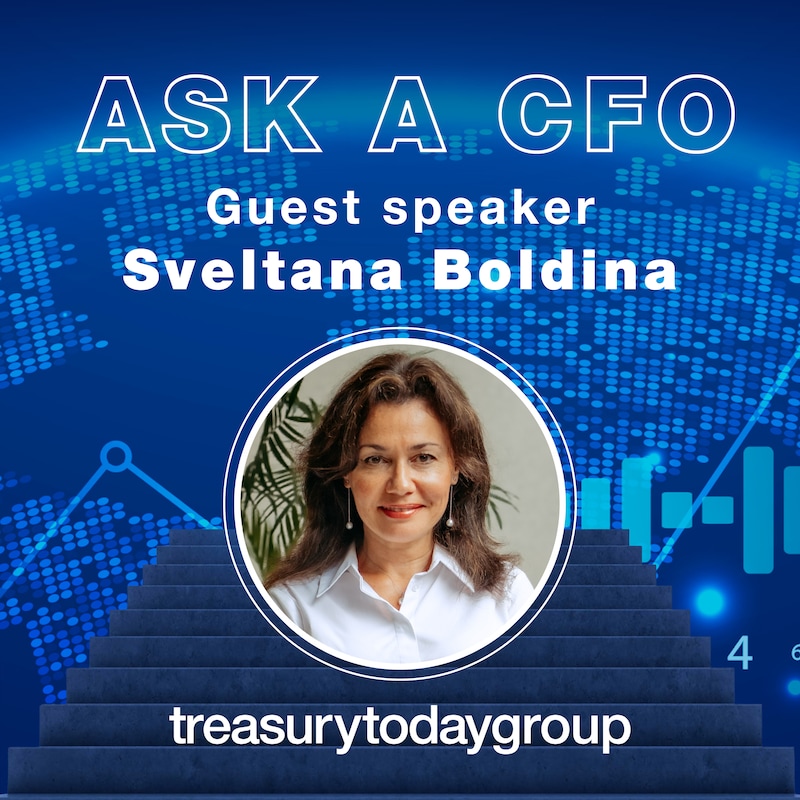
In this episode, Sophie Jackson talks to Svetlana Boldina, Executive Director and CFO for Nestlé South Asia Region. They explore Svetlana’s career journey, experiences working and moving abroad, the evolving skillset needed in the CFO role, and much more.
Transcripts
Hello, and welcome to Ask a CFO, the podcast series that shines a light on the different paths taken to become Chief Financial Officer. We'll also be exploring the personal stories of those that have made the journey.
Sophie:I'm Sophie Jackson, and in this episode, I'm joined by Svetlana Boldina, Executive Director and CFO for Nestlé South Asia Region.
Sophie:We'll be talking about Svetlana's career journey, experiences moving and working abroad, the evolving skillset needed in the CFO role, and much more.
Sophie:Thank you so much for taking the time to catch up with myself and with our Ask a CFO community.
Svetlana:Sophie, thank you very much for inviting me for this podcast. I'm very honoured.
Sophie:So first of all, if you could just introduce yourself and your current role.
Svetlana:My name is Svetlana Boldina. Everyone call me Sveta. This is the short version of my name.
Svetlana:I am Finance Director in Nestlé, India. And actually, I'm responsible for the South Asia region, which is six countries, it’s India, Sri Lanka, Bangladesh, Nepal, Bhutan, and Maldives. And India is a big part of the business, 80% of entire business, and we are listed here.
Svetlana:So I'm two and a half years, almost three years, have an assignment in India for Nestlé.
Sophie:Amazing. So I wanted to kick off by asking if you could tell us all a little bit about yourself. Where did you grow up, your early days in life? Tell me.
Svetlana:Yeah, thank you. Look, I'm Russian. I was born in Russia and grown up in Moscow. And the whole of my life until 42 years old, I was living in the same city. No movement anywhere else but Moscow.
Svetlana:So I'm actually, I graduated from physics and mathematics school. And then surprisingly, I also graduated from the Technical Communication University of Moscow. So I have a master's degree of the technical communication engineering. So I end up finance at the later stage. So my first education is technical.
Sophie:Amazing. And tell me a little bit about what made you in your early days when you're growing up in Moscow think that a career in finance was for you? Were there any early inspirations or moments that you can look back and think that was the first step on the path to where you are today?
Svetlana:It was not early inspiration. It was not a bee my bonnet, definitely. I was dreaming about some being a scientist through my childhood because all my family, they are all mechanical or chemical engineers. So that was my also dream towards that.
Svetlana:But then interesting, when I was writing my diploma from this technical university. The diploma was on the quasi electronic station, which is maybe not relevant anymore. It was more than 30 years ago.
Svetlana:But there was one chapter of my diploma was of their feasibility study or return on investment to this station. And that was everything around financial parameters. And then I realised that excites me the most of the part of my diploma. And then I start to thinking that maybe this is what I need to explore a bit more.
Svetlana:When I graduated, I didn't have any day of working with my first specialisation. I re-enrolled myself to the Finance University in Moscow and I got an MBA in finance. And my first job was accounting and tax. So I found this much more exciting for me.
Svetlana:But I absolutely have no regret of my first five years in the telecommunication university, because it gave me interesting boost of my brain, because brain is a muscle, so I have trained within these five years my brain massively stretched out.
Svetlana:And it helped me to be more agile, more, let's say I would say faster and more sophisticated in my finance experience and journey. So it was definitely not a waste of time, even though I have not done any day in this specialisation, but it was a good stepping stone.
Svetlana:So it happened unplanned and absolutely no regret.
Sophie:Well, I love what you said there about your studies and then being naturally inclined towards an area that perhaps you would never have imagined.
Sophie:Because I think when I think of a successful career path, I think being open-minded and realising that you have a skillset that maybe you didn't see at the beginning.
Sophie:Like when I think back on my career, I always wanted to just write and be very hidden from the public. I had no interest in anything public engaging. And as time's gone on, I found that moderating and public speaking are things that I have the skillset for, even if you don't have, you know, the natural desire or the plan.
Sophie:So I think what they say, God laughs when you make plans. But I think that is something I see in the career paths of those who've really made it is this ability to be open and to go where your brain takes you.
Svetlana:Yeah, absolutely. We have to listen to our mind. And then be flexible not to be prescriptive.
Svetlana:I know that in a lot of my friends and also myself, we have a lot of influence from the families and from parents.
Svetlana:They try to predefine for you what you should do, what you should not do., and sometimes we make mistakes by falling this blade. So it's a new generation is a little bit more disruptive in this, if you wish.
Sophie:Yeah, absolutely. That's a really good point.
Sophie:You mentioned earlier on that you did not leave Moscow until you were 42, but obviously now you're in a very different part of the world with a remit covering some surrounding countries.
Sophie:So tell me, you've made since that time at 42, you've made a few international moves. Can you walk me through those experiences? What motivated each decision? And some of the things that you learn along the way, because I think these can often be moments of real progression, if taken in the correct way.
Svetlana:Well, that's definitely expatriation. It's amazing opportunity, but at the same time, it's amazing, like touch and go. It's a lot of apprehension and a lot of stress when you embark on this journey for the first time, especially if you're not from the childhood, you go one school and other schools from the different countries, like kids of expatriates.
Svetlana:It's a huge challenge, especially when the first time you do so, a lot of apprehension and risks as well implied for you personally and for your families.
Svetlana:Because if you're not going alone, you're going with partners and kids.
Svetlana:Kids are easy, more for the husband. It's a journey.
Svetlana:So it was first expatriation. It was a challenge. But it was a conscious decision. Nobody pressed us, nobody pushed us because I had an opportunity even for the expatriation earlier when I was 35. Then I declined this because my husband didn't want to quit and didn't want to follow.
Svetlana:And for me, family is priority number one. So I never put career over and above of my family. So career is a very good complement and addition to our complete life, but not a substitution to family. And I never believe on the commuting and separating of the family. I'm not saying it's right or wrong, it's just my belief.
Svetlana:So we harness our fears and then we step on this experiment. There is no regret.
Svetlana:I am very grateful that Nestlé gave such an opportunity for me. And overall, seeing that many multinationals with a global footprint give opportunities for the employers, it's a reward, really. If you take it well, it's very, very rewarding.
Svetlana:So, and if I don't count Russia, there's four countries I have an expatriation, but including Russia, it's five. So it was Bulgaria, it was Czechoslovak, it was Indonesia and now India.
Svetlana:So you can see there is very big diversity in the culture. And every time it took enough effort to learn the cultural elements of every country. To go down well with the team and the cultural specificity, you have to prepare yourself.
Svetlana:Even in your neighbourhood, my first expatriation was Bulgaria, and I made a huge mistake, and I'm implying, if my neighbours, they have a similarity in the culture. Every country, even the neighbourhood, they have specifics which you need to respect.
Svetlana:And if you come to the country, you cannot disrupt. You have to adjust. You should be yourself, but you have to adjust and respect.
Svetlana:So it's very enriching, it's very rewarding, but you have to take it with the right and wisdom. You have to adjust; you have to be flexible.
Sophie:Absolutely. And I think there's such diversity, as you will say, though. I remember when I moved, my first move to Asia was living in Japan. And I remember going from Japan to China. And for someone who grew up in like a small town in England, that you think, oh, they're close to each other, they're going to be quite similar.
Sophie:I think it was the most opposite experiences you can possibly imagine culturally and professionally and in terms of business etiquette and so on. So I thoroughly understand what you're saying. And I think presumption is very dangerous when you're working overseas.
Svetlana:Absolutely, absolutely.
Sophie:And then if you think about those moments or those people that have inspired or supported you. Tell me about some of the people who've really had impact on your professional journey.
Svetlana:Surprising because we're speaking on professional journey, but I will still put in the number one in the list, my husband, because he was the cornerstone for me across all my professional journey, always supporting.
Svetlana:And I would not make any move without his alignment and engagement. And there is no pressure. To be a trailing spouse, it is a challenge. And therefore, I'm very respectful to this and I'm very grateful.
Svetlana:Every time we move, huge support from him, huge advice, huge guidance. He's my best HR director, if you wish, because he knows even the names of some of my colleagues. So he's the best advisor and he inspire me and support me all the time.
Svetlana:Professionally, seriously professionally, there is one person who played the pivotal role in all of my career development was Philippe Blondiaux, and put his name forward. He was back more than 20 years the CEO in Nestlé, Russia.
Svetlana:And he actually put in my mind the strengths and confidence and the beliefs that I can make to the CFO. Because I didn't have my roadmap that I went into whatever finance field and I want to become a CFO. It was not like that.
Svetlana:So I went with the flow. I did one thing, project. Elevated a bit with my career, very curious, going left, right and centre, pushing the boundaries, but I never dreamed or thought about the CFO.
Svetlana:And he was the first one. He said, you have certain qualities and traits and so on. Let's do so. Let's develop what is missing. And his support, he brought this idea to my mind and he started pushing me. And he inspired me not only by the fact that he was pushing my career up, but himself as an individual.
Svetlana:He has a unique leadership style, very, very powerful, very, very huge driver. He's the speed for the change. He came to Russia, he disrupted the system for the massive change, for the change for the best.
Svetlana:And he managed to do this not with a top-down matter, with a fear, but with the inspiration, when engaging the people, embracing the energy of others and support and inspire. So it's unique.
Svetlana:I don't think I have met so many people. It's not that I have not met good and inspirational leaders. I do have my way within Nestlé. There are many talented leaders.
Svetlana:But him, he played the exceptional starting point role, if you wish, in my career. I still keep in touch with him. Unfortunately, he left Nestlé. He is now the Group CFO of Chanel.
Sophie:Oh, wow. Oh, yeah. Okay, I know who you're talking about. Yeah. Amazing. I love what you're saying. There's a number of different points I'd like to ask you more about.
Sophie:So the first one was you mentioned you never had a roadmap. Do you think there are moments when it is important to have a roadmap or to have a goal in mind? Or do you think it's important to always kind of, as you said, go with the flow?
Svetlana:It should be balanced. I don't say that you should absolutely be free and go with the flow without any plan and ambition in your mind. It should be balanced.
Svetlana:I often hear in Nestlé, I have on the monthly basis, We call it Nescafe with a CFO. I have a roundtable with ten to 12 people of young finance people from my team. And they are so ambitious, they are so aggressive with their aspiration and inspiration and so impatient. And they often ask me, what is your roadmap, when you have decided to become a CFO, how you should plan, what shall I do, can I learn from you?
Svetlana:I don't like this because I don't think you should go absolutely, I repeat myself go with the flow. You can have some aspiration, you can have some ambition. If you have a mind to become a CFO, it's a good aspiration.
Svetlana:Yeah, but to have a roadmap and go crazy about this, because sometimes my subordinate is coming to me. I am already 35. By 38, I should step up to this role. I said, why you put this threshold on 38? Be relaxed. Enjoy what you're doing. Learn with a pride. Go in depth.
Svetlana:Because youngsters go to the breadth and not go to the depth enough. Jumping very fast, hopping from one position to another position.
Svetlana:So I would say balance. Plan, if you're ambitious person, do plan. It's okay. No problem with this. But don't put certain frames and milestones that you go crazy about.
Sophie:Yeah, I totally agree with you. And I think that's probably symptomatic of a culture in which fast growth and unicorns and all this kind of energy is seen as the path to success.
Sophie:And when I think back when I was younger, there was all the lists of, journey, it was all the top 30 under 30 and all these things about being so young when you've attained certain things. And sometimes I feel like people waste a lot of their energy feeling like a failure if they haven't done something by a certain age.
Sophie:Whereas it's not about how fast you get somewhere, it's that you get there and you get there sustainably with the tools that you need to stay at the top of your game, right? And I think that patience element of the career path that we do is often left behind somewhat.
Svetlana:Yeah, exactly. Because if you don't achieve certain milestone, you start to deprecate yourself and impact your confidence and that you are, especially youngsters, I see particularly in India because environment is very competitive here. They compare each other.
Svetlana:You are the same batch with me of the year 2015, but you got a promotion. I'm behind. So there is a bit of stretch and competitiveness and un-healthiness in this competitiveness, I feel.
Sophie:Yeah, I totally agree with you. We do a lot of personal development work within our Future Treasury and Finance Leaders Forums.
Sophie:And one of the things that we always talk about is Matthew McConaughey, someone wouldn't normally reference in a conversation with the CFO. But he has this quote that you should be comparing yourself to your future self rather than to other people. And I see a lot of misery created when people compare themselves to leading figures or to people that they know. I don't think it's a way to ever feel in your skin or to become who you're supposed to be.
Svetlana:Yeah, absolutely.
Sophie:You mentioned Philippe's leadership style and this, I mean, I would describe it as, you know, kind of benevolent power and the ability to change people's minds and hearts rather than rolling with an iron fist. How would you describe your own leadership style and in what ways do you try to support and give power to those in the team around you?
Svetlana:Yeah, look, by, let's say, design or by education or by culture, I'm a plain spoken. My communication style is very full right to speak in a full right manner.
Svetlana:And within my journey down the road, with the moving, with the various cultures, I adjusted my management style. I polished this, especially when I arrived to Indonesia. This is a very soft culture. They cannot tolerate very direct, very top down leadership style. So I learned, I learnt about this in advance and I prepare myself in advance and I suppress a bit myself because I have very high bar in the very high standards for myself.
Svetlana:Respectively, let's translate to people as well. So I have exceptional speed to execution, exceptional impatience, things should happen immediately. And I do acknowledge the fact that people around can be on the same page with me and they're not at the same blistering pace. And I have to collaborate it. And I am mindful about this, and I manage it with myself.
Svetlana:So the management style fundamentally remain is that I am direct. I'm soft and the communication depends on the cultural environment. I am transparent. I say what I think. I put down all the water and all the political elements, so I speak out what I need.
Svetlana:I encourage people and I'm tolerant to their mistakes. I want people to feel safe in the office and not to hide. Particularly, it's applicable to Asia and also in India as well, not only Indonesia. People are driven not by fear, by pride.
Svetlana:They cannot accept mistakes. They're scared that manager learn about mistake and they have this tendency to hide.
Svetlana:So what I do, I try to encourage transparency. I try to encourage that in case of the mistakes suffice, there is no punishment, there is a learning, understanding, there is no publicity. So I try to create a safe space and that people are as transparent as I am and they have very collaborative platform, very open platform, and people feel comfortable speaking to me, be open, differently and not feared.
Svetlana:When I need to drive the change, because for instance, now in India, we have a lot of transformation. I have a new CEO with new ideas. He came from Amazon. Also the speed and everything.
Svetlana:I also try to manage my team, giving them about these changes as much transparency as I have. I can give them more encouragement and engage them for this transformation, give them empowerment, how they participate and contribute.
Svetlana:So this is what I try to do. But if you ask my team what they will talk about me behind my back, this, I don't know. This is how I see it.
Sophie:Maybe that's for the best. But yeah, I think you make some very valid points though. I remember that when I was first working in Japan and encountering this culture more of shame, I think was very challenging for me to understand how that manifests and how pervasive it can be.
Sophie:And as you say, creating a culture of trust where people are confident to be vulnerable or to be transparent is the antidote to that. But that is something you have to prove through your actions over time being consistent. So thank you for that.
Sophie:As you well mentioned, I mean, you're talking about your Nescafe time with the CFO and so on, these open discussions that you have. There are many assumptions about what it means to be a CFO. You know, these large roles, I think, have a lot of mystique and idealisation around them.
Sophie:What would you say aligned with your expectations of the role and what elements of being CFO have surprised you?
Svetlana:Surprise, on the lighter note, what is the fallout of being CFO? You are responsible for everything, even though you are not CEO, but you're responsible for 360 degree of everything.
Svetlana:On the serious note, we always compare pilot and co-pilot concept. So if you are in the plane, in the cockpit, something happened to the plane, if you crash, both crash. You don't say it's my responsibility; it's not my job description. The plane crash, you crash, you crash with the pilot.
Svetlana:If something happened to the pilot, co-pilot should land the plane. It means that all knowledge and skills and everything inside the copilot should possess the same as the pilot.
Svetlana:Another comparison I also do for myself that pilot is the head, the copilot is a neck. So you move your direction where the head should go.
Svetlana:So I enjoy of having this role because it's very powerful role if you wish to exercise this.
Svetlana:So CFO should have 360 degree of strategy, of operation, of everything around, and should envision and anticipate few steps ahead. To be part of crafting the strategy, to be part of deploying and implementing the strategy and execution to the operation, know all the nitty gritty details, and guide and navigate if any tweaks and correction is required.
Svetlana:I don't want to sound of over-estimating the role of the CFO. Obviously, the pilot's role is the CEO role, but the CFO role should be very much in sync and complementing everything what is happening in the company.
Sophie:Absolutely, I think it's a great analogy. There is a lot of talk and there is constant talk as advancements come in technology and so on of the evolution of different skillsets involved in everyone's function really. How have you seen, if indeed you have, seen the role of the CFO evolve and what skills do you recommend for today's finance leaders that they look to improve and enhance?
Svetlana:Well, it is definitely evolved. I don't think I will say anything new in terms of the technologies, automation, generative AI. It's absolutely, it's the buzz, expressions, buzzwords now.
Svetlana:So definitely the modern CFO should draw upon technologies. Obviously, this is by default, by design. We have to be tech savvy. It doesn't mean you should code and program yourself. But you should be comfortable of the using technology instead of wasting time on the same routine.
Svetlana:Not only CFO, but the whole finance leadership team should be tech savvy. Leverage technology, not just automated reporting, but also using analytics, not only analytics of speaking about the past where you are learning and based on this, you have to manage the predictive analytics.
Svetlana:This is what is an important aspect which we are learning. I don't say we are all there. Predictive analytics is still, I would say, a journey and a work in progress, but this is the direction where a CFO and all finance leadership team should go to. Free up resources from the team and spend more time for the intelligence, for the insight to guide and support the businesses to navigate in the best possible manner.
Svetlana:Because the analytics, the predictive analytics, gives you an ecosystem, because we should not boil just within our data. We have to see the ecosystem will operate, benchmark with the competitors, anticipate the trends and plan to the securities and potential adjustments in the portfolio.
Svetlana:But this is everything that is forward-looking. Because we used to use even technology, analyse the past and always come with a lot of database, a lot of analysis and what has happened. We need to shift a little bit more towards predicting the future.
Sophie:Absolutely, absolutely. Although I think that's a hard task to master. But as you will say, there's so many advances right now.
Sophie:One of the things I think troubles me, especially we just hosted one of our leaders forums in East Asia. And I think for those aspiring to CFO and to those that have made it there, often taking care of themselves or having balance isn't something that they've really been taught to do or thought of as important.
Sophie:But to me, being successful means that you are taking care of yourself at the same time. And these roles are not going to get any less challenging anytime soon.
Sophie:So what are some of the ways that you approach taking care of yourself and working towards balance?
Svetlana:You know, look, I will start with a hobby because the work is an amazing part of our life and they can, I would say at this stage, the biggest part of our life. It is important, but you should have hobby because not having hobby that your brain is totally occupied by the work and there is nothing else left.
Svetlana:So hobby is a very nice thing. It can be mental, it can be physical, whatever you do, but something different to what you do in the office. Of course, family and activities with the families. But I think hobby is a very important element.
Svetlana:Do sport. Sport again, you don't need to be crazy five times a day, but a little bit sport, a little bit of exercise, because when you improve the blood circulation, you create more energy, more brain functioning, and so on.
Svetlana:And as well, I am trying to promote this culture of the balance for the team as well. Because I see, for instance, in India, intensity, when I came here, I saw that Saturday, Sunday, people are writing emails to each other. Not a small note, WhatsApp. Huge emails means that people put a lot of energy and work to write, to analyse, to calculate Saturdays and Sundays nonstop.
Svetlana:So I am now very proud after two and a half years being here, I modified this. We improved a lot within my team at least.
Svetlana:And even myself, if I have some habit on Sunday in the morning, I can sit and write some emails. I have time to catch up. I put a delayed delivery to my team. It comes nine in the morning on Monday. If it's not a crisis, why should I bother? I like to do it, so I did it on Sunday, but my team is not disturbed. So with this culture, they saw that Saturday, Sunday, it's a sacrifice. This and they see team also a little bit slow down and we improve overall balance within the team because the work life balance cannot be just for the boss. It's for the entire team. It's proliferate.
Svetlana:And but sometimes crisis happens and you're unfortunately forced to do evenings or Saturdays, Sundays happens. It's life. But crisis is crisis. It's not an everyday, but everyday routine should not be planned as if it's everyday crisis.
Sophie:100%. And what's a hobby of yours that brings you pleasure?
Svetlana:I do yoga. I do regular sport. I will not talk about, but I started doing yoga. I play tennis and I play golf.
Sophie:And then finally, one of the most proud things for me with ask a CFO would be if it helps to encourage, to inspire, or to show a possibility to those who maybe didn't imagine themselves or don't see many people like themselves in the role of CFO.
Sophie:So what advice would you offer to those maybe starting out on their journeys to become future finance leaders about reaching the upper echelons?
Svetlana:My recommendation, but again, it's very subjective. Don't be obsessed with the roadmap. Enjoy what you're doing. Like what you do. Learn, continuously learn. Don't be complacent because there is all positions have prescribed job description.
Svetlana:Go beyond, push the boundaries. Be curious. Try to learn more every day. And enjoy what you're doing and be transparent.
Svetlana:Also talk to your manager because we always believe that manager's responsibility is to manage my career. It is not. Management's responsibility is to help you to grow, to develop, but manager is not instead of you to be here to manage your career.
Svetlana:So it's in your hands. So respectively, talk to your manager, but be balanced. Don't be pushy. Don't be crazy in the speed and impatience. So be balanced.
Svetlana:Speak your mind. Ask for the things where support is required. Build your networking. But don't benchmark and compare with your peers. The unhealthy competition is destructive.
Svetlana:And don't do aggressive roadmap. Just go with the flow. But if you see there is some opportunities, some step up and the next step, steps are common. Yes, you plan it, but don't make the milestones with the years, with the age, when and what they need to achieve. This is very destructive.
Sophie:Yeah, I totally agree with you. And one of the things that I see professionally wreaking havoc is jealousy. And I think that comparison, that competition, instead of forming collaborative groups, like when I think of the moments in your career where you get ahead, having a powerful network of people who respect and admire you is so important, especially at those later stages.
Sophie:And if you've been someone, people can smell jealousy miles away. And so I think getting rid of, trying to be conscious of it in ourselves and trying to diminish it as much as possible is a really good tool, especially when you're starting out.
Sophie:Is there anything else that you would like to share with the community or any other pearls of wisdom that you've learned from your career journey?
Svetlana:Nothing specific. I just wish everyone within finance journey just enjoy, love your job, because you have to love what you do. We spend most of our time in the office with our colleagues. You have to love what you do. You have to like the environment, the people you work with, and go with the flow.
Svetlana:My opinion, don't do crazy roadmap, just enjoy. And that will come if you do well. If you are healthy, you have a healthy ambition, and you have brain and drives and positivism, things will come.
Sophie:Absolutely. Thank you so much for being part of our community and for sharing your experiences with myself and with everyone that's listening to Ask A CFO.
Svetlana:Thank you, Sophie.
Sophie:A big thank you again to Svetlana for taking part in our Ask A CFO series. Please subscribe and share and stay tuned for the next episode as we continue to share the journeys of current and former CFOs located across the world.
