:
Randy Black.
:
Randy Black.
:
Randy Black.
:
Randy Black.
:
Randy Black.
:
Randy Black.
:
Randy Black.
:
Randy Black.
:
He's a troublemaker.
:
Hey, everyone.
:
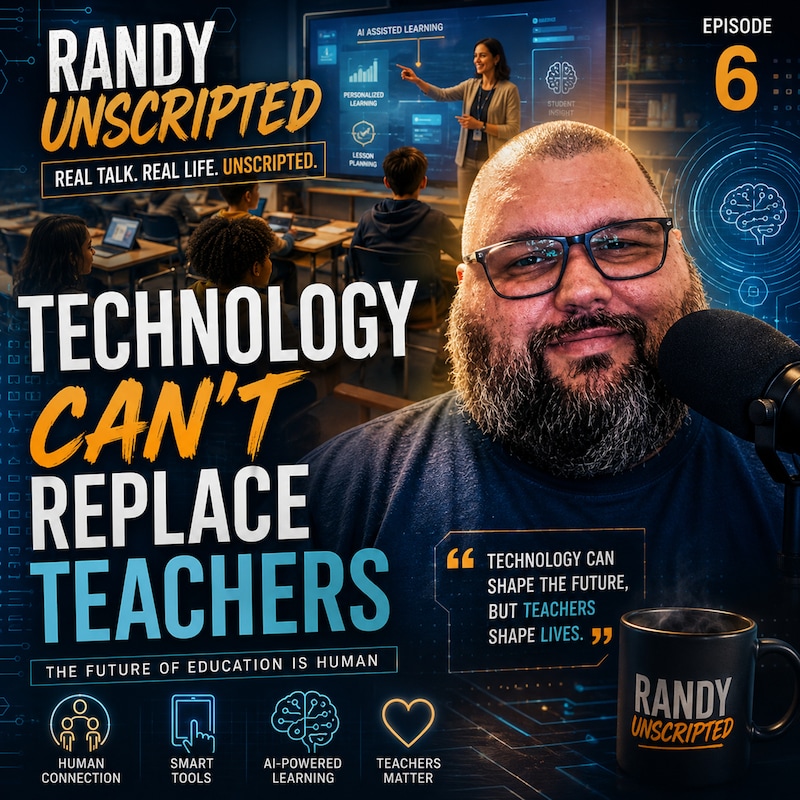
Welcome back to Randy Unscripted.
:
I'm Randy Black, and this is another entry in my NAPOD POMO Challenge.
:
That's National Podcast Post Month, where podcasters all around the world are pushing themselves
:
to create and publish 30 episodes in 30 days.
:
It's all about creativity, consistency, and community.
:
Today, working in education, I thought that I'd take the time to unpack a topic that's
:
transforming classrooms, it's challenging educators, and it's exciting students everywhere.
:
That's artificial intelligence.
:
We're going to talk about how it's being used in schools, what opportunities it brings,
:
and what ethical questions it raises.
:
Let's start with the big picture
:
Artificial intelligence or AI isn't some far-off futuristic idea anymore
:
It's already woven into the tools that teachers and students are using every single day
:
From grading systems and learning platforms
:
To tutoring chatbots and accessibility apps
:
AI is reshaping how education works
:
But before we go deeper, it's important to clarify what AI actually is and what it isn't.
:
At its core, AI is about machines simulating human thought.
:
It's not magic, and it's not alive.
:
It's software that is built to recognize patterns, to process data, and to make predictions from those.
:
There's all kinds of different types of AI, but the ones that are impacting schools today are usually narrow AI.
:
They are systems built for very specific tasks like grading, providing feedback, or recommending learning resources.
:
We also hear about machine learning, where systems, they learn from data to improve over time.
:
And we also hear about generative AI, which creates new content like text and images or even video.
:
Those are the kinds of tools that are now slowly making their way into classrooms.
:
For teachers, AI can be a real game changer.
:
It's not here to replace educators.
:
It's here to help them.
:
Imagine being able to instantly generate quiz questions,
:
differentiate assignments,
:
or even get automated insights into which students might need extra help,
:
all without having to stay up past midnight doing grading or lesson prep.
:
That would be awesome.
:
AI can do some very powerful things for you,
:
Like, it can create personalized learning plans based on student-specific performance.
:
AI can automate grading and feedback, saving you valuable time with what you do to prepare for your classroom.
:
AI can provide curriculum support for you, generating prompts and activities on demand.
:
And AI can offer professional development by suggesting resources that are tailored to your strengths or your needs.
:
It's like having an assistant who never gets tired, but still needs guidance and supervision to stay on course.
:
For students, the impact might even be more immediate.
:
Adapted learning tools like Dreambox or CanMingo adjust difficulty levels for work that they're doing in real time.
:
and writing assistants like Grammarly provide feedback instantly to them.
:
Students can get 24-7 tutoring support.
:
They can practice with AI-powered and generated flashcards.
:
Or they can use text-to-speech tools that make content more accessible.
:
These technologies are helping learners at every level,
:
including students with disabilities or those who speak multiple languages.
:
AI is making learning more responsive and more personal, but it's not without its challenges.
:
And that brings us to the ethical side of things.
:
As AI becomes more embedded in classrooms, schools need to think critically about privacy, bias, and equity.
:
For example, if an AI tool uses biased data, it might give unfair results or recommendations.
:
If schools collect and analyze student data, who controls that information?
:
And how securely is it stored?
:
There's also risk of over-reliance on automation, letting algorithms make decisions that should involve some human judgment.
:
Teachers bring things to the table like empathy, creativity, and moral reasoning.
:
Things that AI simply can't replicate.
:
So the goal isn't to automate education.
:
It's to enhance it.
:
To make teachers' lives easier.
:
To help students learn better.
:
And open up new opportunities for innovation without losing the human connection that makes learning meaningful.
:
So here's something to think about.
:
How can schools balance the efficiency and the insight that AI provides
:
while still keeping the essential human element at the center of education?
:
That's a question worth asking, not just for educators,
:
but for anyone who values the role of people in a world of machines.
:
That's all for today's episode of Randy Unscripted, part of my NAPOD POMO series.
:
I'm diving into a new topic every day this month, exploring how technology, culture, and creativity intersect in our everyday lives.
:
If you're a podcaster or thinking about becoming one, I'd love to encourage you to join in the challenge.
:
Create. Share. Experiment.
:
There's no better time than now to add your voice to the bigger conversation.
:
So keep chasing knowledge, keep challenging ideas, and I'll catch you in the next round of Randy Unscripted.
:
What if they want an encore?
:
You unplug and you run, run off stage.
:
Smiling, smiling, of course.
:
No encore.
:
.