Shownotes
This episode explores foundations questions about life through the lens of Genesis and Job, focusing specifically on why we are here, what went wrong, and whether there is life after death. We talk about the critical themes of creation, the Fall, and the nature of suffering, examining how these narratives inform our understanding of human existence and God's purpose. We will also look at the nature of evil and suffering, as well as God's sovereignty over these challenges. My goal in this lesson to provide clarity on the foundational questions that shape our faith and perspective on life's struggles. Join me as we delve into these essential topics that will give us a solid foundation for the remainder of our study in the Bible and our lives.
Takeaways:
- The podcast explores fundamental questions of existence, including how we got here and the nature of our purpose.
- Job's narrative illustrates the reality of suffering and the responses we can have towards it.
- The discussion emphasizes the importance of understanding Satan's role and limitations in our lives.
- Job provides a clear affirmation of life after death, highlighting hope and renewal beyond earthly suffering.
Transcripts
Welcome to through the Bible in chronological order from Bible 805 and Yvon Prehn. This podcast is a somewhat unique and I trust, a helpful historical and thematic commentary on the readings in the Bible.
It's not a verse by verse study, but one that I pray you'll find thoughtful and challenging.
New episodes are released each Wednesday and today our lesson is Genesis and Job Answers to the Big Questions of Life, Part TWO
We're going to look at why are we here, what went wrong, and is this all there is in this? In the next lesson, we'll primarily look at how Job answers our questions with some references to Genesis.
We'll talk more about the people and stories of Genesis in other lessons that follow in review.
To review the topic of this lesson, What are the big foundational questions that I'm referring to:
Number one, How did we get here?
Number two, What went wrong?
And the sub question of that, Who is Satan and what power does he have?
Number three, Is there life after death?
Number four, What about people who've never heard of Jesus?
Number Five, Why do innocent people suffer?
And Number Six, How can we help people who are suffering?
We'll cover the first three in this lesson and then the next three in the next lesson.
Now let me give you first of all, an overview of the Book of Job.
The book opens describing Job as God's ideal man.
Satan appears before God and challenges God that Job only serves him because God blesses him. To see if that's true, God allows Satan to harm Job and he loses wealth, family and finally his health.
Three friends and a fourth later come to comfort Job, but instead accuse and repeat false beliefs about God. Job consistently defends himself and demands a defense before God. God responds and shows his power.
It's important to note, though, that even as God responds, he does not and he never does answer Job's questions. Job repents and is restored.
Now question number one, let's just jump right into it. How did we get here?
It's answered actually in both books, Genesis begins with "In the beginning God and Genesis continues with a record of God's creation of all things. God is Creator is confirmed in Job when God confronts him and begins by establishing who he God is on the basis of creation.
When he says, "Where were you when I laid the foundations of the earth? Tell me if you know so much. Do you know how its dimensions were determined and who did the surveying?
What supports its foundation and who laid its cornerstone?
As the morning stars sang together and all the angels shouted for joy?"
This reality that God created us is the foundation for his claims on us and the answer to our life's questions for meaning and fulfillment. The rest of the Bible affirms God's creation as it does in Psalm 103 where it says, "He made us."
In Acts:And in Revelation 4:11 it says, "You are worthy our Lord and God to receive glory and honor and power.For you created all things and by your will they were created and have their being."
There is no such thing as a self-made man or woman. Humanity is not the result of time plus chance.
Not being self-made though is a good thing because we know so little, but God knows what is best for us and designed our lives for meaning and purpose. We sometimes trivialize the description of the Bible as the owner's manual and for the best functioning of people.
We tell people to read the directions and but it is so true. CS Lewis put it this way, "God cannot give us a happiness and peace apart from himself, because it is not there. There's no such thing."
Question number TWO, What went wrong?
Genesis tells us that part of the story and then Job expands it. In Genesis 3, an antagonist enters the story.
Satan, first introduced as simply the serpent. God gave humanity only one negative command.
They had this whole wonderful garden and all of these things and everything that they could want or dream of, but only one command that was negative-- "Don't eat of the tree of the knowledge of good and evil."
But the antagonist Satan, created doubt about God's goodness and offered an alternative to trusting God, wisdom rather than a relationship. Genesis tells us Adam and Eve chose the alternative.
We call this action the Fall.
In the storyline of the Bible, the Fall is a conflict that initiates all the following actions of the Bible. Everything changes with this event. Immediately after the Fall, God promises a Savior.
And though we don't know the entire story at this time, the actions of that promised Savior would reverse paradise lost with paradise regained. But that's a long time from now in our story. As we start, let's look more closely at the antagonist at Satan so we can understand his tactics better.
Because unfortunately he's part of many Bible stories and of our stories. Let's look at a few other scriptures to understand Satan more fully.
He was the highest of created beings, an angel who once held a place of honor before God. But he rebelled and was removed from his place.
world," it tells us in Isaiah:Read Ezekiel 28 for more pictures of his fall when you have time. We wish we knew more about this extraordinary backstory.
What we do know, though, is clothed in symbolic language, and there is much we do not know. However, God's told us everything we need to know.
Satan's past does not concern us as much as what he's doing now.
The book of Job gives us important insight to his current actions and limitations. That's really important. We need to keep these things in mind as we read through the Bible and in our daily lives.
Here's what Job shows us about Satan 1. Satan has access to God. He is also allowed, and the important word here is allowed to initiate natural disasters, personal tragedies, crime and death and sickness. All of these he did to Job. Nowhere in the Bible are we given specifics about his ability to do them or how he does what he does.
,:Now a little bit more about how Satan's power is limited. Clearly, in Job, Satan is subordinate to God. There is no dualism in the Bible. God and Satan are not two equal powers engaged in a cosmic battle.
Satan is God's creation, not eternal, not all powerful, not all knowing. He cannot read your thoughts or know the future for certain. He is also not omnipresent.
He can't be everywhere at one time, though he has legions of demonic powers. In Job 1, Satan appears before God in an obvious place of submission. God questions him, limits him. We see this as a foundational lesson in Job.
It is an assurance also repeated for us in the New Testament, where it says, "You are of God, little children, and have overcome them." And this is referring to Satan and his influence. "Because greater is he that is in you than he that is in the world."
1 John 4:4.
Though limited, Satan can still cause a lot of trouble. Satan is not at all original in his strategies.
What he used to tempt Adam and Eve, he continues to use now. The simple statement in Genesis 3:1. "Did God really say" Satan continues to use again and again and again.
Satan always begins with questioning if God really said something and then progresses to suggesting an alternative that sounds good but is ultimately destructive. To stand up against that, you need to know what God's Word truly says. What he wants you to do.
Don't just take it from what others say, from hearsay, from what you may have even heard at church. You've got to get to know God's Word. Because it is only through God's Word that you will know for certain what God wants.
Because our world, our culture, our values today seem so pleasing in many ways, as fruit did to Eve. But they are ultimately destructive.
Additionally, what we see about Satan in Job, Satan is restless.
He wanders the earth, and he is an accuser of God's people, then and now. In Job 1:7, it says, "The Lord said to Satan, where have you come from?
Satan answered the Lord, from roaming throughout the earth, going back and forth on it."
In the New Testament, we see this hasn't changed. In 1st Peter 5:8, it says "Be careful. Watch out for attacks from Satan, your great enemy.He prowls around like a hungry, roaring lion, looking for some victim to tear apart. '
Now, in that wandering, he accuses God's people.
In Job 8, God pointed out the blameless life of Job, and Satan responds.
"Does Job fear God for nothing?" Satan will twist every good thing in our lives and the lives of others into something evil.
That chatter in your head, constantly telling you what a mess you are, is seldom from God. God's voice of conviction gives you a way to do better. Satan simply pounds on you. Don't listen to him. Evaluate your life in light of God's word.
Confess your sin if necessary, and press ahead, assured of God's love and forgiveness. Also, this is why slander, gossip, thinking evil of our brothers and sisters, of anyone, is so wrong. We're listening to Satan.
When we do that, we're doing his work and we shouldn't be doing that. We can never know what is truly going on in another's life. Grant them the grace you receive from God and want for yourself.
Don't gossip, grant grace; don't accuse, pray for people. Satan's interference with people is significant, but it won't last forever.
We are reminded in Ephesians 6:12 that we're not fighting against people made of flesh and blood, but "against persons without bodies, the evil rulers of the unseen world, those mighty satanic beings and great evil powers of darkness who rule this world and against huge numbers of wicked spirits in the spirit world."
But Jesus rose from the dead, defeating Satan, and Satan's interference with God's people will also someday come to an end when Satan will be thrown into the lake of fire. The accusing chatter in our minds will cease. The interference in our lives and world will be over.
In Revelation:Hopeful words, but who will be around to see them? Will we? Will any of us? And so we get to question Number Three. Is there life after death?
tells us in First Corinthians:Of the many big questions of life, Job answers the question, is there life after death?
Is definitely the most important because it literally puts everything else that happens to us into proper perspective. If there is no life after death, no salvation from the punishment of death, there is no point in the rest of the Bible.
But there is salvation from death. There is a Savior who will conquer death, and the effects of his victory will reach back to the earliest days of humanity.
Our God is an eternal God, and he did not create throwaway creatures. And Job affirms this truth. And remember from our first lesson, this is most likely the first book written in the Bible.
answer to this question. Job:I'll read it, and then we'll take a closer look at the Hebrew words in it that are so powerful. So listen very carefully. It says, "If someone dies, will they live again? All the days of my hard service, I will wait for my renewal to come.
"renewal", there is the Hebrew word khalifa, which is a change of garments, a renewal. You will call, he's speaking to God, and I will answer you. You will long for the creature your hands have made.
I know that my Redeemer lives and that in the end he will stand on the earth. And after my sk, which is the word besar, has been destroyed, yet in my flesh, same word basar, I will see God.
I myself will see him with my own eyes. I and not another. Oh, how my heart yearns within me. A few notes on this. First of all, that word chaliyphah.
It's similar to how the Apostle Paul was talking about his earthly tent being exchanged for a heavenly one. And here Job already is referring to it as his renewal. This exchange, this renewal.
And then what is most powerful and in many ways couldn't be more clear is the Hebrew word, basar. He's talking about after my skin, my basar has been destroyed. Yet in my flesh, he goes on to say same word, basar. I will see God.
The resurrection to the Christian is tangible, solid, a renewal into what we were created to be. Even early in his struggle, Job knew this. As the passage we just discussed shows, Job knew that his earthly pain was not all there was to his story.
There are sadly many, including some in the church and some who teach the Bible who will say, well, in the Old Testament, there's no clear belief of life after death. That is absolutely not true.
As first of all, this passage in Job and many others show, I also have another lesson that's entitled it's totally just on this topic, Is there Life after Death?
It's available on Bible 805, where I go through many Old Testament passages that affirm the truth of life after death, plus a shorter lesson that critiques those who deny it. Please check out the podcast, the videos, all that stuff that's on that topic of Is There Life After Death?
It's available at www.bible805.com One more hopeful reminder, as one writer said, If we truly believe in the promised joy of a fulfilling, meaningful eternity spent with those we love and a God who loves us, even the most horrible experiences of life will seem like one night spent in a bad hotel.
You might be in that horrid bad hotel right now, but be assured that as the book of Job shows us and the rest of the Bible affirms, joy will come.
Perhaps not in this life, but it will come and it will last forever. What's Next? I pray that the topics that we've covered today are really comforting truths to those of you who know Jesus.
And yet, sometimes as we answer these questions, they bring up even more questions.
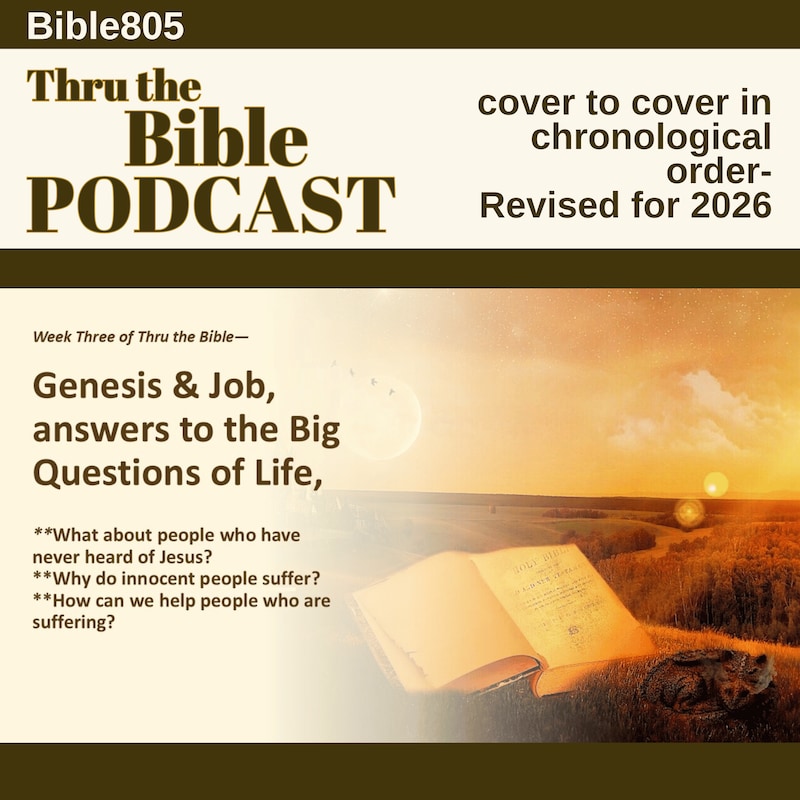
And here's what we're going to be covering in Genesis Genesis and Job Answers to the Big Questions of Life Part 3.
All this sounds great, but question number 4is, What about people who never heard of Jesus? Number 5 Why do innocent people suffer?
Number 6 How can we help people who are suffering?
Join me as I continue to lay a solid foundation for studying the remainder of the Bible. Because the big questions covered in this lesson and the next will come up again and again.
And until then, be encouraged with reminder of these final words from Job. I know that my Redeemer lives and that in the end he will stand on the earth, and after my skin has been destroyed, yet in my flesh I will see God.
That's all for now for notes from this lesson. Related resources and links to teaching materials, go to www.Bible805.com
in closing, I'm Yvon Prehn your fellow pilgrim, writer and teacher for Jesus, and I'd like to close with this benediction--
May you know the invitation of God to move from confusion to clarity, from wandering to rest, from loneliness to knowing you are loved. From turmoil to peace, from wherever you are on your spiritual journey to a growing knowledge of God's Word and in your personal relationship with the Father, Son, and Holy Spirit. Amen.

