Shownotes
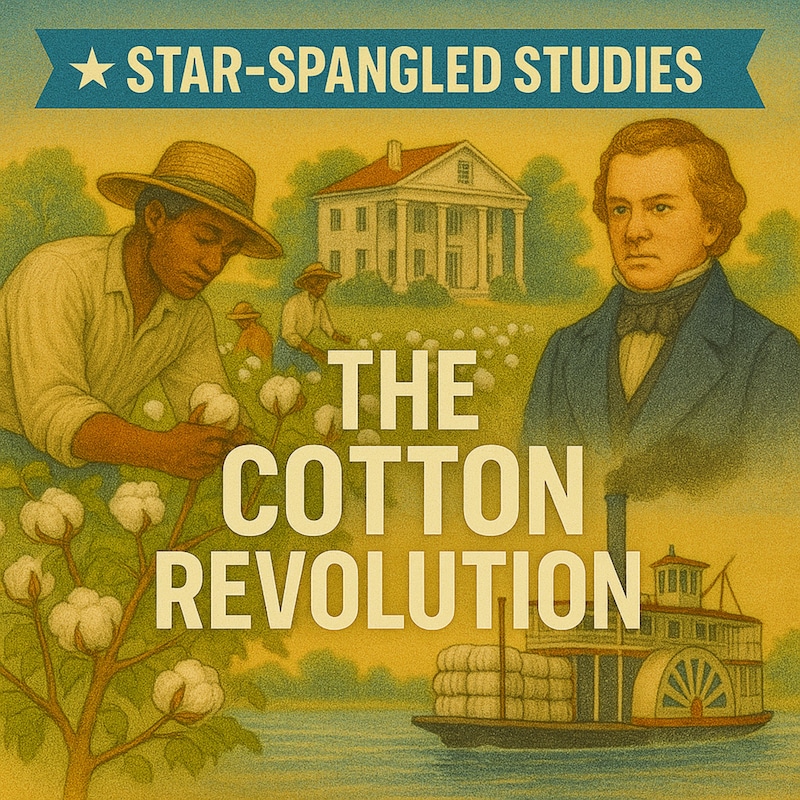
In Episode 11 of Star-Spangled Studies, Dr. G examines how cotton transformed the South and fueled slavery’s expansion. Key topics include:
• Eli Whitney’s cotton gin & short-staple cotton boom
• “Petite Gulf” cotton strain & steam-powered river transport
• Indian removal & the opening of the Cotton Belt
• Domestic slave trade (“Second Middle Passage”) & New Orleans markets
• Southern cities as modern commercial centers built on slavery
• Southern honor culture, duels & paternalistic pro-slavery ideology
• Enslaved resistance: family, invisible churches & daily acts of defiance
• Historiographical debate: paternalism vs. capitalist brutality
Follow Along & Stay Connected
Stay connected with Dr. G and the podcast community:
📸 Instagram: @star_spangled_studies
Don’t forget to subscribe, rate, and share Star-Spangled Studies with fellow history lovers!
Episode 11 of Star-Spangled Studies explores the Cotton Revolution: the gin, the Gulf cotton strain, Indian removal, the domestic slave trade, southern honor, and enslaved resistance.
Transcripts
Hello y'all.
2
:It's me.
3
:It's me.
4
:It's Dr.
5
:G and welcome back to Star Spank Studies.
6
:Now they call this white gold and it
fueled a global economic revolution.
7
:It built fortunes overnight and
it turned the American South.
8
:Into a kingdom, the
kingdom of king Cotton.
9
:But this kingdom was built on the
foundation of human bodies and the legacy
10
:of which would tear the nation apart.
11
:This week on Star Spangled studies,
we're gonna dive into one of the most
12
:consequential and contradictory periods of
American history, the era of King Cotton.
13
:The story of the Antebellum South is
often told as one of tradition of a
14
:region that was stuck in the past,
insulated from the modernizing world.
15
:But as we will see, the south
was anything but static.
16
:It was a place of explosive
growth, of cutting edge
17
:technology and of global ambition.
18
:As our textbook puts it, the
South quote, actively engage new
19
:technologies and trade routes.
20
:It became an integral part of an
increasingly global economy end quote.
21
:But this modernizing capitalist impulse
was harnessed to its most traditional and
22
:brutal of all practices, chattel slavery.
23
:This is the central
paradox, will unravel today.
24
:This revolution of cotton
didn't happen by accident.
25
:It was built on three critical pillars
that together transformed the south's
26
:landscape and its global economy.
27
:So let's go.
28
:The first pillar was technology in 1794.
29
:As we talked about in a previous episode,
a Massachusetts born inventor named
30
:Eli Whitney patented a machine that
would quite literally change the world.
31
:Cotton gin before Whitney processing
cotton was a painfully slow process.
32
:A single laborer could spend an
entire day picking the sticky
33
:seeds out of just one pound of
short staple cotton Whitney's gin.
34
:The simple device with wired teeth that
pulled fibers through slots too narrow for
35
:the seeds to go through, could clean 50
pounds or more in the same amount of time.
36
:It revolutionized cotton production.
37
:It made cotton production.
38
:Actually a lucrative business.
39
:This was a boons for the southern
economies that were starting
40
:to turn away from tobacco into
the now more lucrative cotton.
41
:It was immensely profitable, especially
because short staple cotton grew
42
:really well in the deep south.
43
:We had talked about in a previous
episode how this fueled slavery's
44
:expansion in the south and the
domestic slave trade from northern.
45
:Old south or old states to the deep south.
46
:The second pillar was biology.
47
:The gin was a brilliant machine, but
it needed the right raw material,
48
:and that arrived in 1820 with
the discovery of a new strain of
49
:cotton near Rodney, Mississippi.
50
:It was.
51
:Known as the Petite Gulf Cotton.
52
:This was a Planter's dream.
53
:The fibers were long and
luxurious, but unlike other high
54
:quality strains, it grew densely.
55
:Its bowls opened wide for easy
picking, and most importantly,
56
:it seeds slid through the new
cotton gins with remarkable ease.
57
:This was the biological catalyst that
made the cotton revolution po possible.
58
:But technology and biology were
useless without the third and
59
:most foundational pillar land.
60
:And the land for this new kingdom
was acquired through a campaign of
61
:violent state-sponsored expansion.
62
:The story of king cotton is inseparable
from the story of Indian removal.
63
:The federal government through
legislation like the Indian Removal
64
:Act of 1830, which had forcibly
displaced the Choctaw Chickasaw Creek,
65
:Seminole and Cherokee nations from
their ancestral homes in the southeast.
66
:Following this ethnic cleansing,
the government surveyed divided and
67
:auctioned off millions of acres of
fertile land in what would become known
68
:as the cotton belt Southern Georgia.
69
:As well as Alabama, Mississippi,
and northern Louisiana.
70
:This land became, quote, readily
available for white men with
71
:a few dollars in big dreams.
72
:End quote.
73
:This process reveals a crucial
truth, often obscured in the popular
74
:narrative of the self-made planter.
75
:The rise of King Cotton was not
simply a story of market forces
76
:or agricultural ingenuity.
77
:It was a deliberate, violent project
underwritten by the full power
78
:of the United States government.
79
:A federal policy of Indian removal
was essential for the first step of
80
:this, the precondition that cleared
the way for subsequent economic booms.
81
:The wealth of King Cotton was
from its very inception rooted
82
:in a partnership between private
ambition and public violence.
83
:The transformation was
astonishingly rapid.
84
:The traveler Joseph Holt Ingram,
who visited Mississippi, captured
85
:the dizzying pace of the change.
86
:He recalled how, quote, where
yesterday, the wilderness darkened
87
:over the land with her wild forests.
88
:Today, the cotton
plantations whiten the earth.
89
:End quote, thousands rushed into the
cotton belt, and with it the help of the
90
:new steam powered riverboats to ma to
move the goods, the American South quickly
91
:became the world's leading producer.
92
:Cotton, but that was all
done by the labor of slaves.
93
:Something we cannot forget,
millions of hands were needed
94
:to do the backbreaking work.
95
:And in Antebellum America, that meant the
dramatic expansion in the intensification.
96
:Of the single most
controversial institution in
97
:the nation's history, slavery,
98
:the US Constitution had banned
the international slave trade
99
:starting in 1808, but this did
not end slavery within the nation.
100
:Instead, it gave rise to a massive and
brutal internal or domestic slave trade.
101
:This forced migration of enslaved people
from the older slave stout states of the
102
:upper north like Virginia and Maryland to
the new cotton lands of the deep South is
103
:often called the second middle passage.
104
:It was a staggering demographic upheaval.
105
:Over a million enslaved African
Americans were forcibly moved, marched
106
:over land in chains, or packed onto
ships bound for ports like New Orleans.
107
:This journey was a second traumatic
dislocation, tearing people
108
:from the communities and kinship
networks that had, they had
109
:managed to build over generations.
110
:These statistics are chilling and
historical estimates suggest that
111
:between one fifth and one third of all
slave marriages were broken up by sale
112
:or force migration during this period.
113
:The destination for many was the
slave market, a place of profound
114
:terror in dehumanization cities
like New Orleans became the largest
115
:slave markets in North America.
116
:Their economies boomed from
this trade in human flesh.
117
:To understand what the spear
the experience was like.
118
:We can turn to the powerful narrative
of Solomon Northup, a free black man
119
:from New York who was kidnapped in 1841
and sold into slavery for 12 years.
120
:His account became 12 years
a slave, and it gives us that
121
:visceral first person view.
122
:Northup describes how potential buyers
treated him and others like him.
123
:They treated him like
livestock, not as people.
124
:He wrote quote, he would make us hold
up our heads, walk briskly back and
125
:forth while customers would feel our
hands and arms and bodies turn us about.
126
:Ask us what we could do.
127
:Make us open our mouths and show our teeth
precisely as a jockey, examines a horse,
128
:which he's about to barter for purchase.
129
:The greatest horror was
the separation of family.
130
:Northup witnessed the agony of a
woman named Eliza, who was being
131
:sold away from her children.
132
:He recounts her desperate pleas.
133
:She besought the man not to buy her
child unless he also bought herself.
134
:She promised in that case to be the
most faithful slave that ever lived.
135
:End quote.
136
:Her pleas were ignored.
137
:The system's profitability depended
on the ability to sever the
138
:most fundamental of human bonds.
139
:This brutal commerce was the engine
of urban growth in the South.
140
:As our textbook explains, southern
cities like New Orleans, Charleston, St.
141
:Louis and Mobile quote, doubled
and even tripled in size and global
142
:importance in the antebellum decades.
143
:They became modern cosmopolitan centers
with global shipping lines, connecting
144
:them to Liverpool, New York, and Lisbon.
145
:They boasted theaters and universities.
146
:They had a wealthy, educated elite,
but this sophistication was built
147
:directly upon the slave trade itself.
148
:The slave pens and auction houses
were often located just blocks
149
:away from fine homes, mansions,
and cultural institutions.
150
:The modernity of these cities was not
in spite of slavery, but because of it,
151
:the very mechanisms of modern commerce,
the trading firms, the warehouses,
152
:the port facilities, the financial
instruments like credit and insurance
153
:were all developed and perfected to
make the buying and selling of slaves.
154
:More efficient and profitable.
155
:The city was the sophisticated
public face of a barbaric system,
156
:a place where the profits of human
trafficking and laundering into
157
:cultural and economic capital.
158
:The barbarism and the.
159
:Sophistication.
160
:Were not just coexisting,
they were symbiotic.
161
:This vast system of human trafficking,
which treated people like livestock was
162
:defended by a complex and violent culture.
163
:I cannot state that enough.
164
:To understand the mind of the enslave,
to understand how they could attend
165
:a slave auction in the morning.
166
:In a church service in the afternoon,
we have to explore their worldview.
167
:A world built on the violent defense
of honor in a chillingly new ideology.
168
:So for the white man of the planter
class, public reputation was everything.
169
:This was a culture of honor.
170
:Honor was not an internal
feeling of self-worth.
171
:It was a public performance of authority
and mastery over one's dependence.
172
:This included mastery
over wives, children.
173
:Most importantly, the enslaved people
that they claimed as property to have
174
:one's word questioned to be called a liar
or a coward, was to have this mastery
175
:publicly challenged such an insult demand
that a response, often a violent one,
176
:culminating in the ritual of the dual.
177
:Dueling had largely vanished in the
north, but it remained a central if
178
:illegal part of the Southern Honor Code.
179
:A fascinating example of this code
in action is the dispute between
180
:two prominent South Carolinians
James Hammond and his brother-in-law
181
:weighed Hampton The second.
182
:Hammond had engaged in sexual
relationships with Hampton's
183
:four teenage daughters.
184
:When Hampton found out about this, he
didn't immediately challenge Hammond to
185
:a dual, which was custom at the time.
186
:Instead, he tried to use it
to create a scandal, trying to
187
:ruin Hammond politically, but
in the eyes of their peers.
188
:This was the greater dishonor by
failing to seek immediate violent
189
:satisfaction to the dishonor.
190
:Imposed upon him, Hampton
was seen as a coward.
191
:Hammond wrote in his diary that
Hampton was a convicted bastard.
192
:Those were his words, and that
Hammond himself was no longer
193
:bound to the code to accept a
dual from such a dishonorable man.
194
:This bizarre episode shows just
how ritualized and central this
195
:culture of controlled violence
was to the southern elite.
196
:This code of honor was.
197
:Held up by a radical shift in
ideology in the early republic.
198
:Many southerners, including Thomas
Jefferson, had described slavery as
199
:a necessary evil, a regrettable, but
unavoidable part of their society.
200
:But by the 1830s, under increasing
pressure from the growing
201
:abolitionist movements in the
north, southern intellectuals
202
:began to mount a new defense.
203
:They argued that slavery was not actually
evil at all, but that was a positive.
204
:Good to the slave.
205
:Sounds ridiculous.
206
:But a leading proponent of this view was
a Virginia writer named George Fitzhugh
207
:in works like sociology for the South.
208
:Fitzhugh launched a blistering attack
on the Free Labor Society of the North.
209
:He argued that northern factory workers
were, in fact slaves themselves.
210
:They were wage slaves, and
they were far more exploited.
211
:And insecure.
212
:They were in a worse position than
the enslaved people in the south.
213
:In his view, slavery in
the South was benevolent.
214
:It was a paternalistic system that
protected black people because they
215
:were supposedly inferior, and in
therefore, it ensured social harmony.
216
:Unlike the chaotic competitive
capitalism of the North.
217
:Perhaps no one articulated this new
aggressive pro-slavery worldview
218
:with more confidence, at least
then whom we just mentioned.
219
:James Henry Hammond of South Carolina,
the same man from the dueling story.
220
:In a famous speech on the floor of
the US Senate in:
221
:out two theories that would become
cornerstones of the pro-slavery argument.
222
:The first was his mudsill theory.
223
:Hammond argued that all great
civilizations required a laboring class to
224
:perform the menial tasks, to provide the
foundation or the mudsill upon which the
225
:elite could build progress and culture.
226
:He declared quote.
227
:In all social systems, there must
be a class to do the menial duties
228
:to perform the drudgery of life.
229
:It constitutes the very mudsill of
society and of political government.
230
:Fortunately for the South, she found
a race adapted to that purpose, to
231
:her hand, a race inferior to her own.
232
:We use them for our purpose
and call them slaves.
233
:End quote.
234
:This theory explicitly naturalized
the exploitation of slavery.
235
:It rooted it in a racist hierarchy.
236
:He claimed that the South's enslaved
laborers were happy and well cared for.
237
:While the North's white Hireling
class was miserable and dangerously,
238
:they had the right to vote.
239
:Second Hammond proclaimed the South's
immense economic power, a power
240
:derived from its monopoly on the
world's most vital co commodity.
241
:This was his caught his king
argument with breathtaking arrogance.
242
:He threatened the north and the world.
243
:Quote.
244
:Without firing a single gun,
without drawing a sword,
245
:should they make war on us?
246
:We could bring the
whole world to our feet.
247
:No.
248
:You dare not make war on cotton.
249
:No power on earth dares
to make war upon it.
250
:Cotton is king.
251
:End quote.
252
:These ideals, the Honor code, the
positive good argument, and the Mudsill
253
:theory were not separate concepts.
254
:They formed a unified ideological system
designed to justify and maintain the
255
:power of the planter class, the honor
code regulated power horizontally among
256
:the elites, ensuring that only those who
demonstrated mastery were fit to rule.
257
:The racial ideology of the Mudsill
theory justified their power vertically.
258
:It justified their power over millions
of people, which would stay enslaved.
259
:And violence.
260
:The pistol in the dual or the
whip on the plantation was the
261
:ultimate arbiter in both spheres.
262
:It was a closed self-reinforcing
system of belief and brutality.
263
:When I said it was a system built
on violence, this is what we mean.
264
:The Enslavers built this world on these
ideals of honor, but also on domination.
265
:They wrote books.
266
:They gave speeches to
justify such use of force.
267
:But what about the world of the
4 million people that they held
268
:in bondage, how did they survive?
269
:How did they.
270
:How did they love?
271
:How did they fight back?
272
:We're gonna hear their stories
in their own words next.
273
:While the planter class was
constructing the ideological
274
:justifications for slavery, 4 million
people that they held as slaves
275
:constructed a world all their own.
276
:And it was a world built, not on
abstract theories, but on the lived
277
:realities of family and faith, and I
cannot stress this enough of resistance.
278
:A constant struggle to affirm
their humanity in a system
279
:designed to destroy it.
280
:The institution of slavery was in
many ways a war on the black family.
281
:The ever present threat of sale
of one's family, men members meant
282
:that spouses could be separated and
children torn from their parents at.
283
:Any moment for enslaved women,
the burdens were immense.
284
:They faced the triple exploitation of
their labor, their reproductive capacity
285
:to create more property for their
enslave, and the constant looming threat
286
:of sexual violence from their enslavers.
287
:The narrative of Harriet Jacobs
incidents in the life of a slave girl
288
:provides one of the most powerful
accounts of this struggle writing.
289
:Under the pseudonym Linda Brent
Jacobs details the relentless
290
:sexual harassment and violence
she endured from her enslave, Dr.
291
:Flint.
292
:She writes.
293
:His chilling words, he told me I
was his property, that I must be
294
:subject to his will in all things.
295
:My soul revolted against the mean tyranny,
but where could I turn for protection?
296
:He peopled my young mind with
unclean images and such as only
297
:a vile monster could think of.
298
:End quote.
299
:She's talking about rape to escape.
300
:Flint's Predations Jacobs
made a desperate choice.
301
:She entered into a relationship
with another white man named Mr.
302
:Sands, with whom she had two children.
303
:Her goal was not love, but survival,
and it was a desperate bid for a
304
:measure of control over her own body.
305
:She appeals directly to her northern
female readers who could not
306
:comprehend her dilemma, but oh ye.
307
:Happy women whose purity has
been sheltered from childhood,
308
:who have been free to choose
the objects of your affection.
309
:Do not judge the poor, desolate
slave girl to severely.
310
:Her ultimate act of maternal
devotion was to hide for seven years.
311
:In a tiny, cramped attic space, what
she called the loophole of retreat, just
312
:so that she could remain close to her
children and protect them from the fate.
313
:She's so feared,
314
:just as enslaved people fought.
315
:Bitterly to maintain family ties.
316
:They also forged their own spiritual
lives, and it was separate from
317
:the control of those who tried
to control it, their enslavers.
318
:While these enslavers often forced
a version of Christianity upon
319
:them, emphasized in passages like,
quote, servants, obey your masters.
320
:The enslaved community
created what historians call.
321
:An invisible institution in secret
gatherings, often deep in the woods, in
322
:what were known as hush harbors, they
created a vibrant and syncretic faith.
323
:These services that were secret,
blended Christian theology.
324
:With West African traditions
featuring ecstatic worship call
325
:and response, singing, dancing in
the creation of Negro spirituals.
326
:The message here was one, not
of obedience, but of liberation.
327
:As one formerly enslaved person
recalled, the white preacher would say.
328
:Do whatsoever your master
tells you to do end quote.
329
:But in the Hush Harbors, that
message was radically different.
330
:It was a belief that God would
one day free them from slavery.
331
:This Theology of Liberation was
a direct spiritual and political
332
:challenge to the enslavers authority.
333
:And the spirit of defines manifested
itself in a wide spectrum of resistance.
334
:It wasn't limited to dramatic armed
rebellions like the one led by Nat
335
:Turner in 1831, which some historians
believed was planned within the
336
:network of these invisible churches.
337
:Resistance was a daily practice,
and I cannot stress that.
338
:Resistance takes many forms.
339
:Enslaved people asserted their
agency in countless small but
340
:significant ways, feigning illness
to reclaim a moment of rest.
341
:Working slowly to protest their
exploitation, breaking tools to
342
:disrupt the plantation's workflow,
stealing food to supplement the re
343
:meager rations that they were given.
344
:Each of these small acts, they might
seem minor in our eyes, but each of
345
:them was a blow against the system, a
reclamation of their time and their labor,
346
:and most importantly, their humanity.
347
:In this context, the primary
battlefield was often cultural.
348
:The slave system's logic demanded the
destruction of the black family to
349
:facilitate sale and control of religion
to OB to ensure their obedience.
350
:Therefore, the determined effort of
enslaved peoples to create and sustain
351
:kinship bonds and to forge a wholly
new theology of freedom, were not.
352
:Coping mechanisms.
353
:They were direct strategic acts
of war against an institution that
354
:sought to reduce them to isolated
soulless property units of labor.
355
:Their most profound resistance
was their collective refusal.
356
:To be dehumanized.
357
:How do we make sense of
this paradoxical society?
358
:For decades, historians have fought
over the very soul of the old south.
359
:Was it a pre capitas aristocratic
world as one major school of thought
360
:had argued, or was it the cutting edge
of a new, brutal form of capitalism?
361
:As a more recent group of historians
now contend this isn't just semantics.
362
:How we answer this question changes how we
understand the causes of the civil war and
363
:the very nature of economic development.
364
:So first, let's look at the paternalistic
thesis most famously articulated
365
:by the historian Eugene Genovese
in his:
366
:Genovese argued that the old South
was a unique paternalism society.
367
:He contended that the master slave
relationship was not a simple cash
368
:nexus, but a complex negotiated
system of reciprocal obligations.
369
:That's how we called them.
370
:However, grotesquely unequal
they might be in this view.
371
:The planters saw themselves as patriarchs
responsible for the care and guidance
372
:of their so-called enslaved family.
373
:This self-serving ideology
Genovese argued nonetheless.
374
:Gave the enslaved a framework
they could use to assert their own
375
:humanity and demand certain rights.
376
:He famously argued that slaves turned
paternalism into a weapon of resistance.
377
:By holding masters to their own
paternalistic standards, they could
378
:carve out a space for themselves, for
Genovese and the planter's worldview.
379
:It was a fundamentally aristocratic
and pre capitas, and it was
380
:driven by a desire for honor and
mastery, not just the bottom line.
381
:However, in recent years, a new generation
of scholars, often called the new
382
:historians of capitalism, has mounted
a powerful challenge to this view.
383
:Historians like Edward Baptist and
Walter Johnson argue that slavery wasn't
384
:a backwards obstacle to capitalism.
385
:Slavery was capitalism in its most
dynamic, violent and profitable form.
386
:Baptist argues that an incredible
400% increase in cotton picking
387
:productivity between 1,818 60 was
not due to new technology, but to a
388
:system of calibrated torture that he
calls the pushing system Overseers.
389
:Use the whip not just for punishment,
but as a tool of production
390
:management constantly pushing.
391
:Enslaved workers to
meet ever higher quotas.
392
:Violence itself was a technology
one to maximize output.
393
:Johnson focuses on the Mississippi
Valley as the epicenter of
394
:a global capitalist system.
395
:He shows how the enslaved bodies
there were not just labor,
396
:they were financial assets.
397
:They were used as collateral for
mortgages and bonds that were traded
398
:on national and international markets.
399
:Fueling economic expansion far beyond the
plantations with which they were confined.
400
:Baptist drives this point home
arguing that the massive increase in
401
:cotton production was due to a quote,
absolutely necessary Increase in torture.
402
:Which was the ultimate
cause of the economic boom.
403
:So, which side is right?
404
:Well, the debate is fierce.
405
:Critics argue that genovese's
theory can downplay the raw economic
406
:brutality of the S slave system.
407
:The new historians of capitalism,
on the other hand, are sometimes
408
:criticized for using an overly broad
definition of capitalism and for
409
:misinterpreting some quantitative data.
410
:Perhaps the most useful way to view this
debate is not as an either or question.
411
:It's possible that the planter's
ideology was paternalistic while their
412
:practice was brutally capitalist.
413
:They spoke the language of honor-bound
patriarchs as genovese's work shows often
414
:drawn from their diaries and letters.
415
:This was how they justified their
world to themselves and to outsiders,
416
:but their actions in the global
marketplace revealed in the economic.
417
:Data and financial records studied
by Baptist and Johnsons were those of
418
:ruthless profit maximizing capitalists.
419
:The paternalistic self image was the
necessary psychological and cultural
420
:mask that made the relentless re.
421
:Pursuit of capitalist
exploitation, palatable.
422
:It was the cultural software that
allowed the brutal hardware of
423
:slave capitalism to function.
424
:So we'll end here.
425
:What was the Cotton kingdom?
426
:Well, it was a modern, global
economic powerhouse built on a
427
:foundation of violence and torture.
428
:It was a society of genteel honor bound
planters who proffered from the systematic
429
:rape and destruction of families.
430
:It was a land of liberty for some built
on the absolute subjugation of millions.
431
:It was in short, a kingdom of paradox held
together by violence and the immense world
432
:shaping power of a single crop cotton.
433
:But a kingdom built on such rapacious
agricultural system won that as
434
:our textbook notes drain the soil
of nutrients, as well as a brutal
435
:labor system that commodified
human beings could not stand still.
436
:It had to expand.
437
:The cotton kingdom was,
as Walter Johnson argues.
438
:Pathologically expansive.
439
:It needed more land for cotton,
and it needed new territories
440
:to extend the reach of slavery.
441
:This insatiable hunger for both
would soon push America's borders
442
:westward across the plains, over the
mountains, all the way to the Pacific.
443
:This relentless drive for expansion,
for more land, for cotton, for
444
:more territory, for slavery, would
soon set the south on a collision
445
:course with the rest of the nation.
446
:And with Mexico, it was a drive
that had a name, a belief that it
447
:was God's given right for America
to expand from sea to shining sea.
448
:Next time on Star-Spangled
Studies, we'll explore this
449
:explosive idea manifest destiny.
450
:I'm Dr.
451
:G, and I'll see y'all in the past.