Shownotes
What if the sun, the same star that’s powered life on Earth for billions of years, could finally free us from the fossil fuel stranglehold that’s choking our future?
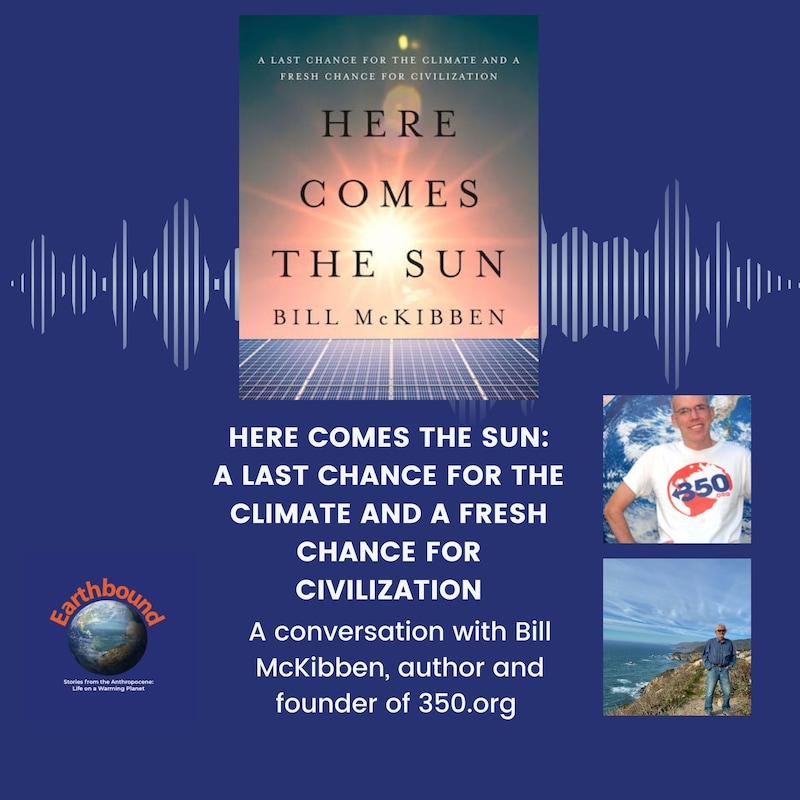
That’s the question at the heart of this episode’s conversation with legendary climate activist and author Bill McKibben. In his latest book, Here Comes the Sun, McKibben delivers a message that's equal parts urgent and unexpectedly hopeful: after decades of fighting uphill against Big Oil, the economics of energy have fundamentally shifted, despite the rhetoric from vested interests and their bought-and-paid-for politicians.
In 2024, more than 90% of new electricity generation globally came from renewable sources. Solar and wind aren’t “alternative" energy anymore, say McKibben, they are the future, and they're already cheaper, cleaner, and increasingly more accessible than fossil fuels. But the window to capitalize on this epochal shift is narrow, and the fossil fuel industry knows it, which is why they’ve purchased political power to protect their dying business model.
McKibben doesn’t sugarcoat the climate crisis—he knows too much about the science for that. We've already locked in significant warming, and we won't stop short of 2 degrees Celsius. But he argues passionately that we're in a race to shave off every tenth of a degree we can, because each one represents 100 million people pushed out of livable climate zones.
My conversation with McKibben explores practical, real-world solutions that are scalable right now: heat pumps, induction cooktops, electric vehicles, and even balcony solar panels that renters can plug directly into their walls. From California’s grid running on over 100% renewable energy during peak hours to China’s EV revolution eating the world’s lunch while America’s political leaders serve it up on a silver platter, McKibben paints a picture of a world in transition.
This isn’t a conversation about distant doom or abstract policy—it’s about the tangible, human-scale changes we can make right now, and the massive structural shifts already underway that prove rapid transformation is possible. McKibben’s clear-eyed honesty about where we are, combined with his grounded optimism (though he says he isn’t an optimist) about what we can still do, offers a roadmap illuminated by the sun itself. The question isn’t whether the technology exists to save ourselves. It does. The question is whether we’ll choose to use it before it's too late. If you've ever felt paralyzed by the scale of the climate crisis, this episode will remind you that, even as we have backed ourselves into a corner, we have a brightly lit, if narrow, path out.
Takeaways:
- Bill McKibben highlights the shift in energy economics where renewable sources are now cheaper than fossil fuels, marking a pivotal moment for climate action.
- The podcast emphasizes our deep connection to the sun, both biologically and emotionally, making renewable energy not just feasible but a natural choice for humanity.
- McKibben’s journey through climate activism illustrates how grassroots movements can reshape global agreements like the Paris Accord, showcasing the power of collective action.
- The conversation underscores that transitioning to solar and wind energy is not merely an alternative but the primary path forward for sustainable living.
- McKibben argues that while the climate crisis poses serious threats, there are still viable paths to mitigate its impacts through immediate, aggressive adoption of renewable energy.
Resources:
Transcripts
About 4.6 billion years ago, give or take, a giant swirling cloud of cosmic gas and dust.
The solar nebula succumbed to the forces of gravity, the pull of the fabric of space time, collapsing a cloud of cosmic dust into a hotel dense core and igniting the sun. And that's lucky for us, living here on a planet brought to life by the light and warmth of the great solar fire in the sky.
On a clear night, away from the city lights, we see a universe charged with pinpricks of energy from stars thousands, millions, billions of light years away. But on a clear day, the star, only eight minutes away on the light speed train, rains down on the Earth all the energy we could ever need.
Our reverence for the sun is therefore little surprise. How could we not? We live on a solar powered planet. Which brings me to my guest today on Earthbound, Bill McKibben.
books, including his:He has written countless articles and is the founder of 350. Org third act, and is also a fellow at the Post Carbon Institute.
Throughout his career, McKibben has been on the front lines of climate communication and action.
Starting in: d the do the Math campaign in: Talk of the town column from: , to name a few accolades. In: In:While he doesn't claim to be an optimist, I know too much about climate science, he says. He does argue that we have before us an opportunity to avert the most pessimistic prognostications about climate change.
s been turned on its head. In:The grid parity of renewable versus fossil energy has not only been reached, but surpassed. Solar and wind energy are now cheaper than fossil fuels. McKibben calls this an epochal moment for human civilization.
The question for us in the midst of these trying times is if we heed the call of the sun, or will we instead continue to dig up ancient sunlight, burn it, only to dig up more on and on and on and on until we choke on a destabilized planet, wishing we had done something when we had the chance. McKibben is one of the most important environmentalist and climate communicators of our age.
He has remained stalwart, courageous, and eloquent in his mission to inform, inspire, and resist the forces that endanger the future of life on this planet. We've backed ourselves into a corner in McKibben's Here Comes the Sun. We see a narrow path out, illuminated by the sun, leading to a better world.
in Paris in: Bill:That was definitely a high water mark.
And it's what, you know, 10 years of good activism had produced a situation where they had no choice but to give us an agreement, you know, and a good one in many ways, especially with its emphasis on 1.5 degrees. And that made a big difference.
Tom:Yeah. What are your thoughts about where we are now with the Paris Agreement?
Bill:Well, I think that really everything has shifted, which is what, why I wrote this book.
On the one hand, there's been an enormous retreat from climate goals, and all the people making promises at banks and companies all turned out to have feet of clay and all of that.
On the other hand, all that activism through Paris and really beyond for the next five or six years took place in a world where fossil energy was cheap and renewable energy was expensive.
Basically, the dynamic of climate action over those 30 some years was let's try to make fossil fuel more expensive with carbon taxes, with divestment, to drive up their cost of capital, with stopping their expansion of pipeline projects and things to slow them down. Beginning about four years ago, we moved into a very different world. And in this world, renewable energy is cheap and fossil energy is expensive.
And that's set off this cascading series of changes that I describe in the new book. And now the job of activists is to, well, is to take advantage of the fact that economic gravity is now working in our direction.
The ball has begun to roll off the top of the hill, and our job is to get behind it and push it so it rolls really, really fast, maybe even fast enough. Catching up a little bit with the physics of climate change, that's a very different task.
It calls for a different set of, you know, not complete change. We still need to keep taking on the fossil fuel industry, but they're, in a sense on the defensive now.
I mean, it looks at the moment in America like they've got everything going their way because they've purchased the Trump administration and they're getting their bidding done.
But the reason they felt like they had to purchase the Trump administration was because they're utterly terrified by this shift in the economics of energy.
California, which has done more than any other state to really embrace renewable energy, reached some kind of tipping point in the last couple of years, most days. Now they make more than 100% of their electricity from renewable sources for long periods of the day.
At night, when the sun goes down, the biggest source of supply on their grid is batteries that weren't there three years ago.
Taken in total, California, fourth largest economy on planet Earth, is using 40% less natural gas to make electricity this year than they were two years ago. That's an astonishing number.
And that's the reason that the hydrocarbon headquarters in Houston is in a panic and having to resort to political gamesmanship of this kind, because they're now producing an inferior, dirtier product at a higher price. And the only way to save their bacon is with political intervention.
But remember that their control, at least for now, mostly exists in the United States, which is only about 10% of fossil fuel consumption on planet Earth. The rest of the world is going in the opposite direction.
China's going in the opposite direction most quickly, of course, and that's bad news if you're Big Oil. Half the cars sold in China last month came with a plug dangling out the end.
Exxon's vision of a world where demand for oil keeps going up depends on the developing world turning into drivers like Americans and those drivers using gasoline. But if those drivers instead are using electricity, they're out of luck. And that's what's happening.
China all of a sudden is dominating the auto export market to the developing world, to any place that isn't putting steep tariffs on them, because the best and cheapest cars on the planet now are Chinese EVs.
You could say that China is eating our lunch, but you also could say, I think more accurately, that we've dispatched a team of waiters wearing red caps to serve that lunch to China. It's truly astonishing to inflict this level of damage on our own economy and our own future. These technologies were invented in the us.
in New Jersey at bell Labs in: Tom:McKibben wants to end the dominant misconceptions about renewable energy, especially the idea that solar, wind and other renewable energy sources are alternative. Maybe it was true 10 years ago, it isn't true now, despite what some people want you to believe.
Bill:I think the key thing here, one of the reasons I wanted to write the book, a big part of the reason, is because I really want to knock the label alternative off. This kind of energy, that's what we've been calling it for 40 years. That's the ghetto that we've built for it in our minds. But it's not.
95% Of new electric generation around the world last year came from sun and wind. It's not alternative. If anything, at this point, coal and gas and oil are the alternatives, and very bad ones at that.
Tom:Bill further explains what he hopes readers will take away from Here Comes the Sun.
Bill:There are two goals. One is this goal of really changing the public perception of clean energy.
The other is making very concrete changes at the state and local level that will allow us to install this stuff much, much more easily. You know, if you live in Australia or the eu, it costs you about a third as much to put solar on your rooftop as it does in America.
We pay three times, in many cases more than three times as much. And the reason has a little bit to do with tariffs on solar panels, but mostly it has to do with the Byzantine bureaucracy.
We've got 15,000 municipalities in this country. Each one has their own set of building codes, their own crew of building inspectors, on and on and on.
That's why it takes months to do what's a simple task. We justify it in the name of safety. But these are not dangerous technologies. 40% Of Australia have solar panels on the roof.
If there was an epidemic of solar panel fires across Australia, you can be very certain that Fox News would be showing them to you 24 hours a day. This really shouldn't be much more difficult than putting in a new refrigerator or something.
Tom:There is, of course, the elephant in the room.
The policies and misinformation, dare we call it lies from the Trump administration and its toadies in the Republican Party have undoubtedly done a lot of damage. And they aren't done as they rake in millions from the fossil barrens.
But renewable energy sources, particularly solar, poll well across the ideological spectrum. Of course, for many, renewable energy is a key weapon in the fight to alleviate a climate disaster.
But even folks who might agree with Trump on climate and other issues like the idea of self sufficiency powering their homes and businesses with solar in wresting control from the heartless utilities that charge what they want for power.
Bill:So the good news is, is that even with the fossil fuel industry and the Trump administration going overtime in their attacks on clean energy, it's caused some definite damage among Republican voters and things. But the polling indicates that people across partisan lines remain very attracted to renewable power, especially solar power. It pulls remark.
Well, I think that the reason for that lies in the fact that it has different appeals to different people. I've lived most of my life in rural America, some of it in purple state parts and some of it in very red parts. I have lots of conservative neighbors.
A surprising number of those have solar panels on their roofs. The reason in their case is not a desire to do something about climate change. The reason is they think their home is their castle.
And they think it's a better castle when it has its own independent energy supply. I mean, look, they're planning to defend it with the AR15 that they've got in the gun safe downstairs.
They're not going to surrender it easily to some utility exec either.
Tom:Then how is it that we are still witnessing this drill baby, drill policy nonsense?
Bill:The fossil fuel industry purchased one of our political parties.
You know, the Koch brothers were the biggest funders of the Republican Party for decades and the Koch brothers are the biggest oil and gas parents in our country. So it's not surprising that it became what you had to do and say in order to be part of. And we've, you know, everything's gotten politicized.
It is absurd. These are just, it's just physics that we're talking about here. But that's not as true of the set of solutions to this problem.
And that's good news and stuff that we should take advantage of.
Tom:We are fundamentally tied to the sun biologically, spiritually, emotionally and mentally.
Who doesn't love the warmth and light of the sun on a bright summer morning or look in awe as an orange sky ushers the sun below the horizon for a glorious sunset? Here's a pop what is the most streamed song in the Beatles catalog? I bet you can guess.
Bill:People really do like solar power and, you know, just at every level. I obviously stole the title for this book, Here Comes the Sun from George Harrison.
And I was gratified to learn when I looked into it on Spotify, that Here Comes the Sun is the most popular, the most streamed song in the Beatles vast catalog. It beats hey Jude and let it be 2 to 1.
And I think there's just something about that gentle and optimistic anthem that connects with people because we like the sun. There's not a human being alive who doesn't smile when the sun comes out from behind a cloud and hits their shoulder blades.
You know, we've got this local star that already gives us warmth and light and via photosynthesis, our food. And now it's offering to give us all the power we could ever need. What's not to like? Unless you own an oil well, and then it's a huge threat.
So that's basically how the lines get drawn up here.
Tom:It's like some sci fi political old western thriller all rolled into one. A limited series on Netflix, perhaps? Nope. It's the world we live in.
Bill:I was very struck last year up here in the Northeast.
We had a big eclipse and it was the big event of the year where I live, you know, the big traffic jams as people streamed in from out of state to watch it.
re I hang out, and there were:And though we obviously take it for granted in a lot of ways, our connection to the sun is very deep. Look, people get. Lots of people get literal depression because when the sun gets lower in the horizon in the winter, you know, so it's good stuff.
And the good news is that now these energy sources, sun and wind, balance each other pretty well. And we have the invention of batteries.
That's really the thing that we don't think about as much, but that's technologically been just as key that we now have cheap battery storage that essentially allows the sun to not set in energy terms. We're really.
There's an almost Hollywood drama aspect to this, that exactly the same moment when the climate system is fully getting out of control, when we're seeing the worst possible news, when systems like the jet stream and the Gulf stream are flickering and faltering, that it's within those same months that the calvary is appearing, you know, at the top of the hill, in this case carrying, not carbines, but carrying solar panels and blades of wind turbines. It's a race. And it's not clear how the race is going to go. I mean, we're obviously not going to stop global warming. It is too late for that.
But we may, may be able to stop it short of the place where it cuts civilization off at the knees.
I'm haunted by that study from a few years ago that showed that every tenth of a degree Celsius that we increase the temperature moves about 100 million of our brothers and sisters out of a comfortable climate zone and into a dangerous one. So if even if we shave a few tenths of a degree off how hot it gets, that's a third of a billion people who get to stay where they are.
Tom:And considering the impact of each 1/10 of a degree of warming, McKibben pulls no punches on our current climate trajectory.
Bill:We're not going to stop short of 2 degrees Celsius, and we're on a trajectory at the moment to take us to about 3 degrees Celsius. So the goal is to shave as much off that as we can, I think.
Tom:But what if we do reach 3 degrees Celsius of warming above pre industrial levels, what happens then?
Bill:Three degrees is the UN estimates. You know, we're talking about something like somewhere between 1 and 3 billion climate refugees. Try to imagine that world.
A couple of million refugees were enough to completely discombobulate our political system, bringing the ugliest possible ideas to the fore. Multiply that by a thousand and try to imagine the world that we live in.
Even before you start talking about agriculture or sea level rise or anything else, we gotta do everything we can to prevent as much of that as we still can.
Tom:Given this urgency of climate action, the consequences of inaction and the political reality on the ground. What is the best case scenario?
Bill:Best case scenario is that the rest of the world spends the next four years going full speed ahead and that at some point the United States realizes that it has no choice but to join the rest of the world and push hard.
And if we do this, then we're capable of making the kind of exponential growth that's capable here starts retiring Lots and lots and lots of coal fired power plants. We get gobs of cheap clean energy and we use it to radically and quickly electrify everything about our lives.
Know for most of us that means the trinity of appliances.
The EV or E bike in the garage, the heat pump in the house instead of the furnace, and the induction cooktop in the kitchen instead of the open gas flame. I will just say since I use all these things that they're way better than the stuff they replaced. And that's part of the thing.
I mean, if you like cars, an EV is just a better car on every dimension. It's quiet, it goes faster than the car you have now if that's a big thing for you. And it has almost no moving parts.
So maintenance is a breeze and you just plug it in at your house. At night I go to the gas station only to pick up diet Dr. Pepper. Now that's it.
Tom:I asked McKibben how some of these solutions work for renters.
Bill:Well, so the heat pump, that's a problem with your landlord. The induction cooktop, you can buy one for 60 bucks at Amazon and just put it on top of your burner and use it. Couldn't be easier.
I'm the cook in our house and that's what I did for years until we got the cooktop put in. But for apartment dwellers, it's this balcony solar is the real revelation. Millions and millions of Europeans and now legal in Utah.
And hopefully we can make it legal everywhere soon. But that's the most simple and elegant solution in the world. You just have a cheap solar panel designed to hang from the railing of your balcony.
It plugs directly into the wall. You don't need a lot of fancy equipment and suddenly you're making a fifth or a quarter of the power that you use.
Tom:And why, I ask, McKibben, is balcony solar illegal in most places in the United States?
Bill:Well, because our building codes are antiquated and the underwriter's laboratory has never gotten around to monitoring this kind of equipment and so on and so forth.
It's quite aggravating how slow, even good Hearted blue city bureaucracies move in the face of the climate emergency because there's no reason, I mean literally, it's no more dangerous to plug this thing into your wall than it is to get a new refrigerator. But it took this state senator in Utah to stand up and say, well, I don't see any reason not to do this.
And if they can do it in Germany, we can do it in Provo. And the state legislature unanimously supported them.
Tom:I'm middle aged only if I live to be 134, you can figure that out.
orld will be like in the year: Bill:Yes, if you happen to be anybody listening, happens to be over the age of 60. We started third act three years ago and there's now about 100,000 of us around the country. It's become a very effective group.
Our dual charge is to stand up for climate and democracy, both of which are under deep threat. And that threat in many ways is interlinked, as we've discussed. But we've, we've become quite effective in many ways. We.
Last week in Washington D.C. the president's sidekick, Stephen Miller declared that everything was going great with their efforts to militarily pacify our nation's capital. Except that he said there were a lot of elderly hippies out yelling at them and suggested they should go take a nap.
So this, I gotta say this, nothing has galvanized the third act network more than this. People were as happy as can be at this news and have been making all kinds of funny videos and stuff ever since.
We are a force because we have time, because we have connections built up over a lifetime and skills built up over a lifetime, and because we have this sense of a legacy that we now need. And so it's been really beautiful organizing work.
I have never enjoyed anything as much as working with, you know, older folk like me across the country.
Tom:As our conversation draws to a close, I asked McKibben about writing here Comes the Sun and the challenges of being a climate communicator.
Bill:I think that sometimes people worry that they're, you know, going to depress people or that they're not going to depress people enough or whatever. I gotta say, I've found it best policy to just be as honest as one can at any given moment.
And I'm finding that helps me right now, because there's no one who is, no one who knows my history will argue that I'm a Pollyanna about any of this. I mean, the first book I wrote about all of this was called the End of Nature.
And I think that allows people to take it more seriously when I tell them that there actually is some good news out there that we can mobilize around.
Tom:Now McKibben shines a bright light on solar energy. Wait, was that a pun? Anyway, I asked him if the change in solar energy economics and development keeps him optimistic.
Bill:I'm not optimistic. I mean, look, I know too much climate science. We're not getting out of this unscathed in any way.
But for the first time, we have something scalable that we can do, and that will help a lot. And so, damn it, we should do it. And then we'll see what happens.
Tom:We've all seen the ads from fossil energy companies touting themselves as the future of energy. So how about that?
mate research way back in the:I bet you know the answer.
Bill:I'm afraid that that's just, at this point, never going to happen.
The CEO of Exxon said last year that they would never invest in renewable energy because it didn't offer, in his words, above average returns for investors. And basically, he's right about that. You can't hoard sunshine. You can't hold it in reserve.
Once you've put up a solar panel, it comes for free, which, from Exxon's point of view, is the stupidest business model of all time.
But from everybody else's point of view, is a huge gift, one that would make the world cheaper and easier to run, just going forward forever into the future. So I'm afraid that we're going to have to do this over the objections of the fossil fuel industry, much as I might wish otherwise.
Tom:Fossil fuels undoubtedly powered the industrial world of the 20th century. But there is an inherent insanity in continuing to believe it should power the 21st.
Will we take the sane way out or just keep doing this crazy thing we're doing?
Bill:A way of visualizing this in your mind is that a boatload of solar panels coming from, say, China to the US will, in its lifetime, produce more 500 times more energy than a boatload of coal coming from China. So if you're in the business of sending boatloads of energy back and forth to make your fortune. That's a very scary idea.
If you're anybody else, it's a very beautiful idea.
Tom:As we wrap up, McKibben places our odds of success as a species not so much on our big brains, but rather on what binds us in our shared humanity.
Bill:Climate change is a test of whether the big brain was a good adaptation or not. And really, it's going to come down, I think, to how big a heart that brain is attached to. So we will find out. Thank you very much, man.
What a pleasure to talk with you.
Tom:In so many ways, our civilization stands at a crossroads. Can we pull back from the insanity of overreach, or will we continue to pull up the seeds of our own demise?
Sure, it might sound a little hyperbolic, but there must be a point at which we realize the path we are on is unsustainable. As McKibben says, we won't emerge from the climate crisis unscathed.
There have been too many lost opportunities and the buy in to a civilization civilization built on digging up and burning fossil fuel energy ad infinitum is too great for any expectation of an easy way out or much help from the forces that backed us into a climate and energy corner. But we do have a way out. It's shining down on us right now. You can't hoard sunshine.
It may not be a sustainable business model for Exxon or Chevron, but it's surely a sustainable model for civilization. There are links to Here Comes the Sun and other books by Bill McKibben in the show notes. You'll also find links to 350.
Org and the third act, as well as information on the rapid global deployment of renewable energy sources to support our discussion here today. If you like what we're doing, please like and subscribe to the podcast.
Consider leaving a review, and if you can spare a dollar or two, feel free to leave us a tip to help keep us going. We certainly appreciate any of that. Thanks for listening.
We'll see you next time on Earthbound when we speak with scientist, author and entrepreneur Peter Solomon. Good luck, dear listeners, and I'll see you then.
Bill:Sa. Sam.



