Shownotes
Welcome to Day 2 of International Week of Yoga: Movement, Meditation, Spirit & the Divine Feminine.
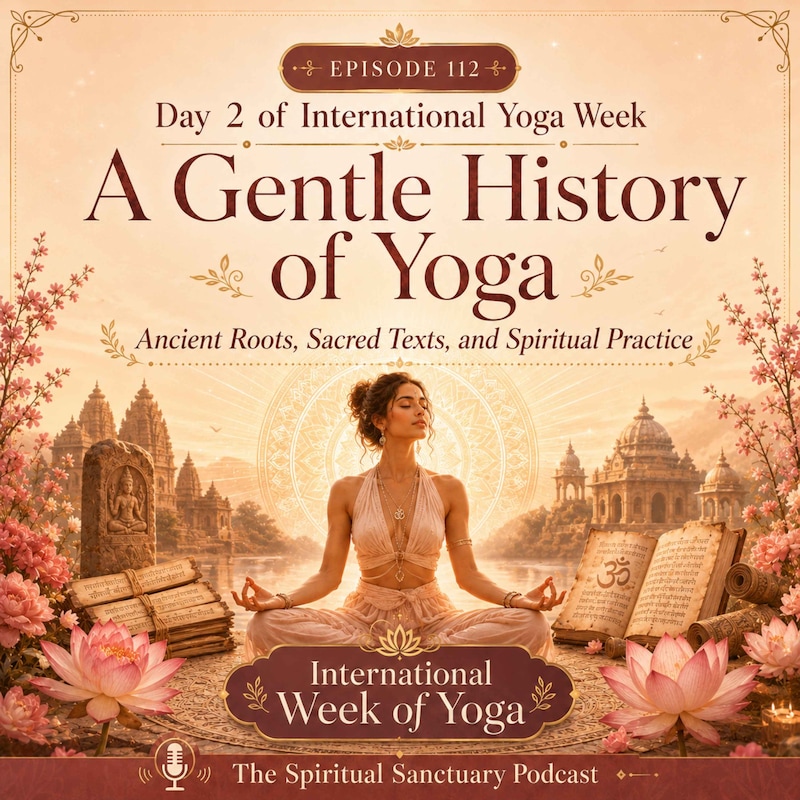
In this episode, we take a gentle and approachable journey through the history of yoga. Yoga is often seen today as stretching, exercise, or physical movement, but its roots are much deeper. Yoga began in ancient India as a spiritual, philosophical, meditative, and embodied path connected to self-awareness, discipline, liberation, sacred knowledge, and union with the Divine.
This episode introduces listeners to yoga’s ancient roots, early sacred texts, major philosophical teachings, and the way yoga evolved over time. We explore early references to yoga in texts such as the Vedas and Upanishads, the teachings of the Bhagavad Gita, Patanjali’s Yoga Sutras, the 8 limbs of yoga, and the development of Hatha Yoga.
We also talk about how yoga moved into the modern world, how it changed in the West, and why it is important to honor yoga’s origins with respect and humility.
This episode is not meant to be a complete academic history, but rather a beginner-friendly overview that helps us appreciate yoga as ancient wisdom and encourages us to practice with reverence, gratitude, and awareness.
In This Episode, You’ll Explore
- Yoga’s roots in ancient India
- Early references to yoga in sacred texts such as the Vedas and Upanishads
- Yoga as meditation, discipline, spiritual insight, and liberation
- The Bhagavad Gita and the paths of action, devotion, wisdom, and meditation
- Patanjali’s Yoga Sutras and the 8 limbs of yoga
- Hatha Yoga and the development of physical postures, breathwork, and energy practices
- How yoga moved into the modern world
- How yoga has changed in Western culture
- Why yoga is more than a modern fitness practice
- The importance of honoring yoga’s origins with respect and humility
- How to practice yoga without appropriating it
- Why learning, respect, credit, and deeper study matter
Spiritual Reflection
Yoga is ancient wisdom that invites us into presence, discipline, and sacred relationship.
Yoga invites us into sacred relationship with the body, breath, mind, spirit, the Divine, the teachers, the traditions, and the wisdom keepers who carried this practice forward.
Journal Prompt
What part of yoga’s history feels most meaningful or surprising to me?
You may want to reflect on what you learned, what moved you, what challenged you, or what you feel called to study more deeply.
Closing Practice
Place one hand on the heart and one hand on the belly.
Take three slow breaths.
Offer gratitude for the teachers, traditions, sacred texts, and wisdom keepers who carried yoga forward.
You may softly say:
Thank you to the teachers.
Thank you to the wisdom keepers.
Thank you to the traditions.
Thank you to the breath.
Thank you to the Divine.
Links
Listen to the podcast:
https://www.bertena.org/en/podcast
View the full International Week of Yoga schedule:
https://bertena.ezycourse.com/en/international-week-of-yoga
Keywords
history of yoga, gentle history of yoga, yoga history for beginners, ancient roots of yoga, yoga in ancient India, Vedas and yoga, Upanishads and yoga, Bhagavad Gita yoga, Patanjali Yoga Sutras, 8 limbs of yoga, Hatha Yoga history, yoga philosophy, yoga as spiritual practice, International Day of Yoga, International Week of Yoga, yoga podcast, Divine Feminine yoga, priestess path, sacred embodiment, spiritual yoga podcast, Bertena, The Spiritual Sanctuary Podcast
🎧 Listen & Subscribe
Find Spiritual Sanctuary: Wisdom for the Divine Feminine on Spotify and all major podcast platforms.
👉 https://open.spotify.com/show/1pNkD0FKF4TpgzcRFQQrhA
Subscribe to my newsletter here
Help Support the Sanctuary here
🤍 Podcast Sponsor: Cosmic Connections Nashville
This episode is proudly sponsored by Cosmic Connections, a beloved metaphysical shop and spiritual community in Nashville.
🎁 Listener perks:
- Discounts on online purchases use bertenapodcast10 for 10% off
- Entry into a gift card drawing when you comment on the episode or share it on social media and tag @bertena11
Supporting Cosmic Connections helps sustain a heart-centered spiritual space for seekers, healers, and practitioners.
👉 Visit Cosmic Connections:
Transcripts
Day 2: A Gentle History of Yoga
Hello and welcome to The Spiritual Sanctuary: Wisdom for the Divine Feminine.
I’m Bertena, Priestess and Spiritual Coach and yoga teacher , and I am so happy to welcome you to Day 2 of our special series, International Week of Yoga: Movement, Meditation, Spirit & the Divine Feminine.
Yesterday, in Day 1, we explored the question: What is yoga?
We talked about yoga as much more than poses, stretching, or exercise. We explored yoga as union, connection, spiritual practice, sacred embodiment, and a path of returning home to ourselves.
Today, we are going to take a gentle journey into the history of yoga.
Now, I want to say right away that the history of yoga is very deep, very complex, and very rich. It spans thousands of years, many teachers, many lineages, many sacred texts, and many interpretations. So today is not meant to be a complete academic lecture on every detail of yoga’s history.
Instead, this episode is a beginner-friendly, respectful overview of yoga’s ancient roots and how yoga evolved over time.
My hope is that by learning even a little about yoga’s history, we can practice with more respect, more humility, and more appreciation for the wisdom traditions that carried yoga forward.
Because yoga did not begin as a modern fitness trend.
Yoga did not begin as a social media pose.
Yoga did not begin as a workout class.
Yoga has ancient roots in India, and it developed as a spiritual, philosophical, meditative, and embodied path.
At its heart, yoga has always been connected to the search for truth, liberation, self-awareness, discipline, and union with the Divine.
The roots of yoga are often traced back to ancient India. Early ideas related to yoga appear in sacred texts such as the Vedas and the Upanishads.
The Vedas are among the oldest sacred texts of India, and they contain hymns, rituals, prayers, and spiritual teachings. While the yoga we know today was not fully formed in the earliest Vedic period, we can see early seeds of spiritual practice, devotion, meditation, sacred sound, and connection with the Divine.
Then, in the Upanishads, we begin to see deeper philosophical reflections on the self, the soul, ultimate reality, meditation, and spiritual knowledge. These texts ask profound questions:
Who am I?
What is the nature of the soul?
What is the nature of reality?
What is the relationship between the individual self and the Divine?
How do we move beyond illusion and suffering?
These are the kinds of questions that live at the heart of yoga.
So from the beginning, yoga was not simply physical movement. It was connected to spiritual inquiry. It was a way of seeking wisdom, discipline, liberation, and deeper union.
Yoga invited people to look inward.
To still the mind.
To study the self.
To understand the nature of suffering.
To explore the relationship between the individual and the sacred.
This is why yoga has always been a practice of both inner and outer transformation.
One of the most important texts in the yoga tradition is the Bhagavad Gita.
The Bhagavad Gita is part of the great Indian epic, the Mahabharata, and it is written as a conversation between Prince Arjuna and Lord Krishna.
The setting is a battlefield, but the deeper teaching is spiritual. Arjuna is struggling with fear, duty, confusion, and moral conflict. Krishna guides him through teachings about life, action, devotion, wisdom, discipline, and spiritual truth.
What I love about the Bhagavad Gita is that it shows us that yoga is not separate from life.
Yoga is not only something we do when everything is peaceful.
Yoga is not only something we do when we are sitting in meditation.
Yoga is also how we meet difficulty.
How we respond to responsibility.
How we act with integrity.
How we surrender.
How we serve.
How we love.
How we seek wisdom.
The Bhagavad Gita speaks of several paths of yoga.
There is Karma Yoga, the yoga of action and selfless service. This path teaches us to act with integrity, to serve without being attached to the outcome, and to offer our actions as sacred.
There is Bhakti Yoga, the yoga of devotion. This is the path of love, prayer, surrender, chanting, and devotion to the Divine.
There is Jnana Yoga, the yoga of wisdom and knowledge. This path invites inquiry, study, reflection, and the search for truth.
There is also the path of meditation and discipline, which is often connected with Raja Yoga, the royal path of mental focus and spiritual practice.
These paths remind us that yoga can meet different people in different ways.
Some people come to yoga through movement.
Some come through devotion.
Some come through study.
Some come through service.
Some come through meditation.
Some come through sacred sound.
Some come through rest.
There is not only one doorway.
There are many doorways into yoga.
Another foundational text in yoga history is Patanjali’s Yoga Sutras.
Patanjali’s Yoga Sutras are a collection of short teachings or aphorisms that outline a path of yoga centered on calming the fluctuations of the mind and moving toward spiritual liberation.
One of the most well-known teachings from the Yoga Sutras is the 8 limbs of yoga.
We will talk more about the 8 limbs in Day 3 of this series, but for now, I want to introduce them as a spiritual map.
The 8 limbs are:
Yama, ethical restraints.
Niyama, personal observances.
Asana, posture.
Pranayama, breathwork.
Pratyahara, turning inward.
Dharana, concentration.
Dhyana, meditation.
And Samadhi, union or spiritual absorption.
What is so important about this is that only one of these limbs is physical posture.
Only one.
That tells us something very important.
Yoga was never meant to be only about the body.
The body matters. The body is sacred. The body is part of the practice. But yoga is also about ethics, breath, awareness, meditation, inner discipline, and spiritual union.
This is one of the reasons I keep saying that yoga is more than movement.
Because historically and spiritually, yoga has always been a much wider path.
Over time, another major development in yoga was Hatha Yoga.
Hatha Yoga placed more emphasis on the body, breath, energy, and physical practices. In many ways, Hatha Yoga helped shape the physical yoga practices that many people recognize today.
Hatha Yoga includes postures, breathwork, purification practices, energy awareness, and preparation for meditation.
The goal was not simply physical fitness.
The body was seen as a vehicle for spiritual awakening.
The breath was seen as life force.
Energy practices were used to awaken awareness, purify the body and mind, and prepare the practitioner for deeper states of meditation and realization.
This is where we begin to see the development of yoga practices that involve more physical postures, breath control, and energetic awareness.
Later, yoga continued to evolve.
Teachers, lineages, spiritual communities, and practitioners carried yoga forward in many different ways.
Eventually, yoga began to move into the modern world and spread beyond India.
In the late 19th and early 20th centuries, Indian teachers began sharing yoga philosophy and practice with broader audiences, including people in the West. Over time, yoga became more widely known in Europe and the United States.
But as yoga moved into Western culture, it also changed.
In many Western settings, yoga became strongly associated with physical postures, fitness, flexibility, and wellness. Yoga studios, classes, mats, clothing, and styles became part of a large modern yoga culture.
There is nothing wrong with people being introduced to yoga through movement. Movement can be a beautiful doorway. Many people first experience yoga because they want less stress, more flexibility, more strength, or more peace.
That is a valid beginning.
But the challenge is that when yoga is reduced only to exercise, we lose so much of its depth.
We lose the philosophy.
We lose the spiritual teachings.
We lose the ethical foundations.
We lose the sacred roots.
We lose the connection to meditation, devotion, self-study, breath, and liberation.
This is why it is important to honor yoga’s origins.
Especially for those of us in the West, we need to approach yoga with respect and humility.
Yoga comes from India. It comes from a deep cultural, spiritual, and philosophical context. It was carried by teachers, sages, practitioners, communities, and wisdom keepers over generations.
So part of practicing yoga with integrity is remembering that we are receiving something ancient and sacred.
We are not the owners of it.
We are students of it.
And that means we practice with gratitude.
We learn where yoga comes from.
We respect the culture and traditions connected to it.
We credit the sources and teachers.
We avoid treating yoga as only a trend or performance.
We deepen beyond the physical.
And we remember that yoga is not just something we consume. It is something we enter into relationship with.
This is an important part of practicing yoga without appropriation.
Cultural appropriation can happen when sacred practices are taken out of context, commercialized, renamed, stripped of their origins, or used without respect for the culture they come from.
So how do we practice with more respect?
We learn.
We listen.
We credit.
We stay humble.
We study the roots.
We do not pretend yoga began with modern fitness culture.
We avoid using sacred symbols, mantras, or practices casually without understanding.
We honor the teachers and traditions.
We recognize that yoga is more than a product.
We let yoga change how we live, not just how we move.
That does not mean we cannot practice yoga if we are not from India. Yoga has become a global practice, and many teachers have intentionally shared yoga with the world.
But it does mean we practice with awareness.
It means we are willing to keep learning.
It means we honor the roots while also being honest about where we are in our own journey.
For me, this is part of the spiritual practice.
Because yoga is not only about what happens on the mat.
Yoga is also about relationship.
Relationship with the body.
Relationship with the breath.
Relationship with the Divine.
Relationship with lineage.
Relationship with the earth.
Relationship with culture.
Relationship with the people and traditions who came before us.
This brings us to today’s spiritual reflection:
Yoga is ancient wisdom that invites us into presence, discipline, and sacred relationship.
I love that phrase: sacred relationship.
Because yoga invites us into relationship with everything.
It invites us into relationship with our own body.
Our own mind.
Our own energy.
Our own truth.
Our own spiritual path.
And it also invites us into relationship with something much larger than ourselves.
The Divine.
The ancestors of the practice.
The wisdom keepers.
The teachers.
The sacred texts.
The traditions.
The living lineage.
When we practice yoga, we are stepping into a river that has been flowing for a very long time.
We may only stand in that river for a moment.
We may only touch one part of it.
But when we know that the river is ancient, we approach it differently.
We approach it with reverence.
We approach it with gratitude.
We approach it with humility.
We do not have to know everything in order to begin.
But we can begin with respect.
So today, as we reflect on the gentle history of yoga, I invite you to ask yourself:
What part of yoga’s history feels most meaningful or surprising to me?
Maybe it is the fact that yoga is rooted in ancient India.
Maybe it is the connection to sacred texts like the Vedas, Upanishads, Bhagavad Gita, or Yoga Sutras.
Maybe it is the reminder that yoga was originally much more focused on meditation, discipline, self-awareness, and liberation than modern fitness culture sometimes suggests.
Maybe it is the idea that there are many paths of yoga — action, devotion, wisdom, meditation, breath, energy, and sacred rest.
Maybe it is the understanding that yoga asks us to practice with humility.
Or maybe it is simply the reminder that when you step onto a mat, sit in meditation, chant a mantra, take a breath, or practice Yoga Nidra, you are connecting with something much older and deeper than yourself.
There is beauty in that.
There is responsibility in that.
There is sacredness in that.
Before we close, I want to invite you into a simple gratitude practice.
You can do this seated, standing, or lying down. If you are driving or doing something that requires your attention, simply listen and return to this later.
Place one hand on your heart.
Place one hand on your belly.
Take a slow breath in.
And gently release.
Again, breathe in.
And release.
One more time.
Breathe in.
And release.
Now, silently or softly, offer gratitude.
You might say:
Thank you to the teachers.
Thank you to the wisdom keepers.
Thank you to the traditions.
Thank you to the sacred texts.
Thank you to the ancestors of yoga.
Thank you to the body.
Thank you to the breath.
Thank you to the Divine.
Take one more slow breath.
And let yourself feel held by the long river of wisdom that carried yoga forward.
Your journal prompt for today is:
What part of yoga’s history feels most meaningful or surprising to me?
You may want to write about what you learned, what moved you, what challenged you, or what you want to study more deeply.
Thank you for joining me for Day 2 of International Week of Yoga: Movement, Meditation, Spirit & the Divine Feminine.
Tomorrow, we will explore the 8 limbs of yoga and how they offer a spiritual map for living yoga both on and off the mat.
Until then, may you practice with gratitude.
May you move with reverence.
May you breathe with awareness.
And may you remember that yoga is ancient wisdom inviting you into presence, discipline, and sacred relationship.
With love,
I’m Bertena, and this is The Spiritual Sanctuary.







