Shownotes
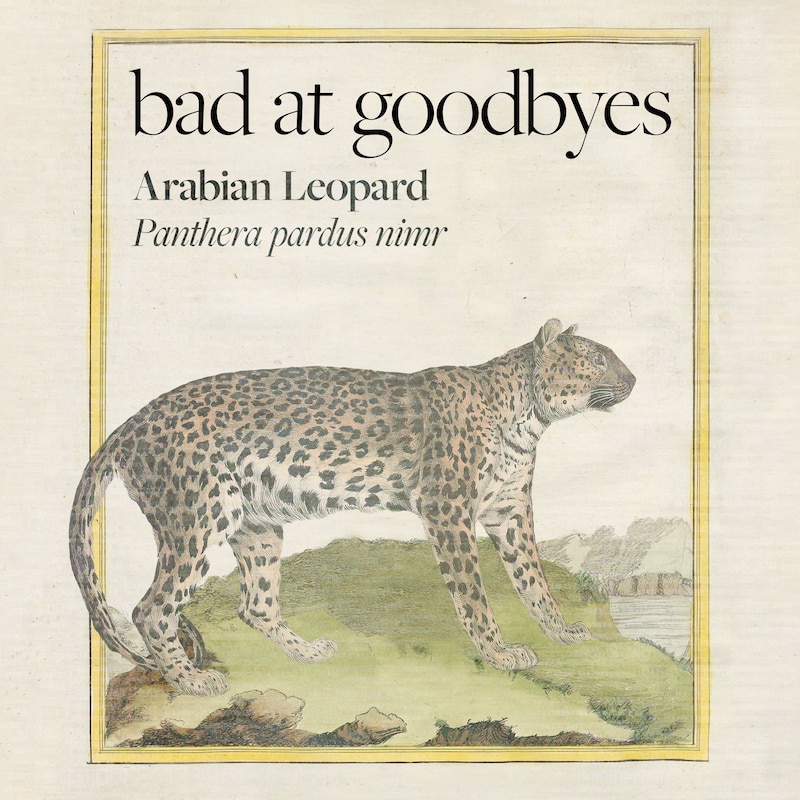
Arabian Leopard :: Panthera pardus nimr
Bad at Goodbyes :: Episode 065
On today’s show we learn about the Arabian Leopard, a critically endangered big cat, a carnivorous feline native to Oman and Yemen.
- (00:05) Intro
- (02:05) Species Information
- (26:13) Citations
- (28:01) Music
- (32:06) Pledge
Research for today’s show was compiled from:
- Al Hikmani, H., Aboalfotooh, A.A.H., Alghafis, S., Almubarak, Z., Baeshen, O., Budd, J., Dunford, C., Ferreira, J.D., Gallacher, E., Mann, G., Shobrak, M. & Spalton, A. 2025. Panthera pardus ssp. nimr (Green Status assessment). The IUCN Red List of Threatened Species 2025: e.T15958A1595820252. – https://iucnredlist.org/species/15958/274968998
- Al Hikmani, Hadi, and Khalid Al Hikmani. “Northward Expansion of the Critically Endangered Arabian Leopard in Dhofar, Oman.” Oryx 58, no. 6 (2024): 710–14. – https://doi.org/10.1017/S0030605324001662
- Al Hikmani, H., Spalton, A., Zafar-ul Islam, M., al-Johany, A., Sulayem, M., Al-Duais, M. & Almalki, A. 2025. Panthera pardus ssp. nimr (amended version of 2024 assessment). The IUCN Red List of Threatened Species 2025: e.T15958A274968998. – https://dx.doi.org/10.2305/IUCN.UK.2025-1.RLTS.T15958A274968998.en
- Alqahtani, Fahad H., Ion I. Măndoiu, Badr M. Al-Shomrani, Sulaiman Al-Hashmi, Fatemeh Jamshidi-Adegani, Juhaina Al-Kindi, Andrzej Golachowski, Barbara Golachowska, Abdulaziz K. Al-Jabri, and Manee M. Manee. 2025. "First Mitogenome of the Critically Endangered Arabian Leopard (Panthera pardus nimr)" Animals 15, no. 11: 1562. – https://doi.org/10.3390/ani15111562
- A.M.H. Al-Johany. "Distribution and conservation of the Arabian Leopard Panthera pardus nimr in Saudi Arabia." Journal of Arid Environments. Volume 68, Issue 1, Pages 20-30. 2007. – https://doi.org/10.1016/j.jaridenv.2006.04.002
- Dunford, Carolyn E., J. Philip B. Faure, Michael D. Ross, J. Andrew Spalton, Marine Drouilly, Kai J.P. Pryce-Fitchen, Ross De Bruin, et al. “Searching for Spots: A Comprehensive Survey for the Arabian Leopard Panthera Pardus Nimr in Saudi Arabia.” Oryx 58, no. 3 (2024): 351–62. – https://doi.org/10.1017/S0030605323000807
- Panthera – https://panthera.org/blog-post/qa-arabian-leopards, https://panthera.org/arabian-leopard-initiative
- Spalton, James Andrew, Hadi Musalam al Hikmani, David Willis, and Ali Salim Bait Said. “Critically Endangered Arabian Leopards Panthera Pardus Nimr Persist in the Jabal Samhan Nature Reserve, Oman.” Oryx 40, no. 3 (2006): 287–94. – https://doi.org/10.1017/S0030605306000743
- Species Survival Commission Cat Specialist Group. Arabian Leopard. 2024. – https://www.catsg.org/arabianleopard
- Timna, Yotam, and Reuven Yosef. "A historic perspective 1: The diet of the Arabian Leopard (Panthera pardus nimr) in Israel", Israel Journal of Ecology and Evolution 71, 4 (2025): 171-183. – https://doi.org/10.1163/22244662-bja10112
- Timna, Yotam, and Reuven Yosef. "A historic perspective 2: Scent, Sound, and Space in the extinct Arabian Leopard (Panthera pardus nimr) in Israel", Israel Journal of Ecology and Evolution 71, 4 (2025): 184-196. – https://doi.org/10.1163/22244662-bja10111
- Wikipedia – https://en.wikipedia.org/wiki/Arabian_leopard
For more information about Arabian Leopard conservation and big cat conservation in general, please see Panthera at https://panthera.org
Please find us on the web at Bad at Goodbyes and on instagram. Please subscribe and rate/review Bad at Goodbyes wherever you listen to podcasts. Please help spread the word about the show and about the species we feature. Please take care of each other, and all of our fellow travelers.
A note on accuracy: I strive for it! These episodes are well-researched and built from scholarly sources, hoping to provide an informed and accurate portrait of these species. That said, I’m a musician! I am not an academic and have limited scientific background. I may get things wrong! If you are using this podcast for scholarship of any kind, please see the cited sources and double-check all information.
Transcripts
Welcome to Bad at Goodbyes.
On today’s show we consider the Arabian Leopard.
Species Information:The Arabian Leopard is a critically endangered big cat, a carnivorous feline native to Oman and Yemen. Its scientific name is Panthera pardus nimr and it was first described in 1833.
The Arabian Leopard is the smallest of all leopard subspecies, weighing roughly 40-70 pounds, measuring roughly 4 feet in body length. They are about half the size of the African Leopard, and about twice the size of distant kin in the feline family, the bobcat.
Their fur is short, coarse and dense, colored pale, creamy yellow to golden-tan, and is, of course, covered in spots. These spots are called rosettes, round, somewhat flower-shaped, rose-shaped black markings, distributed all across their body; a camouflage in their native habitat. In the bright sharp light of their desert mountain home, the spots blend into the rough, shadowed textures of rock faces, and because the pattern is irregular, and lacks straight lines, it breaks up the leopard's physical outline in more open spaces.
Like say human fingerprints, every leopard has a totally unique pattern of rosettes.
The Arabian Leopard has a broad muzzle and powerful jaws. They have two large fur covered ears with complex musculature that can independently rotate roughly 180 degrees to help pinpoint sound, able to hear both low frequency (infrasonic) and high frequency (ultrasonic) sounds from hundreds of feet away.
Their two eyes are large and forward-facing, with golden, greenish irises and deep black pupils. Like all cats, each of the Arabian Leopard’s eyes have a tapetum lucidum, this is a kind-of reflective layer behind the retina that bounces light back through the photoreceptors, increasing light sensitivity; helping the leopard see in low-light. Sidenote: the tapetum lucidum is why cat’s eyes, and the eyes of many mammals, deer, dogs, etc. seem to kind of glow in the dark – we see light reflected back from their eyes, from that tapetum lucidum.
Arabian Leopard have a dark nose and a muzzle covered in long black and white whiskers. These whiskers, called Vibrissae are a tactile sense organ, touch sensitive, able to detect changes in air currents as winds shift, and sense contact with physical objects, used, for example, to help navigate darkened caves.
Their bodies are lean, and muscular, with a long slender torso and four relatively short strong limbs, with large, padded paws and claws that can extend and retract.
They have a long tail that can measure up to 3 feet, which aids in balance and as a kind counterweight when making quick turns.
Arabian Leopard are solitary and elusive, a behavioral lifestyle adapted to avoiding detection by potential prey, and more recently avoiding exposure to humans. They are generally crepuscular, meaning they’re active at dawn and dusk, when it is cool enough to avoid overheating, but with enough light to navigate terrain and hunt prey. During the peak heat of the daytime, the leopard seeks refuge in caves, rock fissures, or under the canopy of Buttontrees. That said, parts of their range are often covered in dense fog, and we have camera trap evidence of Arabian Leopard active throughout the day. The fog keeps the landscape cool and hazy, they can traverse and hunt in the daytime without being seen.
Their range is enormous. A solitary male will have a home territory of about 75 square miles; female roughly 30 square miles. Their territories will have some overlap, but leopard use pheromonal scent signals, vocalizations, urine and feces droppings, and scrape-marks made with their hind claws, to mark trails and boulders and caves in order to avoid one another, to avoid conflict with one another. They also employ temporal avoidance. So they may use some of the same trails but at different times, using short-lasting chemical signals to ensure they do not meet one another unexpectedly. Outside of mating, Arabian Leopard have very minimal contact with one another, maintaining social spacing without direct conflict.
Mating occurs year-round, though research suggests it peaks with some correlation to prey reproductive patterns; when there is an abundance of young (easier to capture) prey, the Leopard is more likely to mate. Females have a roughly month-a-half fertility cycle, during about a week of which they are able to get pregnant. During that time they will vocalize and scent mark more frequently in an effort to attract a mate.
After mating, the male and female separate, no long-term pair bonds are formed, and the female is entirely responsible for rearing. Pregnancy lasts about three-and-a-half months, and the mothers birth in deep caves, secluded, secure dens, safe from wolves and hyenas. Litters are typically 1 to 3 cubs and the young are born altricial, helpless, requiring significant parental care. Arabian Leopard cubs are born blind and weigh less than a pound, and only after about 10 days do they develop eyesight. During this time the mother is constantly with the cubs; the young nurse and the mother relies on fat reserves or stored food.
Cubs are dependent on their mother for 1-2 years, learning communication, survival strategies and hunting skills. Then the family unit disperses, the juveniles seeking out their own new individual solitary territories.
Wild Arabian Leopard live between roughly 10-20 years.
————
In the dream,
to live as though listening was vital to life.
To hear a leaf fall across the chasm, sand shifting on the plain,
a water drop slipping from the buttontree.
To slow the breath, to hold stillness in patient silence.
For sound to mean sustenance
To listen is to live.
In the dream.
————
The Arabian Leopard is carnivorous, they hunt and eat meat. They rely on stealth to hunt prey. Patiently, quietly stalking and ambushing large mammal herbivores like the Nubian Ibex and Arabian Gazelle, and smaller mammals like Rock Hyrax, Arabian Hare, Ethiopian Hedgehog, and occasionally birds like the Arabian Partridge. They use the landforms of their habitat to their advantage, ambushing prey in narrow rock crevices to prevent their escape, or chasing prey off cliffs. Even their attack is stealth-adapted. They will direct a strong bite to the prey’s throat, preventing it from vocalizing an alarm call.
After a successful hunt, Arabian Leopard will drag their kill into deep caves, protecting the meat from scavengers and keeping it cool to slow decomposition, maintaining a kind of stockpiled food larder in this relatively inhospitable landscape where prey can be scarce.
The Arabian Leopard is native to the Dhofar Mountains in southern Oman and the Sarawat Mountains in western Yemen. These are arid rocky high-altitude cliffs, peaks, and plateaus that can reach over 2 miles above sea level, stone landmasses rising sharply from nearby coastal plains. This "resource-poor" landscape is dominated by steep, jagged limestone, granite, and sandstone slopes of sandy loose rock, with narrow ledges, crevices, cave networks, and deep valleys.
Vegetation is sparse, water is rare, and prey density is low. This is a Southwestern Arabian coastal xeric scrub ecoregion, with extreme temperature fluctuations and minimal precipitation. In summer, high temps on the lower slopes can exceed 110°F, in winter, and at higher elevations, temperatures can drop to lows below 40°F. So a 70+ degree swing across the Leopard’s range. Annual rainfall here is less than 4 inches. Though higher elevations in the Dhofar Mountains, are a kind of fog desert where annual monsoons from June to September blanket the highlands in mist and fog, bringing up to 12 inches of precipitation, in the form of fog drip. This is moisture that condenses on vegetation and drips down to the soil, recharging groundwater aquifers, and supporting a microhabitat understory of shrubs and grasses; Plant life that is grazed by the Leopard’s prey: Ibex, Hyrax, Gazelle.
The Arabian Leopard shares its arid mountain home with:
Arabian Woodpecker, Arabian Wolf, Arabian Partridge, Phoenician Juniper, Umbrella Thorn Acacia, Oman Toad, Desert Rose, White-tailed Mongoose, Spiny-tailed Lizard, Arabian Gazelle, Asir Magpie, Wild Pistachio, Globe Thistle, Frankincense, Arabian Hare, Striped Hyena, Arabian Red Fox, Myrrh Tree, Dhofari Buttontree, Rock Hyrax, Desert Tawny Owl, Nubian Ibex, Large-leafed Fig, Arabian Spiny Mouse, Asir Catmint, Wild Olive, Desert Wallflower, Arabian Aloe, and many many more.
r-wheel-drive vehicles in the:Today, the main threat to surviving populations in Yemen and Oman is habitat loss and degradation caused by human encroachment, like road and residential construction, mining, agriculture, and by increased overgrazing by domesticated livestock. That encroachment means that the Leopard’s prey like Ibex and Gazelle are now in a forced resource competition with domestic livestock for the region’s sparse vegetation. And so when wild prey becomes scarce, the Leopard will hunt the domesticated livestock, goats, cattle, camels to survive. Which then leads to retaliatory killings, livestock owners shooting leopards to quote-unquote protect their flock.
So direct persecution of the Arabian Leopard remains a threat: these retaliatory killings as well as trophy hunting, and slaughter for the illegal sale of leopard skins. Capture of live individuals for the illegal pet trade or exotic private collections also continues to deplete wild numbers.
een strictly prohibited since: eopard the national animal in:Offsite, there are successful captive breeding programs in the UAE, Saudi Arabia, Yemen, and Oman, and Saudi Arabia exploring re-introduction programs: returning both prey species and the Arabian Leopard to their original range.
ed on the IUCN Red List since:Our most recent counts estimate that less than 85 Arabian Leopard remain in the wild.
Citations:Information for today’s show about the Arabian Leopard was compiled from:
G., Shobrak, M. & Spalton, A.: (: ., Al-Duais, M. & Almalki, A.: Al-Jabri, and Manee M. Manee.: .: (:Panthera – https://panthera.org/blog-post/qa-arabian-leopards, https://panthera.org/arabian-leopard-initiative
(: alist Group. Arabian Leopard.: (: (:Wikipedia – https://en.wikipedia.org/wiki/Arabian_leopard
For more information about Arabian Leopard conservation and big cat conservation in general, please see Panthera at https://panthera.org
Music: Pledge:I honor the lifeforce of the Arabian Leopard. I will commit its name to my record. I am grateful to have shared time on our planet with this being. I lament the ways in which I and my species have harmed and diminished this species. I grieve.
And so, in the name of the Arabian Leopard I pledge to reduce my consumption. And my carbon footprint. And curb my wastefulness. I pledge to acknowledge and attempt to address the costs of my actions and inactions. And I pledge to resist the harm of plant and animal kin and their habitat, by individuals, corporations, and governments.
I forever pledge my song to the witness and memory of all life, to a broad celebration of biodiversity, and to the total liberation of all beings.




