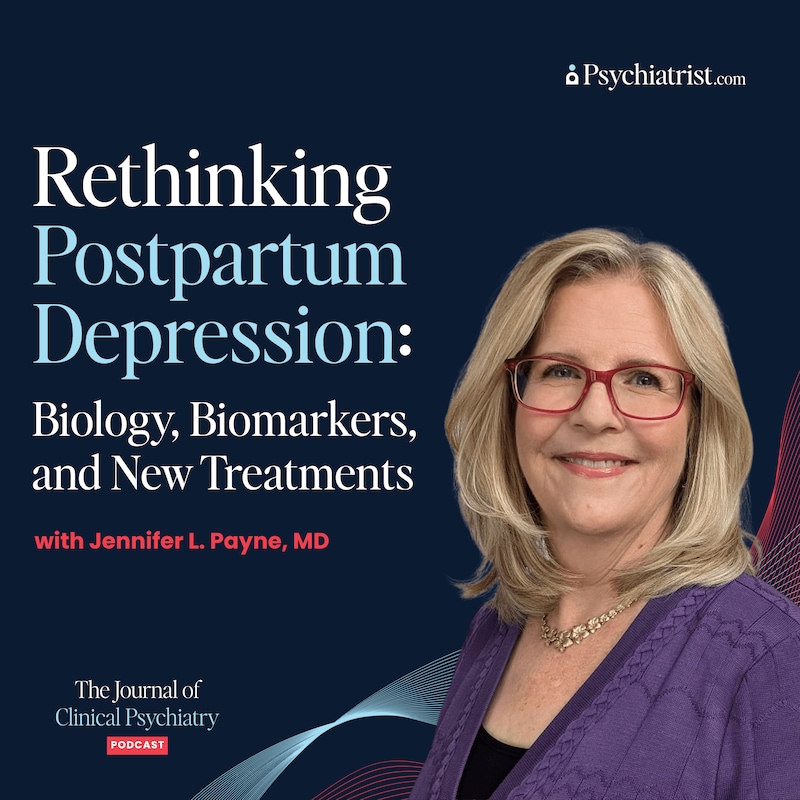
In this episode of the JCP Podcast, host Dr. Ben Everett speaks with Dr. Jennifer L. Payne, Professor of Psychiatry and Neurobehavioral Sciences and Vice Chair of Research at the University of Virginia, where she directs the Reproductive Psychiatry Research Program. Dr. Payne holds a joint appointment in obstetrics and gynecology and has spent her career at the intersection of basic neuroscience and clinical care in perinatal psychiatry. She is widely recognized for her work on the biological underpinnings of postpartum depression, including epigenetic biomarkers that prospectively predict risk, and for her clinical and research contributions to the development of GABAergic therapeutics — from brexanolone to zuranolone — that are reshaping how the field understands and treats this condition.
Postpartum depression affects roughly one in eight women following childbirth and remains one of the most underdiagnosed and undertreated conditions in medicine. Despite this, care has long defaulted to serotonergic antidepressants developed for major depression rather than agents designed around the biology of the postpartum period. In this episode, Dr. Payne explains why the precipitous drop in neuroactive steroids — particularly allopregnanolone — following delivery may be central to postpartum depression pathophysiology, how the GABA-A receptor is implicated in ways that are distinct from benzodiazepines, what the clinical proof-of-concept established by brexanolone means for the field, and why zuranolone's oral formulation is changing real-world access. Dr. Payne also discusses the epigenetic biomarker test her lab has developed with collaborator Dr. Zachary Kaminsky — work now moving toward FDA review — its ethical implications, and emerging parallels with premenstrual dysphoric disorder.
KEY EPISODE HIGHLIGHTS
🔬 PREDICTING POSTPARTUM DEPRESSION BEFORE IT STARTS [12:30]
"We can take blood in the third trimester, and we can say whether a woman is at high risk of developing postpartum depression by three months postpartum or at low risk."
Dr. Payne describes the epigenetic biomarker test developed with Dr. Zachary Kaminsky — replicated in six independent samples and now advancing toward FDA review — that identifies postpartum depression risk from a third-trimester blood draw, enabling preventive planning before symptoms emerge.
🧠 WHY BREXANOLONE IS NOT JUST A BENZODIAZEPINE [24:15]
"The benzodiazepines don't act on those extrasynaptic GABA receptors. So sometimes people have said to me that allopregnanolone and the new FDA-approved treatments for postpartum depression are really just a benzodiazepine, and that's not true."
Dr. Payne explains the critical mechanistic distinction between benzodiazepines (synaptic GABA-A binding) and neuroactive steroids (extrasynaptic GABA-A binding), clarifying why this difference matters for setting the brain's overall inhibitory tone — a distinction clinicians should be prepared to address with patients.
💊 ZURANOLONE: FOURTEEN DAYS, SUSTAINED RESPONSE [31:00]
"You take [zuranolone] for fourteen days, and you see response rates within three days, which again, is groundbreaking in terms of treating a depressive episode."
The shift from a 60-hour inpatient IV infusion to a 14-day oral course has transformed real-world feasibility. Dr. Payne reviews the clinical profile of zuranolone — including rapid onset, sedation considerations, breastfeeding questions, and the practical barriers that still limit access.
CHAPTERS
00:00 - Introduction and Guest Overview
02:45 - Scientific Origins: From Alzheimer's Disease to Postpartum Depression
06:30 - Why Postpartum Depression Is a Natural Model for Studying Depression Biology
08:00 - Screening, Underdiagnosis, and the Stigma Gap
09:30 - A Personal Account of Postpartum Depression and Advocacy
12:00 - Epigenetic Biomarkers: Predicting Risk Before Delivery
17:15 - Ethics, Autonomy, and the Case for a Predictive Blood Test
20:45 - Allopregnanolone and the Neuroactive Steroid System
23:30 - GABA-A Receptor Subtypes: Why Neuroactive Steroids Are Not Benzodiazepines
25:30 - DoD-Funded Research: Neuroactive Steroid Shunting and GABA-A Reconfiguration
29:30 - Brexanolone: Clinical Proof of Concept and Why It's No Longer Available
31:30 - Zuranolone: Mechanism, Practical Considerations, and Real-World Access
37:00 - PMDD as a Window into Shared Biology
39:30 - The GABAergic Hypothesis and the Future of Depression Subtypes
41:45 - Improving Screening and Educating OBGYNs
43:30 - Closing Remarks
LINKS
Full transcript and show notes
https://www.psychiatrist.com/jcp/ep15-rethinking-postpartum-depression-biology-biomarkers-jennifer-l-payne/
Journal of Clinical Psychiatry
https://www.psychiatrist.com/jcp/
Publisher of peer-reviewed research discussed in this episode.
National Pregnancy Registry for Antidepressants: https://womensmentalhealth.org/research/pregnancyregistry/antidepressants/
Biomarkers:
DOD Work in Segment II:
#PostpartumDepression #NeuroactiveSteroidsGABA #PerinataMentalHealth #Zuranolone #EpigeneticBiomarkers