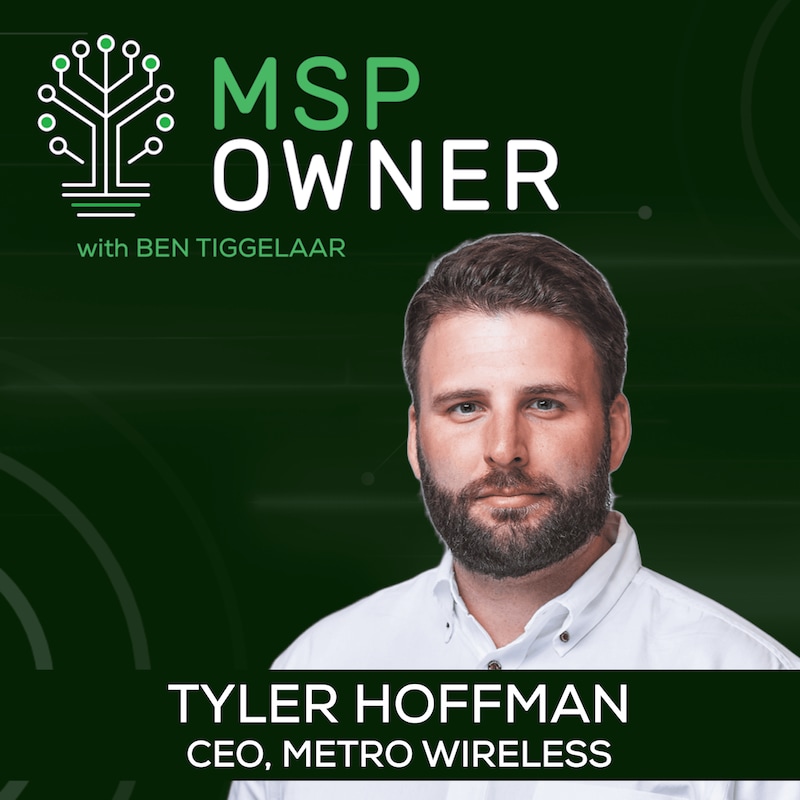
Shownotes
In this episode of the MSP Owner Podcast, I sit down with Tyler Hoffman, owner of Metro Wireless, to talk candidly about what happens after you buy a business—when the spreadsheets are done and real life shows up. Tyler bought his company using an SBA 7(a) loan with minimal money down. Eight months later, a major customer walked—fast. Not a slow churn. A hard stop. Suddenly, the margin for error disappeared.
We talk through: What it actually feels like to run a leveraged business early on
Why customer concentration risk isn’t just a diligence checkbox
The psychological pressure of being the “owner” when things feel fragile
How discipline around sales, retention, and cost control gets built the hard way
Why surviving the first punch often changes how you operate forever
This isn’t a victory-lap story. It’s a realistic one. If you’ve bought a business—or are thinking about it—this conversation is about the part most people don’t talk about: the gap between owning a company and feeling like you’re actually in control.
Listen if you want an honest look at the post-close reality, not the highlight reel.
Title: The Part of Buying a Business No One Warns You About (Tyler Hoffman from Metro Wireless)
Subscribe to email list for future episodes: https://mspowner.aweb.page/p/b75b0b01-5300-477e-b0f1-0de6d899a18d
MSP Owner Podcast website: MSP Owner website
Looking to sell your MSP or partner to take your business to the next level? DataTel actively seeking to acquire quality MSPs to it's capability & client base. If you own an MSP generating more than $1M in revenue annually seeking and wanting a change, contact [email protected] .
Takeaways:
- Metro Wireless is all about wireless connectivity, offering a range of services like Starlink and 5G to enhance client experiences.
- Tyler Hoffman, the CEO, emphasizes their premium approach, focusing on delivering high-quality support and service to their clients.
- About 85% of Metro Wireless's revenue comes from channel partners, showcasing their strong focus on collaborative business relationships.
- The company has overcome significant challenges, including losing a major client shortly after acquisition, but they're bouncing back stronger than ever.
- Tyler's journey from consulting to owning Metro Wireless highlights the entrepreneurial spirit and the importance of adaptability in business.
- Looking to the future, Metro Wireless aims to continue growing organically while also pursuing acquisition opportunities in the wireless sector.
Transcripts
Foreign.
Speaker A:Welcome to the MSP Owner, the podcast where we dive into the journeys of MSP leaders, uncovering insights to help you grow, scale and exit your business.
Speaker A:Today I'm joined by Tyler Hoffman, CEO of Metro Wireless, a Michigan based wireless connectivity MSP delivering business Starlink LT5G, SD WAN, managed Wi, Fi, VoIP, UCast and a bunch more.
Speaker A:Metro Wireless currently does a few million of revenue and has a team of 15 employees.
Speaker A:And they work a lot with the channel, which we'll talk about in detail.
Speaker A:So Tyler's background spans consulting, operations, strategy, and then he acquired this business.
Speaker A:So he's got a wide range of experiences and I'm super excited to dive in with you.
Speaker A:Tyler, welcome.
Speaker B:Thanks Ben.
Speaker B:I couldn't have said it better myself.
Speaker A:Cool.
Speaker A:Tell us a little bit about Metro Wireless.
Speaker B:Yeah, so you know, the business itself has been around over a decade, but to your point, I acquired the business three years ago and I describe it to folks much like you described it.
Speaker B:We are a msp, but our niche is in wireless colloquially to our clients and end users.
Speaker B:We often say that we, we make wireless work, right?
Speaker B:A lot of MSPs, a lot of end users struggle with wireless.
Speaker B:And so we position ourselves as a premium wireless player in the market and we'll get into some of the value add capabilities we have.
Speaker B:But one, for example that's really popular at the moment is we can Bond Commercial Starlink with 5G together, giving faster speeds, carrier redundancy, static IPs, things like that.
Speaker B:So there's a lot of value add in our NOC and what we can do there.
Speaker B:The business historically got started in fixed wireless connectivity.
Speaker B:We manage a network of 2024 pop sites throughout metro Detroit.
Speaker B:We cover about a 90 minute driving radius from the central business district in Detroit.
Speaker B:We're very proudly based here.
Speaker B:We say when you call into our knock, please excuse the Midwestern accent because our team is based here and yeah, so you know, Starlink's kind of the new cool toy that we have in our, in our toolkit.
Speaker B:But really anything wireless we do, whether it's fixed wireless, LTE, 5G, satellite, managed, Wi fi, our niche is all wireless and we take a premium take on that.
Speaker A:So when you think about like the managed services as like a whole sector, right?
Speaker A:Or, or like IT services, where do you play versus where do people.
Speaker A:When people say msp, what do you think they mean?
Speaker A:And then where do you think you play?
Speaker A:Because I feel like there's this language thing that's going on that, that I, I'm interested To dive into you.
Speaker B:Yeah.
Speaker B:And I, and I, I think I see where you're going with that.
Speaker B:We are not your traditional MSP in the sense of we don't do cybersecurity, we don't do like help desk ticketing, managing teams, licenses, things like that.
Speaker B:You know, I'm sure we'll get into the dialogue, but inorganically that's a space I think I want to start pursuing in that, in that realm.
Speaker B:I think we're an MSP more in the traditional like service provider kind of concept of a carrier in a way, that's the way our NOC has been built is to be like a carrier class NOC again because our heritage is in fixed wireless.
Speaker B:We really come at things from a carrier perspective and then more recently have added on, yes, Dwan.
Speaker B:If we're selling like Hosted Voice and UCaaS, it's often in conjunction with the wireless circuit.
Speaker B:That's really where we kind of layer on some of the additional product set.
Speaker B:But really at the end of the day we are a wireless carrier in a way.
Speaker A:Got it.
Speaker A:You're started out with fixed wireless.
Speaker A:You, you're in wireless connectivity, you've got a knock, you've got support technicians, but you're more, you think of yourself more as a carrier than a, you know, than a help desk msp.
Speaker A:But, but you're looking to transition the business in that direction in some way or add capability.
Speaker B:Yeah, and I would say like adding.
Speaker B:Yeah, the capability again.
Speaker B:I, because we are the wireless experts, it's hard for me to say that we can put a stake in the ground and say, hey, we're going to become the cyber security experts.
Speaker B:That's probably a space that at least organically I probably don't see ourselves pursuing here in the near future.
Speaker B:There's just so much wireless business out there for us to kind of tackle that we found our niche.
Speaker B:You know, we're never going to be a fit for every client.
Speaker B:But where we often find our business is in the channel.
Speaker B:Right.
Speaker B:About 85% of our business is derived from the channel.
Speaker B:And so we actually work with a lot of MSPs themselves who need wireless solutions for their clients.
Speaker B:A recent deal we did was with the credit union.
Speaker B:We worked with their msp.
Speaker B:They wanted a failover Starlink circuit at each of their Texas branches.
Speaker B:And so we worked with that MSP to, you know, provide that solution to that client.
Speaker B:So we find ourselves often partnering with probably more like data Tel type msps who kind of do the full suite of services.
Speaker A:Got it.
Speaker A:And then with something like Starlink and then you're basically buying Starlink, reselling it and then providing management on top of it as like a full suite.
Speaker A:Is that in that particular segment we.
Speaker B:Try to stay a word from the word resale.
Speaker B:So we are.
Speaker B:But essentially you're notion is correct.
Speaker B:We are an official Starlink provider.
Speaker B:We're listed on the Starlink website as an official partner.
Speaker B:That was a six figure investment of ours to, to get into that space.
Speaker B:And yeah, the story there on the Starlink was, you know, back in 2022 when I acquired Metro Wireless, because we are again known as the wireless experts, we got the question of well Tyler, what do you think of Starlink?
Speaker B:And I got that question about once a quarter and in 2023 I started getting that question once a month.
Speaker B:And then in 2024 I started getting that question every week.
Speaker B:And we had to have objection handling and our sales cycles and thinking through what our perspective on Starlink was.
Speaker B:Luckily in early 24 Starlink came out with an official provider program that we then became a part of.
Speaker B:They accepted us.
Speaker B:We have case studies now with them on some of our deployments.
Speaker B:And so now Starlink again is our cool toy, if you will.
Speaker B:But the way that we approach Starlink is not a simple resale.
Speaker B:We take a managed white glove approach.
Speaker B:So you know, often we are doing the professional installation and 80% of our deployments we add a Peplink router.
Speaker B:So that way we can route static IPs, we can do a slash 30, a 29, whatever we need, static IP wise.
Speaker B:And then most often again probably an 80% or more of our deployments we're bonding at least some 2nd, 3rd or 4th circuit.
Speaker B:So I just did an oil and gas deployment two weeks ago.
Speaker B:We did it one proof of concept site.
Speaker B:Now I think they're ordering two or three more sites now where we're bonding Starlink plus Starlink plus 5G.
Speaker B:So in that case they care about two things.
Speaker B:Faster speeds because we can aggregate multiple Starlink circuits together for faster speeds.
Speaker B:And then carrier diversity.
Speaker B:Right.
Speaker B:Starlink had a nationwide outage for about a half hour in 2024.
Speaker B:And our clients that had Starlink and 5G bonded together never noticed a blip in their outage.
Speaker B:And they're standard static IP state because we're binding those circuits together.
Speaker A:When you say bonding the circuits together, can you walk through how that, what that means technically?
Speaker A:I mean it sounds like failover, but it sounds like this is a different category.
Speaker B:Yes, exactly.
Speaker B:And that's why the The SD WAN functionality that we have more failovers, kind of more of an active passive setup with your circuits.
Speaker B:Yeah, we run traditionally more active, active circuits.
Speaker B:And so what it does is it takes the traffic from both of those circuits.
Speaker B:Again, we do this via a handoff router, our Peplink device, and then we route that through our data tunnel.
Speaker B:That aggregates those circuits together.
Speaker B:And again, two reasons we typically do that.
Speaker B:One is we want faster speeds.
Speaker B:Not only download, but upload speeds.
Speaker B:Right.
Speaker B:You have clients with CCTVs, construction sites with architectural drawings that need to be uploaded overnight.
Speaker B:For whatever reason, people will care about the upload speeds a lot these days.
Speaker B:And then from there we always routed over a set of static IPs that then get handed off to the client.
Speaker B:So that's why Peplink speak Fusion technology.
Speaker B:There are other competitors out there, of course, but we've been using peplink since 2017 and then it's been really successful for us.
Speaker A:Yeah, that sounds really, really cool.
Speaker A:And a lot of very specific use cases.
Speaker A:And are you seeing the wireless space as like you're taking over these?
Speaker A:You know, I guess from a cost and performance perspective, do you think that wireless is like going to win versus these fixed carriers, or is there always going to be these fixed carriers who are laying fiber or other sorts of, you know, circuitry in the ground?
Speaker B:Yeah, it's.
Speaker B:It's an interesting question.
Speaker B:You know, I.
Speaker B:When I came into Metro Wireless, I. I candidly had done probably a lot more diligence into the residential wireless space.
Speaker B:And so you're seeing a lot of these residential WISPs, wireless ISPs, with their own fixed wireless networks.
Speaker B:You know, the government's putting a lot of money out there in subsidies for fiber to get deployed in the ground.
Speaker B:So it's kind of an interesting time right now to be a wisp in the sense that with all the fiber money going around and the deployments There, you have 5G to the home.
Speaker B:So Verizon, t mobile and at and t have gotten into the 5G game to the home also in the business, which is kind of impacting us a little bit.
Speaker B:And then Starlink, of course, also has a direct product with consumers as well.
Speaker B:So that's kind of what's happening on the RESI side, kind of an interesting time there.
Speaker B:On the commercial side, I'm kind of seeing a bifurcation.
Speaker B:Our clients who really just wanted a cheap failover circuit, kind of like your local pizza shop or your local tire shop down the road, we're seeing AT&T Verizon T Mobile are all offering these 5G circuits for 70 to $80 a month.
Speaker B:And that's a great option for a primary failover if you're very cost sensitive of a consumer.
Speaker B:Where we play is kind of in the other end of the market.
Speaker B:More the premium white glove where we handle the install, we do the static IPs.
Speaker B:Most often we're doing multi site clients where Verizon is good in some areas, AT&T is better than others and T Mobile is better in say a third Geo.
Speaker B:And we'll combine all those carriers together onto one invoice, one deployment, one project management style.
Speaker B:So that's where we really start to add value versus you know, the single Tommy's Pizza down the road who wants a cheap feel over connection so their doordash orders don't go down.
Speaker A:Got it.
Speaker A:And then when you've got, you know, a 70 unit client and then they're not all in your specific geo, are you buying connectivity on that or how is that, how is that working?
Speaker A:And then what's the say?
Speaker A:I'm a franchisor who has 50 locations within yours and I've got a 25 outside of your area.
Speaker A:How does that work on the front end to the client and then also on the back end?
Speaker A:Like how does it logistically work?
Speaker B:Yeah, so our typical quoting process is we always ask for the service address and hey, we have some basic discovery questions.
Speaker B:What are you looking to do with your circuit?
Speaker B:Is it a primary, is it a failover user speeds, static IPs, like you know, all those types of intake questions.
Speaker B:And what we do is we do a site survey for each address that you provide to us and we confirm, hey, who are the closest cell towers?
Speaker B:Is it Verizon, T Mobile or AT&T?
Speaker B:Are those towers 5G capable?
Speaker B:There are multiple flavors of 5G.
Speaker B:So there's a lot of diligence we do up front to confirm who the best carrier is and then from there.
Speaker B:So even though Tommy's Pizza down the street might not be our ideal client, a Jets pizza franchisee is, is a better client for us.
Speaker B:Right.
Speaker B:And you have multi, multi sites with jets.
Speaker B:But so we'll take a look at each of their addresses and say hey, Verizon is going to be better here.
Speaker B:AT&T is better here.
Speaker B:You know, T Mobile is better here.
Speaker B:And from there we also like we have a wholesale and authorized partnership with the Starling.
Speaker B:We also do that with the other three carriers.
Speaker A:Right.
Speaker A:It's all, it's all.
Speaker A:So then to the client it's all on your paper and your work.
Speaker A:The client is paying you, and then you're, you know, figuring out the connectivity.
Speaker B:The carrier on the back, it's all in one invoice.
Speaker B:That's exactly right.
Speaker A:Got it.
Speaker A:Hi, I'm Ben Tigelar, the host of MSP Owner Podcast and the CEO of Datatel, an IT managed service provider with 35 employees.
Speaker A:The mission of this podcast is simple.
Speaker A:To have authentic conversations with IT owners about their journey, how it started, the challenges they faced, and where they're going next.
Speaker A:Every episode, I personally walk away with a new actionable item to strengthen my own business.
Speaker A:But a quick word about my company, Datatel.
Speaker A:We are actively acquiring MSPs who align with our service and culture.
Speaker A:So if your company is generating between 1 and $10 million of revenue, I want to talk to you.
Speaker A:But wait, you're probably thinking, why me and why Datatel?
Speaker A:First is I get you.
Speaker A:I understand the challenges MSP owners face.
Speaker A:Being one myself, feeling overworked, overwhelmed, constantly being on call, struggling to bring in new business.
Speaker A:I have the solutions and people in place to address these pain points.
Speaker A:Second is culture.
Speaker A:We run our business on EOS entrepreneurial operating system, which has been transformative for our employees and clients alike.
Speaker A:I believe that building a great company comes down to finding and retaining great people who are in the right seats.
Speaker A:Everything else is noise.
Speaker A:If any of this resonates, it probably means we're a fit and we should be having a conversation.
Speaker A:Until then, let's get back to the show.
Speaker A:Before we dive into further, I want to get a little bit more context on your background.
Speaker A:Sounds like you did some time in consulting.
Speaker A:Can you talk a little bit about that?
Speaker A:And you jumped into entrepreneurship to acquire.
Speaker A:That's always a very interesting.
Speaker A:Like, how did you get from there to here?
Speaker A:So, yeah.
Speaker A:Can you tell me a little bit about that?
Speaker B:Yeah, sure.
Speaker B:So, correct.
Speaker B:My.
Speaker B:My formative years, I. I did my tour of duty and consulting.
Speaker B:I was into light strategy and operations practice.
Speaker B:I learned a lot.
Speaker B:Right.
Speaker B:I mean, the.
Speaker B:The analytical capability I got working with multiple Fortune 500 clients, different project styles, different teams, was really cool.
Speaker B:Where that contrasted to kind of my other experience in life was both my parents had small businesses, my father had a small advertising agency and my mom a small law firm for much of my formative years.
Speaker B:And the level of autonomy that they had in their lives was certainly a lot different than my experience as a consultant.
Speaker B:And also a lot different from the experience I saw of the partners Right.
Speaker B:At the consulting firm.
Speaker B:And again, you would never read about my parents companies in the Wall Street Journal or what have you, but they lived a good lifestyle, they had a ton of autonomy.
Speaker B:And I really came to realize that I didn't think I was going to be on the partner track and so it wasn't the path that I wanted.
Speaker B:I knew that I wanted to prove something a little bit more entrepreneurial.
Speaker B:I didn't have some sexy hot startup idea.
Speaker B:I didn't have the courage to do that.
Speaker B:And then of course I found out about search funds and entrepreneurship through acquisition and eventually developed a thesis in wireless.
Speaker B:Because it's a lot capex more friendly than fiber or wireline connectivity is.
Speaker B:It was a growing space, right?
Speaker B:Whether it's Starlink, 5G, et cetera, it's growing.
Speaker B:And recurring revenue is a beautiful thing, of course.
Speaker B:So that's how I came and found Metro Wireless.
Speaker B:I'm from Detroit.
Speaker B:It was very coincidental though that I found Metro Wireless, which is also based here in Detroit.
Speaker B:I was kind of sourcing opportunities all across the upper midwest.
Speaker A:So you actually had a very specific thesis on wireless.
Speaker A:That was what you're looking for, a wireless company?
Speaker B:Yeah, I was like, I liked the wisp space because again, recurring revenue.
Speaker B:Everyone needs Internet.
Speaker B:I mean, Ben, there's like a crazy statistic out there that people would rather go without sex than their cell phones and the Internet, which is a wild concept if you think about it.
Speaker B:So people's demand for Internet continues to grow.
Speaker B:And so I just want to kind of follow the macro tailwinds, right?
Speaker B:And so that was an opportunity I saw.
Speaker B:Again, most of my focus was in residential wireless providers, but when I found a commercial opportunity that had B2B auto renewing contractual revenue, I said, hey, let's go.
Speaker A:Tell me how long did it.
Speaker A:So you had the thesis and how long did it take for you to, you know, how many deals did you look at?
Speaker A:What did they look like?
Speaker A:And was this the first one or was this like deal number 85?
Speaker B:It was probably closer to deal 85.
Speaker B:Again, my, my thesis wasn't purely wireless.
Speaker B:It, you know, I looked at the classic H vac, lawn care and snow removal, you know, Porta Potties.
Speaker B:I thought I was gonna be the king of Michigan at one point for Porta Potties, but nonetheless.
Speaker B:So I looked at quite a few deals, right?
Speaker B:And a few residential wisps that didn't work out.
Speaker B:Broken lois, that kind of thing.
Speaker B:And then eventually came across Metro Wireless.
Speaker B:I met with the owner.
Speaker B:We had a really good relationship from the start.
Speaker B:Just because he was also from the Detroit area.
Speaker B:We kind of resonated with each other and the vision for the business and it, it worked out.
Speaker B:It took us probably about four months post LOI to get the deal done and we closed in January 2022.
Speaker A:January 2022.
Speaker A:Okay.
Speaker A:I acquired my business in June of 2023 and I think I, I think I reached out to you and met you around that time because I think I had seen you had acquired the company.
Speaker A:I was like, I had no idea what I was doing.
Speaker A:And you know, I was like, I need to learn about this industry because I really, you know, just talking to other owners is super helpful.
Speaker A:So that was something I appreciated and was something.
Speaker A:I got a bunch of value out just talking to you and, and, and about the opportunity that I was looking at.
Speaker A:Do you, do you remember much about our initial interaction?
Speaker B:I don't, I don't remember what I do actually.
Speaker B:So I know we had a few emails going back and forth and specifically when you were under loi, going through your process, you know, going through the diligence, asking the questions.
Speaker B:And at that point in time in 2023, I was obviously a lot closer to that, that time in my life than I am now.
Speaker B:But yeah, you know, that, that diligence period is always, is really tough, especially when you're going into a space that I had no telco background, no IT background, no channel background, which I actually think is probably the biggest thing.
Speaker B:And again, because I had been used to working with big, large companies, I didn't have a idea on how to run a small business.
Speaker B:But as you well know, you figure it out.
Speaker B:Right?
Speaker A:So yeah, that's wild.
Speaker A:Yeah, it's, it's a wild step.
Speaker A:I mean, you went from consulting to owning a small business.
Speaker A:So like, what were the challenges or things that you really liked about the change in environment going from one or the other or didn't like?
Speaker B:Yeah, the, what I like the most is, you know, in a consulting environment, you're strictly advising.
Speaker B:Right.
Speaker B:It's just, it's, it's time and materials on your billables.
Speaker B:You can make a recommendation to a client, but of course you never know if they're going to implement it.
Speaker B:And certainly you're typically gone by the time you see the results of any recommendation that you made and had then been implemented.
Speaker B:What I liked about small businesses, you can make a decision today and tomorrow you start to see the results, whether it's a comp plan decision, a pricing decision, a product offering decision, a team decision, the feedback is Instantaneous and it's kind of addicting in a sense, which is really cool.
Speaker B:The other thing that I've really enjoyed is growing and developing the team.
Speaker B:So I'm very fortunate.
Speaker B:We didn't have much turnover.
Speaker B:I did have to replace a couple of team members.
Speaker B:But generally speaking we have a very solid team and certainly now we have an excellent team.
Speaker B:So that's been really cool to see develop.
Speaker B:What's been harder is at the end of the day, you're where the buck stops, right?
Speaker B:You make the ultimate decisions.
Speaker B:You don't always know if you're making the right decisions.
Speaker B:You have incomplete information, not enough time to do proper analysis.
Speaker B:And a lot of it's based on gut feel and relationships.
Speaker B:And so that, that part's been a little bit harder to adjust to.
Speaker B:I think my barometer for decision making has gotten a lot better over the last three years.
Speaker B:Not just in IT and telco, but also in business ownership in general.
Speaker B:So things, things are easier now than they were, but it takes time.
Speaker A:So I, I think some people are probably wondering when they first talk to someone like you or me is like, how did you just buy a company?
Speaker A:Like, yeah, you just, you know, what, where'd you get the money for that?
Speaker A:Are you from, you know, are your, is your dad rich?
Speaker A:Or like, how does, how does that work?
Speaker A:How did it work for you and how did that path.
Speaker B:Yeah, I, I, so I'm definitely someone who I now consider myself fundamentally unemployable in the sense that I could probably never go back to a traditional, you know, W2 role.
Speaker B:I could certainly never be a consultant.
Speaker B:I often tell people like, if, if Metro Wireless doesn't work out, let's say there's a bankruptcy or whatever.
Speaker B:I, I don't think I could go back to a normal job.
Speaker B:I would probably try to find an operating role within another small business, maybe consult for a small business.
Speaker B:But I could certainly never go back to a traditional career pathway.
Speaker B:Which is interesting because I got my MBA and I have a lot of friends who, you know, went, you know, was going down the consulting path or the banking route or the private equity route.
Speaker B:But for me, my personal journey to, to get back to the question was I knew I wanted to pursue entrepreneurship, I knew I didn't have a startup idea.
Speaker B:I wanted to pursue this search fund route because it said, you know, re, you know, you try to find businesses that have good characteristics capex like good recurring rev B2B is obviously more, you know, higher quality than B2C.
Speaker B:And so for me When I saw that opportunity, I immediately started sourcing.
Speaker B:Now I was fortunate that I had some savings built up over time and I didn't end up doing a raise, but rather acquired my business by an SBA loan, which is a very common way for people to buy businesses these days.
Speaker B:So I have a 7A loan.
Speaker B:Of course it's personally guaranteed.
Speaker B:And yeah, that's, that's, that's how I got my deal done.
Speaker A:So you didn't raise any money, you just use your own, your own equity for the cash infusion and then SBA financing?
Speaker B:That is correct.
Speaker B:My deal worked out again if you're looking at the capital stack.
Speaker B:Right.
Speaker B:So I have, you know, my personal dollars in that deal.
Speaker B:I have seller financing, of course, and then bank debt and that's, that's for my self funded deal structure.
Speaker B:That's what worked out.
Speaker B:Now of course, I had considered previously doing a raise.
Speaker B:I thought at one point that I was going to have to do a raise for my deal.
Speaker B:However, I learned about, you know, full standby notes right through the sba and I was able to work out a deal with the seller that was more favorable to me and didn't require me to go, you know, complete a raise process.
Speaker A:Gotcha.
Speaker A:So just as you don't have to reveal too much but, but as a percent of the acquisition price, how much equity did you have to come to the table?
Speaker B:Yeah, I, I levered up.
Speaker B:Right.
Speaker B:So I, I contributed 5% of the deal.
Speaker B:Gotcha.
Speaker A:So, so if, if someone bought a company for $3 million, say, you know, putting down 5% would be $150,000 and you would have $2.85 million of bank debt plus seller, seller note.
Speaker B:That's correct.
Speaker A:That's incredible because then you end up owning, owning 100 of a company.
Speaker A:I'm sure some people are like, how do you sleep at night?
Speaker B:Yeah.
Speaker B:And you know, Ben, as you know, my, my story hasn't been all, you know, rainbows and roses.
Speaker B:Right.
Speaker B:So that's.
Speaker B:So yes, I, when levering up that much and I'm not saying that I would do it again, but I'm not saying that I wouldn't have done it.
Speaker B:I guess in a way I'm trying to decide how I feel about my decision.
Speaker A:It's okay to not know.
Speaker A:Okay to not know too.
Speaker B:Yeah.
Speaker B:I, so you know, I levered up all the way just because I, to your point, I was solving for ownership and autonomy and that's.
Speaker B:And I wanted to get in the game.
Speaker B:Right.
Speaker B:I, A quick tangent note.
Speaker B:I Was talking to a guy who had done a traditional search fund process and did a raise with his investors.
Speaker B:And you know, his very smart guy, smarter than me, very well put together, had a good thesis.
Speaker B:You know, he didn't need to get a deal done.
Speaker B:He wanted to run a search fund and if he found the right deal, he would do it.
Speaker B:But he was not someone who had to be an operator.
Speaker B:Operator.
Speaker B:I, I reflected on that conversation with him and I said to myself, I have to be an operator.
Speaker B:Like this is, I'm fundamentally unemployable.
Speaker B:This is the only thing that I can do in my life.
Speaker B:And so I was going to get a deal done at any cost, right.
Speaker B:Whether it was a, a small deal, highly levered deal, you know, whatever I had.
Speaker B:If I had to move to Boise.
Speaker B:Well, Boise is not a bad town.
Speaker B:But if I, Why are you, you.
Speaker A:Trying to throw me under the.
Speaker B:Yeah, I, you know, Drigs, Idaho I guess would maybe be another example.
Speaker B:But I was going to do whatever it took.
Speaker B:And anyway, I highly levered up.
Speaker B:But I did have to pay some price along the way.
Speaker A:So let's dive into it.
Speaker A:Right.
Speaker A:Potentially.
Speaker A:What happened after you closed?
Speaker B:So I had a customer that during due diligence pre deal was not a 25% customer.
Speaker B:When you looked at the trailing 12 months and I learned this term post close, when you looked at something called the next 12 months, the like forward looking financials was going to become a 25% revenue customer.
Speaker B:It actually represented about 50% of the free cash flow that the business had generated.
Speaker B:Again because they were a 25% revenue customer, they were also a very profitable customer, contributing to why they had an outsized portion of the cash flow.
Speaker B:In my business we have a lot of fixed cost leverage.
Speaker B:Right?
Speaker B:And so just because you know, you lose a customer doesn't mean I can take away the underlying cost base because of that.
Speaker B:So anyway, you can see where this comp, where this, this is going.
Speaker B:So eight months post close, our largest customer reaches out and says, hey, we're going to pull the entire business.
Speaker B:They were month to month at this point.
Speaker B:They were not under contract.
Speaker B:The contract was not an auto renewing contract.
Speaker B:They had pulled their entire book.
Speaker B:Let me take a step backward.
Speaker B:They during due diligence just because I want to make it clear that I didn't completely biff this.
Speaker B:I mean I biffed it, but I didn't completely biff it.
Speaker B:The client was still under contract during the diligence phase.
Speaker B:They were actually adding monthly billings each month.
Speaker B:So it was assigned to me that they were continuing to build their book with my company, Metro Wireless.
Speaker B:The relationship was actually with the sales rep, not with the seller.
Speaker B:So it wasn't like a big seller relationship problem.
Speaker B:My team was executing well on it and we continued to do that.
Speaker B:Post blows.
Speaker B:My, my sales rep continued to own the relationship.
Speaker B:I got introduced to the account.
Speaker B:My team was, my knock was doing a great job keeping them satisfied.
Speaker B:They just had a strategic shift in their business about 8 months again post close and they took it away.
Speaker B:They didn't ladder down month after month.
Speaker B:It, it went away in 30 days.
Speaker A:Walk me through strategic shift.
Speaker A:What, what does that even mean?
Speaker B:So I, again, as a new operator, I was freaking out.
Speaker A:Yeah, I'm sure.
Speaker B:So what happened is, you know, there was a period of time where I, I was freaking out thinking how am I going to meet my debt service?
Speaker B:Obviously it's all personally guaranteed.
Speaker B:I'm in a highly leveraged scenario.
Speaker B:Also, I'm going through the classic J curve, right.
Speaker B:So we didn't have a CRM.
Speaker B:I'm adding CRM.
Speaker B:Our employees didn't have healthcare benefits.
Speaker B:I added healthcare benefits.
Speaker B:Like I'm making to this commitment to my team that like, hey, we're going to professionalize the business, we're going to grow.
Speaker B:I'm making a ton of investments and so I'm painting this vision but I don't have the cash flow to support the growth.
Speaker B:Right.
Speaker B:So that, that was a very scary hard time.
Speaker B:What saved us was the, I had underwritten the deal very conservatively.
Speaker B:The, the enterprise value relative to the EBITDA at close was very reasonable by kind of market, you know, valuation metrics.
Speaker B:And so between that, the fact that I did find some savings, you know, post, post close in that first few months that helped kind of cushion us and we had already amassed a good cash flow cushion by that month.
Speaker B:Eight that they had laddered down or canceled got us in a position where we, you know, could survive.
Speaker B:Now unfortunately, we were, you know, hand to mouth for the next two years.
Speaker B:Right.
Speaker B:And so now just in the last year, we are finally getting to the point where we're, we're, we're not having slide sideways years.
Speaker B:We're growing and we're on a really good clip pace to grow this year.
Speaker B:But yeah, it was, it was scary.
Speaker B:Man.
Speaker A:Man, that must have been really challenging.
Speaker A:I mean you find out your largest customer is, is going away and then it obviously impacts a lot of your business.
Speaker A:You're probably like barely cash flow positive, probably negative.
Speaker A:Right?
Speaker B:We, we, we Never.
Speaker B:I mean, we have never missed a debt service payment, but there's not.
Speaker B:There's not extra money left over, right at the end of the day.
Speaker A:Yeah, yeah, yeah.
Speaker A:That's like right along the edge of.
Speaker A:Of pain and then having to do that for, you know, you've got to still build it up and you've got to grow and do stuff and continue doing what you're going to do.
Speaker A:Did you have a really good team around you?
Speaker A:Like, how did you get through that in those first six months, which I'm sure were incredibly hard?
Speaker B:Yeah, the team.
Speaker B:The team knew, right?
Speaker B:I mean, when you have.
Speaker B:They.
Speaker B:They knew how big that client was.
Speaker B:The.
Speaker B:The.
Speaker B:They're in the.
Speaker B:They were in the billing system.
Speaker B:They saw obviously, the monthly revenue attached to that account.
Speaker B:They knew that I was a leverage.
Speaker B:The team figured out pretty quickly.
Speaker B:And I was transparent.
Speaker B:I was a leveraged buyer.
Speaker B:Right.
Speaker B:You know, I was careful to communicate like, hey, we.
Speaker B:We'll never miss a payroll and we'll, you know, if we have to stretch a vendor payment here and there, we.
Speaker A:We'll.
Speaker B:We'll get through this.
Speaker B:But I was transparent with them and I said, look, like the situation with me as an owner is not the same as the situation was with the previous owner.
Speaker B:We are in a different position now.
Speaker B:And thankfully, my team, and it's again, still the same team that I had when I walked in, understood.
Speaker B:And we worked very hard over the last three years to be super cost conscious, super sales focused, super retention focused, right?
Speaker B:So we're not churning much.
Speaker B:And those same discipline that.
Speaker B:That just that same discipline that we.
Speaker B:That muscle we've built over the last three years, we still carry with us, right?
Speaker B:And I think it's actually helped us as a team to kind of forge forward.
Speaker B:And, you know, look, we're from Detroit, right, Ben.
Speaker B:So I talk about the Detroit Lions and Dan Campbell and how the Detroit Lions have come back, right?
Speaker B:The big three automotive, right.
Speaker B:Like, you know, Detroit's never been given a free lunch, right?
Speaker B:And so for us, we're used to kind of getting smacked in the face a little bit.
Speaker B:And, you know, we're used to not things not being easy.
Speaker B:And thankfully, we've come back from it.
Speaker A:I've got a similar experience with my last company, dental services.
Speaker A:Covid hit, and we had revenue, revenue, revenue.
Speaker A:And then dental services were banned.
Speaker A:So we did $0 of revenue for two months.
Speaker A:Literally $0.
Speaker A:We actually were negative because we had to give like a refund, I think, for something.
Speaker A:And so I was like, oh, my God.
Speaker A:And so that was a very low point for me as well.
Speaker A:But it also felt like it was out of my control at the same time, and all I could do was, you know, see what's in front of me and move forward.
Speaker A:So, like, how'd you handle it on the personal side?
Speaker A:Because I. I assume it was very stressful for you with you and your family.
Speaker A:How did you.
Speaker A:How did you deal with that?
Speaker A:Like that.
Speaker A:That's a sign of grit and perseverance.
Speaker A:So I'm curious, how did you handle it, and was it as clean as you.
Speaker A:You feel like, you know, after talking.
Speaker B:About it, the postmortem?
Speaker B:No.
Speaker B:I mean, I was super embarrassed that even though it wasn't my fault that this customer had left and wasn't my team's fault, again, I want to stress that it was super tough because, you know, in Ben, you run into this too, where you close a deal, you're a listed as CEO on LinkedIn, and people think, like, wow, this guy figured, man, this guy's got it going on.
Speaker B:He's doing well.
Speaker B:Like, things are good, and that's just not the case.
Speaker B:Right.
Speaker B:And so it was.
Speaker B:It was super tough.
Speaker B:And my.
Speaker B:My business school classmates were super supportive.
Speaker B:My hometown classmates were friends were, you know, super supportive.
Speaker B:You know, my fiance was super supportive, and everyone understood that I was going to get through it.
Speaker B:But personally, it was very tough.
Speaker B:I kind of neglected my mental and physical health for a period there, thankfully rebounding on that in recent months, which is great.
Speaker B:I.
Speaker B:You know, again, I'm not having the financial outcome.
Speaker B:Right.
Speaker B:That I kind of hoped for.
Speaker B:When you read the case studies from Harvard and all of that, at least not yet.
Speaker B:And, yeah, for.
Speaker B:For a period of time, it was very stressful.
Speaker B:And, you know, the imposter syndrome kind of sneaks up on you.
Speaker B:Right.
Speaker B:Because you're thinking, like, wow, how did I miss this?
Speaker B:Or could I have structured my deal differently?
Speaker B:Or can I operated this problem?
Speaker B:And what.
Speaker B:What gives me pause and what makes me kind of reflect and have a bit of calmness at this point is there's really no decision post close that I would have done differently.
Speaker B:Right.
Speaker B:I.
Speaker B:You know, at the time, I didn't know that seller notes could be contingent with the sba.
Speaker B:Right.
Speaker B:I could have structured my deal a little bit differently based on that customer.
Speaker B:I could have looked at the forward financial outlook versus just the historicals.
Speaker B:But other than that, like, I can't fault myself or my team, and so we just kind of move forward.
Speaker A:Yeah, I think that's the hard thing that some people don't grasp as non owners is like there's just inherent risk in doing what we do.
Speaker A:You can do everything right, you can play the right cards and sometimes they don't turn out the right way.
Speaker A:And what, what's more important is what do you do when you get a bad hand and you lose some money or you lose a big client and, or a key employee and like how do you move it forward and become a better company from there is like I think is the story that plays in my head when bad stuff comes around.
Speaker A:It's like, okay, I can get through this and you know, we can, we can fight through this.
Speaker A:And then guess what, a year later I feel like we're in a better spot than we were before.
Speaker B:And, and that is where I, you know, I want to take a moment to comment.
Speaker B:You know, it hasn't all been bad, right.
Speaker B:So over the last three years some of the great decisions we've made of course was getting onto CRM.
Speaker B:Our sales reps and comp plans are a lot better so they're incentivized for the right type of activities.
Speaker B:The, the quality of revenue in our book has never been higher.
Speaker B:Right.
Speaker B:We had a lot more, you know, Tommy's pizza shops that were late to pay or non payers and now we have great enterprise multi site clients that routinely work with us.
Speaker B:Our channel partners are of super high quality and not you know, really like working with us.
Speaker B:We're low friction in that respect and we continue to grow.
Speaker B:We added Starlink as that product.
Speaker B:That's kind of our new fast growing area.
Speaker B:That's you know, high dollar, high margin as well.
Speaker B:So you know, again it hasn't been all bad and you know we are selling at triple the sales velocity than we were three years ago when I came in.
Speaker B:Right.
Speaker B:So we are what I call selling through that revenue that we lost.
Speaker B:And again we've had a couple slides sideways year due to some big project sales and things like that that we're augmenting our book with.
Speaker B:So 2025 should be, is gearing up to be a really good year for us and the team deserved it.
Speaker A:That's awesome.
Speaker A:That is the nice thing about you bought ultimately you had a really bad thing happen.
Speaker A:You lost a client who ultimately should have killed you with a bad, with a, with a bad business model but you bought a fundamentally sound business model that had good growth prospects on the back end and guess what, you lost it.
Speaker A:And guess what, you grew over time and the result was you Know, so that, that, I mean that is one of the things that you did really well.
Speaker A:Really well is you picked a really good quality business because you knew you wanted recurring revenue, you wanted strong B2P opportunity, you wanted general growth.
Speaker A:Growth trends like that, decisions that you made way back when allowed you to have this better outcome.
Speaker B:Right.
Speaker A:Versus if you were a H vac contractor and you lost your 50% business.
Speaker A:And how are you going to replace that?
Speaker A:Well, sometimes, guess what, you can't make payroll anymore.
Speaker B:Yeah, no, I mean, I think you articulated well, we've been very fortunate and despite some of the headwinds I've had with that customer or what have you on the whole, I'm still very glad I'm doing this.
Speaker B:I'm learning a ton.
Speaker B:I'm enjoying it.
Speaker B:This is a game I want to play for the next 30 years.
Speaker A:So with your company, you've got this wireless focus.
Speaker A:How do you think about growth?
Speaker A:Organically and then inorganically, like do you plan to acquire.
Speaker B:Yes.
Speaker B:So I'll touch on the organic side and then the inorganic side.
Speaker B:So organically we have doubled down on what we're doing.
Speaker B:Well, again, I'm not going to add a cyber security product to my book.
Speaker B:We are, we are the wireless experts and we'll stay in that space.
Speaker B:But one thing we've done a historically for job at is marketing ourselves to, you know, high quality partners, high quality clients and end users, things like that.
Speaker B:So for our focus right now is keep doing what we're doing really well.
Speaker B:We have a great reputation in the channel at this point.
Speaker B:More than half of our business comes from outside the state of Michigan than the inside in our state in our geo, which you know, was not the case of the book when I came in and three years ago.
Speaker B:So not only do we have a strong local reputation, we're, we're developing a really strong national reputation.
Speaker B:We actually have some international clients at this point.
Speaker B:Canada, Costa Rica and I think Mexico.
Speaker A:What TSDs do you sell through?
Speaker B:Yep, we work with Telaris, App Direct and of course, you know, TCG got bought by Telaris and then TBI got bought by App Direct and then we also work with some local ones like Global Telecom Solutions, GTS and Utility Telecom Utel, both of which are based in Michigan.
Speaker B:Jenny is another one.
Speaker B:They're a Jenny Cloud brokerage.
Speaker B:They're based out of Ohio.
Speaker A:Got it.
Speaker A:So my business has.
Speaker A:Okay portion of a business where we have some channel, we have a decent amount of channel, you know, focus even on the connectivity side.
Speaker A:So I'm very curious your thoughts on stepping into this channel world.
Speaker A:I know you probably can't say everything about the channel world because, you know, but, but I'm curious what you can share.
Speaker A:What's your perspective on the channel in general and what your experience is coming into it.
Speaker A:Having no experience with it and then walking in.
Speaker A:Because I'm, I'm doing the same thing, but on the agent level.
Speaker B:Yes.
Speaker B:And I see this.
Speaker B:I do know of other Ms.
Speaker B:Traditional MSPs like a data tell model in Metro Detroit who work with channel partners and I've seen them roll out those strategies.
Speaker B:So I can, I can comment to the extent you're interested on that for your own model, but for us, you know, as I mentioned, the vast majority of our book is derived through the channel.
Speaker B:And there was a time and place in my early operating days when I wanted to pursue more of a direct strategy.
Speaker B:For various reasons, however, I came to learn and appreciate that Metro Wireless is a channel.
Speaker B:We are a channel business.
Speaker B:Our operating model, our sales model, our whole customer life cycle is built around a channel model.
Speaker B:And so I tell people learning channel was harder than learning it or telecom, full stop.
Speaker B:But over time I came to learn, hey, there's a mix of the large TSDs like App Direct and Solaris.
Speaker B:There's the more mini masters or regional TSDs like GTS and UTEL that we work with, you know, and every channel agent or sub agent has a different desire, right?
Speaker B:Some are very commission focused, you know, residuals and spips and all that.
Speaker B:Some are very much like, if I'm going to recommend you as a vendor, Metro Wireless, you guys can't screw this up.
Speaker B:Like, you have to be perfect.
Speaker B:And you know, Metro Wireless, your one wireless circuit is part of a much larger relationship that I own with this customer.
Speaker B:So you got to get this right.
Speaker B:You know, other partners care about recognition, right?
Speaker B:Going out to dinners, getting awards, things like that.
Speaker B:So you really have to tailor your strategy based on whatever the channel agent or that TSD cares about, you know, Look, Ben, sadly we are never going to be the biggest provider like vonage or 8 by 8 who can sponsor all the events.
Speaker A:And you're not, you're not paying 12 times spiff.
Speaker B:No, we're not paying small X upfront spare, right.
Speaker B:I think some of those days, now that the economy's, you know, shifting are kind of going away, but will never be the platinum sponsor, right?
Speaker B:And so what I tell my sales team is there are ways to affordably and to penetrate channel partners, you know, through good old Fashioned brass tack sales tactics.
Speaker B:Right.
Speaker B:Email marketing.
Speaker B:We have a BDR who just focuses on building partner relationships.
Speaker B:I call them dormant dogs.
Speaker B:Like a partner that maybe quoted a circuit a year ago and it's like, hey, you know, you quoted an LTE circuit a year ago.
Speaker B:Are you aware that we do Starlink and wi Fi and das and all this other stuff to kind of rehash and get, you know, dormant agents kind of quoting again, trainings, things like that.
Speaker B:So there's a lot of focus on the channel.
Speaker B:And luckily because we execute just so well, our, our repeat business with agents is super high.
Speaker A:That's, that's huge.
Speaker A:And I also, I also think about, man, all these agents have such, they have such big portfolios that they can consider that they can look at and it's like, what is your, you know, defining feature for why someone picks you?
Speaker A:Right?
Speaker A:Which sounds like getting in front of them.
Speaker A:Right?
Speaker A:Recency bias is like a huge thing, right?
Speaker A:If you're in front of people, you're going to have a better opportunity, which is duh.
Speaker A:But past that.
Speaker A:What, what, what do you, because it sounds like you're never going to be the biggest.
Speaker A:You're, you're a relatively small organization, but you have unique balance benefits from working with you.
Speaker A:What, what are those?
Speaker A:What do you pitch to agents?
Speaker B:Yeah, and I'm laughing because to your point, agents have so many providers that they can work with, right?
Speaker B:They have multiple.
Speaker B:Like UCAS is probably the most competed space and that, and I'm glad I'm not a cure ucas shop.
Speaker B:They're, you know, whether you want AI transcription, the auto attendance, like all the craziness in ucas.
Speaker B:But when I talked, when I talk to channel managers and agents and TSDs, it's.
Speaker B:We are a premium white glove wireless shop.
Speaker B:No, I will not be the $70 a month Verizon circuit.
Speaker B:But if you need a pro install outdoor antennas.
Speaker B:You need static IPs.
Speaker B:You want to bond multiple circuits from multiple carriers together.
Speaker B:You care about a NOC that averages 96 out of 100 on CSAT scores.
Speaker B:We average 5.0 out of 5 on Google with over 100 reviews.
Speaker B:We average a very satisfied ranking on our customer onboarding.
Speaker B:If you care about those types of things, those clients are, you know, willing to pay more for their monthly service to get a better support.
Speaker B:We Average less than 30 seconds Full times to get to a live technician here in Detroit.
Speaker B:So if, if your client cares about that, we are your shop, right?
Speaker B:We're, we are the easy button option for you and that's how we position in a, in a nutshell.
Speaker A:Cool.
Speaker A:I like it.
Speaker A:I, I, I'd choose that over the big guys any day.
Speaker B:Perfect.
Speaker B:You got to convince your client so we can partner.
Speaker A:So acquisition wise, I get, I get, I get your growth.
Speaker A:You're 3xing what your sales volume was before you acquired as compared to today.
Speaker A:So it sounds like your channel efforts are working.
Speaker A:It's, it's doing what you're doing, you're growing.
Speaker A:But it sounds like you have some interest in acquiring as well.
Speaker A:What does that look like?
Speaker B:Yes, and thank you for reminding me.
Speaker B:So we are chasing down the organic growth as effectively as we can at this point.
Speaker B:You know, I'm very pleased with that.
Speaker B:And you know, if you remove the churn impact like our sales team is highly effective, which is great then, and the next step for that is inorganic growth.
Speaker B:So over the last three years, you know, a lot of my discussions are with fellow business owners and I, you know, I'd like to stay in this space that we're in commercial wireless, so I'm continuing to meet with owners in this space to see if there's a potential, you know, transaction that can be had.
Speaker B:I'm also looking, you know, in tangential spaces, whether it be, you know, a traditional pure play MSP like you do at Datatel.
Speaker B:There's a VAR that I've looked at.
Speaker B:You know, there's, there's all sorts of different inorganic opportunity.
Speaker B:I have not had the mental capacity and bandwidth to start sourcing opportunities because I've been focusing on rebuilding my book for the last three years.
Speaker B:But 2025 is now the year for me to do that.
Speaker B:And so we've promoted internally a vice president who's more of the day to day operator at this point, allowing me time to go focus on the inorganic opportunity.
Speaker B:So that's, that's pretty exciting.
Speaker A:Yeah.
Speaker A:I wonder what, what's the most natural business that would, that would fit with yours?
Speaker A:Would it be a var?
Speaker A:Would it, would it be other services that are provided to like mid and enterprise?
Speaker A:Would it be a help desk msp?
Speaker A:Like, would it, like what actually would fit the best?
Speaker B:Yeah, the what would fit the best unfortunately is probably a little too niche for to find nutty opportunities.
Speaker B:But I would look for another commercial wireless operator who's carrier agnostic.
Speaker B:Like we are manufacturer agnostic and has, you know, the, the recurring B2B revenue book that, you know, we have and we can layer on our NOC with that base.
Speaker B:Right.
Speaker B:And, and take over that, that style.
Speaker A:That'D be the idea that seems the easiest.
Speaker B:Yeah, but if you were to add.
Speaker A:But if you're adding something that wasn't exactly what you do, what would that be?
Speaker B:Yeah, the closest next to that would be, you know, we are.
Speaker B:Our hosted voice system is obviously like a weight labeled system.
Speaker B:We would find someone else who does that.
Speaker B:We would also find, you know, the var.
Speaker B:Right.
Speaker B:So we sell peplink is our kind of like a cradle point router.
Speaker B:You know, I'm taking a look at the VARs who do that because there's a huge kind of private equity push right now to convert VARs to an MSP model.
Speaker B:And the margin profile in MSP is a lot more favorable than VAR.
Speaker B:And so I would like to get into that space.
Speaker B:And then finally I've also looked at residential ISP still.
Speaker B:I still think being a carrier is a good space to DN on the whole.
Speaker B:And if you can find the right one at an attractive valuation, I'll pursue that.
Speaker A:Got it.
Speaker A:Yeah, I like the VAR route too.
Speaker A:Or these agencies who have takes.
Speaker A:It seems like your biggest opportunity is in the like mid and enterprise space.
Speaker A:Right.
Speaker A:Like because you want to have larger clients, you want to have multiple locations, you don't want onesie twosie.
Speaker A:It's like you go further down the road with msp.
Speaker A:MSP is small business.
Speaker A:Most of the time var, you end up being medium to large.
Speaker A:So like there's an alignment of, of client, you know, your client base plus you, what you want, where you want.
Speaker A:It feels like.
Speaker B:Yeah.
Speaker B:And so again it's, it's obviously easier said than done.
Speaker B:I'm just kind of generating the, working on generating the deal flow.
Speaker B:But again, I've done this process before.
Speaker B:Right.
Speaker B:So I know what to do.
Speaker B:I just gotta get the cycles in.
Speaker B:And yeah, I'm having a lot of fun with it at this point.
Speaker B:You know, there was obviously a period in that first 18 months that was very hard, very stressful.
Speaker B:But now that we're kind of coming on the other side of that, it's.
Speaker B:I'm having a lot of fun.
Speaker A:So it sounds like some of your clients might be.
Speaker A:Could a, could an MSP in California use you for a national client who has a bunch of, you know, as 25 locations, would that be a potential.
Speaker B:Yeah, that's typically what we run into.
Speaker A:Right?
Speaker B:It's typically.
Speaker B:And they're great partners for us because, you know, and they receive commissions obviously residuals and spiffs and all that, but they find us to be the easy button option to work with.
Speaker B:And it depends if they want to be the client, they want to be the party installing all the routers and doing the project management.
Speaker B:We don't ever want to step on their toes.
Speaker B:We want to be a good partner to them.
Speaker B:To the extent they want to be hands off, we're happy to be hands off too.
Speaker B:So there's lots of different arrangements that we can work on with traditional MSPs.
Speaker A:Interesting.
Speaker A:Yeah.
Speaker A:This IT services world, I think, is much bigger than just, you know, help desk, right?
Speaker B:Yes.
Speaker A:It's cybersecurity, it's wireless, it's fixed connectivity, it's, it's, it's all of it that comes into this IT umbrella, which is how I think about it.
Speaker A:I don't know, I think a lot of people think, oh, they think of a pure play MSP as the only thing, but in reality, it's a spectrum.
Speaker A:It's, it's, it's from over here to, it's all the way up from the carrier all the way down to, you know, a single location.
Speaker A:And then it goes, you know, it's a wide, expansive universe.
Speaker A:And so it's just interesting to hear your perspective because it is, it is similar business model, Right.
Speaker A:You're finding clients, you're providing a value on top of some other thing that you're providing.
Speaker A:There's usually a service component, there's a customer service component.
Speaker A:You're just playing in a different spot.
Speaker A:And then your sales are typically being generated by an MSP rather than by the actual end client many times instead of going direct.
Speaker A:So it's, it's interesting.
Speaker A:There's so many different ways to play, play the game.
Speaker A:And it's cool what you've, what you've done and the challenges that you've overcome too.
Speaker B:Yeah, it is.
Speaker B:And I think you're right, like there, there are a lot of different ways to skim a cat, but as you know, at the end of the day, like if you, you, you have to take care of your clients.
Speaker B:Right.
Speaker B:Check in with them, do account management, making sure things are going well, proactively addressing issues.
Speaker B:You obviously have to have a good sales cycles and a frictionless process.
Speaker B:But at the end of the day, it's all, you know, it's B2B sales and B2B relationships.
Speaker B:Right.
Speaker B:You have to, you know, take care of your clients and get those referrals and kind of develop your pipeline and yeah, it's a game.
Speaker B:The great game of business.
Speaker A:Yeah.
Speaker A:Where do you want to be in three years?
Speaker A:What do you want your company to look like, what do you want your.
Speaker B:Life to look like from a professional perspective?
Speaker B:I had no intention to sell.
Speaker B:Right.
Speaker B:One of the reasons I also didn't want investors on my cap table is I want to do the long term holdco model.
Speaker B:I think it's a very attractive model.
Speaker B:I know it's getting a little hype at the moment, but I think the long term consolidation play is super cool.
Speaker B:And I have no intention to sell.
Speaker B:I have no need for a liquidity event.
Speaker B:I'm a pretty simple guy in the hole.
Speaker B:And so I want to continue acquiring and building in the space, and I want to be geographically flexible.
Speaker B:I like to travel.
Speaker B:That's probably one of the biggest things in my life that I like doing.
Speaker B:And so I want to continue doing that.
Speaker B:From a personal perspective.
Speaker B:I think I was alluding to, again, travel is really important to me.
Speaker B:Building a family, having geographic flexibility.
Speaker B:I spent about a decade in Chicago, so I might see myself ending up there long term.
Speaker B:I'm a big skier, so I like going out, skiing, out west in the winter, so that's what it's like.
Speaker B:But on the whole, if all I ever do in life is.
Speaker B:Is run Metro wireless and.
Speaker B:And run, you know, a good process here, I. I think I've kind of, you know, won the lottery in that respect.
Speaker A:Nice.
Speaker A:Well, I'm excited to see what you do over the next couple of years, man.
Speaker A:Thanks for diving into your story, telling us, being authentic about, you know, the challenges that you've went through with your business and, you know, it's not always easy.
Speaker A:And.
Speaker A:Yeah, that's part of what makes it cool and fun and exciting and why a lot of people don't do it.
Speaker A:Because they don't have that.
Speaker A:They don't.
Speaker A:They don't have it.
Speaker A:Which is okay.
Speaker B:But I think you do.
Speaker B:Thank you.
Speaker B:Look, I appreciate it.
Speaker B:Again, like, you know, being in Detroit, which is the land of, you know, coming back from a down position, we.
Speaker B:It's the story.
Speaker B:Right.
Speaker B:And it's more about, what do they say?
Speaker B:It's the hunt and the dog.
Speaker B:And rather than the dog and the hunt.
Speaker B:And that's definitely the story here with me and my team.
Speaker B:And again, we're.
Speaker B:We're finally, you know, getting some really serious momentum and I'm ready to ride the.
Speaker B:Ride the rocket ship.
Speaker B:So thank you.
Speaker A:Cool.
Speaker A:Tyler from Metro Wireless, thanks for hanging out.
Speaker B:Thanks, man.

