Shownotes
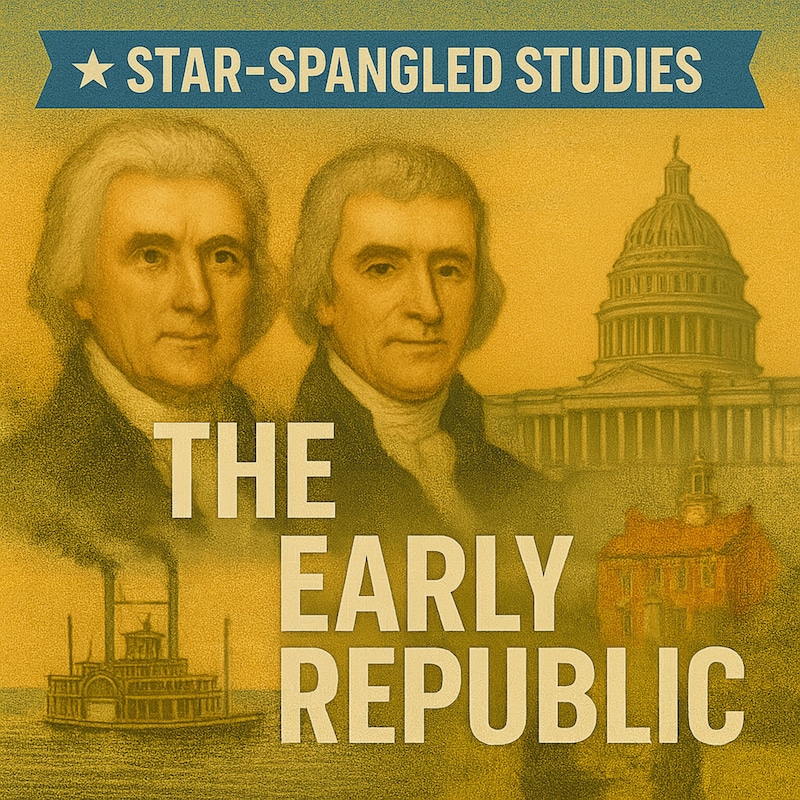
In Episode 7 of Star-Spangled Studies, Dr. G examines how Jefferson’s republic grappled with paradoxes of freedom amid rapid expansion and conflict. Key topics include:
• Jefferson’s presidency, the Haitian Revolution & Gabriel’s Rebellion
• Rise of scientific racism & challenges from Black intellectuals
• Republican Motherhood and early female education
• Peaceful transfer of power in 1800 and Jefferson’s small-govt reforms
• Constitutional crisis over the Louisiana Purchase
• Lewis & Clark’s Corps of Discovery and Native partnerships
• Tecumseh’s Confederacy and Prophetstown
• The War of 1812: from USS Constitution to the burning of Washington
• Era of Good Feelings and the Monroe Doctrine
**Links & Resources:**
– Instagram: [@star_spangled_studies](https://www.instagram.com/star_spangled_studies)
– Facebook: [Star-Spangled Studies](https://www.facebook.com/profile.php?id=61576389415625)
Historian Dr. G covers Jefferson’s paradoxical vision, the Louisiana Purchase, Lewis & Clark, Tecumseh’s resistance, the War of 1812, and the rise of American nationalism under the Monroe Doctrine.
Keywords: Early Republic podcast, Jefferson presidency, Gabriel’s Rebellion, Louisiana Purchase, Lewis & Clark, Tecumseh, War of 1812, Monroe Doctrine, Dr. G
Transcripts
Hello y'all.
2
:It's me.
3
:It's me.
4
:It's Dr.
5
:G.
6
:And the last time we spoke, we talked
about the election of:
7
:so vicious and fraught with crisis.
8
:That Jefferson himself would
later call it the revolution of
9
:1800 as real a revolution in the
principles of our government.
10
:As that of 76 was in its form, it marked
the first peaceful transfer of power
11
:between rival political parties in
American history, a moment that seemed to
12
:affirm the promise of the new Republic.
13
:What kind of republic was it?
14
:Thomas Payne had famously called America
an asylum for liberty, but as the new
15
:century dawned who was welcome in that
asylum today we explore the promises and
16
:the paradoxes of the Jeffersonian era.
17
:We'll see a nation that doubles
in size with the stroke of a pen,
18
:even as its president questions his
own authority with which to do so.
19
:We'll witness the rise of a
powerful pan-Indian resistance
20
:movement in the West and a second
brutal war with Great Britain.
21
:And through it all, we'll confront
the central agonizing contradiction
22
:of the age, the expansion of liberty
for some built on the violent
23
:dispossession and enslavement.
24
:Of others.
25
:This is the story of the
early Republic, so let's go.
26
:Thomas Jefferson came to the presidency
in:
27
:Republican experiment, then check
the growth of government power.
28
:But his administration was
immediately confronted with.
29
:The explosive issue that would
haunt the entire new nation.
30
:Slavery and nothing brought that issue
into sharper focus than two events that
31
:horrified and terrified white Americans,
especially those living in the south.
32
:The first was the Haitian Revolution,
and the second was Gabriel's rebellion.
33
:The Haitian Revolution be had begun in
:
34
:most successful slave revolt in history.
35
:For a decade, enslaved people
in the French colony of Saint
36
:Dome fought for their freedom.
37
:They defeated the French, the Spanish,
and British armies, and were finally
38
:able to establish the independent
Black Republic of Haiti in:
39
:For enslaved people in the United States.
40
:Haiti was a beacon of hope, a
powerful symbol of black liberation,
41
:throwing off the shackles of slavery.
42
:But for American slave holders,
it was a waking nightmare.
43
:Jefferson himself, though a supporter
of the French Revolution feared
44
:the quote, specter of slave revolt
in the contagion of black freedom
45
:spreading to American Shores.
46
:His administration pursued a policy
to isolate Haiti, refusing to
47
:recognize its independence for fear of
encouraging similar uprisings at home.
48
:Those fears would soon
seem to be realized.
49
:In the summer of 1800, right before
Jefferson's election in Henrico
50
:County, Virginia, an enslaved
blacksmith named Gabriel organized
51
:one of the most sophisticated slave
conspiracies in American history.
52
:Gabriel's plan was to march on Richmond,
seized the state armory, and take
53
:Governor James Monroe hostage and
demand an end to slavery in Virginia.
54
:His plot was explicitly inspired
by the language within the American
55
:Revolution and the Haitian Revolution.
56
:According to the trial testimony
of one conspirator, Gabriel planned
57
:to carry a flag emblazoned with
the words quote, death or liberty.
58
:I.
59
:Another conspirator when captured,
reportedly declared, quote, I have nothing
60
:more to offer than what George Washington
would've had to offer had he been
61
:taken by the British and put to trial.
62
:End quote.
63
:The plot was portrayed just hours before
it was set to motion, and a torrential
64
:rainstorm washed out the roads preventing
the conspirators from gathering.
65
:In the aftermath, Virginian authorities
executed Gabriel in 25 of his
66
:followers, the rebellion failed.
67
:But as our textbook notes,
it taught Virginia's white
68
:residents two terrifying lessons.
69
:First, it proved that enslaved black
Virginians were capable of preparing
70
:and carrying out a violent revolution.
71
:One, they avoided.
72
:Luckily.
73
:And two, it shattered white
supremacist assumptions about
74
:black intellectual inferiority.
75
:And lastly, it demonstrated that white
efforts to suppress news of other
76
:slave revolts had ultimately failed.
77
:I.
78
:The ghost of Gabriel and the shadow
of Haiti would loom large over the
79
:politics of the early republic.
80
:The fear of slave rebellion led not to a
questioning of slavery as a system itself.
81
:I.
82
:But rather to a hardening of
racial ideologies in new laws.
83
:This period saw the rise of
scientific racism, an attempt to
84
:use the language of science to
justify slavery and white supremacy.
85
:Even Thomas Jefferson, that great champion
of liberty, was deeply entangled in
86
:this a few decades earlier in his 1788
book notes on the state of Virginia.
87
:Jefferson speculated on the quote.
88
:Real distinctions, which nature has
made between black and white people.
89
:In his own words, he said this quote,
comparing them by their faculties
90
:of memory, reason, and imagination.
91
:It appears to me that in memory
they are equal to whites in
92
:reason, much inferior, and that in
imagination, they are dull, tasteless.
93
:Anomalous, I advance it.
94
:Therefore, as a suspicion only that the
blacks, whether originally a distinct
95
:race or made distinct by time and
circumstances are inferior to the whites
96
:in the endowments of both body and mind.
97
:End quote.
98
:That is a chilling racist passage.
99
:Jefferson admits it is only a suspicion.
100
:Sure.
101
:But by.
102
:Publishing it.
103
:He gave that idea the immense
prestige of his name and intellectual
104
:power to the cause of racism.
105
:It's a powerful reminder that
the Enlightenment's focus on
106
:reason could be used not only to
liberate, but also to oppress.
107
:And this emerging racial science
was powerfully challenged by
108
:black intellectuals of the time.
109
:Especially by a man named Benjamin Er.
110
:He was a free black astronomer.
111
:He was a mathematician and a surveyor,
and in:
112
:almanac to Jefferson, along with
a letter directly confronting the
113
:Secretary of State's hypocrisy.
114
:Sir, I have long been
convinced that if your love for
115
:yourself and for those in the.
116
:Estimable laws, which preserved
to you the rights of human
117
:nature was founded on sincerity.
118
:You could not but be silicious
that every individual of whatever
119
:distinction or color might with you
equally enjoy the blessings thereof.
120
:But sir, how pitiable it is to reflect
that, although you were so fully.
121
:Convinced of the benevolence of the
father of mankind that you should at
122
:the same time counteract his mercies
in detaining by fraud and violence.
123
:So numerous, a part of my brethren under
groaning captivity and cruel oppression.
124
:End quote.
125
:While black Americans were fighting
for their basic humanity, white
126
:women were carving out a new but
still limited role in the republic.
127
:The ideology of Republican motherhood
held that women's primary political
128
:role was to raise virtuous sons
who had become good citizens.
129
:Of the new nation.
130
:This idea in one sense, elevated the
importance of the domestic sphere, but
131
:at the same time it confined women to it.
132
:As historian Linda Kerber has shown
the Republican mother was to be quote.
133
:Citizen, but not really
a constituent end quote.
134
:This new role did, however, create
a demand for female education.
135
:If women were be to be the primary
educators of future citizens,
136
:then they of course would need
to be educated themselves.
137
:And this led to the founding
of New Female Academies.
138
:The letters of women from this
period, like those of Eliza South
139
:GA's Bone deeply reveal a yearning
for intellectual engagement.
140
:Bone right to her cousin,
lamenting, quote, the inequality
141
:of privilege between the sexes.
142
:End quote and argued that a cultivated
mind would lead to stability and
143
:uniformity in the female character.
144
:I.
145
:Yet, even as she championed education,
she also revealed the powerful social
146
:pressures of her time observing
that quote, not one woman in a
147
:hundred Marries for love end quote.
148
:In the New Republic, it seemed
it only offered new roles, but.
149
:Not a fundamental reordering of the power.
150
:When Thomas Jefferson took the oath
th,:
151
:a moment of profound significance
after the bitter and divisive.
152
:Election.
153
:A peaceful transfer of power from the
Federalist Party to the Democratic
154
:Republicans was a testament to
the resilience of the new Young
155
:Nation's constitutional system.
156
:But Jefferson's presidency
itself would mark a dramatic
157
:shift in style and substance.
158
:He rejected the formal trappings of the
Washington and Adams administrations.
159
:In fact, he walked to
his own inauguration.
160
:He answered the door to the
President's house himself.
161
:I.
162
:He even hosted informal dinners, but the
changes were more than just symbolic.
163
:True to his principles
of limited government.
164
:He worked to slash taxes.
165
:He cut the national debt and dramatically
reduced the size of the army and the navy.
166
:His vision was for a frugal
agrarian republic, but.
167
:In a great historical irony, this
champion of small government and strict
168
:constitutional interpretations would soon
make a decision that would stretch the
169
:powers of the presidency beyond anything
the Federalists had even ever imagined.
170
:I.
171
:To understand why we need to actually
move back to Europe in 18 hundreds,
172
:Spain secretly seeded the vast Louisiana
territory, including the vital port of New
173
:Orleans or Nolins back to France, which
was now under the rule of the ambitious
174
:Napoleon Bonaparte for Jefferson.
175
:This was a geopolitical nightmare.
176
:As he wrote to his minister in
France, Robert Livingston in:
177
:quote, there is on the globe one
single spot, the possessor of which
178
:is our natural and habitual enemy.
179
:It is New Orleans through which
the produce of three eighths of
180
:our territory must pass to market.
181
:End quote, French control of New
Orleans threatened to choke off American
182
:commerce on the Mississippi River, and
might one day eventually lead to war.
183
:Jefferson dispatched James Monroe to
join Livingston in Paris, authorizing
184
:them to offer up to $10 million
for New Orleans in West Florida.
185
:But when they arrived, they
were met with a stunning offer.
186
:Napoleon, his plans for a new
world empire having been thwarted.
187
:By the Slave Revolt and its
success in Haiti, and facing a
188
:renewed war on the horizon with
Britain offered to sell the entire
189
:Louisiana territory for $15 million.
190
:It was a deal of a lifetime and it
doubled the size of the United States.
191
:States for pennies an acre.
192
:But for Jefferson, it posed a
profound constitutional crisis.
193
:As a strict con constructionist.
194
:He believed that the federal
government only had powers explicitly
195
:granted to it in the constitution.
196
:Nowhere in the Constitution did
it give the president the power
197
:to purchase foreign territory.
198
:He confessed this dilemma in a letter to
Senator John Breckenridge of Kentucky.
199
:The Constitution has made no provision
for our holding foreign territory,
200
:still less for incorporating
foreign territory into our union.
201
:The executive have done an
act beyond the Constitution.
202
:The legislature must ratify and pay
for it and throw themselves on their
203
:country for doing for them unauthorized.
204
:What we know they would have
done for themselves had they
205
:been in a situation to do it.
206
:End quote, Jefferson initially
believed a constitutional amendment
207
:was necessary to authorize the.
208
:Purchase, but he feared that the
slow, cumbersome amendment process
209
:would give Napoleon time to change his
mind, urged by his advisors, like the
210
:treasury secretary, Albert Gallatin, who
argued the power to acquire territory,
211
:was inherent in the treaty, making
powers assigned to the executive.
212
:Jefferson ultimately set aside
his constitutional strictness.
213
:He rationalized his decision by comparing
himself to a guardian who invests his
214
:ward's money in an important territory,
trusting that the ward upon coming
215
:of age will approve the actions taken
for his own good in October,:
216
:The Senate ratified, the treaty in
the United States had doubled its size
217
:even before the purchase was finalized.
218
:Jefferson was planning an
expedition to explore the vast
219
:and to him unknown territory.
220
:He chose his personal secretary
Merriweather Lewis and an
221
:Army Officer William Clark to
lead the core of discovery.
222
:Their mission was part scientific,
part commercial, and part geopolitical.
223
:Jefferson instructed them to find a
water route to the Pacific for the
224
:purposes of commerce, to document the
plants, the animals, and the geography
225
:of the region, and to establish
trade and friendly relations with the
226
:Native Americans they encountered.
227
:For over two years from 1804 to
:
228
:thousands of miles from St.
229
:Louis to the Pacific Ocean and back.
230
:Their success was almost entirely
dependent on the help that they received
231
:from more than 50 Native American
groups that they met Along the way.
232
:These groups were
crucial to their success.
233
:They provided the core with food, shelter.
234
:Guides and critical and crucial knowledge
of the landscape they encountered.
235
:The most famous of these helpers
was the Lemi Shoshone woman, Saka
236
:Sacajawea, who served as an interpreter
of and whose very presence with her
237
:infant son signaled to other groups
that this was a peaceful mission.
238
:The journals kept by Lewis and Clark
provide an invaluable if one-sided
239
:record of these encounters, detailing
complex negotiations, cultural exchanges,
240
:and moments of tension like when
they're near violent standoff with the
241
:Lakota Sioux and the deadly skirmish
with a group of Blackfeet warriors.
242
:The expedition overall was a triumph
of exploration, but it was also
243
:the leading edge of an American
expansion that would once again.
244
:Have catastrophic consequences
for Native American peoples
245
:this time in the Mid and West
246
:Jefferson's vision of an Empire of
Liberty was also an empire of expansion
247
:and one that continued to put relentless
pressure on Native American land.
248
:In the Ohio Valley, this pressure
gave rise to one of the most
249
:powerful resistance movements in
American history led by two Shawnee
250
:Brothers, Tose and tens Katua.
251
:Tens.
252
:Awa known as the Prophet, was
a spiritual leader in:
253
:He had a vision in which the Master
of Life commanded him to preach a
254
:message of cultural revitalization
to all Native Americans.
255
:He urged them to reject.
256
:All American ways alcohol, European style,
clothing, the idea of private property.
257
:In return to their traditional customs,
his message spread like wildfire,
258
:attracting thousands of followers from
different groups to his new settlement
259
:prophets town in what is now Indiana.
260
:His brother Te come see, was a brilliant
warrior and political strategist.
261
:He took his brother's religious
message and transformed it into a
262
:powerful political movement, traveling
from the Great Lakes to the Gulf
263
:Coast to come see work, to build
a pan-Indian military alliance to
264
:resist further American expansion.
265
:His core argument, which he delivered in
a powerful speech to the governor of the
266
:Indiana Territory, William Henry Harrison,
in:
267
:All Native Americans in common and that
no single group had the right to sell
268
:it, quote the way, and the only way
to check and to stop this evil is for
269
:all the red men to unite in claiming
a common and equal right in the land
270
:as it was first, and should be yet.
271
:For it never was divided, but
belongs to all for the use of each.
272
:For no part has a right to sell even to
each other, much less to strangers, those
273
:who want all and will not do with less.
274
:End quote In another speech, he
warned other groups of the fate that
275
:awaited them if they failed to unite.
276
:Now.
277
:Quote, sleep no longer o choctaws
and Chickasaws in false security and
278
:Delusive hopes we will not soon be
driven from our respective countries and
279
:the graves of our ancestors will not.
280
:The bones of our dead be plowed up and
their graves be turned into fields.
281
:Shall we calmly wait until they
becomes so numerous that we will no
282
:longer be able to resist oppression?
283
:I know you will cry with me.
284
:Never, never.
285
:End quote toe's confederation.
286
:Posed a serious threat to
United States ambitions.
287
:In November, 1811, while Tecumseh
was in the south recruiting allies,
288
:governor Harrison marched an army
of a thousand men on profits.
289
:Town tense awa against tecumseh's
orders, attacked Harrison's
290
:forces, the resulting battle.
291
:Was the battle of Typic canoe, and
this was a brutal two hour fight
292
:that ended with the Americans driving
off the Native American warriors and
293
:burning prophets down to the ground.
294
:The defeat shattered the prophet's
prestige and it broke the back of
295
:the Confederacy for to come see.
296
:It was a devastating blow, and it pushed
him and his remaining followers into
297
:a formal alliance with the British.
298
:Just as a new war between the British
and the United States was about to begin,
299
:historians sometimes call the war of 1812
America's Second War for Independence,
300
:and they do so for good reason.
301
:For years, the United States had
been caught in the middle of a
302
:massive global conflict between
Britain and Napoleonic France.
303
:The British Royal Navy was desperate
for sailors, and it routinely
304
:practiced something called impressment,
which meant they boarded American
305
:ships and forced American sailors.
306
:Into the British service.
307
:This was not only a pro profound
insult to American sovereignty,
308
:it actually put people into war.
309
:At the same time, the British were
continuing to support and arm Native
310
:American resistance movements in the
West, like Tecumseh's Confederacy.
311
:A new generation of politicians in
Congress known as the Warhawks, led by men
312
:like Henry Clay of Kentucky and John C.
313
:Calhoun of South Carolina Clamored
for another war against Britain.
314
:They argued that American honor and
economic independence was at stake.
315
:In June of 1812, president James
Madison, who was Jefferson's successor
316
:asked Congress for a declaration of war
and what it becomes known now as Mr.
317
:Madison's war began.
318
:This was a messy, often disastrous
affair for the United States.
319
:An attempted invasion of Canada failed
miserably, but a small American Navy
320
:achieved some stunning victories at sea.
321
:The most famous of these being that
the US constitutions defeat of the
322
:HMS Garre, a victory that earned the
American ship its famous nickname.
323
:Old iron sides.
324
:By 1814 with Napoleon defeated in
Europe, Britain was able to turn its full
325
:attention now to the American War, and
they launched a three-pronged attack.
326
:One of those prongs was aimed
directly at the Chesapeake Bay.
327
:In August, 1814, British
forces landed in Maryland.
328
:They routed the American militia
at the Battle of Bladensburg,
329
:and they marched unopposed into
the new capitol at Washington DC.
330
:What follows is one of the most
humiliating moments in American
331
:history in retaliation for an
earlier American raid that had
332
:burned the Canadian capital of York.
333
:British troops systematically
burned Washington's public buildings
334
:to the ground, including the
capitol and the president's house.
335
:An eye witness, George gl, a British
officer, described the scene quote.
336
:The blazing of houses, ships, and stores.
337
:The report of Exploding magazines and the
clash of falling roofs informed them as
338
:they proceeded of what was going forward.
339
:You can conceive nothing finer
than the site which met them
340
:as they drew near to the town.
341
:The sky was brilliantly illuminated by
the different conflagrations and the
342
:dark red light was thrown upon the roads
sufficient to permit each man to view
343
:distinctly his comrades face End quote.
344
:First Lady Dolly Madison famously
stayed behind until the last
345
:possible moment saving cabinet
papers and the iconic Gilbert Stewart
346
:portrait of George Washington.
347
:Before fleeing the city from Washington,
the British moved onto their next target,
348
:the much more commercially important
city of Baltimore, but Baltimore itself.
349
:Was fortified and ready.
350
:The city's defenses were anchored
by Fort McHenry for 25 hours.
351
:The British fleet bombarded the fort,
but its defenders refused to surrender.
352
:A young American lawyer named Francis
Scott Key, who was being held on a
353
:British ship, watched the bombardment
through the night at Dawn when he saw the
354
:American flag still flying over the fort.
355
:He was inspired to write a poem that he
called the Defense of Ford McHenry set
356
:to the popular British drinking tune.
357
:It would later become
America's national anthem.
358
:The Star-Spangled Banner.
359
:The final and most infamous Battle of
the War was fought, ironically, after
360
:the Peace Treaty had already been signed.
361
:In January, 1815, a massive veteran
British army attacked New Orleans, which
362
:was defended by a motley crew of American
regulars, a militia from Kentucky and
363
:one from Tennessee, as well as free black
soldiers and even some pirates all under
364
:the command of a tough frontier General.
365
:Named Andrew Jackson.
366
:The British launched a frontal assault
on Jackson's well entrenched position.
367
:The result was a slaughter in less
than an hour, the British suffered
368
:2000 plus casualties, including
their commanding general, while the
369
:Americans lost fewer than a hundred men.
370
:A soldier from Tennessee described
the scene quote when the smoke
371
:had cleared away, and we can
obtain a fair view of the field.
372
:It looked at first glance
like a sea of blood.
373
:It was not blood itself, which gave it
this appearance, but the red coats in
374
:which the British soldiers were dressed
straight out before our position.
375
:The field was entirely
covered with prostrate.
376
:The battle of New War leads, which
happened after the war had been over,
377
:was a stunning American victory.
378
:It had no effect on the outcome of
the war, but it had a profound effect
379
:on the American psyche, believing
that they had now won the war.
380
:It created a new national hero as
well, Andrew Jackson, who would later
381
:ride this to the presidency, and it
fueled a powerful wave of American
382
:nationalism and the era of good feelings.
383
:The war of 1812 was a disaster
for the Federalist Party.
384
:From the very beginning.
385
:They had opposed the war, which was deeply
unpopular in their New England stronghold.
386
:In late 1814, a group of New England
Federalists met in secret at the Hartford
387
:Convention to air their grievances.
388
:They proposed a series of
constitutional amendments to.
389
:Designed to protect New England's
interests, including a one-term
390
:limit for the President and a
two-thirds vote in Congress for
391
:declaring war or admitting new states.
392
:But their timing would, could
have not come at a worse time just
393
:as their emissaries arrived in
Washington to present their demands.
394
:News of Jackson's victory at New
Orleans and the signing of the
395
:Treaty of Gantt, which ended the war.
396
:Happened.
397
:Suddenly the federalists looked
like foolish, disloyal, and even
398
:traitorous and treasonous old men.
399
:The party collapsed after this
and it never fully recovered.
400
:The collapse of the Federalists
ushered in a period of one party rule
401
:under the Democratic Republicans, a
time that a Boston newspaper dubbed
402
:as the quote era of good feelings.
403
:This period was marked by a
surge in American nationalism.
404
:The war, despite its many failures,
like the burning of the white House,
405
:which is why it's white, by the way,
it convinced many Americans that they
406
:could stand up to a European power.
407
:It had, as our textbook puts it, quote,
cultivated a profound sense of union
408
:among a diverse and divided people, quote.
409
:This new sense of national
confidence found his most forceful
410
:expression in 1823 in what became
known as the Monroe Doctrine.
411
:President James Monroe, in his
annual address to Congress laid
412
:out a bold new foreign policy for
the United States, alarmed by the
413
:possibility that European powers
might once again try to re-con newly
414
:independent nations in Latin America.
415
:But Monroe declared that the
Western Hemisphere was off limits.
416
:To future European colonization quote, the
American continents are hence forth not
417
:to be considered as subjects for future
colonization by any European powers.
418
:We should consider any temp on
their part to extend their system to
419
:any portion of this hemisphere to.
420
:As dangerous to our peace and safety.
421
:The Monroe Doctrine was a stunning
declaration, one that the United States
422
:might not have been able to enforce.
423
:The young United States had little
power at the time to actually
424
:make good on this promise.
425
:But it was a powerful statement of
a new American identity, confident,
426
:assertive, and seeing itself as the
dominant power in the Western hemisphere.
427
:So the earlier republic was a period of
profound transformation and contradiction.
428
:It began in an era of Jefferson's
revolution and his vision of
429
:a limited agrarian republic.
430
:But it was also an era that saw
the dramatic expansion of federal
431
:power with the Louisiana purchase,
the brutal realities of a second
432
:war with Britain, and the rise of a
new assertive American nationalism.
433
:And through it all, the
unresolved questions of the
434
:revolution continued to linger.
435
:The nation that Thomas Payne had called
an asylum for liberty was also a nation
436
:that was systematically dispossessing
Native Americans of their land and
437
:building its prosperity on the backs.
438
:Slaves, the era of good feelings
would prove to be short-lived.
439
:The very forces unleashed in
this period westward expansion.
440
:The growth of a national market and the
deepening divide over slavery would soon
441
:shatter the illusion of national unity.
442
:Next time we'll explore the
market revolution and we'll look
443
:at the rise of factories, the
building of canals and railroads.
444
:And the profound social and economic
changes that would transform the the
445
:lives of ordinary Americans, and then
set the stage for the rise of a new
446
:kind of politics under Andrew Jackson.
447
:So.
448
:This is me, Dr.
449
:G, saying, I'll see y'all in the past.