Shownotes
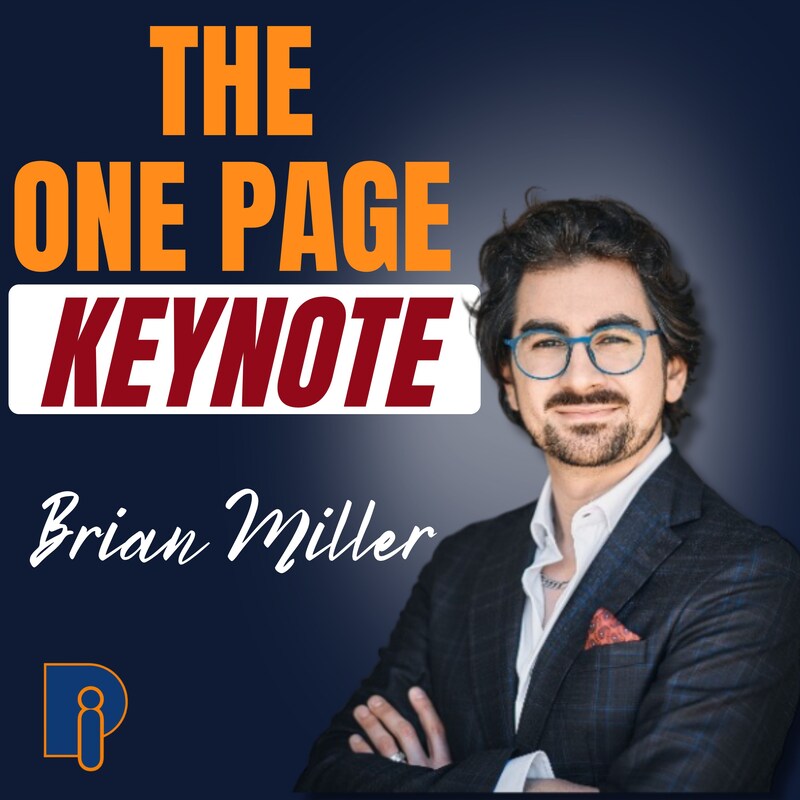
Magician-turned-keynote-speaker Brian Miller built a speaking career on the back of a TEDx talk that went viral in 2015, then watched that career dry up within eighteen months because charisma and entertainment weren't enough to make anyone act on what he'd said. In this episode, Brian and John dig into the real argument underneath most speaker training: is a keynote about how you deliver it, or what's actually in it? Brian's answer, and the thesis of his new book "The One Page Keynote," is that design beats delivery every time, and that the entertainment industry's instinct (be more charismatic, be funnier, be more captivating) is solving the wrong problem for most professional speakers.
The conversation covers what a keynote is actually for (hint: it's not the audience's experience in the room), why "the buzz is the business" is the only metric that matters to the people who write the cheques, how to build credible expertise without a PhD, why slides should be a last resort rather than a crutch, and why the most experienced experts are often the ones most paralysed by imposter syndrome.
Key takeaways:
- A keynote's job is to shift perspective, not create lasting change. Real change needs repetition and reinforcement; a single talk from the front of the room can only move how someone thinks, which is the first domino.
- Event planners judge success by one thing: are people still talking about your talk at the coffee break, in the Slack channel, on the Monday call. If they're not, it doesn't matter how entertaining you were.
- Expertise doesn't require formal credentials. Brian built his on an unreasonable amount of obsessive attention to one niche topic, not a PhD.
- The most credentialed, knowledgeable speakers are often the most riddled with imposter syndrome, because understanding the nuance and edge cases of your topic makes you aware of everything you could get wrong.
- A talk should work with the power out and the slides gone. If it only works with the deck, the talk doesn't work.
- You don't need to out-credential the most famous person in your field. You need a different angle on the same topic; one only you can offer.
- Audiences don't care about your problem. Buyers booking and paying for keynotes care about theirs, and your talk has to speak to the problem they're already trying to solve, not the one you find interesting.
Get a copy of Brian's new book, The One Page Keynote, from all good booksellers, or even Amazon.
In the UK: https://amzn.to/4vRduAv
and for the USA: https://amzn.to/4ozkfo8
To connect with Brian: https://www.linkedin.com/in/brianmillerspeaks
To work with Brian: https://www.clarityupconsulting.com/
CHAPTERS:
00:00 Charisma Isn’t Enough
02:02 Magician to Speaker Origin
04:35 Viral TEDx and Fast Fees
07:28 Why Rebookings Dried Up
09:59 Design Beats Delivery
15:14 No Boring Topics
17:26 Creating Memorable Moments
19:34 Props and Paintings Example
23:33 Tools Over Talent Tricks
25:39 PowerPoint and Slides Debate
25:50 Slides Without Power
26:34 When Slides Help
29:28 Defining A Keynote
31:03 Shift Perspective Goal
32:19 Buzz Is Business
34:34 Expertise Over Inspiration
38:44 Nuance And Edge Cases
42:48 Topic Angle Buyer Problem
47:27 Book Launch And Offer
50:43 Host Wrap And Next Steps
4. FAQ
Does charisma actually matter for professional keynote speakers?
According to Brian Miller, author of "The One Page Keynote," charisma is far less important to a keynote's success than the design of the talk itself. Miller argues that a well-designed talk delivered without much charisma will outperform a highly charismatic, entertaining talk with no clear message, because audiences who can't articulate what they learned won't talk about the speech afterwards or act on it.
What does "the buzz is the business" mean in professional speaking?
"The buzz is the business" is a phrase Brian Miller uses to describe how event planners actually judge whether a keynote succeeded. Miller has asked thousands of event planners what success looks like, and the near-universal answer is whether attendees are still talking about the talk during coffee breaks, in Slack channels, or in the following Monday's meeting. John Ball and Miller agree that if the audience leaves the talk in the room, the speech has failed, regardless of how well it was delivered.
Do you need a PhD or formal credentials to become a professional keynote speaker?
No. Brian Miller, who has a bachelor's degree in philosophy and no graduate qualifications, argues that expertise can be built by spending an unreasonable amount of time obsessing over a niche topic: reading everything available, talking to practitioners, and understanding the nuance and edge cases well enough to know when standard advice would be wrong for someone. Miller built his expertise in human connection this way after his 2015 TEDx talk went viral.
Should professional speakers use slides during a keynote?
Brian Miller's rule of thumb is that a keynote should work even if the slides disappear and the power goes out. Slides become genuinely useful for talks over twenty minutes, for very large audiences who can't stay engaged through proximity alone, and for explaining highly technical or visual concepts that are difficult to convey in words. Below twenty minutes, Miller generally advises against using slides at all.
How do speakers find their unique angle when someone more famous already covers their topic?
Brian Miller advises against trying to out-credential the most recognised name in your topic area. Instead, he recommends identifying the specific perspective only you can bring to that topic, drawn from your own background or experience, so that buyers aren't comparing you directly to that famous person but considering you for a genuinely different angle on the same subject.
Why do experienced experts often feel more imposter syndrome than beginners?
Brian Miller describes this as the inverse of the Dunning-Kruger effect: understanding a topic well enough to know its edge cases, exceptions, and the situations where standard advice doesn't apply makes experts acutely aware of everything that could go wrong, while beginners with shallow knowledge often feel falsely confident.
Do you want to make sure you have speaker positioning that will get you booked? Grab my free speaker positioning tool and see if your positioning needs a tune-up or a complete overhaul: https://present-influence.kit.com/363f7c1d51
Connect with John:
- Find out more about the Known, Booked & Paid Blueprint
- Subscribe to the Serious About Speaking newsletter on LinkedIn
- Find me on Insta
- Find me on TikTok
- Find me on Threads
Discover the bottlenecks in your speaking business with the Applause Vs Invoice Quiz
For speaking/podcast enquiries or to connect with me directly, you can email [email protected] or find me on LinkedIn
You can find all our clips, episodes and more on the Present Influence YouTube channel
If you know a speaker who would enjoy this show, let them know. Thanks for listening.
Mentioned in this episode:
Last Call For Founding KBPB Mebers
There's one last spot in the founding membership of The Known, Booked & Paid Blueprint. This is the only time you can get the program at 50% off. After that, it goes to the full program price, which is still great value, but it's not half-price value. Find out if it's the right fit for you at presentinfluence.com/kbpb
Transcripts
You could spend years building up your stage presence, your
2
:timing, working on your charisma.
3
:You may already have done that.
4
:Today's guest is going to tell you
that probably that's not what's
5
:gonna get you booked or rebooked.
6
:Here's the problem.
7
:Plenty of speakers can walk off stage
to great applause, great feedback forms,
8
:a standing ovation even, and never
hear from that booking client again.
9
:And nobody who was there can even
tell you what the talk was about.
10
:My guest today built an 11-year speaking
career on the back of one viral TEDx
11
:talk, then watched it nearly collapse
because charisma alone wasn't enough, and
12
:he's written a book about exactly why.
13
:Today, we're talking about why
design beats delivery, what the
14
:buzz is the business really means
for getting booked again, and how
15
:to build real expertise without a
single qualification to your name.
16
:Welcome to Professional Speaking, the show
for people who are serious about speaking
17
:and becoming known, booked, and paid.
18
:My name is John Ball, professional
speaking coach, keynote speaker,
19
:stand-up comedian, and sci-fi nerd.
20
:I'm here as your guide on the journey
to a successful speaking career
21
:It's very exciting for me to
welcome to The Professional
22
:Speaking Show, Brian Miller
23
:Brian Miller: John, how are you?
24
:Thanks so much for having me
25
:John: I'm delighted that you agreed
to my invite to come onto the show.
26
:And, I heard you on my friend Bob
Gentles' podcast, and I thought, "Oh,
27
:that's a very interesting conversation."
28
:And that made me straightaway
want to reach out to you and
29
:invite you to come on this show.
30
:one of the main reasons for that was you
talking about the importance of, or the
31
:lack of importance of the charisma for a
keynote, and how really it's more about
32
:having the speech than anything else.
33
:And I thought, "Well, this is somebody
I need to have a conversation with."
34
:And I know that this is to do with
your new book that's coming out,
35
:and we're gonna get to all of that.
36
:But first of all, I have to ask you,
As someone who's been a professional
37
:magician, how did you end up making
that journey to professional speaker?
38
:Brian Miller: Yeah, the journey from
magician to speaker was mostly luck,
39
:which is a terrible answer 'cause
it's not useful essentially to anyone.
40
:I fell backwards into it.
41
:in 2015, I had been a full-time
professional magician for the better
42
:part of a decade, and I-- the, within
the span of about three months, I got
43
:two speaking opportunities, and I had
never pursued speaking, never wanted to.
44
:In fact, I had a very
negative opinion of speakers.
45
:What I thought speakers
were, were just Tony Robbins.
46
:And with due respect to Tony
Robbins, it's just not my jam.
47
:I don't find it interesting or exciting.
48
:I find it just really a lot.
49
:and I often find that style
of speaking a lot of nothing.
50
:And, and so it does a
lot for a lot of people.
51
:It's not for me.
52
:So I thought that's what speaking
is, and so when I got an offer,
53
:though One, I got invited by a
local college prep high school.
54
:So it's a private high school
designed exclusively for college prep.
55
:You would think all high schools are for
college preparation, but this is like
56
:a dedicated college prep high school.
57
:And they were having their commencement
in a few months, and they apparently
58
:go to the community to find at
least one interesting person in
59
:the community to speak as part
of their commencement every year.
60
:And they found me and were like, "Well,
you've been a professional magician.
61
:You must have something interesting to say
to our graduating high school seniors."
62
:And it was incredibly kind of bizarre,
but they, but they really seemed excited
63
:about the idea of me speaking to their
students and families, so I said yes.
64
:I felt very fancy saying yes
to a commencement speech.
65
:I pa- It was-- I genuinely, actually,
I'm being a little silly about it, but
66
:the truth is, John, at that time when
they asked me that, I had a moment
67
:where I thought, "Oh, I made it.
68
:I didn't realize I made it."
69
:Like, I actually your, head's down
trying to just make enough money
70
:doing card tricks at restaurants and
local corporate events and all this.
71
:I was trying to put my wife through
her master's, and I was just so focused
72
:on trying, my then fiancée, I, I was
so focused on just trying to make
73
:it as a magician, I didn't really
clock that I had been successful.
74
:And when somebody invites you
to give a commencement speech,
75
:clearly you've been successful.
76
:And so it was actually this
beautiful external validation
77
:I didn't realize I needed.
78
:and right at the same time, I got
invited to speak at a local TEDx
79
:event being held at a high school,
a different high school also.
80
:and so both of them were the same month.
81
:And so in June of 2015, I delivered a
TEDx talk and a commencement speech.
82
:And when the TEDx talk hit
YouTube, it went just mega viral.
83
:It went impossible viral.
84
:It went like one of the 100 most
successful TED or TEDx talks of all
85
:time viral, at, at that time in 2015.
86
:And the commencement speech, I had
just-- I was flooded with just parents
87
:and students coming up to me for an
hour going, "God, what a great…
88
:This was so helpful.
89
:It's so great to hear.
90
:What a beautiful thing you said.
91
:It made me think of this."
92
:And so those two things happened
at the same time through nothing
93
:I tried to will into the universe,
and I was like, "Oh, maybe there's
94
:something else I can do with my life."
95
:And so I started pursuing speaking.
96
:John: I don't think anybody has the same
journey into speaking as anyone else.
97
:There's so many different ways to go
into it, but that's a, that's certainly
98
:a very nice way to come into it.
99
:And you're not, not, not the
first magician to kind of…
100
:Well, do, do mentalists
count as magicians?
101
:Brian Miller: Well, they would, they
would be very offended for you to say
102
:that, but they absolutely are magicians.
103
:John: Yeah, so we've had
like Keith Kong on the show.
104
:He's a pretty successful
well-known, mentalist.
105
:people did love that episode.
106
:And there's a lot, seems to be a
lot of parallels there as well that
107
:we got into on that conversation.
108
:For you, what, what do you now see as
maybe being the, the parallels between
109
:speaking and your magic career previously?
110
:Brian Miller: That's a great question.
111
:The parallels between speaking and
magic are far fewer than I originally
112
:expected when I made the transition.
113
:I quite expected it to
be an easy transition.
114
:I, I thought, "Okay, I know how to
entertain an audience for an hour.
115
:I can always do magic tricks or
tell jokes or have interaction
116
:if I need to, to fall back on.
117
:I've got a crutch here."
118
:So I thought, "Well, I really just need
to say something mildly interesting
119
:or useful, do some magic and tell
some funny stories, some audience
120
:interaction, and it's gonna go great."
121
:And it did not.
122
:it-- As I started getting booked--
And I started getting paid very
123
:high professional fees immediately.
124
:I did not ramp up because I had a
famous TED Talk, and so big, huge
125
:brands from across the world would
reach out to me, like big names would
126
:reach out and say, "Come do that,
but for an hour and on our stage."
127
:And they were paying
five, six, eight, $10,000.
128
:Now, th-those are very normal professional
speaker fees today, but one, as a
129
:magician, and two, in 2015, these
were absurd amounts of money to me.
130
:I mean, it was just crazy.
131
:And I felt this tremendous pressure to
over-deliver or even just to live up to.
132
:Forget over-deliver, to live
up to what they were paying me.
133
:I really felt like an imposter, and
the truth is, I was an imposter.
134
:I really didn't, I didn't have content
matter expertise, and they were
135
:treating me as if I was an expert
on human connection, 'cause it's
136
:what I talked about in my TEDx Talk.
137
:And I was like, "No, I have 14 minutes and
12 seconds to say about that," and I said
138
:it in the talk you've already watched.
139
:And so I started doing these talks by
basically just doing the 14 minutes
140
:worth of human connection content,
but spreading it out over an hour by
141
:shoving lots of entertainment into it.
142
:And what happened is all of
the charisma that I had did not
143
:make these successful speeches.
144
:My-- I was making people laugh.
145
:They were loving the magic.
146
:They enjoyed the audience
interaction, but at the end of these
147
:speeches, kind of a nothing burger.
148
:Nothing was really happening.
149
:The clients, it was fine.
150
:They were happy enough,
but no one rebooked me.
151
:Nobody referred me.
152
:And after about a year and a half
after the TED Talk, my career,
153
:my speaking career dried up.
154
:The initial burst of inquiries were gone,
and there were no, there's no momentum.
155
:And then I had nothing, and I actually had
to build a speaking career from scratch.
156
:And so your question of what are the
parallels, I kind of answered it in
157
:the negative, but I was expecting
to, that speaking was about charisma
158
:and entertainment and, and, and,
you know, captivating audiences.
159
:And actually, really great professional
speaking is about content and not
160
:delivery in the performance sense, but
it's about delivery of the message.
161
:Is there a clear message that the audience
can understand, they can follow, and
162
:they know what to do with when you leave
the room or when they leave the room?
163
:And that became the journey of my
speaking career, learning how to do that
164
:John: It's it's interesting, and I think
you might be one of the only guests I've
165
:ever invited onto my show who I knew
that I might not completely agree with
166
:on things before I brought you on, but
really wanted to have the conversation
167
:because we might, I don't know.
168
:But it ultimately is gonna
depend on some of the things.
169
:So are you…
170
:I mean, I would say that the
entertainment element is still
171
:relevant in speaking, it's just
not the most important part of it.
172
:Like, there still has to be some
entertainment factor, and it sounds
173
:a bit like you're saying maybe
there doesn't need to be that.
174
:Is, is that right or would that would
that just be the extreme of what, to
175
:take where, to what you were saying?
176
:Brian Miller: So here's my
position: if given the choice,
177
:choose design over delivery.
178
:In a perfect world, I would like to
listen to an incredibly charismatic,
179
:engaging, entertaining performer
deliver a masterfully built speech.
180
:It is rarely the choice
that speakers have.
181
:You tend to have one of two things:
somebody who comes from entertainment
182
:and has to find a message, or, like
I did, or somebody who is an expert,
183
:a, an academic, a scientist, a
researcher, an industry leader, someone
184
:who's an expert in their topic but
is now being asked or told to speak.
185
:And what happens is the experts who are
being told, "You have to speak because
186
:there's gonna be stakeholders in the
room, there's gonna be politicians who
187
:can fund our research," those people turn
down speaking opportunities because they
188
:think they're not entertaining enough.
189
:They don't think they have the
charisma to carry the room,
190
:and they're wrong, sort of.
191
:They're not wrong that
they're not charismatic.
192
:Most of them are incredibly dull,
boring people who are just geniuses.
193
:They're wrong that they can't
deliver a powerful, engaging,
194
:and important presentation that
moves the needle on their work
195
:simply because they lack charisma.
196
:On the other hand, the people that
come in like I did, that come in
197
:from entertainment, what I find is
when audiences watch them, they enjoy
198
:it, they laugh, they, quote-unquote,
"engage" in the most superficial
199
:sense, and they leave the room.
200
:And I do this at every conference.
201
:I ask people after one of those
people has spoken, "Hey, what
202
:did you take away from that?
203
:What was the big lesson?
204
:What was the learning?"
205
:Most people within minutes of
leaving one of those talks cannot
206
:give you an explicit answer.
207
:They say, "Oh, it was just so inspiring.
208
:It was so great.
209
:I just loved their energy."
210
:And, like, pardon me, but so what?
211
:Like, if you're not producing action, if
the audience isn't leaving knowing exactly
212
:what they should do, think, or rethink
as a result of your talk and putting
213
:it into practice, what are we doing?
214
:Like, so that's how I feel about it
215
:John: Maybe we don't disagree
too much then after all.
216
:I, I was, I was just recently
writing about, a speaker I once saw.
217
:he was-- like she'd been
speaking a long time.
218
:She was great on stage.
219
:Presence was there.
220
:The drama was there in her presentation.
221
:She delivered fantastically, and the
whole talk made not one lick of sense.
222
:Like I couldn't connect
the beginning to the end.
223
:And every- I was looking around thinking
everyone else in there is just nodding
224
:and going, "Oh, yeah, really great talk."
225
:And there was just one or two other people
who were looking a bit nonplussed, like,
226
:"What is she actually talking about?"
227
:And I to this day, I still have no idea
what that, what that talk was about.
228
:But, but I get what you're saying,
it's like all style and no substance.
229
:This is something that even Marcus
Aurelius talked about back in the day
230
:of like the sophists and, how it was
all performance and no, no substance
231
:to it, and he didn't like that
232
:Brian Miller: Yes.
233
:And so that my mission is essentially
for the people who have charisma,
234
:performance chops, whether they
come from entertainment or not.
235
:Some people don't come from
entertainment, but they just have
236
:that thing, whatever that is.
237
:it's teachable, sort of.
238
:You know, there's, there's
some natural element.
239
:There's quite a bit, teaching.
240
:Those people, what I want them to do is
go, "Imagine the impact that you could
241
:make on the world if you paired that
with a masterfully designed speech."
242
:Right?
243
:Like, what if we took-- What, what if
you designed a speech that actually
244
:made sense, that had a core message,
that moved the audience to action?
245
:Imagine how much easier your career
would be and how much better the impact
246
:you would make on the world would be.
247
:And on the other hand, my message to the
experts, which are mostly our clients.
248
:We mostly serve properly
credentialed experts who have to
249
:talk, not people who want to speak.
250
:and so my message to them is, "You do
not need to become a charismatic jump
251
:kicks, laughter, interaction performer
to make, to get your work into the hands
252
:of the people who need to hear it."
253
:Right?
254
:You can simply deliver the talk.
255
:If, if you design your talk
properly and simply do it,
256
:John: Yeah.
257
:Brian Miller: it will work
258
:John: I, I think this is all
something that took me way too long
259
:to realize in the speaking world.
260
:You know, I can, I can remember,
being back at speaker trainings
261
:with, with Julian Treasure, who
like we, we did training together.
262
:And like in, in the, in the
competition within one of the
263
:trainings, I beat out Julian.
264
:I'm thinking, "Wow, I beat out…
265
:Beat him out in the training."
266
:And then sort of look, but he's
massively more successful, than me.
267
:but he had the content
and I didn't have that.
268
:I had the performance skills, I
had the charisma, the presence,
269
:all that, but I didn't have the,
the other stuff that was missing.
270
:Like trained, corrected
that issue since then.
271
:But if you don't recognize that,
you, you can end up in this position
272
:like I did of thinking, "How come all
these people are so successful when
273
:I know that I'm a better speaker?"
274
:Brian Miller: Yes.
275
:And that, that is exactly
the thesis of the book.
276
:It is, it's not-- Basically,
it's not you, it's not the
277
:speaker, it's the speech, right?
278
:I, especially when, experts come up
sometimes, and I've had people say
279
:this, they come up and, there was a
financial advisor walked up to me after
280
:I had given my own keynote one time.
281
:and I speak on human connection.
282
:I have my own personal brand.
283
:I do corporate culture,
healthcare, stuff like that.
284
:And I had given a talk, and he
came up and he said, "Man, I wish
285
:I was as entertaining as you.
286
:I have to give talks on personal finance
to try to get people to understand
287
:why they should care more about
this and pay more attention to it."
288
:And he goes, "I just, you know,
finance is just so boring."
289
:And I just stared at him going-- I
thought for I thought, "First of all,
290
:you've made finance your life's work.
291
:Presumably, you don't think it's boring."
292
:He's like, "Well, no,
I find it fascinating."
293
:I'm like, "Okay, let's start there.
294
:There are no boring topics.
295
:There are no boring speakers.
296
:There are just boring speeches."
297
:Like, let's design great speeches.
298
:And also, I'll toss this back to you here.
299
:I, I have a thing, when people
use the word entertainment, like,
300
:"I wish I was more entertaining.
301
:How do I become more entertaining?"
302
:They think you need to be a comedian.
303
:You need to be funny.
304
:And that's one way to be entertaining.
305
:So is juggling, so is streaking
naked on a baseball field.
306
:I've seen it happen.
307
:So, like, there's lots
of entertaining things.
308
:So are cat videos, right?
309
:It doesn't mean that that's the substance.
310
:we award almost every, Academy
Award to dramas, not to comedies.
311
:So comedy is not the only
way to be entertaining.
312
:Movies that are dramas
are still entertaining.
313
:So what I always tell my speakers
is engagement is entertainment.
314
:If you have engaged them fully,
they will be entertained.
315
:They need not be laughing or
falling out of their seats.
316
:John: Yeah.
317
:I, I definitely agree with that.
318
:There's so many different ways
to do it, and everyone thinks
319
:you have to be this or the other.
320
:And I think it's maybe even been
reinforced in the industry somewhat.
321
:You know, there, there's standard jokes
go around about, you know, you need to
322
:be able to make your audience laugh if
you wanna get paid and stuff like that.
323
:It's like, well, yes,
but maybe no as well.
324
:let me ask you though, I mean,
you, I, I'm sure you would've come
325
:across, if not read, Dan and Chip
Heath's book, "The Power of Moments."
326
:And
327
:Brian Miller: I don't actually
think I've read it, so give me
328
:the context that I would need
329
:John: Sure.
330
:So, ultimately that book is about
creating these powerful moments, these,
331
:like the, remember Bill Gates' TED
Talk where he released the mosquitoes
332
:or, the, there's the one, I forget
the, lady's, full name, but, Dr.
333
:Jill something where she brought
out a live brain on the stage.
334
:Creating those sorts of powerful
moments within a presentation.
335
:Like a lot of people say that's essential,
and certainly that seems to be one of the
336
:things that they allude to in that book.
337
:But maybe from what you're saying,
that isn't quite so important after all
338
:Brian Miller: It's-- I, I wouldn't say
that bringing out a prop essentially is
339
:what you just described is essential.
340
:It is one of the ways
to support your point.
341
:in this new book I've got coming
out, at the very end of it, I've
342
:got a chapter on, like, all the
creative ways to support your points.
343
:'Cause of course you can
support it with data.
344
:I have a whole chapter on data,
but I introduce the chapter on
345
:data by saying essentially in
today's world, data is not enough.
346
:It's necessary, but not sufficient, right?
347
:It's not-- You know, I, had a line
that was cut from the book actually.
348
:It's hard to remember after,
like, two years' worth of edits
349
:what's actually in there anymore.
350
:But there was a line that was definitely
cut where I basically introduced the
351
:chapter on data saying, "In a world
where everything's made up and the
352
:facts don't matter," which was, a
reference to Whose Line Is It Anyway?
353
:You know, the game where everything's
made up and the points don't matter.
354
:y- you know, facts don't move people.
355
:They never really moved people,
but they have an even smaller
356
:impact than they ever have.
357
:So you need to support
your points creatively.
358
:And creating moments, as you're
describing, there's so many ways to do it.
359
:The most common way speakers do
it is with storytelling, right?
360
:Storytelling is the thing, right?
361
:We were talking before we started
recording about Francisco Mahfuz.
362
:He's a renowned storytelling specialist.
363
:He works with me and my clients,
which you did not know before
364
:you mentioned him, which was fun.
365
:so stories are real-life
examples that make a point.
366
:Stories can grab people.
367
:They can be funny.
368
:They can be moving.
369
:they can simply just paint
a picture in someone's head.
370
:but I love having props.
371
:I encourage lots of our clients to use
a physical prop on stage, and for most
372
:of them, it never even occurs to them.
373
:It only occurs to me 'cause I came
from magic, and there's something
374
:very-- it's something that Like,
it, it wakes the audience up when
375
:you introduce a prop, especially
uh, I have these moments where…
376
:So there's a, a TEDx Talk we
worked on a bunch of years ago,
377
:one of my favorite ones we ever
worked on from uh, Peter Telefsted.
378
:He's a Norwegian, PR, and
communication specialist, but he
379
:John: I actually know who he is, yeah.
380
:Brian Miller: You know Peter?
381
:Okay.
382
:John: Yeah, through Speaker Lab, yeah
383
:Brian Miller: Oh, okay.
384
:So Peter, we, we worked on his TED
Talk and I spent two years with
385
:him building his speaking career.
386
:If you've followed him, he's
off doing in- incredible things.
387
:worked with him on his first
book and all these things.
388
:In Peter's TED Talk, which is on
forgiveness, he wanted to do a talk
389
:not on granting forgiveness, which
is what you always hear about, why
390
:it's useful to grant forgiveness.
391
:He wanted to talk about why you
need to learn and practice the
392
:art of asking for forgiveness.
393
:It was a very different way of
thinking about it, and it now has, you
394
:know, two million views or whatever.
395
:Now, in Peter's talk, he was explaining
to me when we were working on it at one
396
:point, that, at the end of his forgiveness
journey, basically, his father had had
397
:two commissioned paintings done, like
physical paintings framed, done for him,
398
:and showed him and said, "Here, this
one, Peter, this one represents when you
399
:were, you know, heading away from us.
400
:You were, you know, you, you were
moving in a different direction.
401
:We felt like we were losing you.
402
:But this painting represents
when you found yourself, when
403
:you came home, and you…"
404
:It was just very, very moving.
405
:And Peter said, you know, "Do you
think I should have, you know,
406
:the photos of these paintings up
on the screen during my talk?"
407
:I said, "Probably, yes."
408
:you know, we have a, we have a
no slides rule unless absolutely
409
:necessary, but for that, probably.
410
:I said to him, "But wait.
411
:Let me ask you a question.
412
:These paintings are obviously
incredibly valuable to you.
413
:They're one of a kind.
414
:They're part of your story, your journey.
415
:How comfortable or not would you feel
actually bringing them to the TEDx event?"
416
:And he just went, "No,
I, I could bring them."
417
:And so I went, "Okay.
418
:Here's what we're gonna do.
419
:When you come out to do your TEDx
talk, there will be on one side of
420
:you and on the other side of you two
easels, each with a painting, but
421
:the audience won't know that 'cause
they'll have been covered completely,
422
:top to bottom, in a sleek black sheet.
423
:They will just sit there and you will not
refer to them or gesture to them once the
424
:entire talk until you hit the conclusion.
425
:And at the moment where you talk about
the first painting, you will take
426
:the sheet off of it and reveal it.
427
:And the second one, you will take
the sheet off and reveal it."
428
:And he did this in the TED Talk,
and that moment of physically
429
:revealing the paintings on stage
worked so much better, so much more
430
:emotional, so much more engaging than
simply clicking them onto a slide.
431
:So I am a fan of using audience
interaction, live polls,
432
:physical props, you know.
433
:But there-- you don't need to
do any one of these things.
434
:You just have to choose the
right, the right thing to support
435
:your point at every moment
436
:John: Right.
437
:Yeah, and I've got a, a client
right now who's, a professional
438
:saxophonist and, moving into speaking.
439
:Yeah, really awesome.
440
:But one thing he's been very clear
that he doesn't want to do is
441
:play the sax on his keynote tours.
442
:He's like, he wants to get up and speak.
443
:It's like, absolutely you
do not have to do that.
444
:Just 'cause you have that talent
and ability doesn't mean you
445
:need to bring it into that.
446
:But there are people who definitely can.
447
:I have-- But I've also seen
people who've brought in, like
448
:one lady was a, a concert pianist.
449
:she spent probably about 10
minutes of her keynote playing
450
:piano, and it was kinda boring.
451
:So it's like
452
:Brian Miller: Well, so
that, there you go, right?
453
:And so, but the question-- the,
what we're actually dancing
454
:around is not the question should
you play your saxophone or not.
455
:The question is, is there a moment
in this talk where the point, you
456
:would land the point better and more
memorably by playing the saxophone?
457
:So that is how I think through
the magic in my keynotes.
458
:When I'm on stage for an hour, there's
probably about eight total minutes of
459
:magic over the 60 minutes I'm on stage.
460
:And the reason that each of those tricks
are in there is not for entertainment.
461
:I don't need it.
462
:I do talks.
463
:I have a bunch of talks
I do with no magic.
464
:However, in my primary signature
talk on human connection I've been
465
:booked for for the last 11 years
since the TED Talk, there are
466
:moments that I use a magic trick.
467
:But the question for me is never how can
I shove a magic trick into this keynote?
468
:It's always at this moment of
my talk, what element can I
469
:pull from to make this point?
470
:Sometimes it's straight teaching.
471
:You're just teaching.
472
:Other times, you're using a GIF
or a video to support something.
473
:Other times, I'm doing direct
audience interaction, a live
474
:poll, a stand and share.
475
:Sometimes I have an easel I'm
writing things down on physically
476
:on stage, and sometimes I
choose a magic trick or a story.
477
:So I I mean, I would say to your
saxophonist without knowing what his
478
:topic is or his content at all, missed
opportunity for not doing it at all.
479
:But,
480
:John: And look, he knows.
481
:ultimately it's up to him.
482
:that that becomes relevant at some point.
483
:but he, you know, I, I get what you're
saying, it's like kind of transitioning
484
:from one career into another is like
make, wanna make that transition.
485
:yeah, I mean, it, it's the same kind
of principle as when you're deciding
486
:what stories to use in your talk.
487
:You have to decide what stories make the
most sense and fit with what you're doing.
488
:But there's just this whole world of
other tools that can help you deliver,
489
:more effectively and make bigger
impacts or emphasize something in a
490
:way that's gonna make it more memorable
or more relevant to, to the audience.
491
:So I, I definitely
particularly appreciate that.
492
:It's given me something
to, to think about as well.
493
:When it comes to something like PowerPoint
though, I mean, not getting TED Talk
494
:short, you don't really want to have that.
495
:I know although I have
seen some that, that do.
496
:But what's your general
take on those anyway?
497
:I mean, I know some people tend to
rely on them, and I've always sort
498
:of advised clients, make your talk…
499
:If you wanna use them, use them,
but make your talk so that you
500
:can deliver it without them.
501
:But where, where would you sit with that?
502
:Brian Miller: It's what you just said.
503
:I mean, my, our rule of thumb is this:
if the talk doesn't work without your
504
:slides, the talk doesn't work, right?
505
:That the, the-- You should be able to
stand up in a room that lost power,
506
:there's no microphone, there's no slides.
507
:You should be able to be as effective
as a speaker with no supports.
508
:The me- the mess…
509
:And that's why we prioritize
design, design of the talk.
510
:The talk should work regardless
of the external conditions.
511
:And then if it works, slides are
just another tool like all those
512
:other ones we just talked about.
513
:they're most useful in talks
that are I would say talks
514
:that are over 20 minutes long.
515
:If you're speaking for less than 20
minutes, generally we will say to
516
:you, "No slides unless absolutely
necessary," and even then I'm
517
:gonna try to convince you not to.
518
:Like, that's, that's usually my line.
519
:And the times that it's
absolutely necessary is, for
520
:example, I have a scientist, Dr.
521
:Jacob Levenson, he worked-- he's
a marine biologist collaborating
522
:with NASA on the next generation
of animal tracking technology.
523
:It's very complex.
524
:And so we're already doing a lot of work
to help general audiences or politicians
525
:or science, you know, interested
individuals understand this work.
526
:But when he goes to explain a concept,
it's almost impossible to really convey
527
:it to a non-marine scientist without
putting up a simple diagram that just
528
:helps them orient themselves, like
visually when he's talking about time of
529
:arrival technology is the inverse of GPS.
530
:And here's-- it's like putting
arrows on the screen that
531
:show you the opposite of GPS.
532
:It's just very useful for people.
533
:over 20 minutes Slides become more
useful, and once you're in the 40
534
:plus, where you're doing like a paid
professional keynote, it's almost
535
:impossible not to use them in 2026.
536
:I would've answered
differently pre-pandemic.
537
:pre-pandemic, I had never used
a slide once in a one-hour
538
:speech in my entire career.
539
:I had never used slides at all.
540
:It was 100% me and the audience
for 60, 70, 80 minutes.
541
:and I was always asked to do
long keynotes, probably because
542
:I came from entertainment, so I
could, they figured I could do it.
543
:I never used slides.
544
:The virtual world and the pandemic
and the rapid, you know, AI, and
545
:all the other things that we know
about, they did noticeably change
546
:how people engage and how long they
can engage with only one medium.
547
:so slides, I think for longer
talks are necessary today.
548
:Not, there's certainly could do
it without it, but I think for
549
:most people, slides are necessary.
550
:Also, the larger the group, this
sounds-- I think this would sound
551
:weird to speakers, to, to people
who are not professional speakers.
552
:The larger the audience, the
more slides are necessary.
553
:Because if you have just 20 people
in front of you in a boardroom, you
554
:can, the, you can physically with
your energy, just being a human in
555
:close proximity, keep everyone's
attention for an hour if you need to.
556
:Once there's 1,000 or even like 200, the
people towards the back just have more
557
:opportunities to get distracted simply
'cause they're not up close to you.
558
:And so slides can just help
them stay focused, or when they
559
:do get distracted, click back
into the talk without losing it.
560
:So that, that's, those are
my thoughts around slides.
561
:John: I, I appreciate that.
562
:so, for a show that's about
professional speaking, it's weird
563
:that you're gonna be the first guest
I've ever asked this question to.
564
:but but it does, but it does very
much rely on the book that you've
565
:written that's coming out soon,
the, "The One Page Keynote."
566
:How would you define a keynote?
567
:What's its purpose, and what
what actually is a keynote?
568
:Brian Miller: It's a great question,
and I'm so glad that you asked.
569
:What is a keynote, and
what is its purpose?
570
:Yeah.
571
:It's funny that you said you've
never asked that once before on a
572
:show about professional speaking.
573
:I had never heard anybody ask this
question, which is why a few years ago
574
:I started running workshops on what is a
keynote speech and what's the difference
575
:between it and other types of speeches.
576
:So, the first thing that we should
be very clear about is I define a
577
:keynote as at least 20 minutes long.
578
:Now, this will shock … This will,
this will sound very If you go read the
579
:book, you will be, you will, you will
think I'm, I'm, contradicting myself
580
:here, 'cause every example in the
book is from a TED Talk we've worked
581
:on, which are all under 20 minutes.
582
:The reason the examples in the book are
from TED Talks is one, they're short
583
:enough that the reader of the book can go
watch them in its entirety and understand
584
:the system I'm teaching them, right?
585
:Because they're only
10 or 12 minutes long.
586
:And two, they are public,
they are available.
587
:Whereas most of the keynotes
we've worked on with people, they
588
:are not fully available for the
reader of a book to go watch.
589
:So, the reason the TED Talks are
in the book as examples is not
590
:because they're actually keynotes.
591
:They're not.
592
:Now, a keynote speech is at
least 20 minutes long, where the
593
:audience is fully focused on you.
594
:You are at the front of the
room, and you are there, you
595
:are there to teach, essentially.
596
:but more than teaching, you are there to
change people's perspective on something.
597
:The number one goal of a keynote
speech is to shift perspective.
598
:You will not create actual change.
599
:It's very unlikely that you can create
actual change during a keynote speech.
600
:From the front of the room, in
20 or 30 minutes, the likelihood
601
:you're gonna complete, you know,
create real change … Real change
602
:takes repetition and reinforcement.
603
:That's why we do workshops and
consulting, all this stuff.
604
:The main goal of a keynote speech
is to change how somebody thinks so
605
:that they can change what they do.
606
:People will not do something new
if you don't change how they think.
607
:And so, most keynotes
fail, just right away.
608
:They fail because they don't
change people's thinking at all.
609
:They're … Most keynotes, even really
enjoyable ones, are merely interesting.
610
:But people don't walk away thinking that,
or having a new set of beliefs, right?
611
:There's no actual paradigm
shift for them in their world.
612
:So, that's the first thing.
613
:But if you're a professional
speaker, if you're being paid,
614
:because again, I, I work with a
lot of people who are not paid.
615
:That's not why … They're
not professional speakers.
616
:They're experts who have to speak.
617
:If you're a paid professional speaker,
which is most of your audience, right?
618
:If not all of your audience wants
to be paid professional speakers.
619
:Do I have that right?
620
:John: Yes.
621
:I hope so, yeah.
622
:Brian Miller: So, right.
623
:Well, right, okay.
624
:So if the people listening are all
trying to get paid to speak, the
625
:actual question you have to ask is
not what does the audience need?
626
:It's what does the what
do the buyers need?
627
:And so if you…
628
:I've asked every event planner for
the last, you know, 11 years, so
629
:thousands of event planners, I've asked
them the same question, which is a
630
:version of, "What would success look
like to you when my speech is done?
631
:Like, what are you actually looking for?
632
:How are you going to track the success?
633
:How will you know if we've done the job?"
634
:And I'm telling you, nine
out of 10, if not 9.9
635
:out of 10 of them all
answer the exact same way.
636
:They say some version of, "I will know
your speech was successful if I hear
637
:people talking about it in the coffee
breaks, at the dinner, in the Slack
638
:channel, at the Monday morning meeting.
639
:If I hear people talking about it, your
speech was successful," which is why I use
640
:the phrase, "The buzz is the business."
641
:The business of professional speaking is
to get people talking about it, because
642
:if they're talking about it later, they
there's a higher chance they will actually
643
:do something with what you taught them.
644
:And if people don't know how
to talk about what you do, they
645
:will not talk about what you do.
646
:And as we said earlier, most speakers,
you get to the end, and no matter how
647
:entertaining they were, you have no
idea how to describe what you just saw
648
:apart from fun, interesting, engaging.
649
:And so that's the purpose of a keynote
speech if you're a professional speaker.
650
:It's to create buzz after
you've left the room
651
:John: It's, it's a,
it's a great definition.
652
:I, I just make me think what I always
say to, to my clients who I work with
653
:though, if your, if your audience leaves
the talk in the room, what was the point?
654
:Brian Miller: Exactly.
655
:Yeah, 100% agree
656
:John: very, very much with you there.
657
:Okay.
658
:So, so with that, your focus with the book
is very much on the content of the talk.
659
:What is the right way to go about
creating a keynote, especially when…
660
:Well, firstly, do you need to be an
expert in something to create that?
661
:And if, if you are,
what-- where do you start?
662
:Brian Miller: Yeah, so do you need to be
an expert to create that kind of a talk?
663
:That's, it's, that's a tough question.
664
:I, I will say All of the least
successful talks we have helped people
665
:build are the clients that we no
longer accept into working with us.
666
:We, we-- I am now at a point where we
turn down about 70, 60 or 70% of everybody
667
:who comes into our discovery calls.
668
:we're very curated, and it's because
every time I've ever worked with a
669
:motivational speaker, an inspirational
speaker, or a speaker whose entire
670
:speech is essentially, "I have a story
that's either tragic and I've overcome
671
:it," or, you know, "I, I, you know,
I ran, you know, seven marathons in
672
:seven days on seven continents, and
that's what I wanna talk about."
673
:anybody who's speaking because of either
just pure life experience, a unlucky,
674
:tragic story, or just they're just
such a motivational person, they just,
675
:people love having them on stage, we
don't work with those people anymore.
676
:And it's not because they
aren't capable of building great
677
:professional speaking careers.
678
:They absolutely are.
679
:They can get paid, make
a living, do their thing.
680
:They don't create change, though.
681
:They just don't.
682
:People after those speeches do not
do new things as a result, and that
683
:is why, and I heard you and, just
in the previous episode you had,
684
:John: Elliot
685
:Brian Miller: was
686
:John: Kay
687
:Brian Miller: Elliot, talking about that.
688
:I was so thrilled to hear Elliot
talking about that, saying,
689
:"You have to demonstrate an ROI.
690
:It's not 1987 anymore."
691
:Right?
692
:It, it's just you, you have to.
693
:You have to demonstrate that
there's a return on investment.
694
:If you are not actually an expert,
and I don't mean you have a PhD.
695
:There are lots of ways
to become an expert.
696
:I don't have a PhD.
697
:I have a bachelor's degree in
philosophy that I've never used, right?
698
:It's just, it was a tough
phone call home to Mom and Dad.
699
:"I'm gonna abandon my PhD in philosophy
to do card tricks for a living."
700
:so how did I become expert
in human connection?
701
:I don't have a PhD.
702
:I didn't go to grad school.
703
:I didn't build a-- I'm not an
organizational psychologist.
704
:Well, there's a different way to become
an expert, which is you've spent an
705
:unreasonable amount of time on an
incredibly niche subject more than
706
:anyone could possibly expect, right?
707
:I like, just by obsessing over that topic,
reading everything I could read, talking
708
:to anyone I could talk to, listening
to every podcast, interviewing people.
709
:Over years of doing that over
a topic that didn't even have
710
:a name when I started doing it.
711
:In 2015, human connection
was not a category.
712
:I kind of became the expert people thought
I was when they started booking me.
713
:But it was my effort to know more about
that topic, to understand it at a level
714
:that nobody else seemed to, and from a
different perspective than someone who
715
:was properly credentialed would have.
716
:They understand it from
their academic perspective.
717
:I understand it from a lifetime of
being a professional magician, right?
718
:So- I believe that you have to be an
expert in some way in the topic that
719
:you speak about to create real change.
720
:Because if you are not, then you
don't understand the nuance of what
721
:it takes someone to change their
behavior as well, well enough to
722
:actually make that behavior change
723
:John: Yeah.
724
:Brian Miller: I think it's
very hard to hear for people.
725
:It's not to say you shouldn't speak.
726
:Speak, go speak.
727
:You don't have to be an expert to speak
728
:John: I, I think it's really important
for, for people to get that as well
729
:because, imposter syndrome kicks
in even for people who have all
730
:the credentials, and it's like,
731
:Brian Miller: Mostly for people, more
often for people who have the credentials.
732
:It's
733
:John: the
734
:people who are least
735
:Brian Miller: effect.
736
:That's right, it's the inverse of
the Dunning-Kruger effect, right?
737
:The Dunning-Kruger effect is
you have to be pretty smart to
738
:know how dumb you are, right?
739
:And so that when you know very little…
740
:When I first started talking about human
connection, I thought I was a genius.
741
:I knew a couple of things
from having been a magician.
742
:And the further you get into it and you
discover the nuance and the edge cases
743
:and when good advice to most people
would be bad advice to somebody else.
744
:For example, one time I gave a speech,
went really well, everybody loved it,
745
:feedback forms are great, but one very
shy person came up to me after the talk,
746
:waited for everyone else to be gone, came
up and said, "I really enjoyed the speech.
747
:I learned a lot.
748
:Thank you.
749
:however, you recommended at one
point, you talked about eye contact
750
:for a while and how beneficial
that is to human connection."
751
:And, and they said, "That's clearly true.
752
:I, I know the, you know,
I've seen the data."
753
:They said, "However, I'm on the spectrum.
754
:I am not capable of making eye contact,
certainly not sustained eye contact.
755
:It's just not something I can do.
756
:It would be great if you mentioned that
when you talked about eye contact."
757
:And I apologized to them, said thank
you, and then kind of forgot about it.
758
:And then two months later,
I was giving a talk.
759
:It went great.
760
:Somebody came up to me.
761
:It was like deja vu.
762
:Same exact conversation.
763
:Said the exact same thing to
me, "I'm on the spectrum."
764
:And I went, "Once is a fluke.
765
:Twice is not."
766
:If two people summoned the, the courage
to walk up to me after I'd just got
767
:a standing ovation on that stage and
tell me something that made them feel
768
:a little uncomfortable, or they wished
I had said something different or
769
:explored a different aspect of this,
then there's probably dozens over the
770
:years that have felt like that and
never came up to me, maybe hundreds.
771
:So, I modified that.
772
:First I went and looked at the research,
talked to people who are on the spectrum.
773
:My wife is a therapist, so I'm
able to use her a lot to, like,
774
:help me understand some of that
world that I don't know about.
775
:And then after that, my speeches, when I
get to eye contact, there's an asterisk on
776
:the slide next to the word, and I say, I
say, "Eye contact," and I go, "Now, just
777
:everybody see the asterisk next to that?
778
:I'm coming back to that.
779
:Don't forget about it."
780
:And I talk about eye contact,
and then I come back to it.
781
:I go, "That asterisk, if you're
someone who is either on the spectrum
782
:or neurodivergent or doesn't feel
comfortable making eye contact or
783
:sustained eye contact, then instead of
E standing for eye contact," I clicked
784
:it, and it changes it to engage.
785
:It goes, engage.
786
:Just think, stay engaged, right?
787
:And that's, that's, that's more about
your energy than it is about your, eyes.
788
:And people started coming up to
me in droves after speeches going,
789
:"Nobody has ever recognized us.
790
:Nobody has ever made that caveat."
791
:And that's what being
an expert actually is.
792
:It's knowing the edge cases.
793
:It's understanding the nuance and
making sure that while you do deliver,
794
:like assertively so that people can
take your advice and do something with
795
:it, that you also recognize when that
advice would not be right for someone
796
:else and what they should do about it.
797
:John: Yeah.
798
:That's a great, a great point, and
great that you evolved and, and
799
:delivered something that actually
increased the audience, the audience's
800
:ability to be involved in that as
well, and to feel, to feel seen.
801
:I think what, one, one thing that…
802
:Well, I think just one thing to
just say for our, for our listener
803
:particularly is like you, you undoubtedly
have the credentials here as well.
804
:I've seen that you've recently
won like several Cicero Awards
805
:for speech writing and stuff.
806
:This isn't just all like, "Oh,
I'm telling you how to do this."
807
:It's like, no, you're, you're out
there showing people how it's done as
808
:well and being, and being recognized
for that, which is great, and the
809
:book's coming up pretty soon as well.
810
:Now, I'm not gonna ask you to condense
that whole book into a couple of minutes.
811
:I'm sure that's not possible anyway.
812
:But where, as a starting point for
people who are looking to get paid
813
:for their keynote speaking, where
should they really begin in, in your
814
:estimation in creating a keynote?
815
:Brian Miller: Yeah, where
should people begin?
816
:So, I mean, the, the first place that
people should begin is if you're if
817
:you're at the stage where you're dreaming
of being a speaker, so you're not an
818
:someone who's already an expert on
the topic or has been asked to speak.
819
:If you're just like, like, "I would
love to do that," then the first thing
820
:you have to do is step way back from
this conversation we've been having,
821
:'cause we're in the weeds of…
822
:We're, we're multiple levels in.
823
:What you need to do is step a
few levels back and go, "Okay.
824
:One, which, which topics do I
feel qualified to talk about?"
825
:And you don't have to have a PhD,
but you do need to be qualified.
826
:Not, it, it just, it
shouldn't be merely anecdotal.
827
:Like, if you just…
828
:Like some people are like, "I
just, I feel like if more people
829
:were nice to each other, like,
the workplace would be better."
830
:I'm like, " That's probably true.
831
:Can you back that up?"
832
:And it's like if you can only point
to, like, famous books that have
833
:already come out, the likelihood
you're gonna break into the speaking
834
:market is very low, 'cause there's
already famous people talking about
835
:that with the research and the data.
836
:You need to have something
to bring forward.
837
:But you start to go, "What am I
actually qualified to talk about?"
838
:So that's your topic.
839
:And then you're looking for
essentially your differentiator, or
840
:you could say your perspective on it.
841
:So you go, "This is the topic.
842
:Now, what's the perspective that
I'm gonna bring that would make
843
:it feel different from the most
famous person in this field?"
844
:Because to be honest, I, I get booked
at the same kinds of events that
845
:can also afford to book Brené Brown.
846
:I'm not saying I get booked over her.
847
:I'm saying I get booked by the same kind
of clients that could have hired her.
848
:She's clearly more qualified
than me in many ways to talk
849
:about, say, human connection.
850
:why am I getting booked?
851
:It's not that I'm competing with her.
852
:I'm not competing with her at all.
853
:It would never occur to people to debate
between her and me, because I'm coming
854
:to human connection from the perspective
of what I learned as a magician.
855
:She can't compete with me,
I don't compete with her.
856
:We're just two different people
talking about the same topic.
857
:So you have your topic, and then
what's your unique angle on it?
858
:So you're looking for
a topic and an angle.
859
:That's the first thing.
860
:Start there, but then, and I've heard
you talk about this with folks plenty
861
:of times, John, so this is gonna
be a little bit of repetition, but
862
:it's probably useful for listeners.
863
:You then must identify the problem
that you solve that the, not
864
:the audience, that the buyer is
aware of and is trying to solve.
865
:It doesn't matter if the audience
has this problem if the buyer
866
:doesn't think it's a problem or if
the buyer isn't trying to solve it.
867
:The person writing the check or
inviting people to speak, they
868
:have to be aware of the problem and
they have to care about solving it.
869
:There's lots of problems that
people have that no one has any
870
:interest in actually solving.
871
:Like, that's a huge mistake I see.
872
:They're like, "Well, this is a problem."
873
:I'm like, "Yes, but the person who
writes the checks doesn't care about it."
874
:They're perfectly happy
leaving that problem alone.
875
:Like, it's, you know, it's-- And I'll,
this will make that more concrete.
876
:When I first started selling human
connection as a, as a speaker,
877
:it was very hard because in 2015,
:
878
:about connection in the workplace.
879
:That they were I was pushing a
boulder up a hill like Sisyphus, man.
880
:Nobody cared.
881
:You know when they started booking me?
882
:When I started talking about
attract and retain top talent,
883
:generate sustainable repeat
business, eliminate costly turnover.
884
:When I started talking about the
problems they actually have, and then
885
:human connection was merely my way to
get them to that, and I have a take
886
:on that from being a magician, that's
where my speaking career took off
887
:John: Yeah.
888
:Man, there's so, so many other questions
that could lead me into, I think we might
889
:just have to try and get you back onto the
show again in the future to, But, but lots
890
:of really good stuff here, and I, I…
891
:It's been, been a very
enjoyable conversation.
892
:I do think that just to, onto that
point, I think our the people who
893
:listen to the show regularly will
have heard recently, and will hear
894
:upcoming episodes as well, about how
the information speaking age is done.
895
:It's like if you are an information
speaker, that's kind of over, and,
896
:well, not kind of over, it is over.
897
:So, so when I see people who are still
trying to make their speaking case
898
:in, in that sort of way, it's like
you, you, like, it's like trying to
899
:push a double-decker bus up a hill.
900
:It's, You, you're not
901
:gonna get very far.
902
:It's probably gonna run you over.
903
:So, so very, very important stuff that you
say there, and I, I can't wait to get my
904
:hands on the book when it does come out.
905
:Tell, tell us a bit more about that.
906
:Tell about, the, when the book's
available and how best for people
907
:to find out more about that.
908
:Brian Miller: Yeah, thanks so much.
909
:this was just a great conversation.
910
:So the book is called "The One Page
Keynote: How to Design a Speech That
911
:Works Every Time, No Charisma Required."
912
:That is the title of the book.
913
:And the core thesis, as we discussed,
is design beats delivery every time.
914
:If you have to choose, choose design.
915
:And this book teaches you from start
to finish exactly how to design an
916
:entire keynote speech from a blank page.
917
:And once you understand the system,
the entire talk, whether it's 20
918
:minutes or 60 minutes, can fit on
a single typed, printed piece of
919
:paper if you needed an outline.
920
:Most people don't do that.
921
:But you absolutely can.
922
:You can do it.
923
:You can put the whole 60-minute
thing there, and you'd be able
924
:to walk up and deliver that talk
with no other notes if you had to.
925
:the reason for this book is primarily
that I have shelves of books, I'm
926
:sure you do out as well, on speaking.
927
:Lots of excellent ones,
many more terrible ones.
928
:Even the excellent ones don't do this.
929
:In other words, there are many
excellent books on the business
930
:of speaking, on storytelling, on
performance, on presence, on slides,
931
:on there's so many books on those
topics, on how to be funny in speeches.
932
:You cannot find a book that
teaches you how to build an entire
933
:keynote speech from scratch.
934
:Go to all the books on your shelf,
and you will find that at best they're
935
:given a single in other words, the, the
writing of the speech is given a single
936
:chapter in an entire book on speaking.
937
:And I just think to myself every time
I see that, if you're on stage for 30
938
:minutes, and you talk at the average 150
words a minute, you will say 4,500 words
939
:while you were on stage in 30 minutes.
940
:And you're telling me that in this entire
400-page book on speaking, there's only
941
:been 15 pages dedicated to the words
you're gonna say while you're on stage?
942
:This is crazy.
943
:So I wrote the book to solve that problem
944
:John: Well, it's, it's much anticipated,
and for our listener who'd maybe like
945
:to just find out more about you, what's
the best way for them to do that?
946
:Brian Miller: Right.
947
:So best way actually right now,
it-- the book's coming out May
948
:27th, just in, just in a few weeks
from the time we're recording this.
949
:If you go to keynotedesignbook.com,
950
:keynotedesignbook.com,
951
:you can, just jump on the wait list,
and I'm just hoping that folks will…
952
:It will be $1 on launch
day, the digital copy.
953
:If you can buy it on launch day, if you're
interested, there's your $1 version.
954
:Everybody who buys it on launch day
will actually also get access to a,
955
:full free half-day virtual intensive
on how to build your keynote speeches.
956
:I will personally be leading,
if you buy it on launch day.
957
:And you can find me by just looking
up Brian Miller speaker, Brian Miller
958
:consultant, Brian Miller connection, Brian
Miller magician, anywhere on the internet.
959
:John: Awesome.
960
:Well, I'm happy to say I am on that wait
list, and I'm very much looking forward
961
:to getting my hands on that as well.
962
:Bryan, this has been a
fantastic conversation.
963
:I'm so glad you agreed to come on the
show and, I look forward to having
964
:another conversation with you at some
point in the future 'cause I know
965
:there's much more we could go into.
966
:But, to wrap this up for today,
thank you for coming on "The
967
:Professional Speaking Podcast."
968
:Brian Miller: Thanks so much for having me
969
:John: Now, I don't know about you,
but I'm almost a little disappointed
970
:that Brian and I didn't have a
bit more disagreement about the
971
:importance of delivery and charisma,
stage presence in terms of keynotes.
972
:So I mostly agree that if you have
to make the choice between design
973
:and delivery, if that's a real choice
for you, design matters more than
974
:delivery if you don't have any of those
other skills to bring to the table.
975
:Where I might differ somewhat
really is that it shouldn't ever
976
:really be the case that your keynote
could be delivered by anyone.
977
:I think there has to be an essence of
you in there for it to be the kind of
978
:keynote that can connect with people.
979
:I have bought and read Brian's book since
this episode was recorded, and I have to
980
:say there's lots of great stuff in there.
981
:It is absolutely worth getting
yourself a copy of that.
982
:sadly the sale price is no
longer available, so it is
983
:now available at full price.
984
:But I think it's highly
worthwhile, and completely
985
:recommend getting yourself a copy.
986
:I do plan to do an episode review
of Brian's book as well to go into
987
:some more of my thoughts about it,
and perhaps some of the areas where
988
:we do differ in our thinking on this
as well as what I found particularly
989
:valuable and helpful from the book.
990
:Now, I would say that if you are planning
to do twenty, thirty-minute talks as
991
:part of your offering, then that is a
great structure for you to implement
992
:and use and follow some of those TEDx
guidance elements that work so well
993
:and have won Brian and his speakers
several Cicero Awards just this year.
994
:So my plan for the next episode is to
dive a little more into what a keynote
995
:is, what keynote speaking really is all
about, and whether keynote speaking is
996
:the right career for you and what elements
of that you might want to look at.
997
:I want for you to be able to know
if you're just coming into this or
998
:considering speaking as a business
or career for yourself, what you
999
:would actually be getting into.
:
00:52:52,515 --> 00:52:57,145
And if you hadn't previously thought
that this could be an actual career
:
00:52:57,145 --> 00:53:00,845
and business for you, then definitely
you and I should have a chat.
:
00:53:01,015 --> 00:53:04,165
You can get in touch with me from all
the details in the show notes, as well
:
00:53:04,165 --> 00:53:07,385
as finding all of Brian's information
and the link to buy the book there.
:
00:53:07,815 --> 00:53:10,415
And I hope that you will
come and join me next time.
:
00:53:10,425 --> 00:53:13,285
Do keep an eye on some of my
social media stuff right now.
:
00:53:13,285 --> 00:53:16,995
I'm putting out a lot of content
around speaking and growing speaker
:
00:53:16,995 --> 00:53:19,375
businesses that you won't want to miss.
:
00:53:19,675 --> 00:53:21,675
I look forward to seeing
you on the next episode.
:
00:53:21,675 --> 00:53:24,615
In the meantime, go and do
something worth speaking about.




