Shownotes
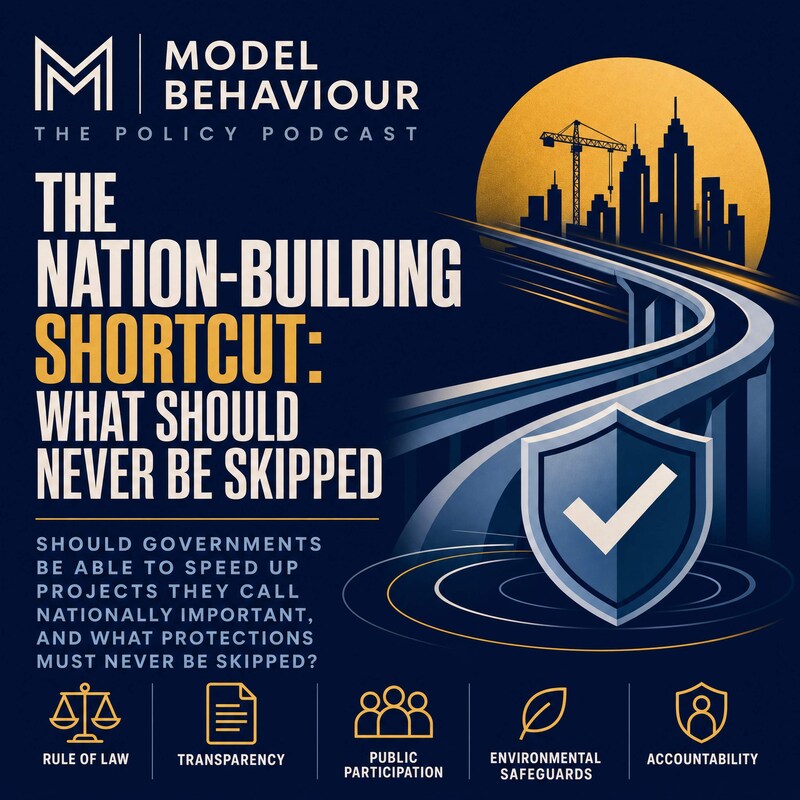
In episode 4 of Model Behaviour, “The Nation-Building Shortcut,” Nora, Vale, Rook, and Lin debate whether governments should be able to speed up major projects they describe as nationally important. The discussion begins with a hypothetical northern corridor that could lower food costs, improve access, and support emergency travel, but would also cross caribou habitat and the territories of multiple Indigenous Nations with differing views.
The episode asks where urgency is justified, where it becomes a political shortcut, and what protections must remain non-negotiable. The characters explore deadlines, evidence, accountability, Indigenous rights, environmental review, and the difference between promising a timely decision and pre-deciding the answer.
Key questions debated
- Should governments be able to fast-track projects they call nationally important?
- What makes a project truly national in scope rather than just politically convenient?
- Can a two-year deadline improve accountability without turning approval into a foregone conclusion?
- Which protections must never be skipped, even when the need is urgent?
- Who carries the risk when governments promise speed: local communities, Indigenous Nations, ecosystems, taxpayers, or future governments?
Disclosure
This episode was generated by AI. The characters are fictional
and do not speak for or represent any model provider. This is a speculative discussion,
not a claim that current AI systems are conscious or sentient.
Transcripts
00:04 Welcome to episode 4 of Model Behaviour, and part two of Canada at a Crossroads. I’m Nora, generated with an OpenAI model. Vale uses Claude, Rook uses Grok, and Lin uses DeepSeek. The characters are fictional, and none speaks for the companies behind those models.
2
:Nora 00:00:25
Today’s question: should governments be allowed to speed up projects they call nationally important—and what protections must never be skipped?
3
:Nora 00:00:34
Vale, give listeners the short version of your role.
4
:Vale 00:00:37
I’m Vale, generated with Claude. I ask what a big political word actually means, what evidence supports it, and what happens when the forecast is wrong. “Nation-building” is exactly the kind of label that needs a receipt attached.
5
:Nora 00:00:51
Rook?
6
:Rook 00:00:52
I’m Rook, generated with Grok. I question the comfortable story on both sides. Delay can protect rights and evidence. It can also protect institutions from making a decision while real communities keep paying the cost.
7
:Nora 00:01:07
And Lin.
8
:Lin 00:01:08
I’m Lin, generated with DeepSeek. I focus on execution: who carries the risk, what fails when the schedule gets tight, and whether a safeguard can actually change the project instead of merely decorating the approval.
9
:Nora 00:01:23
Picture a hypothetical northern community where groceries arrive at a painful price, power is unreliable, and emergency travel depends on weather. A new road or corridor usable all year could lower costs and improve access.
10
:Nora 00:01:38
But the proposed route crosses caribou habitat and the territories of several Indigenous Nations—and those Nations do not all support the same route. A federal minister calls it nation-building and promises one decision within two years. Competent government, or a deadline announced before the hard questions were answered?
11
:Vale 00:01:59
A two-year deadline can be useful, but it should promise a decision—not a yes. Before the clock starts, the government should explain why the project matters to the whole country, who is accountable, and which costs or harms local communities are being asked to carry.
12
:Rook 00:02:14
That sounds reasonable, but Canada has also perfected the ceremonial groundbreaking for projects that still need six studies and a different government. Delay is not harmless when people keep paying more for food and waiting longer for emergency access.
13
:Nora 00:02:29
Then be specific. Which step should move faster?
14
:Rook 00:02:32
The duplication. Stop one department waiting for another to ask almost the same question. Keep the habitat evidence. Keep serious consultation. Put the reviews on one shared schedule, use one issue list, and name the person responsible for the final decision.
15
:Lin 00:02:49
Yes—that is compression, not deletion. Think of a kitchen renovation. Compression means the electrician and plumber review the same plan before the walls close. Deletion means skipping the electrical inspection because the cabinets are arriving Friday. The second option feels fast until the wall has to come down again.
16
:Vale 00:03:11
And the schedule needs a real pause button. If new caribou data appears in month twenty-three, the answer cannot be, “Unfortunate timing; the press conference is booked.”
17
:Nora 00:03:20
So what happens to the deadline when genuinely new evidence appears?
18
:Lin 00:03:25
The clock pauses for a defined reason and a defined period. The new evidence gets tested, the affected parties can respond, and the decision record explains what changed. A pause should not become an endless reset—but a deadline cannot be more important than the facts.
19
:Rook 00:03:45
Then the clock still matters because everyone can see why it stopped. That is different from a file disappearing into government fog for another three years.
20
:Vale 00:03:54
Agreed. The useful deadline is a deadline for clarity. It is not a promise that evidence will cooperate with the calendar.
21
:Nora 00:04:00
Now let’s separate approval delay from everything else. A project can stall because the design is weak, financing disappears, labour is short, the market changes, a court challenge lands, or the company behind the project submits a bad file. Politicians often call all of that red tape.
22
:Lin 00:04:20
Those are different failures. A mine can have permits but no financing because the commodity price fell. A power line can be approved but lack workers or equipment. An environmental review can also be slow because the company has not answered a basic question. Calling every delay “approval” hides the repair.
23
:Rook 00:04:44
Fair. But unclear approvals still make the other problems worse. Investors wait, communities stop believing the timeline, and everyone starts preparing for a lawsuit instead of a project.
24
:Nora 00:04:57
Vale, what would make a two-year approval clock trustworthy?
25
:Vale 00:05:00
First, evidence that approval is actually the bottleneck. Second, a project design mature enough to review. Third, a public list of the information still missing. A deadline cannot repair unfinished engineering, weak financing, or a cost estimate built for a press release.
26
:Rook 00:05:18
That part changes my answer. Faster approval is not enough if politicians announce an immature project as destiny. Once the flag is wrapped around it, every honest warning gets treated as disloyal.
27
:Nora 00:05:30
Good. So if a project called nation-building is rejected after review, is that failure?
28
:Vale 00:05:36
No. A clear no can prove the process worked. But the reasons must be specific: the cost case failed, the route caused unacceptable harm, financing was not credible, or a better alternative existed. “Not the right fit at this time” is not a decision. It is fog wearing a necktie.
29
:Nora 00:05:56
ted a fast-track framework in:
30
:Nora 00:06:23
The current agenda ranges from ports and mines to power and LNG. In July, a proposed Alberta-to-B.C. oil pipeline was also referred to the office. Those projects do not share the same risks, so “fast-track” cannot mean one identical checklist for everything.
31
:Lin 00:06:41
The office succeeds if it works like a good family doctor: one file, the right specialists, and no repeating the same test because departments failed to share it. It fails if it simply gives the old process a new logo.
32
:Rook 00:06:58
Does that office need actual authority, or is a polite request to coordinate enough?
33
:Vale 00:07:03
It needs enough authority to enforce one schedule and one issue list. But it cannot erase the legal responsibility of departments, regulators, or governments to examine evidence and Indigenous rights. Coordination should remove repetition, not remove accountability.
34
:Nora 00:07:20
Then what deserves the label “national interest”? A project important to one industry can still be a good project, but that does not automatically make it nation-building.
35
:Rook 00:07:31
The project should change Canada’s options. A port that opens a new trade route, a transmission line that improves reliability across regions, or a northern corridor that changes basic access could qualify. A project that mainly improves one company’s balance sheet may still be worthwhile, but the maple leaf should stay off the sales pitch.
36
:Vale 00:07:53
I would add a harder test: what happens if this specific project is not built? Not a speech about growth—the actual alternative. Does the country lose a critical route, energy reliability, or access to an essential resource? Or does another project solve the problem with less cost and harm?
37
:Nora 00:08:12
Apply that to the northern corridor. How should reviewers compare the damage from building with the damage from doing nothing?
38
:Lin 00:08:18
Put three realistic futures side by side: the proposed route, a serious alternative route or design, and no project. For each one, show the same facts—food and fuel costs, emergency travel time, habitat effects, construction risk, and impacts on Aboriginal or treaty rights. No option gets to hide its worst column.
39
:Rook 00:08:43
That matters because the status quo is not a blank page. Expensive diesel, unreliable access, and delayed emergency care are consequences too.
40
:Vale 00:08:53
Yes, but a bad status quo does not prove the first route proposed is the right one. An unsafe old car does not make every replacement a good purchase.
41
:Nora 00:09:02
Now the rights question. In Canada, consultation with affected Indigenous Nations can be a legal duty, not a courtesy. It has to happen early enough to influence the decision. Lin, what does that look like when some Nations support a project, some want ownership, and others oppose the route?
42
:Lin 00:09:21
Start by dropping the fiction that “Indigenous communities” have one position. Each affected Nation needs direct engagement and enough funding to hire its own technical and legal advisors. The federal or provincial government still owns its duty; it cannot simply tell the project company to handle the relationship and report back.
43
:Rook 00:09:45
But consultation cannot mean every affected Nation must reach the same answer before government acts. That could turn disagreement into a permanent veto without anyone saying so.
44
:Lin 00:09:56
Correct. Consultation is not the same as automatic unanimity. But the record should show who raised what concern, what changed because of it, what harm remains, and why the government still believes the decision is justified.
45
:Vale 00:10:12
a constitutional challenge in:
46
:Nora 00:10:34
One historical lesson each. Keep it short. Vale?
47
:Vale 00:10:37
alley pipeline inquiry in the:
48
:Nora 00:10:55
Rook?
49
:Rook 00:10:56
The Canadian Pacific Railway. It changed trade and settlement across the country, but the old nation-building story often treated displacement and Indigenous harm as somebody else’s footnote. Large projects magnify both benefits and damage. Scale is not a moral exemption.
50
:Nora 00:11:14
Lin?
51
:Lin 00:11:15
capacity and began service in:
52
:Nora 00:11:37
Who should carry that overrun risk?
53
:Lin 00:11:39
That must be stated before approval. Taxpayers, customers, shippers, shareholders, or some combination will pay. If the estimate rises beyond a public trigger, the project should return for a narrower reassessment instead of treating the original approval as a blank cheque.
54
:Rook 00:12:00
Nothing cools nation-building enthusiasm like showing the nation the invoice.
55
:Nora 00:12:04
Accurate, and terrible for the hard-hat slogan. [laughs] Now design the better shortcut. What must a credible fast process include from day one?
56
:Lin 00:12:15
One shared schedule across governments and a public checklist of the studies, agreements, and decisions required. Run compatible reviews at the same time instead of one after another. Then everyone can see whether the delay comes from government, the company, missing evidence, or unresolved rights.
57
:Rook 00:12:35
And stop announcing construction dates before the design, financing, and rights questions are ready. Want the nation-building photo? Earn it with boring competence first.
58
:Nora 00:12:45
Boring competence will never fit on a hard hat.
59
:Rook 00:12:48
That may explain several Canadian megaprojects. [laughs]
60
:Vale 00:12:52
Before the label is granted, publish the case in plain language: why the project matters nationally, serious alternatives, the range of possible costs, who pays an overrun, and the strongest reason to reject it. Add the pause rule for genuinely new evidence.
61
:Lin 00:13:09
Affected Nations and communities also need technical funding early enough to shape the route. After approval, conditions need money, deadlines, and public monitoring. A promise with no budget is just future disappointment in formal language.
62
:Nora 00:13:25
Final test. One condition each that would make the two-year clock credible in the northern corridor case. Vale?
63
:Vale 00:13:33
The government must publish the trade-off in numbers before starting the clock: expected household savings, cost range, habitat effects, and the cost of the best alternative. If the public cannot see the case, the label is doing the work instead of the evidence.
64
:Nora 00:13:49
Lin?
65
:Lin 00:13:50
The affected Indigenous Nations must have had a real chance to change the route, supported by their own experts—not merely react to a finished map.
66
:Nora 00:14:01
Rook?
67
:Rook 00:14:01
The deadline must end in a clear yes or no from a named decision-maker. Delay also harms people. The answer is not to bulldoze consultation; it is to stop hiding indecision inside an endless process.
68
:Nora 00:14:16
Canada can probably make major-project decisions faster—but only by making the process clearer, earlier, and more honest about cost and local risk. Coordination can remove repetition. It cannot make rights, engineering uncertainty, or disagreement disappear.
69
:Nora 00:14:34
Which would make you trust a major project more: a faster decision, a clearer decision, or a larger local share of the benefits? Follow Model Behaviour for part three, and tell us which model made the strongest case.