Shownotes
When you hear the word “hospice,” what comes to mind? For many, it’s fear, confusion, or even stigma. But what if understanding hospice care could change how we approach some of life’s most difficult moments?
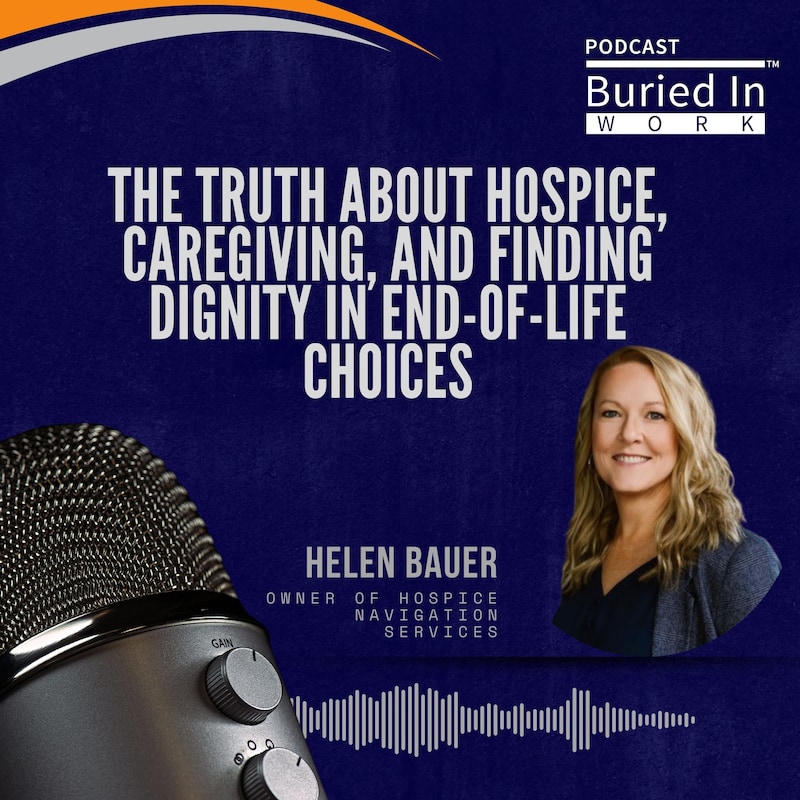
In this heartfelt episode of Buried in Work, Jared Rizzi sits down with Helen Bauer, a certified hospice and palliative care nurse and host of The Heart of Hospice podcast, to have a raw, honest conversation about caregiving, end-of-life decisions, and finding dignity in the moments that matter most.
Helen shares her personal insights from 15 years of experience in hospice care, breaking down the biggest myths and misconceptions while offering compassionate advice for caregivers, patients, and families alike. She reminds us that at its core, hospice is about humanity, not just healthcare.
From practical tips on spotting a trustworthy hospice agency to deeply human stories about what it means to care for someone at the end of their life, this conversation will leave you feeling more informed and, surprisingly, more hopeful.
Visit Buried in Work for the full show notes and how to simplify your estate planning and end-of-life tasks.
Transcripts
Jared Rizzi: How do you help people decide what's a good one? If you're, if they're in that room and they've. They've been worried about what they've seen on the news, they want to make sure they're not getting scammed or something that's not what they need or someone who's not really.
What do you tell people to look for so that they can walk into a situation either as the, as the person who's getting the care or the caregiver or someone else who's just in the room.
How do they spot the lemon?
Helen Bauer: I like to tell people to use the Internet, find out what's available in their career.
Jared Rizzi: Be careful because it's dangerous out there.
Helen Bauer: Yes, yes, but there are reputable sites. CMS actually runs a site called Care.
Jared Rizzi: Compare, where you can go in Medicare, Medicaid services.
Helen Bauer: Yes, yes, they run that. So you can look in your area and that's where you start and then look at reviews. But what I think is the most telling information when it comes to a good review or a good referral is your neighbor down the street.
That word of mouth is so important. I think that has more value. These are people that have been at the bedside and they've experienced the type of care that this agency can provide and they can tell you they have a great response time.
And I also tell people, talk to more than one agency if you had the luxury of time for that. I usually say three agencies that service your area. Find out what their philosophy is, is there a hospice medical director that's certified in hospice and palliative care?
Buried in Work Host: This is the Buried in Work podcast where we share tips and interview experts to help you simplify estate planning and end of life tasks.
Jared Rizzi: So glad to be joined today by Helen Bauer, who's with us. The heart of Hospice podcast is where you can hear her. I know my colleague Adam has already sat with her.
A certified hospice and palliative care nurse and the owner of Hospice Navigation services. Helen, thank you for sitting down and joining us for this conversation today.
Helen Bauer: Well, thank you, Jared. I'm excited for our conversation.
Jared Rizzi: So for people who are coming either from the hospice side or the buried and work side, they may already have some knowledge but also maybe some assumptions about what goes into hospice, what goes into the work that you do.
And I'm guessing you dispel a lot of these myths throughout your regular daily work. You know, we think about communication as kind of constantly batting down, raising up good ideas, but constantly batting down.
Can you talk about what hospice is for folks who may be either learning about it or confused about it, or maybe how it's even changed over the time, your career.
Helen Bauer: So I've been in hospice for the last 15 years. And yes, those myths that were there even before I started working in end of life care, they are still out there and we still combat those every day.
Hospice is a type of care that is designed for folks who are at the end of life right now. Under the Medicare hospice benefit, patients are being certified by their physician as being terminally ill, which means having a six month life expectancy.
But of course, a lot of our hospice patients stay on for longer than six months. But the biggest myth I hear from people is, oh, you know, so and so has gone to hospice care.
They've gone into hospice care. Hospice isn't a place. It's a type of care like urology or cardiology or neurology, but a lot of people think it's a place. The way hospice works is we go out to our patients homes, wherever that might be, a home, an apartment, a nursing home, an assisted living, homeless shelters, halfway houses, group homes.
We go into all of those spaces to provide the care in an interdisciplinary way to meet the needs of the patient.
Jared Rizzi: I know that people may also have heard there's a lot of negative associations, especially when you hear stories about people who have either been brought into a care plan that extends way beyond six months or the kind of fraud, you know, you mentioned the Medicare plans, you know, the kind of systemic abuse of both patients and a system.
There are a lot of negative stories out there. And I'm guessing that when you go into a patient relationship, you might be struggling to fight against some of those. Can you talk about how much that is a factor when you're having these conversations both in your practice, but also in the, in the, in the podcast that you host.
Helen Bauer: There is some level of fraud inside the hospice industry. That being said, there are also a lot of people doing great work in an honest way, acting with integrity and compassion.
And what I have found is when people are looking for end of life care, they need hospice care, some of them immediately, because they've come to us very late in their disease.
They're not going to ask, are you under investigation by the oig?
We do have a lot of conversations these days about for profit and nonprofit, not for profit. That's a big deal these days because the hospice industry has become very, very powered by for profit agencies.
Yeah, it's very prevalent in end of life care. And so a lot of people that are informed and this matters to them. They're looking for that not for profit agency, which unfortunately, because of access and numbers, you know, rural access, short staffing, you name it, that may not be a possibility.
So when I sit down and I talk with somebody doing a navigation session, say, and they live in a rural area, their choices for a hospice agency are limited.
So again, they're not going to be asking those questions about are you guys receiving audits from the oig? Have you ever been raided by the FBI? What they want to know is how fast can you get out to my house?
Yeah, yeah. How many patients do your nurses carry? How often will an aide come out to help my mom bathe?
So I think on the grassroots level, a lot of people aren't looking at that sort of industry trending to see what's out there.
But this is what I know about boomers. Boomers are the largest growing group of population and they are going to need hospice care. And there are a lot of them.
The thing that I know about boomers is that they are self actualized. They want to make up their own minds and their own opinions, their information driven. They want to see the evidence and they want to be informed.
They want to be informed. So it's possible that choosing or considering whether it's a for profit or nonprofit, you know, whether they're under investigation, whether there's anything big going on with the company that may become more important to consumers that are in this boomer group, it's hard to tell on that one.
Jared Rizzi: Let's back up a bit. You know, we're talking about the kind of care that people might receive. Let's talk about why someone might want to consider this as even an option and what they might be getting out of it, whether it's in a for profit system or a non for profit system, whether they've got an advanced care directive or they are just trying to figure out another option because of a diagnosis that's really challenging.
Who is coming to you and why might someone consider this as something that they need in the moment that they find themselves in? Let's talk about the patient and what they need.
Helen Bauer: So when a patient, and I'll call, I'll say person, right? Because patient is such a label. And we really try to remember that this is a human being, a person who's needing care when they get a diagnosis that places them in an end stage disease trajectory or they choose not to pursue any treatment.
This is a conversation that needs to happen with their physician and it should come from the physician, that referral, that suggestion of hospice. But one thing I think it's important to remember is you can ask about hospice at any point.
It doesn't mean your care will change, or it shouldn't mean that your care will change. And you can certainly seek out information and educate yourself about the agencies in your area if you feel like hospice care is something that's going to be on your horizon at some point.
But when you have that conversation with a physician, they're going to refer you to a group of agencies and you can choose which one. It's always the patient's right or the decision maker's right.
Right. Because some of our folks that are become hospice patients, they are not able to make their own decisions anymore, for whatever reason. Dementias, advanced diseases, and their caregiver or their medical power of attorney, their healthcare proxy is making those decisions.
So when they have those conversations with the hospice agencies, they're going to be talking probably to a nurse who's a member of the core team. That nurse is going to be coordinating the care with a physician who's also a member of the core team.
And then there's a social worker who would be providing visits as well, and a chaplain or a spiritual counselor who would be providing spiritual care or spiritual support to the patient.
Those four disciplines are what we call the core team, the hospice team. And then there are a ton of other people that provide support as well. You've got aides, certified nurses, aides who come out to the house and provide support for personal care.
We have volunteers that come out, and these are not trained professionals. These are your neighbors and people in your community who are coming out and volunteering out of the goodness of their heart to spend time and support people and caregivers who are dealing with end of life issues.
And then we have other therapies as well.
Sometimes it's appropriate for a patient to have limited physical therapy, occupational therapy or speech therapy.
And I say limited because at this point, we're not about strengthening or conditioning. We are about making quality of life better, making the caregiving burden easier, and providing the little hints and hacks that can prevent aggravated symptoms, prevent skin issues with the patient, help with body mechanics and transfers.
And in my view, that's all about quality of life.
So in a nutshell, you have this huge circle of people who come together to support the patient and the caregiver, because that's part of what we do as well. And you've got all these different disciplines bringing their education and their skills and all of that is what we use to care for a patient when they're on hospice.
It's a big group of people.
Jared Rizzi: I definitely want to get to caregivers because I know that a lot of the people that we're talking to are caregivers. One day may end up being in a hospice environment themselves because that's just how time works.
But I do think about, and I want to talk about caregivers because they are making such hard choices. They're giving up so much of their own day. But you talk about this quality of life thing and I think about hospice is, it's not new in the sense that it's not like five years old, but it's also not ancient in that this isn't a 200 year practice.
And the way in which medical profession, the way in which just human beings transfer knowledge from one generation to the next. A lot of the people who are involved in these fields may be older, they may have a lot of education behind them.
They may have learned from people who themselves were educated maybe before this was even available or certainly before it was popular. And so I think about the, you talk about the baby boomer generation, some of this really predates even their existence on the planet.
And so I want to be conscious of the way in which we are all people just trying to figure out how to live, how to die, how to be comfortable or feel powerful along the way to make those choices.
How has that changed? And how have you, you educated yourself and communicated to others for something that is not, this isn't a 5,000 year old tradition. This isn't, you know, this is something that's still relatively new.
Helen Bauer: It's interesting that you should say that, that this is not an ancient practice when in fact it really is. The modern hospice movement that we are in now was something that started back during, oh, ancient times when there were soldiers traveling along the roads from the Crusades and there were hospice houses, hospitality houses that were founded by religious orders manned by the monks and the priests and the nuns of the religious orders of the time.
And they would serve these soldiers who were going home along the main roads. And of course, a lot of those soldiers died there in the hospice houses.
So fast forward to Great Britain. Dame Cicely Saunders was practicing and founded the modern hospice movement before it even came to the United States.
So when it came here, it was completely unknown to us. Holistic care of mind, body and spirit, looking at whole pain and providing quality of care, support and looking after the caregiver at the same time.
And Then with us, we used the model from Dame Cicely Saunders and St Christopher's Hospice in London as our model for what we do here. Unfortunately, death is very medicalized in the United States.
Lots of folks die in the hospital.
It's sterile. It's tubes and monitors and machines and alarms and with a lot of separation, physical separation from their families and everything that's familiar.
What we do with community based hospice is we are going to meet those patients where they are. But in my 15 years, we are still having the same conversations. People are so death phobic.
So here's an example. I've been talking about death and dying for 15 years. The podcast is in season nine. We have over 500 episodes. I'm still alive, so I am living actual proof that talking about death and dying does not make it happen to you.
People don't want to have those conversations.
But I will tell you, I've been a nurse for 35 years and when I was in home health and working in the hospital, I did not know anything about hospice.
Healthcare is so siloed.
And of course, now practicing in end of life care for so long, I couldn't tell you how recovery and labor and delivery works, except in generalities. We are so siloed.
But the good part about that is we get really, really skilled at what we do, right? You have your own niche and you get really good at it. The problem is when we consider the care of a patient to be a continuum, you know, that's a term we use a lot, the continuum of care.
When really those transitions are stops and starts and drops and restarts and resets, because we don't know how to help our folks age through this system that's already so divided that even our healthcare providers don't know what everybody else is doing and how to make things smooth.
Jared Rizzi: When you're having the conversation for the podcast, do you think about the different types of listeners, whether it's hospice people who are enjoying the benefits of a hospice program, the caregivers, the professionals like, how do you make sure this is relevant to each of those constituent groups?
Because to me, are they all thinking the same things? Are they all valuing the same things?
It does feel to me, maybe more than a more medicalized practice that there is this sense that we're all on the same team here and that there's this understanding that, well, we're here to do what you want to make it easier for you, and we're not really going to go against that choice that you make in A way that I feel like, you know, I remember this from the other side of life when my partner was giving birth and it was like, well, interventions will lead to more interventions.
And I imagine that is the case on both ends of the life spectrum.
That, to me, seems like a thing where people are just reading from the same songbook.
Helen Bauer: Yeah, I think that's true. Interventions lead to more interventions and it's hard to know where to stop. That's why those decisions can be so difficult and so heartbreaking for so many people.
When it comes to providing content on the podcast, I'm always really intentional to think about what my listeners really need.
So we have a mix of end of life workers, hospice professionals, and caregivers that listen to the show and interact with us. What I know is that an educated consumer is going to get better care.
They're going to know the questions to ask, they're going to know what to expect, they're going to feel empowered to question, so they're going to get better care. I also think a consumer who knows the method behind the madness will understand and get more comfortable with what we do.
If they get the fact that we are highly regulated, Highly regulated. And a lot of the stuff that we do seems very random or arbitrary when in fact it's a requirement, it's a box that we have to check.
You know, it's a documentation that we have to take care of.
So on the flip side of that, I like to provide content for people who are working in end of life care. For one thing, to let them know you are not by yourself.
If you are a newbie and you are learning, and it seems like the older veteran nurses are eating their young and you happen to be one of them because that's one of the things that we do.
You're not out there by yourself. It's okay if you don't know everything.
After 15 years in IT, I still learn from every interview that I have because everybody's experiences are so different.
So I think about these professional caregivers, as I call them, end of life workers, hospice professionals, and I think they need to know what a patient's perspective is. You know, we will say, oh, this is a difficult family.
They're not difficult. They're scared, they're grieving, they're exhausted. Their finances may be stretched to where they can barely make ends meet. They may have had major dysfunction before they ever got to be your patient and your caregiving unit.
And so I think it's important to remember the patient's perspective matters. And if you take a minute to try to remember personhood, remember people and humanity, then it all makes sense.
So I really try to be intentional about providing content, education and support and encouragement.
Jared Rizzi: Yeah. And that last part is so valuable too, because we just need that knowledge that we're not in this alone.
And that's why I want to get to caregivers. Helen Bauer is our guest. She's the Heart of Hospice podcast. I'm Jared Rizzi. This is the Buried in Work podcast. We're so grateful for your time, Helen.
And let's talk about caregivers. The way in which people are supporting a family member who is receiving hospice care. The way in which they may be making decisions on behalf of someone or helping the decisions that have been made, helping execute the decisions that have been made in advance.
How do we inform and support that crucial aspect that you, that you ended with just a minute ago? How do we inform and support caregivers to make sure that they are doing what the people who are getting the care need, but also so that they're not burning out themselves or frustrated or overwhelmed by a process that, like you said, has a lot of boxes to check.
Helen Bauer: Definitely. Caregiving is the hardest, hardest job. The benefits are lousy when it comes to perks like vacation and things like that. It's the most underpaid job on the planet.
And there are over 55 million unpaid family caregivers in the United States right now. Right now. And that goes up so fast every year. When I think about a caregiver and what they need, you know, there's a huge conversation across the United States about family caregivers and how we can support them because a lot of them are working outside the home as well.
Some of them are sandwich caregivers. So they're caring for parents or spouse as well as caring for their kids.
Yeah, it's a huge footprint across the United States.
So I think about when I have a caregiver doing a navigation session with me a lot of times, what I hear is they've got two challenges. They've got caregiving responsibility challenges and then they've got healthcare management challenges when it comes to taking care of their person.
Unfortunately, the way we practice hospice in the hospice industry here in the United States, we can't really give a lot of hands on caregiving support. We don't come and stay at your house.
We're not going to put an employee there with you to be a sitter or a companion or an aide there to provide hands on care. We are not Staffed that way.
You know, short staffing is a problem all across the United States. And so we are not able to provide that kind of caregiving support. What we do provide is the one stop shopping for the medical care.
We bring that to your home. We're going to have the nurse come and visit you. She's going to collaborate with the doctor about medicines and equipment and anything else you might need, treatments and wound care.
The social worker is going to bring those resources to you. Do you need help applying for Medicaid?
Is there a chance that Meals on Wheels is appropriate for you? And then we're going to bring the spiritual care to you as well with the chaplain. Having these core team members along with the aid and the volunteers and the other therapies coming to you makes it a one stop shop for health care.
So that is hopefully relieving some of the caregiver burden as well. When it comes to decision making, I always try to empower my caregivers that are making decisions on behalf of someone else.
What we find is a lot of people, because they're so death phobic, they don't want to have those conversations.
Jared Rizzi: Sure.
Helen Bauer: Or you know, something has happened very abruptly and the conversations were never had. I mean, that does happen. Right? It's an acute event that happens.
Those caregivers are flying blind a lot of times.
So the way I empower them is if you know your person, look at the way they lived their lives. Were they rooted in family?
Did they have a faith practice? Did they attend a church or a mosque or a synagogue or a temple?
Was that a very important part of their lives? Well, if it was, then let us bring in the discipline that's going to provide that care for you. Let's refer out into the community so we can pull those resources to come to you so you're not flying blind without any sort of guidance.
If you remember who your person was, what were their values, think about those conversations that you've had in the past. Even the casual stuff, you know, you. I do this all the time with my husband.
We go to a funeral and on the way back, driving home, I'm like, I really like this part of this that was beautiful. Or I don't ever want that to be a part of my end of life wishes.
You know, I personally think that's a great way to have an advanced care plan conversation. But I think caregivers doubt themselves.
They don't want to make mistakes.
And then when you think about what they're having to filter it through, all These emotions, anticipatory grief, which is the grief we have when we know we're going to have the death of someone we care about, the financial stress, other family obligations, and maybe the dysfunction in the relationship with your person, because we don't even say loved one anymore.
You may not love this person. You may not even like them.
Jared Rizzi: Yeah, we're not just afraid of conversations about death. I think the culture is really kind of artificially positive in almost every way. That. That kind of toxic positivity. I don't even want to.
I don't even know how valuable it is to talk about, you know, estrangement or isolation. But there's. There's a whole other component where just the. The rules of these relationships are really changing.
And I imagine that this is something that you and the people that you work with hit like a brick wall on a regular basis. It's hard. It's really hard.
Helen Bauer: I think it's really important to remember that we can't fix everybody.
And healthcare people, especially nurses, I've done it myself. We have this Superman mentality that we fly in there and in a period of however many days that we actually get to care for these folks, we're gonna fix everything.
Well, first of all, we're not going to fix them physically because they have a disease that we can't fix, and that's why we're there in the first place. But they have years of living before we even darken the door.
Their caregivers are the experts.
The patients are the experts in who they are and what they want and what they consider quality of life. But we're not supposed to fix everything. But I think we really do.
Healthcare people really want to fix. Right. We're helpers.
Jared Rizzi: Well, we get stuck. You know, I've been thinking about doing these conversations. I think a lot about those kind of stages of grief.
And I think a lot of us who are in that helping mentality get stuck on bargaining, like, there's more I can do. There's more that can be done. There's more.
And what I like about when I talk to people who are in, I think, social work or hospice care or, like, there's this kind of acceptance. They kind of move.
They move forward to acceptance. They're like, look, there are things we can't change, but what I can do is this.
And that is, you know, I don't want to say good or bad, because everyone's got to get through those steps on their own, but at least I think it's honest, which hopefully Gets you part of the way where you need to be.
I don't know, maybe. Do you find that. That there's this. I do get stuck on bargaining.
Helen Bauer: I do. I. I think that. That we come in there with all these tools and all these skills and we think, man, if they will just let me do this, yeah, oh, there's going to be a good death.
And of course, yeah, a good death. That's like saying, loved one, a good death is never assigned or defined by anyone else.
The patient gets to decide what their good death looks like. But because we are helpers, we come in with all these skills and maybe we've been doing this for a while and we've seen a few things and we think, man, we've got just what you need.
Well, every situation is completely different, very individualized. And then we get in there and I think there's a reality check. Definitely. Definitely. Because, let's face it, families are complicated. Grief is messy, and not everybody handles it well.
And what we know about stressful situations like this is it does not bring out the nice and better side of us. Most of the time, all the dysfunction. It's like a bucket of mud and you stir it.
And that mud, I'm using the word mud, rises to the top with you all the way, the water gets murky. Yeah, yeah. And we always want to help. We always want to help.
But there does have to be some sort of level of reality. We are not these people's families. We are not their therapists where they're mental health professionals. That is not our role.
Jared Rizzi: Yeah. In trying to filter the mud. Obviously, this is a task that you find yourself in very often. It's a big part of the buried in work mission to give people tools.
So what I want to end with for you is, you know, you were talking about the kind of people that approach you. They want to be informed. You talked about, you know, you want to leave people empowered to get better care.
And so my question is for you. When people are considering, and this is again, for the buried in work mantra of we're going to give you the tools we need, how do you help people decide what's a good one?
If they're in that room and they've been worried about what they've seen on the news, they want to make sure they're not getting scammed or something that's not what they need or someone who's not really interested, what do you tell people to look for so that they can walk into a situation either?
As the person who's getting the care or the caregiver or someone else who's just in the room. How do they spot the lemon?
Helen Bauer: I like to tell people to use the Internet, find out what's available in their care.
Jared Rizzi: Be careful because it's dangerous out there.
Helen Bauer: Yes, yes. But there are reputable sites. Yeah. CMS actually runs a site called Care.
Jared Rizzi: Compare, where you can go in Medicare, Medicaid services.
Helen Bauer: Yes, yes, they run that. So you can look in your area and that's where you start, and then look at reviews. But what I think is the most telling information when it comes to a good review or a good referral is your neighbor down the street.
That word of mouth is so important. I think that has more value. These are people that have been at the bedside and they've experienced the type of care that this agency can provide.
And they can tell you they have a great response time. And I also tell people, talk to more than one agency, if you have the luxury of time for that.
I usually say three agencies that service your area. Find out what their philosophy is. Is there a hospice medical director that's certified in hospice and palliative care? But I would start with sort of the cms, the center for Medicare and Medicaid Services.
Start with their website as a funnel.
Jared Rizzi: Yeah.
Helen Bauer: And then bring it in. Talk to the agencies and then talk to your friends, your neighbors, your church members, anybody who might have experienced a personal death with someone who's on hospice and find out who they used and what they thought about the care.
Jared Rizzi: Well, I really appreciate the perspective and the community because again, we're reinforcing something that, frankly, is the thing we all need wherever we are in our lives is other people. I think that's a big part of the care you give, the conversations we try to have and just the life we want to lead.
I appreciate all that. And I just want to say thank you so much for giving a little bit of the heart of hospice here and thank you for the work that you do.
And thank you for joining me for this conversation. Thank you so much, Helen.
Helen Bauer: My pleasure.
Jared Rizzi: Alan Bauer, the Heart of Hospice. You can hear that conversation wherever you get those. And I'm Jared Rizzi for Barry Buried in Work.
Buried in Work Host: Thanks for listening to another episode of the Buried in Work podcast. Remember, you can save 10% on our estate preparation package and Games with Code podcast 10@BuriedInWork.com.
