Shownotes
This special episode of Boomer Banter is part of Podcasthon's week-long initiative to have podcasters shine a spotlight on non-profits they support.
I chose to highlight the impact of the American Association of University Women (AAUW), with an in-depth examination of the organization's commitment to advocating for women's rights and educational equity.
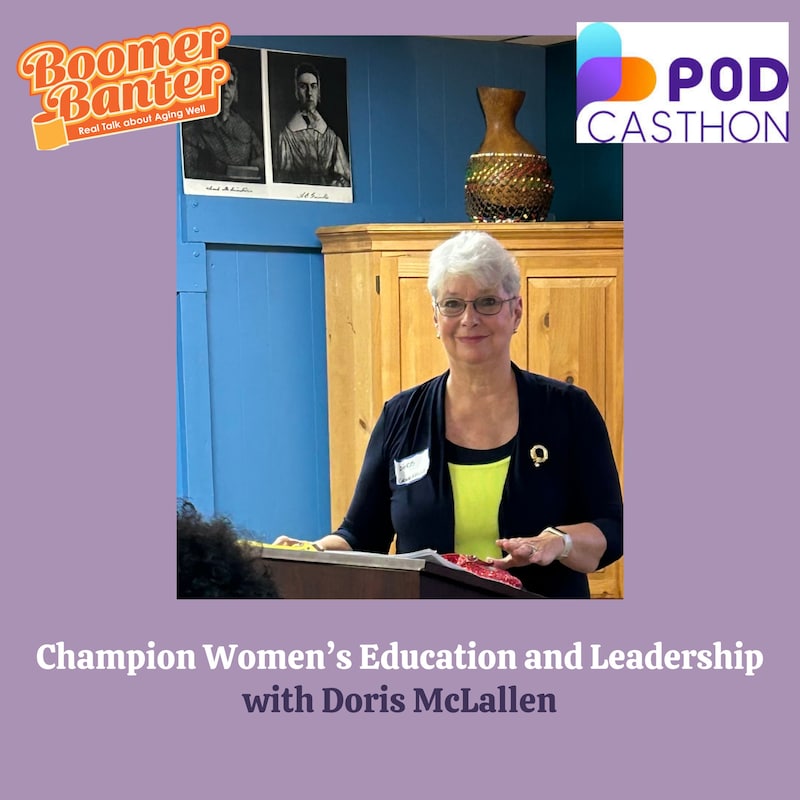
My guest, Doris McLallen, is the State President of AAUW-SC and has been a member of AAUW since 1978. She told the historical story of the founding of the organization, tracing its origins back to 1881 when a group of women sought to redefine the societal expectations placed upon them. Taking us to the present, the mission of AAUW is "to advance gender equity through research, education and advocacy."
In our discussion we reflected on the barriers that continue to impede women's progress in higher education and employment. Doris discussed AAUW's innovative programs, such as Work Smart and Start Smart, which empower young women with the necessary skills to negotiate salaries and advocate for themselves within the workforce.
This was an inspiring episode that reflected on the advancements women have made in education and the workforce and reminded us of the barriers that are still present.
Takeaways:
- AAUW has been advocating for women's education and employment opportunities since its inception in 1881, highlighting its longstanding commitment to gender equity.
- This episode emphasizes the importance of community engagement in empowering women through networking and mentorship opportunities provided by organizations like AAUW.
- The discussion outlines the challenges women face in negotiating salaries and the vital role of programs like Start Smart in equipping them with necessary skills.
- The episode illustrates the historical context of women's rights and the ongoing struggles for equality, emphasizing the need for continuous advocacy and support.
Links referenced in this episode:
- Join us on the next Boomer Banter membership Zoom, on Tuesday, March 25 at 5:30pm ET. Email me at wendy@heyboomer.biz to claim your free month now!
- Visit www.podcasthon.org to discover hundreds of other associations through the voices and talents of amazing podcasters!
- Explore the amazing work that the American Association of University Women is doing to support women and girls in higher education and the workplace. aauw.org
- Email Doris McLallen directly to learn more about AAUW.
- Learn more about Greenwood Capital or find resources at www.GreenwoodCapital.com. Boomer Banter is sponsored in part by Greenwood Capital Associates, LLC. Greenwood Capital Associates, LLC is an SEC Registered Investment Advisory firm with offices in Greenville and Greenwood, SC. As a fiduciary firm, Greenwood Capital is obligated to disclose any potential conflicts of interest with this arrangement. The host of “Boomer Banter”, Wendy Green, is a client of Greenwood Capital, and her show “Boomer Banter” has been compensated for her testimonial through Greenwood Capital’s sponsorship. Greenwood Capital is a Legacy sponsor at the stated rate of $2,600 for the 2025 calendar year.
This podcast uses the following third-party services for analysis:
OP3 - https://op3.dev/privacy
Transcripts
Well, happy St.
Speaker A:Patrick's Day to you all.
Speaker A:As the Irish say, wishing you a pot of gold and all the joy your heart can hold.
Speaker A:And I'm very happy to participate in this third edition of Podcast thon.
Speaker A:For one week, more than a thousand podcasts will highlight a non profit of their choice.
Speaker A:Imagine that.
Speaker A:And today I have the pleasure of welcoming Doris McLallan to talk about the work that the American association of University Women, AAUW for short, is doing.
Speaker A:So podcasters all over the world for this week only are going to be addressing one of their favorite charities in this event to raise awareness for what is going on in the world and how so many people are trying to help.
Speaker A:In this episode, we're going to talk about breaking barriers in education and and employment for women and why this work is so vital today.
Speaker A:I am a member of AAUW and have been advocating for women's rights and women's equality for most of my adult life.
Speaker A:If you care about women's advancement, leadership and education, this episode is for you.
Speaker A:So welcome to Boomer Banter.
Speaker A:My name is Wendy Green and I am your host for Boomer Banter.
Speaker A:I want to mention very quickly about some of the other things that we do here on Boomer Banter.
Speaker A:And as you know, as we get older, our social circles can tend to shrink because our friends move away, some relationships fade, and if we're honest, life can start to feel a little quieter and maybe even a little lonely at the same time.
Speaker A:Some of us worry more about our energy, our memory, and what aging really means.
Speaker A:But we don't always want to talk about it.
Speaker A:Although we do on Boomer Banter, because deep down, admitting we're getting older can be tough.
Speaker A:So that's exactly why I created Boomer Banter membership.
Speaker A:A warm, welcoming space where real conversations happen, friendships form, and we navigate this next chapter together.
Speaker A:So for just $25 a month, you'll get exclusive access to two interactive meetings each month.
Speaker A:And the best part, you can try the first month free.
Speaker A:No commitment, no risk.
Speaker A:Just email me at wendyboomer Biz and I'll get you set up.
Speaker A:And if it's not for you, no hard feelings.
Speaker A:But if you love it, and I think you will, we'll welcome you into our thriving, supportive community.
Speaker A:Spots are limited, so don't wait.
Speaker A:Grab your free month today.
Speaker A:Email me at Wendy at heyboomer Biz.
Speaker A: uest on Boomer Banter back in: Speaker A:Wow.
Speaker A:I'm so excited to have her back.
Speaker A:So Doris and her husband Scott moved to Greer in Greenville County 12 years ago from Watertown, New York, where she had been a member of the Jefferson county branch of AAUW.
Speaker A: She joined in: Speaker A:Doris has retired from a career in public school administration and before moving to South Carolina, served 15 years on the Black River, New York Village Board, including eight years as mayor.
Speaker A:Finding a nearly 100-year-old branch of AAUW in Greenville, South Carolina was Doris into her new community and the beginning of many new friendships.
Speaker A:Excited to be a part of the revitalization of the historic Greenville county branch, she served as president for the next seven years.
Speaker A: UW South Carolina in April of: Speaker A:She enjoys the AAUW Book Group and has volunteer affiliations with Greenville County Schools, the American Cancer Society, Relay for Life and Road to Recovery programs, the League of Women Voters, and Moms Demand Action for Gun Sense in America.
Speaker A:Wow, we could have talked about any of those things.
Speaker A:Doris's children and grandchildren are her pride and joy, and she is especially proud to be an AAU legacy member.
Speaker A:And I am so happy to welcome Doris back to Boomer Banter for episode number 224.
Speaker A:We've come a long way since that first interview, Doris.
Speaker B:We certainly have, Wendy and I've been so delighted to be along for the ride and watch Boomer Banter go from know hey, Boomer, which we were happy with, to, you know, things evolve and you evolved into Boomer Banter.
Speaker B:We love that too and enjoy being part of it.
Speaker B:Thank you for thinking of me and this nonprofit AAUW for the podcast.
Speaker B:Podcast A Thon.
Speaker A:Podcast Thon.
Speaker A:I know it's not easy to say it's caspon.
Speaker B:Exactly.
Speaker B:I'm thinking of all the worthwhile organizations.
Speaker B:What a great effort on behalf of.
Speaker A:Podcasters everywhere and nonprofits.
Speaker A:Yeah, I'm very excited about this event.
Speaker A:So let's start by telling people a little bit about the history of AAUW.
Speaker B: very beginning of AUW was in: Speaker B:So over 140 years of an organization that is working for women and girls around the world.
Speaker B: Well, why: Speaker B: What was happening in: Speaker B:Well, there were some young women in Boston who they were, well, to do enough that they were allowed to go to college.
Speaker B:But when they got out of college, there was nothing expected nothing except a trip down the aisle and they would get together and have tea and just decide that they wanted to do something more.
Speaker B:And so they started raising a little bit of money and putting that money aside and then establishing fellowships.
Speaker B:Okay.
Speaker B:Funding women for higher education to give them opportunities.
Speaker B:I want to say that the very first fellowship, this is a.
Speaker B:Certainly an item of pride for auw, went to Marie Curie.
Speaker A:Is that right?
Speaker B:That's right.
Speaker B:To buy her a little bit of radium that she needed to do her research.
Speaker A:That's exciting.
Speaker B:And of course, she was in France.
Speaker B:And so that points out that AUW started out global and is still a globally active organization.
Speaker B:Yes, it was.
Speaker B: Now, remember: Speaker B:Anthony.
Speaker A:Sure, yeah.
Speaker B:No, Susan B.
Speaker B: Anthony, since the: Speaker B:And she traveled all over.
Speaker B:She didn't give up.
Speaker B:But did she ever see women vote?
Speaker A:No, she didn't.
Speaker A:Did.
Speaker A:She?
Speaker B:Never did.
Speaker B:She never did.
Speaker B:So it's in that era, Susan B.
Speaker B:And all the women's organizations are growing up.
Speaker B:AAUW is established and has thrived ever since.
Speaker B:And, yeah, I'm delighted to be a member here.
Speaker A:So it.
Speaker A:So it started in Boston?
Speaker A:Yes, started in Boston.
Speaker A:And then how did they get the word out?
Speaker A:How did it start to spread?
Speaker A:Do you know?
Speaker B:Well, not exactly, except that they're called.
Speaker B:Branches were established and just grew, you know, from Massachusetts to other states.
Speaker B:There are currently 47,000 members across the US and I think that number is down.
Speaker B:Unfortunately, we're in an era now where women have made strides.
Speaker B:A lot of women are working.
Speaker B:Young women aren't joining.
Speaker B:And if I can make a plea right now during this, or if you, if you're a grandma or a mom and you have a young woman in your life that could use some support, some mentoring, some a fellowship, perhaps to go to graduate school, check out.
Speaker A:Well, and I think.
Speaker A:I think you're right.
Speaker A:I think this is a global problem, particularly since the pandemic.
Speaker A:I've read so many articles about people got so used to isolating that they're not joining as.
Speaker A:As much as they used to.
Speaker A:And of course, younger women are busy with work and families and whatever, but it's a great organization for young women to learn so many skills, in fact.
Speaker A:What.
Speaker A:What are some of the things that AAUW will teach young women, whether they join or affiliate themselves with aauw?
Speaker B:Mm.
Speaker B:Well, raising awareness and providing opportunities through webinars and.
Speaker B:Or, you know, other other workshops and things.
Speaker B:Always done.
Speaker B:But we have a program called Nick Whistle, that's the National College Collegiate College, Collegiate Student Women Leaders.
Speaker B:And it's a four day conference every year in May at the University of Maryland.
Speaker B:It's held young women come from across the country to attend Nick Whistle.
Speaker B:And I'm very proud that our Greenville branch in South Carolina choose to support that organization.
Speaker B:And so all kinds of wonderful speakers and opportunities to primarily learn leadership skills.
Speaker A:And do they have to be a graduate student for that or is that undergrads?
Speaker B:No, that's undergrad.
Speaker A:I have to tell my granddaughter about that.
Speaker B:Yes, absolutely.
Speaker B:And it's a lot of fun too.
Speaker B: n who introduced me to AUW in: Speaker B:My baby boy wasn't even a year old.
Speaker B:I decided to go on a trip with a lot of ladies who at the time were older.
Speaker B:Was the Historical Society.
Speaker B:I have the same white hair now that they had then.
Speaker B:But I was 27.
Speaker B:I had moved to an area I didn't know a soul.
Speaker B:But I decided I wanted to take this bus trip to Toronto.
Speaker B:No, pardon me, to Ottawa, Canada, to see a Monet Manet exhibit.
Speaker B:Well, before I got off that bus, I was introduced and welcome and.
Speaker B:And as invited to auw, those ladies on that bus are still best friends of mine.
Speaker A:Wow.
Speaker B:The connections you make, the lifelong friendships, can't put a price on that.
Speaker A:That's for sure.
Speaker A:That's for sure.
Speaker A: ticed you in the beginning in: Speaker B:I wasn't wholly in tune with the need for women to continue to break barriers.
Speaker B:I don't know.
Speaker B:I'm the oldest of five.
Speaker B:I had four brothers younger.
Speaker B:I was already a leader.
Speaker B:Right.
Speaker B:And in charge.
Speaker B:But.
Speaker B:But going way back to when Abigail Adams wrote to John, many of you know this, and he was working on the Constitution and said, john, remember the ladies.
Speaker A:Oh, God bless Abigail Adams.
Speaker A:Right?
Speaker B:Yeah.
Speaker B:But did John and the boys remember the ladies?
Speaker A:No, they did not.
Speaker B:Did not.
Speaker B:And we are still fighting that battle, and that's a battle that AAUW is deeply involved in, is the.
Speaker B:Well, we've passed the 28th amendment, the ERA, the equal rights Amendment, fought so hard for so long, and now there are barriers to the quote, unquote, publication of the era.
Speaker B:But anyway, I attended a college in a college town with the neighboring college was a school for engineers, for engineering, and in the late 60s had only just gone co ed.
Speaker B:And those first young women in the engineering school, they allowed in 50.
Speaker B:And today, because of the hard work and the great quality, women weren't even invited into those stem, those science, technology and engineering fields.
Speaker B:Now I hear there are more young women than young men graduating in engineering.
Speaker A:Yeah, I hear, I hear that.
Speaker A:Engineering, law, medicine, all of them.
Speaker B:But progress, but hard fought progress.
Speaker A:Hard fought progress.
Speaker A:I mean, I remember in, in school, you know, you didn't want to really show that you were smart because.
Speaker A:Right.
Speaker A:Because girls were supposed to let boys answer the questions.
Speaker A:And you know, that kind of it was.
Speaker A:And I.
Speaker A:And you know what?
Speaker A:We didn't even think about it then.
Speaker A:That was just the way it was.
Speaker A:That was the messages we were given.
Speaker B:Right.
Speaker B:What you're bringing up is something that AAUW has done, done very well, is research into many of these things, actual hardcore research.
Speaker B:And then created the programs on top of the research.
Speaker B:Well, there was one had to do with how teachers interact with their students at all levels, elementary, junior high, senior high school.
Speaker B:And the research showed that teachers actually treated the young women in their classes differently.
Speaker B:Called on them.
Speaker B:The girls weren't as likely, but they would call on the boys first.
Speaker B:Now I was a school principal when that came out, I thought that video, my fellow principals need to see this.
Speaker B:And our leader allowed me to present it at a principals meeting.
Speaker B:And that was the first time some of these guys, especially two, I'll never forget it, when it was over, they said, well, that was a damn waste of time.
Speaker A:Is that right?
Speaker B:Oh, yeah.
Speaker B:I had never.
Speaker B:They.
Speaker B:Because I'm nice, right?
Speaker B:Treat me nice until I shake it up a little bit and they don't like it.
Speaker A:Nobody expects it from you, Doris.
Speaker A:No, because you're so nice.
Speaker B:Every once in a while though, get out of the way.
Speaker B:And so that's really true.
Speaker B:But when that word got out, maybe in teacher training courses, you know, be aware, just be aware of how you are interacting with your students, gender wise.
Speaker A:Yeah.
Speaker A:So interesting.
Speaker A:So interesting.
Speaker A:And, and I guess the other side of the coin, sometimes the teachers expect the boys are going to be the problem ones and the little girls are all going to be so good until they meet you.
Speaker A:No, and me.
Speaker B:We should.
Speaker B:But let me mention the mission of the organization.
Speaker B:It is to advance equity for women and girls through advocacy, education and research.
Speaker B:So since I brought up the research, very important.
Speaker A:So break down the advocacy and the education parts.
Speaker B:Right.
Speaker B:So advocacy is a really important part.
Speaker B:And I'm sorry to say I don't know how much time we have left, but a lot of the things that have been successful and we've made strides in are getting a lot of pushback right now.
Speaker B:And we can get into that more if we want to, but some things have never, you know, gone away.
Speaker B:The pay equity is a huge issue for AAUW.
Speaker B:You know, women are still paid at about 70 cents on the dollar, and that's an average.
Speaker B:And that's mostly white women, but, you know, non white or Hispanic women.
Speaker B:It's down to half.
Speaker B:But who.
Speaker B:Somebody does the research for that.
Speaker A:Yeah.
Speaker B:And AUW has been part of those efforts for a long time.
Speaker B:So it's an ongoing fight.
Speaker A:I do want to come back to that.
Speaker A:I do also want to take a quick break to mention our sponsor, Greenwood Capital.
Speaker A:Greenwood Capital is a fiduciary.
Speaker A:And my advisor, Melissa Bain, really takes her time to understand what my needs are, what my desire is, and help me work towards my goals and my purpose for retirement.
Speaker A:So as an independent advisory firm, Greenwood Capital, like I said, is a fiduciary.
Speaker A:That means they place your interests above their own.
Speaker A:So I want to share that as a sponsor.
Speaker A:Greenwood Capital has compensated my business for this testimonial.
Speaker A:For more information about how they can help you make a financial plan, go to greenwoodcapital.com all right, let's get back to my conversation with Doris and talk about, you know, some of the things that are.
Speaker A:That feel like setbacks a little bit now to us.
Speaker A:You know, we.
Speaker A:Like you said, Doris, you've been working since 78.
Speaker A:I probably jumped on the train of women's rights in the 80s, but the goal to get even equity in pay seems to be getting further and further out rather than closer and closer in.
Speaker B:It does.
Speaker B:And AUW addresses that gender pay gap with a couple of really wonderful programs.
Speaker B:One is called Work Smart, one is called Money Smart, and one is called Start Smart.
Speaker A:Okay.
Speaker B:Young women can engage in these.
Speaker B:Some branches are holding these at colleges and things, these programs.
Speaker B:Others make it possible for women to do it online, these programs.
Speaker B:But I love the Start Smart because research showed that young women are not very good at negotiating that first paycheck.
Speaker B:Right.
Speaker B:That first job, you know, and that's right.
Speaker B:And they don't have to tell you, you know, what somebody else is being offered or made.
Speaker B:And.
Speaker B:And it's just been proven that women tend to settle and be so happy.
Speaker A:That we get the job.
Speaker A:That's right.
Speaker A:We're just happy that they hired us.
Speaker A:Really?
Speaker B:You're really going to pay me?
Speaker B:Oh, how nice.
Speaker B:No, there's strategy and there is a knowledge base that young women need to have in order to properly advocate for themselves at that time.
Speaker B:And the same thing, the Work Smart program follows women into the workplace.
Speaker B:And again, when do you have the courage to go to the boss and say, you know, I've been here so long and I'd like to talk to you about a raise or that.
Speaker B:That job over there that I'm fully qualified for and you haven't even talked to me about it or things like that.
Speaker A:Right.
Speaker A:So how do they.
Speaker A:How do they help us with the wording?
Speaker A:You know, because a lot of times you hear men go and they just confront the boss and they're like, I've been working.
Speaker A:I.
Speaker A:I need this.
Speaker A:And typically they get it.
Speaker A:Women, if we were to go in like that, we're like, what a.
Speaker A:Say that on a podcast.
Speaker B:You said it.
Speaker B:I did.
Speaker A:I could say that on a podcast.
Speaker A:But, you know, I mean, we're aggressive.
Speaker A:We're, you know, not being team players or whatever it is.
Speaker A:How does a UW help us with the wording to get what we want without coming across in a way that.
Speaker B:Yeah.
Speaker A:Is seen as negative?
Speaker B:Well, you know, learning to be assertive, knowing your worth, this is the big thing.
Speaker B:Knowing your worth, believing in yourself, knowing there are other people that believe in you and there's power in that.
Speaker B:There's power in community.
Speaker B:And, you know, I haven't taken the courses myself.
Speaker A:We should take them doors just to see.
Speaker A:We should make them.
Speaker B:Yeah.
Speaker B:I was in a position, my last job where I became aware that in the school districts in the area where I was, we were a small district, but that the, the other principal and I were the lowest paid in the area.
Speaker B:And, you know, if you do your research and you find that out now, this will go.
Speaker B:This will go out there.
Speaker B:But I'm going to just say I asked the big mucky muck boss of all the school districts that I knew well, and I said, mister, could this really be true that we're the lowest paid among 18 school districts?
Speaker B:And he said, yes, but if you ever tell anybody, I'll deny it.
Speaker A:Oh, my gosh.
Speaker A:So no.
Speaker A:No desire to fix it?
Speaker B:Well, he did.
Speaker B:He gave me the.
Speaker B:The information, and I was able to work up my courage to drew a report, take it to the superintendent, who said, well, take this to the school board.
Speaker B:See what happens.
Speaker B:I did.
Speaker B:And there is a headline on the back page of the Watertown Daily Times that I will forever love.
Speaker B:It says, alexandria School elementary principal gets 11 raise last night.
Speaker A:Good for you.
Speaker B:Nobody was getting 11%.
Speaker B:You know, two, three, maybe four.
Speaker A:Yeah.
Speaker B:Anyway, it was worth the effort and I am glad I did because it matters when Women aren't paid what they're worth.
Speaker B:And there is an equity.
Speaker B:Look what it affects.
Speaker B:We pay into Social Security all those years and when we retire, we're behind the eight ball because we haven't made enough.
Speaker A:That's true.
Speaker B:It matters.
Speaker A:It really does matter.
Speaker A:And it matters for our Savings and the 401k and all of that.
Speaker A:It matters.
Speaker B:There is a more recent study that I believe the number is 80% of women surveyed said they felt financially unstable.
Speaker A:80%.
Speaker B:And if I'm wrong about that was a big number, I will, I will correct it.
Speaker B:But it's a lot.
Speaker B:Okay, so why should that be?
Speaker B:What are the barriers?
Speaker B:Why should that be?
Speaker B:Because for every man out there, he's got a mother, a wife, a daughter.
Speaker B:See, we have to get men on board.
Speaker B:Can't do this alone.
Speaker A:Amen to that.
Speaker A:So when you moved to Greenville, you found this hundred year old branch here that I don't know what the state they were in at that time.
Speaker A:I mean, what did you find and what have you done?
Speaker B: ranch had been established in: Speaker B:So even in South Carolina, there was a movement afoot and they had to be really brave women.
Speaker B:All right, we're coming out and we're going to talk about pay equity and we're going to talk about, we're going to vote because we've worked for this.
Speaker B:And they grew and grew, grew my understanding, because that's 100 some years ago, they established libraries.
Speaker B:They really worked in education.
Speaker B:They did a lot, A lot.
Speaker B:But like many organizations, there's a curve, an ebb and a flow, and people had, you know, passed away and they were down to about 10 or 12 in a book group, but they were vibrant and lovely.
Speaker B:And when I showed up, I was the youngest one there and I said, we need new leadership.
Speaker A:There you go.
Speaker A:You've just been volunteered.
Speaker B:Yes, but you know, the women there, I mean, your mom was among them.
Speaker B:They're women with PhDs and they're authors and community leaders and former politicians, which, which I was too.
Speaker B:I had, I had been a mayor of my village.
Speaker B:I want to tell you my claim to fame being mayor.
Speaker A:That is a claim to fame.
Speaker B:Well, no, that's not enough to really have a claim to fame.
Speaker B:You have to be the mayor when you have to convince the community that they need a sewer system and they're going to pay for it.
Speaker B:And so you, you convince them at public meetings that, yes, we cannot dump our wastewater into the river anymore.
Speaker B:Folks can't do that.
Speaker B:So, yes, there are going to be many hundreds of dollars every year you're going to pay it.
Speaker B:And so we built sewer system, and sewer systems have little pump stations all over town.
Speaker B:And on those pump stations there are plaques.
Speaker A:Oh, so does it.
Speaker B:There's my name on every sewer treatment plant, pump station.
Speaker A:Oh, my goodness.
Speaker B:This is your reward for community involvement, folks.
Speaker B:You can have that, too.
Speaker A:You can have.
Speaker A:You too could have your name on a sewer playground.
Speaker B:That's right.
Speaker B:But important.
Speaker B:Good work.
Speaker A:So proud of you for that.
Speaker A:Okay, so one of the things that I know our branch is doing is this whole emphasis on stem.
Speaker A:STEM learning and STEM education.
Speaker A:We've done some camps for the young people.
Speaker A:Can you tell me a little bit more about that?
Speaker B:Yes.
Speaker B:And we're not the only branch in South Carolina doing a lot with stem.
Speaker B:Over in Rock Hill, down in Charleston, over in Due west, there are, you know, things going on for.
Speaker B:For young women.
Speaker B:Ours was at the KROC center.
Speaker B:We had 30 or 40 girls between ages of like 8 and 12, and they had a day of doing science projects, primarily robotics.
Speaker A:Fun.
Speaker B:Yeah.
Speaker B:And they had a lot of fun.
Speaker B:And they ate a lot of pizza and they learned that they can do it.
Speaker B:They can do it if they are given the opportunity and the materials which we were able to provide.
Speaker A:So important.
Speaker A:It's so important.
Speaker B:Yeah.
Speaker B:But, yeah, STEM is a big issue, but now our other issues are, you know, when did we think we were going to have to worry about the banning of books again?
Speaker A:Yeah.
Speaker B:Yeah.
Speaker B:Our Charleston branch is just huge to fight back in South Carolina, the banning of books by libraries and school libraries.
Speaker B:So that's huge.
Speaker A:Yeah.
Speaker A:Good for them.
Speaker A:In fact, I remember a story about that, Doris, from our last state meeting where they were talking about some high school girls that went to the school board to talk about it, and they actually got.
Speaker A:They made a difference.
Speaker B:Yeah.
Speaker B:Yeah.
Speaker B:We do have small scholarships in our branches.
Speaker B:And I think the meeting you're remembering is when we provided these young women who had started an organization in their high school for girls only.
Speaker B:And they said they started it because they needed a safe place to be.
Speaker B:Think about that.
Speaker B:We needed a safe place to be and talk.
Speaker B:And this is other research that AUW has done on sexual harassment, on the work in the workplace and in school education.
Speaker B:Yeah, Big, big time.
Speaker B:Yeah.
Speaker A:Especially if you're a woman going into one of the higher education fields that seem to be male predominated the sexual harassment.
Speaker A:And at the military academies.
Speaker A:Yeah.
Speaker A:It's.
Speaker B:Yeah.
Speaker B:Other issues I'M looking at my list here.
Speaker B:But paid sick leave has been a huge thing because women are affected more because they have family responsibilities and, you know, have to stay home more often.
Speaker B:And you stay home and you don't work and then you lose your job.
Speaker B:So paid sick leave is a huge thing.
Speaker B:Back to the Equal Rights Amendment.
Speaker B:New York State and a few other states have actually done their own.
Speaker B:You know, when the federal government is dragging their feet, people can rise up and make a difference where they are.
Speaker A:So just to be clear, can you tell us what it would mean to have the Equal Rights Amendment actually published as part of the Constitution?
Speaker B:Well, women and others just aren't there.
Speaker B:So it would legally, our understanding is you'd have more power, more ability to bring suits and stand up for your rights because you have rights.
Speaker B:It's the equal rights.
Speaker B:Whereas they can squash other suits and other opportunities.
Speaker B:This whole business of cutting back the Education Department right now, that's title nine, that's something that women worked so hard for, to have equality in education.
Speaker B:But in sports, it seemed to go to sports.
Speaker B:When I was in high school, we had girls Athletic Association.
Speaker B:You had volleyball after school.
Speaker B:There was no such thing until late 70s, early late 60s, early 70s of, in where I lived in western New York of girls teams playing each other in other schools.
Speaker B:We got to think about that.
Speaker B:That was fought for and there just wasn't.
Speaker B:Now if you tell a, you tell a high school junior who is on the tennis team or the soccer team that there weren't those opportunities in their grandmother's time, they, they probably look at you like.
Speaker A:You're kidding, right?
Speaker A:There weren't those opportunities and, and now there is funding for it.
Speaker A:And so what you're saying is that could be cut by cutting the Education Department?
Speaker B:Well, it required.
Speaker B:It required schools to.
Speaker B:If you're going to have boys teams, you have to have.
Speaker B:Has to be equal.
Speaker B:Have to be girls teams.
Speaker B:And facilities.
Speaker A:And facilities.
Speaker A:Right.
Speaker B:The girls were, you know, way back.
Speaker B:But anyway, so how.
Speaker A:How can individuals, both men and women, support aau?
Speaker A:W's work to create more opportunities for women in education and in the workplace?
Speaker B:Well, you can go to AAUW.org and there's a big donate button right there.
Speaker B:You can join a branch.
Speaker B:When I joined AUW, there were no men allowed.
Speaker B:That changed in the 90s.
Speaker B:My husband is a member.
Speaker B:And we were also told, because there was so much money over time, millions and millions of dollars are set aside for fellowships and scholarships and community action grants.
Speaker B:And the feeling really was in those days if men were allowed to have their, they'd get their hands on the money and it wouldn't go to what we believe it should go for.
Speaker B:Well, we have more faith in the men now, and men are allowed to be members.
Speaker B:But the just last year we gave $6.2 million in fellowships, and those applications are on that website, auw.org There are some undergraduate.
Speaker B:It's still mostly graduate and postgraduate research, but our point is to give women the support they need to stay competitive in research.
Speaker A:One of the things I love is we start early, getting the girls to understand that they matter.
Speaker A:They can be involved in the sciences or the engineering fields if they want to.
Speaker A:Then we support them through their education and ongoing graduate work.
Speaker A:And then through something like Smart Start, like you talked about, we help them learn what they need to know to get the best job and the best starting salary.
Speaker A:I mean, it's like a whole ladder up that we as we as young women never had that kind of opportunity.
Speaker A:So it's very exciting what AAUW is doing.
Speaker B:Thank you.
Speaker B:I am proud and happy to be a member and a leader.
Speaker B:We're going to have a 11 to 13 state eastern Atlantic Regional Conference next year in Pennsylvania in Lancaster, if you want to come to the historic Lancaster, Pennsylvania, folks.
Speaker B:That will be fun.
Speaker B:I want to say before we close though, AUW is political.
Speaker B:Oh, really?
Speaker B:Political.
Speaker B:All these issues we've talked about, they have to do and they are.
Speaker B:They're issues that get changed through the political process.
Speaker B:We are political, but get this.
Speaker B:Not partisan.
Speaker A:That's right.
Speaker B:We're issues oriented.
Speaker A:Yeah.
Speaker A:So thank you for that, Doris.
Speaker A:Tell me again how people can find AAUW or find you if they have further questions.
Speaker B:I am.
Speaker B:Well, there it is.
Speaker B: McClellan: Speaker B:When I moved to South Carolina from Northern New York, I went online to find a.
Speaker B:A branch nearby and I contacted the state president.
Speaker B:I am now that state president.
Speaker B:And I'd love to hear from anyone who would want to reach out and find a branch near you and go to AAUW.org for everything you'd ever want to know about this wonderful organization that I love and am proud to represent today.
Speaker B:Thanks for the chance.
Speaker A:Yeah, well, thank.
Speaker A:Oh, thank you so much for being part of this special Podcast Thon episode.
Speaker A:And if people are interested in discovering other podcasts and nonprofits that were supported by Podcast Thon, you can find them on the Internet at podcaston.
Speaker A:It's podcast thon T-O-N.org 1t.
Speaker A:All right, so just a reminder to join us on the Boomer Banter membership where we have amazing conversations and we get to meet with guests from that month.
Speaker A:Our next membership meeting will be on Zoom on Tuesday, March 25th at 5:30 Eastern Time.
Speaker A:So email me if you would like to claim your free month.
Speaker B:It's really fun, everyone.
Speaker B:Yeah, love to see you there.
Speaker A:Thanks, Doris.
Speaker A:All right, next week on Boomer Banter, I'm bringing you a conversation that you won't want to miss.
Speaker A:Well, every week I bring you a conversation you won't want to miss.
Speaker A:But I'll be talking with veteran journalist and author John Gallagher, whose memoir Rust Belt Reporter dives into his decades of covering urban transformation, resilience, and storytelling.
Speaker A:Whether you're fascinated by cities, journalism or even considering writing a memoir, this episode is for you.
Speaker A:So tune in next week and learn about the comeback of Detroit and the legacy and stories that John had to tell.
Speaker A:So it really is interesting.
Speaker A:I want to again thank Greenwood Capital for their support of Boomer Banter.
Speaker A:They are an independent registered advisory firm providing wealth management, investment solutions, and financial planning to clients in 23 states.
Speaker A:Thank you, Greenwood Capital, and thank you all for joining us today.
Speaker A:Doris, this has been fabulous.
Speaker A:I'm so glad you were able to come back and be with us for a second time.
Speaker A:Share this show with your friends.
Speaker A:Let them know about Boomer Banter.
Speaker A:The more people refer and recommend, the more people will know about all the great things that that we talk about here.
Speaker A:Thank you so much.
Speaker A:We'll see you next week.
Speaker B:Thank you.
Speaker A:Bye.



