Shownotes
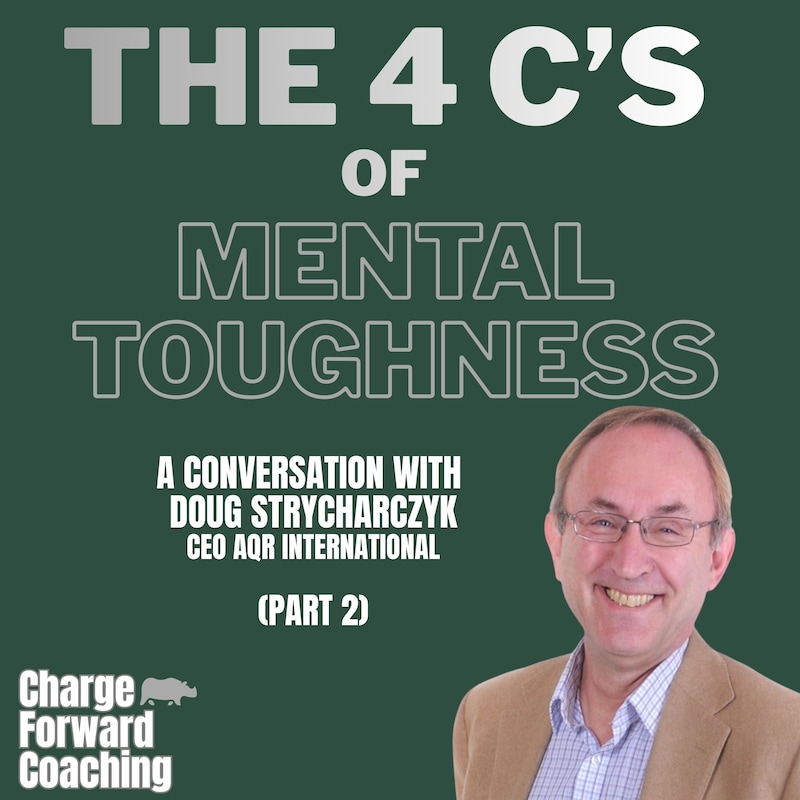
In Part 2 of this powerful two‑part conversation, James Blasco and Doug Strycharczyk go even deeper into the practical side of Mental Toughness and the MTQ framework. Building on the foundations explored in Part 1, Doug shifts the focus toward real‑world application — how individuals, teams, and leaders can strengthen the 4Cs and use them to perform more effectively under pressure.
Doug shares insights from decades of research and fieldwork, including how mental toughness shows up in everyday behavior, why self‑awareness is essential for growth, and how mentally tough and mentally sensitive people can work together more effectively. James and Doug also explore common misconceptions, the role of mindset in innovation, and why optimizing strengths often matters more than “fixing” weaknesses.
Listeners will learn:
How to apply the 4Cs in real situations at work, in sport, and in daily life Why self‑awareness is the foundation of developing mental toughness How mentally tough and mentally sensitive individuals can complement each other Practical strategies for strengthening mental toughness over time What the latest research reveals about performance, innovation, and resilience Part 2 brings the science to life — giving listeners the tools, clarity, and confidence to start building mental toughness in meaningful, sustainable ways.
If you’re an athlete, coach, leader, or anyone who wants to understand how to perform at your best when it matters most, this conversation is a must-listen.
Key topics:
Mental Toughness vs Mental Sensitivity
How your experiences impact your mental toughness
The importance of self-awareness and customization in mental toughness training
Overview of the MTQPlus assessment
Sound bites:
"Challenge relates to resilience and risk orientation."
"Mental toughness is rooted in ancient Stoicism."
About the Guest:
Doug Strycharczyk is the CEO and founder of AQR International, one of the world’s leading organizations in the development and application of mental toughness. Since 1989, he has helped AQR expand into more than 80 countries, providing research-driven tools and assessments used across sport, business, education, health, and the military. Doug is widely recognized as a global authority on mental toughness. Working alongside Professor Peter Clough and Dr. John Perry, he has been instrumental in shaping the modern mental toughness framework and co-developing the MTQ assessments, the most widely used measures of mental toughness worldwide.
Their collaborative work has advanced both the theory and practical application of the 4Cs model—Control, Commitment, Challenge, and Confidence—and has been validated through extensive academic research. He is the co-author of several influential books, including Developing Mental Toughness, Developing Mental Toughness in Young People, and Developing Resilient Organizations. His work has been featured on BBC Television and adopted by elite performers, leaders, and institutions across the globe. With decades of experience helping individuals and organizations build resilience, adaptability, and high performance, Doug continues to be one of the most respected voices in the field of applied psychology and mental toughness development.
About the Host:
James Blasco is a CTA Certified Coach, and a Certified Functional Mental Toughness and Resilience coach, and a Certified Neuroscience Coach based in Ormond Beach, Florida, with a rich background in sales, media, and entrepreneurship. Throughout his career, James has excelled in sales and sales coaching for some of the largest media companies, owned three successful businesses, and worked in media relations in the NFL. His diverse experiences have equipped him with a deep understanding of leadership, communication, and the drive needed to achieve success. James is also trained specifically to coach to all aspects of mental toughness and resilience.
Resources:
Website: www.chargeforwardcoaching.com
LinkedIn: https://www.linkedin.com/company/chargeforwardcoaching/
Facebook: https://www.facebook.com/ChargeForwardCoaching/
Instagram: https://www.instagram.com/chargeforwardcoaching
YouTube: https://www.youtube.com/@ChargeForwardCoaching
Spotify: https://open.spotify.com/show/ChargeForwardCoaching
Apple Podcasts: https://podcasts.apple.com/ChargeForwardCoaching
Guests Resources:
Developing Mental Toughness (Book) - https://www.amazon.com/Developing-Mental-Toughness-Strategies-Performance/dp/XXXXXX
AQR International - https://www.aqr-international.com/
Doug Strycharczyk's Profile - https://www.linkedin.com/in/dougstrycharczyk/
Transcripts
First of all, thank you for segueing into self-awareness because for me, that's been one of the biggest things that I have not just learned, but realize I need to apply in my own journey. You talk about mental toughness and mental sensitivity like you described it. And when I first.
went through the book and then went through training. And I kind of thought, silly me, wow, I kind of got this figured out. I get it. But every day, the more I learn, the more I absorbed through, whether it's your talks or other sources, I realized I'm just scratching the surface here. This is going to be a lifelong journey in learning and understanding this. And it's going to evolve. Like you said, you're doing so much research. We're going to learn even
even more. I have a question when it comes to the roles of personality, genetics, even culture and its impact and influence on a person's mental toughness.
Doug (:Right, so we know from the research, the University of Western Ontario did a really interesting study, I don't know how they did it, but in North America, if you're a twin and you're separated, or you're orphaned, or something happens to your parents, it's not uncommon for twins to be separated and brought up differently. So genetically they're going to be the same.
but they're brought up in different circumstances. That wouldn't happen in Europe.
but it does happen in North America. And so the University of Western Ontario was able to find, I can't remember something, 800 sets of twins, and they were able to apply the mental toughness questionnaire to these twins. And it's an ideal study. And what they discovered is pretty much what we kind of already know is that about half of your personality, personality being your default responses to events, comes from is genetic in origin.
doesn't necessarily mean it's entirely fixed but it's substantially fixed but about half of it is experiential and so about half of your mental toughness half of your default mental responses are either like habits you've developed over your lifetime and of course the most significant years for developing these habits are your early years you know your parents influence you ⁓
teachers influence you but your friends, your peers influence you a lot and so your parents, your teachers, your peers they are actually part of your culture too so if you're brought up in as I was when I was young my parents never intended to stay in UK they always planned to go back to Poland so I was brought up in a Polish community in Scotland
and I couldn't really speak very good English until I was about five and I had to go to a British school. So I was brought up in a Polish culture so my behaviours were shaped by that culture but my mental toughness wasn't. My mental toughness was interplaying with culture to produce a set of behaviours. So your life's experiences have a big part to play in
developing your mental toughness. And that's a good thing because if you can learn a sort of significant degree of your mental toughness, you can unlearn it and relearn, if you need to, a different mental approach to events, which will translate into different behaviours.
James Blasco (:So you said there's no silly question. So I'm gonna ask this question. Cause I think you might've just answered it in part or in full, but I'm gonna ask it anyway. What role does programming? Cause I think a lot of what you're talking about is some of the programming that goes in to our minds, even in our subconscious and things like that. Is it possible to use new programming to help with mental toughness? Is that what you just described as our?
How do you do something like that?
Doug (:Well, ⁓ right, Professor Perry has identified five groups of mechanisms that contribute to our mental toughness. One of them is our experiences. And so our experiences to some extent are introducing programs through the development of habits. So.
you can develop habits that reflect your mental toughness but if those habits aren't working for you, can explore where that habit came from, understand that it's part of your mental toughness has contributed in part to that habit and that habit has contributed in part to your mental toughness so you can say okay I will
consciously try to do something about that. But it doesn't always mean to say you have to change it. But for a lot of people they try to change it if there's an advantage for them in doing that.
James Blasco (:Yeah, I think one of the things as I work with people, I even work on myself is trying to understand like, number one, what should I be changing and how could I change it? And you brought up the word habits and I'm a big believer in habits, routines, rituals, all those things play a big role. And I do see that influencing change in individuals in positive ways.
So I could see where that would be important. ⁓ What about the MTQ Plus assessment? I know you have a number of assessments. That's, I believe, your leading assessment. Can you describe where that came from and how it's applied?
Doug (:Well, when Professor Clough, Peter Clough, first did his work, we had to develop an instrument that would measure what he was seeking to measure. So the very first version of the mental toughness questionnaire was a very simple questionnaire, 18 questions, and he was able to demonstrate that he could measure overall mental toughness from that.
As we began to understand the concept in deeper detail, we first of all found there was four Cs, then we found that two of the Cs had subscales and now we know there are eight subscales, the eight factors. As that evolved, you basically had to develop an instrument that would either confirm or reject what you were trying to find. So the mental toughness questionnaire, the MTQ +, is a byproduct of all the research.
I mean it's a necessary byproduct if we didn't have it we wouldn't be able to say and this is why it works and this is why what it is. So it's a big byproduct of all the research and we're in a happy state now of having a psychometric measure the MTQ plus we've just had in the last couple of weeks confirmation that it's going to be published in one of the leading psychometric journals, global ones.
and his technical properties are essentially as good as anyone else's. So if you look at behavioral measures, know the big ones like Hogan, these are the high quality measures, how measures stand in comparison to things like Hogan, and way, way better than most of the measures that are around. But it's essential because mental toughness as a concept is invisible, we can't see it.
So somehow we need to crystallise it and that's what the questionnaire helps us to do. The questionnaire is like any other questionnaire, it's not perfect, it's a statistical tool. Basically when you've completed the questionnaire and you have a pattern of responses, all we can say is people with similar patterns of responses have a high level of life control or a low level of interpersonal confidence. It still needs checking out.
pretty confident that most of the time with most people provided they've answered it honestly and without trying to think too hard about it it'll produce a good enough response for them to be able to start thinking about who they are.
James Blasco (:Are there demographic limitations in terms of age of who can or should utilize the assessment?
Doug (:Right, so...
It's a normative measure, means that your results are compared to the average person on the planet. for our MTQ 48 norm group, that's 78,000 people from all over the world. And that norm group was consisted of people aged between 18 and 65. So what is conventionally called an adult population. whoever completes the questionnaire, their results get compared to
average adult on the planet but you can use that with people who are younger than that and we don't create norms for 15, 12, 13, 14, 15 year olds people those
those norms if they did exist very widely. what we say is we can compare your profile to the profile of an adult and that gap will tell you what you might need to do to develop life skills that will enable you to function as an adult. So we're comfortable just having one norm group. In terms of the questionnaire itself, in its English form,
it's been designed to be read and understood by a 10 year old. So you can comfortably use it from age 10 or upwards. Below that age, they can understand the questionnaire, but they don't understand how to answer the questions. So now, know, each question says something like, ⁓ I like doing difficult tasks and it goes from never to always.
then young people aren't capable of making that judgement effectively. They can't tell the difference between never, sometimes, occasionally and so on. And so we find we don't advise people to use it below the age of 10.
James Blasco (:I ⁓ kind of figured that and I know in the work and in the book and in ⁓ the training that you have shared with us that was mentioned but we do work with a lot of young athletes so is there a way to potentially not use the assessment and still have interventions of sort and do it properly?
Doug (:Well, one of the things about working with adolescents, we know the midpoint on every scale is 5.5 on a scale of 1 to 10. So an adult, the average adult, if the average adult existed, would score 5.5 on each of the eight factors. What we know is in general, ⁓ a 10 year old or 11 year old will score about 4.2. So there's a gap.
We don't expect them to be as mature as an adult and they haven't had the life experiences and so on that would enable them to do that. By the age of about 17, that score has only gone up to about 4.5. So between the ages of 18 and 25, there is quite an acceleration. That tells us two things. One is we're not keen on people not using the questionnaire.
development of people because ⁓ you're just flying blind but with adolescents there is a case for arguing that you could probably
carry out general development activity for most adolescents that would benefit them because they still in that stage of growth. But there goals that to be a lot that would benefit from an individual understanding of their profile because they are as varied as adults. although I say the average is 4.2 or 4.5 you will have young people who scoring 6 or 7 and some who are scoring 2 or 3. You really want to kind of understand that as well and not
treat everybody like you know the average young person.
great thing about working with young people is you see such a lot of work with young people connected to sport and sport is a great metaphor for life. You know we see people using it with golf, with soccer, with rugby and I guess there are different sports in North America because you get to learn about how to respond to a challenge, how to deal with losing, how to deal with winning and so on. ⁓
We think sport is a wonderful way to engage young people in learning. But what I find is a lot of sports coaches kind of still focus on the physical attributes and the skills and not so much on the mental attributes, which is where the real development lies.
James Blasco (:Yeah, and that's where I'd like to center my focus in time with the folks that I work with is on that mental side. They usually have, especially like golf or tennis, they have their coaches, they even have physical trainers, a lot of them, but not many to your point are working on the mental side of themselves in their game, so to speak. So, So kind of a ⁓ broad question, maybe a...
Doug (:you
James Blasco (:Tricky question, but where do you see the future of mental toughness? Where do you see it going? How do you see it evolving?
Doug (:Well that's a really good question and we're being contemplated. Well I think one of things that we have grown to understand is this term self-awareness doesn't mean the same thing to everyone. A lot of people when you talk about self-awareness they mean do I understand my behaviour? What we mean by self-awareness is do we understand why I behave the way I do?
James Blasco (:I don't know.
Doug (:My question is quite important and I think that can be a game changer for a lot of people. But the other thing is, there are so many very simple superficial models around that people use and yet the reality is, as a human being, you and I are very complex. We live in a very complex world.
So a lot, I would say 90 % of the tools and techniques that are used in people development in one form or another are scratching at the surface of development. They're not digging deep enough to be able to say, well, this is what you really need to do. This is the real you. This is how you're responding. This is what difference it makes in different situations. So if you want to respond differently, understand where that's come from.
But lots of people shy away from that complexity. So some people embrace it. That's what we try to explain in the book. And we try to explain through webinars and podcasts all the time. But we still get a lot of resistance to the complexity. People say, no, I've got a very simple model here. I can categorize everybody into four colors. know, these people are reds, these people are blues. We're much more complex than that.
You will not get down to a decent level of understanding with superficial concepts like that. I believe that the advent of technology might just, AI technology might just help us to make a complex idea more accessible to people. And I think that's going to be a big part of the development going forward.
We think we understand mental toughness to a very detailed degree, more detailed than a lot of people can accommodate. AI technology might be the very thing that helps us to make it accessible. So for instance, if we have 40,000 profiles, AI can help to guide a user to say, well,
these, this person's profile lies in this area you don't have to look at 40,000 you can just look at a few to kind of understand things
James Blasco (:That's amazing. AI in general, we all know is amazing. A little scary, but amazing. That would be just awesome to be able to get that type of information and really, really help individuals with that.
Doug (:Well you're probably aware that I've done other webinars with people like Clutterbuck one of the gurus of coaching and he's already forecast that the world of coaching is going to separate into two. One will be coaches who do a very skin-deep job and coaches who really understand what they're doing and dig deep.
I think what we're going to be trying to do is to help the people who want to dig deep. That's where we see ourselves.
James Blasco (:Well, you
definitely have a head start on that. Your work is incredible, both you, your team, the organization, and we're very thankful for that. So I know you get around and talk a lot. You have your podcasts and webinars and speaking engagements. What's next for you and how can people connect with AQR International?
Doug (:Okay, so what's next for me is more of the same and it's very kind of you to describe us in this flattering way. But I see myself as a conduit. I listen to lots and lots of people. One of the reasons why I like webinars is I like the questions that I get asked. I like the comments that I get back. The eight factors, they have almost entirely been derived from listening to practitioners.
They ask us questions, they say, well I've tried to apply this, I don't understand how to apply it. So you have to come back and think, why did that person not understand it? I need to explain it in a different way. And as I begin to process that, I begin to think, hmm there's something else here that I haven't dealt with. We're learning all the time.
ess. If I'm really honest, in:But you think we still only account for that proportion of the population. There's still a lot of people to bring on board, but a lot of people to learn from as well because they're bringing their experiences, they're bringing their perspectives into play. the work that you saw us present recently, that's all come from other practitioners. I find it guilty sometimes.
even being credited with it I try not to claim the credit for it I just I'm a listener I'm a conduit I put it together
James Blasco (:Well, you're a very, very, very good conduit. That's for sure. We could at least say that. And you're right though, a lot of people, almost every day really, when I talk to somebody, especially a new acquaintance and they ask what I do and I tell them what I do, they're like, wow, that's fascinating. You know, I never thought about that. I know somebody that could, you know, use that information or learn more about that. And it is, it's like going out and kind of preaching and letting people know. And that's the feel good part for me.
is, well, I have something that I could share with others. Yeah, I didn't create it, but you know what? It's just so powerful. It's helped me. It could help a lot of other people. So I totally understand. So Doug, thank you so much for your time. I'd love to have you back on in the future to talk about a bunch of other things, but I really appreciate your time today.
Doug (:I'll be very happy to come back and talk about a specific application. mean that's the other thing that has really blown my mind. We've been working for years on the world of work, the world of education, social work, increasingly in well-being, but we've got a big project running on longevity now and mental toughness has got a big role to play in longevity and believe it or not it's growing in importance because
Our average life expectancy in North America and the UK is now 74. When I was born it was 65. So we live another 11 years longer, but the quality of those 11 years is very suspect. Can we make a difference through mental toughness? Well the answer is we can, because we can use mental toughness to develop habits.
that optimise our lives. So I'm thinking, goodness, I never ever thought that I'd be involved in something like that.
James Blasco (:Yeah, well, I'm going to take you up on that because that is an excellent topic to discuss. think that's interesting. I have a birthday coming up, so I want to learn as much as possible so I can take advantage of that information.
Doug (:I'm out of
If anybody wants
to get a of me it's doug at aqr.co.uk and I'm on LinkedIn, very accessible there.
James Blasco (:Yes, and for everybody out there, I'm gonna put in the description and show notes all of the information for Doug and AQR and mental toughness. So you could just go there, you're gonna get a ton of links. So take advantage of it. In the meantime, don't forget to like and subscribe and share and all that good stuff. If you wanna learn a little bit more about me and mental toughness, go to chargeforwardcoaching.com. You can even reach out, I'll give you a free discovery call, learn a little bit more about you and your goals.
and you can learn about me and my coaching, but in the meantime, just keep charging forward.