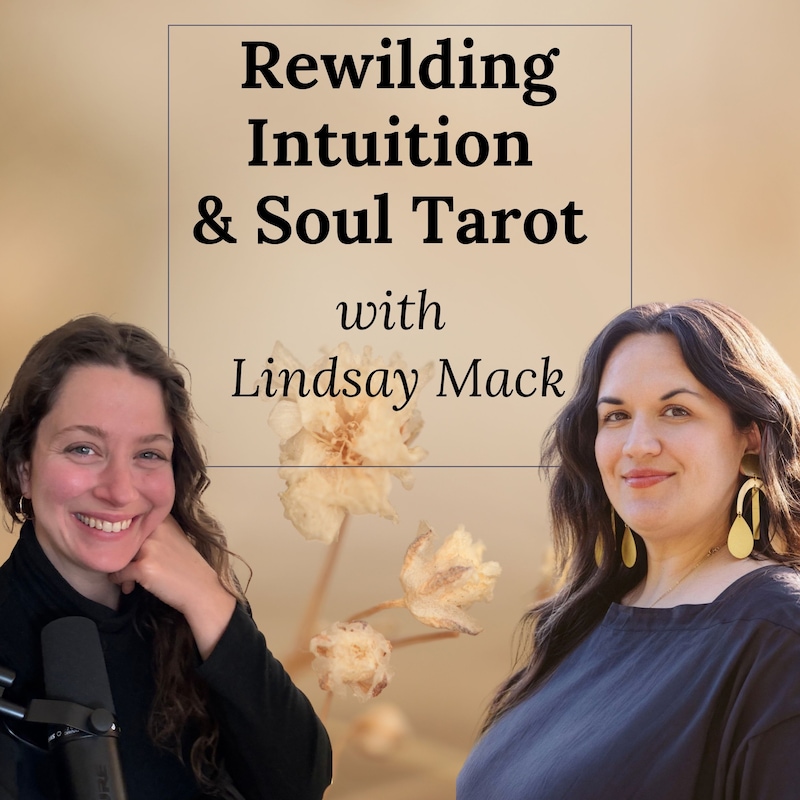
Transcripts
Lindsay,
Speaker:thank you so much for coming
here and being on the podcast.
Speaker:I'm seriously so delighted
that you're joining us.
Speaker:My God, this is the joy of my
life. I'm so excited to be here.
Speaker:Thank you so much for having me.
Speaker:Yes. Yeah. Oh my gosh. I mean, yeah,
this is a dream come true. I'm so,
Speaker:so delighted that you're here.
Speaker:And the timing couldn't be more
perfect because your book and your deck
Speaker:are about to come out and we're going
to talk about that today on the podcast
Speaker:because I'm just so excited for you.
Speaker:I'm so excited for the
world that your book,
Speaker:Tarot for the Wild Soul is coming
out, is going to be available.
Speaker:And then it's coming out
with this insanely gorgeous
deck, the Soul Tarot Deck.
Speaker:And I can be a little bit
snobby sometimes about decks.
Speaker:I have my preferences. Please. Yes.
Speaker:I like what I like and everything
that I've seen, all of the imagery,
Speaker:it is so beautiful.
Speaker:Thank you.
Speaker:It's so soulful. I mean, everything
you do is so soulful. Thank you.
Speaker:I'm just so excited that everyone gets
to experience this. So before we begin,
Speaker:I'm going to read your official bio
so people know who you are and who I'm
Speaker:talking to, and then
we're going to launch in.
Speaker:Okay.
Speaker:Lindsay Mack is an intuitive
tarot teacher, author,
podcast host, Death Doula,
Speaker:and the founder of Tarot for the Wild
Soul. Through the beloved workshops,
Speaker:retreats and online tarot courses,
Speaker:Lindsay has had the profound honor of
teaching soul tarot to many tens of
Speaker:thousands of students from all
around the world. As a queer,
Speaker:neurodivergent and now joyful
survivor of childhood abuse,
Speaker:living with complex PTSD and chronic pain,
Speaker:Lindsay is passionately
dedicated to honoring and
helping to bring space, light,
Speaker:and healing to those who are
experiencing mental, emotional,
Speaker:or physical suffering. Their first book,
Tarot for the Wild Soul and Tarot Deck,
Speaker:The Soul Tarot Deck will be released
on May 19th of this month by
Speaker:Running Press. So Lindsay,
Speaker:I can't even remember the
first time I heard about you.
Speaker:It was before I even met you and I
ended up meeting you at a gathering.
Speaker:And then I put two and two together
who I was talking to. I was like,
Speaker:"It's the Lindsay Mack." But I mean,
Speaker:I know so many people who have
been listening to your intuitive
Speaker:readings now for, I mean, years,
years and years and years.
Speaker:Every month religiously tuning in,
Speaker:you are such a clear
channel and not only do you
Speaker:receive so much and share so much with us,
Speaker:but you do it in a way where
it really meets people.
Speaker:A lot of people talk about being
trauma informed and trauma aware, but
Speaker:you embody that and you live in that and
inside of that in a way that is just,
Speaker:it's always felt so comforting
for me. I've always felt so seen.
Speaker:And I know that that's a
huge reason why so many of my
Speaker:dearest friends just
have adored you for so,
Speaker:so long and continue to
be devotees of your work.
Speaker:And so I want to say thank you for
that. I know that we in particular,
Speaker:we met at this gathering like
10 years ago or something,
Speaker:and then we connected, reconnected
after our daughters were born,
Speaker:which was a really big deal.
Speaker:We were kind of on a very similar wave
because they were born about a month
Speaker:apart. And I know that
in those early times,
Speaker:just exchanging emails with
you was just so helpful for me.
Speaker:It just felt so grounding.
Speaker:I felt less alone and I've just been
really honored to be in deeper connection
Speaker:with you over these past few years.
Speaker:Oh, Asia. I mean,
Speaker:right back at you a thousand
times over with regard
Speaker:to everything that you shared.
Speaker:It's a gift and a blessing
to know you. It was,
Speaker:and God bless you for your willingness.
Speaker:I just cold emailed you
and I was like, "Hi,
Speaker:I know we're both in early
postpartum. This is a nightmare.
Speaker:How are you doing?" And I remember also
right around the time where I sent that
Speaker:email economically things were really
shaky and I was like, "Is that just me?
Speaker:".
Speaker:And I was like, "No".
Speaker:What are we doing?" Yeah,
Speaker:you were so warm and lovely and just like,
Speaker:"Hi." It meant the world to me.
It was such an important lifeline,
Speaker:even just those emails in
those days. And yeah, same.
Speaker:I mean, when I came up to you
at that gathering, I was a fan,
Speaker:so it means a lot to hear that
from you and your words mean so
Speaker:much to me.
Speaker:Just thank you so much for all that
you had to say about the podcast and my
Speaker:approach. It's incredibly meaningful.
Speaker:Yeah. Oh yeah. I mean, it's just my joy.
Speaker:And I think we all need mirrors
like this for each other.
Speaker:And I think that that's so much of
too what we are doing in our work
Speaker:is just being like that benevolent mirror
so folks can see themselves clearly
Speaker:and- I agree. Yeah. And
you're so good at that.
Speaker:So let's dive into some of the
questions I have for you here today.
Speaker:We're going to just see where we
go, but this is an exciting moment.
Speaker:When this podcast comes out, it's going
to be right as your book is coming out.
Speaker:So excited.
Speaker:So there's going to be a lot of momentum
around this and I'm super excited for
Speaker:you. So the book is called
Tarot for the Wild Soul,
Speaker:and your body of work as a whole is
called Tarot for the Wild Soul. And.
Speaker:Yes.
Speaker:Some folks might be really
new to you. So I'm curious,
Speaker:what does it mean to
you to have a wild soul?
Speaker:And this might've changed over the years.
Speaker:I know when we have long-term businesses,
things like this, our conceptions,
Speaker:our frameworks change, but
from where you are right now,
Speaker:what does it mean to
you to have a wild soul?
Speaker:And how do you know if maybe
you've lost touch with yours
Speaker:or you know really, I think even better,
Speaker:how do you know when you
are in touch with it?
Speaker:I love that question. So it's
useful for me to meditate on that.
Speaker:What does it mean for me today?
Speaker:Well, first and foremost, I think,
and I know you'll understand this,
Speaker:you're so deeply in touch with this too,
Speaker:your work encompasses the wild
so profoundly and beautifully.
Speaker:I think that to
Speaker:aim to be in connection
and contact with our
Speaker:wild soul to me is to be in
Speaker:touch with and in contact with the
Speaker:real essence of you,
letting it be as it is.
Speaker:And I think about the concept,
Speaker:which I know you're
familiar with, of Rewilding,
Speaker:which is a kind of a form of
ecological restoration where humans do
Speaker:as little as possible,
Speaker:where we're looking at an area in
nature that's been over-harvested,
Speaker:overrun, which I don't know
that we can get away with.
Speaker:The idea of purity,
Speaker:I think is something that we sometimes
connect with wildness. And I'd love to
Speaker:gently
Speaker:lift the mantle of pressure
off of that because for nature,
Speaker:it might be pollution, it might be dams,
Speaker:it might be overinsertion,
but for human beings,
Speaker:there's colonialism and there's
white supremacy and there's
Speaker:ableism and there's lots of
systemic harms that even if
Speaker:someone is sitting there
thinking, "Well, oh,
Speaker:those things don't affect me
personally." Gently, they do,
Speaker:they do affect all of us, even those
of us with privilege. So I think
Speaker:the things that can be the
dykes and dams around our
Speaker:wild soul are sometimes
it can be so well-meaning,
Speaker:subtle or really overt over
Speaker:insertions from caretakers, from society,
Speaker:from community that invited
you to not trust yourself,
Speaker:that invited you to put
your intuition aside,
Speaker:parts of your identity,
Speaker:parts of who you are that were never
really given a chance to flower open in
Speaker:one way or another. I think to be in
connection with whatever our wild soul
Speaker:means also means that if you're a lilac,
Speaker:you let yourself be that and you don't
try to be a Sequoia. Or if you're moss,
Speaker:you don't feel the pressure
to have to be anything else.
Speaker:We're just knowing that we
change over this time in life,
Speaker:really a gradual willingness
to be aware what was
Speaker:placed in the garden of
my life by me, by others,
Speaker:maybe through no fault of anyone,
Speaker:what is it to devote and dedicate
ourselves to the lifelong work of gently
Speaker:in terms of rewilding, noticing where
there's been an overintervention,
Speaker:gently removing it and then
letting that area take itself back.
Speaker:So to me,
Speaker:I think it probably would've given
you a different answer years before,
Speaker:but to me, I think that's
what I connect with now.
Speaker:Well, what you shared right
now speaks so much to me,
Speaker:Lindsay.
Speaker:It's like there's this reclamation of
the word wild even that you're doing in
Speaker:the wholeness of this description that
Speaker:wildness is essential self,
Speaker:that it is the essential wholeness
that can actually never be changed.
Speaker:It can just be covered and uncovered.
Speaker:And I absolutely love the way
in which you tie this into
Speaker:the intuitive work that you do that so
much of this is about returning to just
Speaker:our essential selves. If you're a
lilac, be a lilac. If you're a Sequoia,
Speaker:be a Sequoia.
Speaker:And there's so much liberation in
that at the same time that we're,
Speaker:and I love that you named this,
Speaker:divorcing it from the whole purity
culture idea of what wild is or
Speaker:wilderness is,
Speaker:and all the ways in which we
just subconsciously start putting
Speaker:those pressures on ourselves,
Speaker:even on our journeys of healing and
self-discovery and self-acceptance that
Speaker:somehow then it has to be perfect or we
have to get to this place where we're
Speaker:always in alignment with
ourselves, never making mistakes,
Speaker:always able to hear intuition
clearly, whatever that is,
Speaker:but that's not the wild soul.
Speaker:I don't think so. Yeah, I agree.
Speaker:Especially not being in a human
body. That's not how it works.
Speaker:Just not.
Speaker:How it works.
Speaker:Yes. And I think I also want to say
that I think sometimes when folks
Speaker:who've been in their practice for a
while speak about this, sometimes,
Speaker:I don't know, for me, I don't know, maybe
this is just the way my brain works.
Speaker:I just also want to name, I am
a student of this craft too.
Speaker:I'm still noting where
ableism lives in me.
Speaker:I'm still aware of,
Speaker:I'm still actively working on things
that happened in my childhood,
Speaker:like patterns and working through
stuff like invitations into
Speaker:projection around what my child
is going through and being like,
Speaker:"That's something you went through.
Speaker:Where's that coming from?" And
this is day one stuff, of course,
Speaker:but stuff that, I don't
know, somewhere in me,
Speaker:I thought maybe I've evolved beyond that.
And I'm like, no, no, no, no, no, no.
Speaker:So I'm still very much
on the path as well.
Speaker:Well, I feel like to me,
Speaker:one thing that makes you such a
role model is the fact that you are
Speaker:willing to be honest
about being in process.
Speaker:Yes.
Speaker:And this is just, it's true for
everyone. It's true for all of us.
Speaker:And I've said this before
with what I teach, I'm like,
Speaker:I teach what I need to
hear. That's what I teach.
Speaker:I teach what I'm learning right now.
Speaker:I'm teaching what I need to hear
and understand and go deeper into.
Speaker:And I think that in some ways it's so
Speaker:empowering to hear folks who
are holding space or in the
Speaker:craft or whatever it is, speaking
honestly about the fact that, yeah,
Speaker:we're in process That's a
lifelong thing. Yes, it is.
Speaker:That only ends when we die,
Speaker:and so we'll be doing it
until that point. Yes,
Speaker:absolutely.
It's so important to name.
Speaker:And I feel like it dovetails
so, not dovetails. I mean,
Speaker:it's so interwoven with the
way that you approach tarot
Speaker:and intuition in general, but
tarot in particular, how, I mean,
Speaker:for most of my life,
Speaker:working and hearing about tarot from the
time I first got my first deck when I
Speaker:was like 14 or something, everything that
we hear about the tarot is predictive.
Speaker:It's like you get your
tarot deck to find out,
Speaker:do they like me or do they not like
me or whatever it is. Of course,
Speaker:we desire that. We're like so human.
Speaker:It's such a human thing to want
to know and predict the future.
Speaker:And that a lot of people have had the
experience myself included of that sort of
Speaker:continually falling flat.
Speaker:It's almost like the vibrancy that's
possible with the cards doesn't come
Speaker:through when we're coming at it from
that model. And so you have a very
Speaker:explicitly non-predictive model with tarot
Which I love.
Speaker:And it feels so liberating to me. The
way you talk about Tarot is my favorite.
Speaker:This is why I'm so excited for
everyone to have your book.
Speaker:And so I'm curious,
Speaker:how do you help people shift away from
using Tarot to find out what's going to
Speaker:happen to using it to
remember who they are?
Speaker:First of all, again, honored, love you,
right back at you. That's number one.
Speaker:Number two, so
Speaker:I think that for me,
Speaker:when I started reading, similar
age, got my first tech at 12 or 13,
Speaker:it was a very straightforward thing
for me because I think when you
Speaker:start reading at such a young age,
Speaker:it's really very easy to see
Speaker:where the overcultural
Speaker:kind of wave of the way we
talk about tarot in quotes
Speaker:with all due respect to the thought
leaders and teachers who came
Speaker:before me, because they had, I think,
a lot harder of a path than I did,
Speaker:it just completely falls flat.
It just totally falls flat.
Speaker:When you're 12 or 13,
Speaker:there's so much of the definitions
mean absolutely nothing to you.
Speaker:Justice has always talked
about court cases and maybe,
Speaker:I guess, for some 12-year-olds and
13-year-olds, they're dealing with that,
Speaker:but for most of us,
Speaker:they're not. So it was really
easy for me to see very early.
Speaker:It's not even like it's
a wrong right. It just,
Speaker:unless I think you are honoring here some
Speaker:cultural context like Romani tarot
readers who have a closed practice that
Speaker:is rooted in future telling,
Speaker:potentially depending on the practice,
Speaker:I'm not speaking for all
Romani tarot readers,
Speaker:but have a closed practice that is rooted
in cartomancy where I think there is
Speaker:more ability or more gifts or more
inherited wisdom with regard to that.
Speaker:But for most of us, that's not
our medicine. And for most of us,
Speaker:if we're talking about consistency, which
is very helpful to the nervous system,
Speaker:tarot just doesn't do it. It just
doesn't do it. It's not that then ...
Speaker:And the problem
Speaker:with ascribing it to prediction is
that it makes the user feel that
Speaker:they've done something wrong.
Speaker:If they got a card that
feels like it ripped the rug
Speaker:out from under them, and maybe it's worse,
Speaker:maybe it's not as bad,
maybe it's just the same,
Speaker:they can feel like their spirit
helpers are punking them,
Speaker:their spirit helpers are tricking them,
Speaker:which is a massive betrayal,
Speaker:especially when we're so vulnerable
going to the stack with our ...
Speaker:So for me, the way that
Speaker:I help people is by just first
and foremost acknowledging with
Speaker:immense respect and gentleness for me.
And I think for a
Speaker:great many of us, it's never worked,
Speaker:just doesn't work, right?
Speaker:Totally acknowledging there are
some people with gifts, again,
Speaker:with inherited practices
for whom it does work.
Speaker:And I think even for those folks,
Speaker:they deserve on certain days for
certain readings to know that
Speaker:sometimes it just doesn't
necessarily flow in that direction.
Speaker:So then we have to think
about, well, what else?
Speaker:Why else would we use
this tool? And to me,
Speaker:knowing that I don't speak for everyone,
Speaker:I've never really seen much in the way
of evidence that the future is fixed.
Speaker:I think the power and empowerment that
we have as human beings is so enormous to
Speaker:be able to influence and
Speaker:move things with regard to
taking action, doing things.
Speaker:So I think the tarot is incredible
Speaker:because when we do have agency,
Speaker:it can provide that clarity.
And when we don't,
Speaker:it can provide nourishment
and scaffolding to say,
Speaker:"We don't have the ability to move,
Speaker:but here's what might be
possible. Here's an anchor.
Speaker:Here's something that could hold you in
this moment where you don't really have
Speaker:much in the way of choice, but
you can come home still to this
Speaker:moment." And I don't know where that ...
Speaker:It probably has a lot to do with my
own experiences, how I was raised,
Speaker:that I didn't have a lot of choice
and had to deal with a lot of
Speaker:very impossible and completely unfair
Speaker:and unforgiving situations
as a young person,
Speaker:which then continued into young
adulthood. And now I'm still dealing with,
Speaker:because I'm a person on this earth and
I don't have choice about some things.
Speaker:So it's a very helpful tool no matter what
Speaker:to be able to come home to what
is, what's possible, what might be.
Speaker:But yeah, it really does fall flat.
Speaker:And I think
Speaker:the model of prediction that
all of us kind of know as
Speaker:being just the gold standard
of how tarot is used, first,
Speaker:we have to acknowledge that that comes
from appropriation and that's for
Speaker:those of us who are
practicing it that way,
Speaker:I'm not accusing anybody of appropriating,
Speaker:it's just the system of appropriation
that happened with Romani Tarot readers of
Speaker:the day who weren't given their due.
Speaker:And if anybody wants more
information about that,
Speaker:I highly recommend the Romanistan podcast
and the work of Jezmina Von Thiele and
Speaker:Paulina Stevens, who are incredible and
are doing so much education about that.
Speaker:We didn't know. Now we do. We
just have more information.
Speaker:So there is some awareness of the
fact that because it's not our
Speaker:medicine, it doesn't work for
a lot of us. So there's that.
Speaker:And that's amazing because we can drop it.
Speaker:There's totally another way to
work with these cards. And two,
Speaker:I think there was a really nice
attempt to try to get everybody
Speaker:reading with ease, which is
why there's such shorthand.
Speaker:It's like cups are about
love. Pentacles about money.
Speaker:It's just what everybody ...
Speaker:It's the automatic of what
everybody needs and wants and
Speaker:how can we help? How can we shorthand it?
Speaker:So I see the benefit in that.
Speaker:It just completely does not work.
Speaker:It doesn't work at all. And
I wish it did. I mean, God,
Speaker:like you, I mean, I was like, oh my God,
Speaker:I've got it made.
This is going to tell me what's up.
Speaker:Come on. So again, this is not a call-out.
Speaker:It's a point of empathy and solidarity.
Speaker:I wanted that and discovered
this doesn't work for anyone
Speaker:and is super inconsistent and
unreliable. And so my approach to tarot,
Speaker:which is called Soul Tarot,
Speaker:is just rooted in curiosity about what
might happen if you drop that and you
Speaker:open to what might be.
Speaker:It reminds me of something I wrote when
I wrote a blurb for your book after I
Speaker:read it.
Speaker:Thank you so much, by the way.
Speaker:Yeah, absolutely. And I don't
remember the exact wording,
Speaker:but what I wanted to express was that
Speaker:this way of working with a
tarot is meeting where we're
at now as a collective.
Speaker:It's like the way you present it,
Speaker:it's meeting where we are at in
an emergent way in the collective.
Speaker:And it's almost this
level too where it's like,
Speaker:what would we even do if we
know the future? I mean, really,
Speaker:what would you actually even do with
that? We don't even- It's a great point.
Speaker:... have the ability to even use that
in a useful way where we're so ...
Speaker:I mean, bless our hearts,
Speaker:it's like we grew up in
such intense times that
Speaker:the desire to want to control is just
so big and it's inside all of us.
Speaker:It just is part of it.
Speaker:And so how would that be
helpful to even know that?
Speaker:But what is helpful is getting
that anchor, as you call it,
Speaker:which I want to go to that next,
Speaker:but getting that anchor point
or that point where you can
Speaker:see and understand where you're at,
Speaker:understand what energies are
moving through you right now,
Speaker:what you're being asked to respond
to in terms of what is present.
Speaker:I think about when I was pregnant,
I kept picking The Tower card.
Speaker:It was like, "Oops, all towers." And
Speaker:I remember being like, "Nope, no, no, no,
Speaker:no." That was kind of my energy
around it. And I look back on it,
Speaker:and it was one tower after another for me,
Speaker:100% the entire experience, pregnancy,
birth, postpartum for me, many,
Speaker:many towers falling.
Speaker:Only tower. Same.
Speaker:And I look back on, I'm like, oh, I mean,
Speaker:I was in such a fear place too where I
was like, cannot look at that right now.
Speaker:But I'm like, what if I had been able
to just meet it as like, "Hey, babe,
Speaker:this is actually already where you're
at right now." And at the time it
Speaker:was. I just wasn't able to actually
embrace that or adjust to that or
Speaker:acknowledge that inside of myself. But
what have I been able to be like, "Babe,
Speaker:this is already happening and I'm
literally just coming up to help you
Speaker:so that you don't feel so alone or this
catastrophe is just happening upon you,
Speaker:but that there's possibility
here within how you respond
Speaker:to this present moment and how you sit
with yourself." And I just think that
Speaker:what you teach is exactly that.
Speaker:And so I want to touch on this idea of
the anchor card because you brought it up
Speaker:before. And I just love it because while
you were talking about the simplicity,
Speaker:how we were handed these super
simplistic definitions of the cards,
Speaker:as you were talking, I was thinking, oh,
Speaker:what we need is not super
simplistic definitions of the card.
Speaker:We need simpler practices for working
with them so that we can receive
Speaker:the complexity of the
messages inside of the card.
Speaker:So tell us more about what this
practice of the anchor card is.
Speaker:Yes. So I think people know this because
I think you're going to share it,
Speaker:but the essence of the practice
that I developed and teach,
Speaker:and this will connect to
the question is Soul Tarot,
Speaker:which is a non-predictive trauma informed,
Speaker:trauma sensitive, heart-led, inclusive
Speaker:way of approaching the
cards in a way that we aim
Speaker:to do it for the present moment.
We aim to do it with compassion,
Speaker:with common sense, with
critical thoughtfulness. And
Speaker:tarot anchoring or anchor
cards, which is, I mean,
Speaker:lots of people refer
to tarot as an anchor,
Speaker:but the specificity of the practice
of anchor cards as I teach it
Speaker:came from a moment very similar
to what you're describing
Speaker:where I kept pulling the same
card over and over and over again,
Speaker:and I couldn't find any medicine in it.
Speaker:I couldn't find any peace in it.
Speaker:I was not able to find any relief in that.
And it was a very
Speaker:specific moment in time where
Speaker:my deck couldn't have given me
anything that would've helped.
Speaker:It was like acknowledgements of the
moment I found myself in were very
Speaker:activating.
Speaker:I didn't believe the cards
that promised there's something
Speaker:on the other side of this that will be
peaceful when there were any that were
Speaker:somewhat spiky, it was
an enormous response.
Speaker:And it was really heartbreaking because
it was the first situation that I felt
Speaker:like I couldn't go to my deck
without feeling activated when it's
Speaker:always a refuge for me. So yeah,
Speaker:I just was kind of like, "Well, there
are no rules. I can do whatever I want.
Speaker:" So I thought I definitely
don't need to know
Speaker:what I'm in because I know
I don't need to know ...
Speaker:There are alternative questions that
are usually helpful. They were not.
Speaker:So
Speaker:the practice in the essence of tarot
cards is that you get to pick the
Speaker:card that you want to pull closer to
you in the moment that you need it. So
Speaker:if you know you're in a
tower or you see the tower,
Speaker:I'll provide two examples actually.
Speaker:So example number one is you're
in just a suspended moment in
Speaker:time where everything is just
intense. It's stressful. Usually
Speaker:some similar ingredients for many
people who might choose to do this are
Speaker:like,
Speaker:"We don't know what's going to happen."
And in a very big and suspended and
Speaker:lengthy way, our nervous systems
are, it's so intense to be like,
Speaker:"I have no idea what this is
going to be." So let's just say
Speaker:we want The Sun card.
Speaker:Let's just say we want The Star
card. Let's say we want The Empress.
Speaker:Let's say we want The Emperor. It really
doesn't matter what card you want,
Speaker:but you pick it, you
put it in front of you,
Speaker:and you can do a couple
of things with it. One,
Speaker:you can just start drawing
in associations. If you're
looking at the way we
Speaker:might use an anchor, and
this is anecdotal on my part,
Speaker:but in a psychological way,
Speaker:if we're using a photo or a
poem or a memory of someone,
Speaker:we're doing the stitching work,
Speaker:the tapestry work to anchor that
in when we're not activated.
Speaker:So it's one of those things where if we
really love the star card and if we want
Speaker:to remember in a difficult time,
there's no winter without spring,
Speaker:not possible. So no
matter how bad this is,
Speaker:no matter how much my brain is
saying, we're cooked, this is it,
Speaker:we're never done, even if we
might not be there to see it,
Speaker:but there's never a finish point.
Speaker:So we might put that in front of us and
then we might notice a poem that reminds
Speaker:us of that, a song. We might
remember a place in nature.
Speaker:I talk about this in the book,
but Windy Ridge up on Mount St.
Speaker:Helens, which is the blast zone
where the eruption occurred,
Speaker:it's a place I go to all the
time when I think, "Well,
Speaker:we're never going to get
through this. " I'm like, "Well,
Speaker:that landscape is living
proof that you can hold both,
Speaker:so how can you be different?
You're not that special.
Speaker:You can't be more special than
that land." That helps me.
Speaker:So remembering that, sometimes
even just notes on my phone,
Speaker:so simple where I can
find it outside of the
Speaker:practice of reading.
Speaker:I don't have to go to my deck
and be hit with a surprise.
Speaker:I can work with just memory anchor points,
Speaker:little lighthouses,
Speaker:constellations of them. The other
way that we can work with something
Speaker:like that is let's say we pull The Star
for an anchor, we can stitch together
Speaker:deeper questions that are
wrapped around that card.
Speaker:So we can say for The Star,
Speaker:how can I connect more fully with
this card in this moment of my life?
Speaker:And we can pull a card for that.
Speaker:How can I draw upon the greatest
degree of support from this card right
Speaker:now? We can pull a card for that.
So we're controlling the pull,
Speaker:but letting it blossom
within those conditions.
Speaker:And I find that when our nervous
systems for one reason or another
Speaker:don't have our normal degree of
capacity to cope with any old card,
Speaker:this is a really respectful and lovely
and expansive way of connecting.
Speaker:So that's kind of option one.
Speaker:And the other option that we
might work with might be that
Speaker:we kind of do something
similar with the card that you
Speaker:pulled. So let's say we pull The Tower
over and over and over and over again.
Speaker:And I'm sure you did this, Asia,
Speaker:but for anybody else who might be out
there who might be like, "Oh my God,
Speaker:I'm in the exact same situation." It can
be really helpful to ask questions of
Speaker:the card and just be like, "Why do
you keep coming up, exactly? And
Speaker:I'm also, this is really, I don't know,
Speaker:potentially controversial for some ...
Speaker:I've never actually faced controversy
for it. It's a soft controversy.
Speaker:It's very hyperbolic.
Speaker:But I really believe in the power and the
medicine of just pulling a card out of
Speaker:the deck that is, you're
getting it a thousand times.
Speaker:The way that I look at it is
like, okay, I know you're here.
Speaker:What I need to know is how to
deal with what you're bringing.
Speaker:So I'm not interested and it's not
actually all that useful to see you. So
Speaker:thank you. Not bypassing it, but I'm
going to put you in a drawer for now.
Speaker:And then I kind of make a deal
with my guides and I'm like,
Speaker:"You have to figure out a different
way to tell me what you're telling me."
Speaker:There are other little
tweaks that you can do too.
Speaker:If I feel like I'm in a moment
of really being in the intense
Speaker:kind of tractor beam of a card,
Speaker:sometimes I'll only work with minors
and court cards because we don't usually
Speaker:have to surrender to a minor in a court
card in the same way we do a major.
Speaker:So all kinds of little tweaky
things to feel like in this moment
Speaker:when I'm just in tower, on
top of tower, on top of tower,
Speaker:I have some agency here. So
Speaker:that's the structure.
Speaker:Well, that was exactly the
word I was going to use too.
Speaker:And just hearing the
whole structure is agency.
Speaker:It's like actually giving people
agency through working with the cards
Speaker:instead of feeling like
it's yet another system that
Speaker:is actually stripping away agency or is
controlling their fate or any of those
Speaker:things.
Speaker:It's like the way that these models work
is you're actually giving people agency
Speaker:again within this practice
that is meant to help you.
Speaker:It's meant to be supportive for you
Speaker:and that it's possible for it to be
supportive no matter what card you pull
Speaker:because within this framework, it's
like, yeah, you have the agency,
Speaker:you only work with certain decks or
suites or put away that card that keeps
Speaker:showing up. And all of that brings us
deeper into relationship with ourselves,
Speaker:which is really the point, which
is the heart of all of this,
Speaker:is reconnecting to our essential selves.
And I
Speaker:think you just touched on this in what
we were talking about, but I love,
Speaker:because I had this question for you of
this idea of the card that keeps coming
Speaker:back
Speaker:And how sometimes what we need
to do is actually stop hyper
Speaker:fixating or focusing on that one
thing and expand the gaze a little bit
Speaker:wider and be like, "What's surrounding
this? Who can come help me with this?
Speaker:" And I think we can definitely
get that hyper-focused sort of
Speaker:vibe going on and then it can disrupt
our ability to receive the nourishment
Speaker:that is there for us. So I'm curious
how you think this fits in too,
Speaker:because I know a lot of the community that
Speaker:surrounds my work and the community that
surrounds your work are people who feel
Speaker:really deeply and have been through
a lot in their lives and have often
Speaker:been told that they're deep feeling,
their emotionality, their sensitivity,
Speaker:their neurodivergence, whatever
it is, that it's a problem.
Speaker:And I see for a lot of folks this
sort of rupture that's happened
Speaker:where there's a tendency to
distrust their own perception.
Speaker:And that this can come up for people
when you're like, okay, when I'm going
Speaker:off book or off guidebook and I'm
just trying to receive for myself,
Speaker:how do I trust what I'm
perceiving, especially ...
Speaker:And this question comes up all the time,
Speaker:Lindsay. If I could pick the number
one question that people ask me,
Speaker:it would probably be this, is how do I
tell the difference between intuition.
Speaker:Yeah.
Speaker:And that brain voice, that
sort of fear-based brain voice?
Speaker:And so this is kind of a
multifaceted question, but yeah,
Speaker:what would you say to someone who's like,
Speaker:how do I trust my perception and how
do I know that this is coming from this
Speaker:deeper place of intuition and not
like I'm just being led down this
Speaker:path? That's my brain being very scared.
Speaker:Oh my God. I mean, this is the question.
Speaker:And I know I appreciate your trusting
me with it because I know you
Speaker:do get asked this and you
answer it really beautifully.
Speaker:And I think a lot of what I have to
share is very similar to how you probably
Speaker:answer it to your students and
to the folks that you work with.
Speaker:Okay. So
Speaker:one of the ways that
Speaker:the mind and intuition behave
and communicate totally
Speaker:differently from one another, totally
differently, that we can trust.
Speaker:And I try really hard
for the most part to be
Speaker:super transparent. I am
no all- knowing person.
Speaker:I'm not the end all be all
on what your intuition is,
Speaker:what your guides sound like.
If you even work with guides,
Speaker:because we can be intuitive without
any kind of belief system in anything
Speaker:larger than us or nature or whatever.
But
Speaker:I believe that the core
of the inner voice is
Speaker:one that guides drop into
rather than it being ruled
Speaker:by them. And it's the
same cadence both ways.
Speaker:It'll just take on different
amplifications depending
on what we choose to work
Speaker:with.
Speaker:If you're worried about
is this true or not,
Speaker:chances are there's something to the
message you're getting and the brain might
Speaker:be really scared about it. In general,
Speaker:I find that if something is admonishing,
Speaker:annoyed, angry, critical,
a should, a you ought to,
Speaker:if it feels like a warning, an omen,
Speaker:if there's an undercurrent of emergence,
Speaker:if it's telling you you have
to do something immediately,
Speaker:it's your brain every single time.
It was really interesting actually,
Speaker:and just the gentlest content warning
for anybody who just doesn't want
Speaker:to hear, I'll keep it super light,
Speaker:anything at all about
emergency medical situations,
Speaker:but had a situation after I gave birth
where I had to actually call an ambulance
Speaker:and it was an emergency situation.
Speaker:And I remember while I was on the
floor tuning in and being like,
Speaker:"Am I going to be okay? What do I do?
" And the voice was very, it was like,
Speaker:"You just need to call 911.
Speaker:You need to call 911." Even
that was different than
Speaker:the siren that my brain was putting out
there. My guides were like, "Oh yeah,
Speaker:you got to go to the hospital."
But also it wasn't to scream,
Speaker:it was really different. So everyone is
different. I don't speak for everybody,
Speaker:but generally speaking,
Speaker:if we're talking about intuition,
our guides. Our guides,
Speaker:and this is any beloved
figure, any beloved entity,
Speaker:energy out there who just
loves you, holds you.
Speaker:It's an unconditionally
loving chorus of support.
Speaker:You don't owe anything to this
chorus. Technically speaking,
Speaker:we kind of do just by being
citizens of the world, but also
Speaker:they're not holding any accounts.
Speaker:It's not love with an agenda.
They just want to help,
Speaker:but you're in charge of your life.
Speaker:So I have often found that
guides suggest, they invite,
Speaker:they welcome.
Speaker:Almost always my guides,
Speaker:what they have to say is far
gentler and more expansive,
Speaker:even in difficult times
than what my brain says. So
Speaker:it's tricky. It's a lifelong
sense of teasing out.
Speaker:I've actually started to accept it as
just a part of the life, just being like,
Speaker:"Oh, this doesn't end.
It just keeps going.
Speaker:It just keeps spiraling."
So that's one of the ways.
Speaker:The thing for anybody who's like,
"Oh my God, how can I trust?
Speaker:How can I trust?" Two things I would say.
Speaker:In my experience,
Speaker:the spirit realm or the other side of
the veil is kind of refreshingly clear
Speaker:in that if you say you don't want
something, they'll actually listen to you,
Speaker:they'll go away. And if you say
you want more, you'll get more.
Speaker:So I think that before
we tune in and read,
Speaker:all that really is required for
any kind of clarity or filtration
Speaker:system is just,
Speaker:I want to hear from any energy that
has my highest and best in mind today.
Speaker:So it's just stating what you're
available for. And by doing that,
Speaker:I think we state very clearly
what we're not available for.
Speaker:And so when we do that, I like to
really think of that as I've said it,
Speaker:I've named it in one way or another,
Speaker:and then it's about letting
yourself be in the repetition
Speaker:of practice. The more you do it, the
more you will really begin to see ...
Speaker:I think
Speaker:it feels kind of floppy.
I don't know if this is anything.
Speaker:I'll put it down and I'll
see if this comes back to me.
Speaker:But the other thing that helps me
Speaker:is when I remember that
Speaker:nature really adores me and I'm chosen
Speaker:and my guides really
adore me and they want to,
Speaker:just like I think bodies try
their best to get to a state of
Speaker:equilibrium and just like plants will
do their best in the environment.
Speaker:I look at life and the world
and the proliferation of
Speaker:any plant, any mycelium, anything.
Speaker:And I think, well,
Speaker:the essence of evolution and growth is
to expand and to flower and in some cases
Speaker:to die. But if I'm asking for help,
Speaker:I really do believe that there is a
generous universe that wants me to know
Speaker:what's important for me to know.
Speaker:And sometimes that can get really tricky
when what we want to know lines up with
Speaker:what we hear. When it's like we want to
get a certain kind of message and we do,
Speaker:it's very vulnerable to trust that.
Speaker:Everything stands to
want to support you in
Speaker:being in alignment with your intuition and
Speaker:with helpful, growthful information,
Speaker:not only because it helps you,
Speaker:but because it helps on the
planet, but it helps everybody.
Speaker:So there's something that I know you're
familiar with because I'm assuming
Speaker:you've read The Way of the Rose. Yeah.
Speaker:I really appreciate ... I'm not a
religious person, but as an ex- Catholic,
Speaker:I really
Speaker:was raised praying to Mary
and still really enjoy that
practice. And I like that
Speaker:Perdita Finn and Clark Strand speak to
Speaker:praying to Mary as not
just one religious act,
Speaker:but like a whole universe of practice
that's been whittled down and kind of
Speaker:co-opted by this religion.
But they say like, any mother,
Speaker:Mary really wants you
to have what you'd like.
Speaker:So they talk a lot about how like, don't
just pray to Mary for what you need,
Speaker:really pray to her for what you like.
And I like to put that
Speaker:on my tarot deck too. I'm like,
Speaker:I want to believe that you want
me to have more than just the bare
Speaker:minimum. I don't know if
that helps or makes sense,
Speaker:but that's what I got.
Speaker:Well, I absolutely love that.
Speaker:And everything you said was like literally
the word in my head was like helpful.
Speaker:This is so helpful.
Thank you. Yeah,
Speaker:so many gems in there and especially
this overarching framework of like
Speaker:your guides, these forces that support
you, they want you to flourish.
Speaker:They want you to connect to
your intuition. They want
you to get the message.
Speaker:There's actually so much
that's working for you.
Speaker:And I love too that you mentioned
this is a lifelong practice.
Speaker:And I know this is something we have
talked about together and then we touch in
Speaker:a little bit on your podcast,
Speaker:but this idea that things are
actually always changing in your
Speaker:intuitive life. And you have a course,
Speaker:intuition as a spiral or
intuition as a spiral. And
Speaker:I was curious to drop into
this next because I think the
Speaker:more life experience you have and the
older you get, the more you realize, oh,
Speaker:nothing is linear. When I was
in my 20s, I thought, okay,
Speaker:you get more and more and more intuitive
and it just expands and you just have
Speaker:more access and it gets easier and easier.
And then you go through life and you
Speaker:experience more, you have a child,
whatever it is, and you're like, "Oh no,
Speaker:this is not nearly so linear." And so
I was curious if you could speak to
Speaker:just your experience of
intuition as a spiral and if you
Speaker:feel like it, if you want to,
Speaker:to speak to the experience in
particular of becoming a parent,
Speaker:because I know that's been huge for me.
Speaker:And I know for a lot of
folks in my audience,
Speaker:that's been a huge threshold and change.
Speaker:And often it's a change that then it's
not talked about the ways in which this
Speaker:does affect our intuition, our practice,
I mean every aspect of our life.
Speaker:Yes.
Speaker:I'm honored to share and love being in
conversation with you about this always.
Speaker:We talked about this. Your
interview with me is coming out.
Speaker:I believe when this drops,
Speaker:it will either be coming out
around the same time or very soon.
Speaker:Yes.
Speaker:Intuition like all things is
a spiral I think in that we
Speaker:do get to these places
where there is a big stretch
Speaker:of awareness where I think we do reach
these points where we're like, "Wow,
Speaker:I have come so far. There's
so much to be gained here.
Speaker:I've learned so much. I have
access to this part of me.
Speaker:" And then inevitably something happens
in your life and you keep going. And
Speaker:I think spiral is really helpful because
that is the symbol that has helped me
Speaker:most as a trauma survivor
because often with trauma,
Speaker:it makes you feel like you're
going back into something,
Speaker:which is devastating. It certainly was
for me. And that idea of like, "Oh,
Speaker:it's impossible. You can't go back no
matter what. You're only going forward,
Speaker:only growing, only learning,
Speaker:because that's also what we
see everywhere around us." So
Speaker:how can we be different? That is
very helpful for me to come back to.
Speaker:Being becoming a mother, man, I mean,
Speaker:I think that I have a
teacher who I don't work
Speaker:with as much anymore named Michelle,
Speaker:who has just been so helpful
to me because she really
Speaker:understands the intersection
of biochemistry and
Speaker:intuition and how
Speaker:when you have a very, very,
very loud brain, which I do,
Speaker:it can be really challenging
to hear, perceive,
Speaker:understand your intuition,
much less to trust it.
Speaker:So I could talk about this forever,
Speaker:but here are some of the things
that I think motherhood has given me
Speaker:with regard to my intuition.
Speaker:Motherhood has made my brain noise louder.
Speaker:It has made it more difficult,
I would say in general,
Speaker:to connect to my
intuition. And it's sort of
Speaker:made the impact of the
intuitive channeling
Speaker:I do feel more middling right now because
Speaker:there's so little space on my nervous
system to actually let it land.
Speaker:But paradoxically,
Speaker:that has caused me to look more fully
Speaker:into support.
Speaker:I'm in the process of a giant multifaceted
Speaker:blood work journey right now to be
like, "What in the fuck is going on?
Speaker:Sorry to curse." With all
of this, cortisol, adrenals,
Speaker:hormones, oh my goodness.
Speaker:It's made it harder to connect. It's
made it harder to trust, I would say.
Speaker:And yet
Speaker:it has really expanded my capacity to know
Speaker:things in a way that I didn't
have before I became a mother.
Speaker:It's a little bit less about tuning
in and feeling it and listening and
Speaker:more about, there's a shorthand
now where I'm like, okay,
Speaker:I think I know enough to
know if my brain's over here,
Speaker:I can just kind of
quickly touch base. Okay,
Speaker:I have a sense of the
direction, I'll go with that.
Speaker:And then there's a little bit more of
a shorthand, there's a little bit more.
Speaker:And when I can actually let myself
get quiet and have the space,
Speaker:it's so much more of a refreshing
process than I think it was
Speaker:even before. So
Speaker:you're catching me at a moment
with my motherhood journey.
Speaker:I think a year ago,
Speaker:I might have told you something different.
Now my child's four and
Speaker:there's more issues now for me that are
cropping up just with perimenopause and
Speaker:everything where it feels my
guides are still coming through,
Speaker:but the chemistry is so
divergent to what they're saying.
Speaker:I have a lot of practice with knowing
that my chemistry doesn't tell the truth a
Speaker:great deal of the time.
Speaker:So there's a great many moments of
Speaker:my life. I would say the majority of my
life is proceeding with what I'm hearing
Speaker:in my channel rather than
what I'm feeling in the body,
Speaker:which I know is really different than
how a lot of people work with intuition.
Speaker:Intuition has a lot less to do with
feeling it than I think we give it credit
Speaker:for. I think for those
of us who might have OCD,
Speaker:whatever,
Speaker:I often feel like something is
wrong when it's precisely right.
Speaker:I often, often. So intuition's
very helpful for me in that way.
Speaker:Yeah.
Speaker:I hate to not have a
sugarcoated dovetail on that,
Speaker:but it definitely has made it so that
Speaker:it's a different container now.
It's very different. I'm learning,
Speaker:proceeding with different structures
and different things in place.
Speaker:And I have absolutely, even
though my child's only four,
Speaker:have had the experience of, which
a lot of parents talk about,
Speaker:especially mothers,
Speaker:I have a feeling something's going
on with my kid and I can't tell
Speaker:you why, but I know and
Speaker:most of the time I'm right
and some of the time I'm not,
Speaker:but it's mostly right.
Speaker:But I don't think that any
of that is necessarily a
Speaker:problem.
Speaker:It's made me feel like
very humble in the face of,
Speaker:because I'm still getting
clear downloads, but
Speaker:the way that I'm tuning
in, the capacity I have,
Speaker:the limited amount of space and time,
Speaker:I think is very humbling and has
actually made me a little bit of a better
Speaker:intuition teacher because I think
it has made me be like, "Oh yeah,
Speaker:some people just don't have any time.
They have no space." And how does someone
Speaker:approach this if they've
never had practice now?
Speaker:Yeah, I don't know. It's
been very interesting.
Speaker:I still feel them,
Speaker:but it's a lot harder
now to make the time.
Speaker:Yeah. And there's a lot less space
to doubt to what's coming through.
Speaker:I'm like, "I just can't even ... Nope,
don't have time." Yes, that's it.
Speaker:I guess that, I just need to
write the thing. I just need to-.
Speaker:Yeah, I just have to do it. ...
Speaker:Record the podcast. You just have
to do it. And so in that way,
Speaker:it's like a training
ground of like, "Girl,
Speaker:you just don't have time even to doubt
this right now." Yeah, the perfectionism.
Speaker:Let it flow. See what happens. Yes.
Speaker:Spending a week tuning in about the
right name, I'm like, "This is the name.
Speaker:It's got to come out now." And
Speaker:if it doesn't feel wrong, it's
just really different. It's.
Speaker:Really different. And I'm so glad you
brought in the chemistry piece too,
Speaker:because I mean, that was
so huge for me postpartum.
Speaker:I had pretty gnarly postpartum OCD and
Speaker:depression and anxiety. And
I just remember being like,
Speaker:"Wow, I am so humbled right
now by what my brain is doing,
Speaker:what I'm having to encounter." And
it did point me towards lifelong
Speaker:patterns I had always had.
Speaker:I just had a lot more space and
time to kind of just manage them.
Speaker:And I think that looking back now,
Speaker:I wouldn't change anything
about my intuitive journey,
Speaker:but I look back on myself having done all
these intuitive readings with parents.
Speaker:Now that I am a parent.
Speaker:I was like- Yeah, I understand.
Speaker:What.
Speaker:The fuck?
Speaker:I had no idea. I'm sure I
said things that were helpful,
Speaker:but I think there's this reality in
which you cannot know until you know.
Speaker:And to me,
Speaker:that's part of the goal
of lived life experience.
Speaker:And I think why I believe as a species,
Speaker:we are built to have grandmothers and
Speaker:matriarchs and elders who have gone
through this initiation leading
Speaker:us because we have been through all this,
Speaker:because we have gone through the fire.
Speaker:We have experienced these
primary life experiences and
Speaker:obviously having a child's one of the
biggest life experiences you could
Speaker:possibly have.
Speaker:And so I really want to say
that I appreciate you so
much for being honest about
Speaker:that because I think a lot of people
are like, "What is wrong with me?
Speaker:" And I've had people even
reflect back to me like,
Speaker:"You just seem like you had a child and
just everything just kept expanding and
Speaker:it's not a problem." And I'm like,
Speaker:"Are you kidding me?"
And it's been such a journey. So
Speaker:it's just the honesty around that
feels so big. And I'm curious,
Speaker:we have a tiny little
bit of an overlap here.
Speaker:My book came out when my child was five
months old, so I wasn't writing it,
Speaker:but I did come out when she was very
young. And that was a whole thing for me,
Speaker:very challenging in my nervous
system. And I'm curious for you,
Speaker:you wrote your book
During these early years.
Speaker:I did.
Speaker:Yeah. So just to bring it
back to the book, I'm curious,
Speaker:what was that experience
like? And at the same time,
Speaker:you're also running your podcast.
Speaker:You do brilliant one-on-one
intuitive readings with people.
Speaker:And so yeah,
Speaker:I'm curious how that interwove with
everything in such a big transitional
Speaker:moment.
Speaker:Well, I mean, I have to say,
and I think I'm remiss in not,
Speaker:this is the one piece that is very
important that I didn't bring,
Speaker:which is even though
intuition has gotten harder to
Speaker:sort of make space for in
the way that I used to,
Speaker:having my child becoming a
mother and her presence on
Speaker:this planet has
Speaker:shifted me in ways that are more
important than I could ever say.
Speaker:And it's my favorite job and
the job I love to do most,
Speaker:and she is my favorite
person. I love being a parent,
Speaker:and it has immeasurably
improved my life in every way.
Speaker:But the process of having
a baby has destroyed my
Speaker:hormonal and nervous system wellbeing,
Speaker:not my child's fault at all.
Speaker:So it was already a tenuous situation
to begin with, to be honest.
Speaker:So it was a bold move on my part.
Okay.
Speaker:I know that sometimes people
say this and I'm like,
Speaker:"Ugh." But I don't totally
remember how I did it.
Speaker:I know that
Speaker:it happened and then all of a
sudden the book was finished.
Speaker:And the whole time in the
year I wrote it, I was like,
Speaker:"I don't know how I'm going to do this.
This is impossible. I can't do it".
Speaker:There was a lot of grief around,
Speaker:why didn't this happen before my
daughter was born? like I was there.
Speaker:I was ready. Where was
everyone? I was ready to go.
Speaker:But it was exactly the right
time. It really, really was.
Speaker:I'm grateful for the
timing. I am. It was wild.
Speaker:It really did take the cobbling together
of the village that we had at the
Speaker:time without my partner,
Speaker:without our nanny who is now a beloved
Speaker:occasional babysitter, but who was
coming three days a week at that time.
Speaker:We didn't have anybody else. I
don't know how we would've done it.
Speaker:I just really don't. So yeah,
Speaker:it was a little bit, I think, like how
I imagined having another baby would be.
Speaker:There was a lot of ... I was
awake at all hours doing it.
Speaker:There was a lot of writing and
editing after she went to bed.
Speaker:I don't know how we do it,
but it's happening. That's
the way that I look at it.
Speaker:I'm not quite sure how that's
happening. But there were many times,
Speaker:even though I was like,
Speaker:"I just can't understand why this didn't
happen a little earlier." In ways that
Speaker:are both kind of known to
me and also not known to me,
Speaker:there's no way I could have ever written
this book without becoming a mother.
Speaker:No way could I have done that.
Speaker:And my work has changed since becoming
a mother. The structure, the container,
Speaker:how it's run has radically
changed, even though it all,
Speaker:I think, looks the same to a certain
extent. It's totally different.
Speaker:So that was all because Because
I just couldn't devote the same
Speaker:time and energy that I
used to devote before.
Speaker:So the structure had to change. And yeah,
Speaker:it was very magical, very powerful,
Speaker:and also a grind.
A grind.
Speaker:Yeah. It's both.
Speaker:Yeah. Yeah. My daughter
has been a really steady,
Speaker:reliable sleeper since
she was born. Such a gift.
Speaker:I know the highest- You've.
Speaker:Been gifted.
Speaker:I know. With all of my friends
who had colicky children,
Speaker:children who didn't sleep, I used to,
when they'd talk about it, just be like,
Speaker:"I'm witnessing you.
I'm just hearing that.
Speaker:I'll never complain ever."
Can't complain, won't complain.
Speaker:You can still complain.
You're allowed. You're still allowed.
Speaker:Yeah. That's true. I am, but also
it's a whole different ballgame,
Speaker:whole different ball game. And
Speaker:I just had to be very economical.
When she napped, I was like, "Okay,
Speaker:I'm going to try my best
to do what I can do." So
Speaker:I think a lot about if I
ever wrote another book,
Speaker:I think you and I talked about
this. I think it would take years.
Speaker:I don't know how I would do it now.
Speaker:There's no nap and the days are much
longer than they used to be now actually
Speaker:when she was younger.
But yeah, it was wild.
Speaker:I think too, I think on your
whole body of work and how
Speaker:you had built so much before
having a child and then
Speaker:this book is like, it's a monument.
It's so much that you've built.
Speaker:And so it's like you had this huge
foundation and then you had this big
Speaker:initiation that made you the person
really who could bring this book
Speaker:into form in a way that's just going to
speak to even more people and help even
Speaker:more people. And so I just
thank you for writing the book.
Speaker:Thank you to your partner and your
nanny and all of this. Yeah, everybody.
Speaker:That supported you to make that
possible because I really mean
Speaker:it that I think this book
Speaker:needs to be on everyone's
shelf because the way that you
Speaker:talk about relating to intuition and
to the cards and to this practice,
Speaker:it's so life giving.
It's so life giving.
Speaker:And that's really what we need right now.
Speaker:And so I just want to close with this
question and you can just let roll
Speaker:whatever wants to roll here.
Speaker:But I know we're living
through such an intense,
Speaker:rapidly changing time right
now. I mean, so, so much.
Speaker:And your intuition, what you pull through,
Speaker:your channel and the ways that you
are, it's such a generous guidepost.
Speaker:And I love tuning into your podcasts. I
love listening or reading your Substack.
Speaker:And so just as like a ... See
what flows through, Lindsay.
Speaker:But I'm curious from your perspective
for where we are right now collectively,
Speaker:what are we being asked to anchor
into as we move through this time?
Speaker:The word that comes to mind
is collaboration. I think
Speaker:there's a very interesting
dance going on right now,
Speaker:which makes sense because it's a Wheel
of Fortune year. And Wheel of Fortune,
Speaker:it's interesting. It's tricky.
Speaker:There's a little bit that Wheel
of Fortune asks of us where
Speaker:I think on a certain level,
Wheel of Fortune says,
Speaker:"If you do the work and if you prepare,
Speaker:you'll meet the moment."
And some of the quote
Speaker:hard work is not stepping our
foot on the gas pedal until the
Speaker:light turns green,
Speaker:which is tremendous in what it asks of us.
Speaker:So I think in some ways there's a
sense of, "I want to do something.
Speaker:I want to change this.
Speaker:I want to go forward." And
for a number of reasons,
Speaker:many of us feel like,
Speaker:"I just don't think I can or I'm not quite
able to in the way that I'd want to."
Speaker:So the collaboration feels like a
little bit of a collaboration with
Speaker:life, with the greater forces,
with the overall spiral of life,
Speaker:like not pressing and revving
before that light turns green.
Speaker:But then when it does, to actually be
bold and brave enough to go, "Okay,
Speaker:I'm willing. I'm willing to go.
Speaker:I'm willing to move with this." So
Speaker:it's a very interesting time.
Speaker:I think collaboration has a
lot of different meanings.
Speaker:And I'm noting for myself,
Speaker:now that we're four months in at the
recording of this podcast anyway,
Speaker:I'm noting, oh, for me,
Speaker:some of the work that I have
to do while the light is red is
Speaker:a little bit around myself and
Speaker:a little bit more
Speaker:cleaning my own house in terms of
how I am tending to myself right
Speaker:now in this season. But for some people,
Speaker:it's totally different.
So I think that collaboration process of,
Speaker:"Okay, I'm willing to look at this.
Speaker:I'm willing to ..." The last
thing I'll say about this is
Speaker:Wheel of Fortune, which again,
: Speaker:Wheel of Fortune seems like it's such
a big mover and a shaker and it is,
Speaker:but only in certain moments.
Speaker:There's a great deal of the time when
we work with Wheel of Fortune where that
Speaker:larger wheel is kind of turning.
Speaker:We don't know quite how it's
turning and what way it's turning,
Speaker:the direction it's going in,
Speaker:and we're not really being
called upon to do anything.
Speaker:And one thing that we can do is just
look around and be like, "Oh yeah,
Speaker:I have to take that teacup to
the sink." So I'll do that.
Speaker:I got to chop apples for my child
and I'll do that. There is very much
Speaker:a literally chop wood carry
water aspect to this year
Speaker:that I think is really
strange with regard to
Speaker:all of the enormity of what's going on
and how disempowered so many of us feel.
Speaker:So collectively,
Speaker:an anchor is whatever the tea cup is
on your table that maybe you're telling
Speaker:yourself is like, who even cares about
the teacup? There's so much going on.
Speaker:I actually think it starts with
the teacup and that feels like
Speaker:a collaboration of sorts to me.
Speaker:Yeah.
Speaker:Yeah.
Speaker:Yeah. I love that. And again, it's
like bringing in this agency piece.
Speaker:How do we actually have
fruitful collaboration? Well,
Speaker:we need to be in our agency and that
other force also needs to be in their
Speaker:agency. And it's like recognizing the
places we have agency of that chop wood,
Speaker:carry water kind of deal.
This is what we're here for.
Speaker:Yes.
Speaker:And this is what gives us that ability
to be in that collaboration or in
Speaker:that co-creation and co-creating
what we want to see unfold next,
Speaker:what we want to give our energy
towards, what we want to see unfolding.
Speaker:So I love that as an anchor.
Speaker:Thank you so much for just the anchor
that you are in this world, Lindsay,
Speaker:and the anchor that this
book is and this deck.
Speaker:I'm so excited to get
my hands on this deck.
Speaker:So I'm curious for folks who want
to go deeper, want to learn more,
Speaker:want to order or pre-order your
book, where do people find you?
Speaker:So first and foremost, happy
to share. First and foremost,
Speaker:just want to shout out and give ample
due in respect to the illustrator of
Speaker:these cards. Yes, please.
Chelsea Granger, the luminous,
Speaker:incredible Chelsea Granger
who concepts are mine,
Speaker:but illustrations are Chelsea's and just
want to fully acknowledge this deck.
Speaker:This book would never be what
it is without her illustrations,
Speaker:and she's incredible.
Speaker:And I highly recommend everybody support
her work outside of this because she's
Speaker:remarkable.
Speaker:Her book about grief and loss called
So Many Ways to Draw a Ghost is
Speaker:my favorite book on grief.
I love it. So that said,
Speaker:where people can find
me is lindsaymack.com.
Speaker:All of the links to all of
my work can be found there.
Speaker:I write a Substack newsletter
called No Bad Cards,
Speaker:and you can find that
again on lindsaymack.com
or by going to Substack and
Speaker:searching for it.
Speaker:I have a lovely membership that I
teach all of the fundamentals and
Speaker:foundations just simply called
the Soul Tarot membership.
Speaker:I love doing that and teach. I
have trainings and offerings.
Speaker:And I'm pretty sure you can order the
deck and the book anywhere in the world,
Speaker:wherever you get your books.
Speaker:Awesome. Awesome, Lindsay.
Thank you so much.
Speaker:Thank you so much for being here.
This has really been such a delight.
Speaker:I'm so excited for you and for
everyone who's going to be getting
Speaker:this book, highly recommend.
I also love your Substack.
Speaker:It's just you're so generous
with everything that you
share and you've shared so
Speaker:generously with us today, Lindsay. So
thank you so, so much for being here.
Speaker:Thank you.
