Shownotes
📺 Watch on YouTube and Spotify
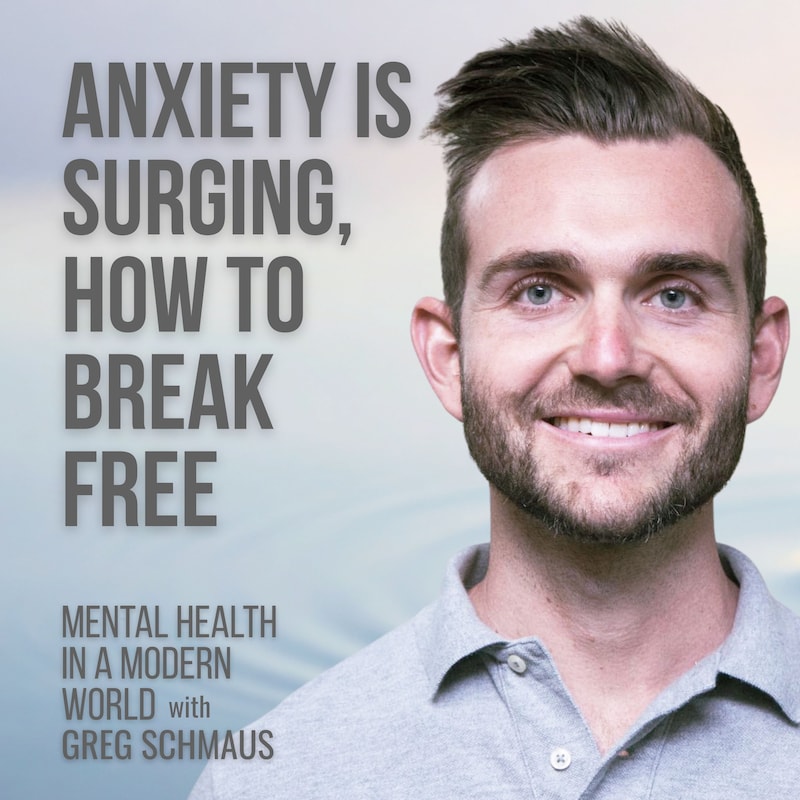
“Anxiety is never the root cause—it’s a symptom of a deeper problem,” says Greg Schmaus, holistic health coach and founder of Healing 4D, who returns to Mental Health in a Modern World with a solo episode devoted to healing in the age of anxiety. As rates of anxiety continue to hit record highs—affecting up to one-third of U.S. adults—Greg Schmaus unpacks why “curing” anxiety with quick fixes or pharmaceuticals fails to address its complex, multidimensional roots.
In this must-listen episode, Greg Schmaus challenges the mainstream approach of medicating anxiety, revealing the staggering statistic that 90% of serotonin isn’t produced in the brain, but in the gut—and warns how overreliance on SSRIs skips the foundational building blocks: sleep, nutrition, movement, breathwork, and regulating our exposure to digital overwhelm. He explores why both top-down (mind to body) and bottom-up (body to mind) strategies are essential, and how anxiety can be a protective response to trauma, attachment injuries, or even signs of spiritual awakening.
Find out how to move beyond symptom-chasing and discover a truly holistic path to healing anxiety—one that acknowledges our uniquely “biopsychosocial-spiritual” nature, and empowers you to reclaim ownership of your mind and body. Tune in to Mental Health in a Modern World to learn what the statistics miss, what every psychiatrist should be asking about your gut, and why your anxiety may be something far deeper—and more transformative—than you think.
5 Key Takeaways
Take charge of your mental health by focusing on foundational habits that target the root causes of anxiety.
- Prioritize high-quality sleep and align your daily rhythms with natural light to reset your nervous system.
- Eat whole, unprocessed foods and support your gut health to reduce inflammation and stabilize mood.
- Move your body daily through exercise to boost mood-enhancing neurotransmitters and decrease stress.
- Establish a daily meditation or breathwork practice to anchor your awareness in the present moment and calm anxiety.
- Limit your exposure to devices, social media, and news—replace digital time with meaningful moments in nature.
Start today—choose one habit and commit to making it part of your daily routine.
Memorable Quotes
"Anxiety is never the root cause of a situation. Anxiety is a symptom of a deeper problem."
"Belief and intention are the most powerful things in the world. What you create in your mind actually starts to shift matter."
"Healing rather than curing is really the only path forward when it comes to this current mental health crisis, but really the chronic disease crisis at large."
Resources Mentioned
You Are the Placebo by Dr. Joe Dispenza - https://amzn.to/4cuAsW3
Connect with Greg
Website - https://www.healing4d.com/
Instagram - https://www.instagram.com/4d_healing/
YouTube - https://www.youtube.com/@gregschmaus
LinkedIn - https://www.linkedin.com/in/greg-schmaus-22929589/
🎙️🎙️🎙️
Podcast Production & Marketing by FullCast: https://fullcast.co
Discover the best podcast services in the world at The Podosphere: https://www.thepodosphere.com/
Mentioned in this episode:
Embark on The HTM Journey
Embark on The HTM Journey
Transcripts
Welcome back to Mental health in a modern world. So today is
Speaker:going to be a solo episode where we're going to dive into healing
Speaker:and age of anxiety. And this is such an important topic right
Speaker:now because rates of anxiety have really reached an all time high.
Speaker:I was looking at some statistics the other day and I
Speaker:found some stats that showed that over A third, around
Speaker:30 to 33% of US adults
Speaker:are currently experiencing some form of an
Speaker:anxiety disorder. And so anxiety, you know,
Speaker:has risen tremendously in terms of, you know, the
Speaker:rates and the statistics. And a lot of this, you know, seems
Speaker:as though it was escalating around the time of the COVID pandemic.
Speaker:But I think there's, you know, a lot more involved in
Speaker:this epidemic of anxiety, this age of anxiety that
Speaker:our culture is experiencing. And today I wanted to do an
Speaker:episode really kind of peeling back some of the layers
Speaker:and really understanding or supporting you in understanding some
Speaker:of the many root causes of anxiety. And one of the
Speaker:challenges that we see in the Western medical,
Speaker:conventional, traditional approach is to
Speaker:try and look for cures. There's this whole
Speaker:chronic disease epidemic, and when we're trying to
Speaker:look for cures, we're trying to look for this linear
Speaker:A plus B equals C equation, which as human
Speaker:beings, because we're so multi dimensional, and like I
Speaker:said in a previous episode, we are
Speaker:biopsychosocial, spiritual beings, since we are
Speaker:so multidimensional, to try and find a this for that
Speaker:cure is really almost impossible. And so
Speaker:that's why understanding this on a holistic level,
Speaker:where we can see the many different root causes
Speaker:that are resulting in enough stress on the organism
Speaker:that the organism is then expressing these
Speaker:symptoms through the body or mind as a stress
Speaker:response and as an adaptation to stress. Right.
Speaker:So today we're going to dive into a lot of these root causes.
Speaker:But just to begin, I'd love to take just a minute or two and
Speaker:do a little meditation with you. And one of the reasons I like starting
Speaker:our solo episodes with some sort of breath work that we did in the
Speaker:last episode and meditation that we do in this solo
Speaker:episode is I want, I want what I'm offering you to
Speaker:be practical. You know, a lot of people listen to podcasts and it's a lot
Speaker:of information, but there's not a lot of practical
Speaker:application that allows you to integrate the
Speaker:information. So I want you to be able to take this information and
Speaker:integrate it into practical application. And so
Speaker:that's why I want to offer you just a very simple practical
Speaker:meditation just for about a minute or two just to begin
Speaker:this journey together. So if you're able to close your
Speaker:eyes while you're listening, please do so. And if you can't, whether
Speaker:it's because you're driving or you're doing something else, then
Speaker:obviously continue what you're doing. But you can actually still practice
Speaker:this meditation as you're listening. You even if you are
Speaker:somewhat multitasking as you're along for the ride with us.
Speaker:So if you close your eyes for a moment or just bring your awareness
Speaker:to your breath, I invite you to notice
Speaker:the in breath and out breath through your nostrils.
Speaker:So if you bring your awareness to the inside of your nose,
Speaker:noticing the airflow as it moves in and out
Speaker:through the nostrils, and really pay
Speaker:attention to the sensation of the breath, the
Speaker:sensation of the air as it flows in and out through the
Speaker:nostrils, and as we're following the in
Speaker:breath and out breath through the nostrils in our mind
Speaker:silently, we're very simply going to count the breath up to
Speaker:10. So as you inhale, you'll just count
Speaker:in your mind 1. As you exhale,
Speaker:you'll count in your mind 2. As
Speaker:you breathe back in, count in your mind 3.
Speaker:As you breathe out, counting in the mind 4
Speaker:and making your way up to 10.
Speaker:If you notice your mind wandering or getting distracted with other
Speaker:thoughts, just gently come back to counting the breath up
Speaker:to 10. Once you get to
Speaker:10, start back at 1 and we'll go one more round
Speaker:up to 10.
Speaker:And then once you finish this Last Round of 10, you can bring yourself back.
Speaker:This is a very simple and practical meditation.
Speaker:And you know, from my experience and my perspective, meditation
Speaker:is the practice of sustained attention. It's sustained
Speaker:attention on the present moment, right? So the
Speaker:breath is only happening in the present moment. You can't breathe in the past and
Speaker:you can't breathe in the future. You're always breathing here and now.
Speaker:And so the anchoring of attention on the breath is what anchors your
Speaker:attention on the present moment. And what's really interesting is
Speaker:that a lot of people talk about anxiety
Speaker:always being this mindset of anticipation,
Speaker:right? So a lot of people talk about anxiety always being this
Speaker:anticipatory mindset. Always
Speaker:anticipate anticipating some potential threat,
Speaker:some potential crisis, some negative outcome.
Speaker:So anxiety is always anticipatory, which is future
Speaker:oriented. A lot of times depression
Speaker:just kind of going there for a moment. Depression is very much
Speaker:past orientation. A lot of times depression comes
Speaker:with the energy of regret, which keeps us tethered
Speaker:to the past, where anxiety is a lot of
Speaker:the energy of anticipation, which keeps us tethered to
Speaker:the future. Right. So depression and anxiety
Speaker:are both expressions of a mind that is
Speaker:either tethered to the past through regret or
Speaker:attached to the future through anticipation.
Speaker:And so meditation is actually the practice of
Speaker:presence. It's actually the practice of bringing
Speaker:yourself back into the here and now through
Speaker:sustained attention on something like the breath, which is
Speaker:always breathing in the here and now. Right. So this is why
Speaker:sustained attention through the practice of meditation, which
Speaker:brings you into presence, is one of the most important
Speaker:practices for the healing of anxiety. A little
Speaker:background. I mentioned that, you know, 20 to
Speaker:30%, maybe a little bit more of us adults are
Speaker:experiencing some form of an anxiety disorder. And most
Speaker:of the mainstream treatments in conventional and
Speaker:western medicine and psychiatry are medications.
Speaker:They're either SSRIs, which are selective
Speaker:serotonin reuptake inhibitors. So they work on the serotonin
Speaker:levels of the brain. And there's also SNRIs, which work on
Speaker:serotonin and norepinephrine. And so these are the
Speaker:two most common classifications of
Speaker:medications that are used for
Speaker:anxiety disorders. Now, one thing that I'll say
Speaker:is I'm not against the use of anything. I'm against
Speaker:the misuse of things, from my perspective, the
Speaker:incorrect order of operations, you know. So for me,
Speaker:if one is to use a medication like an SSRI, that to me
Speaker:is a last resort. There's a whole foundation and
Speaker:building blocks of health that must be put into
Speaker:place before we put the cart before the horse, so to
Speaker:speak, with something like a medication with
Speaker:tremendous side effects and creates patterns of
Speaker:dependency where it's very hard to get off these
Speaker:medications. Legal disclaimer. I'm not a doctor. I
Speaker:can't tell you what to do. But I will say that, you
Speaker:know, these medications, from my perspective,
Speaker:should be a last resort. They should be something
Speaker:that you use after you've exhausted all other
Speaker:mechanisms that have less cost.
Speaker:For example, changing your diet, practicing meditation, getting to sleep on
Speaker:time, exercising, spending more time in nature. There's no
Speaker:downside to those practices. There's no negative side effects.
Speaker:There's no cost to them. There's only benefit. So I'm a
Speaker:big fan of really assessing the cost
Speaker:benefit ratio of any modality and always starting
Speaker:with the least invasive and then working your way
Speaker:up to the most invasive, because the most invasive usually comes with
Speaker:various side effects and has a cost to it. And there's also
Speaker:research that shows that the average placebo
Speaker:is very close to the effectiveness of the
Speaker:medication itself. I was Looking at research the other day, and it showed
Speaker:that on average, an SSRI might
Speaker:have a relative improvement of around
Speaker:50%, maybe 55%,
Speaker:and the average placebo is anywhere between
Speaker:35 to 40% effective compared to
Speaker:the medication. And so that shows you that the
Speaker:effectiveness of SSRIs is actually quite
Speaker:minimal compared to the effectiveness of a
Speaker:placebo. Which a placebo shows you how
Speaker:powerful the mind is, how powerful belief is.
Speaker:You know, if you check out the work of Dr. Joe Dispenza, who wrote
Speaker:an amazing book called you are the Placebo, he
Speaker:really goes into one of the things that gets quite overlooked and
Speaker:in the field of Western medicine, which is the real power of
Speaker:the placebo and how that's happening, right? The
Speaker:mind's impact over your physiology,
Speaker:over your neurochemistry, your belief systems,
Speaker:your intention, are really the most powerful sources
Speaker:of medicine. Belief and intention are the most powerful things in the
Speaker:world. And what you create in your mind
Speaker:actually starts to shift matter, right? Matter can't
Speaker:organize itself without mind, without an observer, without
Speaker:intention, without information. And so the power
Speaker:of a placebo is incredible. And so we just want to make
Speaker:ourselves aware that, you know, a placebo is almost
Speaker:as powerful as some of the medications that are using and
Speaker:for some of these anxiety and depressive disorders, which is
Speaker:something that you should be very careful with when you see
Speaker:statistics like that in terms of getting on a medication like that, which
Speaker:comes with a lot of side effects and. And potential cost.
Speaker:So I want to start with the definition of what is
Speaker:anxiety. So I was looking online for just basic
Speaker:definitions, because it's really helpful to define these things.
Speaker:So two that I came across is anxiety is an
Speaker:apprehensive uneasiness or nervousness, usually
Speaker:over an impending or anticipated misfortune,
Speaker:right? So that was in the Webster's Dictionary of definition for anxiety.
Speaker:So one of the things I want to point out there is an impending
Speaker:or anticipated misfortune, so
Speaker:anticipation, right? Future orientation.
Speaker:So remember, anxiety is always rooted in
Speaker:a future orientation or a mind that is in a state of
Speaker:anticipation, which is why I introduced that meditation
Speaker:to you. We have that anticipatory
Speaker:ingredient in this definition. Then the other
Speaker:definition, which is a medical definition is
Speaker:anxiety is an abnormal and overwhelming sense of
Speaker:apprehension and fear often marked by
Speaker:physiological symptoms concerning a given threat
Speaker:in one's reality and self, doubt about one's
Speaker:capacity to cope with it. A few things that I want to
Speaker:extract from that definition. Number one is
Speaker:physiological symptoms. So we, we very often look at
Speaker:anxiety as a mental health Disorder. But anxiety is
Speaker:mostly experienced in the body, right? It's a
Speaker:somatic experience. So that's why a lot of the
Speaker:somatic body oriented bottom up approach is usually
Speaker:more effective than a top-down approach. Right. A
Speaker:top down is mind to body, a bottom-up is body to mind.
Speaker:It's a two way highway. And so based on this
Speaker:medical definition, anxiety is
Speaker:experienced as a physiology or as a
Speaker:physical manifestation, something we experience
Speaker:somatically or in the body. So this is why bottom up
Speaker:approaches, somatic approaches, and taking care of the
Speaker:health of the body is so important. The next piece is
Speaker:concerning a given threat in one's reality. So
Speaker:the perception of threat. Now the perception of threat
Speaker:always ties into the autonomic nervous system, right? So when
Speaker:we're perceiving threat, we're in a sympathetic fight or
Speaker:flight state. Right? The sympathetic fight or flight state is
Speaker:one branch of the autonomic nervous system that is wired for
Speaker:survival and that gets triggered during times of stress.
Speaker:Now remember, your body and your nervous system doesn't know the difference between
Speaker:relationship stress, financial stress, or being chased by a
Speaker:lion, right? It always moves you into this sympathetic fight or
Speaker:flight response. And so the perception or the lens
Speaker:that you perceive your reality through are going to be
Speaker:through that lens of anxiety. So anxiety
Speaker:is experienced in the body, right? So bottom up
Speaker:physiology. And anxiety is also related
Speaker:to the autonomic nervous system. So nervous system
Speaker:dysregulation or nervous system imbalance. Right.
Speaker:So those three core ingredients I just wanted to extract
Speaker:from some of these definitions that anxiety is in the body.
Speaker:Anxiety is always a future orientation or
Speaker:anticipatory aspect of the mind. And then
Speaker:anxiety is an expression of an imbalance in the
Speaker:autonomic nervous system, a dysregulated autonomic nervous system
Speaker:that is predominantly in a sympathetic fight or flight
Speaker:state. It was important for me to really guide you through
Speaker:the extraction of some of those key ingredients
Speaker:in those definitions. Now we're going to get into
Speaker:going through the many root causes of anxiety.
Speaker:Holistic health is really about getting to the root cause, not treating
Speaker:symptoms, but treating the root cause. And anxiety is always a
Speaker:symptom. Anxiety is never the root cause of a situation.
Speaker:Anxiety is a symptom of a deeper problem. Right?
Speaker:So if you're usually looking at the site of the pain, you're usually looking in
Speaker:the wrong area if you're trying to find the root of it. Right. It's
Speaker:kind of like trimming the weeds versus pulling the root.
Speaker:Anxiety is very much the weeds. And what we'll get into
Speaker:with some of these different areas of holistic health
Speaker:would be pulling the root system, right? So the first is
Speaker:poor sleep and circadian rhythms, right? So when we have
Speaker:poor sleep and circadian rhythms, we increase cortisol
Speaker:levels, we increase sympathetic nervous system
Speaker:activity, we increase amygdala activity,, which is
Speaker:where a lot of the fear and anxiety and sympathetic
Speaker:nervous system activity gets generated. So remember we
Speaker:said anxiety is a nervous system disorder. So if we have
Speaker:poor sleep and poor circadian rhythms, and we have this
Speaker:increase in stress hormones and increase in sympathetic
Speaker:nervous system activity, we really need to attend to our
Speaker:system, sleep hygiene, sleep quality, sleep quantity,
Speaker:and really attuning our biology to the natural rising and
Speaker:setting of the sun, which is our circadian rhythm. So
Speaker:that's number one is poor sleep and poor circadian
Speaker:rhythms. Number two is poor nutrition and poor gut
Speaker:health, right? So nutrition is one of the key factors when
Speaker:it comes to anxiety. And there's a lot of research that
Speaker:shows that anxiety and depression disorders are very
Speaker:much expressions of chronic inflammation. So
Speaker:whenever you create chronic inflammation, a few things happens. You
Speaker:create what's called permeability in the barriers
Speaker:of the body. This is the gut barrier, so your intestinal
Speaker:lining becomes permeable and also your blood brain
Speaker:barrier becomes permeable. And this creates this
Speaker:chronic state of inflammation and also raises
Speaker:cortisol levels and keeps the body in this and
Speaker:nervous system in this low level stress response, which
Speaker:a lot of times we're then constantly perceiving our
Speaker:reality through the lens of stress and survival, right? So a
Speaker:few factors we want to take a look at is inflammation,
Speaker:blood sugar dysregulation. So when we have these
Speaker:constant spikes in blood sugar from eating too many
Speaker:processed carbohydrates, processed sugar and processed food,
Speaker:overall, we create even more inflammation when
Speaker:our blood sugar is high, and we create even more
Speaker:cortisol when our blood sugar is low. And this leads to a
Speaker:lot of anxiety. So inflammation, blood sugar
Speaker:dysregulation, and like I said, the
Speaker:leaky gut. And so the gut permeability and the
Speaker:permeability of the blood brain barrier creating neural
Speaker:inflammation or inflammation in the brain also heightens our
Speaker:immune and nervous system responses, creating this
Speaker:constant state of anxiety through the sympathetic
Speaker:nervous system. Now, the last thing I want to
Speaker:touch upon in terms of nutrition and gut health is we
Speaker:talked about earlier that the many medications that are
Speaker:used for anxiety and depression disorders are working
Speaker:on the serotonin pathway. Most psychiatrists are not
Speaker:telling you that 90% of your serotonin is made by your gut
Speaker:bacteria. 90% of your serotonin is not made in your
Speaker:brain, it's made by your gut bacteria. So one question I
Speaker:have for people that are going to psychiatrists,
Speaker:therapists, how many of them, if you're approaching
Speaker:them with an anxiety disorder, how many of them are
Speaker:asking you about your gut health? How many of them are
Speaker:asking you if you've looked into your microbiome or, or
Speaker:any patterns of intestinal permeability? Very few. I
Speaker:would say less than 5%. You know, if you go to more
Speaker:metabolic psychiatry, holistic and integrative
Speaker:psychiatry, you're going to find more of that. But
Speaker:generally speaking, very few psychiatrists or
Speaker:clinical therapists are really going to be asking you
Speaker:about your gut health. But the truth is, 90% of these
Speaker:neurotransmitters, such as serotonin, are going to be
Speaker:made by your gut bacteria. So if you have dysbiosis or an
Speaker:imbalance in your gut flora, you're going to have an
Speaker:imbalance in your neurotransmitter production, a
Speaker:deficiency in serotonin production. And so that's
Speaker:something to really attend to is your diet and your gut
Speaker:health. Now the next piece is sedentary living. We all
Speaker:know this, that exercise is one of the most important
Speaker:things for boosting hormones and neurotransmitters
Speaker:that support mental health. This is dopamine, this is
Speaker:serotonin, this is our endocannabinoids,, this is our
Speaker:norepinephrine, this is our endorphin system. All of
Speaker:these hormones and neurotransmitters get released
Speaker:through exercise. So sedentary living very much
Speaker:relates to a decrease in these neurotransmitter and
Speaker:hormone production in this hormone and
Speaker:neurotransmitter production that leads to optimal
Speaker:mental health. So a lot of anxiety and depression
Speaker:disorders can be relieved through proper exercise and
Speaker:movements. The next thing is going to be social media
Speaker:and the news. We all know that social, I mean, I
Speaker:hope we all know by now that social media and the news is one of
Speaker:the worst things for, for our mental health.
Speaker:90% of the news is negative for fear
Speaker:based and orientation. A lot of that is for a reason. Because
Speaker:when we pump out negative or fear based information, it
Speaker:triggers a sympathetic fight or flight response. It triggers
Speaker:a hyper vigilance that says, I need to know about this for my own
Speaker:survival. And so it creates these patterns of addiction and these
Speaker:patterns of over consumption and overstimulation.
Speaker:Now social media very much hijacks our neurochemistry.
Speaker:It hijacks our Dopamine system, it depletes us of
Speaker:neurotransmitters, it increases feelings of isolation,
Speaker:it lowers our self esteem, it increases sympathetic
Speaker:nervous system activation, it creates patterns of addiction,
Speaker:and it increases what we call FOMO or the fear of missing out.
Speaker:And it really disconnects you from reality, it disconnects you from
Speaker:nature, it disconnects you from your own body. And it disconnects
Speaker:you from true connection to yourself and others.
Speaker:You know, relational connection, but also connection to yourself and connection
Speaker:to your own soul, your own consciousness. Social media and technology
Speaker:capture your consciousness, it pulls it out of you. And so
Speaker:you're no longer really embodied or ensouled anymore.
Speaker:You're really captured by, you know, a lot of these social
Speaker:media outlets. I don't need to ramble on that anymore.
Speaker:We all know how much social media news increases rates of
Speaker:anxiety and depression. Now one
Speaker:of the pieces that I'm going to dive into with you that's very often
Speaker:overlooked is chronic infections
Speaker:and environmental toxicity. Chronic infections
Speaker:such as parasite infections, fungal infections like
Speaker:Candida, Lyme disease, Bartonella,
Speaker:strep, a lot of these low level chronic, I'm not
Speaker:talking about acute infections where you get sick. I'm talking about low
Speaker:level chronic infections which are usually due to immune
Speaker:suppression, chronic stress, overactive sympathetic
Speaker:nervous system, poor nutrition, poor diet and
Speaker:lifestyle management. The low level
Speaker:chronic infections keep the body and nervous system
Speaker:in a low level stress response all the time.
Speaker:This feeling of unwell, but also what happens which, which is
Speaker:really interesting when we have low level chronic infections and there are
Speaker:these, we can call them internal pathogens that are
Speaker:creating stress in our physiology. A lot
Speaker:of people aren't aware of where that is coming from, so they project
Speaker:it outside of them. They're looking for some
Speaker:external pathogen or perpetrator to
Speaker:explain why they're feeling the way they are in their own
Speaker:biology. So a lot of people have low level chronic
Speaker:infections that they're not addressing in their own
Speaker:physiology. So they project it outward
Speaker:and look for some external reason as
Speaker:to why they're feeling the dysregulation
Speaker:internally, right? So low level chronic infections
Speaker:and histamine is also one of the leading causes of
Speaker:anxiety. When we have these low level chronic infections, when
Speaker:we have gut permeability, when we have a
Speaker:dysbiosis in our microbiome, it increases
Speaker:levels of histamine in the body, which also leads to a lot of
Speaker:anxiety disorders. Now when it comes to environmental
Speaker:toxicity, things like chemicals and pesticides,
Speaker:heavy metals and electromagnetics from non
Speaker:native EMFs all create more
Speaker:stress hormones in the body, more toxicity, things like brain
Speaker:fog, more sympathetic nervous system activity, more
Speaker:permeability in the body and the brain's barriers.
Speaker:And so all of these things express this overall stress
Speaker:load in the organism. And if they're not addressed internally,
Speaker:we perceive the threats outside of us, and it creates high
Speaker:levels of anxiety. So before
Speaker:I move forward, we have sleep and circadian rhythms, we have
Speaker:nutrition and gut health, we have sedentary living and the need for
Speaker:exercise, we have social media and news, we
Speaker:have chronic infections and environmental toxicity. And then
Speaker:we have trauma. You know, unresolved trauma is one of the leading
Speaker:causes of anxiety. Because what happens when we experience trauma
Speaker:is in a traumatic event, there's a part of our psyche
Speaker:that fragments off, gets frozen in time, and does
Speaker:not move beyond that experience. And that part of our
Speaker:psyche becomes a protector which is constantly on
Speaker:the lookout for any potential threat that resembles the
Speaker:initial trauma. And it will create a heightened state of
Speaker:anxiety or hypervigilance as a means of trying to
Speaker:protect you from any reoccurring trauma. So, for
Speaker:example, if you got. If you were robbed or assaulted
Speaker:by someone wearing a red sweatshirt, anytime your mind sees
Speaker:a red sweatshirt, it's going to activate the fear, stress, or
Speaker:anxiety from that trauma as a way of trying to protect you
Speaker:from any environment, situation, or engagement that might
Speaker:replicate the trauma. Right? So trauma creates a
Speaker:protective system that often is expressed as
Speaker:symptoms of anxiety. Right. So they're protectors as
Speaker:parts of the psyche that are assigned to protect core
Speaker:wounds, unresolved emotions, and traumas that we've
Speaker:been through in the past. Right. So trauma is one of the leading
Speaker:causes of anxiety. With that being
Speaker:said, one of the things that has
Speaker:been a source of contemplation for me for many years
Speaker:is this question of is
Speaker:anxiety an emotion, or
Speaker:is anxiety the avoidance of emotion?
Speaker:Almost like, is anxiety a feeling or is
Speaker:anxiety the protector that's keeping you away
Speaker:from feeling a given emotion? Right. So I'm not
Speaker:of the belief that anxiety is an emotion. I'm of the belief that
Speaker:anxiety is a protective system trying to keep you
Speaker:away from feeling a given emotion. Like we said, it's a
Speaker:protector of trauma. So if there's unprocessed
Speaker:grief, unprocessed sadness, unprocessed anger,
Speaker:etc. Anxiety is very often the protective system
Speaker:that's trying to keep us away from
Speaker:feeling the sadness, the grief, the anger, et cetera, that is
Speaker:still unprocessed in our system. And so
Speaker:that's something that I just wanted to distinguish for a moment that from my
Speaker:perspective, anxiety is not an emotion or feeling. Anxiety is the
Speaker:attempt to avoid an emotion or a feeling,
Speaker:which is what we talked about a moment ago, which is anxiety
Speaker:is usually built in protective system as a
Speaker:result of unhealed trauma. Anxiety is often related
Speaker:to what we call attachment injuries. This usually goes back to our
Speaker:childhood. When we're children, we need to try and secure attachments
Speaker:to our primary caretakers, to our parents.
Speaker:And a secure attachment is a sense of a safe connection where
Speaker:we feel seen, we feel heard, we feel valued, we feel
Speaker:attended to, we feel attuned to. And this allows us to
Speaker:feel safe, to settle for our nervous system to soften. When
Speaker:we have attachment injuries where there's a break in that safe connection
Speaker:to a parent or a primary caretaker, it increases the
Speaker:activity in the amygdala, it increases rates of anxiety, it
Speaker:increases stress hormones, and it leads to anxiety
Speaker:disorders. And one of the most common symptoms, which is patterns of
Speaker:addiction. So from my experience, both personally and
Speaker:professionally, most addiction is rooted in attachment injuries, which
Speaker:that's going to be a follow up episode. I'm going to do a solo episode
Speaker:unpacking the roots of addiction. So stay tuned for that.
Speaker:We have trauma, we have attachment injuries. And now the last piece, which
Speaker:is, I would say the most overlooked is
Speaker:anxiety is often symptoms of spiritual awakening. So as
Speaker:we're awakening spiritually, we're expanding in consciousness, we're
Speaker:experiencing the multidimensional aspects of ourselves and
Speaker:we're raising our frequency or vibration. That all
Speaker:has to be integrated into a physiology and into a human
Speaker:nervous system. And anxiety is very often the symptoms of
Speaker:integrating higher frequencies and higher vibrations
Speaker:into a human body and into a human nervous system. And before
Speaker:that integration and embodiment happens, we experience
Speaker:symptoms of anxiety, symptoms of panic, symptoms of, you
Speaker:know, many of the mental health challenges or quote,
Speaker:unquote, disorders that we are seeing in this current
Speaker:mental health crisis. A lot of it is actually symptoms of
Speaker:spiritual awakening. And I'm also going to do a follow up
Speaker:episode on the connection between mental health and
Speaker:spirituality and the connection between our mental health
Speaker:crisis and spiritual awakening. So stay tuned for that as
Speaker:well. So spiritual awakening can very often come with
Speaker:symptoms of anxiety as these higher frequencies, higher
Speaker:dimensions and higher vibrational states are integrating
Speaker:into the physiology and into the human nervous system. Just
Speaker:in summary, when it comes to root causes of anxiety, we have
Speaker:sleep and circadian rhythms, we have nutrition and gut
Speaker:health, we have sedentary living and the need for more
Speaker:exercise, we have social media, news, technology, we have
Speaker:chronic infections and environmental toxicity, we have
Speaker:unresolved trauma, we have attachment injuries, and we
Speaker:have symptoms of spiritual awakening. And this is why
Speaker:taking a holistic approach to mental health and anxiety is
Speaker:absolutely essential and why looking for a cure
Speaker:is not possible. You can't look for a cure
Speaker:in an organism. And a situation
Speaker:that is so multifactorial, where one person's
Speaker:anxiety is rooted in an attachment trauma, another
Speaker:person's anxiety is rooted in a parasite infection,
Speaker:another person's anxiety is rooted in poor sleep, and
Speaker:another person's anxiety is rooted in
Speaker:excess consumption of social media and technological
Speaker:information through, let's say, news outlets. So you
Speaker:could see how can you find a this for that cure when we're so
Speaker:multidimensional and, and the root causes can come from so many
Speaker:different areas. That's why healing rather than
Speaker:curing is really the only path forward when it comes
Speaker:to this current mental health crisis, but really the
Speaker:chronic disease crisis at large. So this is why
Speaker:healing versus curing is so important to understand. And
Speaker:it's never this for that linear left brain type
Speaker:mentality. This is why the use of the right brain is so essential,
Speaker:because the right brain can see the whole where the left brain can
Speaker:only see isolated parts. And unfortunately, most
Speaker:western medicine, which has its value in acute traumatic care,
Speaker:falls short when it comes to healing chronic disease because it's too
Speaker:left brain dominant. It's either this for that, it's A plus
Speaker:B equals C and it overlooks the whole and it just isolates
Speaker:the parts. So when it comes to healing anxiety,
Speaker:where do we start? Well, number one, eat a whole
Speaker:unprocessed food diet, eat organic food,
Speaker:eat food that lowers inflammation, that stabilizes your blood
Speaker:sugar, that supports the health of your microbiome,
Speaker:optimize your circadian rhythms, get to bed by
:00pm, rise with the, the rising of the sun,
:Go to bed, you know, a few hours after the setting of the sun. So
:the more you schedule your day and
:prioritize your sleep with the rising and setting of the sun, the more
:you tune your system with nature. So that's number
:two. Number three is exercise and move your body daily.
:That goes without saying. Number four, have a daily meditation
:practice, a daily breathwork practice to really practice presence,
:sustained attention and to bring that nervous
:system activation down, bring yourself back into a parasympathetic state.
:Number five, spend less time on devices. Pretty
:straightforward. Number six, spend more time in nature. Pretty
:straightforward. As you can see, healing anxiety can
:be pretty straightforward if you set the foundation,
:the Building blocks first and then after that
:then you can go more into special specialty treatments
:and the possible use of medications. But please do
:not put the cart before the horse. Eat whole unprocessed
:food. Optimize your circadian rhythms, Exercise, move
:your body daily, have a daily meditation or breathwork
:practice, spend less time on devices and spend more time in
:nature. And I promise you this will take you
:miles in your progress along your healing journey with
:anxiety. And then if you need, you know, extra support,
:whether it's through medication, through therapy, through
:coaching, you know that's something that you can explore. If
:you would like to explore this further with me, you can go to
:my website, healing40.com you can reach out to me for
:one on one coaching. I also have my online program, Healing the
:Mind A Journey to Wholeness, which is a 21 day mental health program. It
:takes a fully holistic approach to mental health. It dives
:into all of the factors that we're talking about today and so much more.
:And it takes you on this 21 day journey through a lot of diet and
:lifestyle shifts and a lot of practical tools and healing
:techniques. Just like the meditation that I took you through, you know,
:earlier in the episode, you also have the breathwork practice in my
:last solo episode. So there's a lot of resources here for
:you. So healing40.com for one on one coaching
:healing40.com/htm for the healing the Mind program, you
:can use the code podcast at checkout to save 20% off and I
:look forward to sharing more with you in a future episode
:and I hope you have a beautiful rest of your day. If you
:enjoyed this video and this episode, please like,
:subscribe share it with anyone that you feel might be
:supported by this content. We have an epidemic of anxiety.
:This is an age of anxiety and so I'm sure you know people that
:are struggling with some of the challenges that we spoke
:about today. So it mean a lot to me if we spread the love and
:share the message. We need all hands on deck right now to
:support people in their healing and so I appreciate you
:taking the time to go on this journey with me and once again I
:look forward to sharing more with you soon in a future
:episode. Bye bye.




