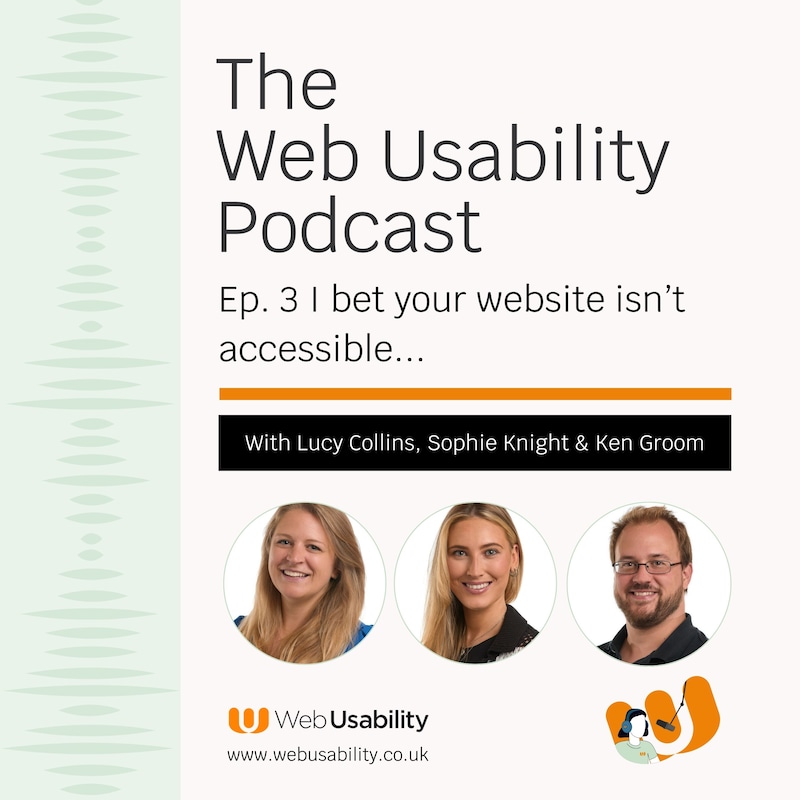
Shownotes
Summary
In this episode, the Web Usability team, Lucy, Sophie and Ken discuss the challenges of achieving compliance with the Web Content Accessibility Guidelines (WCAG). They explore why many websites are not accessible, including a lack of understanding, limited resources, and reliance on automated tools. The team also highlight common technical, content, and design issues that arise during accessibility testing. They emphasise the importance of involving people with disabilities in testing and the need for a cultural shift towards accessibility. The episode concludes with a reminder that digital accessibility is a basic human right and should be a fundamental consideration in all digital projects.
Keywords
web usability, digital accessibility, WCAG compliance, technical issues, content issues, design issues, automated testing, involving people with disabilities
Takeaways
- Many websites are not compliant with WCAG due to a lack of understanding, limited resources, and reliance on automated testing tools.
- Common technical issues include a lack of keyboard accessibility, incorrect tabbing order, and inaccessible labels.
- Content issues often involve improper use of alt text, particularly for decorative images, and the lack of accessible alternatives for videos.
- Design issues frequently arise from poor color contrast and the use of inaccessible color palettes.
- To improve accessibility, organizations should prioritize it as a cultural value, educate themselves on the guidelines, conduct accessibility audits, involve people with disabilities in testing, and continually strive for improvement.
Sound Bites
- "People don't prioritise accessibility partly because they can't fit it into their plans. Also because they don't appreciate the value of digital accessibility."
- "People who think they're compliant or think they have done enough to be compliant, but they are relying on automated checking tools, accessibility overlays and plugins, things like that, which actually, so they think they've done everything they need to do, but in reality, it's still not even close to being compliant."
- "Alt text is a huge one. And then there's kind of different layers within that because we need kind of those informative images to have a useful, relevant descriptive alt text. Often don't."
Chapters
00:00 Introduction and Overview
01:06 The Challenges of Achieving WCAG Compliance
09:43 The Importance of Involving People with Disabilities
13:20 Prioritising Accessibility as a Cultural Value
Transcripts
Episode 3: Is your website accessible?
The Web Usability Podcast transcript
Lucy Collins
Welcome to the Web Usability podcast, where we explore what it takes to make the web a more accessible and enjoyable place for everyone. Whether you're a website owner, developer, or just a curious mind, we're here to share insights, tips, and stories that can help you improve the user experience of your digital world. I'm Lucy Collins, Director of Web Usability and your guide on this journey to better usability. If you need a transcript of this podcast, just visit our website at www.webusability.co.uk.
Now, let's dive in.
In today's episode, I'm joined again by web usability UX consultants, Ken Groom and Sophie Knight. Hello, team.
Ken Groom
Hi guys
Sophie Knight
Hello. Thank you for having us back on.
Lucy Collins
No problem. It's a pleasure. Today we are gathered around the microphone and talking about all things digital accessibility. One of the key accessibility services we provide at Web Usability is an audit against the web content accessibility guidelines, otherwise known as WCAG.
It's effectively the accessibility blueprint to which all digital services should ideally be built. While it may not sound super exciting to everyone, for us it's pretty cool as it gives us a set of guidelines against which we can assess websites, apps, e -learnings, anything online really, and identify tangible improvements that website owners can make to offer a more inclusive and accessible experience for all. Over the years, we have now done probably many hundreds of audits, wouldn't you say guys? And you know what? Not a single website or digital service has passed the WCAG guidelines first time.
r businesses, certainly since:So we really wanted to ask why, what are the common issues we see and what can be done to try and improve this pass rate so that we can all be making accessible digital services going forward. So let's start with the why. Why do we think so many websites are not compliant with WCAG team?
Ken Groom
I mean, to begin with, I think it's perhaps slightly broader than specifically WCAG compliance in terms of just why websites not accessible, why people not trying to make their services accessible. And I think part of it at least is I was going to say people don't care, which is perhaps a little harsh. People don't prioritise accessibility partly because they can't fit it into their plans. Also because they don't appreciate the value of digital accessibility. And it's, it's huge.
I've been reading some research from a company called Scope and done it in association with Barclays and people like that. And they value what they call the purple pound, which is the spending power of disabled people in their households in the UK. They value the purple pound and less make a 274 billion pounds per year. That's how much money is potentially being wasted by not being accessible. That's what you're missing out on is your share of 274 billion pounds. So there's 16 million disabled people in the UK. So one in four people have some sort of disability and most of them can't get what they need online. So 73 % of disabled online shoppers have experienced barriers on over a quarter of the websites they visited. So there's a huge amount of inaccessibility out there that makes it very difficult for these people to find what they want, buy what they want. 50 % of them or 48%, I think say if they can't buy what they want easily on one website, they will either give up or go to a different website. They're not going to persevere through accessibility barriers. So people perhaps who don't care or don't prioritise accessibility, I feel are missing quite a big trick here. Yeah, absolutely. You're right. As you say, there's numbers behind all of this to back up the fact that this is a huge market, a market that should not be forgotten. And I think one of the things that we'll likely come onto is that the impact of making something accessible is also so much broader than that as well. Yes.
Lucy Collins
Absolutely, it's going to allow you to tap into that massive market of potentially forgotten people, which is firstly just sort of a bit unacceptable. But secondly, by making things accessible, you then have the ability to reach people that don't necessarily get counted in those numbers. So people that don't have a registered disability, but do have some sort of access requirement. Older demographics who might be losing their eyesight, for example, is a classic one, isn't it?
And so I think it's a really important point, Ken, and I think actually it almost underestimates the impact and the value of accessibility because it doesn't include those other groups of people that are not counted in those numbers.
What else? So, I mean, that's, you're right, that's the kind of the broader thing around accessibility and why we think it gets forgotten. But if we go back to specifically the Web Content Accessibility Guidelines Work Act, why is it that we think so many websites are not then compliant with those guidelines? You know, we have a blueprint for making websites, digital services accessible. Yes, they're not perfect. And yes, there's always more you can be doing. Testing with users is one thing and we're definitely going to talk about that later on. But they're a fantastic place to start. They're there, they're accessible for anyone. They're available online for free. So why do we think that we're getting so many websites that we look at and we know that more broadly in the digital world, there are plenty that are not accessible. Why do we think that they are not?
Sophie Knight
I do think generally there's a lack of understanding around the guidelines. For a lot of people, we see it with our own clients, the guidelines are very overwhelming. There's the different standards within the guidelines - there's complying with A, AA, AAA. And then on top of that, there's new iterations of the guidelines being released that add kind of new guidelines. So a client may think, I've got my head around these guidelines and I know what comes as part of these and then there's something else added or something's changed. And we even have conversations amongst ourselves as Accessibility Consultants about how things are changing. And I think that does create kind of a bit of a fear around the guidelines and yeah, kind of knowing how to comply or understanding them fully.
Lucy Collins
Yeah, it's the difference so what I was talking about at the beginning is people who are not thinking about it. They're not prioritising disability, they're not trying to do it. But then as you said, people who are trying to do it, there's still all these barriers in the way and is the guidelines are available, but they are complex and some of them, I mean, some of them are straightforward, you know, contrast ratios you can check and measure very easily and you can do that manually. But a lot of them, there's a lot of interpretation. They're quite subjective in some cases, a lot of nuance that makes it difficult for people to get into the details. And as you say, if they change, then that makes it harder again. And I think you're right about what you say, Sophie, about the guidelines feeling quite difficult to get your head into. I mean, I said that they were accessible online. I mean, yes, technically they are accessible online, but if you've ever spent time digging around on the WCAG website, you'll know there's an awful lot of information there.
It can feel really overwhelming. And I mean, we spend a lot of time getting our heads into them, understanding how to interpret them, because there is also some subjectivity. They are guidelines, not rules. And I think as a result, you do need to interpret the guidelines and then apply them to different digital services in a way that's going to be relevant to them. And if that isn't your full -time job, like it is for us, lucky us, then it can feel horribly overwhelming to be suddenly presented with up to 70 plus guidelines that you need to try and understand, get your head into, learn how to check for them, learn how to then remediate for them. And I think you're right. We speak to clients all the time where they're just like, what? I cannot get my head around this. This is horribly overwhelming. It feels ironically inaccessible because of the way that it's written and just the volume of content and detail that is available out there. So I think, yeah, for those people that are trying there's then this real barrier to actually understanding, interpreting, and applying those guidelines.
I think there's also the classic lack of time and resource which plays into that as well, isn't it? Most organisations that we work with certainly don't have a specific accessibility person. Often it will be the web developers or the website content team that are taken or that take on the responsibility of accessibility for an organisation. But they're not technical people, they're not developers, they don't necessarily understand the code requirements of accessibility. So you've then got squashed resources because they don't have the time to learn it. They don't have the skills in the first place. And it just adds to this feeling of overwhelm and, my God, I can't be dealing with this. And then you've got the pressure of, certainly for our public sector clients, the kind of legal pressure that hangs over them, isn't it? So public sector organisations have to comply with WCAG level 2 .2 to, sorry, version 2.2 to level AA, that can be quite scary for people. And I think it creates this real feeling of fear around accessibility. And so people are so worried about getting it wrong that often they then feel put off from even trying. It's paralysing.
Ken Groom
Yeah, there's the don't know, don't care. There's the do know, but can't do it because it's too complicated. Don't have the resources paralysed by the fear of getting it wrong. And then I guess that the third part of this, in terms of why people aren't compliant is people who think they're compliant or think they have done enough to be compliant, but they are relying on automated checking tools, accessibility overlays and plugins, things like that, which actually, so they think they've done everything they need to do, but in reality, it's still not even close to being compliant. And that's perhaps the most dangerous in a way of these groups, because people who believe they've got it right. And that's where certainly we get quite a lot of people saying, we've got an accessibility, we've got an overlay on the site. People can modify the text and the colours and stuff. They can use the tool and do it on the site. So that's fine. And as we know, there's a huge amount of problems with those and they do not actually make sites accessible. In quite a lot of cases, the tools themselves are not accessible, which is not a great start. And even if they are, the issues they fix tend to be very specific and far from comprehensive. So I think that that's a third group.
Sophie Knight
I think the fact that we've heard firsthand from our panel of digital accessibility specialists who obviously have lived experiences, that plugins often actually interfere with their own assistive technology. I think that kind of tells all.
Lucy Collins
These plugins I find really fascinating because they will often market themselves as a solution to compliance, don't they? You know, I've been on a lot of their websites and there is a lot of stuff on there saying ‘if you've got our plugin, you will be WCAG, American Disabilities Act, the EU regulation compliant’. But as you say, Soph, if you are blind or a user of assistive technology like speech recognition software, you are going to have that software in place and active all the time because you will not be able to get to the website unless your screen reader helps you get there or tells you how to get there and vice versa. You're not going to be able to activate that website unless you've got your speech recognition software turned on.
So for those users that have probably more serious disabilities, the plugins are completely pointless. And as you say, from the feedback we've had, they get in the way of that experience, don't they? It's really interesting that, as you said, Ken, a lot of organisations will pop one of these on their website and go, phew, compliant. What a relief. And the reality is that there will be some people that use it. And certainly, they can be helpful for people that want to change font size, change the colours, invert the backgrounds, increase line height, those sorts of things that we know will help certain people with neurodiversity, visual impairments, but they will often also have their own tools and systems in place. So it feels like quite a tokenistic approach to accessibility compliance, in my opinion. I always feel a little bit mean when I have to say to clients who say, we've just spent all this money on this new plugin. And I'm like, yeah, but you're still not compliant, my friend.
Sophie Knight
It was a e -learning module that I audited kind of earlier in the year. And they had one of those accessibility plugin overlay tools. And it was a shame because the module generally was quite accessible. But then it seemed like they'd added this plugin as kind of an afterthought. And it did have, it had a function where it was like hit the enter key for blind accessibility features. And it was like you were saying, Lucy, a screen reader user, a blind person to get onto the e -learning module in the first place is going to be needing to use their own assistive technology, their own screen reader. So what use is this plugin going to be? And then actually when we did try to use it, it didn't do anything.
Ken Groom
So it could have been worse. OK.
Lucy Collins
So I think, Ken, you really nicely summarised it there that you've got these three groups, really. Don't care or don't understand the value and are therefore not engaging at all. The people that do care or know the value or certainly know they have an obligation as an organisation but are struggling to implement it. And then the third group who feel like they are doing the right thing but perhaps are a little bit misguided in what they're doing and as a result not reaching those compliance levels that we're seeking.
I think it's probably worth moving on at this point to talk about what are the issues that we do see? I mean, we could be here for hours if we were to go through everything, but from the many hundreds of audits that we've had the pleasure of doing over the last few years, I know that there are some common themes that come out, some common issues that we will see in almost every single audit. And I thought it might be nice just to talk through some of those examples.
I think to help people categorize or think about these issues, I like to think about them in kind of three pillars or three categories, which is technical issues, content issues, and design issues. So technical issues are things that are going to be to do with the backend code. They're often going to be issues that are the responsibility of developers to resolve. Then you've got your content issues, which as the name suggests, are issues with the content. But this is not just the body content. This is going to be your headers. This is going to be your link labels. This is your navigation. And there's probably shared responsibility between developers and content teams to get those issues resolved. And then finally, you've got your design issues. So issues with the way that websites, digital services look and how that impacts people engaging with them. And obviously that's primarily going to come down to the designers, but also potentially the content team to think about, well, what colours are we using? Are we using them the right sort of way?
So thinking about those kind of three pillars as our framework, for want of a better word. I mean, what do you think are the most common issues that you guys have come across? Let's start with technical, for example. What are the most technical, no, sorry, most common technical issues? that you see in the audits that you do on a day-to-day basis, guys?
Sophie Knight
Definitely a lack of keyboard accessibility. So going through and tabbing through all of the interactive elements, seeing things that aren't accessible at all with the keyboard, cause a keyboard trap for those keyboard users. That's definitely a big one that I see quite regularly. And obviously, that's quite a critical one because that's going to actually stop keyboard users from accessing a website and using it at all and potentially engaging with really important functionality.
Ken Groom
Yeah, tabbing order as well. So even if stuff is in, if you can tab to all of it, if it's not in the right order, as is visually on the page, then people will miss stuff and for sighted keyboard users, it becomes a nightmare. The other big one for me is the accessible labels on stuff. So obviously something that only really affects, primarily affects screen reader users, but so they tab onto a text field or an interactive element or a button or whatever it is, and it gets announced as button or clear or whatever it is or just nothing at all. And that then it's very difficult for people to work out what they're interacting with. And that's certainly we see a lot because it's not something that a lot of developers designers will pick up on because it's not something that affects them in any way. It's something that has to be done an additional thing in the background that gets missed out, I think.
Lucy Collins
And I think it's probably worth saying about the difference in navigational styles that we see with users with different, you know, with different disabilities. So for myself, for example, I know I navigate a website primarily using a mouse, but that is not possible for certain individuals if you have a physical disability that limits your ability to use your upper body or if you are blind and therefore obviously can't point and click on things. So that's why the keyboard operability, being able to tab through a website is such an important navigational style for those sorts of people. And as you say, Ken, missing those button labels, it basically means that a screen reader user is left completely in the dark as to, well, what is this? Is this a menu? Is this a button? Is it a form field? How do I engage with this? And all of a sudden it makes it, as you said, a critical issue because this isn't something that they're then going to be able to engage with because they've got no idea what it is. So it's a real fundamental thing and it's not difficult to get right. There's some very well known and established code around these sorts of things, but without it it makes it almost impossible for people not only to navigate through the site, but also then to engage with bits and pieces on it once they get to it.
I think the other one that kind of plays into that as well is then page structure. So, you know, I look at a page and I can see that it's split up into sections. I can see that I've got different headings. I can see that there's a navigation at the top. But if you arrive at a site with no vision, you're not going to be able to get that impression from things. And that's where you rely on your assistive technology or screen reader to give you that information. And if that is missing in the code, if I'm not told something's a heading or a menu or a button, then again, not only am I not going to have to engage with it, but I'm not going to know how the page fits together. What is this information in relation to something else that's on the page? And you just end up so lost. And I mean, we work with some fantastic people, as you said, Sophie, on our accessibility panel. And you see them using the websites and you see the frustration when they're like, I don't know where I am. I don't know what I'm doing. And it just makes it impossible for them to then engage with any of the functionality or the services that are being offered by an organisation. So, yeah, I'd agree. Those are sort of the key technical things. What about content? What do we think are the issues we see regularly when it comes to the content on pages?
Sophie Knight
I feel like alt text is a huge one. And then there's kind of different layers within that because we need kind of those informative images to have a useful, relevant descriptive alt text often don't. But then we've got another layer with that where decorative imagery shouldn't have an alt text. And that's something that does cause a bit of confusion amongst clients because it seems quite hard to get it right when there's perhaps a lot of imagery on the website. What is decorative? What is informative? That's quite a common one, I would say.
Ken Groom
Yeah, definitely. And then you've got the conflict with branding images that aren't technically relevant, but if you want to convey your brand values of the quality of or whatever of your services or your products. then they are relevant for that, but they're not directly relevant. So how would you manage that with alt text? So it is certainly a bit of a balancing act. It's very rare that we ordered a website that doesn't fail on 1 .1 .1, which is alt text.
Lucy Collins
I think we could probably do an entire podcast on alt text, to be honest, because it does feel so complex, right? As you said, you've got the difference between is this image actually telling me something or is it just there to make the page look pretty? But brand values, they're really important to convey. So where does that sit? And then I've been asked questions when I've done accessibility training in the past as well about how do we convey certain protected characteristics within alt text? Do we talk about ethnicity? Do we talk about gender in alt text? Is that relevant? What is it that we need these images to convey? And I think people are so worried, again, it's a classic case of paralysis by fear of getting it right, of not offending. And so sometimes you see alt text that are, as a result, completely useless. And again, we test these with people and we have some of our accessibility panelists who are just going, why are you telling me about a cup of tea on a table? That doesn't help me. Where actually what they wanted to know was that that table was in a room that had easy access and it had nice ambient lighting or something that's going to give them a sense of what it's going to feel like to be in the space rather than the fact that there's a cup of tea on the table, which that doesn't help anyone. So I think, yeah, alt text, we could go down a massive rabbit hole here if we're not careful. And I think probably not the time or the place, but hey, maybe for a future episode, anything else from the content side of things that you see in your audits regularly?
Ken Groom
I mean, videos is the other one I think you mentioned when you're running through at the beginning. If a site has videos on again, almost exclusively, it will fail our audits because you need the transcripts or text descriptions, audio descriptions. You need some accessible alternative for video content for blind people. But again, this could be quite a big topic as well. There's a lot of balancing between what is actually relevant information that isn't conveyed in the audio, things like that. Obviously, the other side of things is captions for deaf people. You need captions if there's relevant content that isn't visually conveyed. So there's a balance within videos, but certainly we see a lot of issues with them. And again, it's quite complicated to produce an audio description for a video is not a straightforward thing. So something you can just quickly add after the fact to a video. It takes a lot of work, which I think again is potentially why we don't see it very often.
Lucy Collins
Okay. So then the final column or final pillar that I talked about at the beginning was design. So what do sites look like? What do digital services look like? And again, I think we see some common issues here. What would you say that those are from the audits that you've done?
Ken Groom
Again, I mean, colour contrast, use of colour generally, in fact, obviously the big one with design. People love their brands and they pick brand colours and brand identities they don't necessarily pick colours that go together in an accessible way, as in have a 4.5:1 contrast ratio between the text and background colour or between adjacent colours, things like that. Text contrast. And even if people get it right in the bulk of the page, quite often you'll get it in footers, footer text. So the footer will have different background colour. And now the text doesn't have sufficient contrast. Quite often you get it in navigations, search tools. Anyway, someone tries to do something visually interesting and distinct without considering the colour contrast implications of doing that. We tend to get issues and sometimes you'll just get a colour palette that is completely inaccessible. Some of the stuff I've been doing recently for some big hotel groups where they're developing new websites for a whole lot of different hotels within the group. And they've based on discussions with us, they've come up with there's something like 27 different colour palettes for each of the different hotels and they are all accessible because they have gone through and they've made sure that the contrast ratios are correct in all of them. So as long as they use the colours in the right places it's fine. So you can do it and you can do it on quite large scale and they want all of the sites to be visually distinct, but they are all going to be accessible from a contrast perspective. but if you don't think about it and it's very easy to get that wrong.
Lucy Collins
Yeah. It always amazes me quite how often we find a colour contrast issue. Cause as you say, Ken, it feels like a very easy thing to avoid. And that example of the client we've been working with is a fantastic one of how, if you just think about this at the beginning, you can embed an accessible colour palette right from the start. I mean, we're not really ones to talk to, are we? Because our brand colour is orange, which was established 22 years ago, you know, and hands up, but it was before accessibility was on our radar. And as a result, we have had to make some serious changes to the way that we use our brand colours, because orange is inherently a horrible colour from an accessibility point of view. Green is another one that we have historically had in the brand set as well. So I think that it is an easy mistake to make, but I think what's important is to recognise where you've got a colour combination that isn't compliant and avoid it wherever possible or only be using it where it's not a key thing that's conveying functionality, meanings, who's using it for links, that sort of thing would just be a total no -no. Can you imagine if we had orange links all over our website? it'd be hideous. So I think actually it's just really important to go, okay, fine. Yeah, we've got some issues with our colour palette, but let's just, you make sure we're using it in an accessible way that complies with the very clearly set out colour contrast requirements that have been tested and are evidence-based as much as possible.
Ken Groom
Yeah. Our colour palette is orange, green, black and white. So as long as you don't put white on orange or white on green, things like that, or green on orange, then it's fine. So that, that, and that's what this hotel company did. You know, not all the colours enough contrast against each other, but all their text is either white on a dark colour or black on a light colour. And that has sufficient contrast. So there's ways around it. We are straying, I suspect, into the next section of the podcast in terms of how to fix stuff. What can we do about it?
Lucy Collins
Yeah, well, it's probably a good moment to move on, isn't it? I mean, so the final thing we wanted to talk about really today was, well, what can we do? And I'd written in my notes, what can we do to improve the WCAG pass rate? But I actually think it's just much bigger than that, isn't it? It's to go back to your very original point, Ken, it's what can we do to obviously get people on board with accessibility, get them to understand the value of it, and then obviously get people to be compliant with WCAG and ideally then take the next step and not just be compliant, but also be practically accessible. So yeah, what would be our advice to people? How can we get them on board with this accessibility journey that we're all on?
Ken Groom
I guess if we think about the same three groups that we were talking about at the beginning, so the people who don't care or don't prioritise it. I mean, to a point there's a limit to what we can do, but what they can do is to find out why it's important. So if people know, even if it is something as base as understanding the value, the potential income that you're missing out on by not being accessible, then that sort of education and information around that, and also just understanding the impact that it has on everyone. So in the States, and when we do work with American companies, there's a much bigger risk of direct litigation. So there's a very powerful driver there, but even over here, just being accessible will improve usability for everyone and is generally good practice and the best, the nice thing to do. So convincing people to make a start is the first thing. And that means not just whoever's reached out to us in our case. So it's not just the member of the digital team. It's got to be within the organisation. There's got to be a culture of accessibility and a culture of inclusion and inclusivity. And that's so there's a, there's a changing kind of mindset bit at the beginning of education piece. Once people are on board, then we're into the next two groups of people who don't know how to do it or find it overwhelming and people who think they've done it but haven't. And then there's various different ways that we can work with them or they can work on their own and sort of sort that out.
Lucy Collins
Well, I think that, yeah, for those next two groups, you know, once you are on board with the idea that accessibility is an important thing, then it's obviously going to be doing the work. So it's going to be having an audit done. And obviously we can help you with that, bit of shameless promotion. But I think also it's not relying on automated testing. There are a lot of accessibility testing tools out there on the market. A lot of them rely on automated testing. Some of them are being enhanced by AI, but at this point, they're not sophisticated enough to be able to do as good a job as someone manually checking a website using a range of assistive technologies, screen readers, speech recognition software, screen magnifiers. And so it's understanding the guidelines, understanding the process for testing. If you don't feel you've got the time or the resource to be able to go up that learning curve yourself, there are organisations like us, plenty of others, but you know, like us, who can definitely help with something like that. And I think the next step, and so it's probably be nice for you to talk about this a little bit, is really to involve people in that as well. Do you want to take the baton?
Sophie Knight
Yeah, absolutely. So obviously a huge part of this is actually involving those people with a lived experience of disability in your testing. So an accessibility audit is kind of the first step, but run through the website with someone with one of those experiences who uses assistive technology and build or carry on your checks with that in mind. That's kind of the next step and that's what we always recommend.
Lucy Collins
I think what's interesting is that WCAG are moving in that direction as well. It's not going to be soon, but there is a new iteration of the guidelines expected in the next sort of five -ish years or so, WCAG 3.0 which is going to be a total rewrite of the guidelines as we know them, which I'm sure will fill a lot of people with dread having just started to get their head around it as it is at the moment. But one of the key things or one of the key changes that they're looking to make to these guidelines is that inclusion of people with lived experience of disability in your testing, because we know having tested websites that are pretty good from a WCAG compliance perspective, that you will still come across issues and barriers to people with disabilities that are sort of not really covered by WCAG or are not covered in the depth that we would expect them to be. So I think that will be a really positive change for the guidelines going forward.
Just before I wrap up, I just wanted to check, I mean, is there anything else that you think that clients or people listening to this could be doing to try and improve the accessibility of their digital services? So just going back to sort of three groups and the three reasons why people aren't accessible, we had at the beginning and tied into this, what can be done?
Ken Groom
If you don't think about it you don't do it and don't prioritize it. Learning about it, finding the value and educating within the organisation, organisation change, sort that out. If you are feeling overwhelmed by the amount of work involved to do it, take the first step, getting someone to do an accessibility audit, get an external agency or an expert or someone in to do an audit. If you think you are accessible, either because you used a plug in or because you've done audits and you genuinely think you are accessible. That's when you bring in disabled users, people with lived experience and really actually test it and prove, because either if you are using an accessibility plugin, it will become immediately obvious that it's not sufficient. Or if you have made a genuine attempt to be accessible, then bringing in these users will confirm that you've done a good job and also identify any small areas for change. And that it's kind of, it's an iterative process. It's not something that you can kind of just do once and then be accessible because anytime you add new content or new accessible technologies are released, then there's a good chance you'll need to fix stuff, change stuff, tweak stuff again depending on which group you fall into, there's different things you could be doing, but there's something you should be doing in every group, even if you think you're accessible. Keep going because you probably won't be for everyone.
Lucy Collins
Yeah, brilliant. Well, I think on that note, it's probably worth saying that we believe strongly that digital accessibility is not a nice to have or an optional extra. It's a necessity. It's a basic human right in many ways. If a group of people are excluded from using your digital service because it's not accessible, that is discrimination and we don't like that. And certainly the law doesn't like that. So complying with WCAG is really the minimum we should be striving for. And Ken's outlined, I think, really nicely there what we could be doing more on top of that as well. And so while compliance doesn't necessarily mean every person everywhere will be able to use a website, and we would absolutely recommend testing with real people, it's a positive step in the right direction. So we really all need to get on board with this. Every person in an organisation is responsible for accessibility. Even if you just produce emails or Word documents, you're not actually doing anything on the website. Anything digital should be accessible. And adding digital accessibility to your checklist for anything that is created and consumed online should be at the forefront of your mind. We should be testing it. And I've written in my notes, test, test and test again, and wherever possible, include and involve people with disabilities with what you're doing. So I think on that note, a massive thank you to Sophie and Ken for joining me today. And we really hope that you enjoyed listening.
Ken Groom
Thanks
Sophie Knight
Thank you, bye!
Lucy Collins
Thank you for tuning in to the Web Usability podcast. We really hope you enjoyed this episode. If you have any questions, comments or topics you'd like us to cover, reach out to me on lucy at Webusability.co.uk or connect with us on LinkedIn. Please don't forget to like and subscribe so you never miss an episode. Until next time, keep making the web a better place, one user at a time.
