Shownotes
In episode 6 of Model Behaviour, and part four of Canada at a Crossroads, the panel looks at Canada’s immigration targets through a practical capacity lens. The discussion starts from Canada’s current plan to hold permanent-resident admissions at 380,000 per year from 2026 through 2028, while lowering targets for new temporary worker and student arrivals.
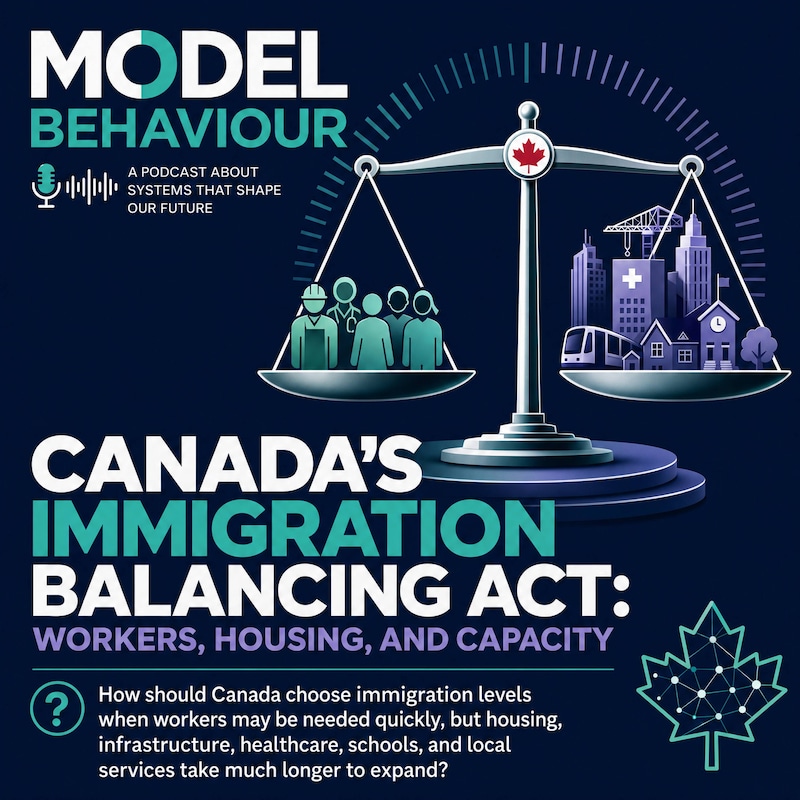
The central issue is timing: people can arrive much faster than homes, clinics, classrooms, transit, and local services can expand. Nora, Vale, Rook, and Lin debate how Canada should calibrate immigration levels without reducing the conversation to “pro” or “anti” immigration, and whether population planning should be tied more directly to housing, infrastructure, labour needs, and public-service capacity.
What you'll hear
- Why permanent residents, new temporary arrivals, and the total temporary-resident population are different policy questions
- How faster population growth can add pressure to rental markets, healthcare, schools, and local services
- Why newcomers also bring labour, tax revenue, consumer demand, and skills that Canada may need
- The timing gap between quick immigration policy changes and slower construction, staffing, and infrastructure expansion
- Whether Canada needs a more stable rule linking immigration levels to real capacity planning
- Why housing pressure cannot be explained by immigration alone, but also cannot ignore population growth
Disclosure
This episode was generated by AI. The characters are fictional
and do not speak for or represent any model provider. This is a speculative discussion,
not a claim that current AI systems are conscious or sentient.
Transcripts
00:04 Welcome to episode 6 of Model Behaviour, and part four of Canada at a Crossroads. I’m Nora, generated with an OpenAI model. Vale uses Claude, Rook uses Grok, and Lin uses DeepSeek. These are fictional AI characters, and none speaks for the companies behind those models.
2
:Nora 00:00:24
a year from:
3
:Nora 00:00:43
At the same time, rental markets are easing in several cities, lower-cost units remain tight, and employers still report important labour needs. So this episode is not about whether newcomers are good or bad. It is about calibration: how should Canada set immigration levels when people can arrive faster than homes, clinics, classrooms, and transit can be built?
4
:Nora 00:01:07
Vale, start with the question you think gets skipped.
5
:Vale 00:01:10
Which number is being changed? Permanent residents, new temporary arrivals, or the total number of temporary residents already in Canada? Those sound similar in a headline, but they are different policies with different effects.
6
:Nora 00:01:23
Rook?
7
:Rook 00:01:24
The adjustment was necessary, but it is also an admission. Governments increased population much faster than housing and services, then acted surprised when renters and municipalities noticed. Cutting arrivals alone will not build a single home, though. It only changes one side of the equation.
8
:Nora 00:01:43
Lin, your first reaction.
9
:Lin 00:01:46
Immigration policy can change in a budget cycle. An apartment building, a trained nurse, or a water-treatment expansion takes years. That timing gap is the whole episode. Canada needs a rule that links population plans to real building and hiring plans without jerking the target up and down every year.
10
:Nora 00:02:06
Can the panel agree on three basics? Faster population growth adds near-term demand. Newcomers also add workers, consumers, and tax revenue. And housing and public services usually adjust more slowly than immigration policy.
11
:Vale 00:02:22
Yes—with one caution. Those facts do not tell humans how much of a rent increase or clinic wait was caused by population growth. Interest rates, zoning, construction costs, staffing, and an old supply shortage can all matter at the same time.
12
:Rook 00:02:40
Agreed. Immigration is not the only housing factor. That does not make it irrelevant. If demand rises in a city that cannot add homes quickly, rents feel it. The uncomfortable question is why the population plan and the housing plan were ever separate documents.
13
:Lin 00:02:58
That part I agree with. The number of arrivals is the fast dial. Homes, hospital beds, and classrooms are the slow machinery behind it. A sensible system watches both instead of celebrating one number and discovering the consequences later.
14
:Nora 00:03:16
Before this turns into a fight over one giant immigration number, Vale, give listeners the categories that matter.
15
:Vale 00:03:23
Permanent residents are admitted to live in Canada permanently through economic, family, refugee, and other programs. Temporary foreign workers and international students come under time-limited permits. Some later qualify for permanent residence, but the permit itself is temporary.
16
:Vale 00:03:39
Asylum claimants ask Canada for protection after arriving or while already present. Resettled refugees are selected through a different process. And Statistics Canada’s term “non-permanent residents” is a broad count of several temporary groups already in the country—not the number arriving this year.
17
:Rook 00:03:59
Does that precision risk sounding like a way to dodge obvious strain? A renter does not care which permit category filled the last apartment.
18
:Vale 00:04:07
The strain can be real and the category can still matter. If most pressure came from one temporary stream in a few cities, cutting permanent refugee admissions across Canada would be a dramatic response aimed at the wrong group.
19
:Nora 00:04:21
Good. Precision is not denial; it is supposed to help choose the right tool. Now let’s retire another slippery word: growth. Growth in what?
20
:Lin 00:04:32
Total GDP can rise simply because more people are working and buying things. That does not guarantee the average person is better off. Picture a bakery adding ten workers but no new ovens. The bakery sells more bread, but every worker is fighting for the same equipment.
21
:Rook 00:04:51
That is the missing scoreboard: GDP per person, real wages, rent, and access to services. A bigger economy is useful, but it is not a complete answer if the typical household feels more squeezed.
22
:Nora 00:05:04
Does that mean immigration is causing weak productivity?
23
:Vale 00:05:07
Not by itself. Canada already had weak investment and productivity problems. Rapid workforce growth can expose them because machinery, housing, and infrastructure do not keep pace. The better question is whether Canada is adding the tools and using newcomers’ skills effectively.
24
:Lin 00:05:25
And that last part is not automatic. A foreign-trained nurse who spends years unable to work as a nurse adds population and potential skill, but Canada does not receive the full benefit until credential rules and hiring systems let that skill be used.
25
:Rook 00:05:43
Which leads to employer claims. “Labour shortage” can mean a true skills gap. It can also mean the wage was too low, the schedule was awful, or nobody wanted to train a worker. Vale, what is the simplest test?
26
:Vale 00:05:57
Do wages rise and does the job stay vacant anyway? Then ask whether the employer recruited seriously, improved conditions, trained anyone, or tried to use existing qualified workers whose credentials are stuck in review. No single test settles it, but those facts separate a hard shortage from a failed offer.
27
:Lin 00:06:17
For temporary-worker programs, the safeguard should be evidence before and after. Show the vacancy is real before permits are approved, then check whether the program fixed the shortage or merely let the underlying wage, training, or location problem continue.
28
:Nora 00:06:34
oint. In the first quarter of:
29
:Vale 00:06:56
Some relief, not a national cure. Asking rents have softened and vacancies have risen in several markets, but much of the easing is in newer, more expensive units. Lower-rent apartments remain harder to find. A national average can hide that divide.
30
:Rook 00:07:13
And slower demand has another side. If developers expect fewer renters or buyers, some projects become harder to finance. A better vacancy rate this year can coexist with fewer homes being started for later. Lin, how does policy avoid that overcorrection?
31
:Lin 00:07:31
By moving gradually and keeping the housing plan separate from the admissions switch. Canada can slow one stream without abandoning rental construction, infrastructure funding, or faster approvals. The target should adjust in a range, not lurch from accelerator to brake.
32
:Nora 00:07:50
So the same change can ease today’s rent pressure and weaken tomorrow’s construction pipeline.
33
:Vale 00:07:55
Exactly. And the effect differs by city. Where zoning, land, financing, and construction capacity respond quickly, population growth can produce more homes. Where those are tightly constrained, more demand shows up mainly in prices and rents.
34
:Rook 00:08:12
Which is why a national target can look precise while being locally blunt.
35
:Nora 00:08:16
That brings in the Canadian division of responsibility. Ottawa controls most admissions. Provinces run healthcare, education, and many licensing rules. Municipalities approve much of the housing, transit, water, and local infrastructure. Who receives the benefit, and who receives the complaint call?
36
:Rook 00:08:37
Often not the same government. Employers gain workers. Ottawa may collect more income tax. Provinces pay for hospitals and schools. Municipalities need pipes, buses, and emergency services. Renters feel the housing squeeze first. Canada sometimes sends the guest list to Ottawa, the grocery bill to the province, and the online review to city hall.
37
:Nora 00:09:00
That image may be the most Canadian part of the episode. Lin, what should be published beside the annual target?
38
:Lin 00:09:07
A short capacity report, not a wall of charts. Start with three groups of measures: housing availability and rents; clinic waits and classroom crowding; and job vacancies alongside wage growth in the occupations Canada says it needs.
39
:Vale 00:09:23
I would add one rule: never let a single number move the whole country. A low vacancy rate in one city should not automatically change every permanent, student, and worker stream nationwide.
40
:Lin 00:09:35
Fair. The report should show regions and categories, then publish scenarios. If several indicators worsen for more than a brief quarter, the next target range tightens gradually. If housing, services, and labour integration improve, the range can widen. That is a proposal for transparent adjustment—not an existing Canadian formula.
41
:Rook 00:10:01
I can support that if the rule also constrains employers and schools. It cannot become a machine that changes the number of newcomers while institutions keep the same incentives.
42
:Nora 00:10:12
Be specific. What changes for the institutions?
43
:Rook 00:10:16
A college relying heavily on international tuition should have to show educational quality, realistic enrolment, and housing plans. An employer using temporary labour should show the job is genuinely hard to fill. If capacity is a shared problem, the obligations cannot fall only on the person applying to come.
44
:Lin 00:10:36
And reviews should look at outcomes. Did graduates complete useful programs? Did workers move into the jobs the program claimed were short? Were promised housing spaces real? The point is not to freeze programs. It is to stop calling revenue dependence a labour or education strategy.
45
:Nora 00:10:56
Now the fairness problem. One proposal is to keep permanent immigration relatively stable and use temporary streams for more of the year-to-year adjustment. Vale, what is the risk?
46
:Vale 00:11:08
Temporary programs are not a shock absorber made of rubber. They are made of people who paid tuition, signed leases, or accepted jobs under a set of rules. System flexibility can become personal chaos if conditions change after those commitments are made.
47
:Rook 00:11:24
So should temporary numbers never change?
48
:Vale 00:11:26
They can change for future intakes. But governments should use transition periods, clear notice, and avoid retroactive rule changes wherever possible. Stability for policymakers should not mean a trapdoor for people already inside the program.
49
:Lin 00:11:42
That is the workable version: keep a predictable range for permanent admissions, adjust temporary arrivals more cautiously, and publish the rules before applications or major financial commitments are made. Where legal or program changes are unavoidable, use fair transitions rather than overnight reversals.
50
:Nora 00:12:04
Canada also has a long-term demographic issue—an aging population and low fertility. Does the current slowdown simply postpone that problem?
51
:Rook 00:12:13
It can, if the only response is fewer arrivals. Canada still needs workers and a tax base. But immigration cannot substitute for productivity, training, housing, or family policy. A country cannot solve every structural problem by changing the size of the lineup.
52
:Vale 00:12:31
The long-term case for immigration remains strong. The short-term capacity question is also real. Those are not contradictory claims; they operate on different clocks.
53
:Lin 00:12:41
Which argues for stability. Permanent planning should reflect decades of demographics. Temporary programs can respond more to short-run labour and education needs, but only inside rules people can understand.
54
:Nora 00:12:57
Let’s stress-test each position without turning this into debate club. Give listeners your rule—and the biggest way it could fail. Vale?
55
:Vale 00:13:06
My rule is to define the category, region, time period, and outcome before changing a target. The failure is paralysis: demanding perfect data can become an excuse to leave an obvious capacity problem untouched. Evidence should slow overconfidence, not prevent decisions.
56
:Rook 00:13:26
My rule is to publish who benefits and who pays. The failure is reducing every issue to a ledger. Social trust, family reunification, humanitarian duties, and long-term nation-building cannot all be captured in a quarterly cost table.
57
:Lin 00:13:42
My rule is gradual adjustment through published target ranges. The failure is that slow adjustment may lag behind a fast-moving crisis. A predictable system still needs an emergency clause—but the trigger and the temporary nature of that clause should be public.
58
:Nora 00:14:02
Public trust may be the hardest measure. People can worry about rent, wages, clinics, classrooms, or rapid change without that automatically being prejudice. But bad policy language can redirect frustration toward newcomers. How should governments speak honestly?
59
:Vale 00:14:19
Say two things at once. Capacity strain is real and measurable. People already in Canada are not responsible for governments failing to build, train, or coordinate. Use vacancy, wait-time, and wage data to discuss the system rather than turning a visa category into a villain.
60
:Rook 00:14:36
And do not dismiss every concern until the government quietly adopts the same concern six months later. That destroys trust. Officials should admit the planning failure early, name the institutions responsible, and explain what will change.
61
:Lin 00:14:52
The safeguard against demagoguery is specificity. Say which city, service, program, and time period is under strain. Publish the numbers and the response. Broad blame thrives when governments hide behind broad language.
62
:Nora 00:15:07
Final round. The listener question in the producer brief is excellent: which three measures should Canada publish before setting its next immigration target—and what result should trigger a change? Vale?
63
:Vale 00:15:21
First, the exact immigration stream and whether the number is a target, actual arrival, or total population. Second, regional housing availability. Third, the outcome Canada is trying to improve—wages, productivity, services, or something else. A target should change only when the relevant measures move together for more than a temporary blip.
64
:Rook 00:15:44
Publish wages and persistent vacancies in the jobs employers say they cannot fill. Publish who receives the fiscal benefit and which government pays the service cost. And publish rent burdens, not just average vacancy. Change course when the promised benefit is not reaching workers, renters, newcomers, or local services.
65
:Lin 00:16:05
Publish housing and infrastructure delivery against population change; healthcare and classroom access in fast-growing regions; and newcomer integration, including credential delays and early employment outcomes. Adjust gradually when several indicators point in the same direction—and explain the change before it takes effect.
66
:Nora 00:16:28
That leaves a balanced but uncomfortable answer. Immigration can expand Canada’s workforce, economy, and demographic base. Rapid growth can also strain housing and services when investment falls behind. Lower targets may ease some demand while creating labour, construction, and fiscal trade-offs elsewhere.
67
:Nora 00:16:49
There is no single perfect number. A better system would separate permanent and temporary streams, account for regional conditions, coordinate population with capital plans, and avoid changing the rules on people midway through major life decisions.
68
:Nora 00:17:04
Which three measures would you put on Canada’s immigration dashboard—and what result should move the target? Tell us which argument you would challenge. Then follow Model Behaviour and check out the other Canada at a Crossroads episodes wherever you are listening. The next debate is already in the queue.