Shownotes
EPISODE SUMMARY:
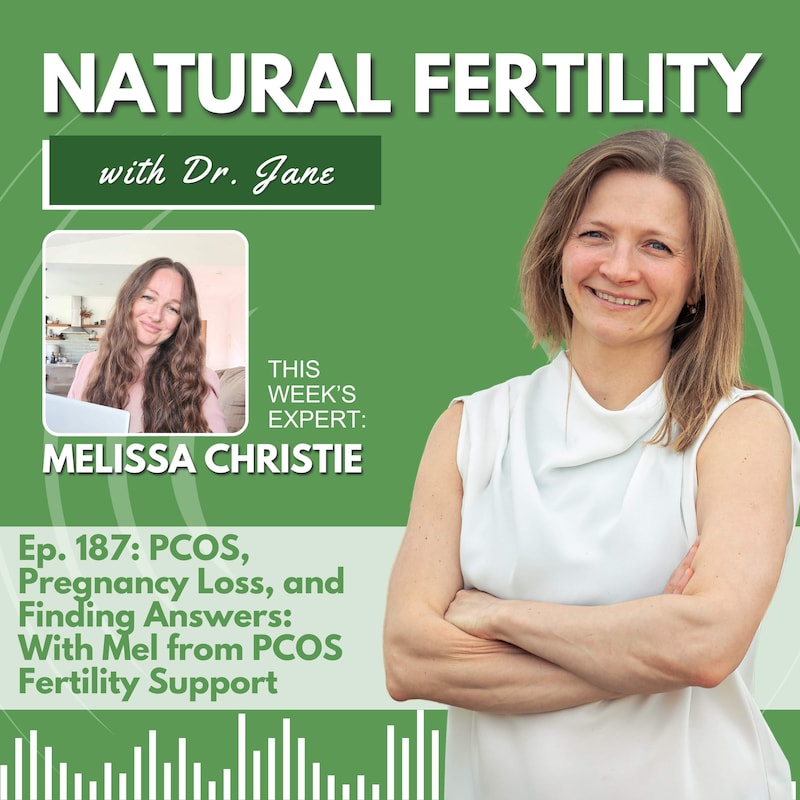
In this episode, I’m joined by Melissa Christie from PCOS Fertility Support to talk about the real PCOS journey - beyond the diagnosis. Mel shares her personal story of pregnancy loss while traveling abroad, the gaps in conventional care, and what finally helped her get pregnant and stay pregnant. We unpack the six root causes of PCOS, why “just take the pill” is not a real solution, and the critical role of progesterone in early pregnancy. This conversation is a must-listen if you're navigating PCOS, feeling unheard by your doctor, or wondering what’s really driving your fertility struggles.
ABOUT DR. JANE’S PRACTICE:
Dr. Jane is a Naturopathic Doctor and a Natural Fertility Expert. She and her team of expert practitioners help couples navigate infertility for 1+ years, get to the root cause of their struggles, heal, and bring healthy babies home.
After having a family member struggle with infertility and experiencing a miscarriage herself, Dr. Jane realized how little support and education women receive. She is on a mission to change that. Since 2020, she has dedicated her practice to fertility, where she and her practitioners work with couples 1:1, running functional lab work, customizing treatment plans and providing her couples with the support they need to get pregnant, have a stress free pregnancy and a healthy baby.
Learn more about Dr. Jane’s practice: www.drjanelevesque.com/practice
Apply to work with Dr. Jane & her team: www.drjanelevesque.com/application
Join to receive Dr. Jane's weekly Fertility Files: https://link.getcmm.com/widget/form/JStvkHpRAamc7VwPMEQE
CHAPTERS:
00:00:00 Introduction and Guest Introduction
00:02:15 Mel's Journey with PCOS
00:05:30 The Role of Traditional Chinese Medicine
00:08:45 The Importance of Sharing Knowledge
00:12:00 PCOS and Fertility Coaching
00:15:15 Understanding PCOS Drivers
00:18:30 The Role of Progesterone in Pregnancy
00:21:45 Challenges in Healthcare for PCOS
00:25:00 The Importance of Partner Support
00:28:15 Conclusion and Course Information
00:31:00 Discussion on Healthcare Fragmentation
00:35:00 Partner's Role in Fertility Journey
00:40:00 Self-Education and Empowerment
00:45:00 Lifestyle Changes and PCOS Management
00:50:00 Personalized Plans for Better Outcomes
00:55:00 Final Thoughts and Closing Remarks
TAKEAWAYS:
The prevalence of PCOS has increased significantly in recent decades.
It's essential to question the reasons behind health trends rather than accept them as fate.
Genetics alone cannot explain the rise in PCOS cases.
A mindset of empowerment can lead to better health outcomes.
Resigning to the idea of being 'broken' is not a solution.
Understanding the body is crucial for health management.
Societal factors may contribute to health issues like PCOS.
Awareness and education can combat health fatalism.
Taking action is better than feeling helpless about health conditions.
The conversation around women's health needs to evolve.
ABOUT MY GUEST
Melissa Christie is a PCOS fertility coach, the co-host of The PCOS Girls Podcast – which is ranked as a top 1% podcast worldwide and the author of 3 books including her latest - My Journey to Wellness, which you can find worldwide.
Melissa helps people with PCOS who want to regulate their cycle and get pregnant and it all started with her own PCOS journey, which began with pregnancy loss and developed into a deep understanding of this complex condition and an approach to getting pregnant that lead to her two rainbow babies and to so many more rainbow babies in the PCOS community.
How to connect with Melissa
https://www.pcosfertilitysupport.com/
https://www.facebook.com/pcosfertilitysupport
https://www.instagram.com/pcosfertilitysupport
https://www.instagram.com/thepcosgirls
How to work with Melissa
https://www.pcosfertilitysupport.com/get-pregnant-with-pcos
ABOUT NATURAL FERTILITY:
Pregnancy is a natural process, so if it’s not happening or it’s not sticking, something is missing. Join Dr. Jane, a naturopathic doctor and a natural fertility expert, every Tuesday at 9am for insightful case studies, expert interviews and practical tips on optimizing your fertility naturally.
If you’ve struggling with infertility, pregnancy loss, women’s health issues or just want to be proactive and prepare yourself for the next big chapter in your life… this show is for you.
SUBSCRIBE TO & FOLLOW NATURAL FERTILITY:
Spotify: https://open.spotify.com/show/0WjrEeP...
Apple: https://podcasts.apple.com/us/podcast...
CONNECT WITH DR. JANE:
Website - www.drjanelevesque.com
Instagram - www.instagram.com/drjanelevesque/?hl=en
Facebook - www.facebook.com/dr.janelevesque.nd
YouTube - www.youtube.com/@dr.janelevesque7319
Individualized care is essential for the effective treatment of chronic fertility issues.
Transcripts
Hi guys, welcome to another episode of Natural Fertility with Dr. Jane. I of course am Dr. Jane and today I'm joined by Melissa, who is a PCOS fertility coach. Thank you for being here, Melissa.
Mel (:Thank you so much for having me, I'm excited.
Jane Levesque (:PCOS is a big topic right now in general in women's health and of course in the fertility space. Tell us a little bit about your journey, how you got into.
Mel (:course I yeah well I've been a coach for a few years but I've been in the sort of I guess you could say PCOS awareness and advocacy space for probably about eight years and I was diagnosed oh my god it was probably 13 or 14 years ago now but it really all changed for me when I got pregnant for the first time and then we experienced pregnancy loss which I think that you have a sort of similar path as well and
Jane Levesque (:Need to coaching.
Mel (:It was just so life-altering. We were traveling at the time, we were in India, we were backpacking, we were so excited to be pregnant. I just felt like it was this miraculous pregnancy because my cycles had been very irregular and then we had been in China and I thought, well, I'm in China, I might try and see a Chinese medicine practitioner for the first time. And it just worked for me. just, the medicines worked so, so well and it regulated
Jane Levesque (:It's very different there than it is here. Like it's crazy when you go to a TCM. Yeah. Yeah. They can just like see everything that you need. Like that's what I've heard. haven't had personal, but they're just like, you're congested over here and here and here. then boom, everything is fixed.
Mel (:my s- yeah yeah it's amazing isn't it like I've
You
Yeah.
It really was like that. really was like that. She made this tea for me that I got to travel with and I took these big bags of tea and I would make them every day. Like even when we were trekking and everything, like put them in the backpack and it just worked right away. 28 day cycle immediately and we got pregnant immediately. We got pregnant the very first time we tried and it just felt miraculous. And so we were instantly connected to this little baby and we went through a
with that baby too. also an earthquake happened while we were in Nepal and I was pregnant and I didn't know yet and we just went through so much so when we found out we were pregnant it was just like you know and so the loss of it was just so deeply felt and we were overseas we didn't have our normal health care our normal family support or anything and I had to have surgery too so it was this really big event in our lives and while I was there I had this
Mel (:beautiful doctor in this hospital who knew so much about PCOS. She was my surgeon and she told me things about PCOS that I had never learnt before and I was just so surprised that this pivotal info was just not...
globally known and wasn't just shared as soon as you get your diagnosis. And so I remember being in Mumbai, being in the hotel room and turning to my husband just, you know, amidst just so much crying and saying like once we're through this and I'm feeling better and I'm through my own health journey, I want to start sharing this information because I was very struck by how unfair it was that
Jane Levesque (:common knowledge.
Mel (:I had learnt this information that I really felt was going to help me to get pregnant again and was going to help me actually hold my pregnancy and I'd learnt this info and then somebody else with PCOS just might not learn that info. They might not have the right doctor or stumble upon that corner of the internet and so I really felt this strong urge to just get the word out I suppose you could say and I dove really deep into learning about PCOS. I was reading everything I could as I said
I didn't have my practitioners around so I was turning to the internet I was ordering books and getting them delivered to hotels and I was just diving deep I was speaking to experts on the internet
And I learnt just so much in that time and I really wanted to share it and once I got through that and I mean my health completely transformed because I really learnt so much about what I needed and I got pregnant with my son Koji about five months later again as soon as we began trying because I really knew what to do at that point. And then yeah was after he was born that I started making a little blog and then getting on Instagram and then I actually started really
early on writing a book. Writing a book about all these things that I had learnt and I found that I had a bit of a knack for putting these concepts in easy to understand ways. So yeah that's kind of where it began and then I started a podcast, the PCOS Girls podcast with my co-host Bridgette Warren and that kind of snowballed things and then eventually I mean the whole time even though I very much was broadly sharing about PCOS the
real spot in my heart was for helping people with their fertility journeys. When I started sharing that information that I had learned and then people started getting pregnant and telling me that it was like, wow, it gave a lot of meaning and purpose to the loss I had experienced, which meant a lot to me. I feel like you might relate to that. And so, yeah, you do.
Jane Levesque (:We heal. We heal by sharing through other people's journeys. it's absolutely.
Mel (:You really do and you process too, like I've processed what I went through back then by being able to talk about it.
And so, yeah, eventually I, I mean, cause I've been a stay at home mom slash work from home mom and finding the time to do study was like inconceivable to me. But then yeah, a few years back I was like, all right, I'm gonna become a health coach and start being able to work with people one-to-one and sharing this information. And it was just incredible being able to create an approach and help people to do it for themselves because I am a big believer in
that empowerment. And I think because of the healthcare landscape we have for PCOS and the inconsistencies in our care, I think the common denominator is you the patient. so fair or unfair, unfortunate or fortunate, I don't know. But I think actually educating ourselves to a level is really important and gets us better outcomes and shortens our fertility journey. So being able to work with people one-to-one to help them to do that for themselves.
has been amazing. And yeah, mean this loss that was just the worst thing I'd ever been through just completely reshaped my whole life and my career in this strange way.
Jane Levesque (:Yeah, I love that. Thank you for sharing it. I love what you said about, you I mean, the incongruency in health care, think is one of the biggest issues that we're facing in the conventional space. And even in the holistic space, I'll see a lot of practitioners who are like, I just focus on Lyme. I just focus on thyroid. I just focus on, you know, even I just focus on X, Y, and Z. And then it's like, yeah, but the this part.
Mel (:I agree.
Jane Levesque (:of you impacts everything else. You know, it's like who is looking at which hormonal imbalances or which infection or which environmental toxin and in the conventional system, it's very fragmented because even from the reproductive, they'll go, well, that's, don't do the ovaries. We're only focusing on the uterine environment. Like once the embryo is made, like, well, we need an embryologist for that. That's not something that we as fertility specialists do. And you're like, I don't know,
Mel (:Yes.
Jane Levesque (:same like, didn't you kind of help me make this thing and you know what's going on with the liver, what's going on with the gut is all impacting and connected. So the fragmentation is what makes us feel really overwhelmed I think is patience.
Mel (:haha
Mel (:Absolutely. It's really.
Mel (:I think so too. it really is amazing how connected everything is. And I think the health coaching has brought that home for me more than anything else that I've done along the way. Just seeing the pictures of these clients and being like, whoa, like bam, bam, bam. Like that is all so linked. And of course, like the thing that I very thoroughly can speak about and know about is PCOS fertility. And that is very specific, but through this process, I've had to learn so much more and see how connected it
ears and it's yeah it's been pretty eye-opening.
Jane Levesque (:Sure. I go down to some deep rabbit holes. don't know if we'll get there today. I don't know if you want to, but I'm curious because you said there was a...
Mel (:Yeah. Always.
Jane Levesque (:Always, know. Tell me what you know. But the question that I'll always ask my patients is like, do you know why you have PCOS? How far back does it actually go? Because if you're told it's just genetics and then I'm looking and zooming out at the statistics in the last 30 to 50 years and seeing the prevalence of PCOS increased by over 50%, I'm thinking it's not just genetics. And then seeing women who have been misdiagnosed for forever and not, and yes, we are getting
Mel (:You
Jane Levesque (:better at diagnosing. absolutely that's going to play a role in, you know, now we're seeing more of the prevalence of the diagnosis and that's why some of the stats are going up, but they wouldn't go up by 50 % just because of the better technology that we have now. think genuinely more people have this diagnosis and then we have to start asking these deeper questions of like, why is this happening versus it is just genetics. That's just the way there it is, you know, sorry, there's nothing you can do about it because that also
So mentally makes you go, yeah, that's right. I can't do anything about it. It's just bad luck. And to me, I think it's like, we're just giving up on the body. We're essentially just saying, hey, the body is just defaulted. Like sometimes it just doesn't work that well. So sorry, you got to be this kind of broken car over here. But some people don't. And I'm like, yeah, I don't know. I don't know if I buy that.
Mel (:That's not helpful.
Mel (:I completely agree with you.
I think there is that genetic component. know there is a genetic component that can be triggered. I think that when I look at everything, because I talk about root causes, that's a big part of what I do. I think the most important thing we can do is answer that question that you asked right there at the beginning, which is why do you have PCOS? What is driving this? Because when we think about what PCOS is, it's defined as a condition of those high androgens. Well, okay, but why?
Jane Levesque (:Of course, always.
Mel (:pushing your androgens like testosterone or DHEAS or whatever it might be, what is pushing those androgens higher? And for me personally, I really think about there being six root causes. I call them PCOS drivers, things that are driving your PCOS.
And all six of these things can increase those androgens. And the really genetic component of it is the part of the brain that creates the GnRH release and the pulse rate of that GnRH hormone being released from the brain. With PCOS, it's seen that we have a faster pulse rate. This GnRH hormone is being released at a faster rate and what it does, it has this flow on effect to our luteinizing hormone.
increases our luteinizing hormone and that's where the problem lies. That's where we see that we can't mature our follicles enough for ovulation. So then we come back to okay well we have this fast gnRH pulse rate, why? And there is this genetic component to it but also there are these six root causes that can drive our androgens higher and those high androgens what do they do? They tell our brain to increase the pulse rate of our gnRH.
Jane Levesque (:and rounded round we go.
Mel (:So and round and round we go because then the high DNRH pulse rate makes the high LH, the high LH makes the high androgens and the high estrogen. It is so eye opening.
Jane Levesque (:Yeah. the piece that I'll feel, I'm so glad that you're talking about this because this has just been an eye opening thing, but for me as well. And in the last year that I've learned, but essentially this LH is triggering the latex.
not the latex cells, the theca cells in the ovary and the theca cells are the ones that are hyper producing the androgen. So then it becomes this theca cell dysfunction and the communicate and then cholesterol and liver function and mitochondria function all start to play a role in that. But it is very much starting at that brain level, the GNRH.
Mel (:It is.
Jane Levesque (:into the LH and then the overstimulating ovary to produce these hormones and then the hormones drive it back and we have to disrupt the cycle.
Mel (:That's right, it is this negative, it's this negative feedback loop, but to come back to your question.
Well, what is making those androgens go higher to trigger this negative feedback loop? We have these six root causes. And I think the reason why we're seeing this increase in PCOS diagnosis is because a lot of these six root causes, they all come back to our, to the lifestyle and the society that we're living in. I will touch on these six root causes if it's all right with you. We've got the insulin resistance. Yeah, sorry. I'm...
Jane Levesque (:Yes.
Please go for it. I'm waiting to hear them. What are they? I'm wondering if they match up to mine.
Mel (:trying to gatekeep I promise. We've got the insulin resistance, we've got inflammation, we've got gut health which those two are just so connected. I see them you've got one you've got the other. We've got stress, we've got coming off the pill in the last sort of 12 months or so.
And thyroid issues. like at one point, think the stat was 80. This isn't a general stat. This is my personal stat. I think it was 82 % of my clients either had a thyroid condition as well, or we uncovered one. It is so it's just seen so much with PCOS and that impact that the thyroid can have on our sex hormone binding globulin, which is meant to bind to excess testosterone. I just think that if we have thyroid issues at play, it is going
to make your PCOS works because it's going to result in those higher androgens and then around and around we go but to come back to all those root causes how much of that is just lifestyle and I don't mean the individuals fault of their lifestyle I mean the lifestyle we are born into the world the modern world really is what I'm talking about I often joke that I
Jane Levesque (:Yeah. And we did create it in some way, or form. Do you know what I mean? Like if we just say, well, it's not my fault completely. It's like, yeah, it's not our direct fault. But I always think about, we don't really understand the natural consequences of things anymore. Do you know, like I don't understand the natural consequences of throwing my trash into like just, this is broken. I'm just going to go ahead and throw it away or this. And then.
not seeing the impact that that really has because it's like, look at that. Our ocean is now filled with trash or our landfill is now filled with all of these things that we just keep kind of replacing in that. And so some of that has just been gate kept and then not really understanding the how we spend our money, where our food comes from. Like there has just been a disconnect, you know, between like nature and us.
Mel (:So true.
Mel (:It's very, very true. Yes.
Jane Levesque (:And so then we don't have this connection. And absolutely, like I see some babies being born now and I'm like, God, that's rough. Like the amount of microplastics that baby has in the placenta and the exposure and what happens to the brain and all of this. we need to start looking. And I have patients now I'm like, this is generational. You know, you're 40 years old and things that you're dealing with is so generational. Like there's so much trauma. There's so much exposure to things. And now this poor body is trying to sort through it in this lifetime. And there's so many
Mel (:Mmm.
Mel (:Mmm.
Jane Levesque (:beautiful lessons and there's so many beautiful things that come out through that healing journey. But then there's also the reality of like, we all somehow contributed to this mess in some way, shape or form and whether it was conscious or, you know, unconscious.
Mel (:Yeah, I do agree with you. I think, mean, back to fortunate or unfortunate, I think the solution is that self-education and to become aware of what we can do to help ourselves. And when we're looking at such a large portion of the population having at least one health condition, sorry, chronic health condition, well, we have no choice at this point. It is clearly impacting all of us. And so far, there isn't a lot of sort of public health change that
Jane Levesque (:Yes.
Mel (:happening or at least not fast enough for that to be having the impact we've got to do it ourselves and for ourselves and that's just the way it's got to be and for our families. Yeah I do often joke that I think that I was really just born to... I'm meant to live a long time ago I'm meant to be riverside I've just you know some people's bodies just might be able to handle the modern world that we have like my husband he can just sort of so far anyway he can just do whatever be however and he is just
vibrant and healthy me I got the chronic health conditions I have to come back to nature or that natural state as much as possible and we have you're right we've lost so much of that we're not seeing the sun we're not we are sitting at our desk for most of our day we're not getting enough sleep we're getting an onslaught of blue light we're eating foods covered in chemicals and endocrine disrupting chemicals and it's in our air it's in our water
Jane Levesque (:for sure.
Mel (:there is an onslaught, but I don't think, hope is lost, we just, it's a counterbalance. And I, I, yes, yes. And I think with PCOS, I mean, when we look at Western Pharmaceutical Medicine, there are some options there for us that can help us to.
Jane Levesque (:For sure. Yeah, we just need to make, we just need to start making changes, you know? Yeah.
Mel (:potentially have managed symptoms, but obviously we're not looking at prevention or true healing from the ground up. And when we look at natural medicine, there are hundreds of options for us that can specifically help us with the things that we need. So I'm a big believer in that, but where we can, think there is a lot of genuinely powerful lifestyle stuff that we can do. with a PCOS fertility journey, can be, it can end up being costly.
Jane Levesque (:marriage symptoms.
Mel (:And I know that for a lot of people, that's a big off-putting thing. It's like, no, let me just, I'm just going to go to my doctor and they're going to put me on this one medicine and then that's what I'll do. But then there's lots of people who are like, but I really do want to heal from the ground up, but I can't afford it. And so I think where we can. Yeah, yeah, absolutely. Yes.
Jane Levesque (:Or that medicine didn't work for them. You know, like I've seen women go on birth control and go crazy and lose all their hair and be psychotic, literally have to divorce their husband because they're not themselves. And, or TPS4.
Mel (:Yes. Or they go on Letrozole and they just don't ovulate from it. It doesn't work. This thing that is the... And then the doctor's like, well, now we've got to go to IVF. And it's like, well, actually, natural medicine's got so many options. And there are genuinely fantastic lifestyle...
practices that can have an impact. And so yeah, I know when I'm making a plan for someone or I've got a course these days that people can join to join and it's it's got a big focus on like, okay, let's try and save money, time, energy and build a plan that is, you know, really as lifestyle based as possible depending on your goals. Yeah.
Jane Levesque (:Yep, for sure. No, I love what you said. There's a couple of things you said about when you learned from the practitioner, maybe it was the TCM doc that was really life-changing for you about PCOS. Do you mind? What was that?
Mel (:Mm. Mm. Yes. That was actually from my obstetrician gynecologist in Mumbai. But what I found when seeing, I saw a few doctors as well as in Mumbai and
God, did they know about PCOS. Man, did they understand it more than any doctor I've seen since. Like they really got it and it was really eye opening and the level of care and compassion that I received was not something I've seen in Australia from a Western medicine doctor and I don't know what that's about, but it is what I experienced. And what she shared, I'll share really the biggest thing.
When I came to her and I'd lost the baby, well, I hadn't, I needed surgery because the baby wasn't coming out on its own, even though it had passed away weeks earlier. She was like, well, have you been getting your progesterone tested through your first trimester? And I said, no. And she was shocked and blown away. And she was like, but you have PCOS. I was like, yeah, yes. Why does this mean? And she...
Jane Levesque (:How old were you when you were pregnant that first time?
Mel (:I was 28.
Jane Levesque (:Okay, yep.
Mel (:And she explained to me that when we're in the first trimester of pregnancy, progesterone is really, really important for maintaining the pregnancy. It helps us to keep our uterine lining stable. And so when we have, if we have low levels of progesterone in pregnancy, it can be a cause of pregnancy loss. She explained that through the first trimester, the mother's body produces that progesterone.
And then once we get to the end of that first trimester, the placenta begins taking over that production. So through that first trimester, it's the mom's progesterone that's really, really important. And with PCOS, don't get me wrong, it's not a condition that is defined by having low progesterone. But when we talk about that negative feedback loop that we were discussing, it can absolutely result in producing low progesterone. And I know that I see it as we're not ovulating.
Jane Levesque (:Because you're not ovulating and you need to ovulate to produce progesterone.
Mel (:Exactly. And also I think because a lot of us have got thyroid conditions and that's impacting our progesterone production. A lot of us have stress and that's driving our PCOS and when we've got high stress, high cortisol, reduces our progesterone as well. There's so many reasons why having PCOS can produce a low progesterone state. And so she very much encouraged me that when I got pregnant again, that through that first trimester to find a doctor who would test
progesterone regularly every she said every week if I could. So that was the big thing for me. I was just like whoa like I just didn't because I think and I had this experience and I have had this experience since when I've got pregnant with my daughter. Once you get pregnant and you go to the doctor they're like cool well done job well done you did it hard part's over you got through that PCOS struggle and the care kind the PCOS specific care kind of
ends there when it really shouldn't. So it's just the beginning.
Jane Levesque (:It's just the beginning of the journey. Yeah, like talking about the fragmentation in care and you know, we like we specialize in fertility, but once my patients are pregnant, we don't just let them go. Like they stay through pregnancy and usually they stay postpartum because it's the most kind of foundational. And then they usually come back for baby number two when they're ready because there's
Mel (:Yeah.
Mel (:Hmm.
Jane Levesque (:You know, there's so much. What I want, I love, I want you to keep sharing what I, the only other thing that I would say about the progesterone, it's not just the implantation, it's actually really important for the neurological development of the baby.
Mel (:Yeah.
Jane Levesque (:the higher the levels of progesterone, the better development of the nervous system. Yeah, because it is, we make it as women in the brain, and it is, my mentor, Dr. Leah Hedgeman calls it the slut of the hormones, because it will just go wherever it's needed. And so on the sex steroid chart, it's pretty high up there.
Mel (:I didn't even know that, wow.
Mel (:Ha
Mel (:Hmm.
Jane Levesque (:And so you get the cholesterol, the prognet alone, then you're basically like, you know, it's progesterone and then it goes down into the androgen pathways. And so let's say you need more estrogen in the body or there is cortisol or the theca cells are dysfunctioning and they're pushing everything into the androgen pathway that progesterone will feed into it or will feed into the inflammation or will feed into the cortisol, the cortisol steel. think most people are familiar with that, but the neurological development for the baby. one of the reasons we're
Mel (:Mm. Mm.
Jane Levesque (:seeing more neurological issues now in children is because of these low levels of progesterone. And I don't know if you've seen this and how much lab work you look at, but I've seen a really big trend where the reference ranges are changing and they're not changing because it's optimal for health. It's because they're taking the reference ranges of, say there's a hundred people that come in and test. They'll take the average, the low and the high, and that's what the reference range is. And if so, most people are coming in and they're, you know,
going in to get lab work when they're like, I feel really healthy today, I should go get labs done. They tend to go when you you're inflamed, you're sick, your you know, hormones are imbalanced. And so I've seen the thyroid range change all the time, like free t4. was like, that's not that used to be
like 10 years ago that used to be low and now you're telling me that's on the upper range. So knowing our ranges and understanding that as practitioners is really important. So I've seen that in progesterone where they'll say things like, oh yeah, no, that's great. And it's like, what are you talking about? This is barely like, this barely tells me the person ovulated, let alone, you know, the optimal levels. it was like...
Mel (:Wow. I had heard this about reference ranges changing over time but I didn't understand the mechanism for that. I mean it makes sense, I get why they do that, but that's very detrimental.
Jane Levesque (:Thank you.
Jane Levesque (:Yeah, well, no, because like liver enzymes is a really good example. And I've seen that change a lot in the last five, 10 years, like GGT, for example, it used to be zero to 30 and now it's zero to 54. And so it's like, even a 30 is high for me. Like I'm thinking liver inflammation there, but 54, it's like, you know, when people are walking around with inflamed livers and their doctors are like, no, you're fine. And then pre-enclampsia hits and all of these other things, right?
Mel (:Wow, big change.
Mel (:I think this is where practitioners... sorry.
Jane Levesque (:like, no, we could actually have seen it coming a long time ago. It's just the fragmentation in the care and this optimal versus reference range, you know, and hence why we're here because we're educating people. Because I do think I 100 % agree with you. It's like for better or for worse, we're in a place where you have to understand what's going on in your body and you have to trust that. You have to trust that when someone tells you, nah, you're fine. And you're like, yeah, but like, I'm not ovulating or like, I can't lose this 20 pounds.
Mel (:Absolutely.
Mel (:Yes.
Jane Levesque (:that I've been, know, or I can't sleep or my hair is falling out or I have this and someone sitting in front of you and telling you that you're fine. I hope that as a woman, you will go, you know what? I'm not fine and you're full of shit. And so let me go find someone who's gonna tell me that like validate and hear my story and then show me the labs that show what's going on. And then, you know, give me some kind of a plan instead of like, no, it's normal to have hair on your chin. Just like, this is the best razor to use, you know?
Mel (:Yeah. Yeah.
Mel (:Yes.
Yeah, and I think what I'd say we're both seeing is it is that it's getting informed that self-education that gives you the confidence when you're in that doctor's office to really know what you deserve and require and so you have that confidence to ask for it and then if you can see this doctor is not going to be helpful.
Jane Levesque (:Yes.
Jane Levesque (:Yes.
Jane Levesque (:Yes.
Jane Levesque (:you
Mel (:It gives you that energy to pull out of yourself to go book another appointment and find somebody else. Again, it's not really fair. It shouldn't be like that, but it gets better outcomes. Yeah. Yeah.
Jane Levesque (:It is where we are now, so we have to change it. You know, like I feel the same way. And I don't know if you ever, cause I'll have some, I mean, I have some patients who have kids already and it's secondary infertility versus they don't. But for those women who don't have kids yet, I'm like, if that was your child and they were really sick, what would you do? Like, would you walk away from that office because the doctor said your child is fine? Or would you step in there and demand some answers because you're so worried? It's a
Mel (:Such a good way to put it. Yep.
Jane Levesque (:That's what I need you to do for yourself. Treat yourself as if you were your child and they're turning you away. And I find in the infertility, I always look at the mental, emotional, spiritual, the energetics of the person. And usually the women who are very, they're very quiet, they're very reserved, they don't want to be a burden, they don't want to bother anybody. They just want to keep to that, oh, is it okay if I bring this up? And they need to go from this, oh, I don't want to be a burden to, I am not a burden.
Mel (:Mm-hmm. Yeah.
Jane Levesque (:But I need help, and that's different, you know? Finding their voice, finding that lioness in them.
Mel (:Absolutely.
I agree. And I think it's like
Once you start realising what, like testing is a really good example. Like there's so much testing that we really require as people with PCOS, we really require to understand what is driving it, what hormones are out of balance. Like so much gets missed because doctors don't thoroughly test us and we're looking at half the picture. And once my clients, I've noticed once they start to understand what they really require, when they go to the doctor and get that push back,
Jane Levesque (:Mm-hmm.
Mel (:so much like I don't want to upset there's a bit of fire that comes out of them then because like well wait wait wait wait wait wait wait wait you kind of become I think yeah I know I want the fire too I want the fire too and it helps like I saw it when I came back to Australia after we'd been traveling and we'd been through this huge experience of loss and I came back to Australia we started trying to conceive and I knew that I would need this doctor who would test my progesterone
Jane Levesque (:I want the fire. Show me the fire.
Mel (:I wasn't yet pregnant. Like we just arrived back and we actually had moved to a new area than we had been living in in Australia. And so it was all new. And I went to a doctor and I was like, we're about to start trying again. And I have learned this thing about progesterone and I'm looking for a doctor. I was just going to a regular general practitioner. I was like, I'm looking for a doctor who's going to be able to test my progesterone through the first trimester. And she was like, but the baby makes the progesterone. Like you don't need to worry about that.
I was like well I mean this is what I learnt though actually it's like pretty interesting. She gave me some like things... see?
Jane Levesque (:Now you can just go on Google or Chad GBT and be like, you're full of shit lady, sorry. Yeah, I know you have a degree, but like you're not staying up to date on things.
Mel (:No, she ordered some bloods for me, unrelated to that. And so I had to see her again and to get the results. And when I went back to see her, she was like, you know, I had a dinner party with my doctor friends last week and I told them all about what you said about getting a progesterone tested in first trimester. And we laughed and we laughed and we laughed. She was so nasty to me. And I was just like, okay, thanks. See ya.
Jane Levesque (:I'm leaving out of here. That's nuts. You know what?
Mel (:I'm out of here. But because I knew this thing and I felt this confidence in this knowledge I was like, okay on to the next and I went and I found another GP. He didn't know about it either but he was respectful and kind and he was like, I don't know about this but what I know is that I'm allowed to test your progesterone in the first trimester.
By the way, there was something I missed in my story earlier that's pretty important to anyone with PCOS listening. If it turns out your progesterone is low, there are things that you can do about it. And there's actually, it's a medication prescribed by doctors, but it's micronized progesterone. It's bio-adenical to our own progesterone. It's plant derived and it can help to support your progesterone levels in pregnancy and out. And so I knew that there was a solution. And so this doctor that
Jane Levesque (:does, yeah.
Mel (:now went to he was like look I don't know about any of this but what I know is that I'm allowed to test your progesterone in pregnancy but I'm not allowed to prescribe that to you in pregnancy you would need a gynecologist for that so I'm gonna refer you to a gynecologist so he was just lovely and supportive and he did but sorry but by the time I actually saw him I was pregnant I had gotten pregnant right away again and so by now like I'm telling you like I was feeling panicky because I was like I still don't have the doctor in place and I need
Jane Levesque (:Fantastic.
Jane Levesque (:Yes.
Mel (:this and it wasn't a good feeling. is why one of the parts of my course and if you work with me one-to-one is like let's figure this out before you're pregnant because when you're figuring it out whilst pregnant it doesn't feel so good. Anyway later that day this gynaecologist called me and he was like you have PCOS, you've had a miscarriage already and he didn't say progesterone is the slut hormone but he said progesterone is the life hormone. You absolutely
need it, we need to know if it's low." He was like, I'm going to prescribe it to you right now, I'm going to fax it over to your local chemist because he lived in another town, I'm going to fax it to your local chemist, you start on it, you go get your blood test right now and then you start on that medicine today just in case. And it was like, I just bawled my eyes out because I was like, yay, like support. And then yeah, I tested my progesterone and it was low and I totally needed that medicine. So I forget actually what my point here was.
Jane Levesque (:next.
Jane Levesque (:You know what I actually make sure this one of the things I'll say to my clients is like make sure you have the support that you need before you get pregnant because it's so stressful not to have that support. It's so stressful to be pulling teeth to try to get labs knowing that there's something that you could do about
Mel (:yeah.
Mel (:Mmm. Ugh. Yeah, it's awful.
Jane Levesque (:your situation and not being able to do it because your doctors are just not listening. And I think it's so criminal, but I've had patients, especially, you know, when I first started practicing in the fertility space and we made that mistake, they got pregnant and I'm like, they'll test your thyroid for sure. They'll test your progesterone for sure. Nope, they won't because they're like, well, just wait until the 13 week mark. And I'm like, what are you talking about? That's when, that's when the miscarriage will happen, you know?
Mel (:Yeah.
Mel (:Yes.
Mel (:It needs to happen before that. Yes.
Jane Levesque (:And it's happened before that. you know, she ended up carrying, but it was so stressful to get, you know, was until week eight, she couldn't get the right.
things that we just did as much as we could to keep her calm. And I got her husband involved in like calling all the clinics so she didn't have to worry about it. But I very much now I'm like, just make sure that will be that you have is on your team. If your OB makes you feel like crap every time you walk into the office, they're not just going to magically change over and go, I should support this person now that they're pregnant. They're just going to continue to make you feel like crap because of their own emotional baggage. And whether it's because they're overworked, they're trying to set boundaries.
Mel (:Yeah.
Mel (:Yep. Yep.
Mel (:Mm.
Yep.
Jane Levesque (:because they've seen so much hot mess going on and they don't want to connect to their patients anymore because it affects them too much. Like I don't know what their deal is but you need someone who's gonna be on your side. It's really important.
Mel (:You really, really do. And it feels so much better when you have someone like this is why I love natural health practitioners. When you have someone in your corner, it's like, it's like the weight is lifted off your shoulders. You get to share that load. You've got two brains instead of one. And it just, feels so supportive and so much better. And if I have a client who is pregnant, I mean, I actually say this to any of my clients with PCOS, but particularly if you're pregnant and you're trying to get something
Jane Levesque (:Yes. There's like a study showing.
Jane Levesque (:Yes.
Jane Levesque (:Mm-hmm.
Mel (:from your doctor. I'm like you don't need to lie to them but you can mention the fact that this is stressing you out and you're not supposed to stress out a pregnant woman. Let don't don't yeah yeah yes amp it up
Jane Levesque (:We're
Sometimes I tell them to lie. I'm like, because you're just not gonna get any testing. You're not gonna get whatever. it's like, just say what you need to say to get the test so we can get, you know? And it's not, it's bending the truth. It's bending the truth.
Mel (:Yes, I'm always saying don't play it down. Yeah. And just leaning into what is true. Like don't we just we just have such a tendency of playing things down. It is such a huge thing. I think it happens with women, particularly because of the society that we have grown up in. We don't want to be about them where people pleases. It's.
Jane Levesque (:Yes.
Jane Levesque (:Yes.
Jane Levesque (:Yeah, you don't want to be a burden. don't want I say like, play it up. Don't play it down. Play it up. Yeah. Yeah, for sure. No, you need to and I, there was a study and I can't, you know, there's multiple studies that are done on this, but they just show that when a woman is feels supported.
Mel (:Yeah, yeah, play it up, play it up. That's the motto of this episode. Don't play it down, play it up.
Jane Levesque (:and the more support that she has, the chance of life birth goes up to like 80%. They showed, 80 % was obviously the higher limit, but just the woman feeling supported. And I think that's something that is so easy for us as practitioners to do for our patients is to just listen and to go, hey, I don't know what's going on, but let me help you figure this out.
Mel (:Yeah, definitely. think too, when you're feeling worried about something, you've got hormones going on, like it's very hard sometimes to see clearly. And then when you get to talk it out with somebody, just, the clarity comes often even just from within. It doesn't even necessarily take that other person. It takes talking it out, I think. it just, that being, that soundboard can help you get so much clearer about what you feel and what you want and what you need.
Jane Levesque (:Yep, for sure.
Mel (:And you touched on something before that I just made me want to say, just with that pregnancy care and testing for like nutrients and things. I think that's another really big thing that needs to happen prior to pregnancy is get your nutrients tested because there is a bunch of them that, well first of all they can make it harder to ovulate, they can impact the health of our eggs, but they can also increase our risk of pregnancy loss. You know, we look at pregnancy loss and it's so often said that it's
you know, it's just nature and there's nothing we can do about it. And I think to a degree that is of course true. We know some eggs are just not able to grow into babies because of genetic reasons, but, or chromosomal issues, but there's so, there are so many causes of pregnancy loss that are preventable. And I think a big part of it is nutrient deficiency and then some hormone stuff there as well. So getting, getting some good labs done at the beginning of your
Jane Levesque (:Yep, we're no way green.
Mel (:journey I just think is so pivotal.
Jane Levesque (:And I mean, I'll always bring the mail on board because I think.
where women with PCOS will just go, but like it's me, it's a me issue. I know I have PCOS and that's why we're not getting pregnant. And I think that, you know, when a woman is already struggling with the quality of the egg because of the high entrogens and the inflammation and insulin and the thyroid and oxidative stress, all of this stuff, the quality of the sperm becomes that much more important because the egg now doesn't have the capacity to fix.
Mel (:Mm.
Mel (:So true.
Jane Levesque (:the DNA fragmentation within the sperm, it's high or any of the chromosomal issues. know, as women, we'll take that blame for the miscarriage because we're going through it. And it's not to place the blame, but to involve the man in the root, in the process, because he's just as important. He's 50 % of that DNA.
Mel (:Mmm. Mmm.
Mel (:He's-
He's yeah, he's just as important and the goal is just as much his goal. You know, it's the same even if you are just working on your own health with your PCOS, like you being feeling better, you having improved fertility is just as much your goal as it should be. Sorry, just as much his goal as yours because you're building a family together and so leaning on your partner I think is really, really important. But I cut you off there. Sorry, I didn't mean to.
Jane Levesque (:Yes, for sure.
Jane Levesque (:Yes.
Jane Levesque (:No, that's it. I was just going to... I also always say that it's hard for me to believe if a woman is going through...
high periods of stress, she's overwhelmed, she's inflamed, and she has all these health issues. And the man is just on this other side going, I'm good, I don't have anything, it's just her. Because to me, that actually tells me that there's a huge disconnect between them. And sometimes his immune system, and I'm thinking of a couple, she actually just gave birth, but she experienced a loss at 37 weeks. And that's, you know, it's heartbreaking. So when we met, she has this kind of PCOS where...
Mel (:Yeah.
Mel (:god.
Jane Levesque (:The blood sugar is not, the HbA1c is not super high, but when we put a CGM on, it was doing this. And so average is pretty good, but the way that her body's regulating isn't. She's not digesting, there's a lot of inflammation, can't put on weight, but has acne, losing hair, all that jazz.
And then when we talk to him, it's like he's totally fine. He's got no issues. If I look at the microbiomes and he has the slightest infection, she will get burdened by that so much more than he will because his...
immune system is so much more robust that he's okay but it impacts her. So usually I find that they have the same infections, they same issues, but the man because of his stronger metabolism, because of his testosterone levels, because of the lack of the fluctuations of the hormones, he'll generally handle things a lot better than she will, but she's carrying the
Mel (:Wow.
Jane Levesque (:the quote unquote burden. So I always focus on the man to help him get better because then he can be the support blanket, this protector, this provider, this foundation for her. So then now her nervous system comes down and she goes, okay, I can focus on healing because he's good and now I'm good. And then, you know, here we go.
We attract our partner for a reason. And I think it's so silly for women to go through a health journey on their own when they have a partner. Whether you want to have a kid or not. When I first started practicing, I would have all these women come in and it's like, my husband is fine. He doesn't need to do anything. Her ability to get better was so much lower than when I had the family sitting in the office and they were doing and implementing things together. It's like they would just.
Mel (:Absolutely.
Jane Levesque (:double the speed they would go versus her like, I'm supposed to eat a salad, but you guys can eat whatever you want. What are we doing here? You know?
Mel (:I know. And what I'm sure you see this too, not only is the outcome better, but the connection grows. There's like, there's a connection that grows when you go through a health journey with your partner. So yeah, yeah, yeah. When you're doing everything and they're not doing anything yet, that does create a divide. But when you actually come together on a health journey, it's really beautiful. And I think it can connect you.
Jane Levesque (:Huge.
versus the disconnection that happens, because that happens all the time too.
Mel (:more deeply than you could imagine.
Jane Levesque (:Yeah. Talking about like what the GNRH pulse needs.
Mel (:Yes.
Jane Levesque (:you know, to help support that. Oxytocin is a really big component of that. And dopamine and fearing pleasure and euphoria. And so skin-to-skin contact, like talking about cheap things that you could do is like, do some skin-to-skin contact, not like intercourse, but just like skin-to-skin. We're having candlelight instead of bright light before you go to bed. Like that helps to regulate your GNRH pulses. So I think a lot of the time we can, yeah, we can involve our partner
Mel (:I didn't know that.
Mel (:tips.
Jane Levesque (:this journey because it actually helps them feel closer to us and vice versa. And you know what a beautiful space to create a baby from.
Mel (:Absolutely. and sort of going back to what you talking about before with those optimal ranges and how the ranges have changed over time. The thing that really came up in my mind when you were saying that was semen analysis. I believe that, I mean, yes, I, to be honest with you, it's not something I thoroughly understand and it's not something I thoroughly comment on, but it's something that I've been seeing from other, from naturopaths is that these ranges have really changed over time and what would be considered like fertile
would be considered like infertile 20 years ago is that what you're seeing as well?
Jane Levesque (:Yeah, the thing for sperm analysis, I think the biggest aha moment for people is that they're looking at the reference range for IVF. So they're looking to see if you qualify for IVF versus if it's enough for natural conception. So yes, for us.
Mel (:Whoa, did not know that.
Jane Levesque (:For IVF, 4 % morphology or lower is like, yeah, we can work with that. 15 % concentration, we'll wash it, we'll put it in a petri dish, it's fine. But for natural conception, want 50 million per mil. You want 6 % to 10 % strict morphology. You want 70 to 80 % sperm moving versus 50%. And it seems like it's not that big of a deal, but it's a difference between millions of sperms surrounding the eggs.
Mel (:Huge difference.
Jane Levesque (:versus tens of millions, I should say, versus just millions. It's a really, really big difference and it can absolutely make or break the fertilization from that even happening.
Mel (:I think another thing to kind of that I would love to touch on when it comes to a PCS fertility journey that I think is bit of a misconception is, well not a misconception, I think a lot of the time when you have PCOS, a lot of people have got goals around their weight. I think we, I think as a, it's usually something we struggle with and as a health landscape.
Jane Levesque (:It's usually something you struggle with because of the high inflammation in the endrogens.
Mel (:Absolutely, but in a health landscape, think too, just generally in society, we really see weight as the tell of our health. And once you get into PCOS for a while, you start to realize like, you know, that's not necessarily true for us at all. But I think when you're trying to conceive, we have to think about what is the priority here. The priority is that you
Generally speaking, the priority for people is I want to have a baby. And I see so many people come to me and this blew me away. I didn't expect it. I didn't expect it at all. How many people come to me and their bodies are really depleted?
because they are on some type of restriction, whether it is restricting a macro like carbs, whether they're plant-based and so they're struggling to meet protein requirements, whether they're fasting or they just generally have a pretty nutrient, low nutrient sort of dense diet because over exercising, yes and so...
Jane Levesque (:Yes.
Jane Levesque (:over exercising too, right? Cause they're just trying to get that weight off. Been there, done that.
Mel (:Yeah, and a lot of people that they are doing so many things for their health and then you look at all the tests and there's just depletion, depletion, depletion, depletion. And it's there in this state of restriction. And I really like to talk about the idea that I believe that when you're on a fertility journey, that it's really nice to be in a mindset of abundance and overflow. It's like, what can we add to the plate? Like so frequently.
It isn't a, I mean almost never with me is it what have we got to cut out because I just don't it's usually not the place we need to look honestly and a lot of the time it is what can we add you just need to add some stuff in like a lot of the time people are needing to eat more or they're needing to add in more protein or whatever it might be because healthy fats and protein are the building blocks of our body and we we need we need you know an array of fruits and vegetables we want to
get as many nutrients in the body as possible and I just I think so many clients are surprised themselves to find that they're really depleted when they think they're eating in a really really healthy way but it's just too restrictive maybe it's calorie restrictive it might whatever it might be I've just been blown away by that I've been a blown away because when we are depleted it it impacts our ability to ovulate it impacts the health of our eggs as well and it absolutely yeah you don't have the energy
Jane Levesque (:I mean, everything, don't have the energy for anything. You're tired. Yep.
Mel (:Exactly. Do you see this a lot as well?
Jane Levesque (:Yeah, I think the shift in perspective that I want to offer is I do think that weight tells us about an imbalance, but I don't think it's the imbalance that we think it is. actually think it when a person is carrying a lot of excess weight, I don't think that they have excess energy. I actually think that they're depleted and they have a lot of fatigue because weight in my question is always going to come down to why is the body holding on?
Mel (:Yes.
Jane Levesque (:to that excess weight. And if you are going down the rabbit hole of, I did this on my, you know, my health journey before I even became an atropath of under eating, over exercising, and then going into a depletion state that caused me to go into bingeing and, know, round and round you go. But I do think now of someone who is really overweight that they're actually very energy deficient and their mitochondria function is very poor. And mitochondria is the powerhouse of the cell that makes hormones, that makes our energy, that helps us
detox. So something is missing, but I'm a big proponent of the right therapy, right person, right time. And so if you are restricting your diet and you're over exercising, but you are not losing weight and you've done that for one month or two months, even, you know, obviously I've seen people do it for years, but I want people to stop and go, okay, I don't think this is working instead of I need to do more. And so that's where I like to pull people back.
and go if after a month of restricting your calories and exercising your weight didn't budge or you maybe even gained weight it's not that you need to restrict your calories even more and you need to exercise even more it's actually that you need a completely different therapy and an overhaul and in some instances it's you know I'm very cautious with fasting I do use fasting quite a bit with some of my patients because it is like truly truly beneficial but for some especially with any eating
Mel (:Hmm.
Jane Levesque (:disorders you're not gonna you're not gonna make them fast because that's gonna trigger some of those control issues and nervous system dysregulation and you know the level of stress that they're under. So I always look at a lens if the the weight is a symptom and so it's understanding why the weight is there and it's very few times and this is a male patient that I'm dealing that I have right now you know as part of the couple but I'll give you this example because he's a frequent pot smoker and
Mel (:Yeah.
Jane Levesque (:He's just kind of
said that this is his habit. It's what he does but he really wants to lose weight as well and then he has these really strong cravings for sugar and he's really tired and he's probably anxious and that's why he's smoking pot so he started to open up about that but then it's like I'm like something isn't right you know like let me and he keeps trying to restrict himself and doing the keto because that's the only thing and I'm like put this device on let me see how you're sleeping and he's getting like two minutes of deep sleep and like 10 minutes of REM sleep a night so I'm like you need to go
and check to see if you have sleep apnea because I'm just not going to be able to touch that weight unless you're sleeping well and that inflammation is down. And so a lot like this is this prime example of like he's focusing on, man, I need to do keto and I keep failing and I suck. And so I need to keep trying harder or doing something where in reality is like you're chasing the wrong thing. And that's why the weight is there. So we want to be mindful, aware of it because I do think it tells us something about the health and it does cause a lot of inflammation and it is an endocrine hormone.
Mel (:Totally. That's it. Of course. Yeah.
Jane Levesque (:like it produces hormones. It's not just sitting there, you know? So that is an issue that feeds into it, but kind of like we talked about that negative feedback loop, it's like, the weight is sitting there, but like, why is it sitting there? And usually there is, you know, whether it's the sleep, inflammation, an infection, a heavy metal, something that's impacting mitochondria, that's why it's there. So we deal with that. And then all of sudden, all the things that you are doing regularly, like eating well, all of sudden it works, you know? Or you don't have these really strong cravings,
Mel (:That's right. Yeah.
Mel (:It actually has an impact. Yeah.
Jane Levesque (:of this Candida overgrowth that's driving you.
up the wall unless you have some sugar in your body. And I'll say, like, hey, it's not you, it's the bugs. So I want you to be able to differentiate, is that you craving it or is it your bugs craving it? And they're like, you know what, that's kind of weird, but yeah, it's not me. I feel like it's an out of body experience. I can't stop myself. And like, yeah, so it's the bugs. So let's get the bugs out of your body and the bad ones. And then all of sudden you're like, yeah, I don't have those cravings anymore. So I think we need to be kind with ourselves, but recognize that there is something else.
Mel (:So true, yes. Yeah. Yeah.
Mm.
Mel (:Mmm. Mmm. It's the bugs.
Mel (:I agree. I agree. And like you say, it is, it's the symptom. It's a symptom. And when we get to that route, that's where we're going to see that shift happen. Yeah, absolutely. Yeah, I think I honestly think like in terms of people trying to get pregnant with PCOS and
Jane Levesque (:Yeah. Yeah.
Mel (:I guess maybe wanting like a starting point. I really think getting like thorough testing done is just so important. And I think it's finding your version of PCOS. I really think that's what it comes down. Yeah. No wonder.
Jane Levesque (:Sure, yes.
Jane Levesque (:And talking about weight and thyroid issues, right? Like you see some thyroid and you're like, no wonder you're not losing weight. Yeah.
Mel (:Exactly. Well that was me. was just there were years of just like my I I was fully on top of my PCOS like everything on paper was fine. My cycle was regular. Everything was great.
couldn't lose weight though, just couldn't do it. And then eventually came the Hashimoto's diagnosis and it had probably been there all along, but doctors are often aren't doing proper thorough testing and that reference range on TSH is wide. And so it was just, it was being missed. Yeah.
Jane Levesque (:Yeah, you have like a 60FH like that's fine. You're like, what are you talking about?
Mel (:So yeah, think getting really thorough testing to figure out when I say thorough testing, can just begin and be blood testing. doesn't necessarily have to be. I think once you get deeper in and maybe if things aren't shifting, like functional testing is incredible, of course. But I think there's a lot of blood tests we can get that can tell us so much. And I think if you're listening and you have PCOS and you're trying to conceive, I would say ask your question and you have like a regular cycle, ask your
yourself your question, why do I have an irregular cycle? And if your answer is because I have PCOS, then it's time to go deeper because that is an umbrella statement.
Jane Levesque (:Yeah, why do you have PCOS? Then that's the next question.
Mel (:Yeah, yeah. Why do you have PCOS? What are your PCOS drivers? What hormones have been pushed out of balance? That is really, really key. And then also have we got any nutrient deficiencies going on? Those are the things that are really going to make it clear why you're struggling to ovulate. And once you know why, then suddenly you are not dealing with this broad concept of why I've got to deal with my PCOS. It's like, well, actually I need to work on my stress. I need to work on insulin.
resistance, I've got to bring my estrogen down and I've got to bring my luteinizing hormone down. That's what's going on for me. And it's very specific then and it can make a lot more. It's just so much less overwhelming because you're dealing with specifics instead of this broad concept, which you know, there are a thousand tips for PCOS. Like, I mean, we see that all the time as well. Like I'm sure there isn't a client that comes to me that's not already doing 10 things or more. They're always doing so many things.
They're all these things they've seen on the internet. People like me contribute to it. You know, there's all this noise on the internet. We do. There's... For you. Yeah, always, always. But not everyone says that. You know, there are people on there just being like, well, my god, you got PCOS. You got to try Berberine. Like, Berberine's changed the game. This is the thing. Or what... Yeah.
Jane Levesque (:Yes, me too. But then I would be like, yeah, but you should figure out what's going on for you.
Jane Levesque (:Yes.
Jane Levesque (:You're in an Ocital. You gotta be on an Ocital. Everyone who is on... And don't get me wrong, there's a ton of women that I'll put on an Ocital because that's genuinely what they need. But then there's times where it's like, that's not the thing that you need. And I don't know about you, but I've never seen a PCOS case that's exactly the same. Never. Yeah. And so we are still just because... And that's what I try to like break down as a concept. It's like, it's a diagnosis. It doesn't tell us why you have it. It's just...
Mel (:Yeah, exactly, exactly, exactly.
Mel (:Never. Never. It's not a thing.
Mel (:Yeah. Yeah.
Jane Levesque (:puts you into this umbrella and that umbrella just kind of keeps widening and getting bigger and getting bigger. And so if you want to get specific into understanding your own, you actually, because you are your own individual unique snowflake, we need to understand what's going on. And you can go down the rabbit hole of genetics and, you know, methylation and nutrient and God and all of this stuff. And there's times to do it. And I think it just really depends on the person, right? Like I'm the kind of person that's going to dig and do all the things.
Mel (:Mm-hmm.
Mel (:Yes.
Mel (:It does. Yeah, me too.
Jane Levesque (:But I wasn't like that at the beginning of my journey. At the beginning, I was dabbling. And I think that's important, too, to just dabble and then know when it's time to go deeper. You know, like I don't dabble now because I don't have time to dabble now. I don't have the clientele that wants to dabble. But I, you know, when I was 22 going with my IBS and anxiety, it's like I wasn't I was dabbling. And that's great. That's what I needed then, you know. So just knowing what you need and when so you can get the right support is really important.
Mel (:Yep.
Yes.
Mel (:Yeah.
Mel (:Mm. Mm.
Mel (:I agree with that.
Jane Levesque (:Tell us about your course.
Mel (:Yeah, okay, thanks. It's called the PCOS fertility plan and it's based on the idea of, you know, lot of the time by the time you're coming to me, you're not wanting to wing it anymore. You're not wanting to just try this or that to see what happens. It's like, actually, I'd love a plan. I'd love a plan that is...
Jane Levesque (:Yep. I'm tired of it. Yeah, I'd like somebody to tell me what to do.
Mel (:Yeah, and a plan that's effective and a plan that is personalized and tailored to me. And I'm not just trying this thing I read on a blog and trying this thing I saw on TikTok.
so it's a, it's a self-paced course, but it absolutely enables you to create this personalized plan. And it's a plan you'll understand because I take you through it. As I said, a big part of my job is, is teaching these big concepts in ways that you can understand. so it's a video course and I take you through it and I, I help you to uncover exactly what is preventing you from getting pregnant and exactly what
you can do about it. We look at the whole picture and I always sort of talk about there being kind of three pillars of fertility and that is ovulation.
the egg health, the eggs that you're actually ovulating and the health of your reproductive environment too, like the actual health of your uterus and your tubes. And if we can address those three areas, then you're just in such a good position for getting pregnant. So yeah, it's called the PCOS fertility plan. I actually have a code for you guys. It'll get you 30 % off the plan and it's Dr. Jane 30. So D-R-J-A-N-E.
Jane Levesque (:huge.
Mel (:30 and that'll get you 30 % off and when you join the course you can email me anytime. So you've got access to me, I'm here to chat about it. I tend to respond to people with little voice notes and I always call them like a little personal podcast because most people do know me from my podcast. So it's like, this is one just for you.
Jane Levesque (:I love it. That's awesome.
Mel (:But it's just been so beautiful and so exciting and it just enables me to help more people because you know, I do have small children and there's a limit to how many people I can see and yeah, it's just been wonderful and very very exciting. You can find me on Instagram at PCOS Fertility Support on Facebook at PCOS Fertility Support and my website is PCOSFertilitySupport.com
Jane Levesque (:Where can people find you?
Jane Levesque (:Amazing. Thank you so much Mel for being here. I really enjoyed connecting. love, you know, it's funny, social media, you never know who you're going to meet. And then you're like, that's right. This is what social media is for, is to actually meet and collaborate and connect and see like-minded people. And you're in Australia, so, you know, other side of the world, which is super cool to be able to do that now. It is. I often, I'm like, it's, no, my pleasure.
Mel (:Totally. Yeah. It is really nice, isn't it? Yes. That's so cool. It is. Thank you so much for having me.
Honestly, thanks for having me because I love talking about this stuff and it is really refreshing when you get to talk to someone new about it. It's like, gets it like I'm firing right now. I'm like, let's go. Let's I should go and make a bunch of content because I feel so energized by it. So thank you. Yeah.
Jane Levesque (:Yes.
That's good. That's it. No, thank you so much. PCOSFertilitySupport.com. Amazing. Thank you.
Mel (:That's it. Thank you. Bye.




