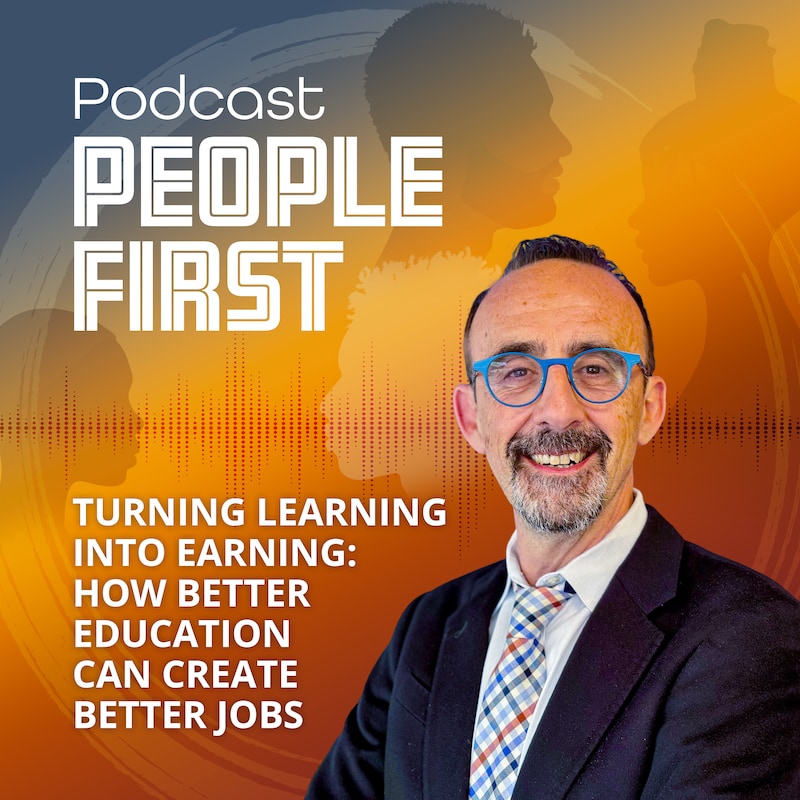
In this episode of People First Podcast, we explore how stronger education and training can power better jobs, highlighting why human capital is essential for growth and what’s working to boost foundational learning. We also look at how digital skills, private sector partnerships, and innovative financing can help turn learning into earning.
Our special guest, Luis Benveniste, Senior Advisor and Acting Global Director for Education and Skills at the World Bank, shares how countries are boosting foundational learning through partnerships and new financing models. From tackling learning poverty to building digital and job‑relevant skills, discover practical solutions shaping Africa’s future.
The People First podcast is available online, on Spotify, and on Apple Podcast. For more updates, follow us by subscribing, and don’t forget to rate and comment on this episode.
Sequences
00:00 Introduction
00:54 Education as infrastructure for good jobs
01:57 Closing education gap in Sub-Saharan Africa
05:58 Staying competitive with digital transformation and new skills
07:24 Delivering impact and unlocking opportunities for young people
09:55 Conclusion
About People First Podcast
People First Podcast provides a human angle to concrete development topics as they affect people in Western and Central Africa. It also features World Bank Group projects and initiatives. Join us for a sustainable and inclusive development!
About World Bank Group
The World Bank Group is one of the world's largest sources of funding and knowledge for low-income countries. Its five institutions share a commitment to reducing poverty, increasing shared prosperity, and promoting sustainable development.
Transcripts
[:
Rama George: Hello and welcome to People First, the podcast from the World Bank that brings you stories and voices from Western and Central Africa. I'm your host, Rama George.
In this episode, we'll talk about the ideas shaping how we learn, work, and grow.
My guest today is Luis Benveniste. He is the Senior Advisor and Acting Global Director for Education and Skills, here at the World Bank. He will help us to unpack one simple but powerful idea: how better education can create better jobs.
We’re keeping it fast and focused — so let’s jump right into how learning can turn into earning, especially across Africa’s booming young population.
[:
Luis Benveniste: Hello, Rama. It's great to be here. Thank you for inviting me.
Rama George: Let’s start with the big picture — why does the World Bank call education the ‘infrastructure for good jobs’? What makes it as essential as roads or power in driving economic growth?
Luis Benveniste: That's a really great start, Rama. We oftentimes think of infrastructure as roads and energy and all of that is really important. But human capital is also a critical foundation for ensuring that a country thrives, that economies grow, and that jobs are opening up. And why? Because human capital is those skills that are fundamental to people to be active citizens and active workers.
Better educated mothers can help their children to have better health. Education is linked to prosocial behaviors. We know that education, for example, improves the productivity of workers. So, human capital, and education in particular, translate into great opportunities for people.
[:
Luis Benveniste: So, Rama, this is heartbreak. 9 out of 10 children in Sub-Saharan Africa cannot read a paragraph with comprehension by the age of 10. Let me say that again because it's worth repeating. 9 out of 10 children cannot read a paragraph that is age appropriate with comprehension. So, this is an urgent task that we all need to embrace and remediate.
Why are we here? Well, part of the challenge is because schools are under-resourced, teachers can be under-prepared. Schools are not able to provide those teaching and learning materials or textbooks that are so necessary. So, we need to invest in the foundations, and we need to make sure that those basic resources are available in every school for every teacher and every child.
Now, at the same time though, I think that the region has been putting a lot of energy and muscle behind trying to make a difference. How? First, by really focusing on the science of learning how to read, how to do basic math, with a structured pedagogy, with teaching at the right level…with having, for example, digital tools that can support students and teachers. Senegal, Ghana are shining examples of large-scale nationwide efforts bringing that basic literacy levels up and we're beginning to see important positive results that can really make a big difference.
Rama George: You’ve mentioned the need to go from ‘learning to earning.’ What are the most effective ways to make education more directly linked to employability — especially through partnerships with the private sector?
Luis Benveniste: So, oftentimes education programs or skilling opportunities are not linked directly to the labor market. We have a mismatch between the kinds of skills that people get and the kinds of job opportunities that are out there. So being able to bring these two worlds closer together is really critical in the process. We want to have employers, industries much more involved in a co-creation of learning programs, of skilling programs that give people the types of capacities that will lead to good jobs.
Oftentimes firms complain that they have a hard time finding people with the right skills for the right opportunities that they have to offer.
And so promoting ways in which the skilling centers are attuned to the labor market asks is critical. And then also to find ways in which, for example, bring industry and education closer through internships, through on-the-job training, through apprenticeships. All of these opportunities lead to much greater likelihood of graduates finding good employment.
The private sector can support micro-credentialing, so doing short cycle courses where people can take some time off and get the types of up-skilling programs that they need.
I am also thinking of the great work that the African Centers of Excellence are doing in terms of really thinking through how to focus on the critical bottlenecks that are impeding Africa's own development, whether it's in these areas of health or climate or agribusiness, and put research and innovation at work to trying to focus in these areas, to promote in attracting the right types of students. Promoting, for example, opportunities for women to access STEM careers, and in that way, invest in Africa's future, in Africa's potential.
[:
Luis Benveniste: So, I talked before about how basic literacy and basic numeracy were foundational skills, as well as the need for strong socioemotional skills. Because the world is becoming increasingly digitized. Digital literacy is becoming more and more embedded in the fabric of work and life.
Digital gives us the opportunity to being able to harness that potential for improved learning. Digital can support teachers to provide better resources, more attuned lessons plans that are able to give feedback as to where students are at, as well as to the kinds of ways in which they can present content better. And also can support administrators to really understand, again, how the whole classroom or a whole school, how it is progressing, and the kinds of support that they might be useful to really enhance their work.
And so the availability of digital tools, the acquisition of digital skills are important in all of the aspects of our lives.
[:
Luis Benveniste: And that is so true, Rama. The average low-income country spends $55 per student per year. $55 per student per year. That is painfully not sufficient to provide an adequate basic quality education, but we need to start where we are. And so, what to do?
First is to really focus on the foundations, on resources, on those population groups that need it the most. And so being able to do the best with the resources available.
Second is to think about which types of strategies and interventions have the greatest impact and the most cost-effective.
And then think about what mechanisms can be put into place to ensure that there is a positive feedback in the available resources with the educational needs of the population and the country. And for example, how to think about putting into place debt for education swaps like we did in Côte d'Ivoire, where we could put into place savings in debt repayments and put those savings to work in the education sector.
Rama George: Last question. If you had 30 seconds to advise a policymaker in Africa today, one key action to unlock opportunity for young people, what would it be?
Luis Benveniste: I said it twice, and I'm going to say it a third time. I want a reminder that 9 out of 10 children in Sub-Saharan Africa cannot read a paragraph with comprehension. So, we need to invest in getting every child off to the best possible start, and that opportunity is given by a strong education.So, investing in early nutrition, investing in early stimulation, in making sure that every child can learn those basic literacy and numeracy skills will get everybody off to a great start. And being able to use every penny in the most effective and efficient way, an investment in the future. So then as they grow older and acquire more skills, they're able to have those job-relevant skills that will allow them to have a good job and a success in the labor market.
Rama George: Luis, thank you for joining us today to share these insights about education being a foundational infrastructure for good jobs.
Luis Benveniste: Thank you, Rama.
[:
To help children transition from learning to jobs, we must invest in teacher readiness and educational technology, innovate to finance education, and partner with the private sector to tech job-relevant skills.
I'm Rama George, and you've been listening to People First, the podcast featuring not only the voices but also the programs and initiatives supported by the World Bank in Western and Central Africa.
If you liked this quick dive, hit follow or share it with someone curious about the future of work in Africa.
You can also stay connected by following us on your favorite podcast platform. If you haven't yet, subscribe, rate, and review us on Spotify, Apple Podcasts, and banquemondiale.org. Yes, you heard right! We’re also available in French.
Join us next time for another episode of People First.
On behalf of the production team, thank you for tuning in!
We’ll be back soon with more smart voices and bold ideas.