Shownotes
This is your go-to Podcast, where we help parents navigate the complexities of family life. Hosted by Ali Kessler of Greyson’s Choice, we’ll cover everything from understanding domestic violence to navigating the legal system, finding the right therapists, life hacks, family law, mental health, custody battles, and how to protect children in dangerous situations.
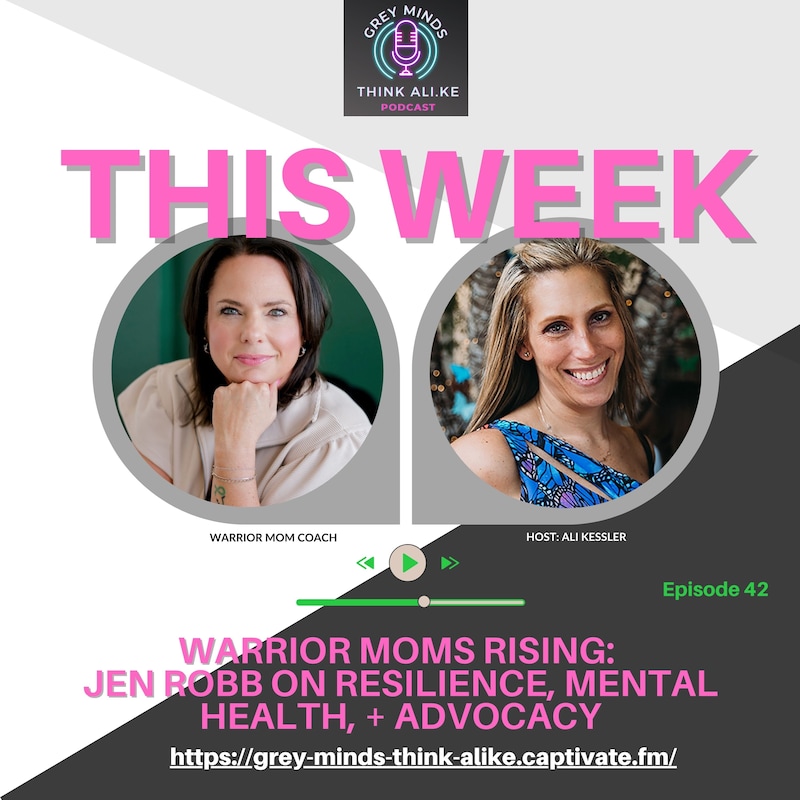
Host Ali Kessler interviews Jenn Robb (the “Warrior Mom Coach”) about resilience, motherhood, and rising after hardship. Jenn shares her family’s experience when her daughter began struggling at 12 with anxiety, depression, and self-harm, culminating at 15 in a near-fatal alcohol poisoning, later revealing the root trauma of a peer sexual assault. Jenn discusses prioritizing her daughter’s survival over prosecution, the lack of support for moms in crisis, and how writing her book, "Warrior Moms Rising," was both triggering and cathartic. She emphasizes self-care, positive self-talk, avoiding social-media comparison, education, and strong advocacy in medical settings, including refusing overmedication and finding better-fit providers. Jen encourages overwhelmed moms to seek community, outlines her group coaching and resources at warriormomcoach.net, and stresses that women are never alone and that purpose can be found in pain.
About Jenn Robb:
Known as the Warrior Mom Coach, is a mentor, speaker, and author dedicated to helping moms find strength and healing after hardship. In her new book, Warrior Moms Rising, Jenn shares her own story and the tools she uses to guide women toward resilience, self-love, and empowerment. Through her coaching and community at warriormomcoach.net, she inspires moms to rise above challenges and embrace the warrior within.
Instagram @warriormom_jennrobb
Fb: @Jenn Robb FB community: Warrior Mom Rising
About Ali Kessler: Ali Kessler is a writer, marketing professional, passionate parent advocate, and founder of Greyson’s Choice, a 501(c)(3) created to raise awareness about the risk of domestic abuse on children. Greyson’s Choice was founded by Ali Kessler in memory of her sweet, vibrant, and fearless 4.5-year-old son, Greyson, who was murdered by his biological father in a murder-suicide during an unsupervised, court-approved visit in Ft. Lauderdale, FL, in 2021. This came just hours after her petition for a domestic violence injunction was denied by a Broward County judge, citing that the “petitioner has failed to allege any overt acts by the respondent which would constitute domestic violence under Florida Statute.”
Ali’s advocacy efforts culminated in successfully passing Greyson’s Law during the 2023 legislative session. This bill now requires the court to consider threats against ex-partners or spouses when making child visitation and custody determinations in the court, expanding to include the following factors: evidence of domestic violence, whether a parent in the past or currently has reasonable cause to believe that they or a minor child is, or has been in imminent danger of becoming the victim of domestic/sexual violence by the other parent, even if no other legal action has been brought or is currently pending in court.
Contact Ali:
Transcripts
Jennnifer Robb Podcast
Ali Kessler: [00:00:00] Welcome back to Grey Minds Think Alike, where we dive deep into the conversations that matter most with experts who enlighten, inspire, and empower. I'm your host, Ali Kessler, and today we're talking about resilience, transformation, and the courage it takes to rise after hardship. Our guest today is Jenn Robb, also known as the Warrior Mom coach.
Jenn empowers moms to navigate motherhood with courage, compassion, and strength, especially when facing trauma, high conflict situations or major life transitions. She's also the author of the inspiring new book "Warrior Moms Rising", where she shares powerful strategies and personal stories to help women reclaim their voices and step boldly into their purpose.
Whether you're in the thick of it or just coming up for air, this podcast is for you. Hi Jenn. Thank you for coming on today. And welcome.
Jennnifer Robb: Thank you. I'm glad to be here.
Ali Kessler: Absolutely. I guess to start, you've walked through a difficult road yourself. Can you share a little bit about your personal journey and what inspired you to become the Warrior mom coach?
Jennnifer Robb: Yeah, our journey started when my daughter was about 12 and she [00:01:00] started really struggling with mental health, anxiety, depression, ultimately self-harm that ultimately ended up to almost taking her own life. And so it was really, the book was born through navigating that. 3, 4, 5 year season with her and really trying to get her to come out on the other side and find healing and enjoy again.
Her situation really stemmed from a sexual assault from another peer, which we didn't find out about until years later. She had been carrying the burden for a very long time and did not wanna talk about it until she was at rock Bottom
Ali Kessler: which was when? At what age?
Jennnifer Robb: So rock bottom for her really was, I mean we'd had some really low points, starting when she was about 12.
But she was 15 and she, my two boys, I couldn't get ahold of her. She had been home. We had pulled her out of school 'cause we were homeschooling her Now. I couldn't get ahold of her. I had gone into the clinic to see some patients and so I sent my two boys home who were in the high school down the road, and they found her unresponsive face down, laying in a puddle of vomit.
So of course, they called 9 1 1. Didn't really know what had [00:02:00] happened until we got her to the er, and that's when they had found that her alcohol level was four times the lethal limit. And so she had broken into a liquor cabinet that had two locks on it. Because she wanted the noise to quiet in her head.
All of those feelings. And so it really wasn't until she was about 15 when she had told us really what had happened and that she had been carrying that burden and that pain for a very long time.
Ali Kessler: Got
Jennnifer Robb: it.
Ali Kessler: So at that moment when she told you what was your first response or what was your first course of action, I guess you can say?
Jennnifer Robb: I mean there's mama bear, right? Mama Bear wants to come out and Mama Bear wants to, pounce. But. In the moment, that really wasn't what she needed, right? Like she, she needed someone to be there for her and her advocate in that moment. We did talk to the DA and we had, all that kind of stuff involved, but there was no way at that moment that she could ever take a witness stand for anything at that moment.
I was trying to keep her alive. And sometimes I, we have to make those hard decisions. Is it worth prosecuting this and dragging her through the mud and dragging her back through this [00:03:00] when she doesn't even wanna be alive at this moment? Or is it better to try to save my child? And we chose, obviously, our child, and I think that, I don't regret that decision, I think ultimately that person will get what they deserve.
At some point now, we could go back now 'cause the statute of limitations hasn't, really expired. But again, I don't know that it's really worth her mental health of dragging her back down that road.
Ali Kessler: Yep. That is a decision. I talk to parents all the time that go through similar situations. Some of them want the justice, some of them want to make sure that person doesn't harm another person.
So there's definitely different ways to handle it. And it's personal, so it's different for each person.
Jennnifer Robb: And I'm
Ali Kessler: just thinking, so I guess from there, why don't you tell us how, where your moms came about?
Jennnifer Robb: So it just really was born like when I was watching her struggle, but then I also felt like there really wasn't a voice for the moms, right?
Like everything that we do as a mom is revolved around our children, right? When they're sick, it defaults to us. We are the, the gatekeepers in the home. We are all of those things. And so often the mom's [00:04:00] pain and the struggle and the heartache that she's feeling often gets overlooked because all of the focus is on the child.
And if you look out there, like there's a ton of information and research and all of these things on teens, right? How to help them, how to help mental health, how to help them over. There's all this. Books and data on that, but it's very limited on that's helping the mom learn to not only advocate for herself, I mean for her children, but also advocating for herself.
And I think that is where it's really important. 'cause I remember like being at rock bottom, right? Everything was about keeping her alive. And you forget like how much you give of yourself, right? When you're not only, you have someone who's struggling, but then you're. You're still working and you're still taking care of, the rest of the family and the household and all of those things.
And then you wake up one day and you look in the mirror and you don't really even know who you are, right? Because you're past burnout, you're past full exhaustion and you're just keeping up the facade of I'm okay. When in reality you're not. You're really have been taken to a low [00:05:00] point yourself.
'cause it's hard to watch your children stuck. Absolutely. And so that is really how the book became, and it's really about the moms and looking at what was going on from my perspective in her challenge, and how I felt. And then trying to give moms practical steps. And a lot of that revolves around just taking care of yourself and not forgetting yourself during those hard seasons when you're taking care of someone else.
Ali Kessler: Of course,
Jennnifer Robb: yes.
Ali Kessler: So what was the hardest part about writing Warrior Your Mom's rising? Did putting your story down on paper I'm sure felt a little healing, but I'm sure it was also triggering.
Jennnifer Robb: Yeah, it's, it was definitely tough ' cause you have to go back and think and, and relive the parts that you really wanted to stuff down.
But in a lot of ways it was cathartic, right? And you think about mental health treatment plans. A lot of times it is journaling or writing or things through that. Because it's better to get it out and put it on paper. It was both. It was a little bit, triggering in the beginning, but then in the end it really was more cathartic.
Ali Kessler: Right, of course. And not only that, but not only are you sharing your story, but you're also hoping that other moms will read it and [00:06:00] know that they're not alone, which I think is. Very important in situations like this when you feel a sense of community.
Jennnifer Robb: And a hundred percent is I felt alone, we didn't really talk about her mental health struggles in her journey with people.
With people. One, there's so much judgment that comes around it and the stigma that's associated with it. And so it really wasn't something that we talked about. You do feel alone. You feel isolated. And especially in today's society where you're looking at social media all the time, right?
And you're scrolling and you're seeing over there that you know the Joneses are living their best life and they're happy, and they don't look to have any problems, right? And so then you get caught up as a mom in this comparison game, which only fuels the guilt and the shame that you already feel about your current situation.
And so that's why like I really encourage moms to learn how to advocate for themselves, to put the phones down, to put the social media down, and to step away from that stuff. Because as much as I do that nobody's life is picture perfect. Some people are better at hiding it than others.
And of course, social media is only a [00:07:00] glimpse of the really good times, right? And I, yeah, and I'm not saying I don't like, I call it
Ali Kessler: fake book.
Jennnifer Robb: I'm not saying I don't like social media because I do. Like you can connect with people all around the world and
Ali Kessler: sure
Jennnifer Robb: it has its
Ali Kessler: purposes,
Jennnifer Robb: right?
There are benefits, but as moms, sometimes we really get stuck in this comparison game with other moms who appear to have it all together, and that's just simply not the case. And absolutely, mom guilt is already hard enough. And then when you're comparing yourself to someone else, right? It just feeds that.
And then you just get more and more burnout and exhausted and beat down, and then you're in your own kind of spiral, if you will. And then you've got to figure out how to now get yourself out and get your child out too. So what I want is for moms to understand that taking care of yourself even 10 or 15 minutes a day, it's not selfish, it's needed.
And absolutely that can prevent a whole lot of backlash. Later when you're dealing with hard struggles. And at the end of the day, we're all gonna have hard struggles. Life is always going to life. No matter who we are, what we do, it's always going to life. Yeah. And we just have to be better [00:08:00] prepared for it by taking care of ourselves.
What.
Ali Kessler: 1000%. I actually just had some experts on last week that just talked about parents have feelings too, and their number one messaging was just like when you're on the plane and the oxygen masks come down you put it on yourself first so you can help others, right? So that's basically the mindset there.
Now, a theme in your work, is breaking free from cycles of pain and stepping into empowerment. What practical steps can a mom take today to move from surviving to thriving?
Jennnifer Robb: Again, a lot of it goes back to how you take care of yourself and how you treat yourself, right? That is a huge factor.
And what do you tell yourself every day? Do you tell yourself, I'm a failure because I missed something that was happening, right? Or are you telling yourself positive things like. I'm a good mom, right? I'm fighting for my child or whatever it may be, right? And it just comes to. The instance where you're taking care of yourself and you're finding something that pours back into you and only you, right?
It doesn't have to make sense to everybody, right? If it's reading a book or, for me personally, it was listening to [00:09:00] worship music, right? But it could be taking a 10 minute walk and just being by yourself in the sunshine, right? And shutting out everything else. That is the biggest absolutely thing that's going to make a difference, right?
Is how you take care of yourself and how you show up for yourself. Because then, ' cause if you're running on empty, you're no good to anybody, right? If you're literally like dragging what the cat, left out, and that's all you got left is the leftovers. How are you gonna show up as a mom?
Are you gonna show up happy or are you gonna show up very short tempered and angry and frustrated and then you're just trickling down this horrible cycle of. Of dis, discouragement for other people, right? Because now your kids are like, why is she so snappy? Why is she upset? Why is she whatever?
Same thing with your spouse, right? Like it's just you've got to break the cycle of being burnout and exhausted, and the only way to do that is to take time for yourself and to take care of you.
Ali Kessler: Absolutely. Are there any other steps that a parent can take aside from taking that time to become empowered and to make a bad situation better?
Jennnifer Robb: I [00:10:00] think a lot of it has to do with too is like educating yourself, right? Educating yourself on the necessary struggle, right? Sometimes as parents, we get wrapped up in my kid is struggling with mental health. We think that sometimes they're just being a teenager, but are they really just being a teenager?
Right?
Ali Kessler: There's a deeper
Jennnifer Robb: issue is more, right? There's more to the story sometimes. 'cause our kids, at the end of the day, they're don't, I don't believe that kids are just purposely acting out for the, for funsies. A lot of times when they're really struggling. They don't really know what to say or what to do either, because remember, their bodies are going through all kinds of changes, right?
Their brains aren't developed. There's hormones. There's all of these other things. And sometimes we just have to be the bigger adult in this, in the room and be like, okay, this is way atypical for you. This is not your normal pattern. So what is changing? And a lot of it's just educating yourself on what's what could potentially be wrong, right?
Or is. And then the other part of that is just advocating. For your child, right? If they need to go to a counselor or to go to a therapist or whatever, it's advocating in those rooms for the child too. Or it could be your [00:11:00] spouse, it could be your elderly parent. It could be so many gamut. Like for me, it was specifically a mental health struggle with a child.
But as moms and as women, we are often put in roles of advocating for our spouses or our ailing parents or whatever it may be, right? And sometimes it's just being in those rooms and advocating because you, yourself know your child far better than someone who's seeing them for the first time. And you do take the power back when you're advocating for them.
The biggest thing for me was like when Chloe initially started struggling and we were just beginning to see the beginning signs. She was 12 of anxiety and depression. And so her, of course, her pediatrician was like she needs to see a psychiatrist. So we take her to a psychiatrist.
And what was the psychiatrist first move? Let's put her on five different medications.
Ali Kessler: Yeah,
Jennnifer Robb: five different medications for a 12-year-old.
Ali Kessler: Yeah.
Jennnifer Robb: Are you kidding me?
Ali Kessler: Right,
Jennnifer Robb: and I've been in medicine for over 20 years, right? I'm a nurse practitioner, but no ma'am. That is not how we're gonna roll with this.
There's so many things wrong with that, right? And me saying absolutely not. [00:12:00] If we need to do one medication to help her with the anxiety so she can go out and function in the world, then fine. But five medications at one time. I have no idea what interactions. It's going to cause in her own body what, how do you know which ones even
Ali Kessler: what it does to your brain down the road? Yeah. She's everything
Jennnifer Robb: right? Or what do you even want is doing any good? Like, how do you even know?
Ali Kessler: So what did you do in that scenario? What did you, instead of taking the five medications, what did you do for her?
Jennnifer Robb: We said no, I told him no. It was a male. And of course they oftentimes, as sometimes as male providers, they don't like pushback of women, right? So the answer was no. And it was as simple as that. And I said, we can try her on one med to help her com, help her anxiety, because she was to the point where she was debilitated, right?
Like with anxiety, she was overridden. She didn't, she could, didn't wanna come out of her room. She, it was too much. And that's fine, but at the end of the day, we're gonna get to the root cause of what is causing this instead of putting a bandaid on it. And so the answer was no. And ultimately we went back to him because she started having some like crazy side effects to this medication and he, all, he wanted to do, she was [00:13:00] like full on hallucinating from this medication.
Ali Kessler: Wow. Yeah.
Jennnifer Robb: And all he wanted to do was up the dose. Yeah. No, thank you. Okay. Thank you for your time. But you are fired friend. Okay. That is the, you end
Ali Kessler: of the story. Did you get another doctor?
Jennnifer Robb: We did and I actually ended up finding a nurse practitioner that was a psychiatrist, that had psych background and that's in the route that we went because I'm a nurse practitioner and so there's a common like understanding, right?
And typically nurse practitioners tend to lead a little more understanding of the whole picture. And that was the route that we went. But in the end of the day, I just needed someone to listen and help me navigate it, right? Not just try to push a bunch of pills down her throat and make her numb, or a walking zombie.
That was not at all what we needed.
Ali Kessler: Absolutely. So what can friends, family, and professionals therapists, lawyers, doctors, advocates, what could they do better to support moms who are trying to rise and get the help they need for not only themselves, but their family?
Jennnifer Robb: Really, I a hundred percent thinking it's being open-minded in listening instead of judging.
I have been in medicine for so long that I get it. Like [00:14:00] sometimes as providers, we're jaded. We see it, we've heard it, we feel like we know it all, whatever. But at the end of the day, patient care is an individual sport, if you will, just because somebody comes in with anxiety or depression. They don't always fit in that box.
And oftentimes what I find is that modern medicine providers, they often get stuck in that box. And if it doesn't fit in that box, then they don't know how to treat it. And they often start throwing just ultimate pills and all this other stuff because they don't really know. So it's really about listening.
Without judgment and trying to be open-minded and find something that is right for that particular person. And at the end of the day, the mom or the wife or whoever is in there that is talking, they are the expert on that person. You are not the expert. You have met my child for five minutes,
Ali Kessler: right?
Jennnifer Robb: I've known her whole life.
Yeah. That's what I used to say. I know her idiosyncrasies. I can tell you what her mood is. I can tell you by her hand gestures, I can tell you by the look on her face, she doesn't even have to say a word and I [00:15:00] can tell you what mood she's gonna be in. You don't know my child.
Ali Kessler: That's how I feel about, family court judges when they have to, make decisions for families.
And they don't even, they don't even know these people, right? We're putting like our whole entire lives into strangers hands. So I always find that very difficult.
Jennnifer Robb: A hundred percent. To say the
Ali Kessler: least.
Jennnifer Robb: But I think it's, I think it's also okay to say, you know what, if you're not getting that, I hate using the warm and fuzzy, but if you're not getting that kind of vibe, that they're really there to help you and to help your child.
They're just there to collect a paycheck, if you will.
Then it's time to move on. It's just time to move on. Yep. And that's okay. Like it doesn't make you a bad person because you were like, no, thank you.
Ali Kessler: I always tell everyone to always, test out a few doctors or whoever your, the professional is before deciding on one, because you never know what the next person is going to bring.
I always, when I see a dessert table, I look at all my desserts first before I pick one.
Jennnifer Robb: Right. And it goes the same way with counselors, right? We changed counselors three times before we found the right counselor for her. And it wasn't at all that the original counselor was bad because she wasn't right.
She was one of the sweetest women I've [00:16:00] ever met in my life. But she was not what Chloe needed. Chloe needed someone who was gonna call her out on the issues at hand instead of coddling that behavior. And there's a difference. So we moved on. I'm like, thank you for your time, but you're not what she needs.
'cause she's not making progress. And then you just keep going until you find them. You keep vetting the process and the people until you find someone who is the right fit for your child. And it's also about is your child feel comfortable with them, right? If Chloe's not talking and she's yeah, okay, I feel better.
But it's all a lie. Have you helped her?
Ali Kessler: So I guess for a mom listening right now who feels completely overwhelmed, what would you say the first step she can do to begin her own journey of rising? The very
Jennnifer Robb: first, most important, I think, is to find someone or a community that can help you, right?
Because there is, again, I navigated this isolated just with my husband and our, our family. But that really probably wasn't the best option. Because there is empowerment in community and empowerment in when you're really at a low [00:17:00] point that can regu, repoint you and reguide you to the correct path.
And to keep you motivated to keep fighting right? And not to end with just this is it, right? Like it's never gonna get any better because if we get stuck in that place, it's really hard to get out of it. So community is huge and important in, it takes a village, situations like this, right?
Yeah. It just does.
Ali Kessler: It sure does. Yeah. I've found some amazing groups, even just on Facebook.
Reddit and just everything. There's a group for everything. And just to know that other people go through similar situations no matter what it is, and there is.
Someone like you, that's definitely
Jennnifer Robb: helpful. That's the same, right? Everybody's journey is never gonna be the same. Even if your child is struggling with the exact same diagnoses that my child was, our journeys are very different, right? The reason that they're struggling or how they got there may be different.
Our stories are different, but there's commonality, right? Because we can relate and we can understand, we can empathize and sympathize and really give you. From another perspective, that [00:18:00] hope and that strength and encouragement that you need sometimes when you're really in the trenches, right?
Ali Kessler: I 1000%. So what is next for you and the Warrior Mom movement? Do you see workshops, retreats, policy advocacy as part of your mission? Or what is coming up?
Jennnifer Robb: Really and truly, my next goal is really to do, is to do speaking engagements, right? Is to really help moms to find their own voice and to help, really all women to find their voice, right?
There's so many different seasons in a woman's life, right? There's kids, there's before kids, there's kids, there's after kids. There's all of these seasons that we're navigating as women, and I really feel like it's really about finding your purpose, and sometimes it takes those really hard struggles for us to get in line with what our purpose really is and how we can help.
Others and make an impact. And so for me, the goal is, I'm building a course that people can go in and do on their own at self pace, but they can take a moment, step back and refresh. But ultimately it's really speaking and engaging with other women to step into their full [00:19:00] purpose.
Ali Kessler: You offer coaching, correct?
So how does someone and is it local? Is it virtual?
Jennnifer Robb: So we have, I have a website. It's called warrior mom coach.net. Okay. So there's free resources on there. There's the VIP community there. 'cause that's on Facebook. That's a free group, where we just offer insights and help through that. But yes, we do coaching. It's a group coaching because I really feel like, again, it's community oriented.
Ali Kessler: And who is your ideal client , is it doesn't have to be obviously a parent that has a child with mental health issues who would reach out?
Jennnifer Robb: It's really just women who are really struggling with something or someone, right? Again, it can be a child with addiction, it can be a spouse with addiction, it can be a child with mental health. It could be loss, grief. It's just a woman who needs. A community of like-minded women. But they need someone to help them find their strength and their voice along the way.
Ali Kessler: Sure. Got it. That's great. That's, I'm sure every woman to be fair, because there's always something that everyone struggles with. Where could people find your book?
Jennnifer Robb: So [00:20:00] the book Warrior Mom Rising is on Amazon. It's just now been released on Barnes and noble.com too. Wonderful. So it's in several places.
You can also download the e version of the book on my website. Okay. If you just use like a Kindle version. So there's different strategy, but all of that can be found on my website as well.
Ali Kessler: Okay. And what's the number one thing you want women to get out of reading that book? What's the one thing you hope they take away?
Jennnifer Robb: You are never, ever alone, ever. And that there's also pain, that there is purpose in the pain.
Ali Kessler: I know that one for sure. Ever since my son died, I started the nonprofit. I do this podcast. I try to find a purpose so I can help others and does it take my pain away? No, but it does help. So I definitely agree with all of that.
Do you have any final words for our listeners?
Jennnifer Robb: Just, you could do it like there is hope and there is strength, but find your community, whether it's through mine or someone else's. Find community and find strengths together with some, with other women that want the same things for you.
Strength, empowerment, finding your purpose.
Ali Kessler: [00:21:00] That's the hardest part is finding that strength to even take that first step to find community.
Jennnifer Robb: Right.
Ali Kessler: Getting outta bed sometimes is the hardest part.
Jennnifer Robb: Yes, agreed.
Ali Kessler: But once, once you do that, getting that community together will help you.
Jennnifer Robb: And the only thing you can do is just keep getting up every day.
It's really just about one, one step at time. Putting one foot in front of the other every day. That's really all you can do. And if some days, if it's all you can do is to get out of bed and make it to the couch, then great. You at least made it that far. And don't beat yourself up for that.
We all struggle and go through our own process of grief in different ways, right? And so it's really important that to remember that you have to just, you have to keep rising, you have to keep getting up, keep moving, keep going forward.
Ali Kessler: Absolutely. And that's what I try to do as well. So thank you so much for sharing all of that with our listeners and I will put all of your contact info and links in our show notes.
Jennnifer Robb: So
Ali Kessler: I hope to connect again. I'll definitely reach out.
Jennnifer Robb: Okay. Awesome. Thank you so much.

