Shownotes
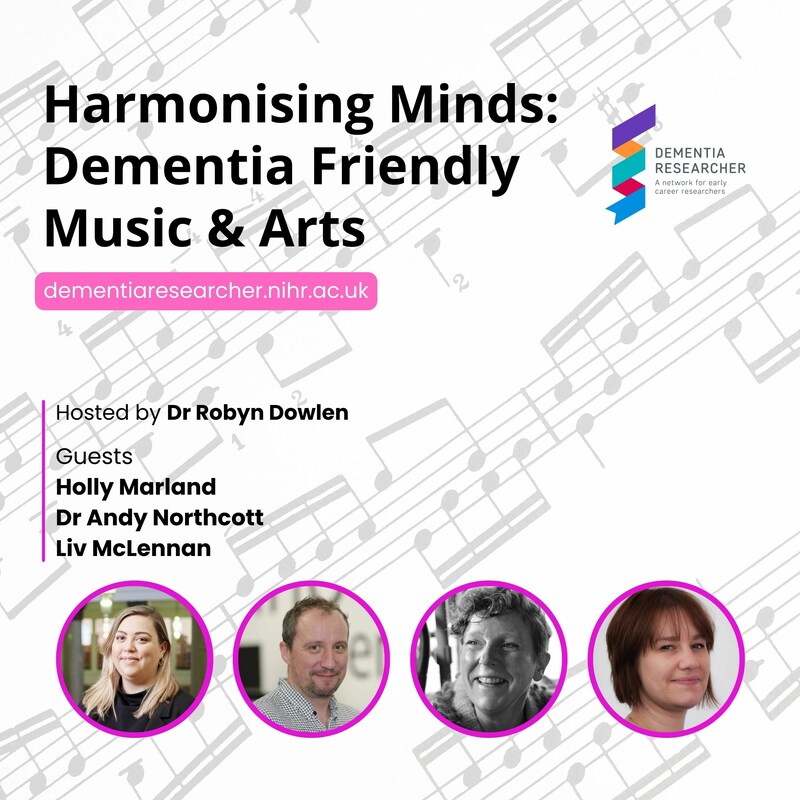
In this episode of the Dementia Researcher podcast, guest host Dr Robyn Dowlen leads a fascinating exploration of the intersection of music, arts, and inclusivity in the context of dementia.
This episode features a trio of remarkable guests who have been instrumental in integrating dementia-friendly initiatives into the arts. Our guests are Holly Marland, Former Churchill Fellow and Music Therapist and dedicated advocate for community music projects; Dr Andy Northcott from the University of West London, who brings an academic perspective on the impact of arts and how to make events more accessible; and Liv McLennan from Sounds Better Community Interest Company, a pioneer in using music as a bridge to memory and joy.
The episode explores the inspiring stories behind our guests’ projects, ranging from festivals to operas, highlighting how they’re creating spaces where every note and performance opens doors to accessibility and understanding. Robyn, a researcher at the University of Manchester, also shares insights from her work on capturing the musical experiences of people with dementia. This episode is not just about the arts, but also about how these initiatives foster community, inclusivity, and a deeper understanding of dementia’s impact on lives. Tune in for an enlightening discussion that promises to be as informative as it is inspiring, showcasing the powerful role of arts in enhancing the lives of those living with dementia.
Links mentioned in the show:
- Sounds Better CIC – https://soundsbettercic.org/
- So Many Beauties – https://somanybeauties.org/
- The Geller Institute of Ageing and Memory – https://www.uwl.ac.uk/research/research-centres-and-groups/geller-institute-ageing-and-memory
--
A transcript of this show, links and show notes and profile on all our guests are available on our website at https://www.dementiaresearcher.nihr.ac.uk.
If you prefer to watch rather than listen, you will find a video version of this podcast on Apple Podcasts, YouTube, and on our website.
Leave us a tip:
https://dementia-researcher.captivate.fm/support
Follow us on social media:
- https://www.instagram.com/dementia_researcher/
- https://www.facebook.com/Dementia.Researcher/
- https://www.twitter.com/demrescommunity
- https://www.linkedin.com/company/dementia-researcher
- https://bsky.app/profile/dementiaresearcher.bsky.social
Download and Register with our Community App:
https://www.onelink.to/dementiaresearcher
We gratefully acknowledge the support of our funders: Alzheimer’s Association, Race Against Dementia, Alzheimer’s Research UK, Alzheimer’s Society, and the National Institute for Health and Care Research.
The views and opinions expressed by guests in this podcast are their own and do not necessarily reflect those of the producers, funders, or sponsors.
Subscribe to our sister show 'Dementia Researcher The Blogs':
Transcripts
- [Voice Over] The Dementia
Researcher podcast,
Speaker:talking careers, research,
conference highlights,
Speaker:and so much more.
Speaker:- Hello and welcome to the
Dementia Researcher Podcast.
Speaker:I am Dr. Robyn Dowlen and
it's my absolute pleasure
Speaker:to be guest hosting today's show.
Speaker:In this episode, we'll be exploring
Speaker:the beautiful intersections
where music, arts,
Speaker:and inclusivity meet, and how
they transform the experiences
Speaker:of those living with Dementia.
Speaker:Joining me are three fantastic guests
Speaker:who've been at the forefront
of weaving Dementia friendly
Speaker:initiatives into the rich
tapestry of the arts.
Speaker:So we have Holly Marland,
who has enriched lives
Speaker:through her commitment to
community music projects.
Speaker:Dr. Andy Northcott from the
University of West London,
Speaker:bringing us insights from
academia on the impact
Speaker:of the arts and opera.
Speaker:And Liv McLennan from
Sounds Better Community
Speaker:Interest Company, an
innovator known for her work
Speaker:in using music as a
bridge to memory and joy.
Speaker:Together we'll uncover the stories
Speaker:behind their inspiring projects
from festivals to operas
Speaker:and discuss how their crafting
spaces where every note
Speaker:opens doors to accessibility
and understanding.
Speaker:And before we get
started, just to tell you
Speaker:a little bit about me as well,
Speaker:I'm a researcher at the
University of Manchester.
Speaker:And in my work I look at how
we understand and capture
Speaker:the in the moment musical experiences
Speaker:of people with Dementia.
Speaker:But that's enough from
me. Let's meet our guests.
Speaker:(bright music)
Speaker:So before we talk about
their individual work,
Speaker:let's get some proper introductions.
Speaker:Holly, can you start us off?
Speaker:Can you tell us a bit about yourself?
Speaker:- Well hi there Robyn.
It's lovely to be here.
Speaker:I am a freelance professional musician
Speaker:and a music for health specialist,
Speaker:and I work in hospitals, care
homes and daycare settings
Speaker:with people of all ages.
Speaker:I've been learning and playing the kora,
Speaker:which is a traditional West African harp.
Speaker:And I've been playing
for about 13 years now,
Speaker:supported by my amazing
teacher, Mohammed Saho
Speaker:who lives in The Gambia.
Speaker:And I started my musical
journey on the piano
Speaker:and in the local church choir.
Speaker:And I've always written music
Speaker:and I've always felt that I wanted
Speaker:to bridge the performer audience divide,
Speaker:which I felt was always a
culturally imposed thing.
Speaker:So I love working within
different communities
Speaker:to co-create music and
to share ideas together.
Speaker:- Thank you, Holly. That sounds wonderful.
Speaker:I'm looking forward to
unpicking all of those things
Speaker:with you later in the episode.
Speaker:Andy, can I come to you next?
Speaker:- Yeah, of course you can.
So I'm Dr. Andy Northcott.
Speaker:I hate how long winded my job title is.
Speaker:I'm a Senior Lecturer
of Sociology of Medicine
Speaker:at the Geller Institute
of Ageing and Medicine
Speaker:at the University of West London.
Speaker:Takes a deep breath.
Speaker:My main research is sort
of unrelated to the arts.
Speaker:If anyone googles me,
you'll find lots of stuff
Speaker:about hospitals.
Speaker:For the last almost 10 years,
I've been doing ethnographies
Speaker:of hospital care and observing
people living with Dementia
Speaker:during unplanned acute
hospital admissions.
Speaker:And kind of my side second job,
Speaker:because that doesn't take
up enough of my time,
Speaker:is trying to make social
spaces more accessible
Speaker:for people with Dementia.
Speaker:So that started with about seven years ago
Speaker:looking at making cinemas
Dementia friendly.
Speaker:And in the last year I've been
working on Dementia friendly
Speaker:operas, which I'll be
talking to you about later.
Speaker:- Amazing, and welcome
to this wonderful field
Speaker:of arts and Dementia, we're
a friendly bunch (chuckles).
Speaker:Liv, can I ask you to
introduce yourself as well?
Speaker:- Thank you, Robyn. Great to be here.
Speaker:So my name's Liv McLennan
and I'm a musician
Speaker:and community musician.
Speaker:I'm based in Wilshire now.
Speaker:I play the cello and
the Highland bagpipes.
Speaker:But more recently the ukuleles
become quite important to me
Speaker:and in my work as well.
Speaker:And also in my research, I'm a
part-time doctoral researcher
Speaker:at the Guild Hall School
of Music and Drama,
Speaker:and they also run a
community interest company
Speaker:called Sounds Better.
Speaker:- Thank you so much.
Speaker:It's just wonderful to have
such an array of expertise
Speaker:within the virtual room.
Speaker:(bright music)
Speaker:Okay, I think it is time
that we heard a bit more
Speaker:about your individual work.
Speaker:So Andy, if I come to you first,
Speaker:I know opera isn't your
first look into Dementia,
Speaker:but I'd love to hear
about how that came about.
Speaker:How have you become immersed in this area?
Speaker:- It's kind of funny because
been doing ethnographies
Speaker:of hospitals for about 10 years
Speaker:and nobody's ever really cared.
Speaker:I've suddenly got into opera
Speaker:and I've had to make all these
various media appearances
Speaker:and just hope nobody ever
asks me anything about opera
Speaker:because I've only ever been to two operas
Speaker:and I produced one of them.
Speaker:I kind of looked into being able
Speaker:to put on a Dementia friendly
opera in that I'm friends
Speaker:with people who run an
opera company in Wiltshire.
Speaker:So probably not far from where
I live is The Music Troop
Speaker:with Edward Lambert.
Speaker:And just sort of over dinner,
Speaker:we were talking about him
looking for new audiences
Speaker:and I suggested, well, have
you thought about doing
Speaker:Dementia friendly performances?
Speaker:And sort of from there,
probably a glass of wine,
Speaker:too many this escalated
and before, you know,
Speaker:we were putting on a production.
Speaker:So beyond my lack of knowledge of opera,
Speaker:I'm much better on sort
of hip hop and '80's pop
Speaker:than I am opera.
Speaker:But for me it's that communal thing.
Speaker:And it doesn't really matter if it's opera
Speaker:or if it's a rock gig or
if it's standup comedy
Speaker:or it could be reggae or
heavy metal or anything.
Speaker:It's that communal thing
of being in a place,
Speaker:sharing musicians, giving you
something powerful, visceral,
Speaker:that you latch onto and takes
you away from where you are.
Speaker:And also that thing of just
being out of the house,
Speaker:I have this big thing of,
to use one in the media so,
Speaker:so Bobby Charlton died
a couple of weeks ago
Speaker:and all obituaries sort of talked about
Speaker:how he lived in the shadow of Dementia
Speaker:and this shadow kept coming up.
Speaker:And it's taking that out of that that yes,
Speaker:you have that diagnosis of Dementia,
Speaker:but that shouldn't mean
that you are stuck in,
Speaker:to quote another musician
with David Bowie.
Speaker:It shouldn't be, "Pale
blinds drawn all day,
Speaker:nothing to do, nothing to say."
Speaker:You've still got years to
go and you've got family
Speaker:and friends and people to see
Speaker:and you should be able to go and see them.
Speaker:And if music was part of your life before,
Speaker:or even if it wasn't,
it should still be that
Speaker:really up until the point
Speaker:that it really physically can't be.
Speaker:And so we did an opera and I
think if you can do an opera,
Speaker:you can do anything.
Speaker:- Thank you so much.
Speaker:And I think it speaks to the
real importance of, yeah,
Speaker:not as you say, not simulating these,
Speaker:but actually giving real
opportunities for people
Speaker:with Dementia to engage
with high quality arts
Speaker:in the real world.
Speaker:So I'd love to hear a bit
more about the process.
Speaker:You said you've got this
kind of full audience.
Speaker:How was that process for you?
Speaker:- So the opera, we came up
with the sort of basic idea
Speaker:of the music troupe had a new opera
Speaker:they were going to premier
at the Tete a Tete Festival.
Speaker:It was called The Last Siren.
Speaker:It's a sort of small
contemporary chamber opera
Speaker:based on the Greek myth
Sisyphus and the sirens
Speaker:willing the ships onto the rocks.
Speaker:And the opera itself, we didn't change
Speaker:it was gonna be performed the next day.
Speaker:We had the musicians, we had the singers.
Speaker:So it was how do we put this
on and make it accessible
Speaker:to people living with Dementia?
Speaker:That was kind of the tricky bit.
Speaker:That was when I had to put
on my challenge Anneka hat
Speaker:and start cold calling venues
and seeing what could be done.
Speaker:And we really struggled with sort of,
Speaker:and answered emails and
venues that wanted to help
Speaker:but weren't quite sure.
Speaker:And then I stumbled on
by the biggest accident,
Speaker:I emailed the London College of Music
Speaker:and I hadn't realised
they were actually part
Speaker:of University of West
London and even weirder
Speaker:or I didn't realise
that they had a theatre
Speaker:and it was next door to my office
Speaker:had I ever ventured slightly
further down the corridor,
Speaker:like literally three doors down.
Speaker:We had Lawrence Hall, this fantastic,
Speaker:so looks like an old school theatre,
Speaker:the sort of, we always joke,
Speaker:it looks like it's where
the kids from "Fame,"
Speaker:would hang out, it's just
full of all these young people
Speaker:playing music and being very good looking
Speaker:and enjoying themselves.
Speaker:And we were like, okay,
so can we use this space?
Speaker:And they didn't ask any questions.
Speaker:They were just like, yes,
please. How would it work?
Speaker:Can we come in?
Speaker:Everything moves around, what
can we do to facilitate this?
Speaker:And once we had a venue,
it was really quite easy.
Speaker:I mean, I say easy, I'm an academic
Speaker:and it was in a university.
Speaker:So I then I spent two months going through
Speaker:every health and safety and
risk and prevent procedure
Speaker:you can think of.
Speaker:But beyond the normal university
stuff, the actual hosting
Speaker:of the event was okay actually, in fact,
Speaker:possibly the hardest thing we
had was getting an audience.
Speaker:So we had a venue, we had a production,
Speaker:we had everything in place.
Speaker:But then it's how do you communicate
Speaker:to people living with Dementia?
Speaker:Especially if they're
already feeling cut off,
Speaker:like I discussed before,
Speaker:I'm worried I'm rambling
now, but I'll keep going.
Speaker:It's that you can't just stick
it on Facebook or Twitter
Speaker:because not everybody's online and people
Speaker:aren't looking for things.
Speaker:And we timed it just for the moment
Speaker:where the Twitter
algorithm kind of fell away
Speaker:and all the people that
used to see your tweets
Speaker:stop seeing your tweets anyway.
Speaker:So getting the message out
was kind of the tricky part.
Speaker:And we had to reach out
to lots of organisations
Speaker:and begged for publicity and support,
Speaker:but everybody was really helpful with it.
Speaker:And we managed to put on
the production, fill it,
Speaker:sell out all the seats,
yeah, it was great.
Speaker:- Yeah, I think that's such
a wonderful kind of vision
Speaker:for the world and communities
to be more Dementia friendly
Speaker:so that people can kind
of cross those thresholds
Speaker:as it were into these
spaces and feel confident
Speaker:that they're gonna be supported
when they're there no matter
Speaker:what's going on.
Speaker:And perhaps this is a good
point at which to come
Speaker:to you Holly, in terms of the
So Many Beauties festival,
Speaker:I know this is another event that happened
Speaker:within a very established
arts venue as well.
Speaker:So I'd love to hear about
your kind of your process
Speaker:for developing the
festival and how it went.
Speaker:- I just wanna start off
by saying that people
Speaker:living with Dementia have
taught me so much about the joy
Speaker:and potential of being
in the present moment
Speaker:and they're constantly
amazing me with their wit,
Speaker:wisdom and creativity.
Speaker:So I set up the So Many
Beauties project in: Speaker:with funding from the
Arts Council England.
Speaker:To work co-creatively with
people living with Dementia
Speaker:in their communities of care.
Speaker:To harness this incredible creativity.
Speaker:And so we work together
to compose new music
Speaker:and we work together to devise
large scale cultural events
Speaker:that counter as Andy and yourself
Speaker:have just been talking
about the tragedy narrative.
Speaker:And what we're doing is
showcasing what people
Speaker:living with Dementia can
do rather than focusing
Speaker:on what they can't do anymore.
Speaker:So we're currently working
on our second large scale
Speaker:Dementia friendly music festival,
Speaker:which is gonna be at the
Bridgewater Hall in Manchester
Speaker:and it's next September,
on Friday the 20th.
Speaker:So everyone get your
diaries out now put that in.
Speaker:And what we've done is
we've brought together
Speaker:a stakeholder group of
18 cultural organisations
Speaker:and Dementia support organisations
Speaker:who are working across Greater Manchester
Speaker:and we're gonna be working with members
Speaker:of their Dementia support groups to devise
Speaker:all the content for this one day festival.
Speaker:So this includes working
with support groups
Speaker:that are for members of the South Asian
Speaker:and African Caribbean communities,
Speaker:as well as with Manchester's
LGBTQ+ communities.
Speaker:You're probably familiar with the work
Speaker:that the Baring Foundation has been doing
Speaker:around increasing
representation in the Dementia
Speaker:and mental health workforces.
Speaker:And so during the pandemic
I formed a collective
Speaker:of musicians from different
ethnic backgrounds
Speaker:who are going to be
developing their skills
Speaker:in this co-creative
practise working with people
Speaker:living with Dementia.
Speaker:And the So Many Beauties
collective recently featured
Speaker:we had a brilliant project
launch at the Bridgewater Hall,
Speaker:a smaller event, just a half day event.
Speaker:And the collective accompanied
new music that they'd written
Speaker:and they performed with the Age UK
Speaker:Salford's brilliant Buddy Club.
Speaker:And we were so pleased to see the audience
Speaker:who were a complete mix of
people living with Dementia.
Speaker:We had four different
Dementia support groups come,
Speaker:we had researchers, we had
strategic decision makers
Speaker:from Manchester City Council and everyone
Speaker:was just really positive about
this intercultural co-created
Speaker:programme premier, no lyric sheets needed.
Speaker:Buddy Club remembered
all their new song lyrics
Speaker:and rhythms with no need for prompts.
Speaker:So this really combated the popular belief
Speaker:that only old familiar songs will do.
Speaker:So the festival itself is
actually gonna be very diverse.
Speaker:We are taking over the
entire Bridgewater Hall.
Speaker:And we're going to be curating
a programme of new music,
Speaker:dance, theatre workshops,
discussions, cabaret,
Speaker:intercultural afternoon tea,
Speaker:whatever our wonderful participants
Speaker:decide that they want to see
developed or commissioned.
Speaker:So watch this space (chuckles).
Speaker:- That sounds absolutely wonderful
Speaker:and I've made a note in
my diary for next year
Speaker:so that I can hopefully come along.
Speaker:I'm really interested, we hear
this word kind of co-creation
Speaker:a lot within this field.
Speaker:What does it look like in practise?
Speaker:- So musically speaking, because
we are devising new music,
Speaker:we are using musical
improvisation as a starting point
Speaker:for creating new songs
and new pieces of music.
Speaker:So we will probably
build from simple songs
Speaker:and we'll try and evolve those.
Speaker:We'll have lyrical development sessions
Speaker:throwing ideas into the pot,
Speaker:but it's very much about
being in the moment
Speaker:and being spontaneous.
Speaker:We don't want people to
feel hindered, you know,
Speaker:if they say, I don't know,
that becomes a song lyric.
Speaker:You know, you are validating
everybody's responses
Speaker:and this enables people's
creativity to come tumbling out.
Speaker:So musical improvisation,
we use small handheld
Speaker:tuned and untuned percussion
instruments as the impetus
Speaker:for creating rhythms and melodies.
Speaker:And then we weave this all
together into something
Speaker:that is a high quality
piece of public art.
Speaker:In our first project we
actually created an oratorio
Speaker:specifically to challenge this
elitist idea of an oratorio
Speaker:and who could write and perform it.
Speaker:And we had an intergenerational
choir of age five
Speaker:I think to 98, a group of 150
people performing that work.
Speaker:So co-creativity is often using
present moment improvisation
Speaker:to create something
that's much larger scale
Speaker:that can be presented publicly.
Speaker:But we're also doing co-creation
Speaker:around evaluation tools as well.
Speaker:I think there's a saying, I'm
not sure of the exact wording,
Speaker:nothing for us, without us,
Speaker:everything that is being
developed for people
Speaker:living with Dementia should
be developed with people
Speaker:living with Dementia.
Speaker:So this co-creation comes into play
Speaker:even with the project
inception for this festival,
Speaker:we actually spoke to
people living with Dementia
Speaker:about what they wanted.
Speaker:- That's fantastic, and
I think it kind of speaks
Speaker:to some of what Andy was saying as well.
Speaker:We're kind of looking at
involvement and participation
Speaker:in the arts through this
kind of lens of citizenship
Speaker:as it were, it's creating
spaces where people
Speaker:can have their voices heard and yeah,
Speaker:feeling listened to within the process
Speaker:I think it's incredibly
important in a Dementia context
Speaker:because so many decisions
get taken away from people.
Speaker:So maybe this is a good point Liv,
Speaker:to bring you in and your work with people.
Speaker:Could you tell us a
bit about Sounds Better
Speaker:as the organisation and
yeah, how you are approaching
Speaker:using creativity and music
and arts with people.
Speaker:- Yeah, so Sounds Better.
Speaker:Grew out of a collective
of freelancers actually.
Speaker:And we just wanted a bit
more control over our work
Speaker:and you know, being able to set up things
Speaker:in our local communities.
Speaker:It's really important to
us to really live and work
Speaker:and be based and to work with
the people we live alongside.
Speaker:So I'm based in Wilshire,
one of my colleagues
Speaker:is based in London and we have
projects in our communities.
Speaker:So our work with people with Dementia
Speaker:is focused in Wilshire.
Speaker:And one of the challenges that
we really face in Wilshire
Speaker:is that it's a very rural county.
Speaker:And there are so many issues around that.
Speaker:There's transport, there's
isolation, you know,
Speaker:all of these things that
aren't easily rectified.
Speaker:Bigger cities obviously
have their own issues too,
Speaker:but yeah, the challenge of rural living.
Speaker:Well our Dementia work is
based in a little village
Speaker:called Downton and it kind of
has echoes of what both Holly
Speaker:and Andy were saying is
that we work alongside
Speaker:and with people and very
much try and shape the group
Speaker:as to what they want to do.
Speaker:Music is at its core and it started off
Speaker:as a kind of pure music project.
Speaker:One where we sang songs
that were familiar,
Speaker:did pieces of music that were familiar
Speaker:but also wrote our own based
on our own experiences of life
Speaker:and our memories.
Speaker:So we've got kind of more
than an album's worth it.
Speaker:I'd love to get recording, but
at the moment we are working
Speaker:towards a mini performance.
Speaker:It's very much on a very
small scale, you know,
Speaker:nothing compared to
Holly's amazing festivals,
Speaker:but we are going to be part
of a Christmas tree festival
Speaker:in Salisbury, which is, we
are really exciting for me,
Speaker:we're writing our own Christmas carol
Speaker:but because our group
also works with people
Speaker:with other health conditions,
we are bringing them together.
Speaker:They are writing parts of
the Christmas carol together,
Speaker:we are gonna have a practise
and then we'll perform together
Speaker:as well, so we're connecting people across
Speaker:different health conditions,
different communities as well.
Speaker:So we see as our music
and our music making
Speaker:and it's all participatory.
Speaker:And I suppose co-created, I
do shy away from that term
Speaker:a little bit, but you
know, we work with people.
Speaker:Yeah to try, that's the bridge really.
Speaker:The music is the bridge to
bring people to together
Speaker:and it's so lovely to hear
about the intergenerational work
Speaker:and the opera work as well
Speaker:and just see how so many
different forms of music
Speaker:and musicing and different styles
Speaker:can just bring people together.
Speaker:So in essence it's music with
people and music to bridge
Speaker:any divides that might be there.
Speaker:- That sounds really
wonderful and it's kind of,
Speaker:it sparked this kind
of question in my mind.
Speaker:We've kind of been talking
about Dementia friendly
Speaker:initiatives, whereas some of the language
Speaker:that you are all using
Speaker:comes down to this kind
of Dementia inclusive,
Speaker:so it's beyond the kind
of Dementia friendly
Speaker:it seems the work that you're doing.
Speaker:So in terms of that rural context,
Speaker:could you tell me a bit
more about the kind of,
Speaker:yeah, how you develop
those sense of connection
Speaker:through music when people
are kind of not next door
Speaker:to each other say in terms
of physical location?
Speaker:- Good question, it's
around experience I think
Speaker:and life experience and what you find
Speaker:when you get people in a room together,
Speaker:no matter where they're
from or where they live,
Speaker:there's always a commonality
and that's obviously
Speaker:our humanness but we have experiences
Speaker:that we can draw on that
are probably similar
Speaker:to someone sat next to
us, whether that's travel
Speaker:or whether that's having
a family or throughout
Speaker:the life course there are
things that connect us.
Speaker:So it's really trying to draw on those
Speaker:and draw on our togetherness,
our humanness, our connections
Speaker:and using that as the basis
to then take that forward
Speaker:to a group song or piece
of music or production,
Speaker:whatever that looks like,
whatever the group decides.
Speaker:So we are kind of going
from individuals to a group,
Speaker:of really kind of using
that sense of relationship
Speaker:and relational music making
to bring people together.
Speaker:- That's really fantastic,
I love the kind of, yeah,
Speaker:the different ways in which
people can connect without words
Speaker:as well in those situations
music can provide opportunities
Speaker:for that self-expression.
Speaker:So just picking up on that
and maybe it's something
Speaker:that you are kind of
thinking about more widely
Speaker:in your role outside of this as the CIC.
Speaker:I'd love to hear more about
how what you've learned
Speaker:doing the kind of practical
on the grounds grassroots
Speaker:music making with people with Dementia
Speaker:has it kind of impacted on
you in your kind of research
Speaker:when you've put your research hat on.
Speaker:- Yes, so my own research is
intergenerational music making
Speaker:in care homes some as we
know, a huge proportion
Speaker:of people in care homes
live with Dementia.
Speaker:So in terms of the impact on research,
Speaker:I think the way I see it is
that it has to be meaningful
Speaker:for the people taking part,
the subjects I suppose,
Speaker:or mine's practise research.
Speaker:So actually I take
everything from my practise
Speaker:and it becomes my research
Speaker:when I'm in that kind of
project context anyway.
Speaker:So it is things, you know, like ensuring
Speaker:that everyone understands
what we're doing,
Speaker:that everyone can participate to a level
Speaker:that they are comfortable with
Speaker:if they choose to and if they want to.
Speaker:The ability to say no and withdraw
Speaker:absolutely fine with that.
Speaker:So all this kind of
underpinning values I have
Speaker:as a practitioner I take
into my research as well.
Speaker:And I think one of the things
that I find interesting
Speaker:when people talk about
oh, doing the ethics form
Speaker:and that kind of thing, well for me
Speaker:that's absolutely common
sense and it's just, you know,
Speaker:I have to put it in
slightly different language
Speaker:for my ethics form, but I'm like,
Speaker:well this is what I do every
day and it always surprises me
Speaker:when people aren't working in that way
Speaker:and that inclusive, in that
mindful way about other people.
Speaker:So yeah, it's that kind
of taking those values,
Speaker:those underpinning values of
social justice and inclusion
Speaker:and yeah really being
intrigued about other people
Speaker:and then transferring that
exactly into my research.
Speaker:- Absolutely fascinating
and resonates a lot with
Speaker:I'm sure both Holly and Andy
as well in terms of the work
Speaker:that they've been doing.
Speaker:I'm really interested just
as kind of a broad question
Speaker:and I can come to you
each in turn about this,
Speaker:but obviously we've talked
about the kind of the process
Speaker:of it happening, but I'm
just interested to know
Speaker:what was your biggest kind of takeaway
Speaker:at this moment in time
from a recent project
Speaker:or something like that,
something that's just stood out
Speaker:to you in terms of the
impacts that this work
Speaker:can have on people with Dementia?
Speaker:So maybe Holly if I come to you first,
Speaker:- Crikey, I've got a takeaway
bag the size of the moon,
Speaker:but I think it was people's responses
Speaker:to hearing different types of music
Speaker:when I worked with
members of the collective,
Speaker:we took wonderful Egyptian
musician Mina Salama,
Speaker:brought all his incredible
ouds and ney flutes
Speaker:and all these sounds that
people might have heard
Speaker:on film soundtracks,
Speaker:but they'd never actually
experienced close to.
Speaker:And to see the delight and intrigue
Speaker:of predominantly white British group
Speaker:that we were working
with in hearing sounds
Speaker:from other cultures and the gospel music,
Speaker:the Turkish song and just how
that sparked conversations
Speaker:around intercultural collaboration.
Speaker:And I think that's
something that our world
Speaker:needs so much at the moment.
Speaker:So this open dialogue,
as you were saying Liv,
Speaker:this sort of interest and appreciation
Speaker:for each other's cultural differences
Speaker:as well as our humans similarities.
Speaker:So I think for me, seeing an audience
Speaker:that was quite ethnically diverse itself
Speaker:respond so positively to
something new and intercultural
Speaker:and having conversations was
really what was fantastic
Speaker:from our September launch.
Speaker:- Wow, that's amazing and
really speaks to how we define
Speaker:community in this day and age
Speaker:when we have so many different
people, different voices
Speaker:who can be part of these conversations
Speaker:and creative activities.
Speaker:How about you Andy?
Speaker:What's your kind of biggest
thing that you've taken away
Speaker:in terms of the impacts?
Speaker:- The key takeaway you
always take away is,
Speaker:kind of what you just
said, it's when you witness
Speaker:the power that music has on an audience
Speaker:and an audience living with
Dementia is no different
Speaker:to any of our audience.
Speaker:They're taken to another
place while that's happening.
Speaker:I think the biggest takeaway
I've had from putting on events
Speaker:is getting over...
Speaker:So we talk about making
things Dementia friendly
Speaker:and you have all these
things around risk and things
Speaker:and you have to go through all of this.
Speaker:Okay so we're gonna have
a quiet space over here,
Speaker:we're gonna signpost the
toilets, we wanna make sure
Speaker:this, this, this happens and
if this happens we can do it.
Speaker:And all these things
are necessary in a way.
Speaker:But in all my time of doing
Dementia friendly opera
Speaker:and I did Dementia friendly cinema
Speaker:in Cardiff for years before.
Speaker:I've never used any of them.
Speaker:Once the event starts, people
are taken with the event,
Speaker:with the music, with the spectacle.
Speaker:And when an opera is going,
Speaker:it's very hard not to be taken in.
Speaker:It's this incredibly loud
powerful thing, it's very visceral
Speaker:to be part of and all of
our feedback said that was,
Speaker:this was something new, people
hadn't heard this before
Speaker:but it didn't matter, it
took them to a new place.
Speaker:But then when everyone's
left you have all the people
Speaker:from the venue, all the
people that you've given that,
Speaker:the sort of swift
Dementia friendly training
Speaker:and the volunteers and
they're all thinking,
Speaker:well I didn't need to be here,
well you did need to be here
Speaker:but you are a safety net
that we never really needed.
Speaker:And that says something
about why aren't more events
Speaker:Dementia accessible?
Speaker:Because when we make these
things Dementia accessible,
Speaker:we don't really use any of
the Dementia accessible stuff
Speaker:anyways, it's just sort
of there just in case.
Speaker:- Yeah, that's really
interesting and I'll tie a bit
Speaker:into the question that I've
got to kind of round us off
Speaker:in a few minutes.
Speaker:But Liv, I was just
wondering if you had any
Speaker:kind of key takeaways from
well this way of working?
Speaker:- I think because my work is participatory
Speaker:rather than focused on a performance,
Speaker:we don't have an audience in the same way,
Speaker:although we're all
performers and we're audience
Speaker:and you know, there's all
kind of underlying theories
Speaker:around that.
Speaker:But I kind of just made a
little note for myself there.
Speaker:But we have different
ways of knowing as people
Speaker:and we have different
ways of being as well.
Speaker:And I think the way my work
Speaker:or you know, any kind of music
related work in Dementia,
Speaker:you know enables those
different ways of knowing
Speaker:and different ways of being
to really come to the fore.
Speaker:And because it's relational as well,
Speaker:people can relate to
others in a different way
Speaker:and also it can help reconnect people.
Speaker:So we have a person living
Dementia and a care partners
Speaker:or care team, you know,
things can get quite tough
Speaker:and it is a way of reconnecting them
Speaker:to kind of get to their
essence and to see people
Speaker:in either a different
way or to be reminded
Speaker:of the person that that
they've fell in love with
Speaker:or that, you know, they grew up with
Speaker:whatever that relationship is.
Speaker:And that is so powerful and
it can help to give people
Speaker:the resilience and the strength
to carry on another week
Speaker:in a caring role for example.
Speaker:'Cause that can be quite tough.
Speaker:So yeah, just that way of
connecting and a different way
Speaker:of being with someone
else is so important,
Speaker:particularly with the challenges
Speaker:that Dementia can bring as well.
Speaker:- Absolutely, and I think
between the three of you,
Speaker:you've have such a wealth of kind of,
Speaker:I guess it's embodied expertise
Speaker:in terms of how you're
working with these people,
Speaker:but also the kind of
practical skills, knowledge,
Speaker:experience to be able to
facilitate things like this.
Speaker:So I know in the kind of
broader Dementia landscape
Speaker:there are more and more
initiatives that are looking
Speaker:to become Dementia friendly,
Dementia inclusive.
Speaker:So I guess one of my questions
too is to kind of flip it
Speaker:on its head and maybe
Andy this is something you
Speaker:might wanna jump in on
in terms of accessibility
Speaker:in the first instance is,
Speaker:what makes an arts venue
place space Dementia friendly
Speaker:for this work to happen in?
Speaker:What needs to be put in place
to allow for the successes
Speaker:that you've observed?
Speaker:- I think most places are accessible
Speaker:and wheelchair accessible
and everything else.
Speaker:I think an issue we have
with venues is the assumption
Speaker:that a person living with
Dementia is living in a care home,
Speaker:is not able to move around independently
Speaker:and it forgets all those
stages from diagnosis
Speaker:through to there is a group of
people living with Dementia,
Speaker:with advanced Dementia that
perhaps it would be a challenge
Speaker:to move into a venue
because of mobility issues.
Speaker:But that's a very small
section of late stage people
Speaker:living with Dementia and it's
everyone else in between.
Speaker:And it's not as if people
are coming on their own,
Speaker:most people coming to events
that are coming with somebody.
Speaker:We did have people come
to the opera on their own
Speaker:which was brilliant.
Speaker:People with early stage from
a diagnosis came on their own,
Speaker:got themselves to the venue,
came on the tube or the bus
Speaker:because Dementia is such
a wide spectrum of people,
Speaker:but you had people that did need help.
Speaker:And our biggest issue is parking.
Speaker:You go through all of these
things for Dementia friendly
Speaker:and the thing that
comes down to is parking
Speaker:close to the venue and
being able to help people
Speaker:out with cars.
Speaker:And that's not to belittle
the idea of making everything,
Speaker:we should do everything
we can to make things
Speaker:more Dementia friendly,
Dementia accessible
Speaker:and the more we can do to do that,
Speaker:to promote it and everything else.
Speaker:But the reality of it is any building
Speaker:can be Dementia friendly,
it just has to be willing
Speaker:to promote it and
hopefully we get to a part
Speaker:where don't have to promote it.
Speaker:And just a cinema is both
a Dementia friendly cinema
Speaker:and a cinema, a gig venue
is Dementia friendly
Speaker:and we shouldn't have
to put a special thing
Speaker:if this is an accessible performance,
Speaker:it should just be accepted
that it's a performance.
Speaker:And some people there might have Dementia,
Speaker:but until we get there it's what we need
Speaker:but we're gonna, with my
research we're gonna keep,
Speaker:we've got another event
coming up in February,
Speaker:which we're gonna do, not
at University of West London
Speaker:at a separate venue.
Speaker:Hopefully we have the same things.
Speaker:We'll put all the Dementia
friendly things in place
Speaker:to make it safe and to manage risk,
Speaker:again hopefully we won't need them
Speaker:and then we could come up
with some sort of blueprint
Speaker:which will help venues
to be able to do this
Speaker:and to promote it further.
Speaker:And it doesn't have to be
opera, it could be anything.
Speaker:- I think that's fantastic.
Speaker:And I think you've highlighted
such an important point
Speaker:in terms of the kind of
the assumptions of others
Speaker:are often the biggest barriers
in terms of if someone
Speaker:can or can't access something.
Speaker:I mean in my own research work,
Speaker:it tends to be things like automatic taps
Speaker:and things like that that are the things
Speaker:that people pick up on
when they're auditing
Speaker:a space like this.
Speaker:And so it is actually
the performance itself
Speaker:being as inclusive as possible
Speaker:and then just putting
stuff around it to make it.
Speaker:- Yeah, and there's parts,
I know in my other research,
Speaker:with my hospital hat
on there's a big thing
Speaker:to make hospitals Dementia friendly.
Speaker:There was this big thing to
paint toilet doors yellow
Speaker:and I was thinking unless
toilet doors are yellow
Speaker:at their house, why
would yellow mean toilet?
Speaker:So sometimes we push
things too far and forget
Speaker:that the toilet's a toilet
and the toilet at the venue
Speaker:as long as there's a sign saying,
Speaker:anyway, I'm wittering now.
Speaker:I'll let you move on to everyone else.
Speaker:- Not at all, Holly or Liv,
do you have any thoughts
Speaker:on that?
Speaker:- It's really interesting
to hear Andy's experience
Speaker:and obviously recognising
that if we've met one person
Speaker:living with Dementia, we've met one person
Speaker:living with Dementia.
Speaker:I think what we tried to do
with the way we ran the festival
Speaker:was to curate the experience
so that it wasn't an overload
Speaker:from the get go.
Speaker:So as soon as people
arrived we thought about
Speaker:how to make the space tranquil
Speaker:and able to orientate
yourself in the space
Speaker:by having live harp music
just to settle people down.
Speaker:We curated the flow of the
festival so that people
Speaker:weren't over faced with choice,
but yet there were choices.
Speaker:It felt like a festival, you
know, it was quite chaotic
Speaker:and lively and loud, but we kind of built
Speaker:the whole scope of the day
so that we curated the event
Speaker:so that there were quiet
times, there were quiet rooms,
Speaker:which Andy has mentioned already.
Speaker:I think one of the most important things,
Speaker:I don't know if you can see it,
Speaker:we have these yellow Happy to Help badges
Speaker:and I think most of making
things Dementia friendly
Speaker:comes down to people's
awareness of what Dementia
Speaker:actually is and the fact
that it's an umbrella term
Speaker:for over a hundred different
diseases of the brain.
Speaker:And I think it is helpful
for people to know
Speaker:that people's visuals can be impaired
Speaker:through certain types of Dementia.
Speaker:So they might see something
on the floor if the carpets
Speaker:got some dark flooring,
they may see it as a hole.
Speaker:So just to have people
on hand who are aware
Speaker:of these things, who can
guide people and help them
Speaker:on a human level.
Speaker:I think Andy's quite right.
Speaker:Signposting with yellow signs
and all this kind of stuff
Speaker:is all very well and good,
Speaker:but what it comes down
to is people guiding
Speaker:and making people feel
comfortable in the space,
Speaker:which is what we were very careful to do.
Speaker:And we did work with the
Bridgewater Halls venue staff.
Speaker:We created a package that was drawing
Speaker:from some of the Alzheimer's
Dementia friendly
Speaker:awareness sessions, but we
also made it music specific.
Speaker:How can you help somebody
don't tower over them.
Speaker:You know, consider bringing
yourself to eye level
Speaker:with somebody, especially
if they're in a wheelchair,
Speaker:to talk to them rather
than towering over them.
Speaker:Just these tiny little
details of human interrelation
Speaker:can make a massive impact
on whether an event
Speaker:is inclusive or not.
Speaker:- You put that much better
than me, Holly. Thank you.
Speaker:- Not at all. I just
paraphrased you wildly (laughs).
Speaker:- Thank you so much, Liv. Did
you have any thoughts on this?
Speaker:- I do fully agree with Holly and Andy
Speaker:and it is just the ways of
being a venue staff really,
Speaker:because a building is a building
and there are little things
Speaker:you can do, but lighting or
having it in a particular time
Speaker:of day that might be more useful.
Speaker:But actually it is, you know,
Speaker:the people and how they
support other people
Speaker:regardless of a diagnosis or not.
Speaker:And accepting people for who
they are when they walk in.
Speaker:And not trying to put
expectations, behaviour,
Speaker:or otherwise onto those people.
Speaker:I think that's a way to
kind of be Dementia friendly
Speaker:is to accept that people
with Dementia, you know,
Speaker:they behave as, or humans do.
Speaker:We all behave differently
and like accept that
Speaker:and that's okay.
Speaker:We can be ourselves in the space,
Speaker:a welcoming, inclusive space.
Speaker:- Absolutely. So well said.
Speaker:And honestly, I could talk
about this for a lot longer
Speaker:than we have available to us today,
Speaker:but I just have one final
question about the kind of,
Speaker:so many of our listeners will
be early career researchers
Speaker:or perhaps practice-based
researchers like yourself Liv.
Speaker:And they'll be wanting to
organise events like this
Speaker:or work with communities.
Speaker:So I just really wanted
to pick your brains
Speaker:maybe a one or two sentence answer
Speaker:about what your hopes are
for research or practise
Speaker:in this space going forwards.
Speaker:Holly, maybe I'll start with you.
Speaker:- I would be really keen to,
Speaker:for researchers to address the
current under representation
Speaker:of people from different
ethnic communities
Speaker:in the research story.
Speaker:And I think the most important way is,
Speaker:not to make assumptions,
Speaker:we've talked about assumptions before.
Speaker:I think to go out and see good practise,
Speaker:go and talk to organisations
like Touchstone in Leeds
Speaker:who are really paving the
way for fantastic provision
Speaker:for their BME communities.
Speaker:Go out and observe and listen to,
Speaker:before you make any decisions
Speaker:on what your research
questions are going to be.
Speaker:And really try and listen
to and understand people
Speaker:who come from different
cultural backgrounds.
Speaker:- So important. Thank you Holly and Liv.
Speaker:- Good question, I think for
me as a community musician
Speaker:practise researcher, it would
be about how community music
Speaker:works in this space.
Speaker:So we have a lot of,
what are the outcomes,
Speaker:what are the benefits, yada yada, yada.
Speaker:What actually happens, you
know, we can't articulate,
Speaker:we're not articulating that in research
Speaker:and it's not about, oh yes,
Speaker:it's this welcome song
and that goodbye song.
Speaker:You know, what are those
processes, what actually happens?
Speaker:What underpins our sessions
with people with Dementia?
Speaker:So I'm very intrigued about that.
Speaker:What happens in rooms to get
to these outcomes, benefits.
Speaker:So if anyone else wants to
help me take on that mantle,
Speaker:let's chat.
Speaker:- Yeah, that's absolutely
music to my ears Liv.
Speaker:Andy, what would you say about this?
Speaker:- I mean, if I was speaking directly
Speaker:to early career researchers,
if you've got an idea
Speaker:for an event, my advice would
be go out there and do it.
Speaker:Go and speak to the local
theatre, the local cinema
Speaker:or local bar.
Speaker:Go and speak to local groups
of people living with Dementia
Speaker:and put on the event.
Speaker:Just go and do it.
Speaker:This is your chances to
almost do something outside
Speaker:of the boundaries and rigours of academia.
Speaker:You don't need peer review for
this, you don't need to apply
Speaker:for funding that you know,
even though your idea
Speaker:is brilliant, only 10% of
people are going to get that.
Speaker:And all of those irritants,
Speaker:sort of enhance early career academia,
Speaker:you don't need your
supervisor's permission.
Speaker:You just need to think
of what you want to do,
Speaker:and then go out there and set it up.
Speaker:And it might be something that
you want to do that you think
Speaker:of a people will enjoy
and then just be ready
Speaker:that they might not enjoy it.
Speaker:Or it might be something
that you want to co-produce
Speaker:with people living with Dementia
Speaker:and you can go and speak to them.
Speaker:And then all those
things that we talk about
Speaker:as being really difficult,
of building up networks
Speaker:of diverse people living with Dementia,
Speaker:you'll have found a shortcut to do it,
Speaker:because you've had an audience,
you've spoken to them,
Speaker:you know what they like.
Speaker:It will not only help you
and it will help people
Speaker:living with Dementia, but
it will help your research,
Speaker:it will help your networks,
it helps everybody.
Speaker:So go out and do it. Do an
event. Everyone should do it.
Speaker:- Oh, well, hopefully we've
had some people very inspired
Speaker:by what's been said during this episode
Speaker:and we'll have some
more events popping up,
Speaker:cropping up in the future.
Speaker:I'll certainly be keeping
an eye out for them myself.
Speaker:I'm afraid that's all
we have time for today.
Speaker:I really enjoyed today's discussion
Speaker:and if you wanna find out more,
Speaker:you can have a look at the
Dementia Researcher website
Speaker:where you'll find a full
transcript and biographies
Speaker:of all our guests blogs
and much more on the topic.
Speaker:So I'd just like to extend my thanks
Speaker:to our incredible guests today,
Liv McLennan, Holly Marland,
Speaker:and Andy Northcott.
Speaker:And I'm Robyn Dowlen,
and you've been listening
Speaker:to the Dementia Researcher Podcast.
Speaker:- [Voice Over] The
Dementia Researcher Podcast
Speaker:was brought to you by
University College London.
Speaker:With generous funding from
the UK National Institute
Speaker:for Health Research,
Alzheimer's Research UK,
Speaker:Alzheimer's Society,
Alzheimer's Association,
Speaker:and Race Against Dementia.
Speaker:Please subscribe, leave
us a review and register
Speaker:on our website for full access
to all our great resources.
Speaker:Dementiaresearcher.nihr.ac.uk.







