Transcripts
Sonia Kampshoff
Welcome to Working with Languages, the podcast for language speakers ready to explore the range of opportunities involving languages. My name is Sonia Kampshoff. I'm a translator turned Google Ads specialist and a lifelong language enthusiast. Join me and my guests as we explore how they embraced languages in their careers and what working with languages looks like in the age of AI. Because finding the right inspiration can help you build or shift your career.
My guest today is truly international, with a connection spanning three continents, Asia, Europe, and North America. Of Bengali origin, she was born and raised in Italy and is now based in Montreal, Canada. In this episode, she tells us about the quirks of Quebec French, called Quebecois, and how she uses both English and French at her job in finance, a field she discovered and fell in love with in Canada.
She also hosts her own podcast, Stories Beyond Borders, where she explores the stories that shape people who live between countries. And she also has her own YouTube channel, where she also answers questions on how to learn languages, pass finance exams, and more. Let's dive in.
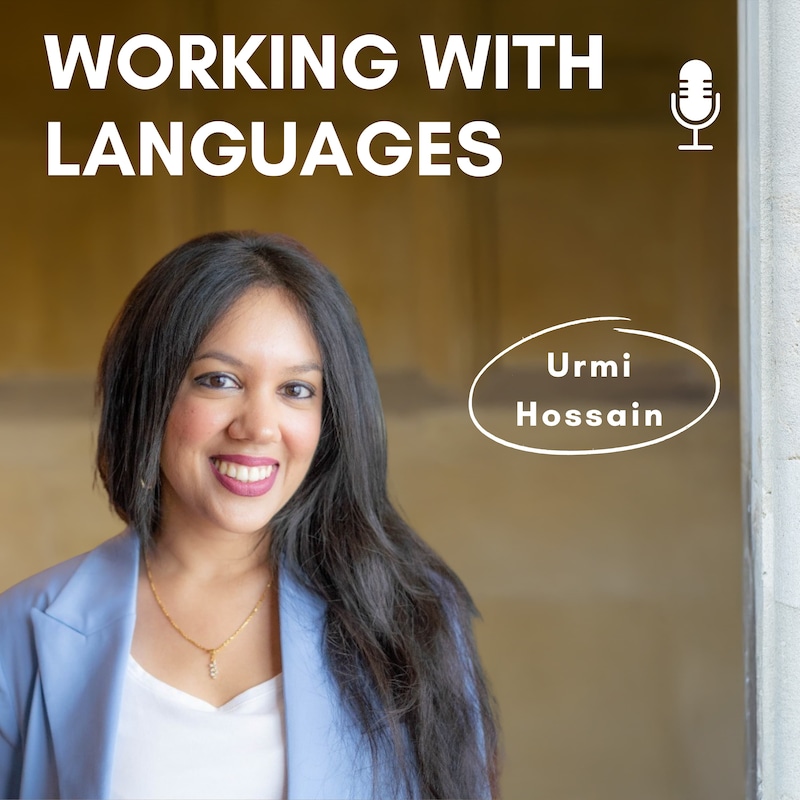
Welcome back to the Working with Languages podcast. My guest today is Urmi Hossain Hossain, who is international, to say the least, of Bengali origin, also Italian, now living in Canada, working in finance, but with a clear desire to talk about multicultural and multilingual aspects, specifically for women. But we'll get into that in a moment. So first of all, hello, Urmi Hossain.
Urmi Hossain
Hi.
Sonia Kampshoff
It's lovely to have you here. So as you know, I normally start with a real fun question. What is your favorite word or phrase in a language that you speak?
Urmi Hossain
So my favorite phrase is an Italian and it's Ti Voglio Bene, which doesn't have an actual translation in English. It just means I want good for you. And it's something that I had a really big difficulty. Like I always had the difficulty expressing Ti Voglio Bene to people when it came to the English language, because here the only way to say that you really appreciate someone is by saying I love you.
But in Italian, we have two different ways of like showing our care and love for someone. Like if you love someone romantically, you usually say, Tiamo. But if you love someone, let's say as like your sibling or your friends or family, you usually say, Ti voglio bene. And back in school, like we would say Ti voglio bene by saying TVB, which was the abbreviation of it. Like you would like write a note to your high school friend and then say TVB, which was the abbreviation of Tibo-Gobini. And that's one of my favorite expressions, which unfortunately does not have a literal translation in English.
Sonia Kampshoff
that's such a nice phrase. I love it. And I understand what you mean. I often want to say it to someone but then can't really say I love you in all situations. So it's kind of, you know, normally just skip it, which is a bit of a shame because it's it's such a lovely expression in Italian and I use it a lot as well. Brilliant. So tell us where you're from.
Urmi Hossain
Yeah. So I'm from Italy. I was born and raised in Italy and both of my parents are from Bangladesh. I was born in Sicily and moved around a lot during my childhood. I went to the north of Italy after nine years of living in Palermo. I lived in Pavia for three years when I did my high school. Then I went one year to the UK where I did also partial high school and then I came back to Italy.
ol before moving to Canada in:Sonia Kampshoff
Well, so you've lived in the south and the north of Italy. You've seen a lot of the country, you? Where about did you go to the UK when you were at school?
Urmi Hossain
I did. I went to, I was living in this place near Northampton called Wellingborough. I don't know if you're familiar with this city. I lived there for a year and over there I learned English basically.
Sonia Kampshoff
That's so cool to go, did you go for a full year?
Urmi Hossain
I did, and then we came back to Italy.
Sonia Kampshoff
So I find it also really interesting that you did the same type of school in Italy that I did. So it's kind of a technical commercial secondary school, but with a strong focus on languages. Which languages did you study at school?
Urmi Hossain
I studied English, French, and German. Not German, German. And I did quite intensive classes. We had really intensive hours, especially of English, French, and German. We also had teachers who came directly, who were mother tongue.
French speakers and German speakers and we would have like conversation just in English just in French and just in German and I also did like certification in each of the languages saying like this is how I learned English properly and the same thing with French. However, German I actually lost it all along the way because it's not something that I was using too often and we learned German because of the because Milan is not far from other countries where Germany was spoken, but I actually never got to use this. only like, I did it for three years. I knew how to speak it. I knew how to have a conversation with people, but then as soon as school was over, I just forgot about it.
Sonia Kampshoff
Yeah, you need to use their languages otherwise over the long term you tend to forget them. So when you finished your secondary school, did you have an idea of what you wanted to do professionally or with your life altogether?
Urmi Hossain
Yeah, there are so many things that I had in mind. I initially, especially with the program that I was doing, was like, you know, I'm going to eventually become a tourist guide. I'm going to go around and talk English to people and French to people and talk about the history of Italy and all the different, you know, monuments and art that we have as a country to show all that to the different tourists. And at some point I also thought of becoming a because I was so much into psychology and solving people's problems.
However, I knew that that wasn't my future, neither becoming a tourist guide or becoming a therapist. It was not going to be my future. And if I was living in Italy, I knew that I wanted to continue with the languages, but at the same time, I was like, I'm not sure where I'm going with this. I'm not sure what path to take. And then, of course, I moved to Canada and I took a completely different path, I would say.
Sonia Kampshoff
It's fascinating. So you moved to Canada, I think at 19, is that right?
Urmi Hossain
Yeah, yeah, I was quite young, yeah.
Sonia Kampshoff
And how was the move? Because it's a very, first of all, it's geographically far away. So you may miss your family or your friends. But how is the cultural connection to this new country to you?
Urmi Hossain
I would say that it was quite an exploration and quite an adventure when I moved to Canada, because there was only little that I knew. Like I live in Montreal, which is in the province of Quebec. And I remember I learned the word Quebec when I took a French class back in Italy. And I was like, Oh, I don't know what, what, what Quebec is. I must be somewhere like in the world. And before you know it, I'm like living in the province of Quebec, which is so funny.
And then when I moved to Montreal, it was very interesting to see the dynamic with the languages. Like here, it's a bilingual city, so you speak both English and French. And everyone approaches you with the two languages, so they usually say bonjour, hi. And then it's up to the person responding to choose in which language they want to be served. So if, let's say, they say bonjour, hi, and then you start speaking in English, then they will continue the conversation in English.
But then if you respond in French, then they continue speaking in French. So that was a quite interesting dynamic because everywhere is bilingual, basically. So that was something that I really had to adjust. And people switch really easily from one language to another. And sometimes we have what we call, I think it's called, or something like that, which is a combination of both languages. So people maybe speak in English and then they throw some French words or vice versa, which is quite interesting.
Sonia Kampshoff
I remember you saying that French in Canada, maybe specifically in Quebec and Montreal, it's different. It's a very specific kind of French. Is that true? Can you give us some examples?
Urmi Hossain
Yeah, it's very true because back in Italy, like especially in Europe, the French that they teach you is the one from France, predominantly the one from France. But then in Quebec, what we speak is called kibikwa, which is also French, but it's French from the Quebec area. So there are like different expressions. It's a different accent, a different pronunciation. So sometimes it's almost feel like they're speaking a different language, they eat the words maybe to say certain things, know, they use maybe some English words or they make the French word in English.
So it's very interesting in that sense. And I had a little bit of difficulty at the beginning because people would speak to me in Quebec and I would really not understand even though I knew how to speak French and everything, but it was quite a challenge for me. So I really had to work on my listening skills. I had to work on the pronunciation I would say my main work was more with the listening part because they would speak quite fast.
Sometimes I felt like it was rough. Whereas I feel like with the French, some French is a little bit more, I would say elegant when it comes to like speaking where the French from Quebec is a bit more rough, I would say. And so that was the difficult part. I really had to work on that. And Quebec is not always, it almost feels like you're learning a different language.
Sonia Kampshoff
Really interesting. So did you learn did you learn career quest in your everyday life or did you take some courses? Did you have someone helping you?
Urmi Hossain
No, basically what I did, it was more a work that I did on my own. So I knew how to work, because then I had the base, right? I had the grammar. The French grammar is the same everywhere. So I already had the base. I knew much of it. All I had to do is really watch videos on YouTube just to work on my, let's say, practicing the active listening part. Then I had a friend who was from France, and I would speak with him in French just to make myself fluent when speaking.
And I made sure that I was good enough to the point that I can do a job interview and now I actually work in a French environment. So I deal with French Quebecois individuals and that was my end goal.
I did, because the problem was that I didn't want to lose French in the same way that I lost German. And so was like, now I have to make sure that I like work really hard. So I took some courses, but it wasn't like going over the grammar, going over like words or stuff like that. It was just to have a conversation and make sure that I was fluent enough and to have a conversation and also to make sure that I was understanding when the other person was speaking to me.
Sonia Kampshoff
Yeah, yeah. And you also went to university in Canada, where there are classes in English and French for a mix.
Urmi Hossain
No, in Montreal you have universities which are just only in English or just in French. We don't have like bullets. High school and high school and elementary is a little bit different, but when it comes to universities, you get to choose depending on your program. And some universities are just strictly in English, some are just strictly in French. I have studied in English and I did a bachelor degree in finance, which was just in English.
Sonia Kampshoff
Great. How did you find it studying a subject like finance in English when before you studied in Italy?
Urmi Hossain
You know what, I did not find it difficult at all. I think that because of the way that I was taught English back in high school, like I had a teacher who was really tough with us. And so she made sure that we mastered English as we were native speakers. So when I came to Montreal and I was studying in English, was totally fine for me. Like it was normal, like as if I was going to school to Italy. So I did not have that challenge when it came to learning new words or so forth.
And if I did, I would like just Google them and try to understand the definition. But it was quite easy, I would say. Like for me, there was never a challenge when it came to that. But it was interesting for me to see the way everything's changed in my life because my whole life I studied in Italy and I come to Montreal and I studied English and then now I work in French. So that's the interesting dynamic that I'm always reflecting upon when it comes to like my journey with languages.
Sonia Kampshoff
Interesting. And now you work in finance. Tell us more about it.
Urmi Hossain
Yeah, I work in finance. It's been 10 years that I'm in the industry and I always like to say I'm a proud woman in finance. I very much enjoy my job and I also enjoy, I enjoyed my university journey. I always say my experience with finance was like love at first sight. I did learn to finance back when I was in Italy. I actually learned about finance when I came to Montreal, even though when I came to Montreal initially I was like more opting towards international business. Cause I was like, I know languages and this is how I can use it by doing business, business internationally.
But I knew that there was no future. So I was like, you know what, I'm going to switch into something else and try finance. And the moment I took the first finance course, I just fell in love with it. And it's a love that always has always been there. So I very much enjoy being in finance and it's very dynamic, which is, which I feel like it just matches with my personality, which is very dynamic as well.
Sonia Kampshoff
It's the first time I hear someone say finance and dynamic in the same sentence.
Urmi Hossain
There you go.
Sonia Kampshoff
Do you find it also as a you know as a woman in the industry as I know you're now Canadian but you know originally you were from a different country how would you find it is it is it easy you are there any challenges for you?
Urmi Hossain
I mean, I would say the challenge for me, I would say for me, in a way I was lucky enough that I have done my university here and I got my degree in Montreal and I was able to understand a little bit of the workforce dynamic and how it works. And I can see the difference when it comes to Canada and Italy. Like in Canada, it's very competitive, the market. Like everyone is doing something. Like we finish all our degrees, but then we move on and do like a certification, a master or something extra. And there's always like demand for that.
Like people are always trying to invest in themselves, which is something that I did not see back in Italy. Like I feel like you just got a high school degree in Italy and that says who cares about the rest. And here I can see also the dynamic in the workforce. Like you let's say like you go for an interview and depending on the role that you're applying for, typically it's your interview will be in two languages. Like maybe a questions will be in English and then they will move on and ask you some questions in French because they want to test both languages.
And if you're facing, you know, if your client facing that you want to, they want to make sure that you know French well, because it's more prevalent compared to English. And so I had to like really navigate that, that kind of dynamic. And also there's so much competition and people hop from one job to another really easily. Like in Italy, we say that you, if you find one job, you stay in tool, you retire.
But in Canada, it's different. Like you easily change job after one year, two years or three years. You're always changing to find something better, to get a better salary and so forth. So it's quite normal that you are always moving around and not sticking to one place until the end. So that was something that I had to like, I observed that, I learned that a little bit how people were doing it. And I had to learn to like always invest in myself and invest in my knowledge getting new skills, getting new certifications. of course, finance is a challenging industry, meaning that it's very male-dominated, but things are also shifting and changing. I think with the new generation, we have a lot more women stepping up and getting degrees in finance and also working in finance. But it is predominantly male-dominated.
Sonia Kampshoff
Do you have any sort of mentor at work who helps you or maybe at the beginning helped you navigate this different work environment?
Urmi Hossain
I would say that for me, my mentors were different women that came into my life. had few managers, few coworkers who were not officially my mentor. These were people that I just look up to who were, I would say, I idealized, like I would say, an ideal image or an ideal individual of what I wanted to be. So some of my female managers, I always like ask them,
I also had like officially a mentor. It was a male mentor back in my previous work workplace where I would like ask questions and so forth. But I always like, I would say that I have a lot of like managers or people that I work with that I see as my mentors. Like I don't think you necessarily need to have a mentor who's like officially there for you. I think anyone can always give you some guidance and tips and advice when it comes to career or anything in general.
But I did have like a lot of connection. tried to, that's another thing like that I really worked on was building my connection as soon as I started my career, because it was something that I had done and I can see the benefits of having connections in the industry, but also in general, which I feel like it's something that maybe nearly is not so much emphasized. That's another thing that I noticed, but here you really depend a lot on your connections and having people to refer you for a job and so forth.
Sonia Kampshoff
How do you use languages in the work that you do? Are there any situations, for example, that you mentioned you work a lot with French and French is the main language, but are there any situations where you work more in English or is everything in French? What's the influence of languages in the work that you do?
Urmi Hossain
It's quite big, would say, meaning that internally, like internally in the company, everything is bilingual. Like any internal communication, has to be given both in English and French, with French coming before English.
So usually, if there is an internal communication, first in French and then there is the translation in English. And at work, you will have, I would say, a good proportion of people who are, everyone is pretty much bilingual, but there are people who are more Francophone compared to, who are more Francophone than Anglophone. And usually what happens is that, I would say probably like, 70 % of my time I'm speaking in French and then maybe 30 % I'm speaking in English. Like with my coworkers I speak in English, but then with my bosses I speak in French and with the clients I speak in French predominantly I would say. So I would say the ratio is probably like 70-30 and because I'm so used to approaching people in French, French comes to me more natural than English now.
As soon as I hear someone saying, Bonjour, I already go and just speak in French. I'm not like switching in English. And so I'm like, I would say that's the way that I'm using the languages. And there are so many Italians as well in my workplace. So I don't get to use Italian as much because these are people that are born in Montreal whose parents come from Italy, but then they didn't all learn Italian as much. don't get to, like when I'm speaking with them, they have a little bit of hard time like understanding me because they do not know the language properly, so.
Sonia Kampshoff
Great. Are there any other nationalities in your team or in the company that you work for?
Urmi Hossain
We, it's quite diverse, I would say. I would say it's very diverse. have people from all over the world. Although I feel like there is a predominance when it comes to Italian. Like I feel like we have a lot of people from Italian origins who are Canadian Italian. So they're, yeah, so they're born and raised in Canada whose parents are from Italy.
Sonia Kampshoff
Can you tell us more about your podcast and your YouTube channel and why you do it?
Urmi Hossain
Yeah, I have a podcast called the Stories Beyond Borders, which is a podcast where we talk about migration stories and we talk about other cultural kids. talk about people who are multicultural, multilingual. And the reason I started is because I wanted to bring awareness about people moving around and why we move. And it's always interesting to hear people's stories. We all move for different reasons. And sometimes it's not obvious. Some people really move for let's say for reason for were, or some people have no choice.
And I wanted to start that podcast for that reason and to make it more like a storytelling to be able to give people a place to share their stories. And on my YouTube channel, I talk about a lot about public speaking. I also talk about how to learn languages and myself being a big part, like I'm so passionate when it comes to learning languages.
I'm also into learning Spanish right now. I took a few classes when I was in a university, but it's a language of my choice, I would say. Like when I think about, let's say, Italian and Bengali, were not like languages of my choice. These were given to me. then English and French, these were languages that I had to learn at school. But then Spanish is the language of my choice. It's something that I have chosen that I deliberately wanted to learn. So that's another thing. Like I am like constantly learning and continue learning languages. And in my YouTube channel, I also talk about how to pass certain exams when it comes to finance and like giving like tips and tricks, I would say, yeah.
Sonia Kampshoff
that's fascinating. So it's a really wide topic that you cover, you know, from finance exams to languages and telling stories of people moving to different countries. And I listened to your podcast, it's really, really good. So what are your plans for the future for your podcast and your YouTube channel?
Urmi Hossain
I definitely want to have these conversations around migration and people moving around. And it's very interesting. I feel like every time I'm talking to someone, learning something new. I had a guest who talked about her experience being biracial, that she was half white and half black. And she talks about her experience a little bit navigating those that kind of dynamic and how it was for her.
I feel like I'm always learning something new and I want to keep having these conversations. I had individuals who are constantly moving around and constantly learning languages, which I find always so fascinating that there are so many people into languages and being polyglot. And I definitely want to keep growing like my YouTube channel and, you know, give more tips and tricks and share more of my own experience. I think it's a way to really give back to the community, I would say.
Sonia Kampshoff
That's nice. And also I find it interesting why people want to learn new languages and sometimes it's because they want to travel or sometimes it's just mainly cultural and linguistic curiosity. Or maybe they have a new person in their family or a friend who does not, who speaks a different language and they want to be able to speak in that language with them.
And I just find it fascinating the reason behind learning a language because then it will also influence how you learn it and for example which vocabulary you go down with. Is it more like traveling and you know more sort of let's say logistics based or is it more a family member where maybe you talk more about cooking. So that's yeah that's so interesting.
Urmi Hossain
Yeah, I just wanted to add that I also feel like the way we learn languages have changed throughout the years. Like I feel like back in my days, it was really like you would learn a language in the classroom. Like we did not have like having internet was a luxury. You did not use YouTube that much. You didn't have all these applications. You did not have all this platform to learn languages. Whereas now it's much easier. Like I feel like learning languages is much more.
It's much more accessible and it's much easier. would say like you have podcasts that you can use. have YouTube channel, you can watch vlogs. You have all these courses that you can take. have a lot more. Like it's not just at school that you can learn a language. You can also learn language like on your own. If you buy a course online and there's so many teachers out there, so many professors who are like selling courses. I feel like it's just, it's so much easier now to learn a language, which is also probably why I feel like there's
I don't know if it's me meeting a lot of people who learn like learning languages, but I feel like it's more democratized, I would say. So it's just a lot more people are learning languages right now.
Sonia Kampshoff
Yes, I totally agree. I find that when I when I was at school, the emphasis was on grammar, whereas maybe maybe has to it's about the face in life that you're in. So if you're, you know, sort of in your 20s or later, you generally just want to speak. So grammar is still important, but it's not the primary thing. You don't start necessarily with grammar. It's about speaking and communicating and getting your message across. And that is a very different way of learning the language.
Urmi Hossain
I just have one message to share, especially when it comes to learning languages, is that sometimes we think that there's certain, like I heard that once you reach a certain age, you cannot learn a language or you can, but it's much more difficult. But I would say that if you do have a passion for learning a language, it's never too late. You can start learning a language at 30, 40, 50, no matter when you want. And I've seen it. I've seen it because I see it with my Spanish classes when I am in a group of with people, there are people from different backgrounds and different ages and I can see that they are so passionate about learning a language. So my message is it's never too late. You can start anytime when it comes to learning a language.
Sonia Kampshoff
Brilliant. That's a great message. Thank you so much. And thanks a lot for coming on the podcast.
Urmi Hossain
Thank you.
Sonia Kampshoff
What I find so striking about Urumi's story is just how central languages have been to every step of her life and career. At school she studied in Italian, got her finance degree in English, and now she spends the majority of her working day in French. It's a good reminder that in many workplaces, especially in multicultural cities like Montreal, the language you show up in isn't just a preference. It shapes how you're perceived, which roles you can access, and how far you can go.
For Urmi Hossain, investing in her French wasn't just a personal project, it was a professional one. And that's really what this podcast is all about. The very real practical role that languages play in our working lives. Often in a way we don't fully appreciate until we look back. If you enjoyed this episode, please subscribe to the podcast on your favorite platform.
And if you think a friend might be interested, do share this episode or the podcast with them. You can also subscribe to my newsletter. The link is in the show notes.

