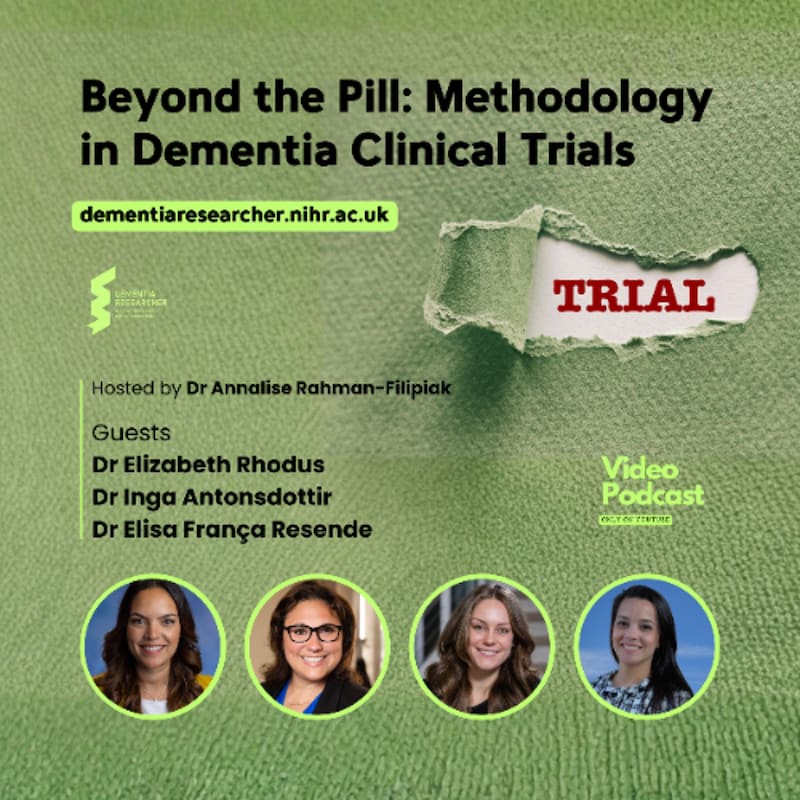
Shownotes
In this episode of the Dementia Researcher podcast we look at how dementia clinical trials reach far beyond medicines. Host Dr Annalise Rahman Filipiak speaks with Dr Elizabeth Rhodus, Dr Inga Antonsdottir, and Dr Elisa França Resende about entering the field, working with behavioural and community based interventions, and learning the skills needed to deliver rigorous, reproducible studies that still respect the individual needs of participants.
The guests discuss their routes into trials, what surprised them, what they wish they had known earlier, and how mentorship and collaboration shaped their progress. They touch on trial design, regulatory processes, cultural considerations, and the value of early career networks that support researchers across different countries.
Topics covered
- What early career researchers find challenging about trial methods
- Working in homes and communities
- Designing sensory and environmental interventions
- Literacy based trials in Brazil and issues of inclusion
- Mentorship, networks and training programmes
- Trial rigour, manuals, assessments and reproducibility
- Regulatory hurdles and timeframes
- Practical advice for researchers wanting to deliver a trial as part of their research
--
A transcript of this show, links and show notes and profile on all our guests are available on our website at https://www.dementiaresearcher.nihr.ac.uk.
If you prefer to watch rather than listen, you will find a video version of this podcast on Apple Podcasts, YouTube, and on our website.
Leave us a tip:
https://dementia-researcher.captivate.fm/support
Follow us on social media:
- https://www.instagram.com/dementia_researcher/
- https://www.facebook.com/Dementia.Researcher/
- https://www.twitter.com/demrescommunity
- https://www.linkedin.com/company/dementia-researcher
- https://bsky.app/profile/dementiaresearcher.bsky.social
Download and Register with our Community App:
https://www.onelink.to/dementiaresearcher
We gratefully acknowledge the support of our funders: Alzheimer’s Association, Race Against Dementia, Alzheimer’s Research UK, Alzheimer’s Society, and the National Institute for Health and Care Research.
The views and opinions expressed by guests in this podcast are their own and do not necessarily reflect those of the producers, funders, or sponsors.
Subscribe to our sister show 'Dementia Researcher The Blogs':
Transcripts
- [Announcer] The Dementia
Researcher podcast,
Speaker:talking careers, research,
conference highlights,
Speaker:and so much more.
Speaker:- Hello and welcome to the
Dementia Researcher podcast.
Speaker:In this episode, we are
exploring methodology
Speaker:in dementia clinical trials,
particularly what it is like
Speaker:for early career researchers
entering this field,
Speaker:and how trials extend much
further than medicines.
Speaker:(upbeat music)
Speaker:I'm Dr. Annalise Rahman-Filipiak
from the research programme
Speaker:on Cognition and Neuromodulation
Based Interventions
Speaker:at the University of Michigan.
Speaker:And I am delighted to be
hosting this week's show.
Speaker:Clinical trials are often viewed
Speaker:as a domain of pharmacology,
yet in dementia research,
Speaker:trials include behavioural interventions,
Speaker:sensory environments, sleep
and activity interventions,
Speaker:and many other approaches.
Speaker:These studies require careful design,
Speaker:strong methods and collaboration.
Speaker:And many early career researchers tell us
Speaker:that they feel unprepared
when first entering this work.
Speaker:So today that's what we wanna get into.
Speaker:To explore this I am
joined by three guests
Speaker:who each work on clinical
trials in different ways
Speaker:and who are part of
ISTAART's clinical trials
Speaker:and advancement of methods PIA.
Speaker:First, Dr. Elizabeth Rhodus,
Speaker:assistant professor at the
University of Kentucky,
Speaker:whose work focuses on multisensory
Speaker:and home environment interventions
Speaker:to support people living with dementia.
Speaker:Hello, Elizabeth.
Speaker:Dr. Inga Antonsdottir,
Speaker:researcher at Johns Hopkins University,
Speaker:whose work examines
sleep circadian rhythms
Speaker:and neuropsychiatric symptoms
Speaker:with a growing programme of trial methods.
Speaker:Hi, Inga.
Speaker:And finally, Dr. Elisa Franca Resende,
Speaker:neurologist and researcher
Speaker:at the Federal University
of Minas Gerais in Brazil,
Speaker:whose research explores cognitive reserve,
Speaker:literacy and dementia prevention,
Speaker:including applied trials
in diverse populations.
Speaker:Hello, Elisa.
Speaker:Hello, everyone, thank
you for having me here.
Speaker:Okay, so thank you again for joining us.
Speaker:To start us off, could I ask each of you
Speaker:to introduce yourself in your own words?
Speaker:Maybe we can start with you, Elizabeth.
Speaker:- Sure, yeah, thank you so much.
Speaker:I clinically have a background
as an occupational therapist
Speaker:and my training started in
paediatrics and neurodevelopment.
Speaker:So I come to this stage in dementia care
Speaker:or in Alzheimer's disease
and related dementias
Speaker:really with this idea of neurodevelopment
Speaker:to neurodegeneration and how do we support
Speaker:both sides of the lifespan
Speaker:through an environmental
and sensory based approach.
Speaker:So if we have a baby
Speaker:who is having a hard
time calming itself down,
Speaker:we naturally swaddle that baby, right?
Speaker:We give it full body proprioceptive input
Speaker:to regulate its nervous system.
Speaker:We rock the baby, we sing to the baby,
Speaker:we give lavender-infused
lotions to the baby.
Speaker:So we care for this
brand new nervous system
Speaker:in a way that's environmental
and sensory based.
Speaker:How can we rigorously design and assess
Speaker:and test a similar type of
intervention for older adults?
Speaker:We're not gonna swaddle our elders,
Speaker:but how can we create an environment
Speaker:that's gonna provide
similar input in that way?
Speaker:So that's really my research
and my experience thus far.
Speaker:- Honestly, Elizabeth, that
sounds fantastic for all of us.
Speaker:So very excited to hear more.
Speaker:Inga, what about you?
Speaker:- Thank you so much for having us today.
Speaker:So I'm Inga Antonsdottir.
Speaker:I'm actually a postdoctoral
research fellow
Speaker:at Johns Hopkins.
Speaker:And my research interests
lie at the intersection
Speaker:of Alzheimer's disease
and related dementias
Speaker:and then sleep and circadian
rest activity rhythms
Speaker:in people living with dementia,
Speaker:but also in their care partners.
Speaker:So tailoring interventions to
make it as easy as possible
Speaker:for us to treat any type of
sleep disorder or disruption.
Speaker:And then I'm also a nurse
practitioner in our memory clinic,
Speaker:so I'm able to see, treat,
Speaker:and assess people with memory disorders
Speaker:as well as other
neurodegenerative diseases.
Speaker:So beautiful way to kind of
combine that clinical practise
Speaker:and the research and see
where the gaps might be.
Speaker:- Fantastic, so glad you're here.
Speaker:Now Elisa.
Speaker:- Yes, I'm Elisa Resend.
Speaker:I'm a neurologist from Brazil.
Speaker:And when I was a medical student,
Speaker:I was impressed by the fact
Speaker:that many of our older
adults with dementia,
Speaker:they were illiterate.
Speaker:And then my curiosity began
Speaker:about how literacy can be
a risk factor for dementia.
Speaker:So I built my career research
Speaker:around understanding this in their brains,
Speaker:and then developing a child to understand
Speaker:if literacy giving to older adults
Speaker:could improve brain health.
Speaker:Fantastic.
Speaker:(upbeat music)
Speaker:- So I'd love to start
our conversation today
Speaker:by talking about early career research
Speaker:and entering this field.
Speaker:So many early career researchers
say they feel unprepared
Speaker:for trial design and conduct.
Speaker:So let's begin with your own journeys.
Speaker:Elizabeth, Inga, and Elisa,
could you each describe
Speaker:how you found yourselves
working in clinical trials?
Speaker:Was that a deliberate decision,
Speaker:or just something that
developed gradually?
Speaker:- Yeah, so I could definitely start off.
Speaker:I was incredibly lucky
in my pre-doctoral work
Speaker:to slowly but surely get introduced
Speaker:to different clinical trialists.
Speaker:And we were doing community-based trials.
Speaker:So Dr. Quincy Samus who had recently
Speaker:kind of closed up her
project mind at home.
Speaker:And we were just starting memory corps,
Speaker:which was an association with
the Alzheimer's Association,
Speaker:and then also (indistinct)
who was adapting one
Speaker:of her clinical trials,
her clinical programmes.
Speaker:But being exposed to those
programmes so early on
Speaker:and how you can go into the home,
Speaker:how you're able to kind of work
Speaker:with people living with dementia,
Speaker:memory disorders and their care partners
Speaker:and adapt things in a way
Speaker:that's going to do what's best for them,
Speaker:but also still giving them
Speaker:kind of this beautiful intervention
Speaker:that's going to help our knowledge
Speaker:of what to do at home
versus what to do in clinic.
Speaker:I was just very fortunate
Speaker:that that's kind of how my
pre-doctoral work started,
Speaker:and I've been able to kind
of have a foot in the door
Speaker:at every step of the way and now I get to,
Speaker:hopefully, build my own practise
Speaker:and kind of understanding of
how to develop these trials.
Speaker:- That's so interesting.
Speaker:So you came in with very
pragmatic community trials
Speaker:as opposed to, you
know, some of the trials
Speaker:that we hear about that are,
you know, purely lab-based.
Speaker:I'm wondering if you could
share if there were surprises
Speaker:or challenges in the pragmatic trial space
Speaker:that you didn't expect?
Speaker:- Yes, so many different
surprises and just as you're,
Speaker:it's amazing to learn
kind of the book side
Speaker:of clinical trials and then
what happens in the real world
Speaker:and realising that life can
be messy and that's okay.
Speaker:But the methodology we
have to kind of make sure
Speaker:that we're putting rigour into our trials,
Speaker:even though life gets messy,
Speaker:so that when we kind of look
back and we get that data,
Speaker:it's as clean as possible
so that we can generalise
Speaker:what we found to other people
Speaker:and make sure that it's reproducible.
Speaker:That was definitely doing home visits.
Speaker:It's such a privilege
to be able to be invited
Speaker:into somebody's home and to
try and help figure things out
Speaker:and into their lives generally.
Speaker:And I'm sure the other
researchers on this call
Speaker:have had some of those experiences
Speaker:where you just learn that one
thing will work for someone
Speaker:and it might not work for another,
Speaker:and we have to adjust and
everything is kind of personal.
Speaker:And so, it deserves to have
kind of a personal touch,
Speaker:but we also have to maintain
the rigour of our methods
Speaker:and make sure that we're able to reproduce
Speaker:what we're kind of creating in this world.
Speaker:- Thank you so much, I really appreciate
Speaker:you talking about that 'cause I think
Speaker:that is a misconception
that we have about trials,
Speaker:is that sometimes we take away the,
Speaker:sort of human or
interactional piece of it,
Speaker:but your work is such a great testament
Speaker:to the fact that we can do both.
Speaker:Elizabeth, how did you
come into this space?
Speaker:- Yeah, I would love to follow
up on what Inga was saying.
Speaker:As an occupational therapist,
Speaker:I'm based in Kentucky and was
working in eastern Kentucky.
Speaker:We don't have a whole lot of resources.
Speaker:It's Appalachia, right?
Speaker:So in going into these homes
and using the programmes
Speaker:that Inga was actually involved
Speaker:in developing these manualized programmes
Speaker:that had an occupational
therapy component,
Speaker:I was recognising that we
were adapting the home,
Speaker:we were improving safety, we
were trying all that we could,
Speaker:but there was still something missing.
Speaker:There was something missing related
Speaker:to the caregiver training,
Speaker:that this nervous system is
now degenerating and dying
Speaker:and how do we accept that?
Speaker:There was something missing
about regulating behaviours
Speaker:through this sensory based approach.
Speaker:None of the research 15 years
ago was talking about that.
Speaker:And so I went in, I decided at
that point, let's get a PhD,
Speaker:let's see what I can figure out.
Speaker:But I had never wanted
to be a doctor, or a PhD,
Speaker:or any of this space.
Speaker:I was a clinician and I still,
Speaker:even though I'm faculty, I
still see myself as someone
Speaker:who really cares about
this clinical aspect.
Speaker:And so, I want to improve care.
Speaker:I came into this space
saying, I'm gonna get a PhD,
Speaker:I'm gonna do a clinical trial
Speaker:with a sensory-based intervention
that we've seen productive
Speaker:and useful in autism spectrum disorder.
Speaker:And I'm gonna do it in
people with dementia.
Speaker:Thankfully, I had some really
good mentors and they said,
Speaker:"No, you're not.
Speaker:You have to prove the fact
Speaker:that you can use a paediatric intervention
Speaker:in a dementia population
with basic science showing
Speaker:this level of interaction first."
Speaker:So during my PhD, I actually
worked with the University
Speaker:of Kentucky Alzheimer's
Disease Research Centre
Speaker:that carries a longitudinal
cohort of up to 700 people
Speaker:and we surveyed people who
had a diagnosis with dementia,
Speaker:so over 350 people.
Speaker:And we found that this
group of population,
Speaker:or these group of people also
had behaviours characteristic
Speaker:of autism spectrum disorder
that aren't already collected
Speaker:or analysed in our basic
neuropsychiatric symptom inventory.
Speaker:And we actually follow people to autopsy,
Speaker:and their brains and the
pathology distribution
Speaker:actually look different.
Speaker:So we're working with a group of people
Speaker:that have behavioural symptoms.
Speaker:We don't have any treatment,
let's think outside of the box.
Speaker:At that point, Dr. Greg Jicha
at the University of Kentucky
Speaker:is our a world renowned clinical trialist
Speaker:and really designs the pharmaceuticals.
Speaker:He designs the mechanisms
to create the medications
Speaker:to cure and treat Alzheimer's disease.
Speaker:He likes what I was
doing, but it wasn't sure.
Speaker:He would call it Rhodus magic sometimes.
Speaker:But I would come in and I would say,
Speaker:"Well, here's my protocol,"
and he would ask me questions,
Speaker:and I'd say, "Well, the
therapist is just gonna use
Speaker:their clinical judgement ."
Speaker:And he said, "The hell, they
are, that's not rigorous.
Speaker:You have to put down exactly
Speaker:what you're gonna do in your protocol
Speaker:and you have to measure that."
Speaker:So it took me about a year and a half
Speaker:of asking how do we individualise
Speaker:or how do we operationalize an
individualised intervention?
Speaker:And through that it's
really about assessments
Speaker:and decision matrices.
Speaker:If this person scores
this on this assessment,
Speaker:then we're gonna treat them this way.
Speaker:If they score this, then
they're presenting this way,
Speaker:then we're gonna give them this group
Speaker:of intervention supplies or
tools or whatever it might be.
Speaker:So that really opened the door
Speaker:for me to understand
how we can use this idea
Speaker:that people are using in
precision-based medicine
Speaker:to tailor medications based on genetics
Speaker:and really dial in at
the pharmaceutical level.
Speaker:How do we develop and
implement precision-based care?
Speaker:How do we create an environment
Speaker:and care systems that are really tailored
Speaker:to that individual to maximise success,
Speaker:but how do we do it in a rigorous way
Speaker:that we can replicate
over and over and over?
Speaker:So that's kind of my space
and how I've gotten here.
Speaker:I've had three clinical trials now
Speaker:that are all in this idea
of behavioural intervention
Speaker:and caring for people in their homes.
Speaker:I've been all funded by the
National Institute on Health,
Speaker:so I've been really fortunate
to have great training,
Speaker:to have great funding and
support and see where it goes.
Speaker:- That's an incredible story.
Speaker:And what I really like about it is that
Speaker:it's a somewhat non-traditional
pathway towards trials.
Speaker:And I love that you're applying so much
Speaker:from your clinical background.
Speaker:I think that really
helps develop new ideas,
Speaker:and bring a new perspective
to the work that's done.
Speaker:You mentioned something
that I do wanna return to,
Speaker:which is this idea of mentorship.
Speaker:I think mentorship and sponsorship
Speaker:is really what can help
an early career person
Speaker:have the confidence to move forward
Speaker:and sometimes the resources
and infrastructure as well.
Speaker:Would you be willing to
talk a little bit about
Speaker:just how mentorship played a role
Speaker:in you being so successful at this point?
Speaker:- Absolutely, I've told
Dr. Jicha so many times
Speaker:that he opened doors for me
that I didn't even know existed.
Speaker:I was in a health profession,
Speaker:I was doing evidence-based
care out in the field,
Speaker:but I didn't know, I was
not trained in a school
Speaker:that had a path for research.
Speaker:I went to a smaller
school, it was not an R1,
Speaker:so I've never really been in a lab.
Speaker:I didn't know what this looked like.
Speaker:So without that mentorship,
Speaker:without that little piece
of him believing in me
Speaker:and then kicking me along,
Speaker:with me kicking and screaming, literally,
Speaker:because I didn't see
the world how he saw it.
Speaker:And he's a renowned neurologist,
Speaker:he's also the clinical side, right?
Speaker:He understands how clinicians
think and provides resources,
Speaker:but he also has that PhD
and leads clinical trials
Speaker:and really strong science.
Speaker:And through his mentorship and training,
Speaker:I really was able to tailor
Speaker:and learn my space and place in this.
Speaker:But I also had multiple
different types of mentors.
Speaker:You know, I would go to him
Speaker:for the really science-based things
Speaker:and then I would have the other mentors
Speaker:that I'd be texting at night,
Speaker:like, crying, like, I can't do this.
Speaker:I'm lost, I don't know what to do.
Speaker:Or the next person of,
how do I really make sure
Speaker:that my career is blossoming
and that I'm well-rounded
Speaker:and I'm getting all
the skills that I need,
Speaker:but not burning at both ends
Speaker:and making sure that, you know, I'm young,
Speaker:I have a 2-year-old at home, right?
Speaker:So how do I blend this space
Speaker:of advancing my academic career,
Speaker:leading the field and clinical trials
Speaker:within occupational therapy
and being true to myself,
Speaker:as a mom and a wife and me, right?
Speaker:So I think that that mentorship landscape
Speaker:really was what helped create me
Speaker:and allowed me to get to this point.
Speaker:- Kind of wanna piggyback on that.
Speaker:I second everything that
Elizabeth is saying,
Speaker:and mentorship is so important
and that team-based approach.
Speaker:I love how you described that,
Speaker:you know, it's not always one person
Speaker:that you go to everything for.
Speaker:It's very much a team of
people who lift you up,
Speaker:and help you understand different
aspects of the research,
Speaker:different aspects of work-life balance.
Speaker:I, too, have been just
absolutely incredibly lucky
Speaker:with the mentorship teams that have
Speaker:kind of become my village,
for lack of a better word,
Speaker:and just to be able to go to people
Speaker:and kind of ask questions.
Speaker:And then finding mentorship
outside of academia.
Speaker:There's different groups
and I know we're gonna talk
Speaker:about this a little bit later
with the clinical trials PI.
Speaker:You can find different
PIs for different areas
Speaker:of research that you want.
Speaker:And finding those people that
you're able to kind of go to
Speaker:that are at different universities
Speaker:or in different spaces in life.
Speaker:There's another one IMPACT-AD
Speaker:where Elizabeth and I
actually got to meet,
Speaker:and you're able to surround yourself
Speaker:with other researchers
either at your stage
Speaker:or a little bit above
or a little bit below.
Speaker:And it's amazing just being
able to chat with people
Speaker:and have those ideas kind of
spur off of one one another,
Speaker:and really just learn from each other
Speaker:and make the science
and the research space
Speaker:just keep evolving and
keep getting better.
Speaker:- I think that's excellent advice.
Speaker:- I have to throw out
there that Inga's father,
Speaker:is another world renowned
clinical trialist
Speaker:at the University of Rochester.
Speaker:- I'm in his office.
Speaker:- He's one of my mentors for my,
Speaker:I have a career development
award through the NIH,
Speaker:and he is one of my mentors.
Speaker:So he's one of those people
Speaker:that I call every other month of like,
Speaker:what am I doing, are
you sure I can do this?
Speaker:Fantastic, so I just wanted to
plug in here for him as well.
Speaker:- It's a beautiful small world.
Speaker:We all like each other.
Speaker:We all, like, want learn
and grow from each other.
Speaker:And I think that's one of
the best things, Elisa,
Speaker:and I feel like I'm talking
over everyone, though.
Speaker:- Yeah, I mean, great notes
about a mentoring network.
Speaker:I think that's excellent advice.
Speaker:Elisa, I'm really interested to hear
Speaker:how you came into this field.
Speaker:- Yeah, so my path is
a little bit different
Speaker:because in Brazil it's really
hard to do clinical trials.
Speaker:That's true because of the rigour,
Speaker:because the ethical approval is very long.
Speaker:Sometimes can take two years
Speaker:to have an ethical approval here.
Speaker:So I started, like, trying
to understand why illiteracy
Speaker:was a risk factor.
Speaker:So I was looking into the MRI,
Speaker:so to correlate MRI with memory
Speaker:and to see if there is a correlation
Speaker:between illiteracy and poor memory.
Speaker:So I found a lot of evidence that,
Speaker:yes, they had poor memory, they
had poor brain connections,
Speaker:but everybody was asking
me, what do you know?
Speaker:It's interesting that they have
poor memory, but what else?
Speaker:Do you know if you do something,
Speaker:can you do something about it?
Speaker:And I think all of you
talked a little bit about,
Speaker:we want to improve patients
and people's lives,
Speaker:so there is no point of
discovering something
Speaker:and then you cannot, like,
put that into practise
Speaker:to improve their lives.
Speaker:So that's how I entered this world,
Speaker:a little bit afraid to
be honest because I was,
Speaker:oh, my God, I'm going
to do a clinical trial.
Speaker:When I was like writing
clinical trial, I was like,
Speaker:I'm not sure if I'm
doing a clinical trial.
Speaker:But anyway, so I had incredible
support from mentors.
Speaker:My mentor here in Brazil.
Speaker:He led a lot of clinical trials here,
Speaker:medicine, behavioural intervention.
Speaker:So he had a lot of experience, he helped.
Speaker:And I had like the Global
Brain Health Institute training
Speaker:that some of you may know.
Speaker:It was a wonderful experience
Speaker:and I learned a lot about
leadership, team management,
Speaker:some things that are really important
Speaker:in running a clinical
trial, respect, community,
Speaker:like, involvement with the community.
Speaker:And also I had the IMPACT-AD training,
Speaker:and I think it was,
Speaker:I did the clinical trial before
Speaker:and when I did the IMPACT-AD
training, I was like,
Speaker:oh, my God, I should, I
made a lot of mistakes.
Speaker:And they say, no, it's okay.
Speaker:I say, okay, you know, so
the papers, they're like,
Speaker:you know, there's this, this,
this and that, I'm so sorry.
Speaker:But anyways, I learned a lot,
Speaker:and I entered this word
to actually to show,
Speaker:so to prove and to bring
this to public policy
Speaker:because some schools here in Brazil,
Speaker:they were about to close
for adult literacy training
Speaker:because the government said,
Speaker:ah, you know, they don't do anything.
Speaker:They just go there, don't learn.
Speaker:And I was trying to show that they learn,
Speaker:their brains get better,
Speaker:so you should invest
in this approach here.
Speaker:So that's how and I agree with our field,
Speaker:like, mentorship is incredible important.
Speaker:And I had like, and I think I
have to say about women here
Speaker:because I had a male mentor, he's amazing,
Speaker:but he doesn't understand
the woman stuff, you know?
Speaker:You said being a mom,
and one of my mentors,
Speaker:she had three children, and I was like,
Speaker:okay, if she can do it, I can do it.
Speaker:So I also had two children,
three I think is too much,
Speaker:but I had two.
Speaker:And like, she helped me
with managing career,
Speaker:as Elizabeth said, career
and being a clinician
Speaker:and also the clinical trials
did the research part.
Speaker:And funding is a very important,
so my first, first trial,
Speaker:pilot trial was from the
Alzheimer's Association,
Speaker:so the grant.
Speaker:So I think you should go
there and find grants.
Speaker:To start you need to do a pilot, right?
Speaker:A small pilot, few people, feasibility,
Speaker:and then you go over into larger one.
Speaker:- Thank you so much.
Speaker:I mean, I really wanna point out,
Speaker:A, that all of us to
some extent experienced
Speaker:or talked about some imposter
syndrome entering this space.
Speaker:And I think that's for a lot of reasons.
Speaker:But we also talked about some
Speaker:of the tools we have relied on
Speaker:or benefited from in
order to overcome that.
Speaker:I wanna shift the conversation
a little bit to a new topic,
Speaker:which somewhat relates
to imposter syndrome.
Speaker:I think coming into the trial space,
Speaker:there was so much emphasis on medicines
Speaker:or pharmacology as the true trials,
Speaker:yet each of you works on interventions
Speaker:that are so far beyond that
and incredibly important
Speaker:and translational and
affecting policy, you know?
Speaker:So I'd love to hear a
little more about that.
Speaker:Elizabeth, could you tell us
more about your multisensory
Speaker:and home environment work
Speaker:and how applying trial
methodology has shaped that?
Speaker:- Absolutely, thank you for that question.
Speaker:If we think about,
Speaker:at least within the
United States landscape,
Speaker:insurance and Medicare and Medicaid pay
Speaker:for interventions that are evidence-based.
Speaker:Evidence-based really boils
down to the gold standard
Speaker:of clinical trial methodology.
Speaker:If we as clinicians have
anecdotal interventions
Speaker:and programmes and things that we see
Speaker:are working in the field,
Speaker:but that don't necessarily
have that gold standard
Speaker:to back it up from an
evidence-based standpoint,
Speaker:then we can't change policy.
Speaker:We can't show up and say,
these are what we need to do
Speaker:because here's the evidence.
Speaker:You can't deny facts, right?
Speaker:So thinking about how do
we take this concept of,
Speaker:we each have these ideas
Speaker:and we wanna change and improve care,
Speaker:but we have to do it within a
space of evidence-based care
Speaker:that boils down to
clinical trial methodology.
Speaker:But a lot of our professions may not be,
Speaker:you know, in developing and
designing clinical trials
Speaker:at the level of medicine.
Speaker:So how do we boil that down?
Speaker:There's actually several different models
Speaker:that have really been integrated
Speaker:into how I've developed my interventions
Speaker:and how I use the environment
that NIH has a stage model
Speaker:of behavioural intervention development.
Speaker:So it talks about the stage
zero of like the basic,
Speaker:understand your mechanisms
Speaker:that are influencing what
you're gonna measure.
Speaker:Stage one is then looking at
the pilot and the feasibility.
Speaker:Stage two is similar to,
Speaker:like, a phase two clinical
trial of a medicine,
Speaker:which you're looking at the efficacy.
Speaker:In ideal situations, can you
actually show a difference
Speaker:because of your intervention?
Speaker:The third is looking at the effectiveness.
Speaker:Then we're moving into
implementation and sustainability,
Speaker:and really looking at this full circle of,
Speaker:how do we create a manualized intervention
Speaker:regardless of if it's how people sleep
Speaker:and prepare to sleep or how they exercise
Speaker:or how they design their home environment.
Speaker:It's about creating a manual,
Speaker:a protocol that you can measure.
Speaker:And if you need to tailor
it here, there, do that,
Speaker:but put that in your
measures and your rigour
Speaker:so that you can replicate
it over and over.
Speaker:So going back to the question of,
Speaker:specifically, how does multisensory
Speaker:and home environment come into play?
Speaker:I mentioned earlier this
idea of assessments.
Speaker:So let's understand the
personal preferences
Speaker:and the personal processing ability
Speaker:or capacity of that individual's brain.
Speaker:For example, we had an individual
Speaker:who was refusing to take showers
Speaker:and we did the adult
sensory profile with him,
Speaker:and we found out that he
had tactile defensiveness.
Speaker:He didn't wanna be touched,
especially in his feet.
Speaker:He didn't wanna be touched in his feet.
Speaker:So we talked to the
occupational therapist,
Speaker:talked to the wife and said,
Speaker:"Have you ever heard or
considered using water shoes,
Speaker:those little non-skid
shoes that people wear
Speaker:to the beach or whatever?"
Speaker:And she left and said,
Speaker:"We used to go to the lake every summer
Speaker:and he would never take his shoes off.
Speaker:He always had water shoes on
Speaker:and we still had four pair in the closet."
Speaker:So the OT said, "Well, why
don't you put him in the next
Speaker:to the shower to create an environment
Speaker:that's prepared for him with
the tools that he needs?"
Speaker:The man independently
put on his water shoes,
Speaker:got in the shower, gave
himself a shower and got out
Speaker:without any behavioural
problems or resistance.
Speaker:He could still independently
give himself a shower.
Speaker:He couldn't communicate the need
Speaker:that he didn't want his
feet wet or touched,
Speaker:and he didn't have the resources anymore,
Speaker:the capacity to go ahead
and independently create,
Speaker:seek out the shoes or, you
know, set up that environment
Speaker:in a way that's prepared for
what his specific needs are.
Speaker:So creating an environment,
Speaker:or home using these sensory elements,
Speaker:or really thinking about
these individual needs,
Speaker:figuring out how do we make it fit?
Speaker:And then training the caregivers
Speaker:to really be the tool to
implement these spaces.
Speaker:Because, like Inga mentioned
earlier, everybody is different
Speaker:and every care situation is different.
Speaker:We don't have manuals on
how to raise children,
Speaker:we don't have manuals on
how to help support people
Speaker:through the terminal process of dementia,
Speaker:but we can find these little ingredients
Speaker:that will make things a little bit easier
Speaker:and a little bit smoother as we go.
Speaker:- That's amazing and thank
you for sharing that story.
Speaker:And I think it, another
aspect that I really love
Speaker:to bring up is involving
participants from the beginning
Speaker:because of stories just like this
Speaker:where we don't know what's happening
Speaker:in every single situation
or every single family.
Speaker:And there's so many things
Speaker:that people have already figured out
Speaker:that can then help another
family or another person.
Speaker:And so, involving people
who are living with dementia
Speaker:or their care partners or their clinicians
Speaker:who maybe have insight
into what might work,
Speaker:what might not work from the beginning
Speaker:just to see is this something
Speaker:that people would actually respond to
Speaker:or that they would like,
Speaker:or are we delivering it
in a way that is helpful
Speaker:or is it actually more of a burden?
Speaker:And I think that's a
really important aspect
Speaker:of kind of methodology and trial design
Speaker:and having a community advisory board.
Speaker:Because in the end, we're trying
to do good on our patients,
Speaker:we're trying to do good for people,
Speaker:and we're trying to make these
interventions really work
Speaker:and work be accessible.
Speaker:And I think involving
people from the get go
Speaker:and having stories like
the one you just told
Speaker:is so important because
we wouldn't know that
Speaker:if we didn't have that story
attached to everything.
Speaker:And I just, that was absolutely beautiful,
Speaker:so thank you so much for
sharing that, I think, so.
Speaker:- Yeah, thank you for your comments.
Speaker:I will say there's one
other element to that too,
Speaker:of when we're putting
people in clinical research,
Speaker:it's kind of hard.
Speaker:It's hard to do things, it's
hard to track your behaviours,
Speaker:it's hard to learn something new.
Speaker:And so making sure that we're compensating
Speaker:and supporting caregivers,
Speaker:but in the very beginning of
this journey that I've been on,
Speaker:I had, you know, social
support teams tell me
Speaker:they weren't gonna refer
people to my clinical trial
Speaker:because I was asking them to do too much,
Speaker:that it was gonna be too burdensome
Speaker:on people that were already burdened.
Speaker:Thankfully, we talked through it,
Speaker:and we did end up getting
full enrollment for the trial,
Speaker:but we tracked caregiver burden.
Speaker:And what we found is that
burden didn't get worse.
Speaker:It actually improved, people felt better.
Speaker:And we know that from
other evidence as well,
Speaker:that when we give caregivers the tools
Speaker:and the techniques to provide the care
Speaker:and teach them how to kind
of understand this process,
Speaker:their burden doesn't go away completely,
Speaker:it's hard to care for
people, but it gets better.
Speaker:It's not as stressful,
it's not as strenuous,
Speaker:and they can be able to prepare and adapt,
Speaker:and live this life the best
they can with the tools
Speaker:that they need with less
stress and higher satisfaction.
Speaker:- I really appreciate the attention
Speaker:to patient-oriented and
community-oriented work
Speaker:and how you're integrating
that into your trials.
Speaker:I think this is a great
point to bring Elisa in
Speaker:given all of the work
that you've been doing,
Speaker:I'm sure community partnership
is such a massive part.
Speaker:Would you tell us more about that
Speaker:and maybe other
methodological considerations
Speaker:that come up in your trials?
Speaker:- Yeah, sure, so I am a neurologist
Speaker:and I decided to work
with literacy training.
Speaker:So first challenge was
how to deliver literacy.
Speaker:So I had to engage with a
educator, a teacher, a pedagogue,
Speaker:and she's specialised in adult education.
Speaker:And I showed her, I
didn't do this first part
Speaker:of community engagement the first time.
Speaker:So I showed her my
protocol and it was like,
Speaker:oh, in, like, very small letters,
Speaker:and not in capital letters.
Speaker:And she said, the participants
will never do that.
Speaker:It's impossible, they are literate.
Speaker:And I said, oh, no, I never realised.
Speaker:So I had to spend a time with
her developing the protocol.
Speaker:And then I spent a time with the teachers,
Speaker:the teachers in the
room, the teaching room,
Speaker:to ask them what would
work the assessments,
Speaker:like, the outcomes that would be important
Speaker:for them and for the students.
Speaker:And then I also, like Elizabeth,
Speaker:spent, like, almost one
year developing the protocol
Speaker:because it was from the beginning
Speaker:my initial protocol was totally wrong.
Speaker:And at the same time,
Speaker:I needed to have hazards and tools
Speaker:that were already published
in the literature.
Speaker:And that was already another challenge
Speaker:because it is in Portuguese,
it has to be in Portuguese
Speaker:because it's in Brazil,
they speak Portuguese,
Speaker:they won't say anything in English.
Speaker:And there was not a lot
of literature out there,
Speaker:and instruments that were
validated some things.
Speaker:So we had to develop a lot of instruments.
Speaker:And the teacher I engaged with the leader,
Speaker:she developed a protocol to teach adults
Speaker:and she published because of the child.
Speaker:So we had this,
Speaker:like, this care of publishing things
Speaker:that we used so people could understand
Speaker:and our trial could be reliable
Speaker:and with the rigorous that it's needed.
Speaker:But I'm also have to say
Speaker:that I am very touched
about Elizabeth story.
Speaker:As a neurologist who takes
care of people with dementia,
Speaker:I see this a lot.
Speaker:And sometimes really hard
during the consultation
Speaker:to understand this, you
know, at this small details.
Speaker:But it has a lot of difference.
Speaker:And the easy part is
to give a pill, right?
Speaker:So to just like run a
clinical trial for pills for,
Speaker:you know, behavioural problems.
Speaker:But you see, you have
like this very interesting
Speaker:and multisensory
intervention that it's safe
Speaker:and it makes a lot of difference.
Speaker:- You know, as you were
talking, I had this thought,
Speaker:if it's okay, I'll just
throw it out there.
Speaker:We talk about health
disparities a lot, right?
Speaker:And the differences that
people have with access to care
Speaker:and all the things that lead
in to health disparities.
Speaker:But as you're talking, Elisa,
there's this element of,
Speaker:I don't know if we would
call it disparities,
Speaker:but disparities in trial
readiness for clinicians
Speaker:and researchers across the world.
Speaker:We have different levels of accessibility,
Speaker:like validated tools and
assessments in English
Speaker:that you have to overcome those hurdles.
Speaker:Or I can get an IRB passed
in two to three weeks
Speaker:compared to two years, right?
Speaker:So there's these elements
that really facilitate
Speaker:and allow kind of changes the
landscape of how easy it is.
Speaker:Everything is hard, behavioural
trials are hard, period,
Speaker:but I feel like there's
so many different elements
Speaker:that make it even more hard based
Speaker:on the environment that you're in.
Speaker:So kudos to you for being able
to overcome so many barriers
Speaker:and that push and that
will to just keep going.
Speaker:But I think it ties into, you know,
Speaker:early career researchers across the world
Speaker:and how do you get started,
but I guess making sure
Speaker:that we're identifying the resources
Speaker:and maybe we need to start writing up
Speaker:and talking about the barriers
Speaker:to becoming a clinical trialist
Speaker:just at that really basic level.
Speaker:- Yeah, and I've absolutely gone through
Speaker:so many different challenges
Speaker:and just the resilience it takes
Speaker:to keep going and to
have this idea and say,
Speaker:this is so worthwhile and we need this.
Speaker:And to keep that moving.
Speaker:I think that's absolutely beautiful.
Speaker:- Yeah, that's true for early careers,
Speaker:especially in non-US based
or non-Europe, let's say.
Speaker:I know Europe is also challenging,
Speaker:so easy some places, right?
Speaker:But so non-US or non-Europe based,
Speaker:we face a lot of challenges.
Speaker:So language and the preparedness
of the participants too.
Speaker:There is some misconception
about participating in a try-on,
Speaker:saying, ah, you are going to be a,
Speaker:I forgot the name in
English, a pig man, no.
Speaker:- A guinea pig.
- A guinea pig, that's it.
Speaker:I don't want to be a guinea pig.
Speaker:And it is really hard to get their trust
Speaker:because they were, like,
they were excluded from life
Speaker:from the beginning of their life.
Speaker:So for 50 years they don't
know how to read and write.
Speaker:So everything, they had to ask people,
Speaker:they are very ashamed of that
to say that they don't read.
Speaker:So in the school they assume that,
Speaker:but if you go to the
community and you show,
Speaker:for example, a prescription,
a doctor's prescription,
Speaker:and sometimes the participant say,
Speaker:or the patient looks at the prescription,
Speaker:and they say, do you know how to read?
Speaker:And the person says no.
Speaker:And it's really, so this
person to engage this person,
Speaker:the clinical trial is
really hard to go to the MRI
Speaker:and to do this, you
know, paper, pencil test.
Speaker:So this is disparity that we have to face.
Speaker:But I said I didn't want to give up
Speaker:because I wanted to give this step,
Speaker:so other people can come
to and give this a step,
Speaker:but it's really a challenge.
Speaker:But I think everyone in
the early career world,
Speaker:especially in the non-US and non-Europe,
Speaker:don't give up, go for it,
you're going to do it.
Speaker:- So even just talking
about an IRB being passed
Speaker:in two or three weeks versus two years,
Speaker:and sometimes it's up, you know,
Speaker:depending on the trial
it's a little bit longer.
Speaker:Early career researchers trying
Speaker:to break into the clinical trial space.
Speaker:Clinical trials take a long time.
Speaker:And I think that's a huge barrier
Speaker:when you're just starting to get into it.
Speaker:When your early career you have
Speaker:to look at the promotions committee
Speaker:and how am I going to get that next job?
Speaker:Because a clinical trial
won't generate any data
Speaker:for papers for several years.
Speaker:And I think that's a
big thing that kind of,
Speaker:if you have a great mentor,
Speaker:they can talk about that early on.
Speaker:I'm extremely fortunate.
Speaker:I have, (indistinct) has,
you know, kind of taught me
Speaker:from my very early stages of career to,
Speaker:hey, you have to have
different streams of research.
Speaker:You have to have, you know,
papers that you're putting out
Speaker:so that you can show that
you're growing as a researcher.
Speaker:So, so you can show expertise
so that you can show
Speaker:kind of that there is this progression.
Speaker:And I think, Elisa, you talked about that,
Speaker:that you needed certain
and certain aspects
Speaker:of your trial kind of taken care of
Speaker:before you could go to the clinical trial.
Speaker:And then you can build
your clinical trial,
Speaker:but it almost has to be on the side.
Speaker:So a clinical researcher,
especially early career,
Speaker:has to wear two hats.
Speaker:You have to be progressing in your field
Speaker:on some other stream so that you can show
Speaker:that you are moving forward
and learning those skills.
Speaker:But then you also have to be working
Speaker:on that trial in the background
Speaker:because you know it's
going to take 2, 3, 7 years
Speaker:for you to then get that data
Speaker:and put that data out
there and analyse it.
Speaker:And I think that it's a
barrier we kind of forget about
Speaker:because time just keeps moving.
Speaker:- I really appreciate you bringing this up
Speaker:and we sort of have gone to
Speaker:what I was gonna ask about next,
Speaker:which is you're all involved in ISTAART
Speaker:and we all share that
we are IMPACT-AD alums,
Speaker:shout out to IMPACT-AD, amazing programme.
Speaker:These all seem like great
ways to get people skilled,
Speaker:ready to conduct trials,
Speaker:but you're also giving
some fantastic advice
Speaker:about other practical steps
that people might take
Speaker:or considerations for starting
Speaker:as an early career researcher in this.
Speaker:I will just add for myself,
Speaker:I think a massive challenge to overcome
Speaker:was just understanding all the
regulatory pieces of trials.
Speaker:That could have been a year
or two of my career alone,
Speaker:just getting up to speed on
Speaker:all of the different regulatory bodies,
Speaker:the differences between needing
Speaker:an independent safety officer versus a,
Speaker:you know, a safety monitoring board.
Speaker:What your institutional
regulations might look like
Speaker:versus things at the funding level.
Speaker:So that was really overwhelming
for me and I did find,
Speaker:you know, taking specific
coursework on that
Speaker:was incredibly helpful.
Speaker:From your own perspectives,
Speaker:any other tidbits of advice beyond
Speaker:what you've already talked
about for early career listeners
Speaker:who wanna enter clinical trials?
Speaker:Maybe we can start with you, Elisa.
Speaker:- Yeah, sure, I think we
should talk about ISTAART
Speaker:because I began my career at ISTAART.
Speaker:So I was at reserve and resilience
Speaker:professional interest area, the PIA,
Speaker:and I was like doing the programme chair
Speaker:and then communications
chair, so I got involved.
Speaker:And as a early career
researcher from other country,
Speaker:from Brazil, this involvement
with the leadership there,
Speaker:like in the United States, in Europe,
Speaker:was very important and I participated
Speaker:in the meetings and the webinars.
Speaker:They are very helpful,
the clinical trials PIA,
Speaker:they have a lot of webinars
teaching this kind of basic,
Speaker:and I think to engage
in this opportunities,
Speaker:to engage in the PIA, in this case,
Speaker:the clinical trials
PIA, is really helpful.
Speaker:Other opportunity I engaged
that it was really important
Speaker:was the Mentors Breakfast
Speaker:and also the AWARE PIA.
Speaker:So we are all women here again.
Speaker:And there is this AWARE PIA at ISTAART,
Speaker:they have this breakfast,
Speaker:and you go there and you, like, listen,
Speaker:you join with the, some,
Speaker:you know, women that it's
a researcher, very famous,
Speaker:or, you know, consolidating the field,
Speaker:and you can talk a little
bit about these challenges
Speaker:that you don't have opportunity to ask,
Speaker:like in the talk or something like that.
Speaker:And it's really important to not only
Speaker:to understand the science,
Speaker:but also what do you need
to do the science properly.
Speaker:So I think that engage these communities
Speaker:and go for and show up and don't be afraid
Speaker:of getting risks that, for clinical trial,
Speaker:it's a risk for from the beginning.
Speaker:But believe, you know,
Speaker:in what we're doing, with
the rigorous of the science.
Speaker:- Awesome.
Speaker:Elizabeth, what about you?
Speaker:- Yeah, I think I have two
thoughts that really stand out.
Speaker:The first is this idea of knowing your why
Speaker:because things get really,
really, really hard.
Speaker:And then like we mentioned earlier,
Speaker:we have lots of internal
challenges and thought processes
Speaker:that can slow us down or stop us.
Speaker:So, if you really think about
and you embody your why,
Speaker:that will help you overcome the barriers
Speaker:and the challenges and the days
Speaker:where you have to stay up till
one o'clock in the morning
Speaker:to get a grant submission
in or whatever it might be.
Speaker:My other thought to that is tied in,
Speaker:but it's this idea of
seeing failure outside
Speaker:of your own identity.
Speaker:That failure is actually learning,
Speaker:and we call them growing pains
Speaker:because it literally is painful to grow,
Speaker:but we don't learn and grow
without that level of failure
Speaker:because I know those tests
that you failed or whatever,
Speaker:that paper that got rejected,
whatever it might be,
Speaker:some of those might be standing
out the most in your memory,
Speaker:but then you learn and you grow
above that and beyond that.
Speaker:So not having those
rejections and the failures,
Speaker:whatever you might call that,
Speaker:it's not tied to your
identity and who you are.
Speaker:You are sound, you're
smart, you're brilliant
Speaker:and doing great things in the world
Speaker:to make an impact for
people who need it the most.
Speaker:But it really lies into
our ability to be resilient
Speaker:and overcome those hard times,
to stay focused on our why,
Speaker:to help us carry through,
Speaker:to be able to celebrate all the wins,
Speaker:and the great opportunities
to connect to people.
Speaker:To go into people's houses
and sit on their couch
Speaker:and talk about how their
quilting is going, you know?
Speaker:Those are the elements,
Speaker:the humanistic side of
why we do what we do.
Speaker:- Incredible advice, I
am officially asking you
Speaker:to be a PIA mentor at this point.
Speaker:Inga, let's end with you.
Speaker:- It's a tough act to
follow, that was beautiful.
Speaker:And I agree everything
that's been said so far.
Speaker:So I think what I can add
Speaker:is just also making
sure that you're trying
Speaker:and putting yourself out
there and asking for,
Speaker:it's not the easiest thing to
email someone or cold email,
Speaker:but the field is just such a lovely place
Speaker:where people are really excited to mentor,
Speaker:they're excited to help.
Speaker:And so, I think if there's
any kind of hesitation of,
Speaker:I'm not sure, or imposter syndrome,
Speaker:I know we talked a little bit about that,
Speaker:just jumping over it, it
takes 30 seconds of courage
Speaker:and just like build it up and
hit send and see what happens.
Speaker:And so, I think it's getting yourself
Speaker:a little bit of experience, even if it's,
Speaker:you know, collecting data or
analysing the data with a team.
Speaker:Those little aspects of
experience kind of build over time
Speaker:and they compound and
then you're gonna build
Speaker:that confidence and start
feeling more and more ready,
Speaker:and then joining these
different programmes.
Speaker:Really, I think those, the
different programmes in ISTAART,
Speaker:so IMPACT-AD, ISTAART, all these things,
Speaker:those are like the catalyst
Speaker:to really bring you to the next level,
Speaker:especially in this field.
Speaker:And it's just a really collaborative,
Speaker:beautiful environment.
Speaker:- Fantastic advice.
Speaker:(upbeat music)
Speaker:So we are almost out of time.
Speaker:Before we finish, I'd
like to end on something
Speaker:a little bit fun.
Speaker:I'm gonna ask that in
the interest of time,
Speaker:you keep your answers to
just the research question,
Speaker:but if you could run a trial
on absolutely anything at all,
Speaker:no matter how unrealistic,
somewhat whimsical or silly,
Speaker:what would you test?
Speaker:So this could be the effect
Speaker:of your favourite snack on productivity,
Speaker:whether dogs and meetings
improve team morale,
Speaker:or just anything that makes you smile.
Speaker:So one research question,
Speaker:and Inga I'm putting
you on the spot first.
Speaker:- Well, I am a huge fan of dogs,
Speaker:so actually that one
really resonated with me.
Speaker:And honestly, I would love to see how dogs
Speaker:just kind of impact people's ability
Speaker:to live their best kind of life, you know?
Speaker:So I know we're keeping it short.
Speaker:- Awesome, fellow dog lover here.
Speaker:Elizabeth.
- Yeah, I'm a music nut.
Speaker:And we know that the music you like
Speaker:from the ages of 15 to 25 is
the music you're gonna like
Speaker:for the rest of your life, right?
Speaker:So we can see that those
genre are generational.
Speaker:So I listened to hardcore
rap when I was 16.
Speaker:My grandpa is not gonna have
the same response to that.
Speaker:If I could do a research
question or a trial,
Speaker:it would really be to
look at the functional MRI
Speaker:and the imaging and the
neurochemical release
Speaker:of listening to your favourite song
Speaker:from that generational era.
Speaker:And what does that do in your brain
Speaker:and how does that correlate
to behavioural response?
Speaker:- The elder emo and me
loves that answer so much.
Speaker:And last, but at least,
Speaker:Elisa, what's your research question?
Speaker:- Oh, my god, that's a tough one.
Speaker:I would say that the
question the teachers ask me,
Speaker:why some people don't learn?
Speaker:So my research question was,
Speaker:the best teaching strategy for adults
Speaker:who are difficult learners, let's say.
Speaker:And using this functional MRI
Speaker:to understand their brains
while they are learning.
Speaker:- Fantastic, well, thank you all so much,
Speaker:Elizabeth, Inga, and Elisa
for joining me today,
Speaker:and to all of you for listening.
Speaker:As ever, you can find more information,
Speaker:links to resources and
details on our website
Speaker:at DementiaResearcher.nihr.ac.uk.
Speaker:Do also check out our community app
Speaker:where we continue these conversations
Speaker:and share news, events,
blogs, and podcasts.
Speaker:This has been an amazing discussion.
Speaker:I feel like you've all shared
incredible information,
Speaker:both as early career researchers
Speaker:and those getting fantastic trials
Speaker:off the ground and finished in some cases.
Speaker:We heard about your dedication
Speaker:to patient-oriented and
community-oriented outcomes,
Speaker:your ability to balance
the rigour of trials
Speaker:with things like more tailored,
Speaker:individualised interventions.
Speaker:We heard about mentoring networks
Speaker:and how you might build them.
Speaker:But I think what I'm taking away
Speaker:is just this idea of all
of you taking chances
Speaker:and putting yourselves out
there, taking those opportunities
Speaker:that are in front of you to learn,
Speaker:but also to, you know, really
grow in your own skillset.
Speaker:So, so appreciative of your
willingness to share that advice
Speaker:and that wisdom with all of us.
Speaker:I am Annalise Rahman-Filipiak,
Speaker:you have been listening to the
Dementia Researcher podcast.
Speaker:Bye.
- Thank you.
Speaker:- Thank you so much.
- Thank you, bye.
Speaker:- [Announcer] The Dementia
Researcher Podcast
Speaker:was brought to you by
University College London
Speaker:with generous funding from
the UK National Institute
Speaker:for Health Research,
Alzheimer's Research UK,
Speaker:Alzheimer's Society,
Alzheimer's Association,
Speaker:and Race Against Dementia.
Speaker:Please subscribe or leave us a review,
Speaker:and register on our
website for full access
Speaker:to all our great resources,
Speaker:DementiaResearcher.nihr.ac.uk.







