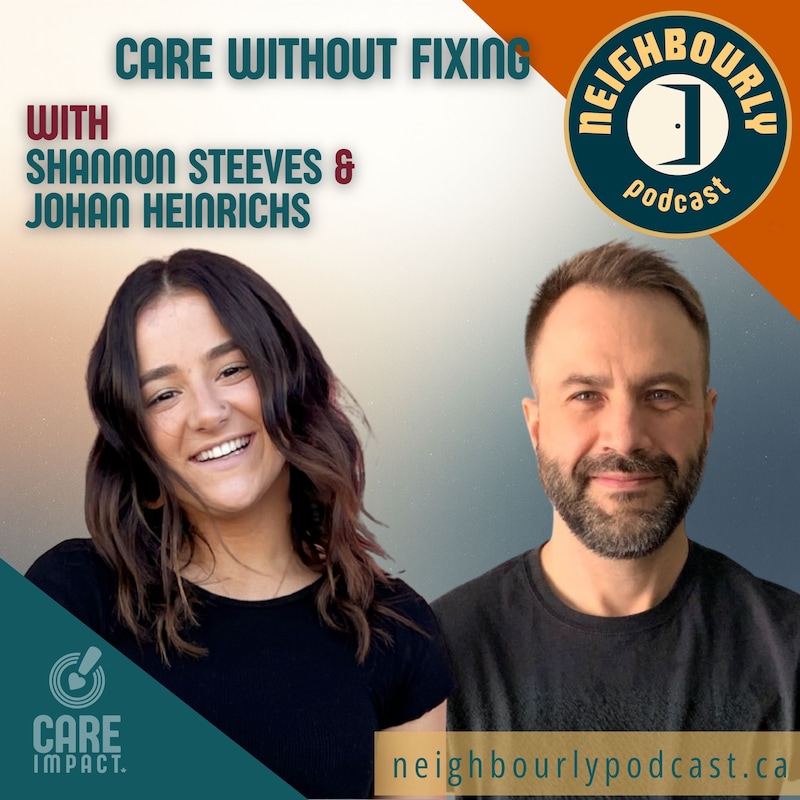
Shownotes
Partner with work of CareImpact and Neighbourly!
Description
How do you show up for someone you care about, knowing you can’t fix what hurts?
This kitchen table conversation wrestles with the urge to jump in and make things better—a reflex that can sometimes get in the way of real connection. Through honest stories and gentle reflection, Johan Heinrichs and Shannon Steeves wonder together if it’s possible that presence, not solutions, is what helps us become the kind of neighbours we long to be.
Takeaways
- Caring does not always mean fixing, presence can be the most meaningful response.
- The urge to fix often comes from discomfort with silence, pain, or lack of control.
- Listening well helps people feel seen and valued, even when nothing is resolved.
- Jesus’ response at Lazarus’ tomb shows that compassion can come before solutions.
- Silence and shared grief are not failures of care, they are forms of love.
- Being helpful is not the same as being present.
- Not every problem is yours to solve, but every person deserves to be heard.
- Practicing a pause can create space for deeper connection.
- Care becomes healthier when it flows from identity, not the need to feel useful.
- Ordinary presence can strengthen relationships and community more than advice.
Time Stamps
04:21 "Sharing God's Work Through Us"
06:41 Struggling with Networking Skills
11:36 Navigating Conflict in Relationships
13:32 "Balancing Support After Heartbreak"
19:12 "Identity Rooted in God's Truth"
20:34 "The Power of Compassionate Listening"
24:15 "Presence Over Fixing Struggles"
26:38 "Neighborly Care, Powerful Presence"
Other Links
Join The CareImpact Podcast Group on Facebook: https://www.facebook.com/share/g/1PgzJWfkq9/
Reach out to us! https://neighbourlypodcast.ca
Email: [email protected]
About the CarePortal: careimpact.ca/careportal
DONATE! Help connect and equip more churches across Canada to effectively journey well in community with the most vulnerable: careimpact.ca/donate
Transcripts
Hey, it's Johan here. Just a quick note. As a podcast guy,
Speaker:as an editor, sound is really important to me. So I wanted
Speaker:to have a bit of a disclaimer on this one that we recorded this whole
Speaker:interview with me using the wrong microphone. I was speaking into my
Speaker:podcast mic. But it was going into my camera mic. So I used
Speaker:a little bit of magic to try to make it sound much better than
Speaker:it actually was, but. Still not up to my standards. But this was a great
Speaker:interview. We couldn't delete it. We recorded the whole thing, and I. Hope you enjoy
Speaker:it. Every one of us has a story about someone who
Speaker:showed up when it mattered most. I'm Johan, and this is
Speaker:Neighbourly, a podcast about the ordinary ways people
Speaker:show extraordinary care. Every other week,
Speaker:Shannon Steeves sits down with someone who's lived that out.
Speaker:Real stories of faith, kindness, and community in
Speaker:action. So grab your coffee and let's join. Shannon at the
Speaker:table. Welcome to the Neighborly Podcast. It's Johan here,
Speaker:and I'm on with my cohort, Shannon. Hello, Shannon. Hey,
Speaker:everybody. So we're doing something a little bit different today. It's going to
Speaker:be Shannon and I kind of discussing one of the questions that we
Speaker:feel like kind of sits in the air in our episodes.
Speaker:Today's question is going to be, how do you care without trying to
Speaker:fix everything? Yeah, this question, it resonates. It
Speaker:hits a little too close to home sometimes for me.
Speaker:And as uncomfortable as it can feel sometimes, I think
Speaker:it's an important question to talk about, and I hope
Speaker:our listeners today can see that maybe in themselves and
Speaker:just walk away with some reflection from today.
Speaker:Awesome. Well, before we get into it, I think it's great when
Speaker:our listeners get to know us just a little bit. You know, you hear this
Speaker:voice, but who is this person behind the voice? They're just asking questions. We
Speaker:don't actually know who they are. So let's start with a little bit of an
Speaker:icebreaker, just to give. Give them a little bit of a glimpse into
Speaker:who we are. And, hey, if our listeners enjoy this,
Speaker:maybe we'll do a few of these episodes once in a while just to, you
Speaker:know, behind the scenes, and we can discuss these questions
Speaker:further and dive in deeper into what it means to be a good neighbor. So
Speaker:the question I had, Shannon, and feel free
Speaker:to take this conversation over because I. I don't know if we actually
Speaker:decided that I'm leading this conversation, but
Speaker:before the icebreaker, even. Shannon, how's this podcast journey
Speaker:been going for you? I mean, you're new to this. You kind of just jumped
Speaker:into it your first few episodes. Hey, I think you're doing a
Speaker:great job with your interviews, but how do you feel it's going? Well,
Speaker:thanks for the question and the encouragement because, yeah,
Speaker:you're right. It has been totally brand new. Not
Speaker:really something I ever would have. I, you know,
Speaker:could have planned to be doing. And so it's great, of course,
Speaker:having a team with you and everyone else at Care
Speaker:Impact, that is just encouraging and supportive, for sure. There's
Speaker:a lot that has surprised me about doing the podcast. You know,
Speaker:I think there's just something about when you put a microphone in front of
Speaker:somebody that naturally it can just feel
Speaker:weird for people. And learning how to
Speaker:have conversations that feel natural but without,
Speaker:you know, letting the kind of. I think some of the fear of, oh, this
Speaker:is being recorded and it's going out into the world, that's
Speaker:been something that. The challenge of that, I think, has surprised me a little
Speaker:bit because I think the conversations that we're having are
Speaker:important and should be shared. And the people that
Speaker:I ask to come on, or that, you know, people on our team ask to
Speaker:come on, have so much meaningful wisdom
Speaker:and thoughts that are important to put out in the world.
Speaker:And I want people to feel as comfortable as possible, but
Speaker:I know sometimes you just have to kind of jump into the deep end and
Speaker:go for it. So that's been surprising, but a fun
Speaker:challenge and journey to be going on with, with this
Speaker:project for me, and. I know it's even challenging
Speaker:for some people that you want to interview to convince them to come on the
Speaker:podcast. I know that's been my experience. Yeah, it's really not
Speaker:that bad. It's exactly. Come on, let's have a
Speaker:conversation. If you're listening to this podcast and I have asked
Speaker:you, or, you know, you have a little nudge
Speaker:maybe from the Holy Spirit that you have something to share, can I just
Speaker:encourage you that you. You likely have
Speaker:something to share that other people need to hear. And I've probably
Speaker:said that before, but it's something that I believe, and I
Speaker:think God does work in our lives
Speaker:in and through us, in order to glorify him
Speaker:and make his name known. And so the things that he
Speaker:uses us for, I don't think that's supposed to stop with us and just keep
Speaker:that to ourselves. And so it's not prideful to come on and
Speaker:share the ways that you care about other people. It's biblical,
Speaker:and I just want that to be an encouragement to People that
Speaker:this is a space to bring glory to God by sharing how
Speaker:he's working in and through us. And Shannon's not so
Speaker:scary, so I hope not, if that's your hesitation. Well,
Speaker:she's like a kitty cat. So good. Oh, no, I don't like
Speaker:cats. Okay. I'm a dog. I'm a Labrador
Speaker:retriever. There, we already learned something new about you. You don't like cats.
Speaker:I don't. I'm a dog person. How about this question for an icebreaker? What's
Speaker:something that you've learned about yourself this last year? We're coming into New Year.
Speaker:Something that you learned about yourself last year that surprised you? Yeah,
Speaker:I sat with this question ahead of time for a long time,
Speaker:and I was like, man, I feel like there's a lot that has
Speaker:surprised me this year. 2025 was a lot of
Speaker:growth and learning for me. And I think one of those big
Speaker:things is that I am not quite
Speaker:as adaptable as I thought I was or as I want to
Speaker:be. I want to be someone who's so super, just
Speaker:go with the flow and can kind of roll with anything.
Speaker:And I've learned that that doesn't come as naturally
Speaker:to me. I think I like the consistency of,
Speaker:you know, things. And I think if I'm being honest, it's probably
Speaker:me trying to maintain control and so, you know,
Speaker:learning to actually surrender that and, like, let the Lord
Speaker:guide my life. So I'm working on it. But what about you,
Speaker:Johan? I'm curious for you. What's something you've learned about yourself
Speaker:that surprised you this year? I don't like being bad at things.
Speaker:So I, I, I have to think about this one, too.
Speaker:It doesn't mean I'm not bad at things. I just don't like being bad at
Speaker:things. But I'm realizing that I'm not a great networker.
Speaker:Like, especially in person, when there's like a crowd that's more than
Speaker:eight people, I kind of get lost a little bit. I don't know if it's
Speaker:introvertedness or what, but I'm not the kind of person that can just
Speaker:go up to a group and start chatting away and finding out about the
Speaker:lives. But it's great one on one. Like, I love small groups. I could do
Speaker:that all day long. But, yeah, realizing I'm not a great networker, which,
Speaker:which is difficult when you're working with a charity and you're
Speaker:trying to raise funds for your charity and support
Speaker:for your charity. Right. You gotta be a good networker. So. Something I'm working
Speaker:on. Yeah, It's a skill. It's a muscle to grow.
Speaker:And I. I'm with you. It's not my favorite thing
Speaker:either. I. I find I just force myself in
Speaker:those situations, and it's hard. But you're doing great.
Speaker:It's weird. Like, if someone asked me to speak in front of a crowd, I
Speaker:could do that, too. And I can lead worship in front of
Speaker:a thousand people without any trouble, but ask me to have a
Speaker:conversation. Nope. Sorry. That's okay. We have our
Speaker:strengths. So, Shannon, you want to get us back into our
Speaker:conversation? The question that we started this podcast out with, one we're
Speaker:going to wrestle with today. Yeah. So today we are talking about
Speaker:how do we care about. Care for each other, care for community,
Speaker:but without trying to fix everything. So we are
Speaker:going to reflect on that a little bit. Johan, what are you. What thoughts come
Speaker:to mind for you with that question? Well, this one's hard for me. I
Speaker:don't know if it's inherently. Because I'm male. We tend
Speaker:to do this where we like to fix things, so we
Speaker:automatically go to problem solving mode. How do we
Speaker:fix this problem? Especially in marriage. That's the first example
Speaker:that comes up. And I love researching. I optimize. I
Speaker:like to make things work more efficiently and better, so that's always where my mind
Speaker:goes first. So this is one that I really struggle with. And
Speaker:I don't like leaving things unresolved and in the air. That
Speaker:drives me bananas. Yeah. What about you?
Speaker:I struggle with this, too. And I think for me,
Speaker:it's. I think it's because for me, fixing
Speaker:feels like it's loving. Like it feels like I
Speaker:am doing something. And I don't. I really don't like
Speaker:other people being in pain. Like, it deeply just
Speaker:unsettles me. And so my first instinct, if someone
Speaker:is, you know, going through something, it's like, okay, how do I make this better?
Speaker:How do I help? How do I. How do I fix this?
Speaker:Yeah, I don't. I don't know where else it comes from besides that, but
Speaker:I think, yeah, on the surface, it's like, I. I don't want someone
Speaker:struggling, and so how can I help change their
Speaker:circumstances? Do you think sometimes, though, when people
Speaker:come to you expressing their challenge,
Speaker:what do you automatically think? Do you think they're coming to you for advice, or
Speaker:is it for presence? Because I think it depends on the way we think. If
Speaker:people come to us with a problem, I think they want me to fix it
Speaker:for Them. I don't automatically go to presence, so I think
Speaker:it's maybe just our default. I don't know. Yeah, no, I think
Speaker:you're spot on. I think people really want to be seen and
Speaker:heard, and that really is
Speaker:oftentimes, I think what they're looking for and
Speaker:just need someone to listen. I think in all of our
Speaker:episodes so far, we've talked a lot about listening
Speaker:and episodes this season, I should say. And,
Speaker:yeah, that comes up again and again. Just people wanting to
Speaker:be hurt. Will someone listen to my story? Will someone listen to
Speaker:what I'm navigating? And so much happens in that space
Speaker:without even trying to solve it or fix what they're going through.
Speaker:And you're right when you say fixing often feels like care.
Speaker:Yeah, because we want to help people. Right. We want to build
Speaker:stronger community. And sometimes sitting with
Speaker:silence can feel awkward. That's sometimes hard just to
Speaker:listen. Especially like for me, if it's a
Speaker:situation that I know I have gifting in and can solve,
Speaker:that's the hardest to not jump in and say, I could fix that for you.
Speaker:But sometimes I just want to listen. Can you think of any
Speaker:specific moments, maybe where this was
Speaker:a situation in your life? Oh, yeah. And you mentioned this a little
Speaker:bit earlier, but I see it a lot in marriage. And
Speaker:I'm. I'm pretty. Pretty young in my marriage where we just
Speaker:had. I think we're around a year and a half of marriage. And so
Speaker:definitely by no means do we have lots of experience or
Speaker:knowledge. But, you know, you see when. When two people come together,
Speaker:you see kind of some of those different friction points. And so I was processing
Speaker:this with my husband before today, and
Speaker:this comes up a lot, I would say, in when we're navigating
Speaker:conflict. So if we're working through some type of
Speaker:challenge or whatever. The issue is I don't like
Speaker:the feeling of tension and I don't really like
Speaker:conflict to begin with. And so my instinct is like, okay,
Speaker:let's just figure out what needs to be done.
Speaker:I'm going to apologize, and then I'm going to do this, this and this
Speaker:and just come up with next steps. Whereas
Speaker:if he's coming to me with, you know, expressing something that
Speaker:I did that, you know, was unkind or whatever,
Speaker:oftentimes he wants me to listen
Speaker:and just wants me to. To be there and
Speaker:not just jump to, okay, here's what I'm gonna do differently next time. Like, we'll
Speaker:get to that. But I. I just might. My
Speaker:instinct is to just get to, okay, let's problem solve and get past
Speaker:this so that I don't have to really sit in that. The kind of
Speaker:uncomfortability of the tension. Are you more the
Speaker:fixer than your husband, would you say? I
Speaker:think we both have the different tendencies where he will at
Speaker:times, but I think it tends to be
Speaker:my kind of gut reaction is to first go to
Speaker:fixing. Whereas I think him, it's more natural
Speaker:to pause. So I'm learning a lot from that. Of
Speaker:course, he has pastoral experience, so he's used to that pause. Right. So
Speaker:yeah, he's really good at listening and just sitting with
Speaker:people. And I again, I want to be that way,
Speaker:but I just jumped to what can I do first?
Speaker:What about you, Johan? How have you seen this show up in
Speaker:your life? It's hard for me to think of an example except for something that
Speaker:happened recently. I'm not going to mention who it was specifically, but a
Speaker:close, younger family member just went through some heartbreak
Speaker:and just trying to navigate that. It's like I could give you a list
Speaker:of ways to help you to move on and think about your future,
Speaker:but then you got to balance. I'm so sorry that happened to you. I'm
Speaker:sorry you need to sit with that grief for a while, but time's probably going
Speaker:to heal the wound sort of thing. It's hard to really strike that
Speaker:balance, especially when it's someone that you care about because you don't
Speaker:want to see them go through the herd and through the challenge and the
Speaker:uncomfortableness. You want to see them happy. So
Speaker:here's. Here's a way to make you a little bit happier when that often does
Speaker:the opposite, where they just need someone to listen, they need someone to love them,
Speaker:they need someone to sit with them with presence. Yeah, I think
Speaker:that is so relatable, Johan. And it really takes
Speaker:us into the scripture that we want to. To dive into a little bit
Speaker:today. And we're gonna hop into John,
Speaker:chapter 11. This passage really just. Just helps us
Speaker:to slow down. Do you want to read that or would you like me to?
Speaker:Sure, I'll pull it out here. Yep. Verse 32.
Speaker:And this is the passage about Lazarus.
Speaker:After he died, when Mary arrived and saw Jesus,
Speaker:she fell at his feet and said, lord, if only you had been there,
Speaker:my brother would not have died. And when Jesus saw her weeping
Speaker:and saw the other people wailing with her, a deep anger welled up within
Speaker:him and he was deeply troubled. Where have you put him? He
Speaker:asked. And they told him, lord, come and See,
Speaker:then Jesus wept. The people who were standing nearby
Speaker:said, see how much he loved him. Okay,
Speaker:so here we are sitting with
Speaker:Mary, kind of complaining, jesus, if you had been here,
Speaker:my brother would not have died. Now, this is funny
Speaker:because earlier in the passage, I'm pretty sure
Speaker:Martha said the exact same thing. And they said they said it to
Speaker:him separately. So obviously they were discussing this together. Complaining about
Speaker:Jesus meant, why wasn't he here? Our
Speaker:brother would have survived. So, like this complaining in the
Speaker:background, behind the scenes, but then they're bringing it right to Jesus.
Speaker:And the funny thing is, Jesus knows how this story ends,
Speaker:right? He can solve the problem, and he's going to.
Speaker:He's not going to tell them he's going to yet, but he still weeps.
Speaker:So he has a solution. He knows how it ends, and he still
Speaker:weeps. And he lets them wrestle with the question, and he
Speaker:lets them mourn and complain to him. So,
Speaker:like, why does he do this? Why didn't he just solve the
Speaker:problem and avoid the complaining and avoid the
Speaker:weeping and sitting with the feelings? Why do you think this, Shannon?
Speaker:Yeah, man, when I get to heaven, I'm going to ask him
Speaker:for sure. But, man, I think
Speaker:we see that to Jesus what was important
Speaker:first was to see people and to
Speaker:acknowledge where they were at and meet them there. And we
Speaker:see that by his presence that he didn't jump
Speaker:to fixing. He got to that later. But what was more
Speaker:urgent than that was just being with his people
Speaker:and weeping. I think that teaches us a
Speaker:lot that what's important isn't actually what
Speaker:we're going to do to address the issue or the problem,
Speaker:but how we sit with people first
Speaker:and allow those feelings to come up and allow
Speaker:healing to come through just grieving together.
Speaker:That's so good, what you said. Basically, fixing wasn't
Speaker:urgent to Jesus at that time, but presence was. And
Speaker:sitting with the pain and the struggles that they had
Speaker:and letting them air that out and just listening
Speaker:and greeting with them at the same time. Like, he. He wasn't just
Speaker:smiling, knowing that he had an answer, but he actually sat to grieve with him.
Speaker:He wept. Yeah, no, that's so good. And I.
Speaker:I think the struggle in this for us
Speaker:as humans is that we don't feel like presence is enough.
Speaker:We feel like just sitting and pausing for a
Speaker:moment doesn't actually do anything.
Speaker:And I think this is, for me, where it really, like, kind
Speaker:of gets to the core of why my first instinct
Speaker:is to. Is to do something is because I
Speaker:consciously or subconsciously I kind of want to be the hero.
Speaker:I want to be the one who helps someone go from, you
Speaker:know, sorrow to joy. And that's not my
Speaker:place. That's a space only Jesus
Speaker:can fill and a need that only he can meet.
Speaker:And so when we try to step into that, it's just not the
Speaker:same. I think it's that need to be or feel
Speaker:useful. Right. Because if you don't have an answer, it's like, well,
Speaker:I'm kind of inadequate for what you need right now.
Speaker:And that's the thing. Like he says, in your weakness, I am strong. So
Speaker:it's actually an opportunity for the Holy Spirit to move at least space
Speaker:for him to move and get the glory rather than us fixing it, but just
Speaker:sitting in that weakness. You know what? I don't have answers, but I have presence
Speaker:and I have the Holy Spirit as a presence
Speaker:within me. And if I could sit with you with that, maybe he can fill
Speaker:that gap. Right. That's a. I think it's something
Speaker:that God has been speaking to me personally in a lot of areas of my
Speaker:life is ultimately, where do I find
Speaker:my identity? Do I find my identity and my self worth even
Speaker:in the things that I'm doing and the
Speaker:experience or feelings I'm helping create for other people?
Speaker:Or am I finding it solely in who
Speaker:God says I am as his child? And
Speaker:I think when our care and our compassion comes
Speaker:from that place, it goes much deeper
Speaker:than maybe coming from a place of, is insecurity
Speaker:really of like, oh, I want to feel useful, I want to be the hero.
Speaker:Because if I'm not, then what am I? And
Speaker:flipping that to say, I am rested in my
Speaker:identity as a child of God and I'm going to be here with you
Speaker:and we're going to seek him together and we're going to seek his will for
Speaker:your life. Approaching it from that perspective is
Speaker:so much more valuable. That's so good. He says
Speaker:presence can make you a better neighbor. That's. Yeah, it's
Speaker:quite profound. Yeah. Let's go to the other side of things. What about a
Speaker:time when someone stayed with you without fixing where they
Speaker:didn't expect you to be the fixer? Can you think of any examples
Speaker:of that? Yeah, I, I think of some
Speaker:examples, but I, I really think about specific people in my life that I've
Speaker:noticed are really good at this. I have one friend that came to
Speaker:mind right away who, she's also
Speaker:a trained therapist. And so I think some of that
Speaker:she's really like honed in on her skills and her giftings. But
Speaker:she is, I think, just naturally, she's so good at asking
Speaker:questions that make people feel seen. There was a time a few months
Speaker:back where I was just sharing with her something I was going through,
Speaker:and she just responded
Speaker:with compassion and acknowledging what I was
Speaker:feeling and asking questions about just
Speaker:how that experience has been, and then pointing me to the Lord
Speaker:and just acknowledging like, God is with you in that.
Speaker:And that made me feel so cared for. She might
Speaker:even be someone who probably would have some great wisdom and some great
Speaker:suggestions on how to navigate what I was going through, given her
Speaker:professional experience. But she didn't. She just sat with me
Speaker:in that, and that was really, really meaningful.
Speaker:What about for you? Yeah, similar to me, I have an older friend
Speaker:that I see at church pretty much every week, and we
Speaker:have a conversation pretty much every week. And it's just him checking in.
Speaker:And I check in with him, too, and he just sits there
Speaker:and listens. I often have things come up in my life that
Speaker:I'm struggling with, situations that are challenging,
Speaker:stressful. And he doesn't solve things. He just
Speaker:sits there and he wrestles with me. There's empathy, but I feel
Speaker:heard, right? And that's enough for me to go home feeling
Speaker:confident that I was heard. And I can wrestle with it with the Lord, knowing
Speaker:that there's someone in my corner. And then also
Speaker:there's, you know, those times where
Speaker:it was the opposite, where maybe someone gave advice that was
Speaker:painful to us or hard. And I was thinking about
Speaker:this where I think I actually have not had a lot of these
Speaker:experiences, thankfully. But I can think of moments where I
Speaker:did that, where I, you know, gave advice or just
Speaker:responded in a way that wasn't. Wasn't presence.
Speaker:I remember a while back, I was probably a teenager, a young
Speaker:teenager, someone I love, lost a family
Speaker:member. And my response,
Speaker:looking back, oh, I wish I could take those words back. And
Speaker:some of it, I know I was young, so there's naivety there. But I
Speaker:responded with, well, you know, they were really sick
Speaker:for a long time and now they're not, type of
Speaker:thing. And it's like, okay, that's true. But
Speaker:basically how the person responded was like, well, okay,
Speaker:but just because they were sick doesn't make it any easier that they're
Speaker:gone now. And I just. That stuck with me for
Speaker:a long time. And I pray that I haven't
Speaker:responded any similar way since then. But really what
Speaker:that person needed was for me to just say, yeah, it's really hard.
Speaker:And we're in it together. Yeah. I think there's
Speaker:a reason why Scripture says he mourns with those who mourn
Speaker:rather than he fixes those who mourn. Right. There's something to that where
Speaker:people just need that presence. They need someone to feel that empathy and sit
Speaker:with it, which is the example we just saw there in.
Speaker:In the Lazarus story. So I think we need our listeners to
Speaker:wrestle with this themselves rather than us coming up with
Speaker:answers. Because, again, this isn't about having answers.
Speaker:This is about shared wrestle, things that we
Speaker:as neighbors wrestle with. So how do we care without
Speaker:fixing? That's something I think we all need to wrestle with in our own circles,
Speaker:because we all have different personalities. We all have different responses to
Speaker:people's struggles. But know that presence matters.
Speaker:We gotta ask ourselves, why does silence feel so uncomfortable to us?
Speaker:Or do we fix because we care? Or because we
Speaker:need that control, which I know you mentioned earlier, is that need for
Speaker:control? And who taught us to feel that usefulness
Speaker:equals love rather than presence? So I don't have
Speaker:answers to these questions, but we can sit with them. Yeah.
Speaker:And I think there's some practices that we can leave with listeners today
Speaker:that help us in navigating those
Speaker:questions. So a few things I'd love listeners
Speaker:to think about this week is notice when you feel the urge
Speaker:to fix. And I have an aunt
Speaker:that always says, practice the pause. And I'm like, that's great advice.
Speaker:And so when you notice that urge, practice the pause and
Speaker:try presence. Just try being there.
Speaker:Whether it is quiet and you are just sitting with somebody,
Speaker:or you just give some encouraging words
Speaker:to say, I'm here for you. Things like that
Speaker:sounds really heavy. Or I'm really glad you told me. Those are
Speaker:some great language you can use to just be with
Speaker:somebody and just allow
Speaker:the Holy Spirit to use you in that moment. You don't have to have all
Speaker:the answers. You won't have all the answers, and I promise you that.
Speaker:Especially when it's, you know, some deep hurts that
Speaker:we're not meant to come in and solve and
Speaker:fill the deep needs that people have. There's only one who can
Speaker:do that. So just allow yourself to
Speaker:just be there and be a friend. That's so good. This was an
Speaker:encouraging and provoking conversation for me, Shannon, and I
Speaker:hope it was for our listeners, too. So, listeners, if you
Speaker:found this encouraging, let us know. If you want us to have more of these
Speaker:conversations, that would be helpful, because feedback.
Speaker:We don't want to fix this podcast, but we want to sit with you guys
Speaker:in presence and in a more meaningful way.
Speaker:So bye. The stories we share
Speaker:here remind us that CARE doesn't have to be perfect to be
Speaker:powerful, it just has to be present. Neighbourly
Speaker:is an initiative of Care Impact, a Canadian charity equipping
Speaker:churches, agencies and communities with tech and training to
Speaker:care better together. Visit CareImpact CA
Speaker:or to find out more about the podcast sponsorships, being a guest
Speaker:or just dropping us a line, visit NeighborlyPodcast CA.
Speaker:We'd love to hear from you. Check the show notes for the link or
Speaker:hop on our Care Impact Podcast group on Facebook to join our
Speaker:podcast community. I'm Johan. Thanks for listening
Speaker:and keep being the kind of neighbor someone will never forget in
Speaker:a good way.
Speaker:Tearing down walls of building
Speaker:up the bridges between the stones
Speaker:Love is turning over tables
Speaker:Breaking off chains When I see you
Speaker:in a stranger I'm no longer a
Speaker:stable table
Speaker:Tearing out walls Building
Speaker:under bridges between us.






