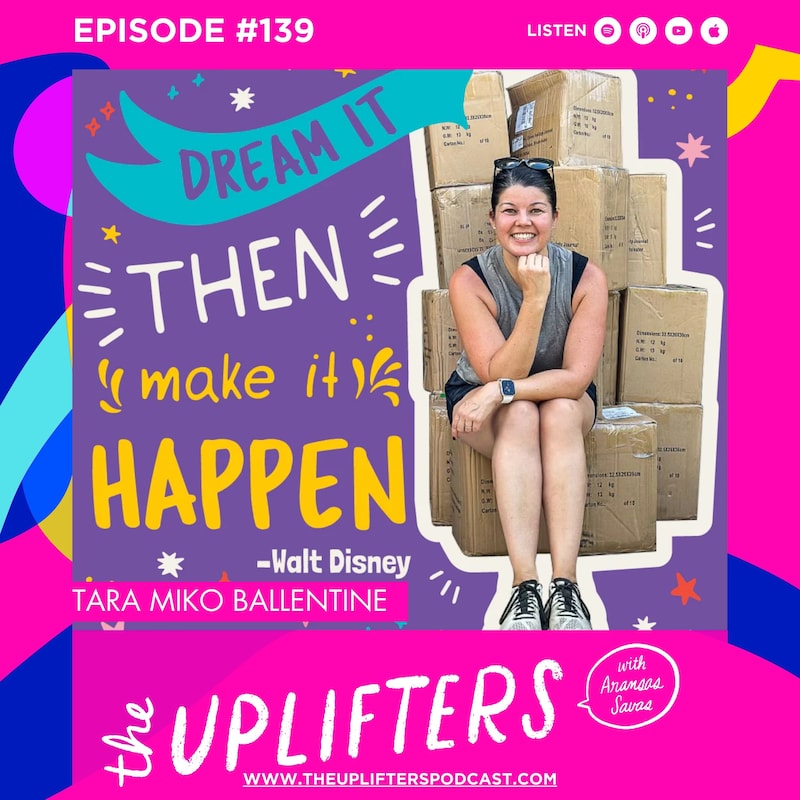
Shownotes
Starting over during perimenopause and midlife doesn't always mean changing careers—sometimes it means creating entirely new solutions the world desperately needs. In this episode, meet Tara Miko Ballentine, founder of Bright Littles, who transformed her experience of childhood sexual assault into a company helping parents have crucial conversations with kids about consent, boundaries, safety, and diversity.
For women over 40 navigating midlife reinvention, Tara's story offers powerful proof that your second act can combine personal healing with public purpose. She launched Bright Littles during the pandemic while parenting full-time, and four years later continues building without breaking even—side hustling, pivoting constantly, and facing the unique challenges female founders encounter when seeking funding.
This conversation offers practical wisdom for midlife women pursuing dreams that matter: how to start before you feel ready, how to find courage capital when everyone questions your path, and how to build something meaningful while managing all the other responsibilities of life after 40.
What You'll Learn:
- How to change careers after 40 with purpose — Tara shares her journey from fashion and marketing to founding an education company, proving midlife career pivots can create entirely new industries
- Starting over during menopause with limited resources — Learn how to launch a business while working full-time, parenting, and navigating the financial realities of midlife entrepreneurship
- Building confidence after 40 as a female founder — Discover strategies for persisting when funding goes to men with ideas while women with products face barriers
- Perimenopause motivation for women entrepreneurs — How to maintain your North Star mission when the journey tests every ounce of your resolve
- Women over 40 starting businesses — Practical wisdom about pivoting, learning new skills (even tech!), and building sustainable side hustles
- Midlife transformation through purpose — How personal pain can fuel public mission when you're ready to turn wounds into wisdom
- Second act career success stories — Real talk about what four years of building looks like without breaking even, and why mission sometimes matters more than metrics
Key Timestamps:
0:00 - Introduction
2:15 - The pandemic moment that sparked Bright Littles
6:30 - Crossing personal and business life for the first time
10:00 - The "am I ready?" questions every founder asks
13:00 - Why 95% of childhood sexual abuse is preventable
18:15 - How to start conversations before problems happen
22:00 - Pivoting from physical products to digital during tariffs
26:00 - The "Periods and Polish" event and online backlash
31:00 - How to support Bright Littles' mission
Key Takeaways:
- For midlife career changers: Start with what you know, then pivot as you learn—Tara began with fashion/product experience and adapted everything as she discovered publishing, retail, and subscription models
- For women over 40 seeking purpose: Your personal experience isn't a liability; it's your competitive advantage. Tara's childhood trauma became her deepest source of mission clarity
- For perimenopause entrepreneurs: Side hustling is sustainable—Tara worked as a CMO while building Bright Littles, still consults for income, and has built something meaningful without traditional funding
Featured Quote:
"I feel so passionate about what I am doing. I think most people probably would've quit. I've not financially broke even in four years. That is not for everybody. But I feel like when I started this company, it was more of a vitamin than a painkiller—I'm asking you to do something before there's a problem." — Tara Miko Ballentine
Resources & Links:
- Bright Littles: brightlittles.com
- Free conversation resources available on website
- Nominated by: Christina Testut (Episode on body image and children's literature
- Tara nominates: Christine Godfrey of Godfrey PR
About Tara Miko Ballentine:
Tara Miko Ballentine is a serial entrepreneur and founder/CEO of Bright Littles, an education company helping families have important conversations about diversity, safety, consent, boundaries, and health. A survivor of childhood sexual assault, Tara transformed her personal experience into a mission preparing children before problems happen rather than addressing trauma after the fact. She partnered with a structural educational engineer and PhD in family therapy to create conversation cards, interactive journals, and a digital Conversation Club serving families nationwide. Tara lives with her daughter and continues building Bright Littles while navigating the challenges of female entrepreneurship, including pivoting to entirely digital offerings in response to tariffs.
About Your Host:
Aransas Savas is a wellbeing and leadership coach specializing in helping women over 40 navigate midlife transitions, career changes, and second-act reinvention. With 20+ years of behavioral research experience partnering with companies like Disney, Weight Watchers, and Best Buy, she hosts The Uplifters Podcast, featuring women doing transformative work in the second half of their lives. Aransas brings both research rigor and personal experience to conversations about courage capital, midlife transformation, and building meaningful second acts.
Connect with Aransas:
- Instagram: @aransas_savas
- Podcast Instagram: @the_uplifters_podcast
- TikTok: @theuplifterspodcast
- Facebook: Aransas Savas
- Website: theuplifterspodcast.com
- YouTube: @theuplifterspodcast
- LinkedIn: Aransas Savas
Keywords:
perimenopause career change, women over 40, midlife reinvention, menopause second act, starting over at 40, women changing careers 40s, midlife transition women, second half of life, courage capital, midlife transformation, women entrepreneurs over 40, female founders midlife, perimenopause motivation, starting business during menopause, midlife purpose women, second act career women, women 40s new career, building confidence after 40, midlife dreams women, perimenopause fresh start
Transcripts
TUP EP 139
Aransas Savas: [00:00:00] Hey Uplifters. I wanna take a minute to talk about something personal to me. In my forties, I started noticing my hair was shedding more so a couple of months ago I [00:00:15] started using Nutrafol. I'm already seeing so much less shedding and my teenage daughter who notices absolutely everything keeps commenting on how thick my hair looks.
As someone who's built my career around [00:00:30] rigorous science, I super love that Nutrafol was the first brand to clinically study hair thinning on menopausal women, which is why I am so proud to have them as a sponsor. Nutrafol takes a whole body approach to [00:00:45] hair health supporting you throughout your life stages.
You can see thicker, stronger, faster growing hair with less shedding in just three to six months. For a limited time. Nutrafol is offering our listeners. $10 off your first month [00:01:00] subscription and free shipping when you go to Nutrafol.com and enter the promo code uplifters. Welcome to the Uplifters podcast.
Every week I get to talk to inspiring women in the second half of their lives. We're doing big, [00:01:15] brave things and through their honest stories and showing and sharing their fears. They teach us all how we can do big, brave things too. Today I am super excited to talk to Tara Miko Valentine, the founder [00:01:30] and CEO of Bright Littles.
You'll hear in this conversation both how she integrates this into the rest of her life and the other things that matter to her, and [00:01:45] how she keeps doing scary stuff like. Looking for funding to grow and expand the impact of her big, brave dream. Tara, thank you so much for taking [00:02:00] time to hang out with us today.
Thank you for having me. I'm excited. So take us back to the moment that you were like, I see this need in the world and I'm gonna do something about it.
Tara Miko Ballentine: So [00:02:15] for me, that aha moment, I guess, was during the pandemic, as many parents were faced with having to tackle everything at once. So I was the teacher, the doctor, the parent, the playmate, because we don't have family nearby.
[00:02:30] It was just us and I only have one. So we were just this like little teeny tiny island of three and. A lot was starting to happen in the world, and for me, there was this moment of realizing that I had grown up in [00:02:45] an environment where I had been protected, thus leaving me not prepared for the world. And I wanted to change that by preparing my daughter so she could protect herself when she goes out into [00:03:00] the world.
But we have these conversations later in life and the product that I was trying to find, 'cause I wasn't trying to start a company, it was, you know, my child has had this happen, been bullied or, and [00:03:15] it just seemed like after the fact and I was like, well, what if we actually started having these conversations a lot earlier and preparing them, because like, let's be honest, like a hundred percent of kids are gonna get bullied at some point in their life.[00:03:30]
We're not trying to stop the bullying, I wish, but that, that's gonna happen. And so instead of addressing it after the fact, what if I prepared my daughter so that when it happens, it doesn't become hopefully this like [00:03:45] core changing moment of her life, of her personality versus. Kind of like water off a duck's back, like you think that of me.
But I don't think that because I've prepared her to protect herself in that situation. So when [00:04:00] I couldn't find tools, and I feel like the world has changed the way that we're trying to parent, we know better. So let's do better. But where are the tools to do that? So I wanted to move away from the talking about the problem to actually [00:04:15] like a tangible product.
Do the work. And so I am just crazy enough that I thought and did
Aransas Savas: do it. Wow. And [00:04:30] like as you had this realization, this thing that I really need and I think a lot of other parents need, and I wish I had had it, and I'm super glad that you're making it. Think about my own. Parenting journey. My daughter's now are later teens.
I have [00:04:45] a 14-year-old and a newly minted 17-year-old. And the most important thing I can do with my kids is create mutual trust. And I think that happens in all relationships. Yeah. Through communication. And so a super [00:05:00] love what you're doing to make it easier for us to feel like we have the support and resources we need in order to develop mutual trust.
But had you started a company before.
Tara Miko Ballentine: Yes, so I'm a little bit of a serial entrepreneur. I get [00:05:15] really excited about starting companies. I love solving problems. Like I really enjoy that. And if it wasn't a company that I've started, I've typically found work in startup situations. So I just like the [00:05:30] excitement of that.
Aransas Savas: Hmm.
Tara Miko Ballentine: However, this is the very first time that it was a crossing of my personal life and my business life. And it feels different. It looks different. It's the first time I've [00:05:45] had my life so intertwined together because I'm parenting at the exact same time. So it's, yeah, it's like massive and I feel a, a huge responsibility and [00:06:00] I take it very serious.
And I also have fun. You know, it makes me a better mom by doing this conversations that I've tackled with her. I just could not even imagine. They were things that like I never [00:06:15] learned, like, you know, it was really later in life and so there's been some healing of my little girl self, if you will, because I'm realizing as she's growing, as we are growing together, just feeling like I [00:06:30] can't go back and change things for me, but like.
Damn. That was a good mom moment today, like celebrating it and realizing that I am changing, if you will, like this generation, like the book stopped with me, that [00:06:45] I was gonna do things different with her.
Aransas Savas: I love that. I think though, for any founder, anyone who's building any dream, there are always. Am I ready conversations in their own mind and whether [00:07:00] it's, do I have enough resources, money, time, energy?
Yep. Do I know the right people? Am I smart enough? What were some of those questions for you? I
Tara Miko Ballentine: mean,
Aransas Savas: I still ask myself those questions to be honest. Amen. Same girl. Thank you for admitting it. That
Tara Miko Ballentine: is [00:07:15] like the entrepreneurial journey of like, I'm amazing
Aransas Savas: what the, but nobody says that. We're like all walking around with these spheres and so people then believe like.
Tara, she is just brave and bold. I'm, but not me.
Tara Miko Ballentine: [00:07:30] I'm, and I am failing and I'm losing money, and I'm scared as shit. And I actually, you know, am treading water. You know, I think that, you know, I am kind of an iceberg, you know, and or like a duck, like I'm [00:07:45] paddling furiously under the water. So some of the big things for me is that.
I've had experience in product company and in service company, so there was a part of that that I'd been there and I'd come kind of mainly from fashion. Actually. This is [00:08:00] product isn't, product is a product, and so I was a little bit more in the luxury market, so going from quality to selling quantity was very different.
I had to learn how to print books. I tried [00:08:15] to print in the US realized that that was not possible to compete with publishing, trying to figure out what publishing looks like. How do I, long story short, I ended up publishing on my own, not realizing [00:08:30] that most bookstores won't carry me. So most of my most obvious places that would retail the product won't because I'm not in publishing.
'cause publishing has deals. And they can like return books and it's a [00:08:45] distribution system that like, I actually didn't realize that so many things, there's not one way to start a company. And now if I look back, like there was 55 million ways I went with the thing that I, I knew the most, which [00:09:00] was going to markets and having a booth and trying to sell to store.
So I started with what I knew. And from there I've pivoted 55 million zillion times. The company looks nothing like how I started. I [00:09:15] had saved some money and you know, I basically cashed in what I have. I don't have any funding and I kept, I've kept a job. I kept a full-time job. I was a CMO of a interior design company for a while and would side [00:09:30] hustle and work weekends and have booths.
And I took the leap about a year and a half ago to do this full time, but I still side hustle. I sent out a scope of work yesterday to do marketing consulting. I'm still trying to make it. I am, and I've been doing this [00:09:45] for four years.
Aransas Savas: Yeah. I love that you said that. I don't think any of us entered this highway totally knowing where we were going.
So part of what I'm.[00:10:00]
So much of success for so many of us is actually measured in agility and the willingness to keep following the breadcrumbs.
Tara Miko Ballentine: Yeah. Well, for me, my North Star is this [00:10:15] is such an important time in our world to have these conversations and you know, I think the thing about being an entrepreneur is you believe in your product and you believe in your company, and hopefully you believe in yourself.
For a long time before [00:10:30] anybody else does, and that is a really hard thing to do because for most entrepreneurs, we don't have a lot of money. We can't have a big staff, and so. It is a very lonely [00:10:45] place to survive. Yeah, and I think that there's a lot of mental health issues that can come with being an entrepreneur, especially if you are an entrepreneur that is social justice and [00:11:00] trying to put out good in the world.
Because I have to take in the bad to create the products that we do and to push out Good. I wish more entrepreneurs would talk about the mental health aspect of being an entrepreneur, especially as a [00:11:15] female. Mm-hmm. I cannot tell you how many rooms I've been in where I. A male has had an idea and received funding, whereas a female has a company, a tangible product, but I lack the traction [00:11:30] of it.
Mm-hmm. But I need the money to get the traction. Like it, it just drives me bat shit crazy. But for better or for worse, and it's depending on the day, the minute or the hour, I am so fricking [00:11:45] headstrong that I. Feel so passionate about what I am doing. I think most people probably would've quit PS I've not financially broke even in four [00:12:00] years.
That is not for everybody. So I've side hustled the shit out of this, but I feel like when I started this company, it was more of a vitamin than a painkiller. A friend of mine gave me this enough. Mm. So I get, there's a lot of books out there for [00:12:15] my child has been bullied because you're focusing on that problem.
You wanna fix that problem. You're looking for the painkiller, I'm the vitamin, I'm saying. I don't know when it's gonna happen. Like I'm pretty sure it's gonna happen, but why [00:12:30] wouldn't you do it? I'm a vitamin. I'm asking you to do something before there's a problem. And potentially you do not see the power of that little conversation that you had until much later [00:12:45] in life or potentially ever.
I mean, one of my north stars is 95% of sexual abuse in children. 95% is preventable with the conversation [00:13:00] about awareness and education because most sexual abuse doesn't start with the act of it. There's grooming and there's touching, and there's let's secrets, and so. That's pretty strong. And when you talk about [00:13:15] 95%, you know, I'm of that 95% and I was five, six years old when I was sexually assaulted.
And those are the things that like, I now know if I would've had a conversation, [00:13:30] could I have used my voice more? Could I have said something like, 'cause when I think back, you know. It was a family friend. It started very gradually in becoming my friend and trusting so. That being said, [00:13:45] there's all kinds of conversations to have right now.
Mm-hmm. There's consent, there's boundaries, there's online safety. One of our conversations this month is what if a, a friend wants to show us something inappropriate online.
Aransas Savas: Mm-hmm.
Tara Miko Ballentine: Different families have different rules. We're talking a lot [00:14:00] about democracy. Like there's so many conversations that are so important to have with our kids.
And the last thing I'll say is our kids are a sponge. Mm-hmm. And if we're waiting till after the fact. Somebody else has filled that sponge with water. There's only so [00:14:15] mm-hmm. Water you can put in a sponge. There's only so much information. Well, I want to be that drop of water to talk to her about those things, because if I wait to do it, the information that I try to give her is gonna [00:14:30] roll off.
Aransas Savas: Mm-hmm.
Tara Miko Ballentine: The internet has filter sponge, her friends have filled her sponge, all of these different entities because when she leaves me. She goes to school with not only the kids in her grade, but then the kids in her school, and then we go to [00:14:45] volleyball, and then we go to math tutoring. She is receiving information all day long.
Mm-hmm. I'm not saying all bad, but like it just naturally, organically happens. Yeah.
Aransas Savas: Well, and I [00:15:00] think as parents so often we don't broach these conversations because we don't know how, and. That's really scary. Like as a parent, you're expected to have some level of insight, and so often I find myself in the middle of a conversation, especially [00:15:15] with teenagers going like, I dunno, what is the right thing to say?
What do I believe about this? What do I think? Yeah. And I will add to your story because I, I really wanna talk about this more loudly. We had a [00:15:30] situation with one of my daughters, and she has given explicit permission to talk about it openly, where she was groomed by a teacher prior to COVID, and then virtually he lured her into a private Zoom room at age 10 and exposed himself [00:15:45] to her.
But we had invested enough in trust and open conversation that she felt safe with us in that moment that when her alarm bells began to go off, that like. She was out of her depth [00:16:00] and didn't know what to do in this situation with a grownup. She found a way out of the room and was able to pull me into the room, which thank God for zoom.
Thank God for COVID, honestly, and for my [00:16:15] first time ever working from home that I happened to be working inches away from her when it happened. And I have so much to say on this because our systems are so messed up that even though we had like. They can't actually do anything about child [00:16:30] endangerment in most states in America.
And that still qualifies as child endangerment because the course didn't actually physically touch her. But that is absolutely sexual abuse, and it was absolutely preventable because we had so [00:16:45] many moments where we felt like, this guy's a little weird. That's a strange thing to say. And she kept bringing us these clues like.
Huh. This felt funny. This felt weird. And we're like, what a nice teacher, because we [00:17:00] weren't thinking about grooming. We didn't know what it looked like, and so we didn't say, there's something weird here and we think it might be grooming. And let's get our kid out of this situation and alert the the school.
Tara Miko Ballentine: Thank you for sharing, and I'm [00:17:15] so sorry that happened to your daughter.
Aransas Savas: Thank you. I'm so sorry it happened to you, and it makes me so angry for both of you, all of us. And I think we have to talk about it or family after family is gonna go through the same thing.
Tara Miko Ballentine: Yeah, a hundred [00:17:30] percent. And I think you brought up a good part, like there's, I think there's a lot of parents, 'cause I was one of them, like I want to have these conversations.
I don't know where to start. I don't know what to say. I don't wanna mess it up. And then there's two [00:17:45] roads. I don't have them or. I figure out how to have them, and I did team up with a structural educational engineer and a PhD in family therapy that helped create the products because I was of that camp of [00:18:00] like, I just didn't know where to start because in my head I go to like the biggest conversation ever and it actually doesn't have to be that way.
If you start young, it's bite-sized pieces. There are many conversations [00:18:15] and they're building and growing. As a child gets older, there's stages and there's levels to it, and the earlier you have them, the easier they are and the more fluid they are because the [00:18:30] child expects it and you kind of get into the rhythm of it and the kid is ready.
We're usually the problem. So yeah, I get that. And I just, you know, whether it's my story or your story, I just am constantly. Trying so [00:18:45] hard to convince parents to start these conversations earlier than they think, and not to mention like we're so good at having conversations that are happening in our home.
Aransas Savas: Mm-hmm.
Tara Miko Ballentine: But what's so important is that we are [00:19:00] having conversations that are more community. Worldly based. Some of the conversations we talk about is how many religions are there in the world. We talk about different cultures. We talk about [00:19:15] diversity, like we're, we're tackling things and conversations that are so important for our kids to know, like, yes, it's important to like talk about stuff and, and make sure they're good with their self.
Our pillars are diversity, safety, self nature, and health.
Aransas Savas: [00:19:30] So
Tara Miko Ballentine: self is giving them the tools that they need for, you know, mental health regulation, consent, and boundaries, all those things. Health is around, why does someone have an allergy? Talking about moving your bodies, giving the tools so that they can make healthy [00:19:45] decisions throughout their life.
Safety is around like swim safety as well as gun safety. What do you do if you find a gun? We talked about self and then nature, so we'll talk about how the bees impact our food. Mm-hmm. [00:20:00] We're having a rainbow of conversations because we're all different and unique, which is what your kids' classroom looks like.
It's what your kids' life looks like, and I think it's really important to teach responsibility, stand up for one [00:20:15] another, and so we try to have a worldly conversation with kiddos and we make it fun. How do people use the cards? Well, this is a fun one for entrepreneurs. So we have the conversation cards, which was my first product, [00:20:30] and these are great on a road trip, just literally at the dinner table, and it brings everybody into the conversation.
From there, I started creating journals. And they're all interactive. So the child is actually the [00:20:45] character and they're put in situations where they have to think through and they earn badges as they learn about games and activities. For online safety, we're talking about digital footprints at a really young age.
We're also talking about how [00:21:00] that your child may not have the phone in their hand, but it doesn't mean that another child doesn't.
Aransas Savas: Mm-hmm.
Tara Miko Ballentine: So because of the tariffs, I knew it was coming and I got product, but I can't get another order. So in the past [00:21:15] three months, I've had to move completely to a digital option.
Aransas Savas: Mm.
Tara Miko Ballentine: Which tech is not my ever. Tech is not me, and it has been one of the hardest things I've ever had to figure out. And so we [00:21:30] created a online portal. It's less than $5 a month. Every week. You get new conversations, exclusive principles. I've never run a subscription. I've never built a subscription. I'm trying to figure out how to do it.
Like how do you [00:21:45] price a subscription? The tech of it. I didn't wanna build an app because I still had products slash I didn't have enough money to do that, like. When I say I have learned and I have pivoted and I probably will again, but it's been, it's been quite the [00:22:00] journey. 'cause like you just don't know what's gonna happen.
And I think that is a really strong part of being an entrepreneur and ultimately like a mom. Like my daughter was sick yesterday. I had to move all my meetings. I'm just so used to curve balls, like that's kind [00:22:15] of what it is to be a mom or literally a woman in this world. So yeah.
Aransas Savas: And learning how to move with that and find the opportunity in there.
This tariff as inconvenient and unfortunate as [00:22:30] it is, was a forcing function to activate a new arm of this, which holds so much potential opportunity for you to reach even more people in more accessible and dynamic ways. So often looking at these things as [00:22:45] how can this be for me? Yeah. Me anyway. Feel more engaged and less like, it's just another thing.
Tara Miko Ballentine: Yeah. I've actually embraced it. Like I wish I didn't have to deal with it, [00:23:00] but at the end of the day, like. Is it easier to use our product now? Yes. Is it actually a lot more affordable? Yes. So I'm all about finding kind of the silver lining in the situation, which right now in the world that we live in, [00:23:15] I'm trying to teach my daughter to get up and to have joy.
Mm-hmm. Is the choice that we make. It's a choice to look someone in the eye. You cannot pass me if we're walking the dog. If I'm like, good morning, [00:23:30] how are you? Like, I'm overly trying to share joy and kindness in the world right now. And so with every problem, and I may not find it at that very moment, but I'm like, okay, why is this happening?[00:23:45]
Where's the good in this? Like, how can I make this product better? How can I. I don't know. Otherwise, I don't know how I would survive.
Aransas Savas: It is so tempting to step back and [00:24:00] to pull ourselves up in a little protective bubble and hope it all goes away, but that's never worked. And the whole of history, it requires getting out there, reconnecting [00:24:15] with our situations.
And actively choosing to, in small ways, usually in our own backyard, make a difference. And it's so energizing, I think, to be reminded [00:24:30] through stories like yours that it doesn't require us to be perfect. It doesn't require us to have all the answers. It just requires us to get started and tackle change.
One tiny challenge at a time.
Tara Miko Ballentine: A hundred percent. [00:24:45] I do think that there is a beautiful place between having a company that does good and it's passionate, and that can also a hundred percent, it makes the journey harder, and it is
Aransas Savas: to be mission
Tara Miko Ballentine: led [00:25:00] a hundred percent. And it's not, it's a lot harder. It's, and it's a choice that I, I made and I just can't imagine.
I dunno. I mean, I've had people who have said, if you didn't make the product so [00:25:15] left, you could probably have more sales. And I'm like, as in making it racist, like, 'cause is that what you're saying? Like, and, and if I took out all the topics that upset people, I just don't know how much of a company I would [00:25:30] have.
I don't think that anything that we're talking about is controversial. I think it's public health. Here's a fun one for you, because the internet is so crazy right now and it's hard for me to convert ads and it's [00:25:45] really hard for me to like cut through the noise. PS if you are an entrepreneur, you do not own the internet.
You do not own that follower and you do not own that. Like the most valuable thing that you can get is an email. That is your goal. [00:26:00] So I've been trying to have events where I can show people who we are. And collect emails. So we had a, an event called Periods and Polish. I rented out a nail salon and had, it was between 20 to 25 youth come and they [00:26:15] learned about menstruation while they got manicures.
And I hired a doctor to come in and chit chat and we were advertising it online for kids to come. And I had a gentleman let me know that [00:26:30] if you talk to people about their periods, that's how they get them. So if you just didn't talk about it, it wouldn't be a problem because you wouldn't get your period.
Aransas Savas: No, and I was like, I know a lot of things is this because nobody talked to him about it and he doesn't understand [00:26:45] why he didn't get a period.
Tara Miko Ballentine: I understand that a lot of things don't math right now in the world, but like what? And that, you know,
Aransas Savas: that's something.
Tara Miko Ballentine: Yeah, it is. But what I think a lot of what can be wrapped with a lot of [00:27:00] embarrassment and a lot of shame, we wanted to create a situation, a core memory where the girls felt really comfortable about what was happening.
NPS. My product isn't female or male. It was really important to me. As much [00:27:15] as I'm raising a little girl and I'm very pro woman and I'm all about us having healthcare and choice, I do believe a thousand percent. The only way we're going to have a better world is if we also have boys at the table [00:27:30] learning like it's, I don't want my daughter to carry the weight of her all.
Only knowing what consent and boundaries and no is. There's another part of that equation that I want and need them to be accountable and to know [00:27:45] that a no is a no both ways.
Aransas Savas: Mm-hmm. And
Tara Miko Ballentine: so our products are for families of all shapes and sizes, and they are for kids all shapes and sizes. And we take families [00:28:00] as they are.
Because I came from a divorced family and my entire life, like I came from a broken family is what I was told my whole life. And now I'm like, that is such a messed up thing to tell a kiddo. Yeah. So [00:28:15] all families, all shapes all welcome at bright littles everyone.
Aransas Savas: I love that. And it is reality. We're not gonna spend our lives hopefully surrounded by people who look and think like us.
[00:28:30] And to learn to celebrate our uniqueness. Every single one of us has unique experiences and gifts, and that is what makes the world interesting. It is why [00:28:45] we as humans are so freaking remarkable. Because we are unique.
Tara Miko Ballentine: We talk about in our family a lot, always talk about like who's sitting at our dinner table of life.
And I think it's really important to have your life be diverse, to have [00:29:00] your friends be diverse, to have the world be diverse. And I think it's interesting that because I've had the opportunity to live abroad, that we embrace. Music, you know, if, if anybody would play their [00:29:15] playlist, like mine is all over the board.
There's, you know, rock and roll, there's, I love music from other countries. I'm always searching out new artists. I even have a little country on there. I love jazz. And equally our tables are food. You know, [00:29:30] we've got, you know, I, I love sushi, I love Mexican food. I love, um, we have a new Korean barbecue, like we embrace.
Parts of culture, but we don't embrace the people and I really love [00:29:45] this idea and push people of who's sitting at your dinner table of life, are you just listening to it and you're just eating it, but you all look the same. That is not the dinner table that I want for my family and my world and [00:30:00] like. I literally, growing up, my mom worked in hotels and she was a single mom and we would have lots of the people from the hotel would come, and through that we had artists and interior design.
I never [00:30:15] grew up questioning if it was okay to be gay. Like there was always different cultures and different people in my life. And because it just was such a normal part that we would break bread with these people, I just have never questioned it. And if [00:30:30] anything, like standing up for them right now, like why shouldn't they be afforded the same dinner table that I want for my family?
Aransas Savas: Why? Like I, it makes no sense because of who they choose to have sex with it, [00:30:45] they wanna have sex with. It makes no sense.
Tara Miko Ballentine: In my experience, happy people that are in love and they're happy. Don't go do wish harm on people, but that's another podcast that, but
Aransas Savas: [00:31:00] yeah, maybe if we took better care of ourselves and each other.
Yeah. So. As Uplifters, we love to uplift other uplifters. How can we best support you in Bright Littles? Tara,
Tara Miko Ballentine: I'd love for you to go to bright [00:31:15] littles.com and to check out what we're doing right now. We're giving 75% off for anybody who wants to try the Conversation Club. PS our Conversation Club is $9 and 99 cents a month, so you can get 75% [00:31:30] off.
And if you join for a year, it's $4 and 99 cents a month. It's less than a cup of coffee, but I know everybody is at different places and stages in life, and so we have tons of free resources to [00:31:45] start this conversation. Yeah, I mean, I, I would love for you to check out Bright Littles, but even if you don't.
Don't wait to have conversations with your kids. It is so important and you cannot rewind time. You cannot [00:32:00] go back like these are conversations you'll never regret having. It's the ones that you don't have that you'll regret.
Aransas Savas: Hmm. Well said. Beach Cast on our show nominates another guest. You were nominated for the show [00:32:15] by Christina Test, who I love.
Who would you like to nominate?
Tara Miko Ballentine: I wanna nominate Christine Godfrey, and she is the owner of an amazing boutique PR firm in California. [00:32:30] And all of their clients are moms that have started kid companies, and they have been such a strategic partner for me and have been such a great sounding board and.
They're just [00:32:45] women, literally uplifting women's businesses. And I wouldn't be where I'm at if it wasn't for them. Like I was on Forbes because of them and I was on CNN because of them, and they really helped get me some street cred, if you will. [00:33:00] So I just love them and everything that they do and it's super important as an entrepreneur to have ACEs in their places and they're one of my ACEs.
Aransas Savas: How wonderful. Well, I hope support comes [00:33:15] out of the woodwork for you and the work that you're doing. It's so needed. And as a mom, as a human, I'm really, really, really grateful that you had the courage to do this and to keep doing it.
Tara Miko Ballentine: [00:33:30] Thank you. I'm on, in the famous words, I just keep swimming.
Aransas Savas: Thank you for listening to the Uplifters podcast.
If you're getting a boost from these episodes, please share [00:33:45] them with the Uplifters in your life and then join us in conversation [email protected]. Head over to Spotify, apple Podcast, or. Wherever you get your podcast and like, follow and [00:34:00] rate our show, it'll really help us connect with more uplifters and it'll ensure you never miss one of these beautiful stories.
Mmm,
Music: big love painted water, sunshine [00:34:15] with rosemary. I'm dwelling, perplexing. You find it.
Be around best love relish in a new prime and a tree in [00:34:30] springtime dance. With that all hindsight, bring the sun to twilight. Lift you up, ball,
lift you up,[00:34:45]
lift you up,
lift you up.
Lift you,[00:35:00]
lift, you
lift.[00:35:15]
Um, beautiful. I cried. It's that little thing you did with your voice, right? In the pre-course, right? Uhhuh. Uhhuh. I was like, mommy, quiet mommy. [00:35:30] Stop crying. You're disturbing the peace.