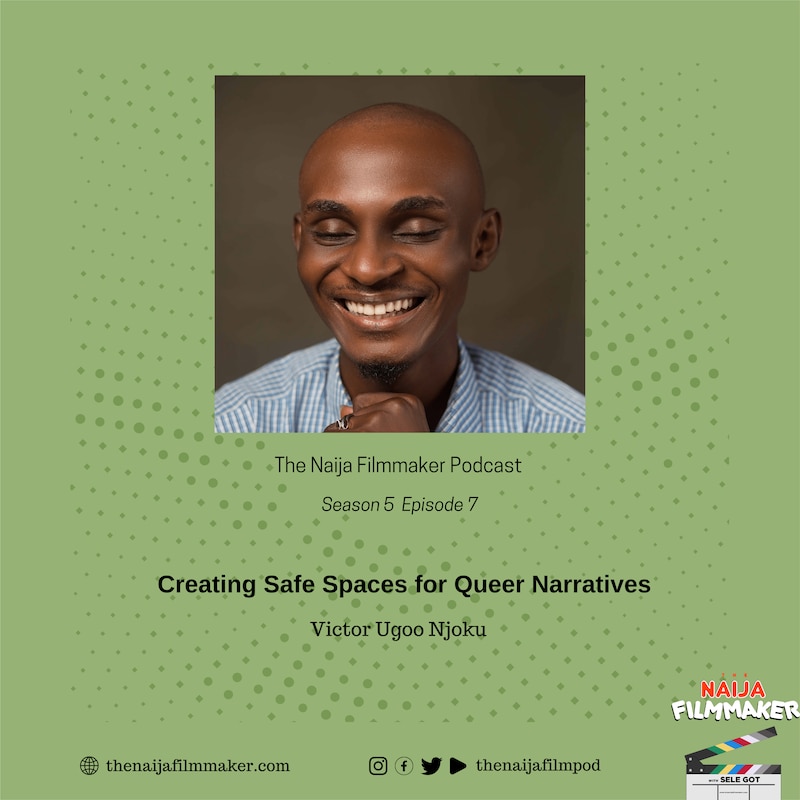
Shownotes
In a compelling exchange on the Naija Filmmaker podcast, Victor Ugoo Njoku articulates his vision for a more inclusive and representative Nigerian film industry. Throughout the episode, he recounts his formative experiences that ignited his passion for filmmaking, particularly the influence of his academic background in mass communication. Njoku discusses the pivotal moments that shaped his understanding of storytelling, emphasizing the need for narratives that reflect the genuine experiences of marginalized groups. His latest documentary, This Is Love, serves as a testament to this mission, as it intimately examines the lives of three LGBTQ couples in Nigeria. Njoku candidly shares the challenges faced during the production process, including the necessity of creating a safe environment for participants to express their truths. The conversation extends to the broader implications of representation in film, as Njoku advocates for improved storytelling practices within Nollywood. He stresses that the success of the industry hinges on its ability to embrace diversity and elevate underrepresented voices, thereby enriching the cinematic landscape in Nigeria.
In this episode, you will learn the following:
- The podcast episode unravels how Victor Njoku’s path to filmmaking began not on a grand stage, but from a place of keen observation.
- Victor's motivations for making a queer-focused film and commitment to authentic representation
- Victor's self-awareness about learning and growth as a filmmaker.
Resources:
https://www.instagram.com/victorugoonjoku/
https://guidedoc.tv/documentary/this-is-love-documentary-film/
Other episodes you'll enjoy:
https://thenaijafilmmaker.com/episode/chiomaonyenwe
https://thenaijafilmmaker.com/episode/creativeoge
https://thenaijafilmmaker.com/episode/danieloriahi
Donate:
PAYSTACK: https://paystack.com/pay/thenaijafilmpod/
STRIPE: https://www.thenaijafilmmaker.com/support
Connect with me:
Instagram: https://www.instagram.com/thenaijafilmpod
Facebook: https://www.facebook.com/thenaijafilmpod
YouTube: https://www.youtube.com/thenaijafilmpod
Twitter: https://www.twitter.com/thenaijafilmpod
Loved this episode? Leave us a review and rating here: https://www.podchaser.com/podcasts/the-naija-filmmaker-1969556
Transcripts
You're welcome to the Naija Filmmaker, a podcast about Nigerian filmmakers, their films, and how it can build a diverse and functional industry. I'm your host, Sele Got. On this episode, my guest is Victor Ugoo Njoku. He's a multimedia content strategist and director.
He directed and produced the documentary, This Is Love, which explores the romantic relationships of three queer couples. We talk about how he got started, the kind of stories he likes to tell, and some of the challenges he faced making this documentary.
If you're a new listener, you're welcome and I hope you enjoy. Hi, Victor. You're welcome to the Naija filmmaker.
Speaker B:Thank you for having me.
Speaker A:All right, can you introduce yourself?
Speaker B:Okay, so my name is Victor and I. I don't like introducing myself because I'm not sure what is expected of me, but I'm going to say that I make films. I have a podcast and I'm a student. I'm doing my master's degree in global communication at the moment. And what else can I say?
Speaker A:I mean, I think that that's a good start. I guess as the interview goes on, we'll learn more about you.
Speaker B:Yeah, we're going to. I'm going to hop on that, too.
Speaker A:All right, so, you know, let's start at the beginning. You know, everybody has that spark that, you know, pretty much, you know, pushes them. Okay, this is. Making films is something I want to do for you.
When did you realize you were interested in making films? What was your first experience, you know, interacting with this industry?
Speaker B:So I think the first experience was. Or the first time I thought this was possible was my first time on a movie set. Right.
And I know this sounds ridiculous because most people who want to make film talk about the arts angle of things and how they wanted to pursue creativity and all of that. I knew I wanted to tell stories. I had a blog at the time. I was a university student, but I got to work with an actor and I had to be on set for it.
And I remember coming and being disappointed. I just thought this could have been better organized. A lot of things didn't seem well thought out and I could do a better job.
And I remember thinking, whose job is it to make all of this work? And that's the first time I remember trying to think about what exactly all these titles you see at the end of films are. I watch film.
I watch them a lot, and I watched a lot as a kid, so you hear about these titles. But if I really think about what exactly does it mean in practice?
I remember trying to Figure out whose job would it have been to be able to make sure that things were seamless on this set. And that's when I started getting interested. So I thought maybe I could actually be a film producer.
Because in my head all you're supposed to do is pull things. Resources, maybe production managers, something along the lines of just being able to.
I think I put it more like it's an event where you just manage people, make sure these things move accordingly.
But also the thing about also being on that set was also it's made me first of all understand how making film work in spite of all the chaos I discovered during the time I was there. And also made me realize how big a medium film is. And you think again, for someone who watches movie, I would have known.
And I was studying mass communication at the time, so you think I should know. But it's. I mean I think I knew in on paper, but just being on this, on this set made me realize the value and the worth and the size of what it is.
And I remember thinking about some of the stories I had on my blog and how it would have been so much better if they were on picture. That was the first of my thoughts. Okay, I would want to be a filmmaker, right? But you don't.
Again, I was studying mass communication, I want to finish my degree, get a job and all of that. So it became something I just thought about and never really took any steps. How do we achieve all of this upwards? I finished my.
My university graduation and I remember the time I started trying to now see how I could still have my 9 to 5 and still do this film thing and decide. But basically that's how the journey started. That's for me, that's the first time.
And eventually after my studies I also began to get more interested in a lot of other things like topics around representation. I don't think it was after my. So it was around my time of my program studying MassCom. My, my. My research also was on.
My bachelor research was on representation or rather was. It's not so much as it's on portrayal, but basically it's something around the topic.
And I think that's also what's then helping me to try to understand the kind of films I wanted to make.
I think I wanted to make films that kinda highlight or portrays people, portray people who are minority groups and yeah, also creates better portrayal of certain other people. But yes, so it is also learning about portrayal. Understand all of this. And that's how the journey started. I can, I could say that. Yeah.
Speaker A:Okay. And you know, this first film said that you are on what, you know, role where you tasked with. And how was that like watching everybody?
Speaker B:I was just an assistant to one of the actors. So as a personal assistant, you're supposed to let him know or the actor know when he was supposed he's dead on set.
For instance, made sure I got the costumes before on time so he could change and then return the costume when he's done. Basically whatever he needed on the set was what I was tasked to help him help do. But also. So it wasn't much of a big deal.
I didn't have any creative contribution to make. I just had also read the script and help him remember which paper. Like when they say it's seen whatever.
And being able to say this is what you expect in case he had forgotten what he was supposed to do. And then when he did the script, I went out to make sure it was available, stuff like that. So it was not any creative work.
So to say I was just there as an assistant. But of course, just being in the process she also seen how other people were working.
I remember I noticed a continuity error that I wasn't trying to notice. And then also realizing, well, who am I supposed to tell? Because you know how Nigerians are when you actually didn't like the community of the job.
I can't say anything about the job, but I remember he came up as a rude person. I think I had wanted to speak to him about something I noticed and he was rude and I didn't point it out. But yeah, in that.
Just being in that set, I could see that the community could have done a better job. I could see that there was no. I mean, I think theoretically there was a plan of which scene comes after.
But there were also times after if has been shot, nobody knows the next scene. It's like they had to talk about which scene is going to. It's like almost like. Almost a random selection of scenes or.
I remember there was a particular day we'd gone to a particular set and all of a sudden they said, we are no longer going to shoot here. We have to do another scene first. We have to move from that state to the other.
And I kept on thinking whose job was it to make this thing not be like this again? I understand now. I understand because I was still worked closely and talked with mop. I know a lot of things could come up at that time.
I didn't have the grace to understand all of it. But I remember just being off put by it.
And also thinking, because nobody seemed to be taking responsibility, just, okay, we hear this, everybody's grumbling, right? Nobody even knows the reason the set, the change has been made. But you just have to show up where you expected to show up.
And even that for me was a problem because I'm also thinking if you make such changes, the least you could do is communicate it so that everybody on the set can see we are moving from this set, another set. Because maybe we realize the lighting is not going to work or maybe we realize that there was what could. Whatever could be the reason.
But that was also part of the things that I thought. Someone who likes to uplan things and who is very orderly. It was just not something I could wrap my head around.
But I was just there on the set as an assistant and I couldn't do much because you couldn't also give feedback. Because a lot of people were seeing me for the first time. They didn't know me. Whatever I thought was something I couldn't express.
Speaker A:Yeah, okay. And you know, you mentioned that you have gone on to work on other films such as Yahoo and Uno.
Speaker B:Yes. So for Yahoo.
Because the person who directed and produced and wrote for Yahoo, plus the one I've known my entire life, I had to read the script first of all, before even anything started. We worked on the script. I mean, I didn't work. I just was giving feedback. I do a lot of that. I talk a lot. So I was giving feedback.
And then the film started.
I was supposed to be on the set of it, but I couldn't be on the set because I had this course I was taking at the time that wouldn't allow me do that. Then I came in eventually to supervise the. The subtitle. Right. And that was my first time being on seeing how post production works. I had. I was.
I actually slept on the studio for a few days and I couldn't. It was very. Again, it's like seeing these things on a different set is a different ball game. Post production, a different ball game. All together now.
I came. But also you realize how it works, right? You have to watch this film again and again. And if you might have seen the script.
And that was my first time seeing the courts and seeing what it looks like. And I was thinking. I don't know what I was thinking, but I was thinking everything was going to be done serially, scene by scene.
But that's not even how the post production. At least that's not the experience I had. So it was a different experience. Just observing things.
But yes, I mostly did supervise the subtitle, being sure that everything was well interpreted because a lot of the conversation happened in Igbo and Pidgin, and also not because we had to also factor in how to make sure the translation was done, not just so that you hear the words and it's English, but also in such a way that it makes sense in an English context for someone who doesn't understand Igbo, for them to understand the sentences and the paragraphs.
And I know I was asked to do that work because one of the things I do a lot when people who know me personally, I complain a lot about subtitles in Nollywood films. It is a lot of times you see films where they just do a literal translation, where this doesn't make sense.
When you think about the fact that it's an English sentence, it doesn't make sense that you translate this literally.
There are things, of course, that has to be translated just literally, but there are things that you have to maybe use the right substitutes, English proverbs or idioms as opposed to doing a literal translation. I always ranted about it. So I think that was. I'm sure that's why he asked me to supervise, so we can avoid some of those.
And also realize for the first time again, when you do things, you also begin to give people more grace. Because it's like, this is not as simple as I thought it was because now you have to think about it.
There are word sentences that we have to really deliberate on a few times to know what works. And then you suddenly realize you don't even know how to speak English because you're no longer sure if it's a plural.
You're no longer sure how Concord works and all of that. But yeah, that's the first. The other project I worked on then for Yahoo. No Yahoo. Again, I got the script. I was.
Because at this point I was more keen on being into production. So I was more a part of the production than I was for Yahoo.
I was every part of the production actually was a part of it up until the shooting of the film and also was part of it to an extent. During the post production. I was in the studio, but I still had to watch the first Courts and give feedback and all the work.
So I was basically there as maybe I would say, as an associate producer and like as a consultant contribution or suggestions and how to make the production more seamless. And.
Speaker A:Yeah, okay, so from these experiences, like, what do you prefer? Do you prefer being on set or in post production, like working in post.
Speaker B:Production, I would say I would prefer being on set, but of course they require different skill set and they require different temperament and one has to, so to say real, not real rain. But basically you just have to remind yourself where you are.
Because with sets there are a lot of moving parts in terms of even the people, in terms of a lot of things that may be out of control. It's more chaotic, I would say. I also think I like the idea of just working with people.
I enjoy it and just seeing how this plan you've mapped out about how this production is going to work is actually working.
And of course there are a lot of unplanned things that come up, but you still would put some structure in place to make sure that we avoid as much unplanned things happening. And. But for the post production part is more.
I think it's more creative, which again, it's also more to an extent boring or not boring, but repetitive. Because if you're going to watch whatever film you're working on several times, if it's.
And even though you've made an interesting film, I don't think, I think at some point you get bored because you've seen this scene 10 times, you've seen it 15 times, and you're just looking for the one thing or trying to think about how to make the scene better. And you're, you're doing a lot of conversation with other people on the, on the project.
And so it could become a little bit repetitive in a way that could bore someone. And it's a slower paced work as opposed to production where there are a lot of quick movements and people doing things. Yeah.
So I think I would prefer production. And also for me at this point, I still, because I'm still very new to things, I'm still trying to figure out things.
It still feels a little more technical than what I could easily handle without having to really think about it, if you know what I mean.
Speaker A:Okay, this project, this your new film, this Is Love. Can you give us a quick synopsis about what the documentary is about?
Speaker B:So this is Love is a documentary film that explores LGBTQ romantic relationships in Nigeria. And this is done by looking at the lives of three LGBTQ LGBTQ couples in Nigeria.
And we're fortunate to have a gay couple, a lesbian couple, and a couple consists of a trans man and a woman. So it is. Which I think to an extent gives us a full idea of not necessarily all the spectrums, but it's expansive in itself.
And I think like the woman dating this trans man was. Has also been. Is the person that has been with men. So I, I wouldn't as far as saying he's. That she's bisexual, because that has never.
That was not communicated to me.
But it also gives perspective because we all talk about at least that you hear people say that sexuality is a spectrum, which I think it is, and how people all of a sudden believe in a straight life, so didn't realize that maybe they might not be very straight or how people who have been gay or realize maybe they actually might be into women. And how someone who. Their life as a CIS person suddenly think or realize that they may be transsexual. So it's not always a constant.
So being that we're able to have people with different experiences, like one of the lesbian couple has also been with men before and also identifies as a sexual. As she said in the documentary. So I like the fact that we are able to get different people with different experiences.
But altogether, this is a film about LGBTQ plus romantic relationships in Nigeria and how people who are in this community navigate such relationships in spite of the fact that it's a country where gay rights is stifled and people could be in jail for being in such relationships. I mean, it's more complex than that, but yeah.
Speaker A:Yeah. Okay, so let's talk about your process. You know, as you were preparing to make this documentary.
So at what point did you, you know, realize, okay, this is a documentary I wanted to make and how did you go about, you know, finding, you know, the vessels, the characters that will carry this documentary?
Speaker B:So how did I, for me, at some point, when I said I was going to really try my hands in filmmaking, it was important for me that the first film was going to be a choir film. However, for the longest of time, I also was not. Was very sure I didn't want to make another sad queer film.
And why was interesting important for me to make a cure film?
It's as simple as the fact that growing up in Nigeria as an affemine person, even before you get a chance to identify yourself, people would identify you as a gay person. And the implication of that is that you get treated as the way people treat gay people.
With basically, you be at the brunt of Nigeria homosexual, sorry, homophobia, in the way people treat you. People are not going to give you jobs and people are not going to want to work with you on certain projects. People are going to say very mean things.
We are going to try to bully you. People are going to bully you. It's not just a trying. People are going to try to hurt you in so many ways. And I have lived in some ways.
Some of these examples I know I remember the first time I had the first interview I did after university. I had gone to an interview and this woman says to me that they wouldn't consider me for the job just because I'm effeminate.
And actually told me that as an affirmative person that the only choices I had is to either work in going to entertainment and be another version of Din really or Bobrisky. And this is. You just think about it, you're just out of university.
This is you've applied for a job, you are happy about the prospect of doing an interview and this is your first experience. That definitely can be crippling. And that was not. That's not the first time I've been to an interview.
And people are trying to make assumptions based on my sexuality or just saying things are problematic and all of that. So for me it's been. But also the thing about living some of these experiences that you also try to mold your life around it. Around it.
There are things I wouldn't do in 93 Nigeria alone. For instance, I wouldn't want to go to a big market in Nigeria alone.
And it's not because I've had a bad experience in the market where you know that it could happen. So just going with someone is the shield. It could be the difference between it not have the difference of it not happening.
I sometimes I wouldn't go to a certain place when I lived in Lagos without an Uber because you don't want to be on the bus. Especially the places that are described as rough. You don't just know what to expect. And it's not just about having the money. It's just about.
I mean, I think I'm in love that I could afford it at the time, but I know people couldn't afford it. So basically some of these experiences means that you have to build your life around protecting yourself.
And for me it meant that also there are things I wanted to try that I never tried out because of the. Not. Not necessarily the fear, but also the. The logistics of protecting yourself in order to do certain things. Yeah.
And so when I said I wanted to make a film, it was important for me that the film is a quiet film for me. It's in some part me saying to. Trying to. Because how do I explain it?
I knew, for instance, if I'd done a film, think about a subject, it could be Science fiction. And it's a good film and I have to talk about it.
If I do an interview to talk about it, I can tell you for a fact, after the interview, the question is going to be about my accents, my voice, maybe my, my demeanor, how I, I'm moving my hand around a little too much. And all of that thing that has nothing to do with the film. So I already know that it doesn't matter what I do.
My, my effeminacy is going to take center stage. And so for me, it's in some way saying that I'm trying to shed off the fear of not doing things just because of the implications of it. Right.
And in some ways also adding my voice to something, a subject I particularly believe in. I do not understand the idea of homophobia. I actually never did.
And I said it as a person who was thrown into the world of people calling you gay homosexual. And you are trying to understand what does this even mean? Because you are not even sexually active. You don't even know.
You are too young to even process all of this. And you have, in this age, trying to also research what does it mean to be gay? What does it mean to be homosexual?
Are you trying to even understand this subject outside of the concept of it just being something that means a man who sleeps with a man? You're trying to understand what does it mean? Why does it have anything to do with me? I don't know if you get the point I'm making.
So you've, yeah, done your research. You're trying to understand all of this, what it means.
And so for me, it's also me saying that in some sense it doesn't so much matter what the title is, because quite frankly, what can I do? Because I don't think hiding or not doing things have saved me from any of the harassment. And I don't think it can ever save me. And.
But also, like I said, it's just me lending my voice to a subject I particularly believe in. And that's what I said about not wanting to look at that choir film because already there's a lot of. A lot of it.
And I also have the belief that every queer story in Nigeria, every story about a gay person, a lesbian person, is a sad story. It doesn't matter how you look at it. So. Which is why it's important that we don't.
For me, I didn't want to tell a predominantly sad story because it doesn't matter how beautiful the story is, it's going to be a sad story. And that was why it took me so much, so long to finally make my first project.
Because I was trying to find what that story that is not predominantly a sad story. And eventually we said what this is.
Speaker A:Why is it predominantly sad?
Speaker B:So it is predominantly sad because, I mean, you watch this, this is love. There are three couples, they are together, but we have these people in a mask.
There is love is supposed to be a beautiful thing that people celebrate and are happy for. But think about telling your love story, but you can only tell it through a mask. There is something about that that is inhumane, sad.
And I really don't think I have the words to think about it to really qualify what it is. It's wickedness. It's Carlos. So there is no way, and we tried so much to make this film to make sure that it has a happy ending.
But when you really think about it, is it really a happy ending that these people are going to leave this set and walk back on the streets and can't hold hands together and can't dance together in a party? Or they can't just go to their family to say that they are gay, lesbian?
I mean, you hear the story, the one who mentioned they couldn't come out to their father because that's the only way they could maintain the relationship they have with their father. You hear the one, the one who's mentioned how many times he's been harassed. Nobody wants to live a life where they have been harassed.
So again, even if these people have built little fun for themselves, they are living beautiful love stories. It is still a very sad story.
And that's exactly why I thought from the get go, this story is going to be a sad story because it's a story of people who are in love, but they are not happy. It's a story about people who are pursuing freedom in some way, but it's not full, it is limited.
So for me, from the get go was important that it was not going to be my first film. Again, there is room for all of these queer stories, regardless of how sad they are.
But for me particularly, I wanted to find a story that it's not just another heartbreaking thing, but something that could also give people some level of hope in the fact that yes, it's hard, but there's no one doing it. Maybe I could find a little patch of happiness as a gay person, as a lesbian person, as a trans person in Nigeria, in spite of all of the hardness.
But yes, it is a sad story and there is nothing anybody could do to make it less a sad story. Until queer people can become queer, Lesbian people can be lesbian. I like to choose lgbtq. Lgbtq.
Plus people can really live a full life where they don't have to hide, where they don't have to take on other identities. Yes.
Speaker A:Yeah. Okay, so at this point, we'll take a little segue. Can you mention three random facts about yourself?
Speaker B:Three random facts about myself. How much of a fat are we looking at? What kind of fat are we looking at? Can you give me an example?
Speaker A:So it could be that, you know, you. You are a master chef. You know how to cook everything in this world.
Or it could be that, you know, you're a virtuoso, so you know how to play the piano. Just random things that, you know, I'm not talented.
Speaker B:That's the first thing that I think is a random thing. But I could. Because you said something about cooking. I make a very, very mean offer. Basically. That's because people call it bangass, too. I can make.
I make. I don't think I can. I don't think. Maybe. Let me not brag a little too much, but I make a very mean bangass, too.
Like, usually my siblings, my cousins, are always excited when I'm at home and I have to make it.
And when I think about visiting home again is one of the things I think I want to just cook so that in the time I'm around, they can have a taste of me making ofako. I know I'm very good at it. And then one other random fact is people I don't. I think it depends on who you meet. A lot of people.
I don't know how to explain it, but people I went to school with would swear to you that I'm the most extroverted person in the. In this life. But anybody that meets me outside of school context. Introverted, I don't know. I cannot tell you how that came about.
But it's always very interesting to hear people from different parts of my life trying to make sense of how someone could think that. Basically just have people, like, if I introduce my friends now from school and someone I met from work and the way they would describe my. The.
The person I work won't understand some of the things the person at school would say and I cannot explain because I don't think I'm different anywhere. It's just that somehow in school, I tend to be a little more instrumental than I am outside of other place.
But I think the point is I'm good at school. So there's no concern for me about. I'm not trying to. I'm not second guessing every other place. Sometimes I second guess myself in a little.
In little doses. Oh, yeah.
Speaker A:Okay. What's the story behind how you became quite good at making faku?
Speaker B:I don't know. I learned cooking from my mother, by the way, and I.
So I just, I think it just, it just happened that they think I'm good at it and I think I believed it and. Yeah, but I learned to cook from my mother, so I usually use that. I would say I use her recipe.
So maybe because my mother is good at it too, but I just said that because I generally cook better stews, better soup than I make stew. I make very good soup. Generally I make good stews, but I make better soup than I make stew. So. But of fact is also like more difficult to make.
So I think the harder the food is to make, the better I cook it. So like think about something like bitter loop soup. I'll make a better bitter sound. Make a bonus soup because one is very simple.
Just bend your money and done. But if you have to pound it, the. The coco yam and the fact.
So for me, when it's take me a lot of work, I have to make it worth it because I'm a lazy person. So I'm going to sweat in this kitchen pounding apple, which is pumpkin up or pounding cocoa yam. It has to be good, please.
That's the least I could do to show off that I really put in the work.
Speaker A:Yeah, okay. All right.
So with this Is Love, did you go into, you know, production thinking you are making a certain type of documentary and how great was that change in terms of what you finally made? You know, sometimes with documentaries you learn things on the go and you have to pivot and change what it is you're focusing on in the story.
But how was that, that transition from what you decided to make and what you ended up making for this?
Speaker B:God blessed for me. Right.
But one of the things that helped because he mentioned about seeing the difference, one of the things that he did was gives me this book when I brought up the idea of this Is Love. And one of the things in that book that I remember that I held on to, I didn't finish reading the book.
I've not finished reading the book more or less.
Was a part of its mention something about documentary film, how the story generally can go to other places you didn't expect it to and how things could change?
Speaker A:Yeah.
Speaker B:And that's something that I think I like the fact that I read because when things seem to have changed, it was not. It was easier for me to adapt to the change because I was expecting it. Right. And also. But I didn't also. But also it helped me to come my expectation.
Right. Because you're thinking you're going to ask people questions, they're going to say this, they're going to, they're going to say that.
But the reality is you don't know these people and it is their story and there's only. You're only working with the story they've told you. Right.
I think the book also mentioned that sometimes, sometimes the story depends on who is telling it in terms of the. Who the character is. Because if you have characters that are very interesting, they're going to tell very interesting story.
Opposed characters who are not very interesting. I'm talking about interesting as their personality, not so much about the story here.
So I also think I'm happy that I knew that much before I went in because if I didn't know that, maybe I would have also been frustrated about what I got. But these are people. And also it also made me a little more open to even expect in terms of what I expected. Right.
Because these are people and people are going to reveal themselves to you in the way they could or in the way they are comfortable too. And there is nothing anybody is going to do about it. So yes, there will be a lot of changes when I started, right.
Because this is going to myself problematic. But because I was trying to make this story to be as I wanted a story that was aspiratory. But because I think romance is aspiratory as a concept.
This is a romance story as much as a documentary. For me, it's a romance story. So romance as a concept is aspiratory. So I want it to be as aspiratory as possible.
And one of the things that makes us especially if given the Nigerian background where there is money is a big problem. And also you fear concerns about queerness or gay people, gay people's experiences where people are trying to equate as choice people make for money.
So at the on start I wanted a story that had particularly people who were doing well on certain financial aspect so that nobody would ever dream of saying that they are. These people are gay, lesbian or what or any of the letters of the Alphabet just because they are trying to make money.
But then you begin to do more research and also you have to come to terms with the reality of it. Right. And based on also trying to just be honest about what could happen. I knew that that is a bit of a taller order.
It's a bit of a tall order because how do I find these people? Who are these people? I'm not saying that we are doing this because we couldn't find them, but also it's like it just also increases the bar.
But also it also means that we're going to remove ourselves from the experience of just the average Nigerian because the average Nigerian is not that successful. And I think also coming to that reality was a very good thing because now I was a little.
We became a little more open that this is actually a documentary. And in documentary story about queerness, a queer person is allowed to be broke, a corporate person is allowed to be whatever.
And this is not to say that they are not be successful. Yes, but I don't think not being successful in the way they are doing so much much have so much money does not make their story less important. Right.
And I think that was a very big shift we had to make where we allowed more people to be open. And I can tell you also it's that choice also was good because we now have people with different financial ranges.
And I think at least there one or two people in that documentary. If I had the kind of money they have, I'll be fine. But. And it's not like they are very rich. But you also get my point.
They're doing well for themselves. Most of them have a career, which is what we made sure we insisted on at the end of the way we try to adjust the reality.
We had to also be at least if you have something that brings them money. Right.
So again, because we wanted to make sure as much as people are not saying this is what this person is gay, this person is lesbian, this person is anything just because they're trying to make money. So that was the bearers that was at least like the only limit we placed on it.
So this someone that makes their own money regardless of how much or how little it is. And then we start we found the people and it was important from the good that is there was a gay couple and there was a lesbian couple.
That was another thing we set out for. Now the third couple, even though wanted to take can be anything. So in that regard we had something better.
We had now a trans man and a CIS woman who in a relationship that was a thing of if it happened that would have been great. And it happened. But for us it was a product about this gay lesbian and then whatever else and so those are part of the changes that happened.
Again, I couldn't control the stories they told. Right.
I didn't ask anybody what story they were going to tell, but the only thing we did was we talked to them before the film and got to have an idea of who they were and what to expect to an extent. But obviously we couldn't predict everything. I don't know if that answers the question.
Speaker A:Yeah, yeah. I mean, it does. Another thing is how were you able to get them to like, truly open up?
You know, because there are times where, you know, you have planned your documentary and you're there and what you're hearing is just really disappointing.
And I mean, it's quite important that you know your characters or the focus of your documentaries, you know, trust you to tell their story and really open up and, you know, show should show their world. So how did you kind of achieve that with this is Love?
Speaker B:So I think it's just honesty. I. That sounds a little too simplistic, but when we met the people that were supposed to be on the project, I think we were honest with them.
And one of the parts we did, one of the things we did because we understood the nature of the documentary, everybody on the documentary signed an NDA. And the reason we signed it, we also have to explain it.
We trust your partner, we trust your partner, but we also want to make sure that even if anything goes wrong, your partner is still held bound to not reveal your identity, which is one of the reasons they had to sign the NDA. So the NDA was just not just to protect them, but not just protect them as a couple, but to protect them as individuals.
And we made sure we clarified that and that's part of the contract. And hopefully if, God forbid, they break up, hopefully nobody's going to try to go against it.
But the idea was to make sure that everybody feels protected as individuals and as a couple. And we explain this is important for you to do this right? And thankfully they bought into it.
But also beyond even having that written agreement where we clarify why it is important to do this, it's also the fact that we explained the idea what is what we're trying to do. This is why we need you as a person to come on board and then what is comfortable for you? What would you want us to talk about?
So even some of the steam build up was a conversation that we had with these people about the things they wanted to do.
Again, we can admit that we would have done a lot more things if we didn't have to consider the fact that shooting on the street of Lagos is a lot of risk. And that was a risk I was particularly not willing to take. I don't think as much as I think we have a very important story.
The safety of the six people whose stories we've told is more important than the story. I was not going to take any chance that is going to put someone at risk. Not even at the risk of. Not even the risk of being bullied.
Let's more a risk of actually being attacked. So we wanted to show things in public and we discussed it. But the reality we had to also talk about.
These are the risk involved and how much of it are you willing to take. And particularly for the couple that wasn't wearing masks. Because I knew it was a big risk and we had to discuss all of it and get an idea.
This is what we are trying to make. So based on the ideas we've gotten from them, this is how we are going to make it work.
Another thing was at the start, which I think also even answers some of the question. The last question you asked wanted to shoot in their houses.
Because we thought that was going to be more comfortable for everybody because it's going to be a safe space. But back to us talking to them as people. People who have agency and who have the right to say no or yes.
When we brought up the idea one, the first couple we spoke to said they won't do that because it's going to. They are not comfortable with strangers coming to their house. Particularly because they are women.
And yes, it's a valid concern because you don't know what the strangers are capable of doing. Even though we expect them to be professional after the structure show has been. The production has been done.
So we're like that's another good argument. So we said we couldn't shoot in their house, but we could at least try to create the scenes to look like their houses as much as we can afford to.
Which is what we try to do. Add elements from their houses in making the production the. The set to look as much as we can from what they feel comfortable with.
So we discussed with them, we told them what we're going to do. And then we also told them every other person working on the project is also signed the contracts. Because we know these are going to see you.
And also we assured them we're going to have like a seminar. I think one of my regrets. I should have documented the seminar. Not documented in terms of recording, but document the material I used.
So we Had a little seminar about queer awareness with the people who we, the crew members. It's just a little conversation.
One, we talked about identity, how to respect people boundaries, what not to say, what to say again, because even though we trusted those people, I don't like living things for chance. And I told the cast, we are going to do this. You're going to talk to the cast to make sure you have. Nobody says anything.
At least we had to make sure we did it. And we spoke to all the crew members, everybody that was going to see the cast on the production. We spoke to them about respect, identity. It's just.
It was a brief meeting. It was not something elaborate. And we had this conversation because we didn't want C to be a situation where nobody says they didn't understand.
And I'm happy we did because they were respectful on set. Even the crew members confirmed, the cast confirmed how they were well treated. Nobody said anything wrong.
And being again that we had three women on set, we also introduced the production manager, who is a woman on time to these people because she was going to be in contact with them.
And it was partly important to have a woman on the production because the two directors are men, the three producers are men, and we were the first contact. And the casting director who got. Who found these people was a man. So it was.
You should understand, given this world we live in, why a woman may not be very comfortable.
So we also made sure they met the production manager on time, who is a woman, to also as they would as to reduce whatever doubts they might have about their security concerns. And we also made the production manager like the contact person for anything going wrong. So.
Because I think it's also easier for people to talk to men than they talk to women. And I think that's part of the things we did to build trust.
You know, one of the cast eventually called me class captain because of how I was going on and on and on and on. And I think. I think at the point, it also made me realize that maybe I should calm down.
But I think it was proof that I was doing something that was trying to really show that I cared. Because Class Captain is like basically saying, yeah, maybe you're doing too much. He meant that as a joke, but I think I got it too.
And I think it was. It's part of the science that we really tried to respect them. And yeah, yeah, I mean, I mean.
Speaker A:Well done on, you know, creating a safe space for, you know, your. Your contributors to, you know, be themselves. So ask what was the Plan with the distribution. Is it available to what watch?
Did you submit it to festivals?
Speaker B:Yes, we were. We submitted to festivals. We didn't have as much success as we expected, but we were at a few festivals.
We won an award in a festival in Brazil and we are live on a streaming platform called Guide Doc. Guide has to guide someone and then doc as short for documentary written together. And it's a documentary only streaming service that is.
It's available everywhere in the world. So anybody could watch in Nigeria, in the uk, in Germany or wherever in the world the person is. Yeah, but it's also like a very strict.
A small streaming platform.
But at some point I think we might have to make it available on YouTube because for me it's also very important that it is something that every Nigerians could easily access. And so there's also plan about making that work at some point.
Speaker A:Okay. Yeah. At this point. Want you to share a film like your favorite film. Whether it's film or series. Which film has a special place in your heart?
Speaker B:You won't believe the film I'm going to share, but I'm going to share it anyway. One of my favorite films is. Why am I forgetting the name? Pretty Woman. Pretty Woman. I need to watch. Have I watched it this year?
I used to watch, I think for a while I watched it almost every year. At least once I stopped but I went back to it. I think I've watched it at least once this year too. I don't know.
And then there is Devil Wears Prada also I'm a big fan of Devil Wears Prada. I also one of those movies I watch a lot like almost yearly tradition kind of thing. And for the first time last year I saw this series.
It's an old series from:And I tell you what, that's one of the best I've seen on TV again because I remember seeing someone talk about how the continuity is flopped and all of that. Like every film, it has its series has its problems. But I love the series a little too much also. It's like it breaks me comfortable.
Actually I was telling a friend recently, if someone is going to like this is love the way I love Golden Girls. I'll feel like I've succeeded in life because I was. There was a time in my life last year I was going through a tough time. I couldn't sleep.
It sounds like a miracle, but I was not sure what to do. So this day I played Golden Girls. I was able to sleep for Like a week I couldn't sleep without playing Golden Girls.
And that's how much comfort it brings to me. Of course I have to win myself out of it, but. Yes. So it's not any of the big films anybody would expect, but these are films I love.
I love films that are just light. And I'm also a big fan of romance.
Speaker A:Romance is kind of the guiding thread through the films you mentioned.
Speaker B:Yeah, I'm a big fan of romance. Yeah. But Golden Dust is not necessarily romance. If so, Gave Way is not romance. But I love romance. I'm just saying. I just need to say it.
I love romance.
Speaker A:Okay. What are you working on? Do you have a project coming up? What should we expect from Victor?
Speaker B:Me? I don't know, actually, at this moment. I don't know. At the moment, there's no project in the works.
I was so sure I was going to do something this year, but we didn't get to it. But there are a few ideas of documentaries that I have written down, sketches and all of that.
We just have to start thinking about how to bring the next one to life. I. At some point, I was sure what the second project was going to be, but right now I'm no longer sure. But I do a few ideas.
But also there's something I've been looking to explore. I want to. I don't think if I'm allowed to share now, we could talk about it personally.
But some of things sometimes I want to do next year and I'm a bit thrilled by it because that's what I've ever done before. It has nothing to do with film, but I'm really excited about it. So I don't think I should share about it now, but.
Because the idea is still visibly still forming. But that's something I think I'm more likely going to do last next. Even more likely than doing a film or there should be a film soon.
I'm not sure when.
Speaker A:Okay. All right. Before we get to how we can keep up with your work, can you talk about.
Yeah, I mean, at the beginning of the interview, you mentioned, you know, being on your first film set. It was quite disorganized. There are a lot of things that you felt could be better.
Having made your documentary, worked on other projects, and I guess followed industry news a bit for you. What do you feel as an industry we should be prioritizing and improving.
You know, like, there are a lot of things that are going good for us and there are a lot of things that are not so great for you what do you think we need to be focusing on to, you know, kind of, I guess, level up to improve what we make as an industry?
Speaker B:I think the story. The story.
I don't want to say too much, but I think the story, a lot of them have holes in them and yeah, some of them have beautiful ideas, but the story could be simplified and more focused and just so much better. And there's a lot of gap between African literature, Nigerian literature, and the film.
When you read Africa, a book by Nigerian writers, it is clear that Nigerians can tell good stories. But when you watch a Nollywood film.
Speaker A:Yeah.
Speaker B:Sometimes you are not sure. Sure what's going on. So we should write better stories. I think then. Language is another thing that happens in Nollywood that stresses my life out.
Within the last couple of years, we've seen more films with of local languages done in local languages, which is very beautiful. I can speak on as an evil person.
There was this film that trended last year, and I was watching it and I couldn't stop but wonder why everybody in the film spoke Igbo in a different dialect. Again, I live in the. I grew up in the East. I knew sometimes you meet people with different dialects from the place that you live in.
But it is not so random as it is in a film where nobody, no two people were speaking the same dialect. In this film, and it's even worse. The movie is cast.
The person, the Parker, speaks a different dialect from the city the movie was cast or the city the. The place they told us he came from. Again, it can't be that hard to find. I'm a big fan of. It's okay. The actor is not allowed to be popular.
Find actors. If you go to that city where the movie is, you can find people who could do the film.
Again, that sounds like I'm not being practical about the economic things of things. The movie doesn't have to be Igbo. Make it an English film.
Quite frankly, if you really cannot do this little work, because if you're trying to draw this, we want it to be language, the least you could do make it make sense.
Because the thing about is it's okay to see all the dialects, but when people speak in different dialects, even with such a multiple, it's such a dialectical language, right. In Anambra state alone, there are about 50 dialects. It's just a small state.
So if you hear this amalgamation of dialect, sometimes it can be confusing. It's just hard to fall. It's distracting. And maybe I'M being a little bit nitpicky, but that's my experience.
I'm not saying dialect is better than the other, but it could be a little more coordination in that regard. If family. Everybody's speaking different dialects. Okay, my family speak different dialects, but it's not so common that it happens.
So I'm just saying there could be more coordination in the language. I don't know what it is like in the Yoruba culture, but I can speak about Ebo culture. It's possible that we could maybe people learn dialects too.
Just maybe make it a little more aligned. Right. And then this accents that people use, this is not like I'm complaining.
verybody should stop it. It's:So why are we having this person making a mess of themselves all in a bit of having an accent that sometimes supposed to be realistic. I think everybody should really reign it in if you want an accent. I think an accent of an evil person is an Igbo accent.
It doesn't matter if it sounds a little American, even though. Because we all don't have the same accent. Even in the East. I grew up in the East.
it's a little too much. It's:Nobody sounds like that. And. But again, the core thing of Nollywood. I'm sorry. Is. Sorry. Beautiful stories. Every other thing is going to fall in place, I think.
Speaker A:Okay. All right. So, you know, with this project you might start next year. Like, how can people keep up with, you know, things?
You're working on your other projects. You have social media, a website.
Speaker B:I don't have a website, but I am on Instagram and on Twitter, on LinkedIn, even though I'm trying to use all of them less than I do at the moment. But I'm. You could just go search my name on the platform. It's the same Victor Gonjok or you'll find me.
Ugo is usually written with double O because most people don't. But I write mine with double O, so I don't know. I think that's how I could be found on social media.
Speaker A:All right, thank you, Victor, for you know, sharing your process and the making of this is love.
Speaker B:Thank you for having me.
Speaker A:We have come to the end of this episode. Remember to rate and review the the podcast. You can also follow me on Instagram, Facebook and X at Selector Film and the podcast at Niger filmpod.
You can now support the podcast by clicking on the link in the show notes. See you on the next episode. Have a good one.






