Shownotes
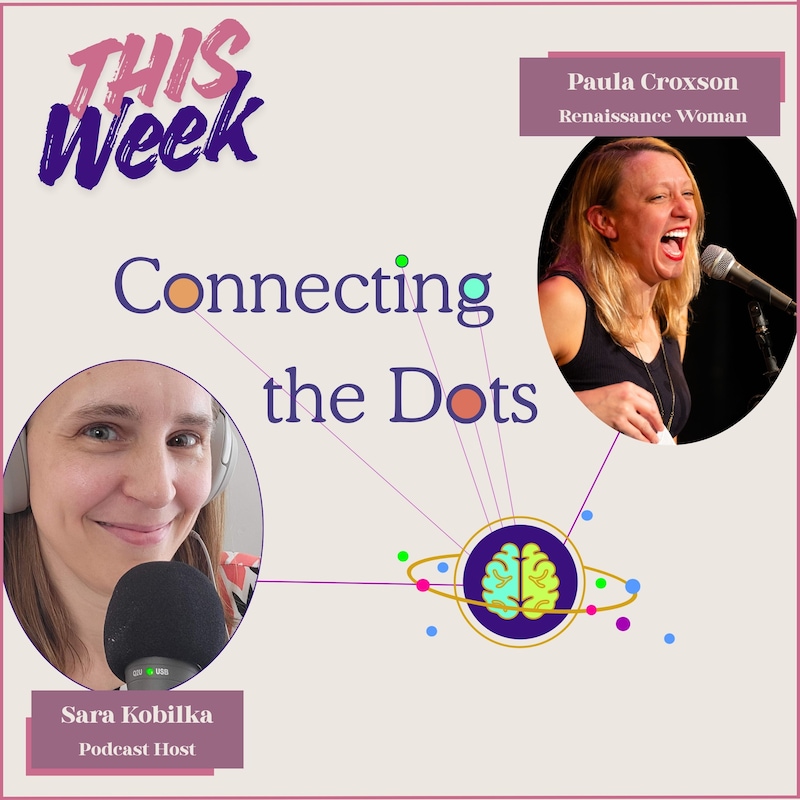
In this episode, I am joined by a fellow Renaissance Woman who has joined me in embracing that identity (you’ll learn why near the start of the show). The title of the episode is, “A Different Kind of Wonderful with Paula Croxson” but my alternative was “How Paula Came to Love Swimming in Chop”. That too will make sense later in the show.
Paula has been near the top of my “dream guests” since I came up with this podcast idea so to say I’m excited is a bit of an understatement. She’s a science communicator, neuroscientist, musician and athlete among other things. The conversation was free flowing, filled with science, storytelling and metaphors galore!
Promised Show Notes Materials (take a drink):
- Sign up for updates on my podcast and what’s happening in the Renaissance People Community.
- Work with me to Find Your Golden Thread
- Jethro Tull (jazz flutist) YouTube video of performance from 1976
- My LinkedIn Left Brain, Right Brain artificial choice rant
- Article from Business Insider where Michelle Obama explains why she too is disgusted by the question, “What do you want to be when you grow up?”
- The Man Who Mistook His Wife for a Hat by Oliver Sacks
- Oliver Sacks biographical information
- Oliver Sacks’ TEDTalk, What Hallucinations Reveal about Our Minds
- NeuWrite
- A Brief History of the Resting State: the Washington University Perspective by Abraham Z Snyder and Marcus E Raichle
- Review of the split brain work that Brenda Milner was part of (credit also to Mike Gazzaniga for this research)
- Story Collider
- Paula’s 2013 Story Collider talk: When Your Grandmother Forgets Who You Are
- Ep. 9 A Mind for Memory with Brian Skellenger, Survivalist
- If you want to become a better storyteller, I highly recommend the podcast The Story Letter with Micaela Blei.
- Stellate Communications
- Ep. 8 Bringing Worlds Together Full Circle with Jess Rowell, Renaissance Woman discusses “find your audience’s why” to help answer “what do you do?”
- Sign up for Brain Dump on May 1, 2026 (or if you missed it, sign up for my Renaissance People newsletter to find future opportunities)
- Paula’s greatest accomplishment post Instagram | Facebook
- Cholla walking inspiration LinkedIn post
- Stellate Communications
Follow Paula on Social Media:
Facebook | LinkedIn | Instagram | Bluesky
A few things Paula and I discuss:
- Survey says…she’s a Renaissance Woman
- The science vs musician choice
- The history and misconceptions of “left brain vs right brain”
- Renaissance Man, neuroscientists, and inspirational figure, Oliver Sacks
- The athletic mindset + Renaissance People = Flow State
- Research on the flow state (it’s not all woo woo)
- What MRIs tell us (and don’t tell us)
- Why the science is in the nuance and complicating the narrative
- Paula’s major career pivot
- Explaining yourself using communications 101, Know thy Audience
- Values as a golden thread
- How Paula stopped fighting the waves and began enjoying them
- Improv Game
- Rapidish Fire Questions
- Life as an omnivert
- Training our pets to do unusual things
Quotes from the episode:
(Paula) I think of boundary spanner maybe as a really useful professional term. But I feel like a Renaissance Person all the time, regardless of whether I'm behaving like a professional or not.
(Paula) I feel like science and music was one of those choices that I had to make pretty early on, that I've spoken to so many people who ended up in science or as musicians who felt like they had to make that choice early on in order to define themself, to carve out what they were doing. When I say had to, I don't think anyone made me. I had a lot of really supportive people around me when I was figuring out what I wanted to be when I grew up. But I felt like it only made sense to be one or the other. And I actually stopped playing music for a really long time, while I was in graduate school. And so I sometimes forget that I'm a musician because I spent so much time creating this version of myself that was the scientist.
(Sara) People sometimes have a job where they'll be a reporter and they'll be a meteorologist. So I decided, I'm gonna bring math and science back into my life. And quite a few people in the journalism program looked at me like I was absolutely nuts because I took chemistry. I took physics. I was taking calculus. And they're all like, "Why? What are you? What's wrong with you? What are you doing?" And I was like, no! I need this! This is part of me too. I can't lose that. I need to use my full brain and not "half of my brain" as the people like to talk about it.
(Paula) That's how the left brain got a reputation for being the "logical", I'm using air quotes here, the "logical side of the brain". Because it rationalized. Because it got in there and it was chatty and explained away the movements of the right hemisphere, having no idea that the whole reason was because the right hemisphere of the brain had just seen a spoon and was responding to the question. So that's how that whole myth arose is because the left hemisphere of the brain talks a lot. However, that doesn't really make it more logical.
(Paula) I had already been interested in the brain and how it worked. But that was one of the things that really drew me in, was reading that book. Little did I know at the time that Oliver Sacks was, himself, a real Renaissance Person!
(Sara) Yeah!
(Paula) He entered that part of his career, the medical part of his career, late in life and the writing and storytelling part even later in life. He was also a bodybuilder. He also swam in the open water. He had all of these facets to himself that were not just what he did for a living. I think I probably was drawn to that as much as the stories and the fascination of the brain, even though I wasn't really aware of it at the time.
(Paula) I started off by joining a group called NeuWrite that was a science writing group that brought together scientists, writers, people in theater, meet people from the media, you know, to collaborate.
My goal was just to write better science papers so that I could get published in my, like, niche journals, but like fancier niche journals that would get me, like tenure and promotion and funding.
But I was around these people and I liked these people and I was drawn to them. And I found myself learning a lot from them in a way that I didn't learn from my colleagues who were in the same niches as me doing the same things, thinking very deeply about MRI and whether this analysis technique worked. And they were wonderful too. But this was a different kind of wonderful.
(Paula) Then I got it. I got that it didn't need to be special or different. What made it relatable to people was that it wasn't special or different, that it was similar to their story, that they weren't by themself. That they could relate to it. That I put into words something that they were struggling with.
And it was so devastating for me in the best possible way. Like all of that affectation that I had had that I just needed to be this like very, very talented special niche researcher doing my thing in my, in my little vacuum just fell away. And I realized that I was a human being, doing a human endeavor that could help other human beings.
(Paula) Figure out who you're talking to. And in a one-on-one situation, you have the ability to do that. And then connect with them about something. So that might mean that I end up telling somebody that I'm a musician or that I'm a scientist, when that isn't like my main day job thing that I do. But that's one of the joys of being somebody who does many things, right? Is that you have many points of contact in many, many ways to connect with folks.
(Paula) I knew who I was for so long through the lens of being a scientist and a researcher, and I had my entire career mapped out. You know, I knew who I was gonna be and where I was gonna be when I was in my nineties if I made it that far and hadn't worked myself into the ground, which was a real possibility. I knew that I was gonna be some kind of emeritus professor roaming the halls of some university, you know. Writing a book, amassing my life's work. I knew exactly how I was gonna be, and I blew all of that up when I changed careers at the old age of 38, and stepped into a field that I had no formal education in.
(Sara) When the pandemic hit, for example, if you'd been in the lab and had all these people scheduled to come in for their MRIs and then the lab had been shut down, like that would've completely ruined those plans or thrown them out or, required things to change. Versus now you're kind of floating on the river and following the current, as opposed to, "I'm just gonna force this, I'm going north no matter what, I'm going north.” You now are kind of like letting the flow of the river, to go back to flow, kind of guide you. And then you're adjusting. And if you get in an eddy, you're gonna do a little spinning around for a bit and then you'll keep going.
(Sara) We always grew up thinking that a career and a steady job and knowing what singular "I'm gonna be when I grow up" is going to give me more certainty. But actually being in this freedom to follow the things, the opportunities that arise, the serendipity that comes forth, is almost more reliable. Because you have yourself. You'll always have yourself. You'll always have your values that can't be taken away from you just because you lose a job or you can't access an MRI machine.
Follow me, Renaissance Woman Sara Kobilka, on LinkedIn, where I put most of my social media energy, and Facebook.
If you’re extra curious, check out Renaissance Woman Consulting to learn more about some of the many types of work I do.
And should you care to support the production of this podcast, I’d love it if you’d buy me an oat milk cappuccino, my caffeinated beverage of choice.
This podcast is hosted and edited by Sara Kobilka.
Theme music is by Brian Skellenger
Podcast distribution support provided by K.O. Myers of Particulate Media
Transcripts
But I was around these people and I liked these people and I was drawn to them. And I found myself learning a lot from them in a way that I didn't learn from my colleagues who were in the same niches as me doing the same things, thinking very deeply about MRI and whether this analysis technique worked. And they were wonderful too. But this was a different kind of wonderful.
(sung) Connecting the Dots with The Renaissance People
[:Welcome to Episode 12, A Different Kind of Wonderful with Paula Coxson. The alternative name that I came up with for with this episode is How Paula Came to Love Swimming in Chop. And that too will soon make sense, but a little bit later.
Now, a little bit about Paula. She has been near the top of my dream guest list since I came up with the idea for this podcast. So to say that I'm excited. It's a little bit of an understatement.
And yes, regular listeners are not gonna be surprised by this. Our Venn diagrams are highly overlapping. She's an absolutely intriguing woman, and I can't wait for you to get to know her.
In today's episode, you're gonna learn about Paula's science versus musician choice, aka the air quotes, right brain versus left brain choice that I myself felt like I had to go through back in high school. We're gonna actually dig into that, the history and the misconceptions of left brain versus right brain. We're gonna talk about the Renaissance We'll talk about how the athletic mindset plus Renaissance People equals flow state. And how there is actually research on flow state. It's not just a woo woo type of thing. We'll discuss what MRIs can tell us and what they can't tell us. Why the science is in the nuance and complicating the narrative. We'll discuss Paula's major career pivot and we will talk about how Communications 1 0 1 know thy audience, as well as your own values is key to explaining yourself and finding your golden thread. Finally, we talk a little bit about training our pets to do unusual things, and I do wanna give the warning that pet loss is discussed at the very end of this episode as it was the very first one I recorded after losing my wonderful dog, Cholla. If you're interested in learning from and getting inspired by other Renaissance People and joining our community, visit www.renwomanconsulting.com. That's Ren with one N to sign up for my Renaissance People newsletter. In it, you'll get updates about the podcast, including having the extensive show notes neatly packaged and placed directly into your inbox for any rabbit hole diving that we may inspire. And if you enjoy this episode, there's a link to buy me an oat milk cappuccino, the caffeinated beverage that gets me through the day. And it helps me defray the costs associated with creating this show, which I adore. So without further ado, here we go. Hello, Paula. I am so happy to have you joining me today, and I'm very excited to ask you the first question that I ask all of my guests. I'm intrigued to see where your answer comes down. So I sent you this ahead of time so that you have a little time to process and think about it. Which of these terms aligns best with your identity? Are you a Renaissance Person, a multi-passionate, generalist, versatile list, Jack, Jill, Jay-of-all-trades, boundary spanner, or is there something else out there that really encapsulates you in your complexity? [00:04:15] Sara Kobilka: Of course! They're so good that way. [00:04:25] Sara Kobilka: That's wonderful. [00:04:35] Sara Kobilka: I love that! [00:04:53] Sara Kobilka: Well, I am in full agreement with all of your science communication friends, some of whom I might already know since we are both operating in overlapping Venn diagrams significantly. When I first came up with the idea of the show, I created an Excel document where I was listing people who I wanted to have on as guests. And you were like first or second person I thought of, honestly of who I wanted to have on. I think you and I actually haven't spent a ton of time together in person, though. We have actually gotten to be in person. 'cause we're both in New York but I have followed you on social media and we'll talk later on about how other people can join in that fun. But just seeing what you were posting about and knowing about your many different interests, I just absolutely saw like a kindred spirit, a fellow Renaissance Woman or Renaissance Person. So I back what everyone else said and agreed, that is the term that jumped to mind for me immediately. Was that one of your top terms? [00:05:58] Sara Kobilka: Hmm. [00:06:18] Sara Kobilka: Sure. [00:06:24] Sara Kobilka: Yep. [00:06:36] Sara Kobilka: Yeah. As I've been interviewing people for the podcast, I have kind of had to take that perspective of there is kind of your career and what category do you fall in for your career versus just you as a person, which encapsulates both your career and your extracurriculars or hobbies or interests or mindset. So I've seen that, in other people too, of when they're thinking about themselves, looking at it in those different ways. Well, that is wonderful. Well, Paula, thank you so much for joining me on the show, and I am excited to dig into all of these things that make you such an interesting person to follow on social media and to know about. As I've said with multiple other guests, you and I have Venn diagrams that look very, very similar. Even the fact that we are both flautists is one of our overlapping Venn diagram categories and. [00:07:32] Sara Kobilka: And fun fact, the very first CD that I ever owned. So I'm gonna age myself for some younger listeners. My first CD was jazz flute. That was the very first CD I ever got from my parents as a present. [00:07:54] Sara Kobilka: There you go. There we go. Well, let's talk about these areas of expertise along with playing flute, and being a musician and being, you've already talked about being a scientist and science communicator. What are some of your areas of expertise where people, when they're thinking of somebody, they're like, Paula, that's who I wanna have involved with this project, or that's who I wanna ask advice from, or something like that. And I think that's very cool because I feel like science and music was one of those choices that I had to make pretty early on, that I've spoken to so many people who ended up in science or as musicians who felt like they had to make that choice early on in order to define themself, to carve out what they were doing. When I say had to, I don't think anyone made me. I had a lot of really supportive people around me when I was figuring out what I wanted to be when I grew up. But I felt like it only made sense to be one or the other. And I actually stopped playing music for a really long time, while I was in graduate school. And so I sometimes forget that I'm a musician because I spent so much time creating this version of myself that was the scientist. And so yeah, the number one thing. When I list out the things that I am, I say I'm a neuroscientist, I'm a science communicator, and I'm a storyteller. And then as a kind of an afterthought, I say that I'm a flutist and, uh, an open water swimmer. So those are like my five turns that I come back to the most. I played flute. I was in All State Band. I played it for the first two years when I was in college. And I also felt that same sort of, no one directly telling me that I had to pick. But this overall message from society and the way that I like to describe it is that it was like, are you a left-brain person or are you a right-brain person. And the interesting thing for me was that I got done with school. And I had excelled in all the left-brain stuff and the right-brain stuff, which, you know, we know is a very false dichotomy. I'll put a link. Yeah, I'll put a link in the show notes! Everybody take a drink! OK, that's the theme. Anytime I say link the show notes we're both lifting our glass. Oh, well, if I took the lid off of my water bottle, it'd be certainly easier to take a drink. Refreshing! Take a drink every time we put something in the show notes, and by the end of this episode, you will be thoroughly hydrated or in some other state of being. But when I had to pick that left brain or right brain thing at the end of high school, I think it was because you had to like, declare a major or decide what school you wanted to go to. So you had to find one that was good at that thing you wanted to do if you even knew it. And for me. I had decided, well, you know, I like being on the stage. I certainly like the sound of applause, but I'm not gonna go into theater. I don't think I could hack it. So I had gotten, started being involved with TV when I was part of the Youth in Government program in Minnesota and had had the chance to be on camera and done the editing side of it. And I really enjoyed all that aspect of TV. And then I did a mentorship at WCCO, which is the CBS affiliate in Minneapolis. And for my last semester of high school, I would skip outta school for like the last half of the day, at least a couple of days per week. And then shadow different people in different departments at the TV station. I was like, oh, I guess I'm just gonna say goodbye to math and science forever. You know, I took my AP calc test and I scored high enough that I got college credit for it. And then I just needed one lab-based science to graduate. And so I was like, OK, well I guess we had a good run of it, math and science. You were fun. But moving on to picking my single career, what are you going to be singular when you grow up? Which Michelle Obama also strongly disagrees with the idea of singular. But show notes, take a look! But I got there and I did one semester of the preparatory classes for my journalism degree, which didn't involve any math or science. And I got done and I was like, something's missing in my life. In my world. I like, I don't feel like me. I don't feel like a whole Sara. And that's when I decided, well, you know, if I wanna be in TV and I want to increase the number of jobs I can apply for, there is this role of meteorologist on TV. And they have to do math and science. And the people sometimes have a job where they'll be a reporter and they'll be a meteorologist. So I decided I'm gonna bring math and science back into my life. And quite a few people in the journalism program looked at me like I was absolutely nuts because I took chemistry. I took physics. I was taking calculus. And they're all like, why? What are you? What's wrong with you? What are you doing? And I was like, no, I need this! Like, this is part of me too. I can't lose that. I need to use my full brain and not quote half of my brain as the people like to talk about it. But from like a neuroscientist perspective, have you ever heard that messaging of like left brain, right brain and had major problems with it the way I have? [00:13:26] Sara Kobilka: Who did it? But there is a little, a little thing called hemispheric specialization, which is where one hemisphere of the brain has a specialty, in a particular area. And those are very few and far between. There aren't very many of them. And one of those is language. So most humans, I think around 98% of us maybe, have language faculties localized to the left hemisphere of our brains. And a very small percentage of us, maybe it's more like 5%, I forget, many of whom are left handed also [00:14:22] Paula Croxson: have language faculties on the right- hand side of their brains. And so number one, it's very biased against left-handed people to say left brain, right brain, different thinking even about language. And so what happened is there were a series of studies, decades ago now, which allowed us to look at this hemispheric difference. And, I saw a talk by one of these scientists. Her name's Brenda Milner. She's a really fantastic neuroscientist. And she had an opportunity to study these people who had this surgery to divide the connections between the two hemispheres of the brain because they had epilepsy that wasn't treatable by drugs. And so in an effort to stop the seizures from spreading from one side of the brain to the other, they had this pretty extreme surgery. And, in many ways, they were totally normal after the surgery, which is amazing! And it helped their epilepsy. But they left with some weird phenomena, like they would find themselves getting dressed in the morning with one hand and the other hand changing the outfit. And they found that there were some things that we do need to coordinate across our hemispheres for. And they were able to bring those people into the lab and do things like have them look straight ahead and show things in their left visual field, which would only go to the right side of the brain or to the right visual field, which would only go to the left side of the brain. But they showed things to the left side of the brain, like an object, let's say they showed a spoon, then they'd say, what do you see? And the person would say, oh, I see a spoon. If they showed the object to the right side of the brain, the person would not be able to respond. Because their right side of the brain, it knew what it was seeing, but it had no way to express what it was seeing. And so people would not say anything at all. But more frequently their left hemisphere would get in there and start confabulating. So let's say that the right hemisphere saw a spoon and they asked the person to pick it up. They could do that, right? The right hemisphere, could control movement. Then they would say, why did you pick up the spoon? The left hemisphere would intervene. Brenda Milliner calls it the chatty left hemisphere. It would intervene and it would say, oh, well I was just feeling a bit hungry, so I figured I'd pick up a spoon so I would have it for after this so I could eat my lunch. And that's how the left brain got a reputation for being the logical, I'm using air quotes here, the logical side of the brain. Because it rationalized. Because it got in there and it was chatty and explained away the movements of the right hemisphere, having no idea that the whole reason was because the right hemisphere of the brain had just seen a spoon and was responding to the question. So that's how that whole myth arose is because the left hemisphere of the brain talks a lot. However, that doesn't really make it more logical. And so she was posting about it on Facebook. And like the classic Renaissance Woman, I'm like, what is this? Must dive down this rabbit hole. And I read all sorts of stuff about it. And then the other way that I've kind of become familiar with that and some of the concepts of neuroplasticity and all those types of things is my abiding love for Oliver Sacks. He... I will put a number of links into the show notes for this, but he is such a wonderful storyteller, first and foremost, much like you. And he also is the neuroscientist and he has the lived experience. And so the stories that he tells. My favorite book title, I think is, what is it? The Man Who Mistook His Wife for a Hat Stand or something like that. [00:17:58] Sara Kobilka: For a hat, yes. It's just like face blindness and just like all of these different things that just makes me love neuroscience. If I was not a meteorologist, neuroscience, by far, is my second favorite of the sciences because the human brain is so intriguing! And how it can change and how it can adjust and all of that is just so cool! What drew you into neuroscience? [00:18:27] Sara Kobilka: Oh, nice. I love it! I love it! [00:18:48] Sara Kobilka: Yes! [00:19:03] Sara Kobilka: Yeah! [00:19:28] Sara Kobilka: That's great. A lot of the Renaissance People that I've spoken with, in particular, a number of us who come from the science, actually no, I wouldn't even limit it to the science and science communicators just of Renaissance People. Quite a few of them have that background in athletics. And not just, I played sports as a kid, but staying into it a little bit longer or being more intensively involved in it. What do you think it is? Is it a chicken or egg situation? Is it that because we're Renaissance People we're drawn to and do well at sports that require perseverance? Is it our training in childhood and learning to have the athlete's mindset that makes us a good Renaissance Person once we move past the childhood when you know, they tell you to be well rounded as a child. So they're like, oh yes, participate in all the things. But oh, you're going to college? You gotta focus now. Like settle down. Music was fun. Put that aside though. Now you gotta really be a focused grownup and get serious. Do you have any thoughts on that athletic mindset and how it fits into our Renaissance... Person…ness? [00:20:40] Sara Kobilka: Yeah. And so I think that's something that a lot of people have in common, when they excel at something or if they're a generalist, is that they're able to tap into that state. And that state is kind of conducive to generating new ideas, to having those aha moments, to making those new connections. [00:21:57] Paula Croxson: which is connected [00:21:59] Paula Croxson: to something else we're going to touch on here. [00:22:02] Paula Croxson: And so I think that, you know, that might draw us also into those kinds of activities that lead to flow state. So like an absorption about playing a team sport and I used to play a lot of team sports. I used to play water polo. And I loved the team aspect of it. But now I'm much more drawn to swimming by myself Or, maybe we with just a couple of other people in a large body of water. Less communication, less conversation will just flow. And I think either of those can lead you that way. But yeah, there's something there that facilitates that connection making and that, creativity. [00:23:01] Paula Croxson: Yeah. Yeah. So I think in the past it was either woo woo or it just wasn't found studyable. So I worked in experimental psychology, which, it's now kind of blended with neuroscience. But we try and get a t what's happening in the brain by creating these tests that will test a particular cognitive function. Of course, there's no such thing as a cognitive function, but these are like mental constructs or ideas that we come up with to explain what's going on. Some like memory, for example. And so, you know, you can maybe think about coming up with a computer game or some kind of card game or some kind of test that would test somebody's short term memory or their problem solving ability. But like, how do you test creativity or flow state? You know it's harder to do those things. And I feel like there was a little bit of a sort of revolutionary moment in my mind in neuroscience when people started to study, what was happening. I mentioned earlier that the brain is always busy even when we're not doing anything. When people started to study what the brain is doing when we are not doing anything, Marcus Raichle and others came up with this term, resting state, which A) implies that there's a state when we are resting. And B) they were able to identify these networks of brain areas that were reliably coactive while we are at rest. And they named this the Resting State Network and it involved, you know, a pretty widespread group of brain areas. That's not super important what they are for this conversation. And started to see that those areas are more active when our mind is wandering. When we are daydreaming. When we are planning for the future. And when we are recalling the past. So when we are making connections ourselves. And when we're entering those states. And after that or around that time, brain imaging technology got good enough that we could start to, you know, do things like put somebody in an MRI scanner and instruct them let their mind wander. Or instruct them to do a creative pursuit, like improvising music as opposed to playing a rehearsed piece of music. And then to see what's happening in the brain during these times. And to see things, for example, like areas in our frontal lobe that are usually our cognitive controllers that allow us to direct our attention, that allow us to suppress inappropriate actions that allow us to sort of stick on that path that we have. Those areas actually are less active when we're riffing or sort of creating something new or improvising or entering that sort of mind wandering state. And there is a creative process that's happening. There is a real thing associated with that kind of flow state. And now there's like study after study and it's been really cool to see those coming out. [00:25:52] Paula Croxson: Yeah, right! Interestingly, same machine. Um, [00:25:54] Paula Croxson: But the F stands for functional in the sense that you are looking over time at brain activity. [00:26:00] Paula Croxson: not just taking a snapshot of the anatomy. But then they're not able to replicate it or that part of the brain lights up for all these other activities. And so they can't necessarily say that it actually is tied to that. Is there any big reckoning that's happening right now regarding fMRIs? Or is this just, I happened to come across an article from somebody who just is trying to like, stir the pot and, and make trouble. [00:27:14] Sara Kobilka: And by active it just means it's giving an electrical signal basically? Like the neuron is releasing... [00:27:22] Sara Kobilka: OK. [00:27:30] Sara Kobilka: Mhmm. [00:27:54] Sara Kobilka: I'm married to an organic chemist, so I'll just go down and ask him a little, knows anything. You can ask him Now what does that mean? Our bodies and brains need oxygen to function. So if a body area or a brain part is working hard, it's gonna be using oxygen and causing that deoxygenation of hemoglobin to happen. We can see that. That signal's called the Blood Oxygenation Level Dependent signal or BOLD signal. It's not blood flow. It's not electrical activity. But it's something that goes along with electrical activity more than other things like blood flow or breathing or any other like biological signal. And so we are looking at something real that is indicative of what's happening. So does that mean that MRI is flawed? I mean, yes and no. Like every scientific method, it's just its thing. And then it has to be taken alongside other things. But what you are talking about is another layer that's not really criticizing the method as such. It's criticizing the way it's analyzed. So for a long time before MRI was around, we had these ideas that these different areas of the brain did different things because of studies, like the ones that Oliver Sacks describes in his book, which I super highly recommend reading. So, the man who mistook his wife for a hat who had face blindness, which coolly Oliver Sacks, also had himself, to some degree, and like writes later about mistaking his own reflection for another person because he didn't recognize himself. [00:29:25] Paula Croxson: Yeah. So this, this person was missing a part of their brain. They'd had a stroke or a brain injury, I forget what caused it. And they were actually missing a chunk of their brain. And so people had started to make these associations, oh, well this area must be responsible for this. Remember I told you about the language areas before. So this language area must be responsible for language. We know that because there was a patient named Tan, who lost that area in an accident and could only say the word tan. I mean, I don't think that was his actual name, but he was known as Tan because that was the only thing he could say! Well, that must be the area for language generation. And so he came up with this like, it wasn't quite chronology where they used to read the bumps in the head. And you sometimes see those like busts, with like the different humors. Like oh, if you're very creative, you have a big bump here. And, it was sort of a little bit like that. It's been criticized sometimes as being the new phonology. So just like, oh, this area does this and this area does this. Now that's fine. But what it led to is things like people scanning people during election season and showing them a picture of the opposing political candidate and then showing the amygdala lighting up and saying, oh, they must feel disgust at this person because the amygdala does disgust. Well, the amygdala probably doesn't do disgust because it also lights up when people experience threat, fear, other kinds of emotions, in memory tasks, in all sorts of other situations. So I think what's been happening is not a change in whether MRI is effective or not, but in how we need to analyze it and look at it. And maybe we should be thinking of the brain as more of a set of interconnected neurons, areas, you know, whatever we have capacity to think about, that are working together. Whether that's tied together by like activity happening at the same time or oscillations running through the brain, or there's lots and lots of research going on to figure out exactly how that happens. But we've expanded our view of the brain now, because we know that it's not just a bunch of areas doing their specialty thing. So the brain areas too, I guess, are like Renaissance brain areas in the sense that they are multifunctional and it depends who they interact with as to what function they're subserving. And I feel like to be a neuroscientist nowadays, if that kind of questioning is happening, you have to be open to the narrative getting more and more complex. Yet the ideal of science is to simplify and make these elegant single equation that explains everything. Is that kind of pulling scientists, do you think, in two different directions of, I want to think about the world in even more of a complex way, whatever I'm studying. But yet I want to simplify and have that elegance as well? Like, I'm only gonna speak for the science that I know best, which is biological science. So this may actually not be universal to all the sciences because, you know, maybe there's a world in which physicists are looking for the most elegant equation. But I've also talk to a lot of physicists who are also looking for these like really, really complicated things that can only be modeled with vast amounts of computer code, for example. And so I have a feeling it stands for at least some other field. I think that it is just a little challenging when you're communicating a concept to try and show all of the chaos and the nuance. And also as scientists, I think we've been trained to portray ourselves as objective and that there is some kind of, you know, like truth behind what we are looking for. Even though most scientists, if you ask them like, is science a search for truth? They would say, well, no, there's no truth. Like what even it's truth, you know. [00:33:38] Paula Croxson: All we're doing is asking questions. [00:33:41] Paula Croxson: All we're doing is asking questions. And if somebody asks me about a scientific finding, well is, is this true? I'll say, well, I don't know. Like it's true under the set of circumstances for this number of participants, in this very particular condition. And like we can probably guess that it might apply to like a larger population or a larger condition. I don't think we are looking for that static one truth. I think for me, science has always been this expansive, let's complicate it. Let's go down this rabbit hole. Oh, this finding doesn't quite make sense. Why is that? Can we go in that direction? But I think that science has set itself up to be an authority in the world. To have to be the thing that says how things are. And that sort of like gatekeeping of knowledge, if you like, created that fallacy. [00:34:43] Paula Croxson: I mean maybe, maybe, I mean, yeah. Like it is true, like physicists were searching for these like, overarching things that, could explain everything. [00:34:55] Paula Croxson: in the Universe, right? But that's never been my personal brand of science. But, so yeah, whether they're laws or rules. But you know what they really are, are theories. [00:35:04] Paula Croxson: And if you listen to physicists now, they'll talk much more about theories or models. Like models is a little bit of a jargon term in particular, right.? I think to most people, a model means somebody who walks down a runway with clothes on or maybe, you [00:35:20] Paula Croxson: Something that you make with glue in your [00:35:23] Paula Croxson: childhood bedroom that's like a plane or something. But like a model is also, I dunno, the scientific term, it's like a theory. It's a way of explaining stuff. And I think words like model or theory suggest that like, yeah, it's just a toy. It's just an idea. And it stands for now, but it could change. And I like that. I like that phrasing more and I think we're more coming into that kind of language now. But did we do ourselves and everybody else wrong by calling these things laws and implying that they're sort of telling everyone how things are? Yeah, maybe Well, you've kind of gotten into this a little bit, but in the work that you're doing now, are you doing MRI research or anything like that at the moment? [00:36:18] Sara Kobilka: So in what you're doing now, did you evolve to this point because this felt like it was allowing you to be more of the Renaissance Person connecting the dots than previous roles that you've played? Or where did you find that your Renaissance Person qualities were most valuable to the work that you were doing in your career? I had my hobbies. I was swimming in my spare time and I was playing music in my spare time, but I thought of them as spare time things. And what really shifted for me, was I started to meet these people who were communicating science in different ways. I started off by joining a group called NeuWrite that was a science writing group that brought together scientists, writers, people in theater, meet people from the media, you know, to collaborate. My goal was just to write better science papers so that I could get published in my, like, niche journals, but like fancier niche journals that would get me, like tenure and promotion and funding. But I was around these people and I liked these people and I was drawn to them. And I found myself learning a lot from them in a way that I didn't learn from my colleagues who were in the same niches as me doing the same things, thinking very deeply about MRI and whether this analysis technique worked. And they were wonderful too. But this was a different kind of wonderful. And I ended up telling this story for the Story Collider, a nonprofit organization that I am still involved with to this day, which spoils the ending of this story. Because I actually didn't wanna tell this story at all. I didn't really think I had a story to tell. I certainly didn't think I had a story to tell that was special to me in any way. As a scientist, I always knew that I had to have my like unique viewpoint and my little niche and be the only one. And I only had this story about my grandmother who had dementia. And I remember thinking to myself, like, everybody knows somebody with dementia. Like, why would I tell this story? What's special about that? Why would that mean anything to people? And after I grudgingly worked on it, and I'm super grateful to Erin Barker, who was my producer for sticking with me despite all my complaints and not wanting to do it, and reluctance. You know, I told this story on the stage in Brooklyn somewhere. Maybe they were a hundred people in the room. Most of 'em I didn't know. And people came up to me after I told this story, and they thanked me so much for sharing my story because they were going through something really similar with a family member, with somebody that they knew. And then I got it. I got that it didn't need to be special or different. What made it relatable to people was that it wasn't special or different, that it was similar to their story, that they weren't by themself. That they could relate to it. That I put into words something that they were struggling with. And it was so devastating for me in the best possible way. Like all of that affectation that I had had that I just needed to be this like very, very talented special niche researcher doing my thing in my, in my little vacuum just fell away. And I realized that I was a human being, doing a human endeavor that could help other human beings. And it changed everything for me. It changed the way I mentor. It changed the type of people who approached my lab because they had heard me be a human being. And so I started to get all these people from different backgrounds. I had high school students knocking on the door of my lab. I still dunno how they got in, asking if they could join my lab before I had built my lab because they heard my story on NPR and they wanted to work with somebody who thought like me, related like me, changed the way I taught. It changed the entire direction of, of, of everything. And eventually it changed my career. And I think that it wasn't voluntary, you know, I wasn't looking for it. So like, sort of when you asked, like, was that something that I was drawn to. Yes. But it wasn't conscious. I just got sucked into it. And I'm very, very lucky that I had met somebody in my, like first year or so in New York who sort of almost like flippantly said to me, oh, I just say yes to everything here because this city's so rich. You just never know what you're gonna get into. And I kind of internalized that. And I had started saying yes to things that like, I didn't want to do that I wasn't really sure about as long as I was safe. She's like, as long as it's safe. And if I hadn't said yes to that, I wouldn't have happened for me, really. Because I would have been totally happy on my own path. [00:41:31] Paula Croxson: Mm-hmm. But New York City does seem to have that. Have you found that a lot of the people in New York City really do give off that Renaissance Person vibe that you've been connecting with and move to the city because of the offerings that it has? And what's for us here is opportunity. It could be cross pollination and meeting other people and finding new paths. Or it could be the opportunity for excellence and to rise to the top, whether that's being on Broadway or, you know, making it as a musician or working in a world class university or like, we have all of those opportunities here. You know, I was drawn here to be single minded. And I stayed here to be multifaceted. And so I've seen it from both sides and I think we have both here. The important thing is that it like connects to what you're dreaming about to some degree. And yeah, you know, it really changed my perspective. I previously lived in Oxford, in England. It's a small city. It's pretty homogeneous. The university makes up a big chunk of it. I met a lot of people who are like me. And here I meet a lot of people who are not like me and that makes me, ironically, more of myself, but like a different version of myself. [00:44:06] Paula Croxson: I mean, if I had this solved, that would be great! The short answer is I sort of pick and choose a little bit how I want to connect with people. So, ideally I find out something about them first. This is not necessarily storytelling, it's more communication 1 0 1. [00:44:25] Paula Croxson: Which, is, yeah, figure out who you're talking to. And in a one-on-one situation, you have the ability to do that. And then connect with them about something. So that might mean that I end up telling somebody that I'm a musician or that I'm a scientist, when that isn't like my main day job thing that I do. But that's one of the joys of being somebody who does many things, right? Is that you have many points of contact in many, many ways to connect with folks. So I don't really have a one-size-fits-all. But if I need to, I say I'm a science communicator. And what does that mean? It means that I help scientists to communicate their work to each other and to people outside of their field in all kinds of ways. And that is completely unclear to people. Nobody has any idea what I just said when I say that! And then I have to list all kinds of examples as ways that I do that. Particularly at Stellate, which is my main job, which is a communications company that I work with. What we do is basically a whole range of things, some of which fall under words that scientists don't like to hear, like PR, [00:45:43] Paula Croxson: Right! But what PR actually sounds for, right? Just public relations. [00:45:48] Paula Croxson: You know, [00:45:49] Paula Croxson: It's just communicating with people. But yeah, it does have a bad name. [00:46:00] Paula Croxson: I know! Do you find that you think about a golden thread in everything going on in your own both career, but also broader interests? Do you see any sort of golden thread for you? [00:46:44] Sara Kobilka: Yep. I have PhD, but it's a neuroscience. I don't have any formal training in science communication, public engagement with science, which is one of my other real passions. It's not just communicating but engaging in a bi-directional way with publics about science. I don't have any formal training in that. I learned it all on the job. It's like very kind of like, feels very uncertain. And when I changed into this field, I asked my first boss, what's your five-year plan? [00:47:33] Paula Croxson: Well, how do what you're going to do? And they, and she laughed. [00:47:36] Paula Croxson: And she said, well, I don't. I don't have one. And I was like, melting down in this, cafe that we were having lunch in, like feeling my whole pathway [00:47:46] Paula Croxson: Unravel in front of me. I said, well, how do you make decisions around your career and your life then? And she said, I just connect to my values. And so I think that's the golden thread, maybe, if there is a golden thread, is that I'm so grateful for that guidance. And I sit down on a regular basis now and I do this sort of semi- painful exercise where I try and figure out, well, what are my values and what are the top three values that I have? And then I look back and how do they compare to the ones I had six months ago or three years ago? But more importantly, I look forward and I say, well, how is what I'm doing serving those? And it helps me make decisions all the time about what I'm gonna be doing next. And what I'm gonna say yes to. And where I'm going to head myself. So yeah, I guess my values and what I'm passionate about are now the golden thread. [00:48:35] Paula Croxson: but I don't literally now don't know where that's gonna lead me. And I don't know what I'm gonna look like or what I'm gonna be doing when I'm 90. And that's part of the joy of it, the very uncomfortable joy. You now are kind of like letting the flow of the river, to go back to flow, kind of guide you. And then you're adjusting. And if you get in an eddy, you're gonna do a little spinning around for a bit and then you'll keep going. For me, it seemed like we always grew up thinking that like a career and a steady job and knowing what singular I'm gonna be when I grow up is going to give me more certainty, but actually being in this freedom to follow the things, the opportunities that arise, the serendipity that comes forth, is almost more reliable. Because you have yourself. You'll always have yourself. You'll always have your values. That can't be taken away from you just because you lose a job or you can't access an MRI machine. You have stability by being flexible as opposed to having that rigidity to your life. [00:50:16] Sara Kobilka: Exhaust yourself. [00:50:21] Sara Kobilka: Yeah. [00:50:44] Sara Kobilka: Wonderful! [00:50:45] Sara Kobilka: Well, I think we'll transition because let's roll with the punches. And let, let's play a little game. You have heard the game before because you've listened to past episodes and it is the fill in the blank. You know you're a Renaissance Person if... And the challenge that I always give myself is that I do not let myself write down my answer ahead of time, because that isn't fair. I try to do it as a riff off of what you're talking about when we have our conversation together. So, I will go first and then you can go second. So my first one of, you know you're a Renaissance Person if... will be, you know, you're a Renaissance Person if your childhood photo book or Facebook posts are full of you in all sorts of different costumes. One might be you on the stage in a play. Another one might be you in a football outfit. And then the next one is you climbing a mountain and being on math team. It's just you wearing all these different costumes because you were doing so many different things. How about you? [00:52:07] Sara Kobilka: Yes. Why can't we expand the day? Come on physics. Write the equation. [00:52:14] Sara Kobilka: Actually we do know! If we get close enough to the speed of light, we can do time dilation. So there's, there's physics for it. We just gotta [00:52:22] Sara Kobilka: Speed ourselves up a little bit. And so I always feel, I feel like it's a mixed blessing, right? Not having enough time because it, on the one hand, there are so many things I want to do and I'm excited about doing, and I'm always committing to these amazing things. And then I'm always feeling a little bit guilty that I didn't spend more time on something or with somebody. So it's [00:52:59] Paula Croxson: a double-edged sword, I guess. OK. do you wanna do another one? Do you have another one in mind or you can improvise it? [00:53:28] Sara Kobilka: Good. OK. We're improvising it. OK. You know, you are a Renaissance Person if you fly on an airplane, don't have the internet and fill some sort of note taking device with all these ideas that you get because you've finally been able to disconnect from the world. That's what happened to me on the most recent flight I opened an email to myself and then I'll type it all in as a draft, and then I just kind of leave it in there and then I'm gonna clean that up. I'm gonna do a spring cleaning, brain dump activity that I will announce to everyone to sign up for. But yeah, getting away. So Artemis Two's mission was yesterday where they were taking pictures on the dark side of the moon Oh yes! They had about 40 minutes where they had no contact. There was no way that they could contact anyone on earth because we can't send the signals through the moon. The moon is blocking the signals and the signals can't travel through a physical body like the moon. And I was kind of jealous. I'm like 40 whole minutes with no ability to connect with anyone on earth? What relief! What freedom! But they were very busy doing science and taking pictures, which is fun. [00:54:38] Sara Kobilka: Yes. [00:54:45] Sara Kobilka: Yeah. So like, I'm just looking around me in my living space right now and I have some artwork on my wall that I painted, like this picture behind me. I have artwork that represents the brain. I have an amp behind me for playing the flute. I have a microphone in front of me for podcasting. I have all these different accoutrement. I have books on all kinds of things. I have a yoga mat, I have, you know, so I feel like if you're a Renaissance Person, if you not necessarily as crowded as my space, I think you could be a minimalist Renaissance Person. [00:55:36] Paula Croxson: Yeah, if you have items around you that are of an eclectic nature. [00:55:46] Rapidish Fire Questions [00:55:58] Paula Croxson: I think we already used it. I think it's the flow state metaphor. I think about the water a lot for my metaphors. And that comes up again and again. [00:56:22] Paula Croxson: I did not. So I grew up in a town in Manchester, in the northwest of England. And then [00:56:29] Paula Croxson: in Oxford for a long time. Neither is terribly far from the water, but neither is right on the banks of anything. There was a lake in Oxford. My friends had a sailing boat. I would sometimes go sailing with them. But actually all my swimming when I was younger, except when I went on holiday to the coast in Wales, was in a pool. [00:56:46] Paula Croxson: So I spent inordinate amounts of time. If you scratch and sniff me, I smell like chlorine. So it wasn't the open water for a long time for me. It was the pool. It was a lot of structure. It was a lot of laps. I did synchronized swimming for years, which is a little known fact about me. And it wasn't until I moved to New York where I was literally surrounded by water on all sides that I met these open water people. What's one rabbit hole that you've gone down recently? [00:57:32] Sara Kobilka: Yeah, [00:57:39] Sara Kobilka: Absolutely. [00:57:47] Sara Kobilka: Yeah. [00:58:13] Sara Kobilka: Yes! [00:58:34] Sara Kobilka: Mm-hmm. [00:58:38] Sara Kobilka: Yeah. We don't wanna anthropomorphize them too much. [00:58:57] Sara Kobilka: Yeah. [00:59:04] Sara Kobilka: I think I've seen a change. So I currently teach the University of Arizona undergrad and grad students in a class. We meet virtually and then I see them in person when I fly into town. But I have seen a difference in the way that, particularly what my students write since we started five years ago. And one of the biggest things that's just shocked me is we have them apply by filling out a very simple survey and like one of the questions is, why do you wanna be part of this project? And I can tell you every single student who used AI to write their answer, and I'm like, you can't answer for yourself why do I wanna be part of this? You're not getting graded. We're not going to be like, oh, invalid. I'm not gonna pick you to be on this team if you like tell us. But [00:59:53] Sara Kobilka: they have to use the AI. I'm like, OK, do we not? Have we lost the ability to like think critically and articulate how we feel? Like, can we talk about our own feelings without having a computer do it for us? And that seems like a big loss if we can't. [01:00:09] Sara Kobilka: Yeah. [01:00:13] Sara Kobilka: Yeah. [01:00:17] Sara Kobilka: Mm-hmm. [01:00:24] Sara Kobilka: Yeah. [01:00:32] Sara Kobilka: Yeah, [01:00:34] Sara Kobilka: Yeah. Very intriguing. OK, one last question, which is, you've already told us about the synchronized swimming, but what's something from your background that might surprise people? And you can take the definition of the word background very widely. [01:00:54] Sara Kobilka: Hey, you shared it yourself! That was not my fault! [01:00:58] Sara Kobilka: You fell for it. Ha ha! [01:01:02] Sara Kobilka: And if you need a suggestion, I have one based on a video I recently saw of yours. [01:01:26] Sara Kobilka: On the stage. [01:01:28] Sara Kobilka: Yeah. And you're great at it! And so I do think that that part of me still exists. And one of the things it does, of course, is it gives me a lot of empathy for people who are in that situation. [01:01:54] Paula Croxson: and also gives me a lot of appreciation for where I'm at now. But I'm curious as to what you were gonna suggest. [01:02:06] Paula Croxson: I did. Both of them, two cats. [01:02:09] Paula Croxson: I talked in the 90 seconds show last week, [01:02:14] Paula Croxson: which was a comedy show. And I would not have said I was a comedian, but now I have to… [01:02:19] Paula Croxson: I talked about one cat, but actually I have two. And I taught them both to use a toilet. And that is still my greatest achievement of all time. As I was watching that video, I got not choked up, though I may get choked up as I tell you this story right now. So this is the first podcast episode I'm recording since my dog passed away. She had to be euthanized while we were on our trip to Arizona. So that was very sad and I've posted about that and how walking her has been when I would get in my flow state and got inspired to do a lot of stuff including, Queued for Thought, my curated podcast playlist. But one of the things I trained her to do, inspired by a friend's dogs, is we have a little it almost looks like Christmas bells hanging on what looks like a leash on our back door. And we trained her to ring the bell when she needed to go outside to pee. [01:03:07] Sara Kobilka: And so it's not pee in a toilet, which would've been kind of funny. But she would ring the bell when she wanted to go outside and use the bathroom. And then she realized, hey, they pay attention to me when I ring the bell. So then she just used it as a, like, humans pay attention to me. You're not paying enough attention to me. I will ring the bell. And I'm like... [01:03:28] Sara Kobilka: This is Pavlov's dog! And I'm Pavlov's dog. And she rings the bell and I respond. So... [01:03:38] Sara Kobilka: Yep! So I got rid of a lot of choice things just so that I didn't walk around the house and like start crying every time I saw something. But I left the bells hanging on the back door as like a little bit of a, a memory of Cholla and how she trained us just as much as we trained her. [01:03:55] Sara Kobilka: Yeah. Well I would love to share more of your great stuff because Paula is very prolific in sharing videos and things on social media. So what's the best way, if people want to hear your story of training your cats to pee in a toilet and many other things, um, what's the best way for them to learn and follow you? Paula? I also share a lot about my science communication work, and what I'm up to in the world of SciComm on LinkedIn. You can find me Paula Croxson on LinkedIn. I also share a lot of opportunities there. So if you're in that field or thinking of going into that field, that's a great place to find me. I also have a website, PaulaCroxson.com. It's probably out of date, but I do try and update it every now and again. And yeah, if you're in New York City, or remote, you could come to a Story Collider show, check out our podcast. I'm involved at all levels in the storytelling world there. And, you could also find out info about me at Stellate Communications, stellatecomms.com, which is where I spend most of my time helping scientists communicate their stuff. [01:05:19] Paula Croxson: Fabulous. So great talking to you, Sara. Thank you. (sung) Connecting the Dots with The Renaissance People



