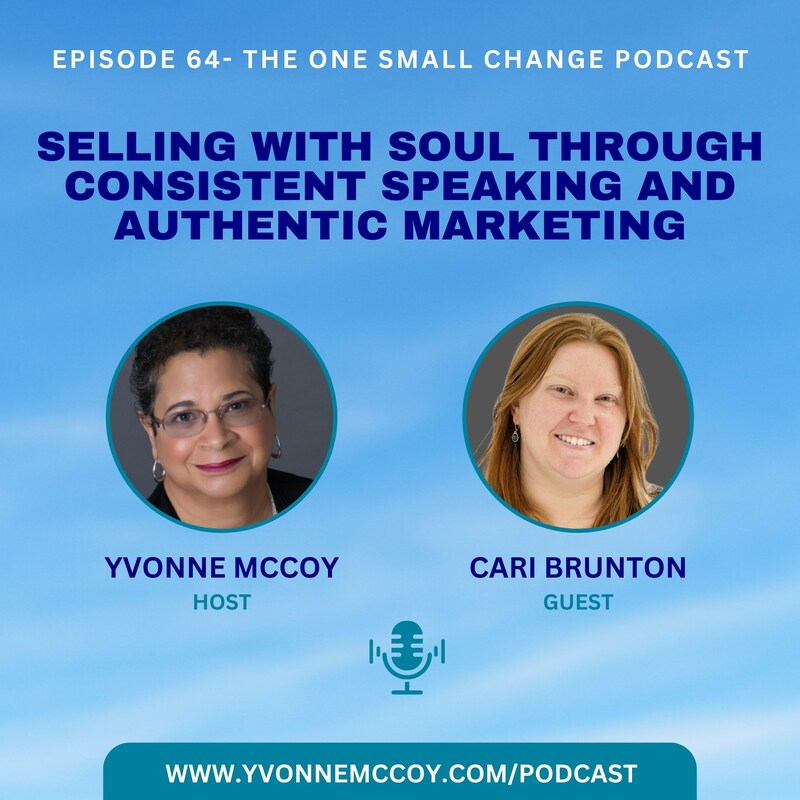
Shownotes
In this episode of the One Small Change Podcast, host Yvonne McCoy sits down with event strategist and speaking coach Cari Brunton, who shares her inspiring story of transforming her business during the pandemic. Cari opens up about the rocky transition from live events to virtual webinars, the valuable lessons learned from initial failures, and how embracing authenticity became the cornerstone of her success. Listeners will get actionable insights on connecting with the right audience, leveraging their unique energy, and why focusing on speaking as a marketing strategy can accelerate business growth. This episode is packed with tips on showing up consistently, finding the right communities, and crafting workshops that sell—not just entertain.
Guest Bio
Cari Brunton is an event strategist and speaking coach with a deep background in nonprofit fundraising, public speaking, and marketing. After shifting her business from live event planning to virtual webinars during the pandemic, Cari’s passion is helping entrepreneurs find their voice, embrace their authentic selves, and turn speaking opportunities into clients. Her approach blends practical sales psychology with real-world experience, guiding clients to connect, engage, and thrive in today’s dynamic business landscape.
Chapters:
00:00 "Exploring Transformation with Yvonne McCoy"
03:23 Early Public Speaking Journey
09:46 Mastering Persuasive Sales Speaking
11:11 Discovering Unique Coaching Strengths
14:24 "90s Gaming Nostalgia: Cruisin' USA"
17:31 "Effective Office Hours Strategy"
21:46 Entrepreneurship: Value of Community
23:27 Prioritize Tasks by Energy Levels
29:07 "Podcast Growth and Impact Journey"
30:28 Embrace Change, Embrace Uncertainty
Quote from the Guest:
“If you don’t like your marketing, stop doing it. Find something you do like. There’s so many tactics out there, guys. Find the ones you like. Stick with them. Your business will go further.”
Links:
7 Questions to Ask Before Accepting a Speaking Gig
Transcripts
Welcome to the One Small Change. And as always, I am
Speaker:thrilled that you're on this journey with me of exploration and transformation.
Speaker:And I'm your host, Yvonne McCoy and I bring almost 30
Speaker:years, I can't believe I'm saying that, 30 years of entrepreneurial
Speaker:experience. I have a passion for discovering growth through the power
Speaker:of seemingly small change. So I am glad that you're joining me.
Speaker:This week we are talking with Cari Brunton and, and she's
Speaker:going to show what the change and share her
Speaker:story with us that had a change in her business
Speaker:and why she does what she does and why
Speaker:she's so good at it. Cari, thank you for
Speaker:coming. Thank you for spending time with us. Thank you so much for having
Speaker:me today, Yvonne. So I, you know, one of the things for me for
Speaker:the podcast is to let other people experience, experience
Speaker:what, you know, other people have gone through in their business and
Speaker:see that they can make a small change in their business and expose them
Speaker:to people from all different kinds of businesses so they can get
Speaker:ideas. So tell us what your, you know, what happened that
Speaker:made you change and I'm assuming that this is your business more than
Speaker:anything else. And you know how it
Speaker:snowballed and built momentum. Yeah.
Speaker:So I decided to host my first webinar in
Speaker:2020 because of the
Speaker:pandemic. And what happened was I had, up until that point
Speaker:I had, was only working on live events. I opened my business
Speaker:for live event planning. That was the focus, that was all of it.
Speaker:And I live in Canada and So March of
Speaker:2020 we shut down everything.
Speaker:And for those of you who don't know, Canada had very strict lockdowns
Speaker:across the country. And then some provinces were allowed to set their
Speaker:own things, just like some of the states were. But we were
Speaker:on very harsh lockdown for a long time, for
Speaker:nearly two years. And so live
Speaker:events were gone, bye, gone out the door.
Speaker:And I had to do something because my business
Speaker:just came to a screeching halt. I, I have to
Speaker:tell you, I experienced the same thing. I was working with
Speaker:female executive directors of non profits and
Speaker:it's like their funding dried up overnight. They couldn't bring
Speaker:people in to provide services. And you know,
Speaker:on Monday I had a business and on Friday I didn't.
Speaker:Absolutely. I, I actually mainly had non profit clients
Speaker:at the time because I have a extensive background raising
Speaker:and they were just like, wait,
Speaker:like we don't know. So yeah,
Speaker:so my contracts just kind of went and I was
Speaker:crying on the couch because
Speaker:how do you deal with that? Right. And so fortunately,
Speaker:I started getting asked about webinars
Speaker:and marketing webinars specifically. And so I watched a couple
Speaker:and I was like, I should do. I should, I should, I should do this.
Speaker:I'm gonna do this. And it just
Speaker:sparked a total explosion in my business that I'm so grateful
Speaker:for. And I started speaking
Speaker:when I was four years old. There was a program through my school that you
Speaker:could do public speaking as an extracurricular type of thing. You memorized
Speaker:a poem and you went and you presented and you got out of school for
Speaker:a day. It was all wonderful. It's all benefits. Right?
Speaker:You know what? In retrospect, smartest thing I could have done,
Speaker:I, I think I was just excited to talk. So
Speaker:I'm still just excited to talk, to be honest with you. But.
Speaker:So I'm extremely comfortable with public speaking. I was like, okay, I have a huge
Speaker:marketing background. Public speaking. I totally got this.
Speaker:So I get on stage, I've got 40 people in the room. Which
Speaker:for anybody wondering for your first webinar is a.
Speaker:It is, right? Because the marketing side. The marketing side, I have. Right. So I
Speaker:had 40 people in the room. I got up, speak,
Speaker:you know, I let it all flow out. People are nodding, people are
Speaker:laughing. People are, you know, people are clapping afterwards. People are telling me, you did
Speaker:such a great job. What a great webinar. That was amazing.
Speaker:Nobody bought a thing.
Speaker:I felt so stupid. Open mouth,
Speaker:insert shoe. I was so certain this was going to be totally
Speaker:easy for me. Like, you know, it was going to be this next thing to
Speaker:breathing for me. Right. And nobody bought a thing.
Speaker:I was so embarrassed,
Speaker:just not because I had made like huge public claims of. I'm going to sell
Speaker:all the things, you know, but just I had been so sure that I
Speaker:had this and smack in the face, no, you don't.
Speaker:I just interject this because please do.
Speaker:You know, one of the things that I have trouble with is,
Speaker:I mean, and I've been paying attention to how many people go, I really
Speaker:had a good time at your workshop. And I. And I've been saying
Speaker:to myself, not enough pain. I am not.
Speaker:They're having too good a time. I'm entertaining. It's not enough
Speaker:pain. So I can understand
Speaker:why that happened to you. I love, I love that. That's,
Speaker:that's the thought. I would encourage you to get out of that mentality.
Speaker:Well, you know, it's not enough decision making information.
Speaker:Okay, okay. But this is the shift I want. You to make on that one.
Speaker:But, but yes, I understand and, and because
Speaker:as. As glad as I am when people have a great time and are
Speaker:entertained when I talk, at the end of. The day, I want you to buy
Speaker:stuff. Well, I had somebody who stayed afterwards
Speaker:and said, I want to give you a couple of tips. And
Speaker:after a minute I had to say to myself, you have to. You have to
Speaker:be careful who you listen to. Right? Yes. And she was
Speaker:in the entertainment business and she wanted to make it more entertaining.
Speaker:And I was like, I see where you're coming from, but that
Speaker:is not what I'm about. So that's not the right advice
Speaker:for me. But anyway, it's just funny that you should say that. Sorry.
Speaker:No, no, no. It's. You know what? Entertainment is great. Like, I don't. You never
Speaker:want to be the boring speaker, right? The speaker who don't. Who love people
Speaker:sleep. And when you make people laugh or you make people metaphorically
Speaker:cry, if you make people literally cry, you'd be really impressed. But
Speaker:I don't see that very often. Uh, but if you're
Speaker:making them laugh, making them cry, they are more likely to buy from you.
Speaker:So those are great. But it's not about the because you're entertaining, it's
Speaker:about because you're connecting. Right. And those are different things.
Speaker:Yes, but we're still amused and engaged when we're connecting. But
Speaker:we're not. It's not necessarily. You know, I'm watching my favorite TV show with a
Speaker:bowl of popcorn, so. So the point that you made that I
Speaker:think is really important and what I talk about is
Speaker:when you are your. When you are you. Right.
Speaker:People spend a lot of time workshopping their
Speaker:workshops, you know, and, you know, what's the time and what's
Speaker:of this and what's that and stuff. And what they forget is the most
Speaker:important ingredient is themselves. You
Speaker:know, how do you do it and come across as yourself? Because
Speaker:people are buying you. Yes, it's the first thing we buy.
Speaker:That's the first thing we really buy, is you. Your services are great,
Speaker:but before you actually start providing that, we're buying you.
Speaker:And I always say that in your webinars and your workshops, Arch and your speaking.
Speaker:Are. Are people test driving you like you're a car?
Speaker:Don't act like a Ferrari if you're a Jeep.
Speaker:There's nothing wrong with being a Jeep. Do you know how many people are out
Speaker:there right now driving Jeeps? Right.
Speaker:There's nothing wrong, but just be who you are. I like to think of myself
Speaker:as like a 1950s, like cherry red Sports car, you know, all the curves
Speaker:and, and the zip. But
Speaker:if I'm going to be a car, I'm going to be a hot car. But
Speaker:so, but, but that's, that is such an important thing, is you got to be
Speaker:new and there's nothing wrong with you. And the
Speaker:more you let you out of the box, the more people like you, the more
Speaker:they connect with you, the more they want to buy from you. All
Speaker:right, So I think that the caveat,
Speaker:but the good caveat is the people that are
Speaker:right for you want to buy from you. And those
Speaker:people will recognize your value and will be willing to
Speaker:pay you more for what you do. And so you don't have,
Speaker:you know, you aren't caught in that cycle of undercharging or saying, should I put
Speaker:a discount on this or should I do. You know, and, and, and the
Speaker:other part is you do your best work
Speaker:with the people who, who
Speaker:naturally connect with you. Yeah.
Speaker:And because they. That you're starting to build that whole trust thing,
Speaker:and you share things in common, you know, that you can relate
Speaker:to with each other. Yeah, absolutely. And you
Speaker:know what? It's. It's all a little things. Like, did you know that if you
Speaker:have a pet and they walk on screen while you're speaking digitally,
Speaker:other people in the room with pets are almost two times more likely to buy
Speaker:from you? That makes sense. It's just, it's an
Speaker:instant bonding thing. It's, hey, they're a pet owner.
Speaker:Their life is like my life. They're gonna get me. Yeah. You know, it's just.
Speaker:It's one of the. We look for those connections. And so it's really important
Speaker:to drop those while you're speaking. And I'm very pleased to tell you that after
Speaker:that first bomb in the face of my webinars, I,
Speaker:I have turned it around. I did a lot of training, a lot of expertise,
Speaker:and I learned a lot of things that so many people don't know about
Speaker:sales psychology, about speaking to sell, about the
Speaker:difference between creating a talk that leads people to make decisions
Speaker:rather than just applaud and say, hey, that was great. Bye now.
Speaker:Right. And because to me, and I realized
Speaker:that so many people were in that mindset that I was. That those things should
Speaker:just be instinctual. It should be natural, it should be easy. You just get up
Speaker:and talk and go. And so
Speaker:those are the people I want to help. And I realized that they need my
Speaker:help. And so I'm here for you, and I'm here to show you that you
Speaker:can be you, you can relax, you can let whatever kind of car you are
Speaker:out of the garage and people are going to
Speaker:want to drive with you. All right? I have friends who, if I say,
Speaker:hey, I'm going to the middle of nowhere and it's going to be really
Speaker:fun. I have friends who are going to say, I don't get, I don't know
Speaker:what you're doing, but let's go. Right. And then I have people who like
Speaker:have, in my life who have just essentially hated me for exactly
Speaker:who I am. And while I personally like to think it's because they're very repressed,
Speaker:I am more of a free flowing kind of person. It doesn't
Speaker:matter. Right. That's on them. Well, here, here's the
Speaker:thing that I think is that I've experienced
Speaker:is, you know, I had, I had a client who was kind of my
Speaker:wingman on a workshop, and after the workshop she said to
Speaker:me, I don't know
Speaker:how to tell you this, but the person that did that
Speaker:workshop is not the coach I love working with.
Speaker:Yeah, because I had, you know, workshopped this thing to death. I
Speaker:mean, I had the timing down and I had the, you know, the exercise
Speaker:up in there. And so that was really a wake up call for me.
Speaker:And so one of the things that I think is so important
Speaker:is to kind of figure out what your unique powers are. What are
Speaker:the things that you're really good at that somebody else,
Speaker:you know, would not be able to help them as easily. And,
Speaker:and, and really trying to put that into my marketing and what
Speaker:I do. And so one of the words for me is energetic.
Speaker:So it's really been interesting to me that the people that I've been
Speaker:talking to in the last couple of months are saying things like,
Speaker:I love your energy. I mean, you make me feel like I can, you
Speaker:know, get things done. Which means people are
Speaker:self selecting out that don't love my energy,
Speaker:which is good because that, that disconnect of
Speaker:having to move so much slower is, takes energy.
Speaker:You know, I think
Speaker:what I, what I, a lot of my clients have taught me is that they
Speaker:get trapped in the mindset of I have to appeal to as many people as
Speaker:possible so that I have as much potential for sales. And
Speaker:what I remind them, and I will remind your audience, is that
Speaker:the people who love you and who love your energy and love you exactly
Speaker:as you are are willing to pay a lot more money
Speaker:to spend time with you because they love you and they get all the benefits
Speaker:of working with You. Can we. Can we talk about that a little bit? Because
Speaker:I think that is so important. And. And the.
Speaker:You know, the. The whole. To me, the whole misconception of the
Speaker:funnel thing, you know, you throw this really big. You know, you throw this
Speaker:really big net and hope that you get enough people
Speaker:in there that they'll, you know, kind of come through where it's.
Speaker:To me, it's much better to throw a more specific net
Speaker:so that you've got more. Instead of having 100 people with only
Speaker:maybe two people who are your. Who are your right client, you maybe
Speaker:have 20 people, but 10 of them are your right
Speaker:client. So you're not wasting your time, you know, and you're
Speaker:connecting with the people who are more likely to buy from you.
Speaker:I find that the more specific you can be about your marketing,
Speaker:the stronger people respond to it, because
Speaker:it's. It's like.
Speaker:It's like the car thing, right? When I mentioned that some people are Jeeps, there
Speaker:are some people in your audience who went, I love Jeeps. Where are the Jeeps?
Speaker:I want to go hang out with the Jeeps. And there are. Some people are
Speaker:like, wait, Cari's a 1950s sports car? Damn, that's specific. She's like,
Speaker:she's. And she's cherry red, and she's got curves. And. And.
Speaker:And for those of you who really want to date yourselves with me, there was
Speaker:a Cruisin World USA video game in the. In the
Speaker:1990s where they had. They had an orca car, which is the thing that actually
Speaker:comes to mind. But, you know, and that
Speaker:made other people go, but those people are
Speaker:instantly more excited and more passionate, and that
Speaker:means they're more likely to take action because
Speaker:they're more engaged and they're more connected. And
Speaker:at the end of the day, you're gonna just have more fun with those people.
Speaker:Yes. You get to be more of yourself. You get to be more relaxed,
Speaker:and you get to create an environment that you're excited to be in.
Speaker:And your coaching environments and your program environments really need
Speaker:to be somewhere that you want to be, because otherwise
Speaker:your business is no fun, and it's going to drag you into the dirt. You're
Speaker:gonna get burned out and look around going, I don't know what's wrong with me.
Speaker:Well, you know, answer is, you don't like your own program.
Speaker:Things I always say to people is, just be yourself. Don't feel like
Speaker:you have to put yourself on a pedestal. Because if you try to put yourself
Speaker:on a pedestal, you're Going to get knocked off. I mean, you know,
Speaker:and, you know, so I'm like, I don't have all the answers, but,
Speaker:you know, we'll find the answers together. Right?
Speaker:Absolutely. Is constantly changing. And my
Speaker:strong suit is to help you to implement and
Speaker:talking about implementation. Let's talk a
Speaker:little bit about. So you talked about going to doing more
Speaker:virtual things and doing your workshop. Did you decide that you
Speaker:wanted to do your workshop, like, on a regular basis for
Speaker:consistency or. It took me a long
Speaker:time to find what I wanted, like, like through
Speaker:speaking. And for a while it was regular
Speaker:webinars. For a while it was a rotating series. For a while I
Speaker:was only doing summit speaking. And so
Speaker:it's rotated a lot. I now do have a
Speaker:fairly regular workshop. I try to do it every other month, actually
Speaker:introducing a new one coming up soon. So I'm excited about that.
Speaker:But I do, I do
Speaker:very much speak regularly. The locations change. The.
Speaker:The certain methodologies change a tiny bit.
Speaker:But speaking is something that I'm very consistent about because
Speaker:that's the thing where I'm seeing all of my clients come from, and it's
Speaker:what I'm teaching my clients to do. So they love that. They love that I
Speaker:do it. It's a nice full circle piece. And I agree with
Speaker:you. And, and so for me, part of it is
Speaker:speaking is a strategy. There are lots of tactics
Speaker:about how you can speak, right. So you can,
Speaker:for instance, do a. I do a monthly workshop
Speaker:and I also do. This year I decided to really jump out even
Speaker:more and try to do at least one summit a month, something like that. And
Speaker:I do some podcasts. But what I tell people, and I, I want to hear
Speaker:your side of this is that it's really important to show
Speaker:up consistently, you know, so that people know where to find
Speaker:you. So if you, you know, one of the things that I suggest for my
Speaker:clients is to do like an office hours.
Speaker:They can do like twice a month. It's like two hours
Speaker:that, you know you're going to be somewhere. You know, you invite people to come
Speaker:if nobody shows up, and I guarantee that nobody probably will for the
Speaker:first two, you're working on a camera, so you're working to
Speaker:make it better. Right? But what happens is
Speaker:they know where to find you, that these two times of
Speaker:the month, this is where you're going to be. And so
Speaker:most people, it, you know that that old thing about it takes
Speaker:people 12 contacts or something like that, and you have to be on, you
Speaker:know, and so the first couple, the first month, they probably are not going to
Speaker:find you. Right? But what they do, whether
Speaker:it is two people, I mean, when I did it, I don't think I ever
Speaker:had more than eight people show up, which was fine because I got a
Speaker:chance to talk to everybody. And the times that I had one or two, I
Speaker:actually probably turned at least one of them into a sale. So
Speaker:it's a, it's a great way to start and start
Speaker:consistency and then you can add other pieces to it and still
Speaker:stay consistent. So I don't know how you, what your, what
Speaker:your point of view is on that. So
Speaker:consistency is really important. I, I don't think you necessarily
Speaker:have to be doing the same thing consistently to be considered
Speaker:consistent. If I like to say, to speak
Speaker:consistently doesn't mean that you are only speak. You know, that you are at
Speaker:a, a summit of some kind every week. It might mean some weeks you're at
Speaker:summits and some weeks you're on podcasts, and some weeks you are,
Speaker:you know, at networking meetings as the guest speaker.
Speaker:It might mean that some weeks you're doing lives. And
Speaker:so I think there needs to be a consistency to it there,
Speaker:that you are frequently doing visibility tasks. I
Speaker:don't think it needs to consistently be the exact same thing. However,
Speaker:the one strategy I have come to absolutely love
Speaker:is hosting a regular workshop. So like I said, mine is every other month.
Speaker:And what I do then is when I speak at summits and on networking
Speaker:groups and things like that as a gift, because you are often
Speaker:asked to give a gift as a speaker. My
Speaker:gift is a free or $1 ticket to my workshop,
Speaker:which is one of my key ways of filling it. And then we
Speaker:actually get to do a little bit of work together. We dive in and
Speaker:actually do a few things. So you get more of a sample of my coaching.
Speaker:And that way it's, it creates
Speaker:a filling system. Right? It's a way for you to fill up. But you are
Speaker:still being that consistent person. You're still being,
Speaker:showing up regularly. You're still offering yourself visibility options.
Speaker:So I don't think you necessarily have to. So if, if it feels good,
Speaker:that my, my big rule in marketing is this, if it feels good, do it.
Speaker:Yeah. If it doesn't feel good, pay somebody else to do it or just don't
Speaker:do it. Those are the two
Speaker:combinations. Now if it doesn't feel good and you want it, but you,
Speaker:you really like the idea, go get a coach.
Speaker:Go get somebody who will show you how to do it and who can either
Speaker:you Know who can hold your hand, who can walk you through the process. If
Speaker:speaking sounds fun, call me. If you know, if social
Speaker:media seems like something that you would have a lot of fun with, go get
Speaker:a social media coach. There. There's a lot of
Speaker:room for that. And anybody who doesn't have a coach right now,
Speaker:you need a coach. I don't care. You need mentors in business. It's the
Speaker:only way you're going to keep going. I don't know anybody successful in business who
Speaker:doesn't have a coat, at least, like, multiple coaches on the go kind of
Speaker:thing. So you need a coach. So if
Speaker:you're like, I want to do this, but I'm not doing it, or I want
Speaker:to do this, but it's hard or anything like that, get a coach.
Speaker:If you're doing it and you're like, I don't want to do this, it's not
Speaker:getting results and I'm not enjoying myself, just stop doing it.
Speaker:Yeah. So either. Yeah. Until you can pay somebody else to do
Speaker:it or just you don't need to do it at all. So if we were
Speaker:talking about steps to take action, you know, one of the
Speaker:things you said is get a coat. Absolutely. To help you
Speaker:to get, you know, and, and, and I add coach and community
Speaker:because sometimes being an entrepreneur is kind of lonely.
Speaker:And like I said, I did, I did everything backwards. I have
Speaker:to admit, it took me a really long time to see the
Speaker:value of community because I felt like when I joined
Speaker:a community, I had to be like an expert.
Speaker:So I was like, crafting whatever it was I was crafting.
Speaker:But the thing about a community is there's always going to be
Speaker:somebody ahead of you. There's always going to be somebody behind you. And what
Speaker:that means is you're going to add value to the people who
Speaker:are newer than you are. You are going to get value
Speaker:from people who are ahead of you and sometimes even add
Speaker:value to the people who are ahead of you because they've forgotten
Speaker:what it was like when they were starting, you know, or they were coming along.
Speaker:And so coaches and community, I think, are
Speaker:absolutely a must. What else?
Speaker:I would add a caveat that it's join the right community because
Speaker:you. There are communities that will fill you up and communities that will drain you.
Speaker:And you need to be in one where you feel comfortable, where you're excited to
Speaker:go to the meetings, where, you know, I have a group that meets on
Speaker:Thursdays, and come hell or high water, I'm there because that group
Speaker:is so Much fun. I get so much out of it. The, the trainings are
Speaker:amazing, the connections are phenomenal. And then I have groups
Speaker:that I consistently skip because I'm not seeing
Speaker:the value and it's not fulfilling to me. So I would, I would,
Speaker:I would caveat that it's so the right
Speaker:community. So I think one of the things that we're both, we're saying,
Speaker:whether it's about community and stuff, is use
Speaker:your, your energy level as part of the way you
Speaker:prioritize things. So things that give you
Speaker:energy, you know, and how much energy you have
Speaker:is a wonderful way to kind of gauge how you prioritize things.
Speaker:And, and for instance, I used to always meet my clients in the morning
Speaker:because I thought that's when I'm the best, right. And then all the tasks
Speaker:that I had to do that required that I really think and you know, whatever
Speaker:were in the afternoon and I would be really struggling with them.
Speaker:And what I found was seeing my clients in
Speaker:the afternoon actually energized me and so I
Speaker:just flip flopped it. You know, I do my, my thinking and you know, like
Speaker:two hours in the morning that I'm doing stuff that I need to do and
Speaker:do my clients later because, you know, they get me going. So
Speaker:we're going to prioritize our energy. We're going to get a coach and,
Speaker:and, and community. What else? We're gonna start to
Speaker:speak and you get to choose what that looks like. If that looks like
Speaker:you start with, you know, office hours. If that looks like you have a start
Speaker:with a webinar, which is actually where I recommend you start because you get to
Speaker:have more control over webinars and workshops when you're the one hosting
Speaker:and, and start growing from there. It is the fastest way to grow
Speaker:your audience. It is the easiest way to bring in enough
Speaker:clients to fill a group program. I cannot recommend speaking
Speaker:enough. It's fun even. I have
Speaker:several clients who are introverts who, you know, were very nervous about getting
Speaker:started speaking and now they love it. And it's their favorite way of marketing their
Speaker:business because they, it's when you're doing it really
Speaker:well, it really feels like you're just going out and hanging out with a
Speaker:bunch of your ideal clients. Yeah. So that
Speaker:brings us to your free gift. So tell us about that. Yeah.
Speaker:So today I have for you all, it's the seven questions to ask before
Speaker:accepting a speaking gig. Now, when you're starting out and you're first
Speaker:speaking, if you want to accept every possible speaking gig that comes your way to
Speaker:get in the practice. Go for it. However, since we
Speaker:are being very intentional about how we use our time and energy,
Speaker:these are the questions I want you to ask before you accept speech
Speaker:gigs. I want you to learn how to
Speaker:ascertain which gigs are going to give you the most return.
Speaker:How to learn who's going to be in the audience, what's going to be expected
Speaker:of you, all the things so that you know that this giga that
Speaker:I'm going into, I'm going to get clients. I'm likely to get clients. Or this
Speaker:gig is probably not a good use of my time, because
Speaker:one of the reasons that you might not be getting clients right now from your
Speaker:speaking, if you've already started, is that you're speaking in the wrong places.
Speaker:Yeah. So I want you to read this and start
Speaker:asking these questions before you say, yes, I'm gonna be there. And
Speaker:you know what? That is so important. I mean, I
Speaker:cannot tell you. Well, when I first started
Speaker:doing podcast interviews, I was, like, taking everything
Speaker:that came along, and somebody would say, well, I go, well,
Speaker:I'm not. I don't really have a program for parents, but I am a
Speaker:parent, and I can tell you the mistakes I made. Right. So,
Speaker:you know, I would. I did probably about 25 interviews before I was
Speaker:like, I'm doing this very wrong. You know, I'm not
Speaker:talking to who I should be talking to. So I think that is a
Speaker:great gift. And it also is the gift of.
Speaker:I don't want to say control, but it's the gift of knowing when you
Speaker:have clarification that you get to say no,
Speaker:who do? And I want. I want everybody listening to this to be intentional
Speaker:about their. About where they're spending their time and energy. And that means
Speaker:if you're speaking, that means being intentional about where you're speaking.
Speaker:I will not take a speaking gig of, you know,
Speaker:in front of 60 accountants. I could. Can I sell to them?
Speaker:Absolutely. Can I teach them how to speak? Sure. Do I want to? Nope.
Speaker:It's just, I. I love my accountant. My
Speaker:accountant is saving my butt. The concept of chat. I am so confused by the
Speaker:concept of taxes. Like, it's just not for me. But that's okay
Speaker:because it's for her, and that's what. And so she's there, but in
Speaker:Texas. For 15 years, just so you know.
Speaker:So I. I absolutely have love for accountants and bookkeepers. They're just
Speaker:not going to be my ideal audience. Yeah, I get it.
Speaker:All right. So I hate to say this but we are running out of time,
Speaker:so I said it. So
Speaker:you're here because we had such a good time when we, when we, when we
Speaker:connected with each other. So the question is, when was the last time you did
Speaker:something new for the, you know, for the first time?
Speaker:I try to do new things a lot, actually, just because. For several
Speaker:reasons. One is I'm fairly certain I have adhd. I'm in the process of getting
Speaker:tested, so I get bored very easily. So it's like, let's
Speaker:do all the things I need
Speaker:to do. And I can think of new things that are coming up that I
Speaker:will be doing. Like, for instance, next week I'm going to a fire walking seminar.
Speaker:I'm so excited. I mean, just the fact that you booked
Speaker:it. Oh, yeah, I'm too. I'm super excited for that.
Speaker:I have a friend who went and like, he got his head lit on fire
Speaker:and stuff and he's got pictures. I'm like, oh, I need that. So.
Speaker:So I'll be doing that next week.
Speaker:As far as I'm concerned, that counts. I think that's. I think. I
Speaker:mean, I'm really excited about it. It's going to be fun. So. But
Speaker:yeah, what we have to do is find out what happens afterwards.
Speaker:That's what we want to find out about. So anyway, so I
Speaker:got to put in a little commercial and, you know, as a first step, if
Speaker:you haven't done this already, please subscribe and share and engage on, you
Speaker:know, with the podcast on, on social media. And the reason I do
Speaker:it is it's part of my way of trying to give back to the community,
Speaker:to introduce you to people that you may not have met and come up with
Speaker:some things that you can use in your business and kind of fuel your quest
Speaker:for growth and impact. And so, you know, I want you to
Speaker:continue to join me on the one small change and embark on a journey
Speaker:where even the smallest shift can yield monumental transformations.
Speaker:And if you haven't listened to the first episode, you might want to, to see,
Speaker:you know, the ideas that I had
Speaker:behind having this and see some, you know, help you with
Speaker:your bold vision and innovation. So, Cari, do you have
Speaker:any last words of wisdom or a favorite saying that you like?
Speaker:If you don't like your marketing, stop doing it. Find something you do
Speaker:like. There's so many tactics out there, guys.
Speaker:Find the ones you like. Stick with them. Your business will go
Speaker:further. That is perfect. That is
Speaker:perfect. Thank you.
Speaker:So remember that change can be simple, but it's not always
Speaker:easy. And it requires a certain amount of courage, resilience, and a
Speaker:willingness to step outside your comfort zone. So you have to be willing to get
Speaker:a little uncomfortable and a little messy sometimes. So I hope you
Speaker:will continue to join me on the one small change as we try to
Speaker:see what. What messiness we can get in.
Speaker:Until the next time, I hope you stay very curious. Cari,
Speaker:thank you so much for your gift and your time. Thank you for
Speaker:coming. Thank you so much for having me. This was
Speaker:great. Bye. Bye.