Shownotes
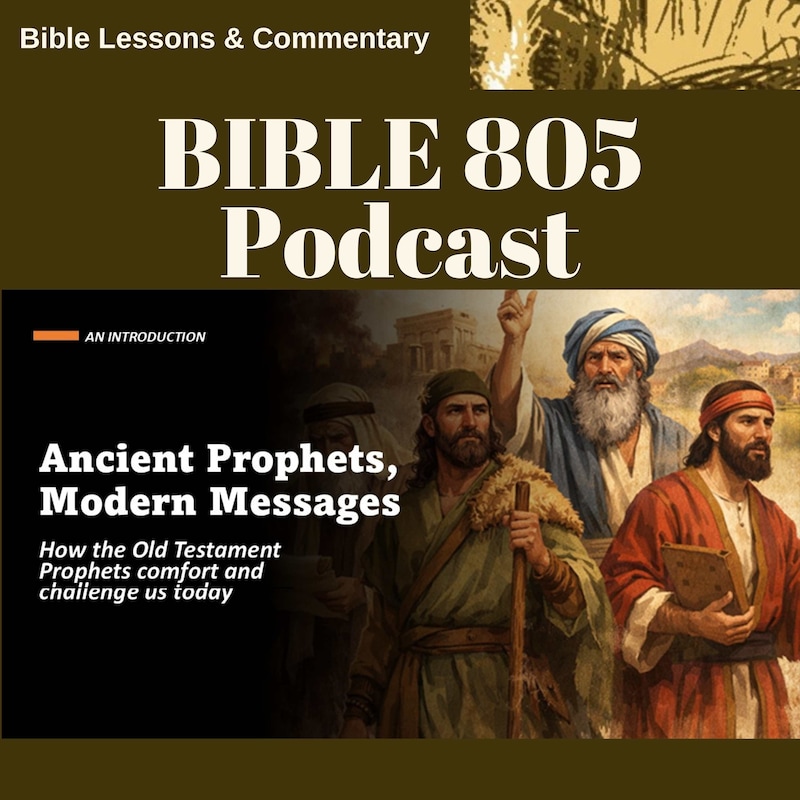
Today, we're diving into how the Old Testament prophets can still bring us comfort and challenge in our modern lives. Many folks assume that these prophets mainly predicted the coming of Jesus or warned about the end times, but that's actually a misconception—less than 2% of their messages are about the Messiah, and even less about future events. Instead, they were primarily focused on addressing the immediate concerns of their communities, reminding them of God's expectations and what would happen if they strayed from their commitments. As we explore this topic, I’ll break down the role of these prophets as covenant enforcers and discuss how their messages are just as relevant for us today. Our journey through these ancient texts will shed light on our responsibilities as modern believers and encourage us to reflect on how we live out our faith.
Takeaways:
- The Old Testament prophets primarily addressed their contemporary audience, focusing on immediate concerns rather than distant future events.
- Less than 2% of Old Testament prophecies pertain to the coming of Jesus, illustrating the prophets' real messages about God's expectations.
- Understanding the historical context of the prophets is crucial for grasping the relevance and power of their messages today.
- God's enforcement of His covenant through the prophets highlights His patience and desire for restoration after disobedience.
- The prophets' messages blend near and far fulfillments, demonstrating the complexity of prophetic timelines and God's sovereignty.
- A foundational lesson from the prophets is that God speaks to His people, calling for both correct belief and correct living.
Links referenced in this episode:
Transcripts
PLEASE NOTE— The transcript for this podcast is A.I. generated and though it has all the content, sometimes has odd breaks, spelling, and spacing.
For an almost exact copy of the text, go to the www.Bible805.com site for downloadable NOTES or to the www.Bible805Academy.com for FREE downloadable and editable Notes, Discussion Guide, Audio and Video files, plus the original PowerPoints—for your personal study or all you need to teach the lesson.
***************************
Hi, I'm Yvon Prehn from Bible 805 and I truly believe the Bible has everything you need to find meaning and purpose, love and peace in this life, and it is a source for forgiveness of sins and eternal salvation. Pretty good stuff. In this randomly scheduled podcast and through longer lessons and shorter challenges, I want to tell you about it by making sometimes complex Bible topics understandable.
So let's do that today with our podcast topic, which is Ancient Prophets, Modern how the Old Testament Prophets Comfort and Challenge Us Today.
What comes to mind when you think of the Old Testament prophets?
When people think of the prophets in the Old Testament, they often think of them prophesying about the birth of Jesus that results in a list of prophecies fulfilled by Jesus in the New Testament. Now that can be helpful and encouraging to our faith. However, less than 2% of Old Testament prophecy is messianic.
In other words, about the coming of Jesus or People think of the prophets as talking primarily about the end of the world, about final judgment, fire and brimstone prophecies, end time events that some try to correlate with contemporary events but but less than 1% of the content of prophetic books concerns events yet to come in the far future time. The majority of the content of the prophets concerns what will happen in the near future of the audience they were writing to.
They were addressing a contemporary audience and reminding them of God's expectations and warning them of what would happen in the near future if they didn't do what God wanted them to do. We'll get into that in a few minutes, but first I just have to bring up this verse that's a caution and a comfort to all of us right now.
And that is, here's what we need to remember in troubling times. Do not call conspiracy everything these people call conspiracy. Do not fear what they fear and do not dread it.
The Lord Almighty is the one you are to regard as holy. He is the one you are to fear. He is the one you are to dread. Isaiah told us this many, many years ago and is so appropriate for today.
Only God, our Lord Almighty, is to be feared, and with him we are totally and forever secure. So if the prophets are not primarily about prophecies about Jesus or end time warnings, and that isn't our focus, what are they about?
First, let's define a prophet. What is a prophet? What does it mean to prophesy? The basic definition of a prophet is one who speaks for God. To prophesy means to share that message.
Writing or speaking it. The prophecy is the resulting message. Again, though we often equate prophecy with talking about future events, that's only part of its meaning.
More than that, their message consisted of explaining God's laws and reminding people of their responsibility to obey them, rebuking and calling people back to God. One way to say this is that prophecy is more about forthtelling than foretelling.
Now, a lot of what I have to say on this, and much of my approach comes from being inspired by the book how to Read the Bible for All It's Worth by Gordon Fee and Douglas Stuart. And this is a book on biblical genre, which means the types of writing that are in the Bible. And here's what they say about the prophets.
They say that the prophets were covenant enforcement, mediators. Israel's law constituted a covenant between God and his people. It was first given in Exodus, immediately after they left Egypt.
We'll talk about this a little bit more in a minute.
The law contained not only regulations and statutes for them to keep, but the sorts of punishments, the curses that God will necessarily mete out if they do not. God does not merely give Israel his law, but he enforces it. That is the message of the prophets.
Now let's look at what they promised and when they did it. Exodus 19. Only two months after the Israelites left Egypt, they arrive in the wilderness of Sinai. And here's what it tells us in Exodus 19.
Then Moses climbed the mountain to appear before God. The Lord called to him from the mountain and said, give these instructions to the family of Jacob. Announce it to the descendants of Israel.
You've seen what I did to the Egyptians. You know how I carried you on eagle's wings and brought you to myself.
Now, if you will obey me and keep my covenant, you will be my own special treasure from among all the peoples on the earth. For all the earth belongs to me. And you will be my kingdom of priests, my holy nation. This is the message you must give to the people of Israel.
So Moses returned from the mountain and called together the elders of the people and told them everything the Lord had commanded him. And all the people responded together. Now listen to this. This is what they said. They said, we will do everything the Lord has commanded.
So Moses brought the people's answer back to God. We may forget what we promised God, what we tell him. Oh, I'm gonna do it. I'm gonna be good. I'm gonna be good. We might forget all about that.
He doesn't. And God later spells out again for them, in fact, he does this numerous times.
Exactly what would happen if they didn't keep their word, if they didn't obey early on after leaving Egypt?
Here two primary areas in Leviticus 26 he says, however, if you do not listen to me or obey all these commands, and if you break my covenant by rejecting my decrees, treating my regulations with contempt, and refusing to obey my commands, I will punish you. And then we know they didn't. They didn't believe him.
They did not trust him to defend them and fight for them before they went into the promised land. So they wander for 40 years, but after 40 years, God hasn't given up on them. They have another opportunity to go into the land.
But they're reminded that the laws still apply. And in Deuteronomy 4:26, God says, Today I call on heaven and earth as witnesses against you.
If you break my covenant, you will quickly disappear from the land you are crossing the Jordan to occupy. After listing and please read these passages in Deuteronomy and Leviticus.
After listing the curses and blessings in Moses final sermon, he ends with therefore choose life that you and your descendants may live. God wants us to choose life. Now, it's really important to keep in mind the timing of these promises.
I have in the handouts that go along with this podcast and video. I have numerous charts that emphasize the timing of these things.
e out of Egypt, approximately:But remember, once again, it's all based on their initial promise that they would obey God. At the very start of Israel becoming a nation. They promised to obey, to serve God, to keep his commands.
At the same time, they were clearly told what would happen if they disobeyed. Much of the rest of the Old Testament events are the result of whether they did it or not.
God does not act in an arbitrary, cruel way in how he treats his people. On the contrary, you'll see incredible care and patience as he sent the prophets again and again and again before bringing judgment.
Now, contemporary application God expects a certain behavior from his people. When we become Christians, we're expected to know what that means. And the Bible, we don't have prophets necessarily coming to us, spells it out.
And the commands are not outdated. There are consequences to disobedience, and these are not only for rewards or punishment after we die in some circles.
There's a belief today that because Jesus died for our sins past present and future. And he did that. We can live how we want to live, do whatever we want to do after we grab the goody of grace and do it all without consequences.
That is a huge error.
The children of Israel thought the same thing, that just because they were God's redeemed people redeemed from Egypt just because they gave him token worship, that they could live however they wanted to live. These books show how wrong that idea is and how God held them accountable for their disobedience.
We can learn from them because God's expectations of his chosen people really don't change now.
This doesn't mean again immediate punishment or blessings, but it does mean that we need to take seriously if we choose to follow God to be his people because we are now his chosen representatives. 2Nd Peter 2, 9 in the living Bible says, you have been chosen by God himself. You are priests of the king. You are holy and pure.
You are God's very own. All this so that you may show to others how God called you out of darkness into his wonderful light. Once you were less than nothing.
Now you're God's own. Once you knew very little of God's kindness. Now your very lives have been changed by it.
Dear brothers, you're only visitors here since your real home is in heaven. I beg you, keep away from the evil pleasures of this world. They're not for you, for they fight against your very souls, astounding as it is.
Yes, these verses mean us. We are representatives our Lord of our Lord and we want to be good ones. Now application to us Pay attention as we begin this study.
The Message translation of First Corinthians 10, 11 and 12 is quite blunt in its application to us of the lessons of the Old Testament and the lessons of the prophets are primary in this and how we ought to act. Here's what it says. These are all warning markers. Danger in our history books written down so we don't repeat their mistakes.
Our positions in the story are parallel. They at the beginning, we at the end and we are just as capable of messing it up as they were. So don't be naive and self confident. You're not exempt.
You could fall flat on your face as easily as anyone else. Forget about self confidence. It's useless. Cultivate God confidence now. How these books will help us. Please God. God doesn't change.
He expects a holy set apart behavior from the people he called to represent him on earth. If his people do not act the way they're supposed to act, there will be discipline as Hebrews 12 tells us that God will discipline us if we disobey.
Like a father who loves his children and wants them to grow up properly.
We don't immediately expect lightning to strike, but we may spend time wandering around in circles just like they did those 40 years in the desert if we ignore God's word to us. And so we'll study these prophets and learn from them to better represent our God. Now here's how we're going to do it. We won't read all of them.
Now please look at the overall chart that I've given you for how they fit in. But these are the ones we're going to cover. Week one we are talking about this introduction. This is what we're doing right now.
The historical setting, how to understand the prophetic writings. Week two, we're going to talk about Jonah. So much more than a fish. Week three Amos, an unlikely prophet of justice.
Week four Hosea, when God uses your life as a lesson. Week 5 Habakkuk, it's okay to challenge God and ask why. Week 6 Ezekiel and Daniel, which we can describe as either wine or work or witness or wonder.
And week seven, Haggai and Zechariah, because God never forgets dreams or promises. Now here's how they fit into the Old Testament. I have a chart for you. It's the Old Testament prophets timeline.
I'm showing it to those on the video in my live classes. You got a copy of it? If you're listening to the podcast, please go to www. Bible805 and download this.
It is by far the most popular download on my website. Literally I don't know how many, 70, 80,000 I lost track of. People have downloaded this on the site, but please do download it.
It shows you when a prophet lived who was king at the same time, basic historical happenings that were happening at that time. I think you'll find it very useful to keep this timeline in of what's happening when with the prophets.
Now don't worry about how they fit into the overall history as we start out because we're going to take them in historical order. I'll illustrate and explain the history of each of the prophets in the coming lessons.
And this understanding of their history and the exact setting of their message is incredibly important because in our Bibles the prophets aren't in historical order nor are they in a context where you can see what was going on that prompted the prophets message. The prophets are all placed behind the historical and poetic books. In your Bible and in this order we have what are called the five major prophets.
Two of them were written by Jeremiah, and they're called major not because of their importance, but just they're longer than any of the others. These include Isaiah, Jeremiah and Ezekiel, Daniel and Lamentations. And then we have the 12 minor prophets. Again, not important.
They're just shorter books. And here we have Hosea, Joel, Amos, Obadiah, Jonah, Micah, Nahum, Habakkuk, Zephaniah, Haggai, Zechariah and Malachi.
They're placed where they're placed according to their genre or the type of book that they are. But what's really crazy about it is they aren't even in historical order in the sections they' in.
Jonah was actually the first prophet of all of these and he's kind of near the end, middle whatever. But they are just how they are. But because of that, you have no sense of the historical setting in which they took place.
And it would be just like, now listen to this little analogy, because it's really important that you understand this about the prophets.
Imagine two to 4,000 years from now, which is the amount of time between when the Old Testament first took place and the New Testament and then today and someone again way, way far distant future is wanting to read about the 20th century. Now, the first part of the book that they pick up, imagine a book like this. The first part of the book.
You'd have a retelling of some of the great events that took place. Maybe the history of the Great depression, World War II, the Civil Rights movement.
Now, after just the basic history, you'd have chapters quoting poetry, philosophy. You'd have some romance stories of, you know, romance is a big deal. So you'd have some romantic stories thrown in there.
And then finally, at the end of the book would be famous speeches of the times. But they wouldn't be in any kind of historical order. Nor would you know where they were given or maybe even necessarily who they were from. For sure.
There'd be a speech by somebody named Churchill telling people to never give up, but we're not really sure what they weren't supposed to give up from or for or whatever. But then there's a speech by an FDR on only fearing fear itself.
And then finally there's one from a preacher named Martin Luther King about a dream that he had. Now, how well would you understand the 20th century if you read about it in that way?
How much sense would it make if the speeches wouldn't make any sense outside of that book? You couldn't place them. You wouldn't know the history that produced them. How much sense does any of it make?
Well, that's what happens when most people read the Bible today. They might just gut it through to say they read the whole thing, but that doesn't mean they understand any of it.
And it's no wonder that nobody pays attention to the power and the purpose of the Old Testament prophets when their words are divorced from the current events that prompted them.
But when you read them in context and understand the current history, when they spoke, they become alive in the same way that it does when you understand what it meant for Martin Luther King to stand on the steps of the Lincoln Memorial in the historical event that it was before a quarter of a million people. For him, a black man who had lived in the terror of all sorts of racial hatred, and for him to stand up there and say, I have a dream.
When you understand the context, you get the power of the message.
Now, the order and placement of the books isn't the only challenge on dating, because some contemporary commentators cast doubt on the exact dating of the prophets. Based really finally and overall on simply anti supernaturalist point of view.
They attempt to date everything far later than when it was first written. But internal biblical evidence, archaeology, source criticism, much current scholarship shows the validity of traditional dating.
And we'll discuss this much more with individual books. And again, the chart that I gave you has very accurate dates.
Now the thing too that this casts doubt on if you don't put things in their proper place is on the overall sovereignty of God. Because as another, another chart shows, and you know, again, go to the website or you can go to the Bible 805 Academy in just a little bit.
Give me a couple hours actually for when you're listening to this, because I have to upload all the things the Bible805academy.com and you can download all the charts, notes and everything on this. But I have another chart that shows you God's time, how he sees everything, past, present and future.
And so he can speak of things as if they've already taken place. Even though from our viewpoint, where we're just little people down below moving through time, we don't know what's happening yet.
So the dating is very important. This is one of the most powerful proofs of the divine uniqueness of Christian scripture. Again, we'll go into the details of each book as we go along.
Now back to more about the prophets overall. First of all, their audience.
Though they spoke primarily to Israel and Judah as covenant enforcers, they also often spoke to the nations around them, because everyone is accountable to God. In addition, some spoke specifically for how they treated Israel, usually as a final judgment.
For example, there are specific prophecies by Obadiah to Edom because they were mistreating Israel, they were not acting as the brothers that they were. And Nahum spoke to Nineveh when they slipped back into sin after the revival under Jonah. Now it's time for their total destruction.
Now, the authority of the prophets, they didn't claim personal authority. They came from a variety of backgrounds. They were farmers, priests, royalty. Some backgrounds we know nothing about.
But they all emphasized that the message was not their own. The message came through them. They did not make it up. They knew they spoke the words of God. They often repeated this phrase.
And by the way, it's really interesting. I was just looking this up actually, after I gave the presentation in my live class.
Almost all of the prophetic books start out by saying the word of the Lord came to. And then it gives the prophet's name, tells the timing of when they spoke. It was all God's message that came to them.
They didn't just decide one day that they were going to speak for God. God called them. And as often the case, some were reluctant, some were hesitant.
I mean, it probably was not going to end well for you if you decided to take up the calling of prophet. But like Jeremiah, the message burned in them and they were compelled to speak.
Now, their message wasn't all negative, but you'll only see that if you read the entire book, not by just pulling out random passages. There was always a message of hope, if repentance. And there was also, almost in all the books, a promise of unconditional restoration after judgment.
In these books, we see the heart of God. We see God's patience.
The warnings were repeated, sometimes for hundreds of years, but we see his love, no matter how badly he's treated, as we'll see in Hosea, we'll see his desire for restoration. Heart's judgment was never God's first choice. That's why he sent the prophets to each generation that disobeyed.
And he did it again and again and again. He doesn't send prophets just to beat up on people, but to restore them, to set them right so he can bless them.
As you read single and repeated messages, you also need. This is another thing about time. To understand the prophetic perspective of time.
This can be really difficult because the prophetic books frequently deal with two timelines, a near timeline and a far one.
Now, this is how Gordon and fee describe should be noted, of course, that some of the prophecies of the near future were set against the background of the great eschatological end times future. And sometimes they seem to blend. It's like looking at two discs with a smaller one in front of a larger one straight on.
Then you look at them from the perspective of history from a side view and you can see how much space is between them. You see when you look just straight on. In other words, when you just first read the passage, they kind of blend together.
You don't know exactly what's what. But from a side view, you see that there may be a lot of time in between. Another illustration is envision a mountain range.
When you look at a set of mountain ranges, actually it looks like they're very close together.
It can be the same way in prophetic events, but just shift the perspective slightly from an aerial view and you can see that the mountain ranges might have really large valleys between them.
Since God sees all of time, when the prophets speak for God, it can sometimes be a bit confusing to know what's supposed to happen when or what might happen as a foretaste, and then the final event much later. Now, one example of both of these is in Ezekiel 37, where it talks about the valley of dry bones coming to life, the near fulfillment.
Israel did come together and return to the land actually during his lifetime. In Ezra 1 and 2, it's talked about it.
But another fulfillment, the far fulfillment, looks ahead to the end of time, of the eternal resurrection of all people.
You see this expansive view of time here and now, the future and forever, constantly intertwined in the prophets and especially in the book of Isaiah. It seems to me that he, among all the prophets, is the one who truly speaks from God's viewpoint.
And he talks about today and tomorrow and the future, the millennium and the kingdom and the, you know, I mean, it just all sometimes in the same chapter. But he, when you realize he's speaking from the view of God, it makes at least a little bit more sense.
Now overall though, the key lesson of the prophets for us is the importance of both what's called orthodoxy and orthopraxy. Now, Gordon Fee explained it in this way. Orthodoxy is correct belief. Orthopraxy is correct living through the prophets.
God called the people of ancient Israel and Judah to a balance of right belief and right living. This of course, remains the very balance that the New Covenant requires as well.
What God wanted from Israel and Judah in a general sense is the same as he wants from us. The prophetic books can serve constantly as reminders to us of God's determination to enforce his covenant.
For those who obey the stipulations of the new covenant, loving God, loving one's neighbor, the final eternal result will be blessing, no matter what the troubles of this world. For those who disobey, the only result is an eternal curse removal not just from the land, but from the presence of God.
Now, keeping that in mind, my prayer for all of us as we start on this adventure of going through the prophets and their historical settings is that we look at them with contemporary applications in mind.
And I don't mean only in political or socially important areas, though there will be a lot to say about caring for the less fortunate as we go along, because this does matter tremendously to God, but always that we're sure that our orthopraxy, the lessons we learn, become personal to us.
And like the prophet Isaiah responded, when he has a vision with God, we can say, here am I, send me to wherever and in whatever way he chooses as we obey his current message. But above all, we need to keep in mind a foundational lesson of the prophets and to us. And that is that our God speaks.
In the beginning he spoke all of creation into being upon the creation of humanity. God walked and talked personally with his creation in the garden, but his creation turned away in the intervening years.
He was always available and some took advantage of it. Job, Enoch, Noah, Abraham, Moses, and certainly multitudes of unnamed others carried on an intimate face to face conversation with God.
But most people didn't.
And so he sent the prophets, gave us His Word, and ultimately came to earth in the touchable, laughing, challenging and ultimately sacrificial person of Jesus. We have this history of God speaking, but we need to remember he's never stopped speaking.
He speaks through gifted pastors, His Word books that help us see him more clearly. We can interact personally with our Lord in prayer and study and waiting quietly for him to speak to us because he will.
But even as we study and pray, remember the ultimate promise of the prophets is that one day, as Revelation 21:3 promises, Look, God's home is now among his people. He will live with them. They will be his people. God Himself will be with them. The glass will no longer be dark. The veil will be removed.
We can walk and talk with our Lord and God, Savior and friend, face to face forever. That's all for now. Please check out the show notes, a complete downloadable transcript, graph expansion and related materials at www.bible805.com.
Until next time. I'm Yvonne Prynn, your fellow pilgrim, writer and teacher for Jesus, and I'd like to close with this benediction.
May you know the invitation of God to move from confusion to clarity, from wandering to rest, from loneliness to knowing you are loved, from turmoil to peace, from wherever you are in your spiritual journey to a growing knowledge of God's word and in your personal relationship with the Father, Son and Holy Spirit. Amen.

