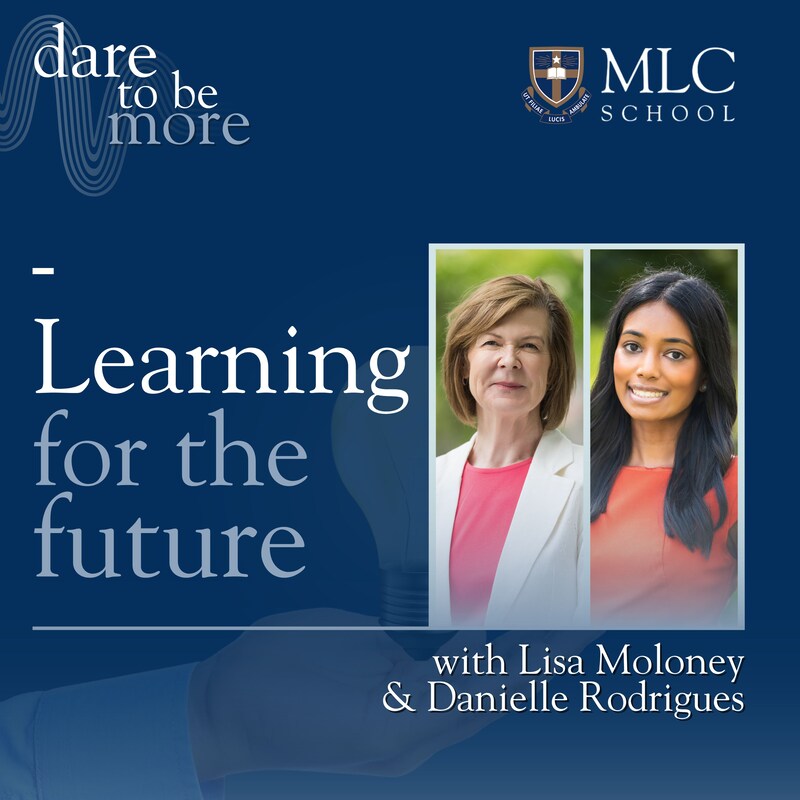
Shownotes
In this compelling episode of "Dare to Be More," host Anthony Perl is joined by Principal Lisa Moloney and the former Head of HSIE Dani Rodrigues, who recorded this conversation before taking on a new role as Director of Students, Year 11 to Year 12, for a rich conversation about what learning for the future truly looks like at MLC School. From a student who used AI-generated voices in her podcast assessment to Year 9 girls designing climate health books for Sydney University, this episode is full of inspiring examples of education at its most innovative.
Lisa and Dani explore how MLC School is embracing AI not by banning it, but by teaching students to use it ethically, creatively, and critically — and how real-world partnerships are transforming what's possible in the classroom.
Featured Guests: Lisa Moloney, Principal at MLC School Dani Rodrigues, Director of Studies (Year 11 & 12) at MLC School
In This Episode, You'll Discover:
- How MLC's HISE faculty uses provocation-based learning to spark genuine curiosity and critical thinking
- A real example of a student using AI-generated voices in a podcast assessment — and the ethical conversation it sparked
- How MLC's partnership with Sydney Science Park brings real-world problem solving into the classroom
- Why MLC chose to embrace AI rather than ban it — and what that looks like in practice
- How the future of learning is about collaboration, agility, and comfort with uncertainty
Key Topics Discussed:
- Project-based and provocation-based learning in HISE
- Ethical use of AI in student assessments
- The Sydney Science Park partnership and real-world problem solving
- Preparing girls for careers and challenges that don't yet exist
- The role of educators as co-learners alongside their students
About MLC School: MLC School is a leading independent girls' school in Sydney, committed to empowering young women through academic excellence, character development, and innovative education. Our mission is to inspire girls to dare to be more.
Connect With Us:
- Website: mlcsyd.nsw.edu.au
- Instagram: @mlcsydney
- Facebook: @MLCSchoolSydney
- LinkedIn: MLC School
Co-host: Anthony Perl
Produced by: 'Podcasts Done for You'Hashtags: #FutureReadyEducation #AIinEducation #ProjectBasedLearning #MLCSchool #GirlsEducation #InnovativeLearning #DareToBeMore
Transcripts
Today I am joined by Lisa Maloney, principal at MLC School and Danny
2
:Rodriguez, head of hissy at MLC School.
3
:In this episode, we explore learning
for the future, including project
4
:based and provocation based learning,
ethical use of AI and student
5
:assessments, real world partnerships
with organizations like Sydney Science
6
:Park, and how MLC is preparing girls
for careers that don't yet exist.
7
:I'm your host, Anthony Pearl.
8
:Let's begin today's conversation.
9
:Well, hello everyone and welcome to
another episode of A Dare to Be More.
10
:And this is gonna be a really interesting
conversation because we're gonna be
11
:talking about learning for the future.
12
:So let me first of all, welcome
Lisa and Danny to the program.
13
:Welcome.
14
:Dani Rodrigues: Thank you.
15
:Thank you so much.
16
:Anthony Perl: Well, I think we
should start by allowing you both to
17
:introduce yourselves, Lisa, for those
that may not have tuned into previous
18
:episodes where you've been featured.
19
:Do you wanna tell everyone who you are?
20
:Dani Rodrigues: Yes.
21
:Lisa Maloney.
22
:I'm the principal of MLC School.
23
:Anthony Perl: And Danny, what about you?
24
:Dani Rodrigues: Hi, I'm Danny
Rodriguez and I'm the head of
25
:department hissy at MLC School.
26
:Anthony Perl: So why don't you tell
us a little bit more about what that
27
:actually means in the context as well?
28
:Dani Rodrigues: Definitely.
29
:I know HSI means a lot of different
things in a lot of different schools.
30
:Unique to MLC, the HSI department
is a dual curriculum department,
31
:so both Nessa and IB courses.
32
:At this point, we are up to 22 different
course offerings across seven, three
33
:to 12, including mandatory geography.
34
:We have two elective lines, which is
global studies, our innovative pioneer.
35
:Outta the box elective, as well as
our traditional offering of commerce
36
:as we move into year 11 and 12.
37
:MLC is filled with plenty
of choices for our students.
38
:So we offer business studies,
legal studies, economics.
39
:We are nearly offering business
services starting next year,
40
:as well as HC geography.
41
:And then if we flip over from an
IB perspective, the offerings are
42
:equally diverse, where we've got
psychology, business management,
43
:economics, and geography.
44
:So in terms of that,
what does that look like?
45
:That's like a team of
roughly 15 to 16 people.
46
:We see every student in the school, and
we are lucky to enough to have really deep
47
:enrollments in year 11 and 12 with a 95%
conversion rate from stage five to a year.
48
:11 students in stage six.
49
:So we're quite blessed
and lucky in that stage.
50
:Anthony Perl: That is a lot of
opportunity people will have there.
51
:And I mean, Lisa, tell me a little bit
about what it means to offer that broader
52
:range of things and where learning for
the future comes into that as well.
53
:Dani Rodrigues: For sure.
54
:Danny sort of hinted there a little
bit about, I guess the elective, and I
55
:think that's the opportunity to really
explore what learning might look like
56
:at the same time as they're really
looking at what the world might look
57
:like has been something that the team.
58
:Danny Leeds has really harnessed and I
think so I might actually get Danny to
59
:talk a little bit about that, but that
this, I think this team is particularly
60
:well placed, both in terms of their
expertise, but also because of the, the
61
:nature of the course that they offer to
really start to explore what learning
62
:of the future looks like now and how
that might progress going forward.
63
:So, Danny, can I, I think one of
the things you were telling me
64
:about was, I guess, the use of AI in
some of the classes and how you're
65
:using that to enhance learning.
66
:I know there's been lots.
67
:There's a lot written about how it
may not enhance learning, but I was
68
:particularly impressed by some of the
work Danny and her team are doing.
69
:Yeah, not a problem.
70
:What I've got, the most innovative
thing we've done in our electives
71
:so far is we really questioned,
funny that we're on a podcast.
72
:We really questioned the
notion of whose voice is it?
73
:So the student had to work individually
and in global studies it's project-based
74
:learning, so they get a massive
provocation at the beginning of the
75
:unit or the beginning of the term.
76
:Something like pandemics are inevitable.
77
:Something really broad, open-ended that
crosses multiple spheres of psychology,
78
:geography, business, and economics.
79
:And they have a choice of how to
present their learning, and that's
80
:what draws students to his ease.
81
:That freedom and opportunity and
where AI fits in is it really gives
82
:us even more choices than before.
83
:So one student decided to do a podcast
and we were like, yep, that's great.
84
:We can do a podcast.
85
:In the unit of work, we go through role
of the media, perspectives of media.
86
:Features of a good podcast, features
of any, all the presentation mode,
87
:but we were really dappling in, okay,
I wanna have a podcast, but I have to
88
:do it myself, but I wanna interview
different people and to present my answer.
89
:I wanna have perspectives from the
media in my podcast, but I'm alone.
90
:So what she did was she typed up a
transcript and the class culture is
91
:so vibrant because everyone's just
presenting their view on that question.
92
:She got a few girls to read it just
to double check that all perspectives
93
:were heard, that it's balanced.
94
:And then she goes, me.
95
:So we speak a lot about ai.
96
:What I want to do is I wanna use
AI generated voices because then my
97
:podcast will sound like a real podcast
because what I'll do is I'll curate
98
:the voices to match the different media
perspectives, and it will sound like
99
:I have a lot of guests in the show.
100
:When she presented that idea
in our project Catch up, I
101
:said to her, that's great.
102
:We're gonna open this up to the class and
we're gonna talk about the ethics of that.
103
:Like is it still your podcast in the
presentation mode as we market, if you
104
:didn't actually say everything yourself.
105
:So who owns that piece, piece of work and
how are you going to decide which voices
106
:to use and when you put it together?
107
:And I have to mark the presentation
quality of that podcast.
108
:Where do we end up next?
109
:Obviously we always push our girls
to be to do next 'cause we're
110
:like, let's just see how it goes.
111
:So she submitted it.
112
:She wasn't happy with the voices.
113
:They still sounded very automated.
114
:It was still her transcript, her voice.
115
:When we did the gallery walk at
the end of the unit, girls listened
116
:to her podcast in the headphones.
117
:They were obviously critical about
some, something sounded a little
118
:bit robotic, but they all had an
appreciation why she picked different
119
:characters for different segments.
120
:And then when we brought it to the
marking team, it taught us to challenge.
121
:Okay.
122
:Our marking guidelines
weren't prepared for this.
123
:'cause when we wrote this task a term ago,
we had the very traditional presentation
124
:guidelines off well paced, well pitched
use of audio, kind of all of these
125
:really traditional senses of what you
think about with an oral presentation.
126
:And at the end of it we were like,
well, what are we actually assessing?
127
:How does that fit into a
very traditional framework?
128
:And I think that's where hissy is
the best position to really take our
129
:students to the next, because we kind
of think what is the future of that?
130
:But also how do we use it responsibly?
131
:And how did we breadcrumb our cause
for that student to feel comfortable
132
:to take that risk in her learning?
133
:And we know perfectionism
is so high in girls.
134
:I think what I love about that too is
that, you know, the future of learning
135
:is not just about the students, is it?
136
:You know, that whole process is about how.
137
:The department, the teachers, the
educators, are learning alongside what
138
:this type of technology means for how,
how we judge whether someone has learned
139
:and what they've learned and whether the
presentation was, what we expect is, I
140
:just love the fact that this is a journey
that we're all on together, and that
141
:as educators, we have to be open to the
fact that things are not how they were.
142
:But at the same time, there is
still real learning to be had.
143
:So I think it's a fascinating
topic and one that we could
144
:chat about forever, I think.
145
:Anthony Perl: And when it comes to
technology, I mean, sometimes it's a case
146
:of just because you can doesn't mean you
should as well as where can you push it.
147
:So it's a nice quandary to have.
148
:And I'm sure there's a lot of ethics to
cover it in exactly this particular area
149
:because what's real, what's not, and that
balance between responding authentically.
150
:And not just relying on
an AI to do everything.
151
:'cause I think that's
the value of it, right?
152
:We are just here, we are responding
to each other in conversation.
153
:And you can't script that.
154
:Dani Rodrigues: No, you can't.
155
:And, but I just think the purpose
of using it wasn't to make her
156
:podcast, you know, content wise.
157
:She wasn't just putting the question in
and putting all her study notes in and
158
:going, Hey, can you write me a transcript?
159
:She just didn't even, that
didn't even cross her mind.
160
:It came through.
161
:I have a problem, I'm not.
162
:She just was very open.
163
:I'm not a very good drum student.
164
:I'm not one of those girls that can
make all these different voices, but
165
:I want my podcast to be authentic, and
this might be as a solo contributor,
166
:how I could potentially get there.
167
:Obviously, I think when we think of
AI and assessment and research based
168
:design, I think most teachers kind
of go through, oh, I give my students
169
:a research based task that they have
to submit at the end of the unit.
170
:They're gonna put it into
chat, GBT or copilot.
171
:It's gonna type them up, a
summary, and then I'm gonna read
172
:a regurgitated version of that.
173
:But when you open your classroom with
AI ethics and you breadcrumb situations
174
:where you push different perspectives to
the students and how it could be used in
175
:an ethical way or how it could be used
next, I think we are less likely to get
176
:those copy paste assignments where we
are just reading what a bot's written
177
:and where they actually have the freedom.
178
:To kind of use it in a different
way than what it was intended for.
179
:Anthony Perl: I think that's
the great challenge, isn't it?
180
:And it's so good to have an education
program that's offering students
181
:that opportunity to challenge the
way things are being done in the past
182
:and, and looking at new technology
and how you can advance that.
183
:Because for so long we were just
stuck in the old ways, right?
184
:That we just had to do things the
way the education system had it.
185
:And now actually looking and
being on the forefront of that.
186
:That's huge.
187
:And let me ask you as well, how
do, how do you reconcile between
188
:the students and what the parents
may think in that situation?
189
:How do you find that balance?
190
:Dani Rodrigues: We haven't actually
had any parental feedback on the task.
191
:I think at year nine is considerably low
stakes at this stage for many parents.
192
:The most is if the students go
home and speak about it with their
193
:parents about how they've used it.
194
:We haven't had a lot of
academic misconduct in our team.
195
:Because most of our assessments are, as
you can see, like evaluative in nature.
196
:So they have to bring some kind of
version of themselves to the question.
197
:And I think we safeguard a lot by having
like group contracts, paired contracts,
198
:group check-ins, everything is structured
in a way where there's really no way for
199
:the students to hide in their learning.
200
:So the teacher as a facilitator
and also teacher as someone that's
201
:visible, means that we are responsive.
202
:And because our team is quite
tight knit every time we.
203
:A problem or something comes to our
desk that's new or unusual because
204
:we kind of resolve it on the front
forefront of resolving it straight away.
205
:So it never really has to
get to a stakeholder where
206
:we have this dicey situation.
207
:Hmm.
208
:Anthony Perl: And you've given a
great real world example in that.
209
:I'm sure there are others where
this is, you know, it's about using
210
:real experiences, isn't it, in
the real world that are going to
211
:enhance what the girls are doing?
212
:Dani Rodrigues: Oh, absolutely.
213
:And I, I, I might jump in next.
214
:I think this is a.
215
:Another, uh, really good example I
guess, of how you enrich learning and
216
:think about learning of the future.
217
:We actually, as part of our strategic
plan, made it a, a deliberate pillar
218
:really around partnerships, around
the fact that the future of learning
219
:is not just contained within a school
classroom or even within a school AI task.
220
:The fact is that in
order for learning to be.
221
:Real sustainable and connected
to the outside world.
222
:We have to get out and partner with
some of those organizations and we're
223
:very fortunate that we have a number
of really rich partnerships across
224
:a, a wide range of subject areas and
professional learning opportunities.
225
:But Danny's team has once again
jumped on board here with that,
226
:with a number of partnerships.
227
:I might get Danny to talk a little bit
about some of the work that they're doing.
228
:Once again, I think mainly at the year
nine level, but we've also got our
229
:similar project going on at year six.
230
:Yeah, so we do have a year six and
nine partnership with Sydney Science
231
:Park, which is run by Celestino.
232
:Essentially it's a Greenfield site,
um, located near the new airport, and
233
:it's gonna be converted into a mixture
of high to low density residential and
234
:commercial areas, commercial space, and.
235
:What we've done this year for the
first time ever, is in our partnership
236
:we've actually leveraged parents as
an expert, as well as experts within
237
:the Sydney Science Park offering.
238
:So what does that look like?
239
:Again, it was a, our first
ever AI embedded task.
240
:So in the past, what we've had is
we've developed a task and it's been
241
:traditional, it's been what we thought
was innovative and the girls have gone,
242
:oh, we wanna do this with ai, or this
with ai, but this time we're like, no, no,
243
:let's just put it in the framework of the
task and you know, roll the dice and see.
244
:Kinda what problems or what opportunities
arise, and essentially the girls
245
:were given a problem statement.
246
:I'll tell you the most challenging one.
247
:So the most challenging thing for the park
is that they would like 40% canopy cover.
248
:So that means large trees.
249
:However, because it's located
near an airport, large trees
250
:that do not attract birds.
251
:So it was a process driven task.
252
:Again, something new and new
for us later in stage five.
253
:But essentially the students had to
undertake primary data and secondary
254
:data, and one of their secondary
data sources could be an AI platform.
255
:It went two ways for
their primary data source.
256
:They could definitely use anything.
257
:We've got so many networks and so many
experts connected Sydney Science Park, but
258
:then we also leveraged our parent body.
259
:As a potential expert.
260
:So architects, anyone in renewable energy,
anyone in urban planning was kind of
261
:used there as well as to supplement it.
262
:Our industry experts that were on site
that were doing the raw data testing,
263
:the students had two approaches.
264
:Each group did something
slightly different.
265
:Some groups put their problem
statement straight into AI
266
:because we said you could use it.
267
:So they went, find me a tree
with 40% canopy, cover that.
268
:Attract birds and they got
this massive list of trees.
269
:As you do, you get this
huge list of trees.
270
:Mm-hmm.
271
:And then they started Googling
these trees and they were like, I
272
:don't like the look of this tree.
273
:Or We can't get this tree in Australia.
274
:Actually this tree doesn't match
the soil or the climate conditions.
275
:So they were starting to find fault.
276
:Process.
277
:And, um, a few groups said the, because
he allowed us to use it, we were
278
:excited, but it actually generated
more questions and answers because we
279
:had to keep going back and quizzing
it because it wasn't getting it right.
280
:And then they had to cross-reference
that to their primary data source,
281
:which was their parent, their floristry
expert, anyone in an like architecture.
282
:Um, some groups did the AI first
and then used that AI answer
283
:to cross-reference an expert.
284
:And discuss the tensions between
what AI produced and what the parent
285
:or um, partnership expert did.
286
:Uh, some groups did it
the other way they got.
287
:I think they did better.
288
:They used it for experts first and
then plugged that into the AI model
289
:and got the AI model to make more
detailed recommendations or explain
290
:why certain trees fit that criteria.
291
:But that's what we mean by partnership
being the future of education
292
:is the whole point of the task
wasn't to get to the solution.
293
:It was to understand that some
problems actually can't be solved,
294
:and it's the journey that you get
there and the twists and turns.
295
:So majority of the task was weighed
on that process, on how deeply they
296
:went out and spoke to people and how
they cross-referenced their data and
297
:the literature review that they did
and how they evaluated their data.
298
:This solution was weighted like
a fraction of the task, and it
299
:really encouraged them to work out.
300
:Hang on, in real life, there's no test.
301
:There's no.
302
:Massive three hour exam and
once I get into the workforce,
303
:I'm set and I'm good to go.
304
:There's gonna be genuine problems
in team building and solution
305
:navigating and being agile and things
might not work in the first draft.
306
:So it was a really interesting way to
get those, our parents, our partnership
307
:and our students working together.
308
:And some of the students just said at
the end, my, our solution is this, but
309
:we still don't think it's gonna work.
310
:And we still think that, you know,
it's still gonna attract birds or
311
:it's not gonna get 40% canopy cover,
but the best we could come up with.
312
:You know, tree X and it just took the
partnership to a next level because
313
:maybe there might be an MLC student
who's discovered the tree next year
314
:or, you know, solved the problem or
they've just crossed out a whole list
315
:of plants that may not potentially work.
316
:Well, I love that because Sydney
Science Park has been one of those
317
:partnerships that has evolved over time.
318
:And just this morning I actually had the,
an interview with the year six students.
319
:'cause the year six students are
also working on Sydney Science Cart.
320
:Looking at it through the.
321
:Innovation, sustainability, and
I guess what the future of the
322
:development might look like in
terms of use of heat and energy.
323
:So my interview this morning was me
being questioned with my background as
324
:a science teacher around how renewable
materials, how that sort of coincides
325
:with the need to be sustainable,
but then also be heat resistant.
326
:The fact that it's out in an open
area where there could be fires.
327
:So this partnership has multiple layers.
328
:Obviously the level at which the students
engage can vary according to the student's
329
:interest, their stage of learning
and, but also just that creativity and
330
:what we know about the future of work.
331
:And what we're hearing from, I guess,
those who, who work in the space beyond
332
:school is that what they want is people
who come out into the workforce with
333
:that curiosity, that ability to work
with other people, the ability to.
334
:Harness the information from AI and
experts and bring it all together to come
335
:up with possible solutions rather than
someone who can come out and say, well,
336
:I answered a three hour exam perfectly
by giving back all the information that
337
:was fed into me during my schooling.
338
:So this is the challenge, is to
create these environments where
339
:the girls can genuinely explore,
question, work together, collaborate,
340
:and be comfortable without coming
up with the perfect solution.
341
:'cause that's also something that can be
hard when we're used to having answers.
342
:Anthony Perl: Absolutely.
343
:There is very rarely a perfect solution,
particularly in real world examples and
344
:encouraging that creative and strategic
thinking is invaluable these days.
345
:It's where the future is.
346
:Dani Rodrigues: Absolutely.
347
:And even, I guess the other thing I love
about these partnership opportunities
348
:is although it's running under the
hissy team, the interconnections
349
:between various departments, various
types of expertise, the fact that.
350
:You know, me with the science background,
the girls are talking to me about
351
:aspects of it, and at the same time
as they might be working with people
352
:out in other departments as well.
353
:So the, these partnerships really
do provide us with really rich
354
:learning opportunities, not just
as students, I need to say, but as
355
:teachers and even principals as well.
356
:So it's lot, lots going.
357
:Anthony Perl: There is a lot going
on there and I, I think, feel like
358
:this is a topic that we could talk
for many hours on still, but we've
359
:only got limited time in this episode.
360
:But I just wanted to finish up by
asking the question, and Lisa, you are
361
:familiar with this because we have asked
it in previous episodes, but I think
362
:it's particularly important to ask this
in the context of the future learning
363
:and and ai, which is a part of that.
364
:What does DARE to be more mean?
365
:Lisa, do you want to go first?
366
:I
367
:Dani Rodrigues: will because I think we.
368
:We demonstrated this
very early in the piece.
369
:So when AI first hit, I guess the
education market, and I'm sure the
370
:students had been working with it
for quite a while before we caught on
371
:as educators that this was going on.
372
:We had a choice to make.
373
:We had a choice to make, and some
schools went down the Let's Ban It path.
374
:And there was a lot in the media about
schools, departments who had decided, no,
375
:we are not allowing AI in schools, but as
a school community, we made the decision.
376
:No.
377
:We weren't gonna try and ban it.
378
:We are gonna be daring.
379
:We were going to model what
it is that we talked about,
380
:but what we were going to do.
381
:Dare to look at how AI
could enhance learning.
382
:How could AI help us as educators
to be efficient in our practice, but
383
:mainly how could it affect learning
for the girls in a positive way?
384
:Now, obviously that's been a journey and
Danny's been at the forefront of that
385
:journey, but that I think is what it means
for us at or did in those early stages.
386
:It.
387
:Let's just see how we can utilize this.
388
:Let's not just pull down the shutters
and say, no, let's look at if as
389
:a school who says, we dare to be
more what that actually looks like.
390
:And I think we've been remarkably
successful and we've had a lot of feedback
391
:from external experts about the, their
positive regard for the work that our
392
:educators are doing in this space.
393
:Anthony Perl: I think it's such
a wonderful way of presenting it.
394
:And Danny, what about for you dare
to be more, what does it mean not
395
:only just to you, but also maybe in
the context of the students that are,
396
:that are actually doing some of these
things that you've spoken about?
397
:Dani Rodrigues: I think for us, dare to
be more in the HSI faculty means giving
398
:the students a space to take risks.
399
:Being there to know that as a facilitator,
that you are in there with the risk taking
400
:with them, so you are in partnership with
them as you navigate through the unknown,
401
:and to be open to the ideas that they
bring, but also to push the boundaries.
402
:Just because we've written a task
or we've written a guideline or
403
:we have these fixed syllabus, is
doesn't mean that we can't push.
404
:Syllabus or the learning to
that next level, regardless
405
:of what that would look like.
406
:And if it doesn't work, we will
all on that journey together.
407
:And we learn so much more for when it
fails in our face than when we do succeed.
408
:So I think that is the biggest
thing for me in girls' education, is
409
:kind of creating a space where the
girls feel like they can take that
410
:perfectionist cap off, they can take
a risk and it's going to be okay.
411
:And it's.
412
:To create a learning environment
where they can rely on their
413
:peers and their teacher as a
facilitator is the ultimate goal.
414
:I think
415
:Anthony Perl: it's how we
create a spectacular future
416
:for all of us, isn't it?
417
:Dani Rodrigues: Indeed.
418
:Anthony Perl: Thank you both for being a
part of this really amazing discussion,
419
:and as I said, I think we could continue
this and we may well do in another episode
420
:in the future, but for now, thank you
so much for being part of the podcast.
421
:Dani Rodrigues: Thank you.
422
:Thank you.
423
:Anthony Perl: Thank you for
joining us on Dare To Be More.
424
:If you enjoyed this episode, please
subscribe wherever you get your
425
:podcast so you never miss an episode.
426
:Your likes and comments also
help more families discover
427
:these valuable conversations.
428
:For more information about MLC School
and their approach to girls education,
429
:visit their [email protected].
430
:Check out the show notes
for more information.
431
:The Dare to Be More Podcast is
produced by podcast Done for you.
432
:I'm your host, Anthony Pearl,
and we invite you to join us next
433
:time as we continue to explore
what it means to dare to be more.
