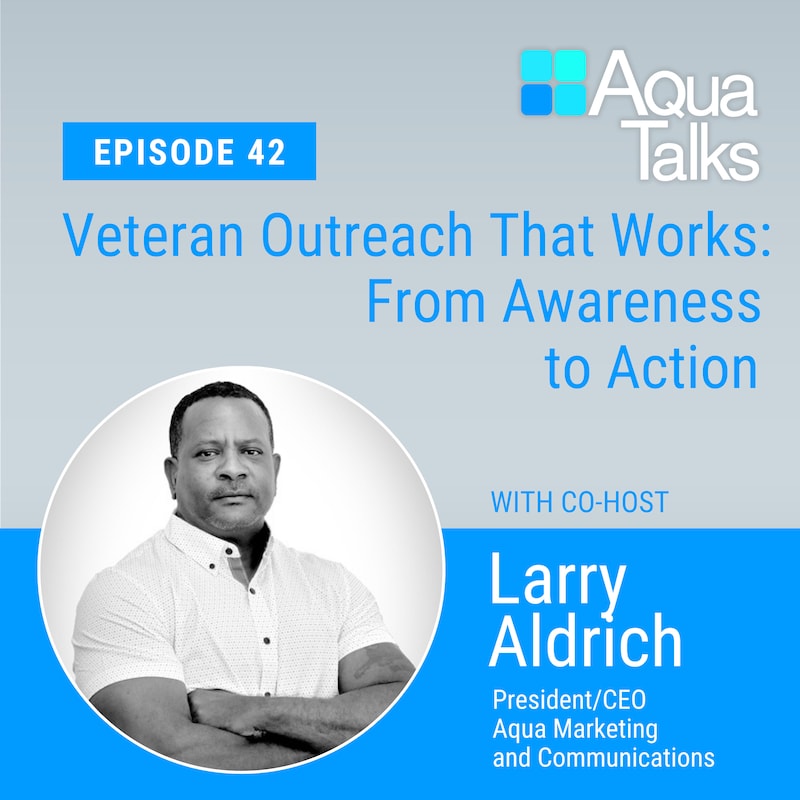
Shownotes
In this episode of Aqua Talks, Larry Aldrich and Mady Dudley explore the role of marketing in veteran outreach and why connecting veterans to resources is both a responsibility and a strategic challenge. Drawing from Larry’s firsthand experience, the conversation highlights the gaps many veterans face when transitioning to civilian life—particularly around awareness of healthcare, education, and employment benefits available through the VA and related programs.
The episode also breaks down how effective outreach is measured, not by profit, but by engagement—more veterans accessing websites, attending events, and utilizing services. From certifications and small business support to building trust and increasing participation, the discussion reinforces that successful veteran outreach requires clear communication, consistent engagement, and a mission-first mindset focused on service
IN THIS EPISODE:
- 00:06 - Introduction to Aqua Talks
- 01:10 - Introduction to Veteran Outreach
- 08:39 - Transitioning from Military to Civilian Life
- 12:13 - Leadership and Veteran Outreach
- 17:52 - Exploring Veteran Outreach
KEY TAKEAWAYS:
- Aqua Talks presents a platform for exploring innovative marketing strategies that resonate with audiences.
- Veteran outreach is essential for informing veterans about their benefits and available resources.
- Successful veteran outreach is measured by increased engagement and trust in the VA and its services.
- Being a certified veteran-owned business can significantly enhance opportunities for federal and state contracts.
- Understanding the transition from military to civilian life is critical for veterans seeking employment or business opportunities.
- Consistent communication and outreach efforts are vital to ensuring veterans are aware of and accessing their benefits.
Transcripts
Welcome to Aqua Talks where marketing meets bold game changing ideas.
Join your hosts, Larry Aldrich and Maddie Dudley as they explore the art and science of cutting through the noise, capturing attention and fostering meaningful connections with your audience.
Whether you're a destination marketer, government contractor, or simply passionate about the transformative power of marketing, Aqua Talks offers engaging discussions, fresh insights and actionable strategies designed to inspire and inform.
Mady Dudley:Hi and welcome back to Aqua Talks. My name is Mady Dudley. I'm the public relations director of Aqua Marketing and Communications.
This is a podcast for marketers, whether you're just getting started or you're a pro with the industry. As always, this is a podcast brought to you by Brensys Technology. And also I'm joined by my co host, Larry Aldridge.
Larry Aldrich:Hello, my name is Larry Aldridge, President CEO of brensystechnology and Aqua Marketing Communications. Today we're going to talk veteran outreach.
We do a lot of work brensis with veterans, working with the veteran, doing outreach with the VA Veteran affairs and working with some nonprofits trying to help get information out to veterans. Get help out to veterans. It's a really important topic and yes, it is something we started a company doing.
Mady Dudley:Yeah.
Well before we get into questions because I have so many Larry, want to know about some trends within the industry right now, whether it's the federal government or being a veteran owned business.
Mady Dudley:Oh, right now, being a veteran owned business, one of the basic things that you want to do is you have to go through the certifications being a veteran owned business. And I would say this to all veteran owned businesses out there.
Get certified through the Small Business Administration SBA and get that veteran owned certified veteran owned seal if fortunate. But unfortunately you're a service disabled veteran owned business.
Get that service disabled veteran owned business seal also and just helps go a long way.
Not only with federal contracts, obviously with state contracts also and being proud to show the work that you've done and the sacrifices you've made to be a veteran. And we like to buy from veteran owned businesses.
We like to support veteran owned businesses as far as reaching out to veterans and support veterans altogether. Health care, employment, education, housing. So we like to be a part of that.
Mady Dudley:I love that. So you've kind of touched on what veteran outreach is and why it matters. But what drew brensis to working with veteran outreach in the first place?
Mady Dudley:Being a veteran myself, thinking about when I got out of the military, I didn't know the healthcare benefits that were available to me. I didn't know much about it. I'm not Saying that the outreach wasn't great, which it is, and it continues to get better.
The VA does an amazing job, and they're getting better every day. Not every week, not every month. Every day. Me, unfortunately, I didn't hear about it until I went to a job fair.
And when I went to the job fair, I was talking to a Navy recruiter. And the thing about the military, the men and women, especially the veterans, they love to share information. They take to heart.
Every veteran that they come across and try to help those veterans, speaking to those recruiters, they were there again, trying to recruit young men and women to join the Navy. And we just got in a conversation about our service that we've given to the military.
And then being out of the military, they brought up the fact asking me if I was registered with the VA and if I was taking advantage of the benefits, the health benefits, the education, education benefits, the employment benefits that were out there, that were offered by the va, that we've earned. Every veteran earned it from the day you go to basic training. I mean, getting up at five in the morning and I could be generous.
And everything you do literally before 10am you do more. And that used to be a slogan, I believe, that the U.S. army had, that you literally do more before 10am than most people do all day.
So sharing that information with me, that's outreach, actually, right there in a nutshell.
And it pushed me to go and register with the VA and see the benefits that were available, which led to also seeing employment benefits that were available and small business opportunities. It showed me that the va, the sba, work with veterans to help create and grow your small business. And that's where we got started.
And when we started brensis, that was the track that we wanted to continue. And that's where we built our business on outreach and helping veterans.
Mady Dudley:So what were some of the challenges that you had just getting started, learning.
Mady Dudley:Getting started, learning to run a small business, learning to manage a small business, going through the certification process.
Now, you don't have to use a consultant to get you through the certification process, but being new to small business, being new to entrepreneurship, a lot of us, we know and how to run a business or how to start a business, and some of us don't.
So understanding that you have to take steps and you're not going to know everything, there are a lot of resources out there like Apex, and there's an Apex office pretty much in every region where you go, and they will help you with all of the resources needed to start a Business, talking to other small business owners, networking, going to conferences.
So there's a lot of information gathering a lot of information that you're learning, and it's all coming at you at 1,000 miles an hour and trying to capture that information, align it into a plan to follow that plan to build the business, plus trying to build the business. So it takes time. It takes your failure. You're going to make mistakes.
And if you can, sometimes it's easier to use a consultant to help you get through some things, not everything. Believe me, a lot of the information out there is free.
And there's a lot of resources that can help veterans get their businesses going or grow their businesses. Some things, yes, we did use a consultant and a paid consultant, and a lot of times that helps us with time, resources.
And I would say a lot of that is when you start to grow. We did a lot ourself. Myself, actually, I did. To get it off the ground. Yeah.
Mady Dudley:Give yourself a pat on the back. I will.
Mady Dudley:And then once we started moving along, little bit, I did go to consultants a little bit, because you can only do so much at a time. And like I was saying, there's a lot of moving parts, but there are a lot of resources out there.
You have a lot of veterans coming off of active duty trying to figure out what direction to go in. And right now, that active duty prepares you to transition to the civilian life.
A lot may be looking to get employed, A lot may be looking to start their own business, but that's where outreach is extremely important. And that's not just from an employment status, but a healthcare standpoint also.
So growing that business, getting separating from the military, trying to understand a plan where you're going to go forward. Because in active duty, your whole day is all scheduled, everything is done for you, everything is in front of you decided.
Your appointments are made for you. The military is very regimented, extremely regimented.
And now you're going from, especially if you've been spent 10, 15, 20 or more years, you go from an extremely regimented life to what do I do next? And that's where organizations that are out there and the va, we do outreach to these veterans to help with resources.
Mady Dudley:So, I mean, I kind of have my own answer for this, but what responsibility comes with doing these platforms for veterans and their families, getting to them
Mady Dudley:before it seems like it's too hard?
Again, like I was saying, when you're in the military and everything is there lined up for you, depending on your rank or your job, either your boss is Telling you you have an appointment today, or your secretary has scheduled your appointments for you. Everything is. Everything is done. You have a plan that's already drawn out for you.
From the time you go to tech school, that's what we call it in the Air Force. Every branch has a different name for their tech school. Your schedule is drawn out for you. It's already created. So just.
Mady Dudley:I couldn't stand that.
Mady Dudley:No. Well, it's because you're not used to that.
Mady Dudley:Yeah.
Mady Dudley:So imagine if you were used to that and then you get out and you're like, I gotta do all this myself. I have to schedule my own appointments. The dentist isn't calling my office telling me my appointment is next week.
You have to schedule your appointment.
Mady Dudley:Yep. Yep, I do.
Mady Dudley:Yeah.
It's different when I first went in, you know, you go in and you go through basic, you go through tech school, you get to your active duty station, you get to your active duty station, and they give you this long list of appointments that are already made for you. And then you just have to make sure you're at your appointment.
Mady Dudley:Okay, I didn't know that. That's interesting.
Mady Dudley:So imagine, you know, pretty much living the majority of your life like that, and then you separate and you're out there on an island. Like, where do I go next? So that's important to have these platforms to be able to show help veterans that there's resources there.
Employment resources, healthcare resources, education resources. The. The VA and the different. The military for separated, separating soldiers, airmen, seamen, veterans. There's a lot of resources for to.
Okay, what are you going to do next?
You want to get educated, you want to get your degree, you want to do a higher degree, you want to do multiple degrees, housing, clothing, food allowance. You come out with an injury health care. We come out of the military.
A lot of veterans come out of the military with health care issues that they don't know about. So continuously seeing clinicians going to the clinics, going to the hospitals, making sure your health is taken care of is paramount.
And we make sure we take care of our veterans.
Mady Dudley:Absolutely.
Mady Dudley:And all of that is showing them that there's benefits available to you. There's everything available to you. Mental health is huge, as you may know.
I mean, we do a lot in service of our country, and in return, our country takes care of us.
Mady Dudley:Yeah.
Mady Dudley:And we have to get that outreach out there.
Mady Dudley:Yeah, that's only right. I love that. In terms of leadership, what was your role leading Brentzes veteran outreach efforts?
Mady Dudley:It's challenging, but it's fun.
My role was making sure that we stay compliant with the contracts that we had, the outreach contracts, making sure the contracts stay on schedule, making sure the budgets are right and on schedule, making sure the tasks are on schedule. So again, it's your people that you work with, the people that you work under, they manage everything.
You just have to make sure from a leadership standpoint that you have good people. You're going to be taken care of, because having good people around you makes everything work smoother.
So leadership is more oversight and definitely staying in contact with the program managers, the program team, the contract officers, the certifications.
So doing a lot of the administrative work, a lot of decision making, a lot of the negotiating, making sure we're getting the contract administrators what they want, because we have to make them look good and, you know, making sure that they're doing their mission and we are supporting them as they complete their mission.
Mady Dudley:I'm curious if you have an exact example or maybe through a friend or just through everyone that we've worked with. Has anyone. Do we have any, like, testimonials of people being like, the way that brensis did this change the way that. I love that.
Okay, tell me, tell me all that we do.
Mady Dudley:For example, one of our programs teams that we work with, the Veteran Experience Office, the veo, work directly under the secretary of the va so with them, we do a lot of designs that they use to communicate to the veterans, to communicate to Congress. So we had a lot of great designers on that contract, and we were giving them what they wanted. And a lot of different offices were using.
Coming to the VEO through the va. Different. When I say offices, different VA offices. It could be different clinics, it could be opia, it could be the cemetery administration.
So when they're putting doing their outreach, they would come to our designers.
They thought we were doing a really great job, so they would ask us to do more and they would make modifications to where now they are able to work with the different offices to achieve the goals that those offices are trying to get and reach the mission initiatives that they're working on.
Because our team was doing what they asked for when they asked for it in a timely manner, basically doing their job and being efficient with it, and they reward you for that. And a reward could be a pat on the back, an attaboy. That's what we call it in the military, an attaboy.
And that goes a long way when someone is telling you you're doing a good job and that makes you work harder.
Mady Dudley:I love this question, which is KPIs are different for every client. But what does success look like in veteran outreach? When the goal isn't profit, but success.
Mady Dudley:Service cape actually, when more veterans are showing up, when you can look at the website and see more veterans are clicking on va.gov when there's more time spent per click on va.gov when we are doing announcements or not so much announcements, but we're scheduling, say, webinars or appointments or DAV may be having something at a meeting or something, and we get more veterans to show up. So it's all about servicing the veteran. Taking care of the veteran is the entire mission.
And when veterans show up on the website, when veterans show up to the clinics, when veterans show up to the hospital, when veterans show up to outreach events, when veterans show up to recruiting events, that is what it's about. That lets us know we're reaching more veterans.
More veterans are receptive to the outreach and they're showing up and they're taking advantage of the benefits and the resources available to them.
Mady Dudley:If you had one key takeaway from this service, what would it be?
Mady Dudley:Oh, key takeaway. I would say when I talk to other veterans out there and we just start having conversations about the service.
When we start having conversations about what they did after they, after their time in the military is over and how the VA is working for them and helping them and when they feel appreciated. Trust. Trust in the VA has skyrocketed and that's one of the main measurements that they like to calculate.
And trust has going up tremendously and they want to continue to keep trust up.
Mady Dudley:I love that. That's great. Trust is very important, especially in my line of work, too. So we're definitely aligned in that.
Anything else we didn't cover that you wanted to discuss?
Mady Dudley:Oh, there's so much we can talk about when it comes to veteran outreach. But why put it all in this one podcast? Maybe another episode.
We'll be doing an episode for veteran outreach every month, so we'll have some great guests on that we could talk to, whether it's other business owners, whether it's veterans themselves or men and women that work at the va, staff members, stakeholders. So every month we'll be doing something that's going to touch on veterans or maybe not more. Maybe even. But definitely federal marketing.
So we'll be definitely. This is a podcast where we talk about marketers and we talk about marketing as marketing professionals.
And every month we're definitely going to make sure we hit the federal and state aspect of marketing and definitely veterans and veteran outreach.
Mady Dudley:Yes. Well, I say it all the time, but thank you for your service, Larry.
Mady Dudley:I appreciate it.
Mady Dudley:And to you and your friends and anyone that you know. But looking forward to more conversations about veteran outreach together.
Mady Dudley:Yeah, so am I. And we'll definitely have some very, very intriguing guests that'll have some really good information.
So stay tuned, continue to watch aquatacs.com subscribe and we'll definitely have some more veteran information on there.
Voiceover:You've been listening to Aqua Talks, where marketing innovation takes center stage with bold ideas and actionable insights. Ready to take your strategies to the next level?
Visit aquataks.com to book your free consultation and explore resources that empower you to thrive in today's fast paced marketing world. Until next time, stay bold, stay inspired, stay imaginative.