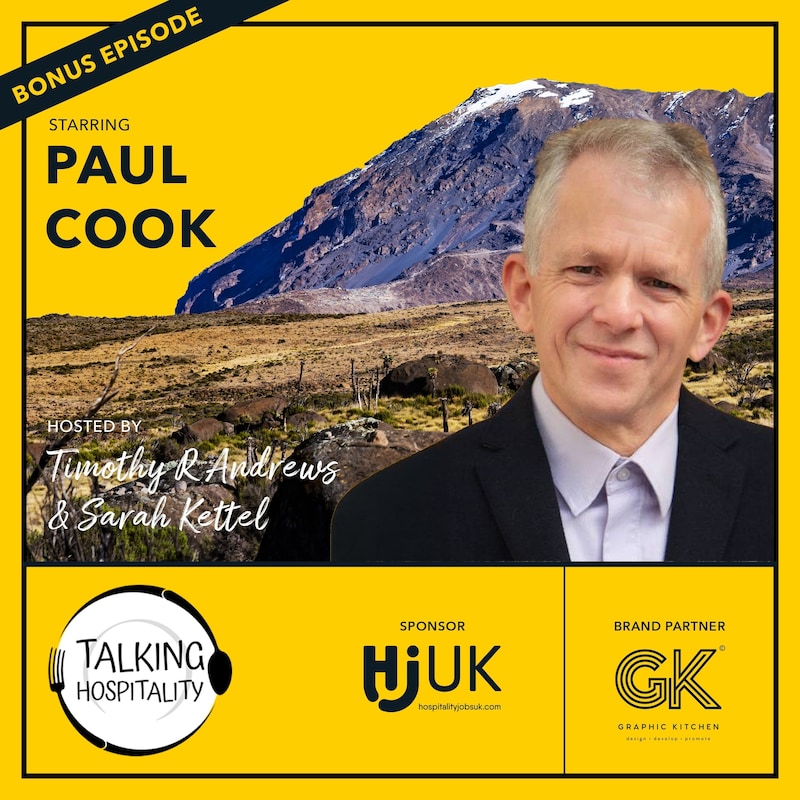
Shownotes
This remastered bonus episode revisits a powerful conversation first recorded in 2020, where a walk up a mountain becomes a turning point for life and career.
Hosts Timothy R Andrews and Sarah Kettel are joined by events professional and author Paul Cook, who shares the story of climbing Mount Kilimanjaro — and how the experience fundamentally changes how he sees work, purpose and success.
What begins as a casual decision made in a pub quickly becomes a physically demanding and emotionally revealing journey. As Paul climbs higher, everyday noise falls away. Material concerns lose their importance. Trust, humility and teamwork come to the forefront — particularly through the guidance and care of the local crew and porters who make the climb possible.
Through exhaustion, fear and vulnerability on summit night, Paul reaches a moment of clarity that stays with him long after he comes back down the mountain. The episode explores career change, respect for unseen roles, and the courage it takes to walk away from work that no longer feels right.
This is a reflective, human story about slowing down, listening properly, and realising when it’s time to choose a different path.
In this episode, we explore:
- Why Paul agrees to climb Mount Kilimanjaro without expecting it to change anything
- Preparing physically and mentally for a climb of this scale
- Trusting experts when you’re out of your depth
- The role of guides and porters — and respect for invisible labour
- Summit night, altitude sickness and mental shutdown
- Reaching the top and experiencing clarity rather than celebration
- Returning home with a changed perspective on work and life
- Making the decision to leave a career that no longer fits
Hosts:
- Timothy R Andrews
- Sarah Kettel
Guest:
- Paul Cook — Events professional and author
Takeaways:
- Sometimes clarity only comes when noise disappears
- Stepping away from routine creates space to think differently.
- Trust matters when you don’t know what you’re doing
- Listening to experts can be the difference between success and failure.
- Invisible roles carry enormous responsibility
- The people behind the scenes often make everything possible.
- Physical challenge exposes emotional truth
- Fatigue strips away ego, certainty and pretence.
- Not all success is about pushing through
- Sometimes it’s about recognising when to step away.
- Loving what you do matters more than staying comfortable
- If something no longer fits, leaving can be the healthiest choice.
Links referenced in this episode:
Companies mentioned in this episode:
Transcripts
(Swahili)
Nyote, asante.
Mlifanya ndoto zetu za kupanda Kilimanjaro kuwa kweli.
Mtakuwa katika kumbukumbu zetu miaka yote.
Timothy R Andrews: In:The episode features hosts Timothy R Andrews and Sarah Kettel with special guest - events guru and author Paul Cook, who shares his inspirational story of climbing Mount Kilimanjaro.
I'd like to thank our sponsors, Hospitality Jobs UK (HJUK), the UK specialist job board and talent attraction platform dedicated to the hospitality, care, leisure, entertainment, attractions and retail sectors and Graphic Kitchen, who put your storytelling into your brand. A very different episode this. I hope you'll enjoy it.
Paul, obviously within the hospitality and events industry at the moment, it's been tough for a lot of people and a lot of people have either lost work or will be thinking of a change of career. So about four years ago, you took a complete career change. Would you like to tell us about that?
What you used to do, what you did that made you change and your amazing story about how a mountain changed your life.
Paul Cook:Yeah, thanks, Tim. I didn’t think I was going to have a career change, really. I thought I was just going to walk up a mountain. Little did I know. Oh my goodness.
It was one of those things where it’s very easy to say, yeah, one day we’re going to climb a mountain, we’ll climb Kilimanjaro.
Had it always been one of my big ambitions? Not really. It was more other people’s ambition than mine. I was approached by one of my friends. We were in a pub on a Friday night.
He’d left his place of work and he said, “Right, I’m taking a year out. I didn’t enjoy what I was doing. I’m going to take a year out and I want to climb Kilimanjaro. And you’ve often said you’d be up for that as well.”
“So do you want to do that?”
And I said to him, “Give me a beer and I’ll think about it.”
He bought me a beer. I drank the beer and I thought, why not?
And then we decided very quickly that evening. Actually, we said, “Let’s go for February. Let’s just go. Let’s do it.” And that meant we were going to have to train over the winter anyway.
So we both came out of the pub and we were not in any way drunk. He’d just finished his job, I’d just finished a beer, and we’d made this plan. So we decided to do some training and we did all of that.
I was okay at the time. I was working. I had an insurance business and it was all around events. That was fine.
But I also had my other company — Planet Planit as well.
There was some content sharing that I was doing there, and I was doing a bunch of other things around events and around insurance, and that was all fine.
In the middle of all of this, I was going out and doing some of these walks, getting ready as much as I could — as much as you can prepare for going up a mountain. Getting the jabs, getting all the stuff you have to do, getting all the kit, spending a load of money on it.
But honestly, it wasn’t until I landed in Tanzania, got off the flight with a bunch of people who were going to do this as well.
There were fourteen of us. And when we met the guides at the airport, I met the guide leader. He’s like a mini Indiana Jones, really. Not that he’s small — just the way he comes across. It’s incredible.
He was sitting there in this minibus. We said hello. And in that instant, I suddenly knew why I was there.
I thought, this is it — I’m here, and I’ve got a job to do. That job is to get up this mountain and down it.
And I realised in that moment that I was really going to enjoy it.
One of the things they drum into you in all the briefings is: enjoy the journey. I thought, I’m going to listen to what he said. I’m just here. I can’t do anything else. I can’t write emails — and I wouldn’t want to anyway.
There was no connection. I’d taken time out of work. Everybody I loved and who supported me was back home.
The guy who was my tent-mate — we were going up this thing together — he was the only person I knew. Apart from the team of porters that you get to know over time.
It was fantastic.
They advise you as well: don’t try to walk faster than the guide. Sounds obvious, but the first day you’ve got this inclination to push on — we want to get there. And they’re always saying, pole pole, slowly, keep going slowly.
It’s solid advice because you don’t know what you’re really doing. Who’s ever climbed a mountain to that height before? And who knows if you’re going to get there?
So my mantra through this was safe up, safe down. That’s all I needed to do.
And the way I was going to do that was to listen to what they told me and just do it. I wasn’t going to be a silly sod who thought he knew better than them. They’ve done this so many times.
I knew I was in good hands, so I put complete trust in the people around me. That was the game plan.
Every day we went out and followed their instructions. You get to know these porters.
Every day they’re carrying your kit up. What you carry is basically a rucksack — a day sack. It’s got your wet gear, some food, and other essentials — torch, that kind of thing — but nothing else.
Everything you need later in the journey is carried by the porters. And they allow you fifteen kilos.
I don’t know if you’ve ever weighed fifteen kilos, but that’s a heck of a lot for someone to lug up a mountain — in addition to their own kit, and the loo, and everything else that traipses up the mountain with you.
I remember looking at one of these porters lugging all this stuff and thinking, I really hope I didn’t pack too much. They do weigh it before you set off, but suddenly you realise you want to travel as light as you can, because anything extra is extra work for them.
You get a real bond with these guys and girls — men and women of all ages. For our group of fourteen, there were about fifty, maybe sixty crew. And they’re with you every step of the way.
Our crew were basically like Indiana Jones — experts in this stuff.
But everyone’s an expert on that mountain because it’s where they live. It’s their home.
The sacrifice is incredible because they’re away from their families as well. And I was really taken by that.
What was happening in my world was that I started to look at things differently. Not that I didn’t value life before, but the material stuff just fell away. It wasn’t important.
It was all of us together on this journey, helping each other.
What they would do — and it still gives me a lump in my throat — is clap you in and sing you in every single night as you came into camp.
They were the last people to leave breakfast. They’d pack up all the tents and the camp. You’d be struggling up the mountain, doing your best.
These people would overtake you on rocky ledges so narrow you could easily fall off. Then they’d make camp, put your food on, and clap you in.
You think, who does this? It’s mind-blowing.
Along the way, you’ve got time to think. All these things — camaraderie, clutter, what am I really doing? — they’re bubbling underneath. You don’t realise because you think you’re just out for a walk.
It’s not a walk. It’s a bloody great trek. Anyone who says it’s like a Sunday afternoon stroll has not done it.
What happened in our group was that the fourteen of us bonded. We looked out for each other. That was special.
We had the group bond, the crew bond, and the bond with the porters and everyone around us.
You take five days up, two days down. The rest is acclimatisation and travel. You’re away for about two weeks.
We got used to the cold nights. We got used to the shocking weather. One day it rained constantly — ice cold. You could take your clothes off, but they’d never dry.
Sometimes there was no water at camp — only a mile or so down the mountain — but the porters would go and get it so they could wash the dishes. Incredible.
When it came to summit night — and that’s the leveller for everyone — however bullish or pig-headed you are, summit night brings you back down to earth.
All the while, the porters have been carrying a summit bag for you. You put everything you need for that night in it because you don’t have time to think. Your brain turns to mush very quickly.
As you get higher, the headaches start. You need to be mindful of that.
We walked to high camp and got there about nine or ten in the morning. You have breakfast, then sleep — or try to. You don’t really sleep because of the adrenaline.
You have a light supper, then bed. Still no sleep. I don’t think anyone slept.
They wake you at eleven at night. You start walking at midnight and go through until eight in the morning.
That’s because the mountain is more stable when it’s cold. If it’s warm, it’s shale and stone and you slide everywhere.
It’s like going up in a deep freeze and coming down in a microwave.
All fourteen of us were still together. No one had been sent down.
We were woken at eleven. You put your kit on, go to the mess tent, have tea and ginger nuts, a final briefing — and off you go.
Because I’d been late starting, I found myself at the back. That’s not where I wanted to be.
We set off. It was horrid. You’re dressed like a Michelin Man. Pitch black. Only your head torch.
The wind was blowing about forty-five miles an hour. At 4,700 metres, that’s something.
It was minus eighteen. Your body starts shutting down immediately.
Everything was frozen except, bizarrely, my left hand.
After about forty-five minutes we stopped. The Indiana Jones guy came up to me and said, “I’m going to move you.”
I said, “Why?”
He said, “We don’t like you at the back. You hate it. And the pace isn’t enough. You’ve been at the front all week and that’s pulled the group on.”
I said, “It’s not a race.”
He said, “No — but we still need to move.”
They know exactly where you should be at each stage.
I moved to the front and felt instantly better.
We trudged on — the smallest steps imaginable, like a moonwalk. Hours roll on. No moonlight. Just head torches and pain.
The cold got worse. The wind didn’t let up.
Back home people say, just put one foot in front of the other. But your brain is mush.
It’s so hard.
I kept going. Then I started coughing. Next thing I knew, I was on the floor. I’d keeled over. I was being sick. I was crying.
I thought, this is it — game over. I thought the guide would say, “Paul, you’re done.”
I had no energy. No reserves.
Some of the group went past me and patted me on the back. I didn’t even know.
Somehow I dragged myself up. I drank water. I found something inside me — it wasn’t my brain or my body.
I kept moving.
I didn’t look up. I knew I couldn’t cope if I did.
The guide stayed with me. Time kept passing. I was in automaton mode.
Then I heard voices. Someone said, “Paul, for Christ’s sake, look up.”
I didn’t want to — but I did.
I was at the top.
The sun came up. The wind dropped. Everything became clear.
We took photos at the board — Facebook and everywhere else.
I found a little space and sobbed for fifteen minutes. I thought of everyone who helped me — back home, the crew, the porters.
Coming down, I knew I had to declutter my life. I knew I couldn’t stay in insurance. I didn’t love it enough.
I exited.
I moved into more creative work in events — writing, hybrid and virtual events.
I gained a new respect for invisible roles — and that resonates with events and hospitality.
Life is precious. If you don’t love something enough, you have to leave it. It really is that simple.
Timothy R Andrews:Talking hospitality Reporters thank you by Paul Cook.
Paul Cook:Thank you, each and every one of you. You made our dreams of climbing Keely come true. You looked after us and took away our fears. You will live in our memories for years and years.
KellyJoy Gakil Swahili Translation:
Nyote, asante.
Mlifanya ndoto zetu za kupanda Kilimanjaro kuwa kweli.
Mtakuwa katika kumbukumbu zetu miaka yote.
