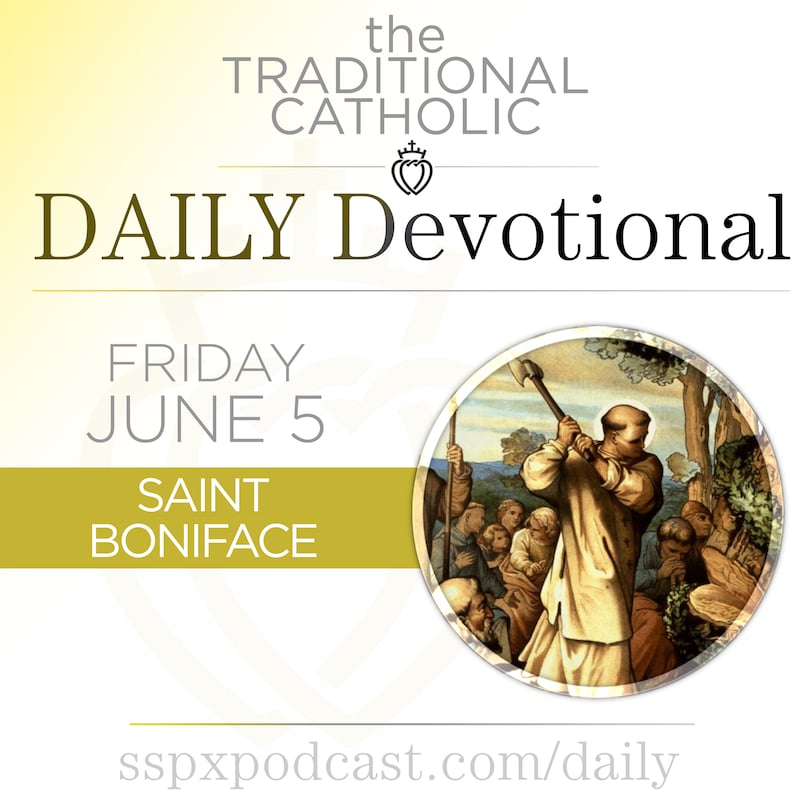
It's the Feast of
St. Boniface, First Fri,
3rd Class, with the color of
Red. In this episode: the meditation: "The Glory Be to the Father", today's news from the Church: "Sick and Healthy", a preview of this week's episode of The SSPX Podcast: "Answering the Objections: Questions About the Consecrations", and today's thought from the Archbishop Marcel Lefebvre.
Have feedback or questions about the DD or our other shows?
[email protected]
Sources Used Today:
- "The Glory Be to the Father" — Eastertide Day by Day
- "Sick and Healthy" (FSSPX.news)
- The SSPX Podcast: "Answering the Objections: Questions About the Consecrations" (SSPX Podcast)
- The Spiritual Life — Archbishop Marcel Lefebvre (Angelus Press)
Sources Used Today:
- "Corpus Christi" — Eastertide Day by Day
- "Xi Jinping Remains Inflexible on the Case of Jimmy Lai" (FSSPX.news)
- "The Dignity, Power, and Obligations of Baptism" (SSPX Sermons)
- The Spiritual Life — Archbishop Marcel Lefebvre (Angelus Press)
Please support our new project, the Archbishop Lefebvre Biography Audiobook!
Saint Boniface is remembered as the Apostle of Germany, a missionary bishop whose courage and perseverance helped bring the Gospel to much of northern Europe. He was born around the year 675 in Wessex, England, and given the name Winfrid. Raised in a Christian family, he entered monastic life at a young age and quickly distinguished himself through his intelligence, holiness, and gift for teaching. Yet despite a successful life as a monk and scholar, Winfrid felt called to leave the security of the monastery and preach Christ to peoples who had not yet fully embraced the faith.
After receiving the blessing of the pope, he traveled to the Germanic lands, where pagan practices remained widespread. There he took the name Boniface and began the work that would define his life. He preached tirelessly, founded monasteries, established dioceses, and worked to strengthen the organization of the Church throughout the region. His mission required not only zeal, but patience and wisdom, as he sought to guide entire communities toward Christian life.
One of the most famous stories associated with Boniface concerns the Oak of Thor, a massive tree revered by local pagans as sacred to the Norse god. According to tradition, Boniface publicly cut down the tree to demonstrate that the pagan gods had no power over him. When nothing happened, many who witnessed the event became more open to hearing the Gospel. Whether remembered as history or symbol, the story reflects Boniface's fearless confidence in Christ and his determination to replace superstition with the true faith.
Boniface was also a reformer. He worked to improve the discipline of clergy, strengthen ties with Rome, and ensure that the growing Church remained faithful in doctrine and practice. Through his efforts, Christianity took deeper root in lands that would later become Germany, the Netherlands, and surrounding regions.
In his old age, Boniface returned to missionary work among the Frisians. In 754, while preparing a group of converts for Confirmation, he and his companions were attacked and killed. Tradition says that he refused armed protection and met death peacefully, holding a book of the Gospels. Thus the great missionary ended his life as a martyr.
The Church honors Saint Boniface as a patron of Germany, missionaries, and those who labor to spread the faith. His feast day on June 5 is marked with prayers for evangelization and courage in proclaiming Christ.
His life reminds us that the Gospel advances not through force, but through conviction, sacrifice, and unwavering trust in God.
Saint Boniface, courageous missionary and faithful servant of Christ, pray for us.
- - - - - -
Explore more:
What is the SSPX Podcast?
The SSPX Podcast is produced by Angelus Press, which has as its mission the fortification of traditional Catholics so that they can defend the Faith, and reaching out to those who have not yet found Tradition.
What is the SSPX?
The main goal of the Society of Saint Pius X is to preserve the Catholic Faith in its fullness and purity, to teach its truths, and to diffuse its virtues, especially through the Roman Catholic priesthood.
Authentic spiritual life, the sacraments, and the traditional liturgy are its primary means of bringing this life of grace to souls.
Although the traditional Latin Mass is the most visible and public expression of the work of the Society, we are committed to defending Catholic Tradition in its entirety: all of Catholic doctrine and morals as the Church has always defended them. What people need is the Catholic Faith, without compromise, with all the truth and beauty which accompanies it.
https://sspx.org