Shownotes
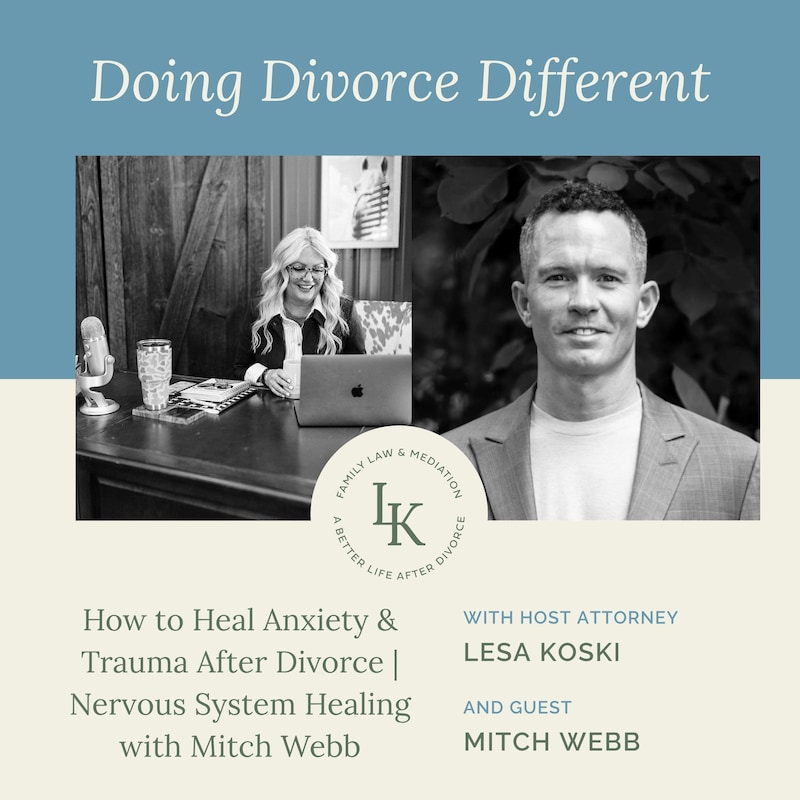
Anxiety after divorce, trauma healing, and nervous system regulation—learn how to heal anxiety naturally and feel better in midlife. In this episode, Lesa Koski talks with nervous system coach Mitch Webb about anxiety, trauma healing, and how your nervous system impacts your health, stress, and emotional recovery. If you're navigating divorce or high stress, this conversation will help you understand anxiety and begin healing your nervous system in a practical, grounded way.
Timestamps:
(00:00) Introduction to anxiety, divorce, and healing
(03:45) Mitch Webb’s story: trauma, illness, and recovery
(10:20) What anxiety really is (and why you can’t “fix” it)
(18:30) Lesa’s cancer journey and wake-up call
(26:15) Nervous system dysregulation explained
(35:40) Why high achievers struggle with anxiety
(44:10) Functional freeze and hidden stress
(52:00) How to stop fixing and start healing
(1:00:25) Co-parenting, triggers, and boundaries
(1:10:40) Building emotional capacity and healing patterns
(1:18:00) Final thoughts + how to work with Mitch
Key Takeaways:
• Anxiety is not a problem—it’s your body communicating
• Nervous system dysregulation is often the root of chronic stress
• Healing comes from awareness and new experiences, not just information
• You can feel anxious and still be safe
• Boundaries and self-awareness are key to emotional healing
Guest Bio:
Mitch Webb is a nervous system and holistic health coach who helps individuals heal anxiety, trauma, and chronic stress by reconnecting with their body. After overcoming multiple health challenges—including traumatic brain injuries, Lyme disease, and long COVID—Mitch now guides others in regulating their nervous system and creating lasting emotional and physical healing.
Resource Links:
Free Nervous System Quiz
https://mitch-webb.involve.me/nervous-system-state-quiz
FREE 30 min Session w Mitch
https://calendly.com/k-mitch-webb/15-minute-meeting
Website and Social Media links:
https://www.instagram.com/kmitchwebb
https://www.linkedin.com/in/kmitchwebb
Sign up for my newsletter https://enchanting-basil-714.myflodesk.com/qwzridafyj
Tags/Keywords:
anxiety healing, nervous system regulation, trauma healing, divorce recovery, emotional healing, stress management, midlife women, co-parenting stress, functional medicine, anxiety help, nervous system coach, healing after divorce
Transcripts
Welcome listeners.
2
:I'm so excited that you're here today
because I have Mitch Webb and he is a
3
:nervous system and holistic health coach,
and you're probably going, why is someone
4
:like this on doing divorce different,
and it's because most importantly, I
5
:just am super interested in this kind of
work, and all of my listeners know that.
6
:I want you to feel better
after your divorce.
7
:So there's probably no better
time to like make some changes
8
:and to grow and to learn.
9
:So Mitch, I don't know that I've ever
really had someone like you on, so
10
:thank you so much for being here.
11
:He's fighting a little
cold and he still came.
12
:So welcome Mitch.
13
:And I do know too.
14
:I don't know you that well, but I know
you've got a story that led you to do
15
:this work, and I always like to start
so my listeners can get to know you.
16
:Would you mind just sharing
a little, a little bit about
17
:what led you to do this work?
18
:Speaker 2: Yeah, sure.
19
:Lisa, good to be here with you.
20
:Thanks for having me.
21
:And, uh, yeah, excited to, to
jump into this despite the cold.
22
:Um, like I was telling you before
we got on, I've been cooped up for
23
:three, four days and this has been
the, uh, the shining light in my week.
24
:Good.
25
:It's good to be here with you.
26
:But yeah, I mean, my journey
started with anxiety.
27
:Um, I, I experienced that after
some head injuries where I fell
28
:out of a second story window,
had a traumatic brain injury.
29
:And had this thing called
anxiety that I didn't, I didn't
30
:even know what that word was.
31
:And, um, you know, the hits kept coming.
32
:I lived in a house that
had black mold in it.
33
:I developed Lyme disease.
34
:I had heavy metals, I
was borderline diabetic.
35
:And, um, that was the first wake up call
that I needed to change some things.
36
:And I went from being a, uh, in corporate
sales in the corporate world, uh,
37
:working with like cigarette companies.
38
:Um, a lot of different corporate
companies that you would recognize and
39
:realizing that I had to make some changes.
40
:And so at first it was, you know,
nutrition and getting back into
41
:exercise and, um, and I found my way to
functional medicine where we found the
42
:mold and the lime, the heavy metals we
worked on reversing that through diet.
43
:And then, uh, I left the corporate world,
fell in love with health and wellness.
44
:You know, I've always been the
person that kind of shared.
45
:I learned, learned,
um, learned everything.
46
:Always felt like there was a lot of
information and really confusing.
47
:And I like to make things simple.
48
:Um, and so I'm, I'm leaving
the corporate world.
49
:I go see one of my first clients and I get
hit by a dump truck on the way to my call.
50
:And so another traumatic brain injury.
51
:Spent a year in, in, uh, post
reco, uh, uh, concussion recovery.
52
:What is that?
53
:I'm, I'm blanking on the word, but.
54
:Recovery, basically, I couldn't, I
went from the best shape of my life.
55
:I couldn't walk for more than 15 minutes
without collapsing for a couple of weeks.
56
:Um, after that, when I healed from
that a year, I, I got long haul.
57
:Uh, three times in a, so for
three years I had long haul COVID.
58
:I went from about one
90 down to 40 pounds.
59
:I couldn't eat, my gut was destroyed.
60
:Uh, had anxiety so much that
I couldn't sleep and fatigue
61
:that I couldn't get out of bed.
62
:So it was really, uh, interesting.
63
:I found my work my way into, you know,
spiritual, uh, healing and mindset and
64
:eventually found the nervous system.
65
:And that's when everything
was like, oh, now I get this.
66
:Um, all of these.
67
:Uh, big issues that I went through.
68
:I feel like now we're trying to get my
attention to look at the dysregulation,
69
:uh, and the trauma that I experienced
in childhood, which was really hard to
70
:see because my parents didn't beat me.
71
:They,
72
:Speaker: mm-hmm.
73
:Speaker 2: Um, they paid for college
and put a roof over my head and,
74
:uh, fed me three meals a day.
75
:And that's a really good distraction
for not being there emotionally.
76
:And so, um, I've went through life as a
child not knowing what safety felt like.
77
:And now these last couple years,
uh, working with the nervous
78
:system, that's been my whole goal.
79
:And I tend to work with people,
um, in the same boat, uh, because
80
:their nervous system is sensitized,
meaning there's, the whole world
81
:has turned into hyper vigilance.
82
:They're trying to fix
things and figure them out.
83
:With all the things that I learned, right?
84
:When we don't think that we are good
enough, um, we take on these, these
85
:trauma roles, these protective parts,
to stay in connection, to be loved.
86
:That's things like people pleasing
and perfectionism, uh, all or nothing,
87
:and living in our head instead of
being in our body because there's
88
:so much going on in the body.
89
:Our body is protecting
us from that intensity.
90
:And the work I do is teaching people
to reconnect with their body, to be
91
:able to listen to that, to respond to
that, um, and that way and express the
92
:emotions that didn't get to be expressed.
93
:And through this journey,
we become our own medicine.
94
:Speaker: Okay.
95
:Wow.
96
:That was way more than I ever expected.
97
:And Mitch, I've gotta ask you, don't
you think, like you are saying, you're
98
:speaking my language because I have
anxiety, um, I, you know, grew up with
99
:great parents and that, you know, I
think sometimes trauma can come when
100
:we don't, when they don't even realize
it and we don't even realize it, right?
101
:Speaker 2: Mm-hmm.
102
:Speaker: Um, or maybe I don't even
really know what caused it, but.
103
:I know that I have anxiety.
104
:I know that I'm a people plea pleaser.
105
:I know that I'm a high achiever and
I knew that I wasn't feeling good.
106
:And I also did your route where I
had a functional assessment doctor,
107
:and I like white knuckled it like
I can do this intermittent fasting
108
:and running marathons and doing a.
109
:But you know, they did tell
me too, that having a glass of
110
:wine at night was good for you.
111
:Which was a lie.
112
:That was a lie.
113
:It's not good for you.
114
:But my, it all kind of hit the fan,
so to say, when it was actually like
115
:two years ago to this day that they
caught stage one breast cancer in me.
116
:And it was, it rocked my world
because I am an anxious person,
117
:and health was always an anxiety
and I thought I could control it.
118
:And so, and I was like a life coach.
119
:I had this mindset, I had all the
tools that I needed and I had to
120
:go, what the hell is going on?
121
:Like, what?
122
:What is happening here?
123
:And I like had to just step back and
be still through everything that I
124
:had to, I mean, I never felt sick.
125
:I did great through
everything, but it was a lot.
126
:I had to go through a lot to get
through that, even though it was
127
:just teeny tiny little stage one.
128
:But what I realized.
129
:In those moments is that I needed
that stillness and then I started
130
:looking at my life and I was like, I
had to like kinda surrender, right?
131
:Like I can't control everything.
132
:This life is a gift.
133
:Like I can't white knuckle it and think
that I've got this all under control.
134
:That wasn't another thing that I learned.
135
:Yeah.
136
:And then I also saw, like
I wasn't Where was the joy?
137
:Where was the fun?
138
:You know what?
139
:There's some, I mean, I got horses
over there, but it just was such a
140
:big realization and so now, so I did
another, like I did after all of this
141
:happened, I did the big genetic test.
142
:I went through all kinds
of health stuff again.
143
:And then I'm like, everything
is good except my stress.
144
:Speaker 2: Yeah.
145
:Speaker: So I did a big, like ai,
it's like why is my stress high
146
:even if I don't feel like it?
147
:And one thing that I learned is
that maybe intermittent fasting
148
:isn't good for a gal my age.
149
:Right.
150
:I am 58 years old.
151
:Probably raises that
cortisol a little bit.
152
:Um, I've been lifting a lot,
increasing my protein, trying to
153
:have that more throughout the day.
154
:I've done like crazy neurolinguistic
programming, brain spotting
155
:because I don't wanna feel, I
wanna feel good, don't we all?
156
:Like, I don't wanna have anxiety and
I know how to work with it through
157
:my mindset, and yes, that helps.
158
:But when something big happens
and you spin out, what do you do?
159
:So there you go.
160
:Blah.
161
:Heal me.
162
:Speaker 2: Well, well, it sounds
like you're, you're doing it.
163
:Uh, you know, congratulations.
164
:It sounds like the, the
cancer is, is better now.
165
:Is that right?
166
:Speaker: Oh, it's cured.
167
:It's cured, yes.
168
:Speaker 2: Yeah.
169
:Congratulations on that.
170
:That's awesome.
171
:Thank
172
:Speaker: you.
173
:Speaker 2: Um, where do I start?
174
:You know, here's where
I'm gonna go with this.
175
:You're, we're similar in this, you
know, we're, uh, we're twins here and
176
:the fact that we did everything right,
we tried everything and it didn't work.
177
:Okay.
178
:Because the nervous system
controls everything.
179
:Uh, it's kind of like the operating
system of the entire body controls all
180
:the systems from hormones to stress,
to circulation, you know, you name it.
181
:Um, and when we.
182
:When we have a lot of stress that we've
avoided, that we've pushed down, that
183
:we've tried to fix, that we're not aware
of yet, uh, the body's just trying to
184
:protect us, and it's went into these
protector roles in a very intelligent way.
185
:And so, number one, we want to honor that
and look at what our body has done for us.
186
:Um, and it's, and it's
recognizing the contrast between.
187
:Where we're at now and
where we want to be.
188
:And so recognizing that, hey,
I just, I don't feel good.
189
:And what that comes down
to is just dysregulation.
190
:Dysregulation means that it
doesn't mean that we're broken.
191
:It means that our body is
responding perfectly to the
192
:environments that we've been in.
193
:Um, I used to think about
trauma from like a, a male
194
:perspective where we want to like.
195
:Get it out.
196
:Like, and, and I don't, I don't like
that anymore because it tells us that
197
:something's wrong, that it's bad.
198
:It's not that there's something bad
in our body that we gotta get out.
199
:Our body has shaped in from the
environments that we've spent time
200
:in, and we take on these roles so
that we can stay in connection, right?
201
:So that we can be seen
so that we can be loved.
202
:And we think we are these
parts until we get an illness.
203
:And I would say thank God for that
because our triggers, our symptoms.
204
:They are trying to get our attention,
but we are taught that they are bad.
205
:And so we try to fix 'em.
206
:We try to put bandaids on 'em, we wanna
take a pill, but all they wanna do is
207
:express, uh, symptoms be, or symptoms
are emotions that weren't allowed.
208
:So as a guy I can really easily go to, you
know, hey, we're allowed to be pissed off.
209
:And that's about it.
210
:You know, if I'm gonna
grieve or I'm gonna be, um.
211
:You know, feel anything other than
anger that I'm gonna be shamed, right?
212
:And so it's, it's slowing down and
meeting the parts of us that we said
213
:weren't allowed, letting out the
emotions, um, that we learn to suppress,
214
:to stay in connection with others.
215
:And here's another thing is that
we learn that we want to feel good
216
:when our, when our life is about
feeling good, symptoms are bad.
217
:So we try to do everything in our power
to fix them from exercise to food,
218
:to, you know, alcohol to drugs, to to
relationships, whatever that may be.
219
:And, but, but it's so interesting
when we have trauma, our body
220
:takes us to the environments in
places that are gonna repeat.
221
:The so that we can complete
the stress that didn't get to
222
:express when we were a kid, right?
223
:So that's why we see ourselves.
224
:I'm on a divorce podcast and that's
why we see ourselves in relationships.
225
:That aren't in alignment, that are
like our, our parents or the teacher,
226
:the, or the coach that we have.
227
:Our body isn't guiding us
to a, a shitty experience.
228
:It's taking us to be healed so that we can
meet it differently so that we can set our
229
:boundaries, so that we can communicate, so
that we can say no, that we can fight or
230
:we can walk away to complete that charge.
231
:That's, that's stuck in our
body causing all of the symptoms
232
:that we're dealing with now.
233
:Speaker: Okay.
234
:Okay, so I'm gonna just get, I mean, I'm
kind of gonna get free coaching from you.
235
:Yeah, we're gonna do that.
236
:So, I'm, I'm thinking about this and I'm
like, well, and I want you to know too, my
237
:stress, like I get it from my aura ring.
238
:Mm-hmm.
239
:I don't even feel it all the time.
240
:Sometimes they're like,
I have the greatest day.
241
:I was chill today.
242
:And then I'm like, what?
243
:Why do I have stress?
244
:Speaker 2: Mm-hmm.
245
:Speaker: But then also I notice that
I will wake up in the morning very
246
:often with a huge amount of anxiety.
247
:Which before I would just
be like, why am I anxious?
248
:What do you know?
249
:I get mad at myself about it.
250
:So this is a new thing where I
just tried to go, okay, it's okay.
251
:Speaker 2: Mm-hmm.
252
:Speaker: You just feel anxious.
253
:But I am a fixer.
254
:Like I, okay, how do I fix this?
255
:And I did like a core wounds course,
and I went back and tried to find
256
:trauma, you know what I mean?
257
:And deal with it.
258
:I've done a lot of stuff like
that, but it's still there.
259
:I don't, I don't want the stress anymore.
260
:Speaker 2: Yeah.
261
:So that's, that's leading
to, that's sensitization.
262
:So the nervous system is flooded
with adrenaline because we've
263
:been constantly trying to figure
out and fix what's wrong with us.
264
:Speaker: Yes.
265
:Um,
266
:Speaker 2: that is what left me
with a lot of anxiety as well.
267
:I thought my superpower
was fixing other people.
268
:If you had a problem, you came
to me and I'll fix that thing.
269
:Speaker: Mm-hmm.
270
:Speaker 2: Um, and I think guys
go into that role really easy.
271
:But what that tells my nervous system
is there's a threat that I can't,
272
:that I can't make, go away, and
I can't figure out why it's here.
273
:And so everything becomes a threat.
274
:Our world gets small, we're avoiding
this food, we're avoiding, we start
275
:to avoid the things that we love.
276
:I've started to blame whatever I did
24 hours before, whether that was
277
:a supplement, a food, a workout, a
278
:Speaker: person.
279
:Speaker 2: My world got really small
and, and, uh, eventually when the
280
:nervous system spends a lot of time in
high activation that we would call like
281
:anxiety, eventually the e-brake comes
on and that's where you hear freeze.
282
:Uh, that is, um.
283
:High tone Dorsals, which
basically is the shutdown state.
284
:And so most of us are walking around
in this hight tone, dorsal, you
285
:could also call it functional freeze,
meaning our body is protecting us.
286
:That's why we don't feel
anything and why your, your ring
287
:will notice it before you do.
288
:It's because our body is intelligently
keeping that out of our awareness
289
:because what's underneath that
is still that sympathetic charge.
290
:It's just our body couldn't
maintain that level of.
291
:Activation without spinning out.
292
:And so the body goes, we gotta
stop, we gotta shut down.
293
:And then we, then we live in this,
um, false window of tolerance
294
:that is actually numbing us out,
that is called functional freeze.
295
:And so we're, we're being protected.
296
:And so the interesting thing too is when
we slow down and we start to work with
297
:this, we do this by paying attention
to our body, following our impulse.
298
:And, uh, we start with.
299
:Uh, you know, responding to bodily
sensations, um, like, I need to pee
300
:and I'm gonna go to the bathroom.
301
:I, I'm need to eat and I'm hungry.
302
:I wanna drink water, and
I'm gonna drink water.
303
:Eventually that goes into, ooh,
uh, you're the, when you start
304
:responding to the body and giving
it what it needs, it gives you more.
305
:So then you find yourself
going, I don't like this person.
306
:You know, I don't, I'm not gonna, I
don't want to go out with them tonight,
307
:or, this place doesn't feel safe.
308
:I'm gonna leave, or, I'm
tired, I need to rest.
309
:And that is bringing up this iceberg of
emotions and, um, old, old situations
310
:that we've avoided to stay safe.
311
:And typically what happens is we
feel more, um, more activation, more
312
:anxiety, more emotions, um, other than
kind of flat and disconnected because
313
:we're reconnecting, uh, with the body,
uh, and, and working with the brain.
314
:We work with, we work with the.
315
:Um, we work with the beliefs just as much
as we work with what's living in the body.
316
:The two can't be separate.
317
:Um, and, and eventually we start
to meet that part of us that
318
:gets mad when we have anxiety.
319
:Right?
320
:Where did we learn that?
321
:Um, that, that, that right there,
just having anger at the anxiety.
322
:You know, I had to, I was the same way
when I went to therapy for the first time.
323
:A lady goes, Hey, why are you here?
324
:Like, let's, let's set a goal for this.
325
:I wanna get rid of this fucking anxiety.
326
:And she said, and she said,
that's not gonna work.
327
:Anxiety's a really good thing.
328
:It's, it's a great thing that our
body is giving us information.
329
:We've just learned to not respond
to it, to shame it, to fix it, to
330
:make it go away, that it's bad.
331
:It's, it's, it's really just, there's
no good or bad, it's just information.
332
:And so eventually I had to learn, oh.
333
:I want to feel safe expressing myself
authentically and be around people in
334
:places that make me, um, celebrate that.
335
:And, and, and eventually I saw
that that wasn't happening, uh,
336
:in my family whenever I, uh, was
myself around my friends and.
337
:People that I work with, it was cool,
but when I was with my family, I would
338
:shut down and I'd feel this grossness
and all my symptoms would kick up.
339
:And it's not here to say like,
Hey, the parents are the thing.
340
:That's just the environment where these
wounds were created and, and that's
341
:why we want to go really slow and,
and I get curious and have compassion
342
:for these parts of ourselves that just
wanna be a part of our life instead
343
:of being told they don't belong.
344
:Speaker: Okay.
345
:Let them be a part of your life.
346
:And
347
:Speaker 2: then here, I wanna
finish something else too, because
348
:you're talking about anxiety.
349
:What you're doing now is the medicine.
350
:The way that we work through
anxiety is to accept it and allow
351
:it to see that fixing and figuring
it out is what keeps us stuck.
352
:That accepting it and allowing it,
that living your life and doing it
353
:with the fatigue, with the anxiety,
with the fear, that's what teaches
354
:our nervous system in our brain, that
it's safe to do these things again.
355
:So we don't heal by getting education
or by even going to therapy and,
356
:and, and working on the emotions.
357
:We heal by doing life again
and, and showing our brain by
358
:creating a new experience, not
through force, um, and pressure.
359
:The more we do that, hey, you
gotta change, you need to suck it
360
:up and not be a little bitch, or
whatever that internal dialogue is.
361
:The more the nervous system feels that
and it's like, okay, then I'm gonna
362
:protect you more 'cause this isn't safe.
363
:Speaker: Okay.
364
:That is so key.
365
:And even, and it's interesting
how that just came to me where I
366
:was like, why am I judging this?
367
:Speaker 2: Yeah,
368
:Speaker: right.
369
:Speaker 2: Well, once you can
see it, you don't have to be it.
370
:It's all about awareness.
371
:So that's a really good catch.
372
:Speaker: So, and it sounds
like it's gonna take time.
373
:Speaker 2: Um, yes.
374
:And things happen quickly too.
375
:We, our job is to believe, we have to have
education about this in the beginning.
376
:We have to understand our physiology.
377
:We have to understand how our brain works,
how our nervous system works with trauma.
378
:We have to believe that healing is
possible, and that's the education phase.
379
:So we have to understand why my amygdala
is constantly scanning for stress.
380
:We have to understand why do I shame
myself when I start overthinking?
381
:Well, the amygdala is right next to
the part of the brain that shames us.
382
:Speaker: Mm-hmm.
383
:Speaker 2: Right?
384
:And so that's a protective thing.
385
:We have to map our, our, um, compuls
uh, compulsions because ultimately
386
:what biohacking and fixing is, is OCD.
387
:It's compulsively trying to fix ourself.
388
:Speaker: That's
389
:Speaker 2: what I, it's very,
it's very, it's very intelligent.
390
:Right?
391
:Mm-hmm.
392
:I sure Me and you could open up our
supplement tablets and we got everything.
393
:Oh my
394
:Speaker: gosh.
395
:Speaker 2: I got, I got
a vibration platform.
396
:I got a red light, I
got a sauna over here.
397
:Speaker: I got a red light, I got a sauna.
398
:Speaker 2: Yeah.
399
:Yeah.
400
:Not to say those things are bad,
but when we use those things to shut
401
:down how we're feeling, to change
how we're feeling to heal, we're
402
:saying brain and nervous system.
403
:You don't know anything.
404
:I know better and I'm gonna fix
you, and you better do it right now.
405
:Okay.
406
:And so we have to see our patterns
and slowly let out the emotion.
407
:When we see that, man, I can see that I've
been trying to fix myself for 30 years.
408
:Yeah.
409
:What's that like, man, there's
a lot of emotion there.
410
:There's grief and there's
anger, and there's sadness.
411
:You know?
412
:That's all healing.
413
:That's good.
414
:We want that stuff to come through.
415
:That's our life force
energy being blocked.
416
:Speaker: We're
417
:Speaker 2: saying you're not allowed
and you don't want all that life force
418
:energy flying through in one session.
419
:But when you can start to map these
patterns, it kind of starts like one
420
:day you see yourself in the pattern.
421
:After the next day, you
pull up to the stop sign.
422
:Oh, next time you see yourself in
it while it's happening, and then
423
:another time you pull up to the stop
sign, you wave and you keep driving.
424
:Not that you're telling us this part
is now in the driver's seat with
425
:you because that's your authentic
self, not this perfection, uh,
426
:pressurized all or nothing, uh, people
pleasing self that we came up with.
427
:That's not us.
428
:That's a survival response,
429
:Speaker: right?
430
:Speaker 2: We meet our authenticity
through this work, and we give ourself
431
:permission to be us and we express
all the emotions that have been.
432
:Very understandably, uh, wanting
to be felt through this process.
433
:Speaker: Okay.
434
:I have to ask you a question and,
and I think this is interesting too.
435
:Um, so I usually help women, I mean,
help couples divorce together through
436
:mediation, which is an amazing process.
437
:And then I help women by coaching them.
438
:And just yesterday I had a man
who wanted me to coach him, and
439
:I was chatting with them and.
440
:Sadly, there's abuse in, you
know, it's, it's a really hard
441
:thing for a guy to talk about.
442
:Speaker 2: Yeah.
443
:Speaker: And then I just today
reached out to someone who works
444
:with men who have gone through this.
445
:And so we might be talking again in
the future because I think you could
446
:be helpful, and I don't know if we
have enough time to really get into
447
:this, but for, for this particular
person, I'm, or you know, man or woman.
448
:When you have children and you're
divorced, you still have to be
449
:connected to that other parent.
450
:Now we can set up really good ways if
it's really bad to only do it through
451
:certain apps and you know what I mean?
452
:But there's still like a connection.
453
:So say you are, or say you are with
somebody who has an anger issue and
454
:you love them and you don't wanna leave
them, but how do you, how do you protect
455
:yourself in these situations when you
have to deal with, with people who are
456
:putting you on high alert, bringing your
anxiety up probably from the past, I don't
457
:know, maybe from something they've done.
458
:What do you do in those moments when
there's kinda someone else triggering it?
459
:Speaker 2: Well, the first thing
I'd say is number one, nobody
460
:can make us feel anything I know.
461
:Um, it's more about the wounds that are
being triggered in that environment.
462
:Speaker: Okay.
463
:Speaker 2: That's very real.
464
:Um, I'll also say, you know, I don't have
kids and I am married, but what, where
465
:I can relate to this is with my parents.
466
:So, um, after a year of like
C-B-T-D-B-T, that's not what I do now,
467
:but that kind of creates awareness.
468
:I learned, man, my early childhood
stuff really did a number on me, right?
469
:And I need to work through this.
470
:And so I tried to bring that up
to my parents and it was met with
471
:dismiss and react, you know, uh,
and which is understandable, they
472
:weren't ready to see that they, um.
473
:Didn't want to feel like they were the
problem, and nor did I want that at all.
474
:I was really wanting to go
like, Hey, here's what I'm
475
:feeling when I get around you.
476
:And I try to be myself.
477
:I can't, I, I get sick for like two weeks
afterwards and I'm doing really good here.
478
:And it was, it just revealed the lack
of connection, the lack of openness and,
479
:um, attunement you would call that in
the, in my early relationship with them.
480
:It got to the point
where I, I cut 'em off.
481
:I called going no contact, and um, I
just said, Hey, I need time and space
482
:and I need to heal and work on me, and
right now I can't deal with you guys.
483
:And they didn't understand boundaries and.
484
:Um, didn't want to hear me, and
so I eventually had to cut them
485
:off, uh, with my cell phone, like
I had to block their numbers.
486
:Hadn't seen them in three years.
487
:Now, oddly enough, today I got a letter
from my dad and we're gonna repair things
488
:and it's gonna be good, which is awesome.
489
:But I needed that time.
490
:You could say, Mitch, you're an asshole.
491
:You're not supposed to
do that to your parents.
492
:But with all the healing work that I've
done, it was me or it was live or, or die.
493
:And if, and if, I've gotta cut
some, I mean, with this, when
494
:you do this work and you start
expressing yourself authentically,
495
:some people are gonna love that.
496
:Other people are not gonna be
down with that version because
497
:they're used to the old version
498
:Speaker: of you.
499
:Mm-hmm.
500
:Speaker 2: You're gonna know
who your friends are, um, and
501
:you're gonna end relationships.
502
:Um.
503
:Maybe you don't have to, but
this, that's what I've experienced
504
:with so many of my clients have.
505
:And are we willing to meet ourself, right?
506
:Are we gonna choose ourself?
507
:Are we gonna choose somebody else?
508
:And I chose to choose myself, and
after three and a half years of this,
509
:I got the letter that I never expected.
510
:Now I didn't need that.
511
:I certainly craved that and wanted it.
512
:I wanted that relationship.
513
:I'm not, I didn't want to be in a
place right now that would affect,
514
:uh, all this work that I've done.
515
:It, it, it didn't feel like
that was, uh, appropriate for
516
:myself or, or loving to myself.
517
:And so I chose me and it
seems like it's working out.
518
:I'm super, super excited about it.
519
:But those are difficult decisions.
520
:Um, and things that we have to see when
we're not wearing the ruby red glasses.
521
:And, uh, when we take those off
and we meet ourself and our, the
522
:people around us, um, we get the
opportunities to choose ourself.
523
:And that, that choosing us is a huge
healing part instead of abandoning
524
:ourself to stay in connection and taking
on these roles that drain our life force
525
:energy and exacerbate our symptoms.
526
:Speaker: Right.
527
:So I guess for these people who
are parenting together with.
528
:Someone who's either wounded them through
abuse or from old wounds, probably the
529
:thing to remember from what I'm hearing
from you is to take care of yourself.
530
:Yeah.
531
:And yeah, they have to be in
some kind of communication, but
532
:to do your best to set it up.
533
:So that it's safe.
534
:Speaker 2: Yeah.
535
:Speaker: And then to realistically look
at it and to love themselves because what
536
:you're saying is they're the ones making
themselves feel the way that they do not,
537
:and this isn't like if someone's like.
538
:Speaker 2: Well, those, those wounds,
they're not necessarily that, that,
539
:when I hear that, it sounds like
I'm making myself the problem.
540
:It's more having passion and understanding
that there are wounds and things
541
:that affected me so that it doesn't
feel safe in certain environments.
542
:And if I can see that, then I would
say in this situation, we gotta be
543
:very clear on how we communicate and
we gotta set strong boundaries and we
544
:have to make sure that works for us.
545
:Whether that's limited contact, no, I'm
not telling anybody to go to no contact.
546
:That was a, that's an extreme example.
547
:Mm-hmm.
548
:And that's the only option
that I had in my situation.
549
:But I'm sure there's a million other,
you know, you name different apps and
550
:Speaker: Right.
551
:And
552
:Speaker 2: you have a
mediator, a third party there.
553
:But make sure that you feel safe.
554
:Do can I actually, it's like we settle
and we please the other person, but if, if
555
:not that they don't matter, but I matter.
556
:And what I need matters.
557
:Can I communicate, you know, and
and feel safe in this interaction?
558
:And if I don't, then I gotta rethink that.
559
:Speaker: I'm taking notes.
560
:I mean, this sounds like why a lot of
people come and see me in the first place.
561
:Speaker 2: And here's another thing too.
562
:When we go through this process of healing
our wounds, we are building capacity
563
:to be with the uncomfortable stuff
that we've been unwilling to address.
564
:So now,
565
:Speaker: yes.
566
:Speaker 2: Uh, three years ago,
I wouldn't have been able to
567
:get a letter back from my dad.
568
:I would've been so angry.
569
:But I've worked on my anger, I've worked
on, I, I remember thinking, uh, when
570
:I got the letter, you know, I got this
coming up and that coming up, I'll, I'll,
571
:I'll wait and read it afterwards because
I don't wanna shut down when I read it
572
:and feel like crap for a week or two.
573
:Now I have the capacity to go.
574
:I don't care what it says.
575
:It could piss me off.
576
:It could, it could make me feel good.
577
:I could get what I want or I couldn't,
but I'm gonna meet myself no matter what.
578
:And I have the capacity to be
with whatever happens next,
579
:and I'm not gonna shut down.
580
:Speaker: Okay.
581
:I like that.
582
:And I think, and I'm watching, the
time is gone is going so fast, but
583
:I think one of the big learning
moments for me in chatting with you
584
:was you kind of kept bringing up.
585
:I mean, I was like, yeah,
don't judge the anxiety.
586
:But then when I started talking about
if I'm in a conversation with someone, I
587
:was calling it my wounds and making it.
588
:Bad about me and there's
so much shame in that.
589
:So that kind of opened my eyes.
590
:Speaker 2: It's sneaky, it's unconscious
and, and like it's really hard to see.
591
:So it's cool to see that.
592
:And I always say once you can
see it don't have to be it.
593
:That doesn't mean I wave a
magic wand and it goes away.
594
:There's so much happens through awareness.
595
:And then changing our behavior
the next time something happens.
596
:We, we heal through creating new
experiences so that our brain learns.
597
:I can communicate, I
can stand up for myself.
598
:Um, I'm, and I'm gonna, not gonna leave
myself if I have certain emotions.
599
:Speaker: I love this.
600
:And sometimes it might mean
walking away from someone
601
:Speaker 2: sitting down
for a period of time or
602
:Speaker: Yeah.
603
:Speaker 2: Or
604
:Speaker: a minute.
605
:You know what it, yeah.
606
:Right.
607
:Speaker 2: Yeah, for sure.
608
:Speaker: All right.
609
:Okay, Mitch, if people wanna work
with you, I'm gonna have all your
610
:information in my show notes.
611
:How do they find you?
612
:Speaker 2: Um, I'm gonna give you
a free link to put in the show
613
:notes for a 30 minute call with me.
614
:Yay.
615
:To see if we'd be a good fit.
616
:Uh, my website is mitch webb.com.
617
:They can contact me there.
618
:I have my own podcast that's on YouTube
and all podcast platforms called Rooted
619
:Conversations, and then I'm active on.
620
:Instagram, Facebook,
LinkedIn, and TikTok now.
621
:Speaker: Awesome.
622
:All right.
623
:I so appreciate you.
624
:I appreciate the work that you're doing.
625
:Thank you for that and for coming
on because a lot of people don't do
626
:it when they have a runny nose, and
I know yours is worse than that.
627
:Thanks
628
:Speaker 2: for having me.
629
:I appreciate the opportunity to share.
630
:Speaker: It was just a
pleasure to chat with you.
631
:Thanks, Mitch.