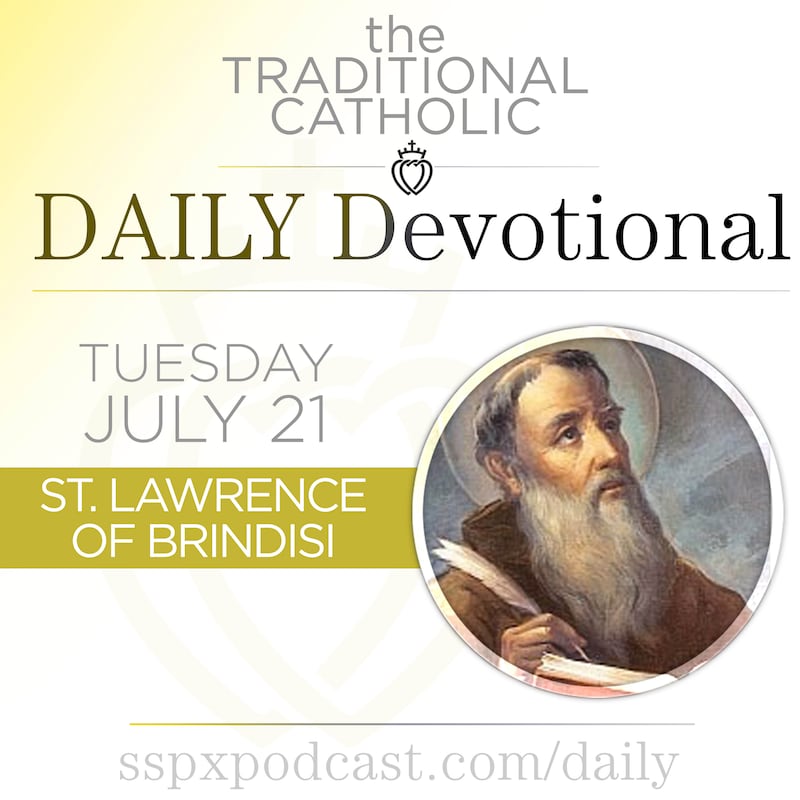
It's the Feast of
St. Lawrence of Brindisi,
3rd Class, with the color of
White. In this episode: the meditation: "A Wily Steward", today's news from the Church: "Letter from the Superior General to all the faithful of the Society of Saint Pius X", a preview of this week's episode of The SSPX Podcast: "Abp Lefebvre Audiobook Episode 6", and today's thought from the Archbishop Marcel Lefebvre.
Have feedback or questions about the DD or our other shows?
[email protected]
Sources Used Today:
- "A Wily Steward" — From Trinity Sunday to the Assumption
- "Letter from the Superior General to all the faithful of the Society of Saint Pius X" (FSSPX.news)
- The SSPX Podcast: "Abp Lefebvre Audiobook Episode 6" (SSPX Podcast)
- The Spiritual Life — Archbishop Marcel Lefebvre (Angelus Press)
Please support our new project, the Archbishop Lefebvre Biography Audiobook!
Saint Lawrence of Brindisi was one of those rare people whose brilliance never got in the way of his humility. He could debate scholars, preach to enormous crowds, advise kings and popes, and still spend hours in quiet prayer before the Blessed Sacrament. For Lawrence, learning was never about impressing people. It was about leading them to Christ.
He was born in 1559 in the port city of Brindisi in southern Italy and was given the name Julius Caesar Russo. Orphaned while still young, he was raised by relatives who recognized both his sharp mind and his deep faith. As a teenager, he entered the Capuchin Franciscans, taking the name Lawrence.
It quickly became obvious that Lawrence had been given extraordinary intellectual gifts.
He mastered Latin, Greek, Hebrew, German, French, Spanish, and several other languages. He knew Scripture so thoroughly that people often remarked he could quote almost any passage from memory. Jewish scholars were astonished to hear this Capuchin friar discussing the Old Testament in fluent Hebrew.
But Lawrence never treated knowledge as an end in itself.
He wanted people to fall in love with Christ.
His preaching became famous throughout Europe. Churches were often too small to hold the crowds that came to hear him, and people spoke of sermons that lasted for hours while holding everyone's attention. He had a gift for explaining difficult truths in ways ordinary people could understand, combining solid theology with warmth, humor, and genuine pastoral concern.
Before long, the Church began asking him to do much more than preach.
Lawrence became a diplomat, peacemaker, and adviser to princes and emperors during a time when Europe was divided by wars and religious conflict. More than once he found himself negotiating between rulers who trusted him because they knew he wasn't seeking power for himself.
One of the most memorable stories from his life comes during the Ottoman wars in central Europe. Although he was a priest, not a soldier, Lawrence accompanied Christian troops as their chaplain. Tradition says that carrying only a crucifix, he encouraged the outnumbered army before battle and inspired them with such confidence that the victory was later attributed, in part, to his leadership and prayers.
Despite his public responsibilities, Lawrence remained deeply devoted to prayer. Those closest to him said that the strength people saw in public was born during long hours spent alone with God.
His writings, especially on Sacred Scripture, continue to be studied today, and in 1959 the Church declared him a Doctor of the Church, recognizing not only his learning but his ability to place that learning at the service of the Gospel.
Visitors to Brindisi and to the Capuchin churches of Italy still encounter the memory of the friar who seemed equally at home in the classroom, the pulpit, the confessional, and the royal court.
Saint Lawrence of Brindisi, fearless preacher and Doctor of the Church, pray for us.
- - - - - -
Explore more:
What is the SSPX Podcast?
The SSPX Podcast is produced by Angelus Press, which has as its mission the fortification of traditional Catholics so that they can defend the Faith, and reaching out to those who have not yet found Tradition.
What is the SSPX?
The main goal of the Society of Saint Pius X is to preserve the Catholic Faith in its fullness and purity, to teach its truths, and to diffuse its virtues, especially through the Roman Catholic priesthood.
Authentic spiritual life, the sacraments, and the traditional liturgy are its primary means of bringing this life of grace to souls.
Although the traditional Latin Mass is the most visible and public expression of the work of the Society, we are committed to defending Catholic Tradition in its entirety: all of Catholic doctrine and morals as the Church has always defended them. What people need is the Catholic Faith, without compromise, with all the truth and beauty which accompanies it.
https://sspx.org