Shownotes
We like to believe that if we do everything right — bring in proven methods, hire experienced people, build the feedback loops — then the system will eventually bend toward better. Marco Heimeshoff spent years inside a company doing exactly that, and watching it fail anyway. Not because EventStorming, context mapping, or domain storytelling were the wrong tools. But because the real problem was somewhere none of those methods could reach.
This is what Marco calls a "graveyard story" — the kind he usually pushes under the rug. Through a multi-year transformation, his team improved the architecture, introduced agile feedback loops, and brought in collaborative modeling. Things kept getting better in parts, and kept failing as a whole. The EventStorming sessions made the dysfunction transparent, but transparency wasn't welcome everywhere. For some people in the room, asking "what can we improve next week?" didn't feel like progress. It felt like an attack. As Marco puts it, "feedback becomes violence" — and he slowly realised that, with the best intentions, he had been walking "through a culture with an ax," hurting people who never wanted the change in the first place.
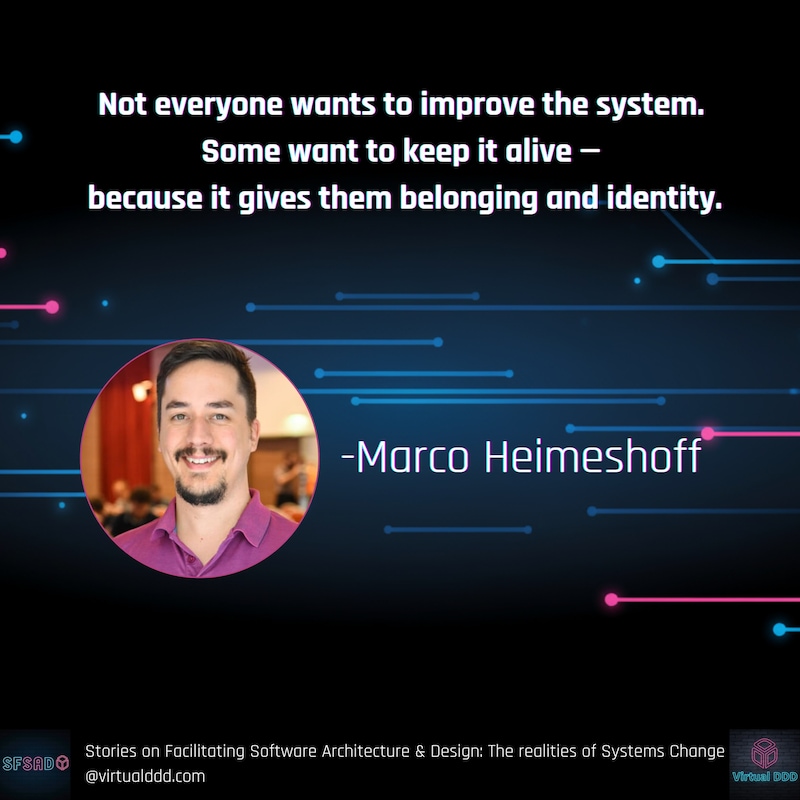
A colleague's introduction to spiral dynamics gave him a language for it: not everyone in a system wants to improve it. Some want to keep it alive, because it gives them belonging and identity. And above all of it sat a boss who said yes to everything, sat at the back of every session with a quiet smirk, and quietly commissioned the company's most revenue-critical software outside the entire process — telling that developer not to talk to Marco's team.
This conversation is about the limits of method, and the power facilitators hold without realising it. We dig into why a sponsor's mandate isn't the same as the team's, why psychological safety is necessary but not sufficient without intrinsic motivation to change, and what it really means to meet a system where it is rather than where you wish it were.
Key Discussion Points
- [00:00] The Graveyard Story: Marco opens a multi-year engagement he usually keeps buried — where everything improved except the thing that mattered
- [02:00] EventStorming Makes It Visible: The sessions surface buried relationships and dynamics that sticky notes can't make safe to break
- [03:30] When Feedback Becomes Violence: Why "what can we improve?" lands as a positive for some and an identity attack for others
- [05:30] An Ax Through the Culture: Marco's uncomfortable realisation that he was hurting people who never asked for his help
- [06:30] Context Mapping the Culture: Using bounded contexts to map mindsets — and why people read it as being put in a corner
- [09:30] The Boss Who Said Yes and Meant No: The smirk at the back of the room, and the revenue-critical software built in secret
- [14:30] How He Knew It Was Cultural: Working through technology, feedback, communication, and method before spiral dynamics named the real problem
- [19:30] Safe and Motivated: Why safety removes a blocker but never creates the desire to change
- [20:00] What He'd Do Differently: Leave earlier, get a real mandate, and meet the system where it actually is
- [23:30] Heuristics for the Pain: Keep your heuristic list short, observe the non-interaction, run small controlled experiments, and hold space — "shut the f*** up" and let people think
Guest: Marco Heimeshoff Hosts: Kenny Schwegler, Andrea Magnorsky, Andrew Harmel-Law
Transcripts
Hello and welcome back to another episode of Stories from Designers
2
:and Architects Doing Facilitation We
always try to get the name wrong I was
3
:just thinking about this one but today we
have Marco hypes off with us who's gonna
4
:tell us a story about his experience from
the past So Marco Thank you for coming
5
:Marco Heimeshoff (he/him):
Thank you Kenny.
6
:So, I wanted to give you a story, from the
very bottom of my heart, like a company
7
:that I was, accompanying for many years.
8
:And, after we did like a
long transformation from
9
:a technical perspective.
10
:Going from, from, very imperative
programming, very uncoordinated
11
:to different architecture styles,
object oriented programming,
12
:even introducing some functional
programming for the domain and so on.
13
:introducing agile feedback
loops and, and whatnot.
14
:So it was a really, a cultural
overhaul of the whole company
15
:over longer period of time.
16
:realizing at some point
that what was missing is the
17
:collaborative modeling part.
18
:So no matter what we optimized
it still failed and failed and
19
:keep on, keep kept on failing.
20
:for me, like in the middle
of the whole transformation.
21
:I realized that all these
failings, even though they looked
22
:different in their signals, they
all felt like the same thing.
23
:It's always we get wrong what the
customer actually needed, and it
24
:failed in different ways because
of different, you know, all the
25
:things we optimized before, but.
26
:It's, we never really
delivered what they needed.
27
:And then we started doing domain driven
design at some point, and that's when
28
:the collaborative modeling kicked in.
29
:So we are like, okay, we need to
be, get better at this and we need
30
:to introduce like ways to, to, get
people to talk to each other and.
31
:It seemed to work for quite a long while.
32
:So we started with simple things like,
just a impromptu modeling session, just
33
:talking about the ubiquitous language,
figuring out which bounded context exists.
34
:So starting from the architecture
that's already there, which is
35
:always an easy start, right?
36
:We had the mandate from the developers.
37
:So the programmers were all in
and said, let's do the thing.
38
:So we looked at the architecture and
the modules that existed in the code
39
:and extracted a context map from there.
40
:And then introduced that to the, to
the product people and said, look,
41
:this is, this is the structure we see.
42
:Sorry.
43
:Is that how you see the business as well?
44
:And then they were like, yes, yes, this
looks good, but we need one more here.
45
:And you realize like, no, no.
46
:They're thinking in software module still.
47
:Like they're trying to tell us
the solution, like we need a new.
48
:Thing that they can click
over there is like, okay, this
49
:transformation took quite a while.
50
:And even though, and then this is
now, this is all the still fun part,
51
:but the, the hard part came when we
were at a level where we realized.
52
:Oh, we are having the buy-in from
everyone now, like product was all in.
53
:The boss of the company was
like super happy about us
54
:doing collaborative modeling.
55
:We did event storming sessions and
the first few were like a bit awkward
56
:because everybody knew each other, right?
57
:There was already some cultural,
used being used to things and, and
58
:there were certain relationships that
were already baked and deep into the
59
:company that wouldn't change anymore.
60
:Most likely.
61
:So there were people hating each other,
other people being like, comrades.
62
:And, and you can feel this in the event
storming, but the event storming made
63
:these things not safe to break because
again, culture was deeply ingrained,
64
:but it made things very transparent and
you could feel where it's off, where
65
:people don't really go deep into details.
66
:And we used the signal to
then go, Hey, okay, let's talk
67
:to these people in private.
68
:Let's figure out what happened here.
69
:And.
70
:More and more and more we introduced
like open feedback loops and tried to
71
:make it more psychologically safe and
said, look, let's have a conversation
72
:about this and feedback things and how
did you feel in this session, right?
73
:And what went good?
74
:What went wrong?
75
:Do you think these models are all
equally valid in their quality?
76
:And so on?
77
:And that's when we realized
the very first problem.
78
:With cultural alignment.
79
:So all the technology and all the
methods we used, they helped in areas
80
:and they made the models better.
81
:But some core problem never got away.
82
:And this feeling was icky.
83
:And during a feedback session, I realized
if you have a green mindset, if you are
84
:an egalitarian and you think like, hey,
self-improvement is great and collective
85
:and collaborative improvement is great.
86
:Like this is what we're here for, right?
87
:We strive to become better as a group,
to better ourselves and humanity.
88
:If you wanna go the Star Trek
route, like this is amazing.
89
:But if you have a conservative mindset,
which is not necessarily negative, it
90
:often sounds that way from green thinking
people, but if you have a conservative
91
:mindset, things are good the way they are.
92
:Like, we are a family here, right?
93
:If you hear these words like, oh yeah,
no, we're a family in our company.
94
:Like, yeah, we all stick to each other.
95
:This is great.
96
:Um.
97
:Then conserving what is keeping the
culture that exists alive is great,
98
:and feedback becomes violence.
99
:So sitting in a workshop saying,
Hey, what can we improve next week?
100
:It's just a positive thing for me, and I
realized I was actively hurting people,
101
:but they of course don't say, Hey.
102
:When you give me feedback, this hurts
me because I have a conservative mindset
103
:and I feel attacked in my values.
104
:That's not what you will hear.
105
:You will hear jokes, you
will hear dismissive things.
106
:You will hear like they will ponder off.
107
:They if it, if you really pinpoint it
too hard, they start attacking you,
108
:blaming, and then you know, the whole
shebang of how people interact when they
109
:are feeling threatened and put in a.
110
:So realizing this at some point
that I wondered why feedback
111
:loops don't really work.
112
:Like the agile feedback loops kind
of worked, but only on the technical
113
:side, not really fixing the culture,
the modeling sessions exposed things.
114
:And once we started, hey, great,
now we see our controversies,
115
:which is a good thing, right?
116
:This is.
117
:The usual.
118
:If you stand in a room, you talk to
people, we're opposing each other.
119
:I'm right, you're right.
120
:We're fighting bad.
121
:But once you stand shoulder to
shoulder against a model like this is
122
:the whole premise of event storming.
123
:We're like, let's attack
this model together.
124
:This is wonderful.
125
:And we see different perspectives and we
can figure out in which context are you?
126
:Right?
127
:And in which context am I right?
128
:This is wonderful.
129
:Yeah, this is wonderful if you want
to improve the systemic problem, if
130
:you want to get out of a systemic rut.
131
:But for the people that wanna keep
the system as it is alive, because
132
:it gives them safety, a place of
belonging, or I'm just other reasons
133
:why they want to keep it that way.
134
:You attack them and you don't
only attack their way of working.
135
:You, you go ahead and attack their
identity without even knowing it.
136
:So involuntarily, I was actually a person
that just went through with an ax through
137
:a culture and really hurt those people.
138
:And I don't think they even
realized that they were hurt by me.
139
:It just felt like, oh, Marco is an idiot.
140
:Why is he always doing this?
141
:Like tree hugging people, blah,
blah, blah, talking about feelings.
142
:We wanna build software here, right?
143
:So all of these things
don't become transparent.
144
:You just feel it kind of in the
room and something is off and
145
:you can't even address it because
it just leads to more violence.
146
:And by violence I just mean soft
violence, but still violence.
147
:So.
148
:That was, that was a really big
learning and a really big problem.
149
:And then we started, so gathering more
people in the company that I knew are
150
:open to feedback and then those who
understand the psychosocial dynamics of,
151
:of, Groups of people trying to figure
out, okay, how can we now make this work?
152
:And we actually use bounded
context mapping for that.
153
:so context mapping to say, look, in this
bounded context, we're assuming the people
154
:in this context are more conservative.
155
:It's a dangerous assumption because
we're just reducing a group of
156
:complex individuals to a property.
157
:But let's work with that assumption
and protect ourselves using a.
158
:Context boundary, right?
159
:So that was, it seemed the solution,
building a proper context map that doesn't
160
:just contain code and team topologies in
the, in the classical sense classical, but
161
:also in the emotional psychosocial sense
saying, okay, what, what kind of mentality
162
:and and culture do we feel, feel here?
163
:And how would that impact our interaction?
164
:And with that, we could
actually start to manage.
165
:The problem with management all of a
sudden is it feels like manipulation
166
:for the people that get managed, right?
167
:So the moment somebody catches on that,
oh, you put us in a group because we
168
:are all alike, they're not reflecting
on because we are the conservative
169
:part and you are the egalitarian part,
and therefore we need a boundary.
170
:They think, oh, you're putting us in
a corner and micromanaging us, like,
171
:and this, we never got out of this rut.
172
:This constantly deepening loop of
people being hurt by cultural mismatch.
173
:And, and this was, we
reached out for help.
174
:Like left.
175
:I mean, you know me, right?
176
:I went to every conference over the
last decade, the, the, the:
177
:every person that was agile system
thinking, sociotechnical, like invite
178
:them to the company, let them help.
179
:And yeah, this, this problem, the more
you try to help, the more it's just like
180
:people just get stonewalled and stuck.
181
:And so just letting go at some point
was the only thing that was possible
182
:to say, okay, let's loosen the nudge.
183
:Let's not.
184
:Try to fix things.
185
:Let's work with an unfit system that
just doesn't properly work ever.
186
:So that was, that was a multi-year
effort that really, really hurt.
187
:letting, letting loose was the only thing,
letting go, of this problem and then
188
:inviting lots of people to help, with
the struggle, didn't solve the problem.
189
:So really just accepting it, working
with an unfit system was the best
190
:that this situation actually, that
we could do in this situation.
191
:So that was a multi-year thing,
and it was very painful because.
192
:I was constantly exhausting myself,
like trying to fix it, right?
193
:You're like, what else can I try?
194
:Like I tried event storming, of
course, and then context mapping,
195
:and we tried domain storytelling
because people were like, oh, these
196
:sticky notes are too vague, right?
197
:the feedback you get is not the actual
thing that happens in them, but.
198
:It's what they think is wrong.
199
:Like, oh yeah, no, this is too vague.
200
:Okay, let's go more diagram style.
201
:Let's use domain storytelling.
202
:Okay?
203
:Then you have, at some point, the
developers are in the in the clear.
204
:They're like, yes, we like this.
205
:This is like UML.
206
:We can build this.
207
:Cool, and you're not talking
about feelings anymore.
208
:Great.
209
:But then you have the strategy
part of the company, like the
210
:other side of the mandate.
211
:Yeah.
212
:They're like, but this
is just technology now.
213
:Right?
214
:This is a programmers problem.
215
:Like, no.
216
:And then we went into the
second phase of our, we can't
217
:solve this company's problem.
218
:Getting the, the leadership involved
into the entire solution, being
219
:like, how can we get out of this Rut?
220
:Leadership was a, and I'm
assuming now just, but felt
221
:like a very conservative person.
222
:That doesn't wanna seem conservative.
223
:Like they wanted to be like a
dynamic leader in technology.
224
:Like yes, we are modern, advanced
and whatnot, but you could feel
225
:in everything they did, like they
were like super conservative.
226
:they were living their own politics in the
external politics inside of the company.
227
:And this was like, it was introducing
a kind of toxic culture, in my opinion.
228
:This is of course, opinionated.
229
:So that person always
said, yes, you can do that.
230
:You can do whatever you like here.
231
:Right?
232
:We give you all the power, like
introduce new methods, do the
233
:domain modeling, collaborative.
234
:That's great.
235
:Like we wanna be part of it.
236
:And they sat in every session and
in every session we did, they sat
237
:in the background and observed.
238
:And I was like, this is event storming
and you are the person that's leading
239
:this company into the next millennium.
240
:Like, great, here are sticky notes.
241
:Would you like to tell us?
242
:What do you think is
the most important part?
243
:Like, no, no, no.
244
:You go ahead.
245
:So I'm gonna tell you if something
is missing or wrong and you're like.
246
:Ah, this was going badly.
247
:So because I knew it was a multi-year
operation, it's not something that
248
:needs to be fixed in like a day or two.
249
:you can let it go for a while, right?
250
:You can, okay, this person
doesn't feel safe in this meeting.
251
:So let them show how the method worked.
252
:Let them show how we find conflict.
253
:And we, we don't blame people.
254
:We just figure out conflict is great.
255
:We learn from it.
256
:We build a better model.
257
:So all of the good things, again, going
through the methods, using all the
258
:things that to, to improve the model.
259
:And the boss person, they, they played the
game at some point, like they never really
260
:fully committed to it, but they played it.
261
:They were like, yes,
let's add sticky notes.
262
:But you could see the smirk, and
it's a smirk that, as you can
263
:probably tell, it still gives me an
emotional reaction of I wanna punch
264
:that face while I'm in the session.
265
:So you feel like, I've been here for
many years really trying to help your
266
:company and you're sitting here like me.
267
:Sure.
268
:Sticky notes program is ha ha ha.
269
:They're like, and everybody
could feel that, that the boss
270
:isn't taking it seriously.
271
:And then I realized all the methods
in the world, all the prowess, all the
272
:expertise, like I was already a consultant
helping companies around the world.
273
:With all of that symbolic power,
you have no chance if your boss
274
:says, oh yeah, sure, this is cute.
275
:Let's do this.
276
:But they don't say that if they, if they
actually say it, you can work with that.
277
:But if they don't say it,
but you just feel it, it is
278
:like, oh, that made me so mad.
279
:And yeah, we, we really
tried open discussion.
280
:But because he's a conservative, he
felt attacked in his identity, right?
281
:So then it's like, okay, let's
try soft manipulation, let's
282
:try nudging the right things.
283
:That's invite him only for a few
hours to get the information we need
284
:to make it, make it about money.
285
:Talk about strategic futures.
286
:We introduced worldly mapping to say,
look, this is how the market evolves
287
:and this is how we evolve, right?
288
:So we went.
289
:Overboard with everything
you can introduce.
290
:And then at some point realizing
that whatever we were doing was
291
:just a very expensive experiment
and our boss was talking to another
292
:programmer, and this is the kicker.
293
:After many years of working in
this, talked to another programmer
294
:to actually build the things that
make the company money right now and
295
:told him to not interact with us.
296
:Because he didn't want this to be dragged
into the agile modeling cycle, right?
297
:This like blah, blah, blah.
298
:The tree hugging developers
like, yeah, it's cute.
299
:What they're doing is great, what
they're doing, like company culture
300
:and whatnot, but please, we need this.
301
:We need this working well
and fast and build it.
302
:And the other problem was just like
building something quick that worked
303
:quickly and it made money quickly.
304
:And it re, we realized after
we learned about this, it took
305
:many months to, to get there.
306
:But after we learned about this, we
realized the new thing they built
307
:are actually at the core of what the
company's making money with right now.
308
:Super important.
309
:And the software was janky of
course, because one person under
310
:pressure, under speed did it.
311
:And we were like, what the.
312
:This needs to be modeled properly.
313
:We need properly language and context
boundaries and there has to be
314
:responsibility and of at least a second
pair of eyes on it and pair program.
315
:Oh God.
316
:But this was the culture clash.
317
:So at some point it.
318
:Actually giving up was the only
thing I could do and say I tried.
319
:I tried for many years.
320
:I think I helped a lot of people
in that company to see how
321
:you can do things differently.
322
:And we improved the quality locally
of certain parts of the system.
323
:But as you know, for systems, if you
don't figure out where the bottleneck
324
:in the entire system is and you
actually repair the system at hand.
325
:Optimizing a local part that's
not in the key value chain.
326
:doesn't, doesn't have any.
327
:So it felt we like really heated
up the universe for a while.
328
:made a lot of money left and
right and whatnot, but in the
329
:end, this was a big non success.
330
:it was a learning for me and some others,
but not the success we wanted to have.
331
:So yeah, this is one of the,
of the graveyard stories that
332
:I push under the rug usually.
333
:But, I wanted to share that.
334
:So, yeah, that's my story so far.
335
:Um, I'm still suffering
from it, but I'm smiling.
336
:So go ahead, ask your questions.
337
:Andrea Magnorsky: the
first question I have is.
338
:How did you know that the
problem was cultural alignment?
339
:Because you started off the story saying
this is a story about cultural alignment.
340
:That means that you spent quite
a few cycles thinking about it.
341
:Marco Heimeshoff (he/him): Yes.
342
:Um, so this was not my
initial analysis, right?
343
:I didn't start at saying, Ooh, there
seems to be cultural misalignment
344
:here, because first of all.
345
:How dare I, right?
346
:Who, who would I be to
understand this quickly?
347
:And if you understand this quickly,
then well check your understanding
348
:because this is probably biased.
349
:so being aware of all of that,
initially I thought this, there's
350
:a technological problem, so let's
fix it with better architecture.
351
:Then I thought it's a feedback
loop problem, so let's fix
352
:it with feedback loops.
353
:Then I figured, no, we're not talking
properly to each other because the
354
:feedback loops are there, but there's
still bullshit coming out of it, and
355
:it's always misaligned content wise.
356
:So let's fix that.
357
:Collaborative modeling and so on.
358
:And then realizing we're doing
everything right by the book, as
359
:I understand domain driven design.
360
:we even got the expert, like I
talked to Alberto and Eric and like
361
:name drop, name drop, name drop.
362
:We talk to like all the book authors
say, Hey, this is what we tried.
363
:What could we do better?
364
:And then it's like after you try every
method, realizing it's still failing.
365
:Like this can't be a problem
of sticky notes or methods.
366
:And at some point, woman ZA colleague
in my office introduced me to,
367
:spiral dynamics, the psychosocial
evolution of human, behavior.
368
:And I usually don't drop this name.
369
:You have to be very careful because
there is an esoterical movement with
370
:the same name and very similar content.
371
:So Googling this stuff is kind of like
gets you into icky spaces, but, um, it
372
:is a psychosocial theory of how people
evolve as individuals and also as groups.
373
:And, yeah, it's, I don't wanna go
into a theory talking now, but the,
374
:just the basic idea of like, there are
different memes you, you, gather during
375
:a lifetime based on the complexity of
the problematic situations you're in.
376
:So you try to survive, right?
377
:And then there's family grouping,
and then there's like power
378
:struggles in your youth and whatnot.
379
:Then you get into a conservative mindset.
380
:Then there's like the, the, aspirational
driven mindset, like scientific
381
:thinking and company struggles.
382
:Then there's green mindset
and so on and so forth.
383
:There's a whole bunch of theory behind.
384
:Why and how this works in psychology, but
these patterns, they mapped really well
385
:on what I was observing in the company.
386
:So I was like, holy shit, this is like,
this is a blueprint and fully aware
387
:of yes, we are all humans, we're all
biased, and whenever the shoe fits,
388
:it's probably not your shoe, but let's,
let's still look at it from all angles.
389
:But the more we try to pro it and say,
okay, this has to be wrong, right?
390
:Good scientific thinking, like
how, what's the null hypothesis?
391
:How can we prove this to be false?
392
:Every time we try, it's like,
oh, this fits, this fits so well.
393
:And then realizing no matter what method
we're using, when we talk to these people,
394
:they react exactly as you would expect.
395
:Someone with this mindset, with
the ex, with the conservative
396
:mindset to react to these things.
397
:And then realizing, okay, so I never
understood why asking for feedback,
398
:making things very transparent.
399
:I hear back echo well, um, making
things very transparent leads
400
:to, to people feeling attacked.
401
:Or getting like humorous or
defensive or whatever, like why?
402
:And this is what you expect
from a very conservative person.
403
:If you let them figure out
what can you do better?
404
:Because you deck their identity.
405
:It's like, okay, this fits too well.
406
:And then we use the methods from that,
that that basically emerged from Spiral
407
:dynamics to say, how can we manage this?
408
:And that management actually
led to some ease in the system.
409
:It made things work better because you
take people from where they are and
410
:don't try to bring them to where you are.
411
:But only figure out where could
they go from where they are.
412
:Right.
413
:Help them do the next step, even
though it's not what you want, but
414
:it's the only thing they can do.
415
:And that changed things for the better.
416
:So this was our like long-term
experimental, first of all, biased
417
:understanding, but then figuring out
what actually works and doesn't work.
418
:And that's when the realization came.
419
:Like, we have a cultural problem here.
420
:there are different mindsets,
different emotional backgrounds.
421
:Different wants and needs and people
are not always able and aware at
422
:the same level to communicate about
their feelings and their inner world.
423
:Not everybody is self-reflected and does
feedback loops on themselves and so on.
424
:Like this is rare.
425
:It's not the norm.
426
:And sometimes we, in the agile space
and modeling space, forget that not
427
:everybody stands at home with sticky notes
and figures out their own life, right?
428
:Many people just live their life
and are happy the way it is, and
429
:they don't want a need to change.
430
:Kenny Schwegler: And this has to do of
course with what's happening at home
431
:how much load do they have there's
many reasons your event storming
432
:Reminds me a bit of Paul Rainer's story
about uh popping open some code and
433
:go refactoring it in public right So
434
:Marco Heimeshoff (he/him): Oh my God.
435
:Kenny Schwegler: work
436
:Marco Heimeshoff (he/him): Yeah.
437
:Let me guess.
438
:Somebody got hurt because
they changed their code.
439
:And made it better, and that person's
like, I worked hard on this code.
440
:You're like, yeah, yeah,
441
:Kenny Schwegler: And it's the
same actually what people might
442
:underestimate with event storming
right Event storming is not just
443
:a method I guess what you do you
444
:Marco Heimeshoff (he/him): yeah,
445
:Kenny Schwegler: people in a
room and you might accidentally
446
:unintentionally attack their models
447
:Marco Heimeshoff (he/him): yeah.
448
:Kenny Schwegler: and if you're not
careful with that their thoughts or
449
:and when people don't feel safe I
guess it's very hard for them to change
450
:Marco Heimeshoff (he/him): Yeah.
451
:Kenny Schwegler: so
452
:Marco Heimeshoff (he/him):
I want to add to that.
453
:Kenny Schwegler: Yeah Yeah sure And
and my question so add something and
454
:my question would be is there something
you would've done different looking back
455
:Marco Heimeshoff (he/him): Yes.
456
:So first I want to interject and say it's
not just if they feel safe, they need to
457
:feel safe and intrinsically motivated.
458
:Kenny Schwegler: Yeah
459
:Marco Heimeshoff (he/him): That
is one very important step.
460
:No matter the level of safety.
461
:If you don't have a need to
change, you will not change.
462
:So the thing that I would've done
differently, looking back, the very,
463
:the very obvious thing is leave way
earlier because I realized I was a
464
:very dangerous force in that group.
465
:Like I was trying to invoke
change that wasn't demanded.
466
:This is something I do differently
with all my customers ever since.
467
:It's like I get a mandate, like not just
from the company, like if a boss pays
468
:me and there's a one, one prodigy in the
company saying, Hey, one sponsor saying we
469
:want you and this is what we're gonna do.
470
:I wanna talk to the people I work with
before we start the workshop, right?
471
:Because otherwise you're, you're,
you're helping people against
472
:their will and that always fails.
473
:That is just a massive
struggle I don't wanna do.
474
:So if you don't want the help or
the change, I don't wanna help you.
475
:Not in a.
476
:In a mean way, but I don't
wanna hurt you with this.
477
:Right.
478
:So that's the one thing
I would've changed.
479
:try to get a mandate and
realizing there is none.
480
:and then going, just leaving the company,
because they were, they were doing the
481
:things they were doing, the system was
optimizing itself to be kept alive.
482
:Um, the, and that's the
defeatist way of thinking, right?
483
:I mean, it's a helpful way, but it's also
saying, yeah, I struggled a long time.
484
:I should have quit earlier.
485
:Let's put that aside.
486
:That is a thing I should have done,
but if I wouldn't have quit, the thing
487
:I would do differently in that company
is to not try to enforce, my culture.
488
:The culture of agile feedback loops
and collaborative modeling and
489
:constant visualization and focus on
clean language and all that stuff,
490
:and psychological safety to make that
the leading culture of the company.
491
:Accept the culture that is right if
people are conservative or power driven
492
:or these are not just ative stereotypes,
but it can be a very complex roster
493
:of, of various emotions and needs.
494
:That's what is, respect what is there and
figure out what help do they really need?
495
:What, what's the next bottleneck?
496
:How can you help this system grow into
its better potential, not into the
497
:vision that somebody sees as a target.
498
:Like you can have a vision where the
whole company could be in five years.
499
:We're all like super emotionally
sharing and have fast feedback
500
:loops, and we release twice a day.
501
:Great.
502
:But that's not real, right?
503
:That's a fantasy.
504
:If you have a company that has
half year cycles and the company
505
:is like teams with clear boundaries
and clear bosses and whatnot, this
506
:transformation is a 100% shift of culture.
507
:There is no way you get there.
508
:You can only figure out what's
the next helpful step and
509
:then also be agile about that.
510
:So the agility, the, the responding to
change and going in iterations on the
511
:cultural change is something I didn't do
and that is something I would do very,
512
:very differently nowadays and that can
very well mean living with a part of
513
:the culture that I don't like and where
I think this is hurtful for the system.
514
:In the way I would like the system
to be, but it's actually the best
515
:thing the system has right now.
516
:And the best thing it,
it works for the system.
517
:So the result I produce don't
have to be in a way that I like.
518
:Right?
519
:My aesthetic, realization
of, I like this shape.
520
:This is beautiful.
521
:Let's go.
522
:There is not what, what
needs to be realized.
523
:So this is a hard thing as a facilitator
or as a consultant, I come with my own
524
:biases of how things should be, right?
525
:What would be a good or right solution.
526
:And I have my experiences from.
527
:200 plus companies and like, yeah,
I feel entitled to know things,
528
:but there are 200 other people in
that company that also know things
529
:and they want different things, so
530
:Kenny Schwegler: Yeah I think what you're
saying you say work with what there is
531
:and also right Think about yourself If I
ask someone ah you should go to therapy
532
:and you are like no well then it's
533
:Marco Heimeshoff (he/him): yeah.
534
:Kenny Schwegler: work And
535
:Marco Heimeshoff (he/him): Yeah,
536
:Kenny Schwegler: even though
everyone can use therapy
537
:Marco Heimeshoff (he/him): yeah.
538
:Of course.
539
:Kenny Schwegler: not in the
situation where I think I did it
540
:in the past but right now no So it
won't work I need to be open for it
541
:Marco Heimeshoff (he/him): Yep.
542
:Kenny Schwegler: I think Andrew you have a
543
:Andrew Harmel-Law: I was
just gonna ask Mark, do.
544
:You like, 'cause you mentioned
like paying attention to kind of
545
:Marco Heimeshoff (he/him): Yep.
546
:Andrew Harmel-Law: So you know
when, when you could push or when
547
:you couldn't push or when you need
to just kind of live with things.
548
:Are there any heuristics or that you've
learned over the time where you're like,
549
:you could obviously find these things by
pushing too hard and then you get pushed
550
:back and then it hurts and it's painful.
551
:But if you kind of developed any
heuristics for kind of spotting this stuff
552
:without having to go through the pain
553
:Marco Heimeshoff (he/him): Yeah,
so I think like 10 years ago or so,
554
:I started a list of heuristics of
modeling, heuristics and cultural change,
555
:heuristics and, and architecture, like
for all the different areas in my life.
556
:I started to build heuristic lists,
and then I realized with my, like a
557
:DH, D brain, like I, I realized I built
lists, but I never looked at the list.
558
:So I stopped actually collecting.
559
:It's the, the thing I do the most is gut
feeling, and that's a very bad heuristic.
560
:I, I totally realize that, but it's
informed gut feeling, so I feel
561
:entitled to it being a better solution.
562
:no, but, but there are some, there are
some mechanics that, that, I often go to.
563
:Like I try to keep my heuristic
list to a very simple, manageable
564
:thing that I actually operate with.
565
:so that's one heuristic.
566
:Keep your heuristic list short and
don't try to have like 500 options.
567
:like you're not an LLM with a bunch
of skills that you can execute
568
:whenever the prompt fits right.
569
:so what I do is, I.
570
:Often open with an event storming, right?
571
:This is my starting here, like take the
modeling method I'm most familiar with
572
:that has the, the highest potential
for people to interact in various ways.
573
:Unconstrained.
574
:And keep a strong eye on the
people that do not interact.
575
:So there are introverts that don't
wanna open up in front of a group
576
:that much, or that takes more energy.
577
:There's political, struggles and so on.
578
:So observing human behavior,
observing body language, observing
579
:the interaction, and very important
heuristic, observe the non-interaction.
580
:As a facilitator, I try to keep an
eye on who's not interacting, even
581
:though they should be from a point
of, of, domain or or power level.
582
:And then.
583
:Interacting in, in shorter cycles,
saying like, Hey, we make the
584
:big session to understand things.
585
:So don't try to fix everything in the
same modeling session is also a heuristic.
586
:if you see a problem, you don't
have to address it immediately.
587
:Just write it down and then
talk to the people, right?
588
:If you have a good, if you have a
good standing with them, if you know
589
:Andrew, you and I, if I have a problem
with you, I think, oh, that's weird.
590
:I know I can just come to you
like, Hey, can we talk a second?
591
:If there's somebody in a suit saying, no,
no, no, this is how we should do things.
592
:Like, I'm like, yeah.
593
:I'm not just gonna go to their office and
say, look, I observed a problem with you.
594
:Like that's.
595
:No, but then you have like a beer
in the afternoon or go to a football
596
:match or just chill a lunch break
and get into the conversation.
597
:So take your time to really
understand, where the struggle comes
598
:from, and then for the next session,
you can then prepare and adjust.
599
:Um.
600
:So those are a bunch of the heuristics.
601
:Um, small control experiments is something
I love to do, and that kind of fits with
602
:Andrea's bite-sized architecture and also
these bite-sized sessions here, right?
603
:Small control experiments
is what I really love to do.
604
:So because I, I'm fully aware, I'm
biased, like I can be the smartest person
605
:in the room and I still get it wrong.
606
:Most of the time you're biased and you
will never lose your biases, not fully.
607
:So given that, just assume
you don't know shit.
608
:So here's an experiment.
609
:What if I try this?
610
:Let's observe what the result is.
611
:Working with n Hypothesis,
figuring out what would be the
612
:how, how can we break this, right?
613
:And just, just figure out what
happens when you try something.
614
:Um, and then in that
case, just be creative.
615
:Like this is, this is where
the DDD community helps.
616
:there is ddd heuristics.com.
617
:That's something I sometimes go through
to just randomly pick something.
618
:Say, let's try that.
619
:And you just try and
figure out what happens.
620
:Andrew Harmel-Law: Yeah, I think
that you mentioned it a few
621
:times, but time to think as well.
622
:Right.
623
:So I think neurodiversity, whether,
you know, whether or not we're
624
:neurodiverse or not, I think.
625
:People, like of us tend to just think
and and process stuff really fast
626
:and a lot of other people just don't.
627
:Right.
628
:Especially if they don't
move between companies.
629
:'cause I think
630
:Marco Heimeshoff (he/him): Yeah.
631
:Andrew Harmel-Law: I realized recently
the fact I'm a consultant is possibly
632
:'cause I get bored quite a lot and
then I just, I get moved from company
633
:to company whether I like it or not.
634
:Marco Heimeshoff (he/him): Yeah.
635
:Andrew Harmel-Law: somewhere for a long
time 'cause they don't wanna move and
636
:they like to understand stuff and it,
they want to think about it longer.
637
:So like you said about kind of
time to think, I think is a.
638
:Can be a big deal.
639
:Right?
640
:Just if you rush people into stuff,
even if they like the sound of it, they
641
:might be like, I just don't wanna be,
I don't wanna go into this too fast.
642
:So yeah,
643
:Marco Heimeshoff (he/him): That
was my biggest personal learning.
644
:So, sorry, Kenny, uh, just finish.
645
:Um, this was my biggest personal learning.
646
:it's not something I want to
give other people, but for
647
:me, this was super helpful.
648
:Shut the fuck up, is what I
learned for me, because I'm
649
:someone I, I think, while I talk.
650
:So if I sit alone in my office and you
want deep thinking for me, forget it.
651
:Like, I can do this for half an hour
max, and then I'm just, I'm gone.
652
:I need someone to talk to.
653
:And while we're talking, like the
whole story I'm telling today,
654
:I didn't prepare any of this.
655
:Like this is not like I don't have
my bullet points in front of me.
656
:I think when I talk on this works
wonderfully so I can come up with
657
:great new ideas in a group of people.
658
:The more people, the more
energy and that's great.
659
:And then I realized not
everybody is that way.
660
:Some people just need silence
and give me time to think.
661
:So I was like, Hey, what do you think?
662
:And they're like, I, I, I, I don't know.
663
:And then while they were not
saying anything, I'm like,
664
:okay, jumping right in again.
665
:So for me, this was the, this is years
ago already, but this was the biggest
666
:learning to say, give people space.
667
:And I just realized, Kenny, I
just shut you up to not give you
668
:space, but, um, give people space.
669
:And just, even though everything in
me is screaming, like, yeah, talk.
670
:You have an idea, go further.
671
:It's like, no, just
wait and open the space.
672
:Hold the space for other people
to find the time and, and, power
673
:to think that's super important.
674
:Kenny Schwegler: So especially you
know big picture events moments are
675
:great but they're a full day So having
shorter experience is what you're saying
676
:Marco is really nice and I don't tend
to my istic now is I don't tend to
677
:make decisions in meetings I say okay
Let's write it down in an a DR then
678
:I'm gonna share it with you and you
679
:Marco Heimeshoff (he/him): Yeah.
680
:Kenny Schwegler: think about it You can
get your feedback and maybe in a couple of
681
:days I put you all together if there's no
682
:icky stuff happening while we're
asynchronously talking So I give
683
:people space and time So I guess
that's I'm similar as you Marco
684
:luckily I have a brilliant wife who
told me to shut up once in a while so
685
:Marco Heimeshoff (he/him): Is there
a correlation between consultants
686
:that are community members and A DHD
or so we should gather data there.
687
:Andrew Harmel-Law: It could be.
688
:Kenny Schwegler: I tend to talk a
lot It's an emotional thing anyway
689
:Marco Heimeshoff (he/him): Yeah.
690
:Kenny Schwegler: for this session
691
:Marco Heimeshoff (he/him): Yeah.
692
:Kenny Schwegler: I think uh that's
it Thank you Marco Or do you Andre or
693
:Andrew have one last daring question you
694
:Andrew Harmel-Law: I am good.
695
:I'm just thinking about a load of
stuff now that all the stuff that
696
:Marcus didn't mention to us, so.
697
:Marco Heimeshoff (he/him):
Thank you so much.
698
:Andrea Magnorsky: I think this was great.
699
:Thank you very much, Marco.
700
:Marco Heimeshoff (he/him): Thanks me.
701
:Kenny Schwegler: Thank you very much
And I don't generally like to say
702
:this but please like us subscribe so
it spread the word of these stories I
703
:hope they're very helpful Come to our
Discord channel Marco's there Andrea's
704
:there Andrew's there I'm there and we
can talk more about these subjects and
705
:maybe you'll be in our next stories
of facilitating design architecting
706
:whatever the show is called nowadays
thanks and see you next time Bye-bye
