Shownotes
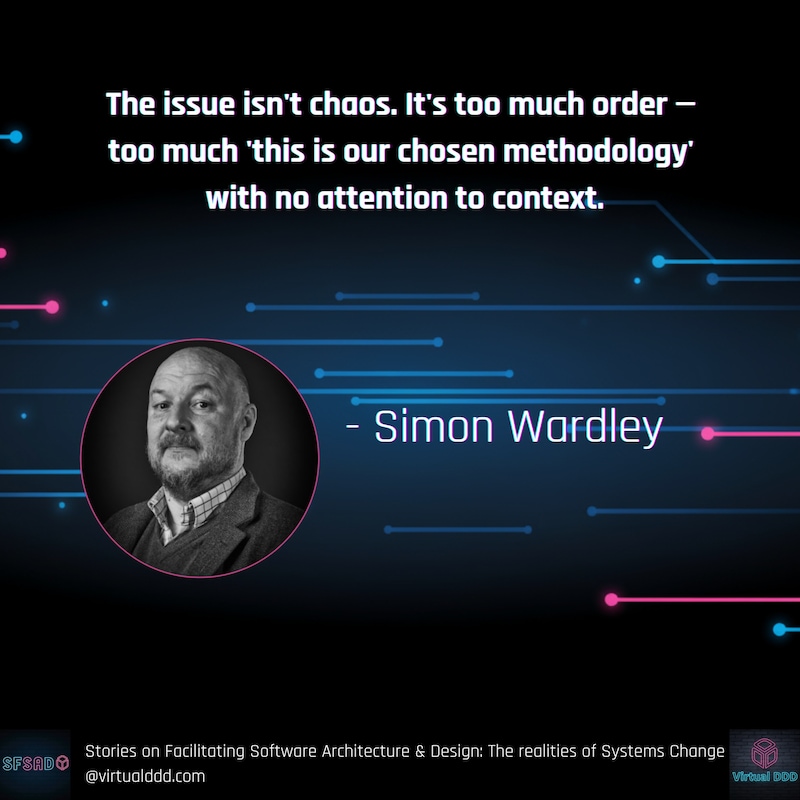
We fight about Agile versus Six Sigma, build versus buy, in-house versus outsourced. We pick our camps and defend them with the certainty of people who've never mapped the territory they're fighting over. But what if the real problem isn't which method is right — it's that we're choosing methods before we understand what we're building?
That's the story Simon Wardley brought to this conversation, centred on HS2 — Britain's high-speed rail project. CIO James Finley needed to build a virtual railway before the physical one, because it's cheaper to mess up a virtual landscape than the English countryside. The typical government approach would bundle everything into domain-based contracts and outsource. Instead, James spent a Sunday afternoon doing something different: he mapped the entire system. Not a component diagram. A proper map — with users at the top, a chain of needs underneath, and a critical question about each component: how evolved is it? Custom-built land referencing systems on the left. Commodity compute on the right. Suddenly, the methodology war dissolved. You need Agile where things are novel and changing. Six Sigma where things are commodity. Lean in the middle. They built the system using multiple methods simultaneously — ahead of schedule, under budget.
But Simon doesn't stop at the success story. The conversation digs into the harder questions: what happens when people have built 20-year careers on a single methodology and you're implicitly telling them they've been doing it wrong? How do you handle dominant voices who weaponise information asymmetry in collaborative mapping sessions? And why do maps create safer spaces for challenge than stories — even when the topic is as divisive as Brexit?
Key Discussion Points
- [00:01] The Virtual Railway: Why HS2 needed to model the entire railway digitally before breaking ground — and how James Finley approached it differently from typical government IT
- [00:06] The Sunday Afternoon Map: How plotting components on an evolution axis — from genesis to commodity — dissolved the methodology debate
- [00:10] Burning the Heretic: What happens when Simon tells Agile conferences that Agile isn't appropriate everywhere — and gets the same reaction at Six Sigma conferences
- [00:13] The Excuse Loop: Why "we didn't specify the requirements well enough" is the most dangerous sentence in software delivery
- [00:16] The Military Advantage: How situational awareness training gives people like James an instinct for context that methodology-trained professionals often lack
- [00:21] Practicing on Real Terrain: Andrea's experience joining a transport research group to deliberately practice mapping on systems, not just theory
- [00:26] Defeating Weaponised Silence: Using multiple mapping groups to dilute political power — you can hide the Eiffel Tower in your map, but it appears in six others
- [00:31] Maps Over Stories: Why challenging a map feels safe but challenging a story feels like challenging someone's leadership — and how Brexit supporters and opponents could argue productively through a map
Guest: Simon Wardley Hosts: Andrea Magnorsky, Kenny Schwegler, Andrew Harmel-Law
Transcripts
Hello and welcome to Virtual DVDs, stories on facilitating
2
:software design and architecture.
3
:Today.
4
:we're here with Simon who's
gonna tell us a story.
5
:as usual, I'm here with my
co-conspirators, Kenny and Andrew.
6
:So Simon, please take it away.
7
:Tell us a story about how you facilitated
software design and architecture.
8
:Simon Wardley: Oh gosh gosh Um first of
all thank you ever so much for inviting
9
:uh me to the show Hopefully the the video
and the sound is all okay Um what I'm
10
:gonna do is I am going to give a story
about that process of how do you decide
11
:what to build Um what to buy what what may
be to outsource because normally there's
12
:lots of arguments and lots of discussion
over this and lots of methodologies and
13
:techniques So I'm I'm I'm gonna give a
story about that and I'm going to do it
14
:in a heavy engineering subject So we're
gonna use high speed rail and I've got
15
:a bunch of slides So I'm gonna put those
up so you can record them and if you put
16
:them on YouTube you can use those there
but obviously I'm mindful that you know
17
:a lot of this will be audio podcasts so
I'll do a lot of description as we go
18
:along Okay So let me first share my screen
19
:entire screen There we are And it's a
picture of a train because we're talking
20
:about high speed rail which is heavy
engineering It's trains across the uk a
21
:picture of a good friend of mine James
Finley who's the well was the CIO for HS
22
:two Okay James had a problem And James's
problem was they needed to build the
23
:railway in a virtual world And the reason
why you build a railway in a virtual world
24
:before you build the physical railway is
because it's cheaper to mess up a virtual
25
:landscape than it is the English country
site So you wanna start off by modeling
26
:you know what this stuff is gonna look
like and So James had this project and the
27
:first thing They did is they they draft
out which is fairly typical the sort of
28
:components involved in the building such
a system So you have different types of
29
:users you you know you had the architects
who want to visually see almost like
30
:virtual headsets walk through to see where
where the trade is going where the tracks
31
:are going And of course that requires some
sort of geographical information system
32
:which of course the engineers will use
course it's not procedurally generated
33
:it's the eng you know it's the English
countryside So you've gotta have lad
34
:registry in there You need to know all
the different components like the tracks
35
:and all the supporting infrastructure
So there's a lot of different resources
36
:we need to know And you've got a Project
information management systems so when
37
:things are being built where they're
being built et cetera then you've got risk
38
:management systems So there's loads of
different components involved in building
39
:a virtual image of of basically the the
the railway And of course then there's the
40
:website so people can go and have a look
at it and see you see what what what's
41
:where the the tracks are actually going
Now the typical way we'd go about doing
42
:this is and with contract structures and
this was back in:
43
:click together various components which
like had a common domain Like some of
44
:them would be engineering some of them
would be back office some of them would
45
:be infrastructure and then typically
government would outsource it to different
46
:partners And they would go and build
it and build the interfaces and mostly
47
:suffer from massive cost overruns and
failures And and so this was fairly normal
48
:and James didn't want to do it that way
He thought there was something wrong
49
:with the way in which we went around
contracting So he spent Sunday afternoon
50
:and he's an old friend so I taught him
how to map many many years beforehand And
51
:so we spent Sunday afternoon mapping out
the actual space So You've gotta think
52
:of normally we would have some sort of
graph or architectural diagram of the
53
:components involved and some sort of
way of grouping them into sort of lock
54
:structures We call and James said well
let's not start with a graph Let's start
55
:with a map so he spent Sunday afternoon
building a map and I better for the people
56
:just listening explain what a map is So
you start by focusing on who the users
57
:are once you've got an idea of the users
you think about what their needs are And
58
:so for example the the engineers need
access to the geographical information
59
:system then you start thinking about well
what does a GIS actually need well in
60
:this case it needs project information
land referencing information a number of
61
:different components And so you build that
the graph of the components so you've got
62
:the users at the top and a chain of needs
underneath then to turn it into a map you
63
:simply go and ask a question About how
evolved the various components are and you
64
:you you map it across an axis a genesis
novel a new custom built examples products
65
:and then sort of commodity utility rental
services So if you think about that graph
66
:of components at the bottom you might have
things like data centers you might have
67
:power you might have compute or computes
very much a commodity And power is very
68
:very much a commodity But when you are
talking about like land referencing Land
69
:registry type systems they're they're much
more custom built And so what happened
70
:is he spent an afternoon he he mapped
this out and he sent me the map I took
71
:the map and challenged him a little bit
on the map and challenges important part
72
:of mapping So normally People tend to run
organizations with stories And the problem
73
:with stories is we tell everybody that
great leaders are great storytellers So
74
:when you challenge somebody's story you
are challenging their leadership ability
75
:And so people get defensive One of the
beauties about getting the story on a
76
:map is I don't challenge the person I
challenge the map I'm saying the map is
77
:wrong So it's much easier to have those
sorts of discussions So and we are I I
78
:was able to challenge his map a bit and
we modified it Now James problem was how
79
:do I manage this environment Well one of
the things you learn with maps is that
80
:all the components are evolving So this
is one of the patterns that you learn So
81
:everything which starts in Genesis Evolves
over time through custom and then products
82
:and converging So it's all moving from an
uncharted space to to very industrialized
83
:And it doesn't matter whether we're
talking about 3D visualization or land
84
:registry or you know compute they all
follow that pattern And one of the things
85
:I'd learned back in 2006 another pattern
was that there's no such thing as one
86
:size fits all methodologies It doesn't
matter whether I'm talking about project
87
:management or whether I'm talking about
financing a system So I'd learned that
88
:Agile extreme programming was very good
on the left hand side of the map in the
89
:uncharted space the Genesis Custom bill
it's good at reducing the cost of change
90
:And changes are norm So when you're
talking about something novel new it's
91
:gonna change a lot So you want methods
which are good at reducing the costs of
92
:change whereas as the components evolve
you need you know methods which are good
93
:at reducing deviation Because with a
commodity you want the same thing over
94
:and over and over again So things like
techniques like Six Sigma when outsourcing
95
:to the for in the middle you're all about
learning and reducing waste So things like
96
:you know lean scrum MVP all that sort of
stuff come to the for So I'd learned back
97
:in 2006 you used multiple methods So if
I apply that to a map what you discover
98
:is on the left hand side of the map you
should be building probably in-house with
99
:agile techniques More in the middle of
the map you should be using off the shelf
100
:products and and techniques like lead
And whereas on the right hand side of
101
:the map you should probably be thinking
about outsourcing to utility providers
102
:if they don't exist If you are building
this is where things like Six Sigma come
103
:into play what you learn is you have to
use appropriate methods And so that's
104
:another pattern that you learn You learn
that things like everything evolves you
105
:you learn you know there's no such thing
as one size fits all you learn you need
106
:to use appropriate methods And so this
was discussion that I had with you James
107
:and once he had the map of course he took
it back to his team They challenged it
108
:more made some more variations because
that's the point of a map it's a way of
109
:discussing that space ended up building it
and they built it ahead of schedule under
110
:budget which was pretty remarkable for
a big sort of engineering project within
111
:government and they use multiple methods
at the same time Now of course I often
112
:tell this story at various conferences
and if I go to you know a Agile conference
113
:and I say agile has a place to be used
but it's not appropriate everywhere Well
114
:people tend to go burn here but I can
go to Six Sigma Conference to tell the
115
:same story and say Six Sigma has that
place where it's appropriate but it's not
116
:useful everywhere And of course they get
burn merit as well It's you know Scaled
117
:Agile framework is one of these frameworks
which believes it's useful everywhere It
118
:has a context If I turn up there and say
you know it has a play burn inheriting
119
:there's we have a lot of you know sort
of let's one size fits all That's the
120
:way should we should do it I would always
argue this understand the context the
121
:environment then apply appropriate methods
to it And you can do this in you know if
122
:you take a map of the environment it's
a fairly pain painless process cause
123
:we can have a discussion about how bulk
the components are And once we've got
124
:that idea then we can start to select
Appropriate methods I suppose that's my
125
:story my my my story of conflict I hope I
hope that was interesting and maybe useful
126
:Kenny Schwegler: Yes, thanks.
127
:I, I think it's, uh.
128
:Interesting one.
129
:What we always say is start mapping it.
130
:So the conflicts will, uh, will be, will
be on the map, the model, or whatever
131
:you call it, and not between people.
132
:my first question is, what I often see
people ask is how do you go about when
133
:people actually don't start modeling?
134
:So you're in a situation, it's anarchy.
135
:Let's say it's anarchy,
and people just start.
136
:I'm from the Netherlands, so
usually it's just they're starting
137
:to discuss without mapping it.
138
:what's your approach to, hold
on, let's start visualizing this.
139
:Simon Wardley: Okay
140
:Kenny Schwegler: a lot
of people struggle with
141
:Simon Wardley: No Oh right I'm gonna I I
think I have a few more slides actually
142
:which oh no no no I I won't I'll just
use um uh I'll do this verbally Um
143
:One of the first of all I don't think
there's normally chaos there's often
144
:the issue is that there is order and
so there's order as in we're gonna
145
:use I dunno agile everywhere or we're
going to use slack This is our defined
146
:methodology and the one methodology
which we're going to use and so that's
147
:your first problem And normally in
these environments you have typically
148
:lots of history of lots of past failure
149
:And it's interesting because if you map
out the environment you try and work out
150
:you know why why is this stuff failing
Why are we having this this this problem
151
:And mostly because when we we break our
contracts into lots we have multiple
152
:different components of different types
So we might have a Genesis custom built
153
:product and commodity component all in the
same contract but we're not mapping the
154
:environment so we're not aware of this and
so when we outsource it We try to or we
155
:give it to somebody else with a contract
we try to define what the problem is and
156
:we can easily define commodities late
products so good on the the genesis custom
157
:cause we don't know what we want It's
going to change But by putting it into
158
:a contract structure we almost guarantee
we're gonna have cost over it And we will
159
:get into a fight with the vendor and the
vendor will say well look look at all the
160
:bits we delivered successfully all the
product commodity stuff And all the costs
161
:are associated with these components the
Genesis custom built And they will argue
162
:that the cost came from we didn't know
what we wanted Well we can't know what we
163
:want Okay We should have used a different
method the worst thing that happens is
164
:somebody on your side says next time we
need to specify better Because you can't
165
:specify it better That's the problem It's
the methodology So often in organizations
166
:our issue isn't so much chaos It's too
much order too much attempt to the one
167
:size fits all whether it's you know we
have very structured method or we're gonna
168
:use agile which is again this structured
method but more design for sort of genesis
169
:custom built We use Agile everywhere so
we is a lack of context So how do you
170
:persuade people looking at the environment
is important Well in case of James
171
:Case he'd been through enough government
projects and seen enough failure He was
172
:looking for something else to do Okay And
fortunately he has a military background
173
:he used to be in the Navy and one of the
thing the huge advantages of people in
174
:with military backgrounds is They are
taught about situational awareness It's
175
:really really important to understand your
landscape and to understand the context
176
:Anybody with military background knows
how important maps are and knows why it's
177
:important to understand the situation
So you know when you show somebody a map
178
:of a system it becomes fairly easy for
them to understand what it is why it's
179
:important why you should use different
methods Of course if you have somebody who
180
:doesn't have that sort of background well
now you've got another problem because
181
:you've got a technique of mapping But
you've first of all got to persuade them
182
:that looking at their environment matters
And these can often be people who've
183
:come through environments where they've
been taught the one size magic This is
184
:our chosen approach with no context no
anything and that's a difficult sell and
185
:it's difficult because if somebody's been
doing a job for 20 years with their one
186
:size fits all method it doesn't matter
how much disaster they've gone through
187
:always excuses and reasons like we didn't
specify it well enough you turn up and
188
:say actually it'd be useful Looking at
the context well that's always like saying
189
:you've been doing it wrong for the last
20 years which they have But you know if
190
:they're senior they're not gonna want to
hear that yeah I'm afraid it's a tough
191
:tough one It really is a tough one it
helps if you've got people with a military
192
:background but you have to start by first
explaining to people Why looking at the
193
:environment might be important And of
course that's really tough if they've
194
:been in that role for a long time it it's
like oh my gosh you know what are you
195
:been doing it wrong
196
:Andrea Magnorsky: I have a
related question there, Simon.
197
:And that is to do with, for
example, I think everyone in this
198
:meeting is, quite acquainted with
teaching, modeling techniques.
199
:I think.
200
:All of us are, kind of
quite practiced on that.
201
:and one of the things that I find it
helps sometimes is show don't tell.
202
:It's like, we're gonna do this thing
or don't even tell what we're doing.
203
:It's like, okay.
204
:So, and you start mapping as a way to map.
205
:You're like, I, you know, I can
understand that I'm slightly
206
:really visual, and you do it.
207
:The thing is that we have
the advantage of having.
208
:Experience and you can't get
good at mapping without mapping.
209
:And I think that's the practice bit is
where, where I have the, is my question
210
:for you, which is how do we help people
get better at practicing a skill that
211
:sometimes they are like, I can maybe see
how this might be useful, but I don't
212
:wanna invest multipliers to find out.
213
:So how, I mean, it's hard for you because
you have done a lot of mapping, but at
214
:some point you didn't do a lot of mapping,
so maybe what would you suggest there?
215
:I.
216
:Simon Wardley: Yes So okay Well my
story was I was running a company and
217
:I realized over time that we had loads
of things called maps in the company
218
:But none of them were maps they're all
graphs And I realized that imp import
219
:running understanding your landscape was
important Now it was easy for me because
220
:I was running the company and as soon as
I realized we had no maps and I understood
221
:how important understanding the landscape
was then I spent about a year developing
222
:a way of mapping outer space And that's
what became wardly mapping And of course
223
:I've been doing this for 20 odd years and
I I use it everywhere from organizational
224
:structures to strategy to all sorts of
different spaces So it's easy for me
225
:but again it's a problem of explaining
to others and explain to others is a
226
:bit like playing guitar you can't read
a book on playing a guitar and pick up
227
:and be Jimi Hendrix You actually have to
get your hands on the instrument So you
228
:have to practice at some point So Andrea
you came along We we did I I often do
229
:these little research groups where we'll
go and map different areas Like we map
230
:healthcare or we map construction or
we map you know recently we did space
231
:Andrea Magnorsky: Transport.
232
:Simon Wardley: and you
233
:Andrea Magnorsky: Yeah.
234
:Simon Wardley: in the
transport One Transport
235
:Andrea Magnorsky: Oh yeah, absolutely.
236
:I knew about wordly mapping, and,
I just, kind of wanted to see how
237
:other people do it for not systems.
238
:So my main quest was like, it was a
deliberate practice exercise for me.
239
:Simon Wardley: Okay So the transport one
was really interesting because it was
240
:during that cause we had some transport
planners from all around the world
241
:Andrea Magnorsky: Australia's well.
242
:Simon Wardley: and um it was interesting
Australia of course Uh and it was
243
:interesting because we had There was a
realization in that through the mapping
244
:that the internet itself was actually
a transport system which impact other
245
:transport systems I don't know how
familiar the people were but certainly
246
:for the some of the transport planners
This was quite a big revelation cause
247
:when they're thinking about congestion
they're they're thinking about in terms
248
:of roads and brail but actually you've
gotta think of the internet as a transport
249
:system as well So it was lovely to see
that sort of uh discussion and several of
250
:the people at the group Were unfamiliar
uh with the technique And so it was a
251
:yeah that was a process of them seeing
it being applied being involved in the
252
:discussion being able to challenge the
components for a topic or domain that
253
:was important to them And so that's why
I like doing those things and why I get
254
:to see groups now using it in healthcare
and other spaces But if you are you
255
:know you could certainly you know if you
are within an organization and you are
256
:dealing with a problem suggest to people
Hey why don't we give this a go and sit
257
:down Just have a map cause maps are in
perfect representation Let's spend a
258
:couple of hours see what comes out of it
The the only word of caution I would give
259
:is that maps tend to get people fired
in organizations Sorry So you know that
260
:happens quite a lot cause what happens
in the process of mapping it out things
261
:come out about what we're often doing and
if you are not careful that can tread on
262
:political toes I'm always So I normally
go into organizations try to speak at
263
:a high level about why situational ma
awareness matters Encourage them to to
264
:get groups of people just to have look
at a problem and to practice it you
265
:can do that lower down the organization
and just be careful only because
266
:politics comes into play unfortunately
267
:Kenny Schwegler: It reminds me,
uh, a bit of, uh, sorry, Andrew.
268
:1, 1, 1 learning before, uh, you
ask, it reminds me a bit of the
269
:anxiety of learning by Atkar H Shine.
270
:Simon Wardley: Mm-hmm
271
:Kenny Schwegler: that there's
two anxieties for people.
272
:One, anxiety is, I think survival
anxiety, and that's, that's the
273
:Simon Wardley: Mm-hmm
274
:Kenny Schwegler: You get fired.
275
:Anxiety.
276
:he talks about a different
anxiety, survival, anxiety,
277
:learning, anxiety in survival.
278
:So the survival one is do shall learn
else, get fired, that's not durable.
279
:The learning anxiety is
supposed to be durable.
280
:So, This is something you
cannot change individually.
281
:It's an organizational thing, right?
282
:But how can I make learning anxiety as low
as possible, lower than the survival one,
283
:and then people might be interested in,
it's an interesting article I that remind
284
:this conversation reminded me of that.
285
:Simon Wardley: The only thing I would say
is that in organizations which have they
286
:often have their set procedures the set
ways of doing things and and even though
287
:they are continuously having failures
and cost overruns and they continue to
288
:reapply the same processes often with the
same set of excuses and my you know the
289
:typical one I see is we Didn't specify
the problem well enough the reality
290
:is you can't specify the problem well
enough you have to use multiple methods
291
:One which is adaptable to constantly
changing environment we don't poorly
292
:understand and one ones which are can be
highly structured and defined We don't
293
:do that because we don't understand the
context So we want our structured and
294
:highly defined whichever one we choose
And so it's gonna impact us And so we
295
:can either you know we do it in the two
extremes like like six Sigma stroke you
296
:know outsource too much or we go the
other way and we do agile everything
297
:which again is not a good idea so the
problem Almost all these problems stem
298
:from a lack of awareness of the context
of the problem that we're doing and we
299
:just don't have the tools And the thing
is when you tell people how to do it does
300
:undermine what they've been doing for the
last 20 to 30 years So just be my fault
301
:Andrew Harmel-Law: That's what I
was gonna ask about Simon actually.
302
:'cause how often do you see people, some
of the things I see a lot are people
303
:weaponizing because to get a really
good map with a lot of context, you
304
:need hopefully people come together and
share their individual context and you
305
:build them together to make this map.
306
:How often do you see people
weaponizing not sharing the that is,
307
:you know, you've mapped everything
else you think this can't be.
308
:It doesn't feel like this, this, this
node on the graph is in the right place.
309
:It feels like maybe if we were
getting more information, we
310
:would, it would be different.
311
:Or maybe this is a bigger
problem or something.
312
:How often do you,
313
:Simon Wardley: So
314
:Andrew Harmel-Law: that?
315
:Simon Wardley: So there's a technique that
I use in the research groups when I I'm
316
:I'm about to do one on quantum computing
I I've done one on AI and things like this
317
:So the the one of the techniques I use
is when you map a space so imagine that
318
:no one's mapped Paris you send a group
out to map Paris and they come back with
319
:a map and you ask them what's important
might tell you Pierre's Pizza parlor cause
320
:they've mapped Paris from a perspective
of where to eat nice pieces so what you
321
:need to do is send groups out to map from
multiple different perspectives and then
322
:you can aggregate So what I I did this
with the a an ai the AI research project
323
:about 60 70 people we mapped out ai we
broke into seven different groups And
324
:so we produced seven different maps from
seven different perspectives And we cho
325
:chose those thought themes beforehand and
then we can aggregate across all those
326
:maps to find what really matters So the
interesting thing about people using it
327
:politically and trying to to to push the
conversation in in a particular direction
328
:is you've diluted their voices because
I break them into seven different groups
329
:so they're within one group So yes they
can highly influence the map of Paris
330
:over here but there's six other maps of
Paris and what we're looking for is the
331
:commonalities the aggregated effects
from the Eiffel Tower you might have
332
:hidden the EEN tower in your map cause
you want to keep it secret Well tough
333
:It's appeared in the other six maps so
it sticks out like a saw thumb So that's
334
:a general technique that I use now is to
take a large enough group and I reduce
335
:the time So if we map an entire industry
we'll do it within 12 hours we're about
336
:to do quantum We do it over three weeks
12 hours up six sessions of two hours
337
:That's all it takes And we'll take the
people and we'll break them into I'll
338
:break them into multiple groups and that's
partially to avoid the super powerful
339
:voices Restricting information within that
because it filters from all the other maps
340
:Andrew Harmel-Law: group, so
341
:Simon Wardley: Yes
342
:Andrew Harmel-Law: everyone's
part of the, the integration.
343
:Simon Wardley: Yeah so basically once
you once once you produce the all of the
344
:different maps so they have in groups
you bring it all back together and we
345
:aggregate across all of them And this is
where all the things bubble out So yes
346
:you can certainly influence and hide the
stuff that matters Haha I'm going to be
347
:evil Information is power in your map Yeah
But there's you know five or six other
348
:maps and you weren't hiding it in those
349
:Andrew Harmel-Law: Yeah, because I
see like my job is, is trying to.
350
:People hiding information
is the big tripping up point
351
:Simon Wardley: Um but um that's the um
you will often get dominant dominant
352
:personalities in the group And and the you
know if you want to get to the the answer
353
:of what is there you still need them to
be involved in the group But what you are
354
:doing is by using several groups is you
can pick up the signals from all of them
355
:And so it diminishes that voice map power
356
:Kenny Schwegler: Actually that's
what the, advice process, Andrew,
357
:that you wrote about, right.
358
:with the ADRs as a transparent beacon.
359
:I see.
360
:That works because you ask
people to write it down.
361
:I actually had someone write an A DR
and tack that person deliberately,
362
:like you can write here, right?
363
:But there will also be six,
seven other people writing
364
:Andrew Harmel-Law: Yeah.
365
:Simon Wardley: Mm-hmm
366
:Andrew Harmel-Law: I'm currently
experiencing, weaponizing
367
:non non contribution, which I
never thought I would see, but,
368
:Simon Wardley: Mm mm No
369
:Andrew Harmel-Law: they're
370
:Simon Wardley: it it
371
:Andrew Harmel-Law: you've
added me, but I'm, yeah,
372
:Simon Wardley: yeah
373
:Kenny Schwegler: yeah.
374
:Simon Wardley: Yeah that does happen
But again you want to do is you want to
375
:encourage safe challenge so you want to
get outta story world because because
376
:Andrew Harmel-Law: disagree,
like you said, Simon, right?
377
:Like in the, in the, yeah.
378
:You, you don't want
379
:Simon Wardley: But you want it on the maps
not personal So my my favorite example
380
:of this you mentioned it goes Shine is I
I needed to produce a map of culture I I
381
:realized some time ago that culture wasn't
one thing It was many many different
382
:components And Kroger who anthropologist
famously said anthropologists have been
383
:arguing for a hundred years and still
can't agree what culture is So and all
384
:these books on culture So this is what
it is And there's all these the experts
385
:saying we can't even agree And that's been
going on for 150 years And then Margaret
386
:Mead she had said that language was part
of culture and that creates a problem if
387
:it's part of culture you won't be able
to explain it completely within language
388
:alone So I had this idea of mapping our
culture and order to do so I actually
389
:took two warring groups Who couldn't agree
on anything and these were in the uk and
390
:these were Brexiters and remainers and
these people couldn't agree in story form
391
:at all but we could challenge and agree
through the form of a map But not in story
392
:So they would all argue about the position
of things on the map and everything else
393
:and we got really good discussion going on
And as a result we used Brexit as the sort
394
:of framing of this they they created quite
spectacular map of culture itself and all
395
:the components that were involved we'd
have got nowhere in in story for we just
396
:have got shouting arguments all the time
397
:Andrea Magnorsky: I think we have hit like
a, a longer time than usual and we have
398
:gone through quite a, a bunch of things.
399
:There's always time for a, another story.
400
:I think.
401
:Andrew, it seems like you
probably have a story for us soon.
402
:Um.
403
:But on that note, Simon, thank you
so much for joining us today and
404
:for sharing your story on creating
and basically designing software.
405
:Thank you very much.
406
:All the best.
407
:Bye-bye.
408
:Simon Wardley: Thank you Uh it's
absolute pleasure and thank you Bye
