Shownotes
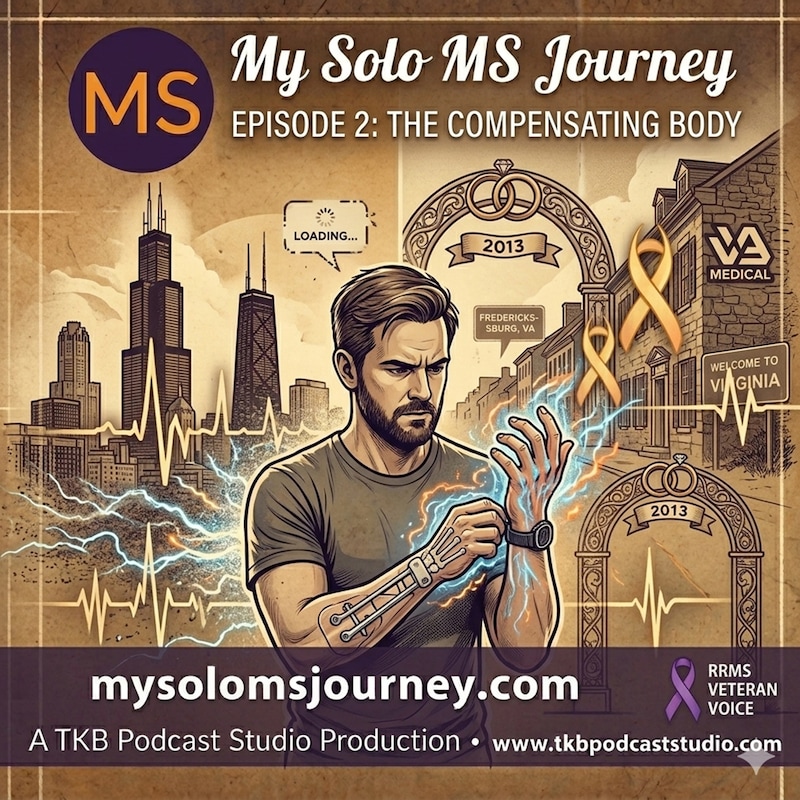
In Episode 2, we dive deeper into the "Ancient History" era (2009–2014). As Tim Brien transitions from a beanbag chair in Chicago to a new life and marriage in Fredericksburg, VA, his MS symptoms begin to mount. This episode explores the physical and cognitive "noise" of early RRMS—from numbness in the hands to the subtle, frustrating start of cognitive slowing.
In This Episode:
- The Physical Puzzle: Managing hand numbness while navigating a fused left wrist and an overworked right wrist.
- The Invisible Symptoms: A candid look at the continuation of ED and its impact on a new marriage.
- Cognitive Fog: Recognizing the very first signs of "the tip-of-the-tongue" syndrome and speech slowing.
- The Fredericksburg Move: The stress of a big move and a life milestone coinciding with a neurological shift.
What I Would Tell My Younger Self Now
"I would look at that man in 2013, standing in his new home in Fredericksburg, and I’d say: Education is your armor. Right now, you’re treating these symptoms like separate, annoying enemies. You’re frustrated with your hands, embarrassed by the ED, and confused by your speech.
Stop just 'enduring' it and start learning it. Learn what a lesion actually does to a nerve. Learn how heat or stress impacts your cognitive speed. If you understand the 'why' behind the symptom, it loses its power to make you feel like a failure. MS is a physical condition, but the ignorance of it is what causes the mental toll. Become a student of your own biology—it’s the only way to stay the captain of your ship."
This episode includes personal discussion of chronic illness, mental health, medical treatment, and the lived experience of multiple sclerosis. Listener discretion is advised.
Website: www.mysolomsjourney.com
Email Updates: Subscribe on the site to follow the journey
Produced by: TKB Podcast Studio
Thank you for listening to My Solo MS Journey. This is a deeply personal documentary of Timothy Brien's journey with Relapsing Remitting MS. The views expressed are Timothy's alone and are not meant as medical advice. This production is made possible by TKB Podcast Studio, where we help you lead through the noise with quiet professionalism. For more information on TKB Podcast Studio, go to www.tkbpodcaststudio.com to discover what we can do for you.
Transcripts
So we're going to start off this episode with being in the ancient history phase.
Speaker A: The year is: Speaker A:I'm leaving Chicago, my hometown, and moving to Fredericksburg, Virginia, and I'm getting married.
Speaker A:Now, on paper, it's the start of a dream, but inside, things are starting to short circuit, and I still don't know why.
Speaker A:This is Timothy Bryan, and the show is my solo Ms.
Speaker A:Journey.
Speaker A:So most people talk about Ms. As kind of a tingling, and for me, it's a practical nightmare.
Speaker A:Now, my left wrist was already fused from a previous issue.
Speaker A:I had an accident when I was in the Air Force, and that meant my right hand had been doing double duty.
Speaker A:It was my worker, it was my rider, my everything.
Speaker A:And then the numbness started in on both.
Speaker A:And I'm not talking the numbness as when your hand or your feet go to sleep because you're sitting on them wrong or you're laying on them wrong.
Speaker A:I'm talking.
Speaker A:I could stab myself with a pencil and not feel it.
Speaker A:Now, I kind of want you to imagine trying to navigate a move across the country and a wedding when you can't fully feel the tools that you're relying on.
Speaker A:I use my hands every day.
Speaker A:My right hand was compensating for my left hand, which was fused, but the nerves weren't cooperating.
Speaker A:It's kind of like your hands are a passenger.
Speaker A:They're not there.
Speaker A:They're not responding the way they should respond now.
Speaker A:Before I had my accident in the Air Force, I used to play bass guitar, used to play tuba.
Speaker A:I could play acoustic guitar.
Speaker A:And after that accident, I couldn't do any of that.
Speaker A:And when you're playing guitar or bass guitar, you develop calluses on your fingers.
Speaker A:And if I would have been playing guitar or bass guitar at the time, those strings could have cut through my fingers and I really wouldn't have felt them.
Speaker A:So these were.
Speaker A:This is one of the physical aspects that I was dealing with with undiagnosed at this time.
Speaker A: Remember, we're back in: Speaker A:But this is a symptom I was dealing with for a long time.
Speaker A:Now, was it because of the fusion?
Speaker A:Was it because of my right hand compensating for my left hand?
Speaker A:I don't know.
Speaker A:My neurologist doesn't know.
Speaker A:My doctors don't know.
Speaker A:To this day, they don't know.
Speaker A:There's no way to know that.
Speaker A:So without this knowledge of why this is happening or being able to pinpoint it, it's frustrating to not know why Your body is doing the things that it's doing, and the doctors can't explain it to you.
Speaker A:So let's take a look at the cognitive signed.
Speaker A:And I do want to kind of preface this with a story about my mom.
Speaker A:She had a stroke back in the late 90s, mid to late 90s.
Speaker A:And one of the results of the stroke was she had aphasia.
Speaker A:That's the inability to.
Speaker A:To speak.
Speaker A:Not because it's not that there's something wrong with your vocal cords, it's just that there is a break in the connection between your thoughts and your ability to actually bring those thoughts and vocalize them.
Speaker A:So let's start there for a moment.
Speaker A:I hope my mom, when she had the stroke, and I think one of the greatest things that I can ever say that I did was I helped her be able to say her ABCs.
Speaker A: p in mind, my mom was born in: Speaker A:So, yeah, there's a huge difference.
Speaker A:And teaching your mom how to say the Alphabet is not the thing that you think you'll ever do.
Speaker A:So I was familiar with what aphasia is, and I was familiar with the effects that it had.
Speaker A:She could speak as well as a 4 year old.
Speaker A:And when my kids turned 4, that was a really rough year for me because they sounded exactly like her.
Speaker A:So you need to know that when I tell you that my cognitive side was starting to slip at this point and I was noticing it.
Speaker A: ng at the time, back in about: Speaker A:So I had to do a lot of talking, I had to do a lot of presentations, and I was missing words from sentences.
Speaker A: o, I've been podcasting since: Speaker A:I was missing words that were simple words.
Speaker A:And it definitely reminded me of my mom and her sounding like a four year old.
Speaker A:And that is something that I don't want to sound like.
Speaker A:Think of it this way.
Speaker A:You're in a conversation with somebody and you have the thought of the word that you want to say, but that bridge to your brain, to your mouth, feels like it's been washed out by a storm.
Speaker A:I noticed that, that slowing, that hesitation, sometimes I would replace words.
Speaker A:So if I was saying, hey, we're Going to do this on Tuesday.
Speaker A: is on Tuesday, April whatever: Speaker A:Clock.
Speaker A:And not a lot of people notice that because we as humans have a wonderful tendency to be able to fix problems without even thinking about it and to fill in the blank when there's something that's not supposed to be there.
Speaker A:Now let's combine that with getting married.
Speaker A:Something that I've learned in my marriage is that communication is everything.
Speaker A:I need to be able to speak with my wife.
Speaker A:I need to be able to communicate my needs, my wants, my fears, everything.
Speaker A:And losing the ability to communicate, noticing the breaks, the pauses, the word switching, that's almost as bad as having ongoing edge.
Speaker A:And you know, I, I felt like an expert patient because I knew what was going on with me.
Speaker A:I, I didn't know the cause of it, but I knew the symptoms of it.
Speaker A:So I was the expert.
Speaker A:I can't even say diagnose her.
Speaker A:And what I actually was is just a man losing his baseline to be able to function in this world and seeing that and fortune telling that and, you know, jumping to conclusions that I'm going to sound like a four year old real soon here.
Speaker A:That's a scary thought.
Speaker A:So basically I was living life at full speed, you know, moving cross country, getting married, you know, getting used to my new hometown.
Speaker A:I'm going full speed, but my nervous system, it's pulling the emergency brake.
Speaker A: And in: Speaker A:I didn't know it was cognitive issues.
Speaker A:I just thought back to my mom and aphasia.
Speaker A:And I thought, holy, this is gonna happen to me too.
Speaker A:You know, at that time I was tired, stressed, broken, or so I thought.
Speaker A:But the fact was that I was probably having a extended relapse, a cognitive relapse with what was going on with my Ms. Now I didn't have a name for it.
Speaker A:All I could think of was, I'm going to end up like my mom.
Speaker A:I'm going to end up sounding like a four year old.
Speaker A:And here I have a new wife, a new family, a new area.
Speaker A:I don't have a support system set up yet.
Speaker A:What am I gonna do now?
Speaker A:If you're feeling that at this point, if you're feeling tired, stressed, broken, even, stick around for this podcast.
Speaker A:Not because I want download numbers, I.
Speaker A:That doesn't really matter to me.
Speaker A:What really matters to me is having that conversation with myself.
Speaker A: Here in: Speaker A:And, you know, I would stand in my new home in Fredericksburg and tell myself that being educated is your armor.
Speaker A:And right now you're treating symptoms like they're separate or annoying, and you're frustrated with your hands, embarrassed by your ED and confused by your speech.
Speaker A:But just stop enduring it and start educating yourself and start learning what these things actually mean.
Speaker A:Because in order to be your best advocate, you need to understand it better than the doctors do.
Speaker A:Not that the doctors don't understand it, but they're not living with it.
Speaker A:So educate yourself.
Speaker A:Ms. Is a physical condition, but the ignorance of it and what causes it has mental toll.
Speaker A:Be a student of your own biology, and it's the only way to be the captain of your own ship again.
Speaker A:This is Timothy Bryan.
Speaker A:The show is my solo Ms.
Speaker A:Journey.
Speaker A:I want to thank you for joining me on this journey because I'm tired of it being a solo journey.
Speaker A:You can find all the [email protected] and I'll talk with you next time.