Transcripts
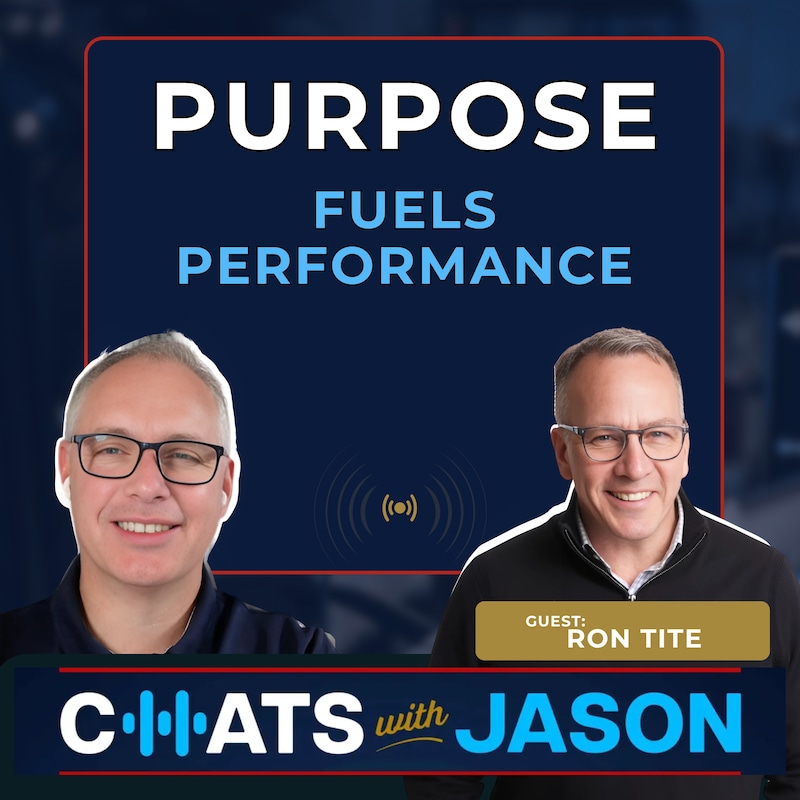
Ron Tite: The Purpose of Purpose
[:Jason S. Bradshaw: If purpose is just a poster, AI will shred it. But when purpose is fuel - teams move, customers stay, and competitors sweat.
Jason S. Bradshaw: Welcome back to Chats with Jason. I'm your host, Jason S. Bradshaw, and today we're joined by someone who turns lofty ideals into measurable momentum.
Ron Tite is a globally in demand keynote speaker. Bestselling author of Think, Do, Say, and founder of Church and State.
He is that rare blend of strategist and showrunner. An award-winning creative director who shaped work for brands like Google, Microsoft, Walmart, and Volvo. And a former standup who knows how to keep it real while keeping you riveted.
I'm really looking forward to this conversation.
ign what you think, what you [:In this conversation, we're going to unpack how to turn FOBO into forward motion, lead the AI revolution without losing your people, and use story as the spark that connects purpose to performance.
After all, organizations don't change, people do. And after today, you'll know exactly how to lead that change. So let's dive in with Ron Tite.
Ron, welcome to the show.
Ron Tite: Thank you, Jason. Right out of the the gate, I think I'm gonna steal your line. Now, when people ask me to introduce myself, I'm gonna say, I keep it will keep you riveted. That's a gold line. I'm gonna use it. I will attribute it to you, but I'm gonna use it.
Jason S. Bradshaw: Use it away. I'm more than happy for you to do that.
on the wall with this great [:When does it stop being a poster and actually start being a profit engine?
Ron Tite: I think the first thing that is really required is that they articulate the purpose, right? Some of the purpose statements that have been written over the past and a while, they deserve to be on a poster. That's the best they're ever going to be.
And leaders responded to the market and consumers saying how evil they were by responding like... but no, but... and the poster was something they could point to, right? It was like, but no... we wrote this purpose statement. We went to a city north of where we, or we went to a resort north of the city and we huddled around a flip chat, we wrote that.
atchers, and just saving the [:So they chose purpose statements that address social cause and issue, absolutely nothing to do with where they made their money. So that was the first thing where they got wrong, which is you, that thing belongs in a poster. 'cause there's no way it can, we can bring it inside the organization because it's not connected to where they make their money.
le in bringing care to life. [:Jason S. Bradshaw: So that all makes sense to me. I'm just wondering though, why do we keep seeing organizations have these purpose statements that are so misaligned? I can think of a couple of airlines as an example where, they talk about sustainable aviation. If you cared about sustainability, you wouldn't be flying a plane. They just chew through so much avgas, right? Why do organizations continue to go down this route? Even though there's people like yourself that have debunked that the purpose statement should be this lofty, misaligned thing to something that is actually aligned to drive profit, and why does it continue?
gh they feel pressure within [:Jason S. Bradshaw: Yeah. And I'm not saying, just to be clear to our listeners, I'm not saying airlines shouldn't care about sustainability. I just don't think that's their purpose on life. Yes, they should be. They, everyone should have steps in that they take to be more sustainable.
s where, if I had a theme for:If somebody says we believe in sustainability, most consumers are like, man, I hope so. Like that's like saying we believe in not murdering people. I hope you believe in that, but I came here to buy a plane ticket so I could get to Florida. Like that's that's how it's gotta come back.
he big groups obviously have [:Was there a shift in your mind or a moment in time where you started to see organizations go, actually, we've got this wrong about purpose, and we need to start again and refocus?
ed in reality. And it's just [:Jason S. Bradshaw: So walk us through a client. I'm not asking you to breach any non-disclosure agreements or anything like that, but where misalignment was costing growth, what changed? [00:09:00] And what moved the needle?
s this place for me and they [:Let's just start with a fundamental belief that's tied to where you make your money. Okay, let's start there. This is what we think you fundamentally believe in. So it's really, it's not throwing everything out at once. It's asking for the approval to question, and to explore through that process, looking for tiny victories along the way so that you can incrementally take a client, and by the time you get to the end result, you've completely overhauled it.
we work in so many ways. I'd [:You've called it a workplace coup. I'm wondering if a leader who's listening today is half curious and perhaps half terrified by this thing called AI, what's the first decision that they must make this week, to lead a revolution and not resist it?
months ago, [:So that's why I think advisor or senior leaders need to really be comfortable themselves and they need to dive in.
I think that you need to ask [:Jason S. Bradshaw: Yeah I love that phrasing around being curious how AI can make us smarter. Reflect on what you said, if we are just looking at the output, yes, our output will go up, but the quality will go down. And when you are using a large language model, unless it's a private large language model, only trained on your own internal data, which most aren't, then, who's gonna say that your great idea, your great commercial that you've just produced with AI isn't going to be reproduced by the other cracker maker down the street. And I love the idea around using it as a virtual audience to test stuff. That's a great insight there.
I'm, we're gonna move on to [:Ron Tite: Oh boy. I wanna make sure the cultures are the same in terms of a 10-year-old, what's in a 10-year-old lunchbox? Like a drinking box? Like a, I have a 7-year-old and a 5-year-old. I'll tell you what's in their lunchbox. There's a sandwich of some sort. There is some sort of thermos with water in it. There's certainly no peanut they're got You don't want a kid going down. And there's some sort of fruit in there.
d be about stopping boredom. [:Jason S. Bradshaw: Makes a lot of sense. Now, in my work around customer and employee experience, quite often a challenge that I come up against is that CEOs and CFOs just think it's fluff.
This is just another version [:Ron Tite: How much this guy charging us?
Jason S. Bradshaw: Yeah, is there a smudge on this invoice? Surely it's not that much. So, to that skeptical CFO, how do you link purpose to numbers in a way that survives the board meeting?
Ron Tite: Yeah, that's a great question. And here's how we do it. 'Cause if you know that the finance person cares about cash, so you gotta make it about cash. You can't make it about engagement. You can't make it about loyalty. You gotta make it about cash. So this is the problem that most CFOs have. They know that their organization needs to innovate. Or they need to be creative or they need to generate new forms of revenue, alternative revenue streams. Oh, they know that has to exist on some level. And so I go in and say, okay, here's what's currently happening in your organization. I should have asked you, can I swear on this podcast?
Jason S. Bradshaw: Go ahead.
Ron Tite: [:Purpose keeps you focused and makes sure that when you generate ideas, when you generate new innovations, they all tie back to reinforce something that you've all agreed on is worth reinforcing. Most organizations, they go we, I love this. When they go. we do. We take a bunch of stuff. I don't know why they're from Alabama all of a sudden, but what we do is we take a bunch of stuff and we throw it against the wall and we see what sticks. Have you heard them say that? And you're [00:20:00] like, what? Like how endless is your budget? Who can afford to do that? You need to make really focused choices in what you generate so that you can be really efficient with your money.
Jason S. Bradshaw: Purpose is that grounding anchor to everything that you do.
Yeah, you're pivot for it. That what a great analogy. I absolutely love it.
Now, we've convinced the CFO, he's doubling down. He's going to invest. He doesn't wanna just fix his purpose and get people aligned to it. He wants to create a culture. And a culture that is driven or seen as a growth lever, I should say, within the organization. What's the fastest way to align personal purpose with company purpose without slipping into the corporate theater?
Ron Tite: Yeah, that's great. So the first thing is to understand whether or not you share the purpose of the organization.
t believe in giving children [:Now you have a role in bringing that purpose to life. What is that? What is that? What do you do? Let's say I am a middle manager in HR. Here's what I believe about my job. I believe that management is about mentorship. Okay. And here's what I do to reinforce that. I set up a coffee once a week with one of my direct reports and I mentor them. I invest in career development in my team. I bring in guest speakers to help them out. So it's what do you fundamentally believe about your role. And the reason why this is important is because if we keep it only at the organizational level and only at that broader purpose, what we find is - you do a lot of work in CX, so you know this, that when you have a CX focused organization, it's all about the customer, then what typically [00:22:00] happens is you get somebody who's in a non-customer facing role, like in HR or in payroll, and they go, I guess what do I have to do with that? I don't speak to customers. And so what that does is it allows them to attach purpose to their role that is independent of the organizational purpose. So I'm a middle manager in HR. This is what I believe about being a manager. Now, I have some fundamental truth and belief to drive the my actions as a manager, that's independent of the organizational purpose.
Now I have a personal purpose in my role, and that helps to bring that broader purpose to life.
Jason S. Bradshaw: Yeah, makes a lot of sense. So give us five simple signals your purpose is actually working in the organization. The on the ground indicators that leaders should see within, say, 90 days.
t. Leaders, they'll want the [:Secondly, is it focusing your path to innovation? Are the ideas coming up really focused on tying back to that, to tying back to that purpose. So are you getting focused ideas from your team?
er in marketing because it's [:What else would you see? You would see executives making decisions that prioritize purpose. And I say it like decisions without bias, like sales is always gonna come in and do its sales does, and marketing is gonna do what they want to do. But when you start to see people prioritizing their budgets. When you start to see people prioritizing their teams and start to recruit people who can reinforce purpose, now you start to see it's really having a profound effect on people.
And then I think if I'm, am I at five? I don't even remember how many on that.
Jason S. Bradshaw: I was just intensely listening to your wisdom that I haven't been counting so.
think the last part is when [:Jason S. Bradshaw: Yeah, absolutely. And some great indicators that are really easy to see that it is working. I'm glad that I didn't hear you say you send out a survey, you ask 50 questions and if you get this sort of score, because the reality is in most organizations when you do that, you then coach the team members to answer the questions in a certain way.[00:26:00]
So if you can break a myth for me, what's one beloved idea about brand marketing employee experience purpose you wish that executives would retire, and what should we replace it with?
n who we are and what we do. [:Jason S. Bradshaw: Yeah, a lot of what we've been talking about today just keeps bringing one word back into my mind, which is intentionality. Being intentional about what you do, why you do it, and how you do it. And as you said, really using that purpose, to anchor your decision making and guide your organization.
So as we come to wrap up this episode. If listeners were only to do three things in the next seven days to think better, do bolder and say clearer, what are those three things?
Ron Tite: So [:Secondly a clear articulation of what you do to reinforce that. And then to ask yourself, what else could I do? That's where innovation comes from, right? What else could I do that's missing? And you can be, again, you can be really intentional with that by doing a customer journey map and highlighting, weaknesses in the market or you can explore the opportunities to help you prioritize what those other things should be. But what do I believe in? What do I do and what else should I do?
all have access to the same [:Jason S. Bradshaw: Ron, what a great way to end the show. Thanks so much for giving so generously today.
Ron Tite: I wish I could end it with a moment of silence.
Jason S. Bradshaw: Yeah I'm not gonna do that.
Ron Tite: The worst interview on a podcast ever. It was just, I'm telling you, it was 20 seconds of just silence.
Jason S. Bradshaw: We didn't know what was going on.
Ron, thanks so much.
Ron Tite: Oh, thanks for having me, Jason. I really appreciate it. And thanks everybody for for listening in.
Jason S. Bradshaw: So, that's a wrap. Huge. Thanks, Ron again, for showing us how to turn purpose into performance.
. Don't let that spark fade. [:If you found value, follow the show, rate it, and share this episode with a leader who needs to hear it.
And by the way, when I read every comment that you leave, so please tell me what your number one takeaway was from this episode.
I'm Jason S. Bradshaw reminding you when you transform the experience, you transform your business and the world around you


