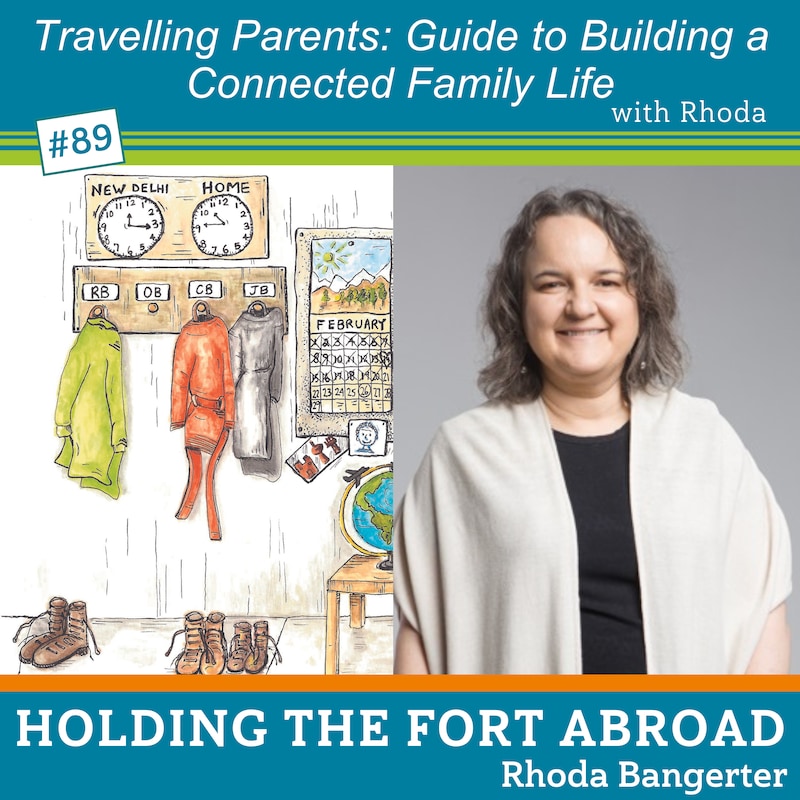
Synopsis:
Practical strategies for families when one parent works away, and how naming your family structure reduces stress and avoids future regret.
Keywords: travelling parents, connected family life, parent away from home, long-distance family
The first of a 3-episode series:
- Episode 89 Recognise it for what it is
- Episode 90 Reframe as WE
- Episode 91 Re-enforce The Bond Across the Distance
Episode 1: What Are We Recognising
Main Takeaways
You’re not broken. Your family isn’t unusual. This is a legitimate family form.
Different names
- Split Family International Assignments
- Multi location families, Split Location Families
- Non family duty stations
- Unaccompanied Postings
- Frequent Business Travel
Different lengths of time
- A few weeks at a time
- Living and working in another country
Different sectors, different scenarios, different reasons
Same absence, same toing and froing
Similar challenges, big emotions, hidden load
- The parent at home becomes default parent
- The travelling parent fears losing connection
- Ambiguous grief for children
Same potential for regret
Two well-known studies:
- Impact on Spouses of World Bank Staff
- Anne Copeland, Interchange Institute, Voices from Home and Voices from the Road
2. Why naming and recognising it matters
- Not recognising it and ‘just getting on with it’ can lead to regrets later on
- Underestimating impact on self and others and self blame
- Couples often don’t anticipate systemic impact. Recognising and naming it allows to put things in place. It gives structure.
3. How do we name it?
Importance of not mis-labeling: single parent, absent parent.
Labels that undermine the travelling parent
- Absent parent
- Not really there
- Part-time parent
- Weekend dad / weekend mum
- Secondary parent
- The one who left
- The one who is never here
- Visitor in the home
- Financial provider only
- Fun parent (implies superficial involvement)
Reduces authority, legitimacy of travelling parent
Child may internalise:
- They are less important
- Their parent is less committed
- Their family is less stable
Even if not true
Labels that overload the home-based parent
- Single parent (when still in intact partnership)
- Solo parent
- Parenting alone
- Doing it all
- The real parent
- Primary parent (can be neutral in research but harmful in family narrative depending on tone)
Why harmful:
Removes the psychological presence of the travelling parent.
Increase overload of home parent
Child may internalise:
- One parent is carrying everything
- The other parent is peripheral
- Family system is incomplete
- Increase anxiety in children
These labels are harmful because they imply deficiency, abandonment, or dysfunction, rather than recognising structure and adaptation.
Wrong labels are often unintended.
Reasons:
- Lack of better language
- Trying to express difficulty
- Seeking validation
- Cultural default language
Not malicious. But still impactful.
Avoid deficiency labels.
Use structural labels.
Examples:
Instead of:
- Absent parent → Travelling parent
Instead of:
- Single parent → Parent at home
Instead of:
- Not here → Working away, still part of us
Do a Language Audit and Create A Family Narrative (Listen to #58)
3. Lived Experience
- 7 Interviews of adults that have grown up with a travelling father
- Across sectors (military, business, airline, non-profit sector) and continents (all continents represented) small sample but the same topics came up) and homogenous experience of this father who was gone and came back
- Many it was the first time they were thinking about it from this angle, started having conversations before the interviews and after the interviews
- All had good relationships with fathers, wanted more time with them, knew them more as a friend I did not have an absent father.
- Looked at the systemic strategies how both parents worked together that will be the next episode. More in Episodes 2 & 3
Episodes to Listen to
#55 Michael Pollock, #48 Lucas, #36 Anaju, #45 Ophelia, #51 Katia Vlachos, #46 Irene
Many more from the point of views of mothers and fathers
Conclusion
- Shift from uncertainty, vague experience and hidden challenges to “We are a multi-location family”
- Labels can be limiting, they can also be freeing: from isolation to recognition, to community
- Shift from "what is wrong with me", "why do I feel this way" TO "many people feel this way", "these are common challenges".
- Recognising this family structure and naming it will help children make sense of their world and increases psychological safety
If this is something that you are living as a parent, then it is not weird, many people live it. What are you going to put in place? How are you going to be aware?
If you have lived it as a child, then what you have experienced is valid. This gives you words for your feelings.
See you in Episode 2 of this series for Reframing: The Power of We.
Contact Rhoda: [email protected]
Receive news regularly on new episodes of HTFA Podcast and on new events and resources. Subscribe to my newsletter.
Buy the book: Holding the Fort Abroad
Your partner's job opportunity in another country seemed like an exciting idea, but lengthy work assignments mean you're holding down the family fort - alone.
OR Your partner is working and living in another country, and you feel like you are shouldering all the home responsibilities alone.
You may be wondering:
- How can we be a family when we're miles apart?
- Can I cope, alone, when troubles arise?
I believe there are answers to the above questions, and the answers start with you. In this context, it's more important than ever to invest in yourself, to care for yourself, to set your own goals and to watch yourself grow. Equally important is to nurture your relationship with your partner and learn to parent together.