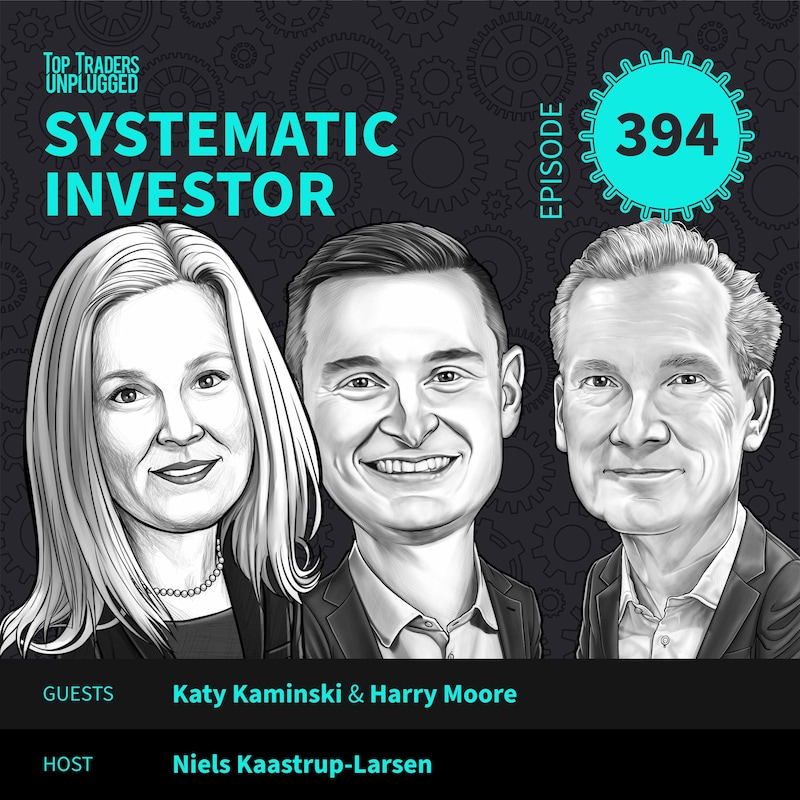
Shownotes
Markets rarely offer clarity when it matters most. In this episode, together with Katy Kaminski and Harry Moore, we reflect on a first quarter defined by sharp reversals, energy shocks, and rising dispersion across strategies. They explain how trend following adapted as leadership flipped across asset classes, and why results varied more than many expected. The conversation moves beyond performance to examine portfolio construction, from market selection and speed to the growing relevance of portable alpha. Along the way, they revisit periods of drawdown, investor behavior, and the role of liquidity in crisis environments, offering a grounded perspective on how systematic strategies respond when conditions change quickly.
-----
50 YEARS OF TREND FOLLOWING BOOK AND BEHIND-THE-SCENES VIDEO FOR ACCREDITED INVESTORS - CLICK HERE
-----
Follow Niels on Twitter, LinkedIn, YouTube or via the TTU website.
IT’s TRUE ? – most CIO’s read 50+ books each year – get your FREE copy of the Ultimate Guide to the Best Investment Books ever written here.
And you can get a free copy of my latest book “Ten Reasons to Add Trend Following to Your Portfolio” here.
Learn more about the Trend Barometer here.
Send your questions to [email protected]
And please share this episode with a like-minded friend and leave an honest Rating & Review on iTunes or Spotify so more people can discover the podcast.
Follow Katy on LinkedIn.
Follow Harry on LinkedIn.
Episode TimeStamps:
00:00 - Introduction and episode framing
01:38 - Market backdrop and Q1 volatility
07:29 - Trend following performance through Q1
09:36 - Diversification vs equities and bonds
11:21 - Dispersion across managers explained
14:32 - Trend vs non trend strategies
18:40 - A month that tested every component of trend
21:17 - Optimal market mix and research insights
30:00 - Macro factors and what trend captures
35:57 - Portable alpha and cash efficiency
42:23 - Risks in portable alpha construction
49:04 - Drawdowns and investor behavior
53:37 - Why trend recovers after shocks
01:00:51 - Measuring alpha in macro strategies
01:06:51 - Geopolitics and future opportunities
Copyright © 2025 – CMC AG – All Rights Reserved
----
PLUS: Whenever you're ready... here are 3 ways I can help you in your investment Journey:
1. eBooks that cover key topics that you need to know about
In my eBooks, I put together some key discoveries and things I have learnt during the more than 3 decades I have worked in the Trend Following industry, which I hope you will find useful. Click Here
2. Daily Trend Barometer and Market Score
One of the things I’m really proud of, is the fact that I have managed to published the Trend Barometer and Market Score each day for more than a decade...as these tools are really good at describing the environment for trend following managers as well as giving insights into the general positioning of a trend following strategy! Click Here
3. Other Resources that can help you
And if you are hungry for more useful resources from the trend following world...check out some precious resources that I have found over the years to be really valuable. Click Here
Transcripts
Welcome to Top Traders Unplugged. In markets success doesn’t come from predicting what happens next, it comes from being prepared for what you can’t predict.
In each episode we go deep with some of the world’s most thoughtful minds in investing, economics, and beyond to understand how they think, how they prepare, and how they decide, and the experiences that shaped how they see the world. No noise, no short-cuts, just real conversations to help you think better and invest with confidence.
Niels:Welcome and welcome back to this week's edition of the Systematic Investor series with Katy Kaminski and I, Niels Kaastrup-Larsen, where each week we take the pulse of the global market through the lens of a rules-based investor.
This week we have a very special guest, namely Harry Moore, partner and senior client Portfolio Manager at Man AHL, who is here to discuss some of the recent papers that he has also co-authored, as well as a new paper that Katy has just published.
So, Katy and Harry, it's really wonderful to have you both here today. I'm excited about our conversation, but first and foremost, happy Easter, if I can say that, over here in Europe. It's something where it gives us a little bit of, how should I say, downtime. Not so sure that the same can be said about the US but it's great to have you here.
Katy:Thanks for having me, fun.
Niels:Absolutely. So, do you get any time off in the US for these holidays?
Katy:The US has one day off. But I mean, I, I have a Swedish husband and he's very sad because, you know, back in Sweden they have two days off and our kids have zero days off. So, it does feel a little bit, you know, less of a big holiday than what, you know, he would have hoped for here in the US. The markets are closed Friday, so Harry and I are off. So, that's good.
Harry:Yeah, absolutely missing the London extra Monday off. So, my colleagues will all be enjoying Monday over in London. But yeah, at least we get the one day off here, on Friday, in New York.
Niels:Yeah, absolutely. I mean, as I do work for a US firm myself, but, you know, based in Europe, I'm allocated with the European holidays, not the US holidays, which I think that should be fine.
Anyways, as I said, we have a great lineup of topics, some topics that are really, I think, very relevant actually as to where we are right now. But before we get to that, we normally just talk a little bit about what else has been on our radar other than trend following. And I'm excited to hear maybe you, Katy, first, anything that has caught your attention recently?
Katy:Well, I mean, obviously we've all been so overwhelmed and following the big moves in the market. So, I think most of us have been at home, de-stressing, watching a lot of very exciting sports.
: Niels:Yes, I was going to bring that up of course, but thank you for doing that, Katy.
Harry, is sports what's distracting you at the moment or something else maybe?
Harry:Yeah, a little bit of sports. I mean, I can't say England are on a fantastic run at the moment. We had a pretty difficult game without Harry Kane the other night. So, yeah, little bit concerning right ahead of the World Cup I guess outside of sports, another thing just wanted to mention, I have a toddler at home, and she's been watching Number Blocks, which is this animated TV series.
And me and my wife now can't get the theme tune out of our head, but we love it. It's a superb way to teach little ones about maths and get them interested beyond learning sort of counting songs. So, I think a lot of kids, they can sort of count because they've learned it by song but here they're sort of trying to teach basic math operators. So, adding, subtracting and yeah, it's a great series. I think it even won a BAFTA.
So yeah, that's certainly been on my radar, not just this week but over the past few months now.
Niels:Yeah, well that sounds good and fun. Always good when the kids can learn something at the same time as being entertained. You know, back when I had kids, living in London, it was the Teletubbies, and I think it was that they were accused at some point for indoctrinating the kids. So, now at least, I know why they are the way they are, I guess. But other than that…
(laughter)
Harry:The number blocks are doing the same.
Katy:So, you're going to have math kids.
Niels: worst quarter, I think, since:But of course, the biggest news that I should mention here is that I finally got myself around to creating a new introduction and outro - intro and outro, as they say in podcast speak. So, when people listen to this today, they will have heard the new music…
Well, yeah, I think it could turn out to be a theme song, but we'll see. Anyways, I'm excited about it. So, there we are.
But let's talk a little bit about trend following And I think, since we're recording on April 2nd, I think it is today, yeah, and since we've just come out of March, we've just come out of the first quarter, I thought the first few minutes here we should spend a little bit of time talking about the month and the quarter. It obviously was a quarter that had some great moments, some challenging moments, for sure. It was something that maybe will be surprising to some people.
Even though March wasn't an easy month for our industry, I think, if I'm not mistaken, this is the sixth or seventh month in a row where trend following, measured by the SocGen Trend Index, has outperformed the MSCI World Index.
I did not actually know that, but I saw a chart this morning that kind of suggests that we've actually done better for a prolonged period now than equities. So, that, I thought, was interesting.
But maybe I'll just turn it over maybe to you first, Katy, and we can hear a little bit about how you saw March, how you saw Q1, and we can have a little bit of a conversation about that.
Katy: gy that we've had, outside of:And so, you kind of found that new trends were building as other trends were pivoting. And so, what happened with trend following was, it was very positive on continuing trends in the first two months, more classic themes like weaker dollar, strong equities. And then, you know, as this tumultuous changes occurred, trend starts pivoting, and some of the new trends offset the reversals in older trends that we saw earlier this year. And so, I think, you know, for me that's definitely a win for a strategy in an environment where equities are down so much.
I mean, granted it's only been a month that equities have been down this much. So, you know, you’ve got to kind of give it some time to see how it evolves. But it's really what you like to see, that diversification, that energies and other asset classes, like some of the short rate positions or short positions in fixed income that profited from the inflation concerns, really sort of offsetting some of the challenges in equities themselves.
So, for me it's been sort of a pivot in some of the themes, but overall, a positive quarter for trend, especially considering the backdrop of where equities are right now.
Niels:And bonds for that matter, I would say.
Katy:Exactly.
Niels:What about you, Harry? How have you experienced sort of March and Q1 in general, when you look at things?
Harry:Yeah, I would really echo Katy in that you had, in January and February, this kind of continuation of risk on, continuation of gold rallying and then this big pivot in March. And I think for investors in trend and people looking at the space, I think this has been one where it's really provided that diversification that people are looking for. So, of course trend had a very good run through the second half of last year, but so did many other asset classes.
If I look at where we're at year-to-date, and look at your trend indices, etc., if you sort of contrast fast/slow, whichever markets you're trading, most formulations will be up somewhere sort of between 3% and kind of 7% on a year-to-date basis. Which, I think, if you contrast that with equities, you contrast that with bonds or a 60/40 is a fairly good result. Especially if you're looking at a long portfolio today and you're sort of saying, well, in this mix of assets, what is it that's going to help me if there is a continued escalation or if Inflation really comes back into markets? And it doesn't seem to be equities, it certainly doesn't seem to be bonds. Gold has clearly had a wobble. And then, of course, people are loaded up on private markets as well. And of course there's issues there.
So, I think trading strategies, like trend, I mean, it's only been one quarter, but it's certainly getting a bit more attention, especially those looking for sort of more defensive allocations.
Niels:Yeah, I think a lot of people would say that the last couple of days of March was kind of like a nice relief a little bit, especially if you were kind of still long equities, and so on, and so forth. But then we had a speech last night and then suddenly, you know, when I look at the screens today, it's kind of, ooh, we're back in March now, again, it seems like.
But (and I know we will talk about this in a lot more detail in a few minutes), the other thing where I think March was really interesting in some ways was that January and February, I think there was a lot of similar performance among managers. Right? March was different.
March, again, showcased the difference in some of the stuff that you've been writing about (both of you, essentially), speed, market universe. The numbers that I've seen so far, early numbers, are really different between managers. The larger managers, yeah, they always, kind of more or less, get in a smaller narrow band in terms of performance, but once we go a little bit below that, but still sizable managers, dispersion seems to be real, I would say.
Katy:This is not surprising. I mean, anytime there's a big trend, it's going to depend so much on sort of subtle differences and selection choices per different programs. And I mean, obviously, how much energy you had was sort of PCA1. Right? So, the more energy you had, the better things were, and also the less of the things that were selling off, the better things were. So, we've also seen that speed was helpful. So, being able to pivot out of some of these, you know, reversing trends also helped.
So, I'd say that, you know, in a big move, you're always going to see a little bit more dispersion. But it's kind of typical given sort of how large the size of the moves are. So, small differences in choices can make big differences in return.
Niels:I don't know this is true or not, Harry. I think it is. You obviously have many different strategies, but you also have some that are pure trend, I imagine. And one of the things that I notice when I see the larger, say the top 20 managers or so, kind of the early indication of numbers, I certainly get the suspicion that certainly not all of them are pure trend anymore. Because when you start looking at some of the soft strategies like carry, maybe some value, whatever, where my gut-feel is that some of those strategies might actually have done really well or could have done really well in a month like March.
So, I think what we, as educators, need to do here is also just to make sure that the people looking at the space, looking at the numbers understand that, yeah, but that might be influenced by things that are really not trend related. So, when they do their assessment that they compare apples to apples and not just CTA to CTA because that could be something. Is that do you think, a fair statement, Harry? You probably overview more different strategies than I have access to, but that's my gut-feel.
Harry:Absolutely, Niels, I completely agree with that. I think whenever anyone's looking at trend following, you need to ask yourself what is this allocation doing and, therefore, how should I build this trend portfolio? And that might be 100% trend following models. I think once you go below 80%, 70% trend following. Right? You're starting to introduce different return drivers.
So, I think Katy's kind of written about this in the past, in terms of your sort of divergent and convergent strategies. Like, if I'm looking at something that I would call trend following, I want that to be a divergent strategy. I want that to be kind of continuing on betting on something that's happening.
Now if, in March, you've had excess performance from other strategies, well that's great. But if it's a dedicated trend mandate, you need to be asking yourself some questions. Right? Okay, how much trend is in here? If it's below 70%, below 80%, how do you expect those other strategies to behave in a kind of prolonged sell-off?
And a lot of those other strategies might do well kind of in the middle of the distribution when you're starting to get a bit of an equity unwind. But if there's a kind of full liquidity break, a dash for cash, sometimes they have these, these kind of horrible left tail. So, I would completely agree with you there Neils, if you're looking at trend, you expect these to be sort of 70%, 80% trend models.
And you know, in terms of the divergence last month, I think a lot can be explained by the market mix and the speed. So, as Katy mentioned, if you were already long oil coming into March, then you should have had some good offsetting profits there. Bonds was a key one. So, if you were trading quickly, you would have been long bonds, which is bad in coming into March, because bonds have sold-off. But then you would have quickly switched to short bond. So, I think bonds will end up seeing being mixed across the universe, and then I would expect most being long equities coming in. So, equities have been on a long run. I think most managers will now be kind of full scaling and also just their momentum signals changing in equities as well.
Niels:Yeah. Do you want to add something, Katy?
Katy:I mean, this is a good point. I often just point to the three key differentiators. One is speed, one is market set, third is like trend or non-trend, so, how much non-trend. And, I think as Harry put it, so starting with the trend or non-trend, you know, carry as an example, if you're trading carry, energy carry worked very well. FX carry worked well. Bond carry didn't work so well.
So, you know, as Harry was pointing out, it's not clear how that's going to react in, you know, this type of environment. It seemed to have been net/net positive if you had carry. But if you're in a divergent strategy, you know how trend is going to react to this. So, it's really a question of investor objectives for that one. And I agree with Harry on that.
In terms of speed, we did see that faster was good, except for maybe in fixed income. So, I do agree with Harry on that. Frankly, fixed income has been a headache for over a year, in my opinion. Every time we think it's pivoting, it's not pivoting. So, I agree with that.
And then finally, market set, as we mentioned, when you have the key strongest trend and you have a 50% move in energy, like every different… you know, if you're 10%, or if you're 20%, like that makes a huge difference. So, I think, you know, that's the natural variation in the space. I mean, we're all measuring trends in different ways. So, you end up with slightly different results, but you're all sort of similar positions. So, I think that's where you see varied results across managers but really, they're all doing what you know, they're all following the trends, but they just have different methodologies. So, I have to agree.
Niels:You know, it's rare that we come across a month where you could say, it really had everything that you can imagine happening in trend. It had the big trends, the energies. Right? It had the big reversals. I mean, and it had markets that just didn't do anything. So yeah, we were certainly tested as an industry.
And speaking of that, I think the industry did really well. The BTOP50 index looks to be down only 1.44%, still up 7.15% for the year. SocGen CTA index down only 74 basis points, up 7.5% for the year. SocGen Trend down 1.5% (roughly), up more than 7% still this year. Short-Term Index or Traders Index, obviously, as it should do well, up 56 basis points, up 4.4% so far this year.
Contrasting with that is the MSCI World down 6.32% at the end of the month, up… no, I think it should be actually down 3.47% (I think it's a typo on my side) for the year. World Government Bonds down 2.4%, down a 0.25% for the year. And the S&P 500 Total Return index down almost 5% in March, down 4.33% [for the year].
So relatively speaking, I think as an industry, I think, we did really well. I was surprised to see that people, there were comments out there already saying, oh but this industry didn't do anything. There was no crisis alpha. I beg to differ on this, and for all the reasons we've talked about, we will probably mention them again today.
But it's a beautiful segue, actually, to the first paper we're going to talk about, which is again one of the papers that Harry has been involved in. It's a paper that I love and I've talked about already a few times on the show with different people.
So, it's perfect to have one of the co-authors with you, Harry, here, to maybe point out some of the things that you found most interesting about your findings, maybe surprising about the findings. I know that Nick Baltas kind of left a little bit of a question for you hanging out there when I talk with him that you might want to talk about.
So, I was going to just give you the floor, and talk us through this wonderful paper which is called A Trend Following Deep Dive: The Optimal Market Mix for a Trend Follower. So, very apropos for March, I would say.
Harry:Thanks so much Niels. Yeah, I appreciate you discussing that with Nick and I think you discussed it a little bit with Rob as well. And yeah, the real background for wanting to write this one was that there's been a lot of work done on speed of trading, including by ourselves, essentially looking at if you trade more quickly, you tend to have more crisis alpha. If you trade a little bit slower, you tend to have a slightly higher Sharpe.
Now, what we wanted to do here was take those ideas and really move it into the plane of, well, what about the markets that I select? So, as trend followers, we have a huge selection of markets available to us. And so, really what we wanted to do is say, well, if I trade more traditional markets (and by traditional I mean the centrally cleared, big liquid futures markets, things like crude, like gold, things that we've already spoken about this morning), how does that differ from a portfolio where I expand that market-set out and push out into alternative markets? So, this might be things like Nordic hydropower, it might be iron ore.
How does it differ if I push out even further and trade things like synthetic markets? So synthetic markets might be equity factors. I can also consider China, Chinese commodities, very differentiated, completely different return drivers to what you'll get from, say, crude or gold, if you're trading bitumen, or if you're trading glass, for example.
So, what we did is we built portfolios from these markets using essentially a maximal diversification. So, you're not putting too much weight into any individual market and just took a look at the results.
Now, what I think was key here is that there's the statistical analysis, right? You do that, and then it gives you some results, and you say, hey, well, the traditional markets, they've tended to give me my best Sharpe in the crisis periods, whereas my alternative markets have tended to give me a higher Sharpe ratio over the long run. That's kind of finding number one.
Now, what we wanted to do was not just say, well, okay, there's the statistical answer, right? Like, that is interesting. That's very interesting to us. That's what the stats say. But take it a step deeper and say, well, is there a fundamental reason, that we can come up with, that explains why that is?
And so, the next section of the paper really looks at those market sets. It looks at returns through time and it decomposes those into, what can I explain with known macro factors and what can't I explain? Now, that might sound a little bit kind of scientific, but what can I explain with macro factors?
At the most basic level, my macro factors are things like risk-on/risk-off, are equities going up or down, is kind of growth doing well, it's things like inflation, right? Sometimes inflation is the main driver in markets, sometimes it's monetary policy. And you can map these factors and take a look to how much contribution they have.
And what we find there is that the traditional markets tend to pick up more of those macro factors and the alternative markets tend to pick up less. And so, they have more idiosyncratic return drivers.
Now why does anyone care about that? Well, what it means is that in a crisis environment, when markets tend to move a lot, what we found (and it wouldn't be a surprise to anyone), what you find is that those macro factors explain more of the variance. They're using a kind of principal components analysis to just figure out how much of that variance can be explained.
And you find, in these sell-offs, things like risk-on/risk-off, or inflation, they explain more and therefore the traditional markets do better. So, we tried to take this point of, okay, traditional markets tend to have higher crisis Sharpe, alternative markets tend to have a higher long-run Sharpe, and then try and map that to why. And what we essentially come up with in the paper is that during those crises those macro factors get stressed and being in the traditional markets helps you.
Now, from there, the next part that we wanted to do was essentially take those findings and say, okay, that's well and good, you've given me some information. How, as an investor, how as an allocator, should I then think about these portfolios?
And so, what we did is we created, essentially, a maximum crisis Sharpe portfolio, and we created a maximum long-run Sharpe portfolio. And long story short, that maximum crisis Sharpe overweights traditional markets; so, again, higher weights to gold, to crude, to dollar versus pound. And the higher long-run Sharpe portfolio has a higher weight to our alternative markets; so, things, as I mentioned, your Nordic hydropower, your iron ore, your China commodities.
Then one final little exercise we did at the end (and that's just because it's come up with so many investor conversations recently) was flip that argument around a little bit and say, well, what if I'm trying to get the maximum cash efficiency out of my trend allocation? Now why is that interesting?
Well, a lot of people that are looking at trend or looking to allocate to trend, they don't really want to sell something they already own. You kind of like your portfolio, you spent maybe years building it, you've done a lot of analysis, so what if I can get trend exposure with minimal dollars committed, almost zero dollars, like minimal dollars committed, get the maximum kind of cash efficiency out of trend following. And so, we did that as a kind of follow-on exercise. And there we found essentially, again, traditional markets that are great for that cash efficiency.
The long story short for the whole paper essentially, for crisis Sharpe traditional, for long-run Sharpe, the broadest market mix, so, including more alternative and then cash efficiency, which kind of links to portable alpha as well. You want to lean on traditional markets. But I'll just pause there in case, yeah, any questions?
Niels:Yeah, sure.
Harry:Niels and Katy?
Niels:Absolutely, I want to turn it over to Katy, but I do want to just throw in the couple of things that I remember from the previous conversations. One was when I saw the number of markets you had found or identified, including these factors, I think you got to like 900 or so. That was quite impressive. Let me put it like that. And I think Nick mentioned something like, 60 factors, he thought, that was quite impressive as well. So, I don't know if you have any insights as to how you discovered all of these.
Harry:Yeah, absolutely. So yeah, Nick, for sure, commented on the equity style. So how are there 60 equity factors? Now, I would agree, if you're going for the kind of six big factors you're going to have your value, your moment, your growth, etc. You can stretch that out a little bit, right? You can go to things like low beta, liquidity, variations of quality factors. So, maybe you get to kind of 12 to 15. What really gets us to 60 there is that we then differentiate by region.
So, if I trade value in the US, and I trade value in Japan, and I trade value in Europe, like those aren't perfectly correlated. And so, once you get to your 15 factors and four regions, that gets us to the 60.
I'm not sure if Nick will be happy with that answer. Maybe he wouldn't like the slip by regions, but that got us to 60, and then it's a similar argument to get to the 900. I do actually think this is an interesting question in trend because If I trade 30 stock indices, if I trade S&P 500, the NASDAQ, Euro stocks, TOPIX, is that 30 markets? Most people would say yes, even though they are highly correlated markets. If I trade 30 commodity markets, cocoa, gold, crude, right? They're lesser correlated.
So, it comes back to this kind of basic philosophical question of what is a market? But yeah, we get to 900 there in the paper.
Niels:What are your thoughts, Katy?
Katy:Well, I mean, first of all, I really liked the paper. It was very interesting and I loved how you turned the question on your head to say, okay, so given the markets that we can trade, what are the different objective functions and what should investors do given those different objective functions?
And I also liked how you differentiated between sort of the max Sharpe, so, something that an investor isn't thinking about as a risk mitigation strategy. But hey, if I want to add this, it's different. What should I do that gives us the most sort of best risk adjusted return over long term versus an investor that's maybe trying to solve a more specific global optimal portfolio by adding a defensive strategy that they're really trying to get that crisis alpha so they can make their overall portfolio more max Sharpe. Right? Because those are very different objective functions.
I thought it was… Also, a couple of things. First, I also thought it was really cool that you went into the cash efficiency. And secondly, I really appreciated the link between those two. You know, how it was very interesting to see that those two ended up in similar spaces. So, for those investors out there looking at risk mitigation, they're actually sort of close to their cash optimal portfolio as well. So, I thought that was kind of really cool as well.
But I think the thing that was the most exciting to me about this paper that had me sort of being like, ah, this is great, this is a way you can explain this, is how you connected macro moves to trend in a way where you're trying to say, okay, when an investor… And this is something, you know, when you speak with investors, I have found myself saying more and more in the last 10 years, is that if you don't know the macro economy is going, you could go out and find a person that tells you that they know. Right? Like, so, a macro manager say, oh, I have an idea, I know what Powell's going to do. I mean, it's tough, right?
Or you know, with trend, you actually are following a lot of the big macro themes and capturing them with a process that's diligent and sort of systematic as opposed to trying to predict which macro theme is going to occur and when.
And so, I think what was really cool about that particular aspect to me was that you kind of showed like what trend is capturing is the changes in macro themes and it’s these traditional markets which are the best at doing that. Which makes sense because for a lot of investors out there that want to be prepared for inflation, that want to be prepared for risk-off, that want to be prepared for trade, your different factors that you're talking about, it's very hard for them to find someone who can predict those themes that are so complex.
And so, it just kind of reiterated the point that, you know, when an investor invests in trend, they're giving themselves exposure to macro themes and if they're doing alternative markets, they're also getting sort of idiosyncratic, interesting return profiles that are differentiated. So, I thought that was, that was very cool.
And I think for me, you know, and it did smell a little bit like the economic trend paper from AQR. Right? They talk about that as well. But that was probably the part that I thought was the most intuitive and exciting because an investor who says, hey, I want crisis alpha, I want this. You at least answer to them, like, this is why you should do this, this is the type of portfolio we suggest.
The last point that I wanted to make, and sort of for me, who's spent a lot of time talking about crisis alpha, we've talked a lot and you mentioned this, Harry, we've talked a lot about speed, we've talked about a lot of the results that people have for crisis alpha. But when you go back to the original paper, some of the things that I was thinking about with crisis alpha, it's a few key things. one, being unbiased; two, being liquid; three, being adaptable. And I think very few people address the liquidity part of it.
And I think the liquidity part is sort of addressed both in a different way in this paper as well because you kind of say, you know,… because a lot of people… and that's the question I get from investors is like, you know, why should I have the bigger markets for crisis alpha as opposed to alternative? And you're the first person I've seen that actually answered that question.
And it does link to this concept of during a crisis, it's the things that are liquid that move with the macro themes that have the potential to find opportunities if you can adapt with them quickly enough in markets that are tradable enough and that can give you that potential offsetting returns that can help in a period of stress. So, I thought that was really awesome and I really enjoyed the paper. So, thank you for writing it.
Niels:That was a lot of praise in a couple of minutes, Harry. So well done and feel free to comment on anything. But of course, you, in the paper, you also mentioned the cash efficiency and I think that kind of segues quite nicely to another paper that we wanted to revisit. Although it's a year old, and it's called Portable Alpha Solving the Magnificent Problem.
It is something that I think, only since it was written, has probably become even more at the front of mind of many investors. And that is how can I, you know, in an efficient way, improve my equity portfolio? And of course, we, in our industry, know that, well, there’s one way that we would like to see that happening and that is by combining it with trend. So, maybe you can take us into that thought process and paper.
Harry:Thanks so much Niels. And yeah, your listeners won't be able to see, but I am blushing from those compliments. So, thank you very much.
The portable alpha paper, it's a little older but it's actually very linked to what we're doing discussing regarding cash efficiency. So, the kind of genesis for writing this portable alpha paper was very much kind of being on the road, and listening to investors, and I guess you see financial headlines, and it makes an easy click, is that the kind of evaporation of alpha in active equities.
So, 10, 15 years ago, most people who owned the US or others would probably have a mutual fund and it might be actively managed. And like we've seen that move quickly to passive over the last decade or so. And a big reason for that is simply allocators, investors, we're all saying, oh, it's so hard to beat the benchmark in the US or it's so hard to beat the benchmark in developed markets. And so, portable alpha is a way to try and address that.
Because when you go down the road of portable alpha, you're essentially saying, right, I'm going to decouple my investment choice. So, the index is hard to beat, well, why don't I just go and replicate the index? So, I'll go and own the index. That might be through a swap or a future, but now I have the index, right? I'm going to get the index return.
Now the alpha question is now a new question. So, before it was, does my manager, who manages my equity book, do they have alpha that's repeatable? Now, it's can I find any manager who I believe has a robust long-run track record at a repeatable alpha?
And so, the kind of genesis for writing this was to say, well, if it's so hard to kind of generate that alpha, why don't I split the problem over, can I find a manager that can deliver alpha? And we're all in the business of trying to deliver long-run alpha. And so, within that paper we say, well, what can you do? Can you do better? And one of the things we investigate is trend following.
Now, why does trend work quite nicely in this context? Well, the first reason is that it doesn't use much cash up, though, again, link into that cash efficiency point. I don't need a hundred dollars to get a hundred dollars of trend exposure. I might only need $25 or $30. That means I have a lot of spare cash. It means I can replicate my beta index very nicely and I can layer my trend on par.
And so, in that paper we essentially look back through time. We consider trend. We also consider a more multi strategy type alpha. And what you find is that, through time, you are able to outperform with more consistency. That's what we're aiming for. So, you believe your theory is that you can outperform with more consistency. Historically that's been the case.
So, you've separated your beta and alpha choice, and trend seems to appear to be quite a nice alpha to sit on top. Now, for sure we can go into some more details on sort of the cash management, the buffers, etc. But yeah, just pause there at the top in case… yeah… leave a second.
Niels:Yeah. Any thoughts from your side, Katy, on this? Obviously, this is also something that you've been writing about and talking about for a long time. But of course, as I mentioned in the beginning, it's something that has become incredibly popular again in recent years.
Katy:I think it's exciting that people are talking about it too because I think people forget the cash efficiency part of our field and, you know, they think about hedge funds, and a lot of them require quite a lot of cash, and that's something that is not quite as cash efficient. The only thing I would definitely say, and I like that this paper pointed it out, is that adding trend as your portable alpha strategy did have the better drawdown characteristics compared to, say, more equity focused or hedge funds. And that's important. But the only thing I always worry about is the term portable alpha, just the idea that alpha and beta are never 100% separated.
And I think this month has showed that particular example. So, I think updating the paper for last month would be fun to see just because I think we always talk about alpha/beta separation. I remember the first time portable alpha was very popular and I think that's going to be the challenge for those of us who work with investors, to help them to understand that, when that alpha beta decomposition falls apart, and I think March would be a good example if you look at, say, for example, the return stacked ETFs, that does something similar to this. So, investors can actually look at that, and it's tough to be long equities and long trend if trend and equities are in a drawdown at the same time.
Niels:So, maybe to both of you, based on the various research you've done, if people are interested in this area, I'm thinking, and I don't know if you already said this Harry (in the first section), but, again, people might just hear this and say, yeah, I can add any trend on top of an equity index. I can even just trade equities as trend following and put that on top of a benchmark. But this is where we have to be a little bit careful.
My, again, gut feel here, without having done the research, I imagine that there are certain kinds of trend following that probably are better suited for this particular thing. It could be, you know, the liquid market universe rather than the alternative or the idiosyncratic universe. It could also be, you know, a certain speed in order to get long-term, you know, portable alpha benefits. Let's call it that.
Did you look at this in the paper? I don't remember specifically, Harry, or just your thoughts on these kind of topics so that people don't go down the wrong path if they're interested in portable alpha strategy.
Harry:Yeah, Niels, I think this really links to Katy's point on like coincident drawdowns and like we saw in March, potentially both your alpha and beta have drawn down together. Now, March wasn't such a large move. That's probably not causing anyone too big of issues. But if you wind back to Covid, or the GFC, then certainly you're going to find moves that could be problematic.
igence. Like those risks from:So, some of those things that certainly need to be looked at are cash buffers. Though, one way that this strategy can really struggle is if it uses up all of its cash. Now, think how tempting it might be if you can go out and own the S&P for a free show with just 10% margin, right? You can get a US$100 of exposure for just US$10. Now, should I go and put $90 directly into another strategy? Wow. Probably not. Because if the S&P draws down 8%, 9%, especially if it draws down 10%, all of your margin is going to be exhausted. You're going to need to source that from somewhere.
Now, if your alpha isn't liquid, you're not going to be able to source that from your alpha and you'll get closed out of your beta. Now, that's not a good outcome. Usually if you want to own equities or an index, you expect it to go up over the long time. So, having that shutdown is not a good outcome.
But you can easily defend against that by holding very supportive cash buffers. So instead of my US$10 to support my US$100 of S&P, maybe I put US$40 alongside it. Okay, Now I have a little bit less to invest in my alpha, but let's link that back to our previous chat.
Trend following is super liquid, right? It doesn't need all of these dollars to fund its full allocation. So, even if I only have US$60 left over from funding my S&P, or my MSCI, ACWI, or whichever index I've decided, trend makes a very nice candidate to go on the alpha side.
Now, just to take that a stage further and really explain, like, okay, we're talking about cash management, we're talking about stress scenarios. What does trend actually do in a stress scenario? Let's take March as a very good example, right? Coming into March, so, let's say we're the 26th or 27th of February, trend is long risk, equities have been going up. Right? It's long equities. Gold's been going up. It's long gold. Bonds and commodities have just been going up. And so, maybe its margin requirements are 25%, 20%. Brent hits the market. Right? Oil volatility is up, the VIX is spiking. What does trend do? Well, trend manages to risk. So, we're managing to risk. Our margin requirements actually go down in the crisis. Right?
So, you have this alpha strategy, through your crisis period, where you might be worrying about your portable alpha structure, is actually taking less cash to run it. So, I think that's kind of one of the beautiful properties of trend that's maybe lesser discussed is that in a crisis its actual funding needs are lower because it exposes, it wants to take lower and that's because it manages to risk.
Niels:Yeah, I think that's a great point. Any thoughts from your side, Katy, before we move to the last two papers?
Katy:No, I mean, I think this is really helpful because I think a lot of people don't focus on the cash management. But in the end, like I said before, in a crisis or in a stress period, liquidity is what matters. And I think you only care about that when you need it. So, you have to be prepared for it. And I think portable alpha, done right, can actually maximize the cash efficiency without putting extra risk on the portfolio.
Niels: s old because back in June of: was going on back in June of:And both of you did the right thing by putting pen to paper and published something that, I think when you look back on it now, is perhaps even more important than at the time it was published. Because we can now go back and see were these arguments actually true? Or maybe true is not the right word but were they solid arguments that were put forward?
o the engine room, in June of: Harry:Yeah, absolutely. Maybe we should put out a new one, Niels, that says the sort of…
Niels:I'm hoping for the updated version. Yes, I am, because some of your charts actually talk about what happens 12 months after some of these things, as far as I remember. So, I would love an updated version.
Harry:Yeah, well certainly we have seen a strong recovery which has been great for the industry and certainly, when you're writing and, of course, you're making forecasts, but of course you're still drawing from a random distribution, In the future you don't know how the recovery is going to go out.
But the way we really approached writing that, and this was our CIO Russell, we essentially approached it in saying, well, if you're an investor, you're going to hold many different assets and at times you expect some of them to perform, and at times you expect others to not perform. Now, when an asset underperforms, what should you do with it? Like, you need to ask yourself, do I believe that this asset no longer works? Right?
There might be a hundred years of data that says that it does, but this particular drawdown has changed your underlying beliefs. Now, if it doesn't, and you think, well, this is just par for the course of investing, sometimes strategies will go through difficult periods. Then what you should actually do is rebalance in that time. You shouldn't be looking to get rid of that asset, you should be looking to rebalance it and get your portfolio back to weight.
ack to April, May and June of:So, we approach this from a few angles. I think the one that I like is essentially running a simulation many times and looking at the different paths. And we picked a path from a 0.6 Sharpe strategy that runs at 50 vol. That's a good strategy you want own. Right? Equities have historically been about a 0.4 Sharpe. So, at 0.6, you're higher than equities.
Now, that strategy spent years in drawdown. It had a drawdown of 33%. Now, we have statistically set that that is 0.6 Sharpe, and it still had this 33% drawdown. So, we know that the underlying distribution is good, but it would still cause you pain in time.
Now, for the holders, that recovers really, really well, and over a long timeframe, you do very well. It's just that psychological pain of being in the losses. So, we analyzed that. We looked at what about if you set drawdown rules such that you deallocate from strategies when they have drawdowns and, again, you find that underperforms. And ultimately, what we were aiming to do is to say, look, there's a lot of evidence for trend over the long run; big, long track record, there's a lot of well documented biases from humans and psychology that explain why trend following works over the long run.
And it was kind of a rallying call to say, hey, look, if we stick with it, it's always done well, again, in the past. We expected to go in the future and very fortunately, and of course a lot of those kinds of forecasts have played out and we've seen a very strong recovery from the industry.
So yeah, it was a big piece of work at the time, but I think it was the right thing to do to get that note out. We went on the road, we spoke to a lot of allocators, people in the markets, and yeah, very fortunate to see that's played out. And it's what we expected from a positive Sharpe and uncorrelated strategy.
Niels:Yeah. Katy, I don't know if you remember having read this paper. I think maybe I forgot to send you the link, but I know you also wrote your own paper around the same time. I'd love to hear your thoughts in general, as well, and any specifics to this paper.
Katy:Yeah, I do remember reading it. I had to take a quick glance at it again. But for me it's interesting, because whenever you have these big events (and maybe Harry's the same as me), I go right to writing a paper. I'm like, okay, let's do the data. Right? Because if I think about how my emotions were after Liberation Day, you're kind of, oh my gosh, did everything change? Has the world changed?
And then when you look at the data (and that's kind of what we did, similar to what Harry did), drawdowns, they happen, they happen over time and sort of consistently over time, they also recover. And actually, there are some philosophical reasons for why. And this goes back to Harry's paper as well about the macro factors.
If you look at Liberation Day, Liberation Day was a huge shock. And if you think about classic finance theory, went back and said, oh my God, the world has changed. And the markets were very volatile, and it was as if the world had to try to distill ‘what does this mean’ in a very short period of time. And they knew that the world had changed, but nobody knew what this really meant.
And so that type of shock is very difficult for trend because there's no actual trend yet. Right? It's just, oh my gosh, change, shock. It's sort of like a big sort of lightning bolt that happens. And then what's interesting is, philosophically, after you have this change then you have the realization of that macro change.
And guess what? Realization of macro change takes time. It takes time for tariffs to affect prices. It takes time for people to understand the US's pivot towards more inner focus. All of those things create massive macro change of which Harry already pointed out, trend following follows those themes.
t year and how you saw, since: rough the CTA winter, in like:So, over time the strategy is sort of self-correcting, just like most strategies. Just like the example of the 0.6 strategy, it's not broken, it just goes through cycles. But it's important to remind people because emotionally it is very tough when you're in that situation.
So, I'm glad that that's changed. And thank you for bringing us back to that, Niels.
Niels:Well, I mean, listening to both of you here, what's so interesting is, when you raise that question like people did at the time, and that is, oh, did the world change? Maybe without realizing, okay, yes, it probably did. I think a lot of people would agree to that. But here's the key. Change will hit all strategies that have a convergent profile because they don't like change. And there are very, very few strategies that will say, well, hang on, change is good. This is exactly what we want. As you've written about and talked about Katy, for all these years, the divergent strategies, right?
So, I think sometimes, and obviously this is what we're trying to do every week, is to remind people that change happens all the time somewhere. Sometimes it's so obvious that everybody can see it. But change is not something that we, as trend followers, necessarily think is a bad thing. It's Actually what we design our systems to deal with. So, change is nothing new. It's the only constant really.
And the other thing, there are two charts, maybe are not the ones that are tables, that are the ones that get the most focus in that paper that I really love. One was figure 4 (and people should go and download the paper on Man's website and, and go and see it), and it's this thing where you talk about the probability of reaching a 2 standard deviation drawdown assuming, I think, 0.5 Sharpe and 10% annualized volatility.
And so, for example, when people bring out a new strategy saying, oh yeah, I've been around for five years and I've never had to standard deviation drawdowns, I must be really good. Well, according to your table (and I'm not a quant, people will realize that, but I can see what the table says), it says, oh, yeah, that's a 21% probability of that happening. But if you've been around for 25 years like some of us have, that number goes to almost 80%.
So clearly (and that's the SocGen Trend index has been around for 25 years plus), of course we're going to have a two standard deviation drawdown with very, very high probability. Those are some of the things we just have get used to.
And the other one that I really liked because I feel I remember (as I'm getting old, I have to say, I feel I remember) that back at the time people were saying oh yeah, it's a crowded space, too many people doing trends, so it's not going to work as well. And what you do, so beautifully here in this paper, is that you go and say, well, how big is the CTA AUM, actually, of the total percentage hedge funds AUM? And you calculate it to being, you know, basically dropping from somewhere almost 30% back in the late ‘90s, to now it's just 5% of the total hedge fund universe.
And you go even further to look at how much is it, as a percentage of the total futures volume? And even that has gone down dramatically to about only 2%. So clearly, this argument we so often hear, oh yeah, there's too many people doing trend, or whatever it might be… And I do know that there are more people doing trend than is the in the official AUM number, but still it's a small percentage. So, it's not really an argument that I take very seriously.
We could go on talking about this paper and to remind people about all these things. And by the way, there's one thing I forgot to say before, when we talked about did the world change? Yes, it did. I think the real question is did people change? And that probably didn't happen. Right?
And that's the basis, in my view, at least, as to why trends form, and so on, and so forth. We don't have time to do that because we do need to go to the fourth paper today. This time we're going to switch from Harry to you, Katy. So, talk to us about your latest, newest, hottest paper.
Katy:Yes, and this is just a short one, but it was fun because it just came out this week. So, I was excited to have Harry read it and tell me what he thinks about it. So, two of my colleagues, Tansu and Jiashu Sun, Tansu Demirbilek and Jiashu Sun, collaborated with me on a fun piece that we were looking at macro strategies. The paper is called Assessing Alpha and Macro Strategies.
And this is a fun paper because there's been a lot of discussion about macro and sort of, you know, particularly fees, and what is macro? Because we are talking about macro today. It's a word that people just throw around, as Harry would probably agree.
And when you're looking at sourcing macro strategies, it's so much harder than trend (because we're talking about trend here) because macro can be defined in so many different ways. And so, what we did, in this particular paper, is show sort of some mathematical techniques where you can kind of keep a macro manager honest.
So, in the sense, because if you look, and this is fun, is that if you look at macro managers over time, what you'll see is a lot of them have of equity exposure and then other ones incorporate a lot of trend. And given what we talked about today, there's some implicit links between trend and macro anyways because they're related strategies.
And so what we did in this paper, which is fun, is we kind of showed mathematically how you can tease out, sort of take out the equity and trend exposure and understand the idiosyncratic alpha that you have in a particular manager and showed some neat formulas of how you can actually think about teasing that out.
And I think this is really important because a lot of investors have been… or there's been a lot of discussion about fees in the macro space as well as in transparency. And we did see that, you know, even dealing with actual data is tricky because you don't have performance data but you do have fee data.
And so, that was sort of a fun exercise where we wanted to kind of demonstrate some important ways to think about what is the idiosyncratic alpha in macro and how can investors actually measure that and think about that?
Niels:Yeah. Any thoughts from your side, Harry?
Harry:Yeah, I really enjoyed this one, Katy, thank you. Thank you for writing it for sure.
So, prior to joining Man, kind of if I go back seven years, a big part of my role there was putting hedge fund portfolios together, in my previous role. And so, looking at risk, and correlation, liquidity characteristics such that you end up with a bit of a robust portfolio. And I think the points that Katy makes in the paper are absolutely crucial to anyone that's looking at allocating to alternative assets.
So, I really like at the start where you decompose your trend and equity returns for those macro managers, essentially making the point that if I can go and access trend via a low cost route, and I can access equities through a low cost route, what is the actual alpha on top of that?
So, Katy looks at that and then also makes the point that look, the fee that you're then going to pay for the manager that you pick, well, there's this huge spread from low fee to high fee. Now, there's a very, very weak positive correlation between higher fee and higher net of returns from the paper, but it's very weak.
Now that's crucial, right, because if you are deciding on one of those managers to allocate to, the last thing you want to be doing is making the error where you pick a high fee manager on the basis of expectation of higher returns and you end up with lower returns for higher fees. So, I love that point.
And the final point was just a classic from the hedge fund literature which everyone needs to be reminded of is the survivorship bias in indices. If I look at 10 managers available today, there might have been 20 managers available in that universe 10 years ago, but the 10 that did badly don't exist anymore. So, my data set is very biased towards the better performers.
So, I really enjoyed it as a reminder. If you're trying to build a good portfolio, you're looking for diversifiers and you're looking at systematic macro, you need to take these things into account, do some basic correlation analysis, do some analysis against factors like equities. You could do it against bonds. Here it's equities and trend. Do that analysis.
So yeah, I love reading it. Thanks for contributing it, Katy. And I think some excellent reminders for anyone building portfolios of alternatives.
Katy:Yeah, I'm glad that you brought up the survivorship point too because that's really fun. We have these neat little graphs with stars and special characters on it and it was so fun to actually see, as you look at sort of who survived and who didn't (there are definitely some themes there), and we looked at that by AUM as well. So, it was kind of a fun paper. So, thanks for taking a look at it, Harry.
Niels:I sure appreciate both of you helping our conversation to keep going with always having something to discuss, but also to go back and revisit from time to time. I think this has been quite fun and very educational. So, thanks very much to both of you and, as I mentioned earlier, you should definitely go (if you're listening and you're interested), go to both Man's website and Alpha Simplex’s website to find the papers and read them for for yourself.
Any final thoughts as we start to wrap up our conversation today? Anything that you're particularly excited about as we look into the future, which we never do but as we…
Katy:Well, I would say, and I'm going to turn this on Harry too, but I'm very interested in geopolitical risk and there's been some really interesting literature in that. So, I'm working on a paper on geopolitical risk and managed futures, and did a talk on it recently. And it's just so fascinating, when you look at that literature, how the literature has actually played out. So, things like oil shocks and what that does in terms of oil shocks cause a weakened consumer, they also cause inflation shocks.
So, it's been a very interesting time from a macro perspective. So, I'm interested in geopolitical risk and its impact on alternative strategies. More to come, maybe next time I see you Niels.
I would love to hear what Harry is excited about and also thinking about or writing about.
Harry:Yeah, absolutely. So, I think the geopolitics, for sure, interested to see how trend continues to evolve, to sort of tilt into those types of trades. So, if we continue to see the inflation theme I think we'll see a bit more oil in there, we'll see shorter bonds. So yeah, excited to see how that plays out.
In terms of writing, I think the next will probably be some more portable alpha, certainly trying to dig into a few more of what I would call the third layer. So already a lot of literature on what it is, how you can construct it.
I think there’s less literature, so far, on things like the cash buffer question, tail codependence, structuring. So, excited to explore that a little bit more. And yeah, I don't want to promise anything, but we'll see if there's something to write on that one and so maybe some more content as well, Niels.
Katy:I love it. Tail codependence and portable alpha. That's like a lovely buzzword salad. I love it.
Harry:Maybe that'll …
Katy:You have to come up with a catchy title. You’ve gotta get a new title because Tail Codependence in Portable Alpha, that's like good.
Harry:Yeah, we're going to get no listeners and more readers.
Katy:You have to change it to something catchy.
Niels: but when we sit here in April:What I really feel about it is that despite everything we do as an industry, I'm not so sure that there is enough people who are well prepared for whatever comes because I still think that the allocation to our space is way too small for what I would like to see. And I think the frustrating part of all of this is that we can have yet another example of where it's so clear that having these strategies, the non-correlated strategies in your portfolio, be it through portable alpha, be through a straight allocation to trend following, how it really helps and how all the evidence once again will be confirmed, I'm sure of that. And yet a lot of people will be doubters and not necessarily feel that they have enough.
But it doesn't stop us from continuing this fighting the good fight and, hopefully with all the stuff that you guys put out as well, we will slowly but surely grow the pie (as our friend Andrew, who's coming on next time, likes to say, despite him eating all the pie at the moment). I think it doesn't stop us from continuing to educate people in terms of all of this. And these papers are so foundational in that journey, even though they're not necessarily new concepts, but the fact that you guys can find new ways of explaining it, talking about it, displaying it, visualizing it, I think it's just wonderful and you do a great service to our industry. So, thanks very much for that.
Thanks for coming on and discussing all of that, and I hope that, to all of you listening, I hope that you all took something away from our conversation today, and that you're going to show some appreciation to Harry and Katy for all the work and time they put into these, because they do take preparation. You can go to your favorite podcast platform, leave a rating and review, and tell them how great they are. That would be wonderful. More people will find the show and hopefully get educated about this.
As mentioned, next week I'm joined by Andrew Beer, so that would be your chance for him to tackle some of your questions. Feel free to make them difficult as he's a replicator, of course. And you can send them to [email protected], that's where I will pick them up and put them forward.
Anyways, from Katy, Harry and me, thanks ever so much for listening. We look forward to being back with you next week, and until next time, as usual, take care of yourself and take care of each other.
Ending:Thanks for listening to Top Traders Unplugged. If you feel you learned something of value from today's episode, the best way to stay updated is to go on over to your favorite podcast platform and follow the show so that you'll be sure to get all the new episodes as they're released. We have some amazing guests lined up for you and to ensure our show continues to grow, please leave us an honest rating and review. It only takes a minute and it's the best way to show us you love the podcast. We'll see you next time on Top Traders Unplugged.
This podcast expresses the views of its hosts and the guests appearing on the podcast as of the date of its recording, and such views are subject to change without notice. Top Traders Unplugged do not have any duty or obligation to update the information contained herein. Furthermore, Top Traders Unplugged make no representation to its accuracy and it shall not be assumed that past investment performance is an indication of future results. Moreover, wherever there is a potential for profit, there is also the possibility of loss.
This content is made available for educational purposes only and should not be used for any other purpose.
The information contained in this podcast does not constitute, and should not be construed as investment advice, or an offer to sell, or a solicitation to buy any securities or related financial instruments in any jurisdiction.
Certain information contained herein concerning economic trends and performance is based on or derived from information provided by independent third-party sources. Top Traders Unplugged may believe that the sources from which such information are obtained are reliable. However, Top Traders Unplugged cannot guarantee the accuracy of such information and has not independently verified the accuracy or completeness of such information or the assumptions on which such information is based.
This podcast, including the information contained herein, may not be reproduced, copied, republished or posted in whole or in part in any form, without the prior written consent of Top Traders Unplugged.




