Shownotes
What does it mean when 6,000 women a day enter menopause but there are only 4,100 certified clinicians to treat them?
In this year end solo episode, I'm reflecting on 2025 in women's health.
It was a year that felt heavy at the start personally for me after losing my mother, and globally with so much suffering and injustice. But even in all of that, women's health moved forward in meaningful ways. Not perfectly. Not fast enough. But enough that it deserves reflection.
I'm covering the moments that shifted conversations this year from the FDA removing the black box warning on estrogen to new cervical cancer screening guidelines allowing self-collection HPV tests. From Addyi finally being approved for women under 65 to the release of comprehensive GSM guidelines that make genitourinary syndrome everyone's business, not just gynecologists'.
And I'm getting personal about why I launched a concierge practice this year, what it taught me about the broken healthcare system, and why sexual health cannot be practiced in 10-minute appointments.
Highlights:
- Why you're not too old for screening and what "safe exit criteria" really means.
- Menopause certification jumped from under 1,000 to over 4,100 practitioners in 2025.
- Menopause divorce vs. midlife clarity: Why hormonal chaos shouldn't decide your marriage.
- DARE to PLAY is a new, topical sildenafil launching in 2026 for female arousal disorder.
- Treating male partners reduces recurrent BV by 50% (New England Journal of Medicine).
- Hormone therapy for prevention: The nuanced conversation about bone health and cardiovascular risk.
- Why I launched a concierge practice and what it revealed about what women actually need.
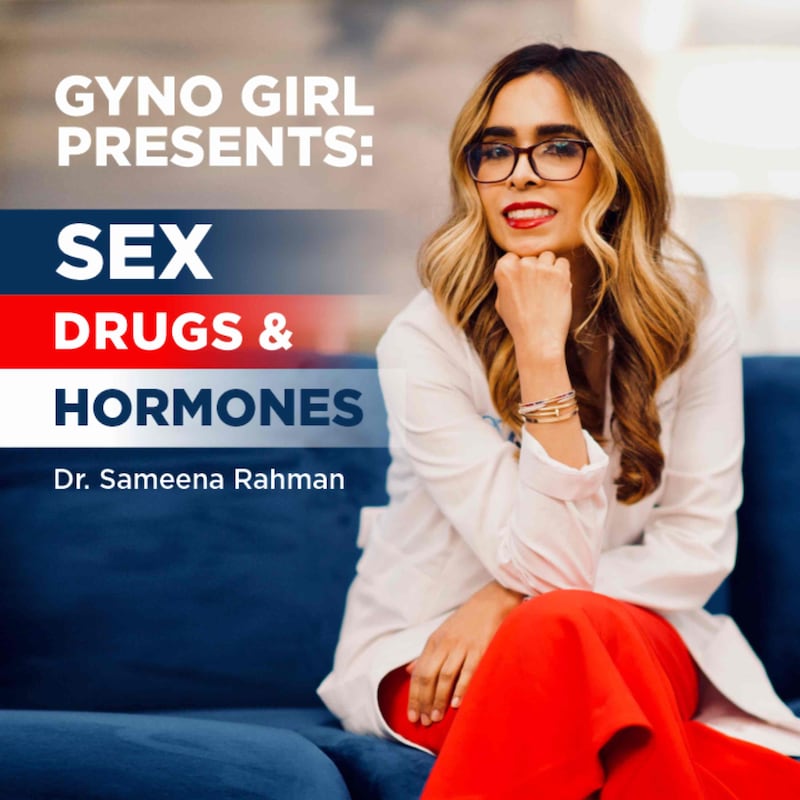
Thank you for being here for another year of Gyno Girl Presents: Sex, Drugs & Hormones. Your support, your messages, and your stories are what keep me going you are my why.
If this year-in-review resonated with you, please share it with someone who needs to hear that they're not broken, not dramatic, and not asking for too much. And keep following the show in 2026 we've got incredible conversations lined up.
Get in Touch with Me:
Transcripts
Dr. Sameena Rahman:** Hey y'all, it's me, Dr. Sameena Rahman, Gyno Girl. Welcome back to another episode of Gyno Girl Presents, Sex, Drugs, and Hormones. I am Dr. Sameena Rahman, and I'm sitting here at the end of December thinking about the year and what I should do for my last podcast of the year. And you know what, I wanted to do kind of a year in review, and so I was looking at some of the times where I was either asked to comment on things that were in the headlines, or just thinking about some of the major things that have happened in women's health. And so today that's what we're gonna do.
Because if I'm being honest, the beginning of the year felt very heavy. It felt heavy to me. Obviously I started off the year without my mother who I lost last year. So that was really heavy. It also felt like the world was on fire. And I'm not just talking about the unfortunate fires that happened in the palisades and in Los Angeles. I'm talking about the world in general. I'm talking about the destruction in Gaza. I'm talking about the genocides in Sudan and Gaza. I'm talking about people suffering around the world. I'm talking about the people that are getting picked up off the streets.
You know things seemed very gloom and doom for a very long time. The news cycle was relentless and I often thought times felt like every step forward for women was met with backlash, misinformation was met with fear. You know, we still have women dying from childbirth and we still have medical racism impacting access for women.
Just in November, we were seeing women who were not getting the medical access to obstetric care that they needed or getting sent home, delivering on the highway. This is classic medical racism that contributes to the maternal mortality rate for Black women that is three times that of their white counterparts. Women's health, access to women's health has been heavy this year.
We've seen OBGYNs leave states that did not have access for medications that are utilized for abortions. We have women leaving states where they cannot do surgeries for ectopic pregnancies. We have our government that was telling pregnant women to continue to suffer with fevers and pain in pregnancy and not using acetaminophen or Tylenol.
But you know what? All of those made headlines and all of that was very much, you know, compelling and truthfully very upsetting to actually hear as well. Right. But here's the thing. Even in all that, women's health has moved forward in meaningful ways this year. Not perfectly, not fast enough. I mean, think about it. 1993 was the first time women were really allowed in medical research.
So we're not having picked up the space that fast, but enough that really deserves reflection. So today I want to do a year in review looking at the moments in women's health, in menopause and in sexual medicine that actually shifted conversations. And I want to do this through two lenses. One is like what changed in the science, what changed in the guidelines. And I want to talk about what changed in the culture, in how women are finally being allowed to talk about their bodies. So let's get into it guys.
All right, well, let's talk first and foremost about something that just came out actually. So it's really with regard to cervical cancer screening, because I don't think patients have ever been more confused, to be honest. There's pap smears, which are just assessments of the cells and whether or not they're normal or abnormal or low grade changes or high grade changes or pre cancers.
There's HPV testing, which is actually seeing if there's HPV involved in these changes. And there's co-testing, that's both the pap smear, actually looking at the cells and the epithelial changes, and HPV testing. And then there's self-collections. This is something that is kind of new for people that have access issues to be able to not be traumatized in the office and to collect your own pap smear.
And so here's what I tell my patients very plainly. Screening is about risk and screening is about history. It's not about vibes, guys. This year updated guidance has moved us forward toward HPV based screening and for the first time self collected HPV testing entered the conversation in a real way and it's only being allowed or it's only being done right now in a few states. I think actually in California is the main one that I've seen. It's really for a selected population that either has access issues or have other concerns.
HPV based testing, meaning that we're just doing a swab to see if there's HPV present. Is it high risk HPV? Is it low risk HPV? We've kind of changed the timing in which women should start getting pap smears instead of age 21. It's being recommended that we start at 25. And that's because women less than age 25 usually do have HPV, but they're able to either clear it or the cells are not impacted in a real way in which women need follow-up or having some colposcopies and unnecessary LEEP procedures.
And so now we're just going to be starting to screen them at 25. That doesn't mean you don't need a pelvic exam. That doesn't mean you don't need a vulvar exam. That doesn't mean you don't need someone to look at your pelvic floor. It means that putting a speculum in the vagina and collecting cells is not always necessary. But the pelvic exam itself is very informative. The vulvar exam is informative. The vestibular exam is informative. The pelvic floor exam is informative. So that does not mean that you should bypass seeing your doctor or clinician that is guiding you through this phase in your life. It just means that the actual process of collecting cells from the cervix is not always necessary based on age.
Right now it's 25 to 65. There are exceptions to each rule. And again, it is based on your risks and your history. And risk stratification is important. Questions like whether or not you got the HPV vaccine. You know, Australia is set to try to eliminate cervical cancer from their country. And they're doing this by rigorous screening and they're doing this by getting a high vaccination rate.
Our vaccination rate, unfortunately, it's 80% in some states, it's 60% in some states. So HPV vaccination, which vaccinates us currently for nine different strains of HPV, including the most aggressive strains, 16 and 18, that cause over 85% of all cervical cancers is really important. And so we usually start that vaccination in our teenage years. Boys and girls should be vaccinated.
And this is what's going to help us eliminate cervical cancer in our country. But again, our guidance has moved forward. We're going to do HPV-based screening. Some patients will be allowed to do self-collection of HPV testing. And really, this matters, especially for perimenopausal menopausal patients, especially for older patients, because many women believe pelvic exams or have felt pelvic exams to be painful. Genitourinary syndrome of menopause makes exams intolerable for some. Trauma histories make exams avoidable and avoidance turns into shame, right?
So this is a whole process and we should have trauma informed care. We should treat GSM and we should make exams accessible. But for those patients who do not have any of that, then perhaps self-collection is the best way to go. But here's the truth. You're not too old for screening and you're not required to suffer to protect your health. If you're over 65, the question is not, am I done? But do I meet safe exit criteria? If exams are painful due to genitourinary syndrome of menopause, we treat the GSM. We don't dismiss the patient. Prevention should not hurt and it should not come with guilt, right?
So these are the things that we have to look at very critically in our patients now. We have to make sure that we're providing trauma-informed care. If you're over 65 and you're out there dating because you're divorced or widowed or just getting your groove back, you probably should still get tested for HPV, right? So again, it's risk-based, it's nuanced, and it's very much a prevention strategy to prevent cervical cancer. Because remember, pap smears are a screening test for cervical cancer. And really, we're looking at HPV and whether or not you smoke, whether or not you're immunocompromised, whether or not you have gotten a vaccine, all of these things. So remember, prevention should not hurt, and it should not come with guilt. So that's really important change in these guidelines.
The other thing I want to talk about: Menopause? Is it having a moment and is it just hype? If 2025 has taught us anything, it's this. Menopause is no longer niche. It's not just this thing that people are doing. It is a highly monetized area of medicine, just like women's health, just like women's wellness, just like women's sexual health. It's one of the most predatory markets around.
And we see this time and time again with people telling you to ditch your doctor and go get X, Y, or Z supplement or this detox. This year I had a patient who literally spent $20,000 with a quote unquote practitioner who told her that her birth control was poisonous to her. She spent 20 grand detoxing from that poison. Someone who has very little to no credentials.
And she came to see me and we worked through her perimenopausal symptoms. But interestingly enough, you know, I found it curious that she was willing to spend 20 grand on detoxing with someone that had very little to no experience and no credentials. But when I was choosing to step out of the insurance based model, she found it difficult to spend money on a physician, which was always shocking to me.
Anyway, but you know what? Menopause is no longer niche. Menopause showed up in workplace policy discussions, policy changes, right? Illinois announced that September was Perimenopause Awareness Month. I acknowledged it, they sent me a huge scrolled thing that said, hear ye, hear ye. I announced that September is Perimenopause Awareness Month from Governor Pritzker.
You know, hospital systems are responding to demand. Media stories about misdiagnosis, about gaslighting are rampant. And open conversations about symptoms women were told to endure quietly are happening online. And let me be clear that menopause, as you know that I've said before, is not just about hot flashes. It's about bone health. It's about cardiovascular risk. It's about sleep. It's about mental health. It's about sexual function. It's about relationships and it's about your workforce, right?
And yet we still train clinicians with shockingly little menopause education. Because time and time again, women tell me that they're told this is just anxiety, it's a normal part of aging, just deal with it, women are meant to suffer. But what I always tell women is that natural does not mean optional. Menopause is natural. Osteoporosis, cardiovascular risk, frailty, sexual pain, they're not rites of passage, right?
And here's the part that really matters, because it's not just vibes. This is the changing of our workforce. This is societies paying more attention. This is women demanding more. This is social media outcries. This is what we're seeing.
And as of late 2025, there used to be less than a thousand menopause society certified practitioners. And as of late 2025, there were over 4,100. At the same time, when I started at the Menopause Society 10 years ago, there were just in the order of hundreds of people attending this conference. We now have 12,000 menopause society members. That's across medicine, psychology, allied health.
This doesn't just happen unless women are asking for help, unless women are demanding more and holding the medical societies accountable and refusing to be dismissed. We're trying to integrate this into medical schools or trying to integrate it into residency programs. I'm part of the integration force at Northwestern and we're doing it. But some people will just say, you know what, menopause is just having a moment. But what they're missing is that we are actively building clinician base to meet an unmet need, right?
6,000 women a day entering perimenopause and menopause in this country. We have 4,100 certified clinicians. That doesn't mean that the other people don't know how to treat menopause, but these are clinicians who have actively taken time to kind of learn about this and take a test that says that they know a little bit of what they're doing. It doesn't necessarily mean that you will get the kind of care that you deserve from these clinicians, but at least we're hoping that it means that they think that menopause matters.
But we also have a lot of telehealth platforms that have popped up and some of them are great. We're talking about, again, access to evidence-based medicine and some of them definitely practice that. But is this enough? No. Is access still equitable? Hell no. But it is a movement and this movement matters. And I think that's why it's very important.
And as we speak about menopause, I want to say that, you know, I was quoted in both Good Morning America and USA Today. Because again, when I was trying to figure out this podcast, I wanted to look at some of the clippings that I've had from different articles or different responses that I had toward the news media when they reached out to me.
So this year, the term menopause divorce went mainstream. Some people call it gray divorce, but menopause divorce went mainstream. All the while, the media loves the headline. The real story is actually much deeper. Midlife women are the center of caretaking for their families. It's not their kids, it's their husbands, it's their parents sometimes, especially the sandwich generation.
They're experiencing sleep deprivation. There are mood changes. There are libido shifts. There are identity changes, right? Like, who am I now? My kids are out of the house. You know, I don't love my career anymore. Should I make a shift? There's real caregiver fatigue. And sometimes there are partners that are minimizing it, right? So sometimes it's that the patient has decided I don't have to put up with this anymore or I don't want to put up with this.
I had a patient tell me this year that she lost a parent and did not find the support she needed from her significant other, her husband in her life. And that significant loss, which, you know, if any of you lost a parent, you know, it's a significant loss in your life, made her refocus and realize like, do I want this for the rest of my life, right? Because that's the other thing that death does for you. It makes you think twice about what you're doing here, but also that life is short and what are you willing to kind of cope with and not cope with and what you want your lasting impression to be. So she lost her parent and decided that she no longer wanted to deal with the person in her life that wasn't there for her.
So I like to say that midlife men experience a midlife crisis and women experience midlife clarity. That all of a sudden they realize their relationship needs support, not silence.
So here's what I tell my patients, don't diagnose your marriage during untreated hormonal chaos, untreated insomnia, untreated concerns around libido, untreated hot flashes, night sweats, panic attacks, anxiety, untreated palpitations, untreated sleep, right? You don't want to make decisions based on that.
Once we've attacked the symptoms through lifestyle modifications, hormones, other medications, whatever's necessary, and you're starting to communicate more, maybe go through counseling, then if your partner dismisses your experiences or weaponizes your symptoms or you realize this is not the person you want to spend the rest of your life with, then you can make these shifts. Then you can decide.
So what I say is menopause doesn't really cause divorce, but it reveals fault lines that were already there. And also your tolerance for those lines become much, much less. So I think that's really important to remember.
Recently in the news, in the sexual medicine world was really around Addi and low desire, which I talked about a lot on my Instagram. In the last few weeks, the big shift happened in sexual medicine. One of the biggest was that Addi, which is flibanserin, which is a medication that has been around since 2015 and is FDA approved for low desire with bother, hypoactive sexual desire disorder. That is you wanna want to have sex but you can't bring yourself to it.
And remember, sexual dysfunction is biopsychosocial. So the bio of it is that your brain is your biggest sexual organ and there's something called the sexual tipping point, right? So there are things in our brain that can put us into an excitatory mode, things which I call the let's go mode, and things that put you into an inhibitory mode, which is like the hell no mode, right? And so when the excitatory is greater than the inhibitory, or vice versa, that will determine your spontaneous desire.
Remember, most women in long-term relationships have a responsive desire, not a spontaneous desire. That means they have to get aroused before they can actually get desired or they have to feel some new connection before that happens.
So, Addi, after 10 years of being only for premenopausal women, which never should have been the case. There never should have been an age delineation was just recently pushed and pushed and pushed by Cindy Eckert, the CEO of Sprout Pharmaceuticals to be approved for women under the age of 65. And this matters not because it's for everyone, but because it reinforces a truth that women have been told for decades.
This matters not because this medication is for everyone. It really works in 40 to 50% of the women that take it. What happens is you have to actually talk to patients about how it works on their brain, right? Because what it does is it increases dopamine and norepinephrine, which are in that excitatory category. And it reduces serotonin, which is an inhibitory category, which is why you get SSRI induced sexual dysfunction because serotonin is an inhibitor of sexual desire. But dopamine and norepinephrine can increase it. Testosterone can increase it. Oxytocin is in the excitatory category, whereas opioids, prolactin, and the neurotransmitter serotonin are in the hell no category, which is the inhibitory category.
But for too many years, women have been told that desire is a moral failing, right? But it's really neurochemistry plus context. And that's really important, right? It's a daily medication, it's subtle, but for some women it's life-changing. People made a big deal about it. They used to call it the Viagra for women, but it's not Viagra because it doesn't work on your genital blood flow, right? This is a medication that works to alter your neurochemistry over time.
You have to wait at least two months, take Addi every night to see whether or not you're going to be in that percentage of women that gets a little bit of increase in sexually satisfying events. And what that means is I have patients who have had sexless marriages for some time where they just don't feel like they want to have sex. They have no desire with their husband, but they feel like they want to want to have sex. And maybe 10 out of 10 times, their husband will approach them and they say no. But with Addi, maybe it's just one to two out of 10 times, maybe it's three out of 10 times, but it's enough to where they can start communicating, they can start enjoying each other's company. And it might be subtle, but the reduction in distress is what we're looking at. We're looking at how much improvement in that distress do we feel.
And that's how Addi works. For some women, it can be really life changing. And here's what I see clinically all the time is that even if that one sexually satisfying experience can dramatically decrease your distress, then it's worth it. Because libido is not about wanting sex constantly. And a patient got told by her doctor, you're going to become a nympho if you take this medication. That's not it. That's not what this is about. This is about reducing distress around your desire that used to be there.
You know, of course we have testosterone, which we don't have an FDA approved version of testosterone for women. So we titrate FDA approved men's testosterone for female dosing. But the strongest evidence we have is for post menopausal women with hypoactive sexual desire disorder. It's not a panacea. You still have to look at the biopsychosocial. It is very important. It improves people's libido. It can improve people's mood. It can improve a lot of things. I have patients that come to me and say they feel different on testosterone. And so we can't pretend like women don't have androgen receptors. It's science. It's truthful. And it is something I see in my office.
Speaking of sexual medicine, there's a medication by Daré Pharmaceuticals, which is called Dare to Play. And it's a topical sildenafil cream that has been studied through the FDA and is going to be released a little bit prior to approval, but it has been rigorously studied and rigorously tested. And I'm going to do a separate video about this actually. But it's been rigorously studied and rigorously tested and it works for female arousal disorder. That means you can't get the genital arousal that you feel. And so if you rub it on the clitoris and on the vulva before intercourse, you get a rush of blood flow to the area, which will improve your desire as well. Because again, most women have responsive desire. So improving arousal, then people start wanting to have sex. And so this is an on-demand medication that's used for sexual intercourse.
It's called Dare to Play. It's going to be released after the new year as well. Topical sildenafil cream 3.6%. It is one of these medications— Sildenafil is the non trade name generic name for Viagra. So when we talk about women's Viagra, I've talked about it in my podcast before, it doesn't always work for women but this topical version will bring blood flow to the vulva and the clitoris which will then allow for arousal and as well as improvement in desire. And it's going to be approved for women with arousal disorders. So that is on the pipeline after the new year. I will talk about it in more detail, but it should be released in a number of states starting in the new year.
All right, so that is really what was new in the sexual medicine space in the last month, as well as upcoming in the new year, the Dare to Play. I have to say that I have spoken for them at the last conference of ISSWSH. I was asked to speak for them. So in that way, I have a little bit of an affiliation with them as an advisor, but I only take on roles like that when I really believe in science and there's some evidence behind it. So that is my disclosure to you guys.
So that's kind of what happened in the world of sexual medicine this year. A little bit of that at least. There's a lot more actually that we can talk about. And if you want to learn more, come to ISSWSH www.isswsh.org. There is a meeting going to be February 12th through the 15th in Long Beach of this year that I am the scientific chair for. So I'm putting together the whole meeting. And so it's going to be good. So for those of you clinicians out there listening, you should come on to Long Beach in February. Spend Valentine's day with us.
All right. Next I want to talk about estrogen, the FDA and the seismic shift that happened. So this year there was a huge seismic shift. The FDA moved toward removing that misleading box warning language around estrogen based products. And it's not like the language and the warning is not on the package at all. It's just lower down. Remember the boxed warning is the life threatening packaged warning that's in your face that's saying this can be life threatening. And so they've just removed the big box around it.
And what this means is that we can shift from fear-based counseling that has harmed women for decades. That's what I talked about with Urology Times and some of the other news outlets that asked about this FDA estrogen removal, what it means. Let me be clear on this. This does not mean hormones are for everyone and that does not erase the individualized risk assessment. But it does mean we can stop treating estrogen like a dirty four letter word. Fear. Fear is not informed consent. Okay. That is really important for everyone to remember. And so we have to treat the whole patient in a nuanced way. We have to understand their risk. We have to understand their history. We have to understand their symptoms. We have to understand what lifestyle changes they can make. We have to understand, and they have to understand how these hormones can help them and how they can reduce their risks.
All right. Genitourinary syndrome of menopause, another big thing happened in July of this year. It's one of my favorite shifts this year. GSM is now everyone's business. The release of the comprehensive GSM guidelines by the AUA and the Urogynecologic Society was huge because it should mean for everyone that this part of menopause care should no longer be siloed.
GSM is not just about vaginal dryness. I did a whole episode on this. Remember, we used to call it the senile vagina. We used to call it vulvovaginal atrophy. We used to call it all these things. And it wasn't until 2014 where our urologist, Dr. Irwin Goldstein, who I talk a lot about because he started with the impetus for ISSWSH, said we gotta put urinary syndrome as well. It has to be the genitourinary syndrome.
And actually most of us believe that we should call it just genitourinary syndrome of, and then you put in what type of syndrome it is. Is it of lactation? Is it of menopause? Is it of cancer treatment? Is it of hormonal birth control pills? Is it because of infertility medications?
What is it? It is a genitourinary syndrome that is not just vaginal dryness. Some people call it that they have had vulvar awareness for the first time in their life. That means that something feels funny down there, but they don't know what it is. It just feels like they're aware of their vulva in ways that they never have been. It's pain, it's burning, it's urinary frequency, it's urinary urgency, it's recurrent UTIs that will be reduced by 50% if you use vaginal estrogen.
Remember, it is local estrogen therapy that is safe for everyone. The guidelines kind of outline all of this. Local estrogen therapy is safe for everyone. And that is because, not because estrogen is not absorbed in the vagina systemically. You do get systemic absorption, but it is just not an appreciable amount. It means that the dose that we use, the micro dose that we use is just enough to act locally only.
And so that is really important because sexual avoidance happens and quality of life is eroded when people have genitourinary syndrome of menopause. So vaginal estrogen and vaginal DHEA are legitimate tools for that, for recurrent UTI prevention, for reducing Medicare costs in the hospital, for reducing urinary sepsis, and I've said this for many years now, for saving a life.
Because if you've ever had a loved one in the ICU because of urosepsis, because they got delirium from having a UTI that led to sepsis, you know that if you could reduce that risk by 50%, you would have done it. And you know that the cost of reducing that risk is so minimal and it's so easy to do because we have so many options. And I've talked about them in previous podcasts, so take a listen to that.
But vaginal estrogen, vaginal DHEA are life saving. They're safe for most patients. This is not about cosmesis. This is about equity and it is about saving lives.
Another important thing happened recently. ACOG brought out some supporting guidelines. There was an article in March of last year through the New England Journal of Medicine about recurrent bacterial vaginosis, which about a third of my patients come through at any given time. BV, there's new evidence to show that treating male partners can reduce recurrence. I did an episode on this as well.
It means, and I was asked about it on the media circuits, which means we can finally stop framing BV as a women's hygiene failure. We don't have to say that this is because of this or that, that you used the wrong thing in the vagina, that you shouldn't have used this. It doesn't mean every case needs partner treatment, but if we want to reduce the recurrence, we don't have to blame the patient. We're not blaming the partner either. We're just saying that we know that if the partner is treated that we don't get the bacteria from them, that we can reduce the recurrence. And I have again an episode on that.
And so that is from the New England Journal of Medicine. That is from a randomized control study that showed treating the partner can reduce the risk of bacterial vaginosis recurrence, which is that discharge, which is that smell, which is that irritation in the vagina that you get from this infection.
This October, I was actually asked to write a menopause e-consult as an educational committee member of the Menopause Society. And this is a clinical case commentary that was distributed nationally to menopause specialists. The question was simple, but it was incredibly loaded. What do we do when healthy women in early menopause or late perimenopause ask for hormone therapy because mainly they're not miserable, but because they're worried about their heart disease, osteoporosis, diabetes, and dementia risks. They're hearing about the benefits on social media, they're trying to be proactive, they're asking thoughtful questions.
So the real question became, should hormone therapy be used for primary prevention? And the answer, like so much of menopause that doesn't make the headlines is that it's nuanced. Our major clinical guidelines or menopause position statements are pretty clear. Hormone therapy should not be used for the primary prevention of chronic disease. It's not FDA approved for that, but here's the part that really gets lost a lot of time. The menopause transition is a biologically vulnerable window.
Bone loss accelerates dramatically before the final menstrual period. Cardiometabolic risk shifts independent of aging and fractures, not hot flashes, are what steal independence later in life. Osteoporotic fractures exceed the incidence of stroke, breast cancer and heart disease combined. And the consequences of those fractures are dramatic. Not being able to get back to a normal quality of life, it's death, it's not getting back to the normal way of living. The one-year mortality of a fragility fracture approaches 20 to 25 percent after a hip fracture. Okay so that's not anything to dismiss.
So while hormone therapy isn't a blanket prevention strategy for everyone, discounting it entirely as a preventative tool, especially for bone health is a disservice for many because the formulation matters, the route matters, the timing matters. Transdermal estrogen does not carry the same clotting risk. Micronized progesterone that is biologically equivalent to what your ovaries make is safer than most synthetic progestogens. Estrogen alone therapy can reduce cancer mortality in long-term data. And that estrogen only therapy was Premarin, which is oral conjugated equine estrogen.
So the takeaway really isn't that everyone needs hormones, okay? But it is this, prevention and quality of life are deeply connected. Shared decision-making is what matters and nuanced care is what matters. And women deserve counseling that reflects biological complexity, not fear. My friend Rachel Rubin always says, what are we afraid of? Most clinicians are afraid of getting sued.
And that's the truth. I'm an OB-GYN. I've dealt with lawsuits. We know this is a litigious society and most clinicians practice fear-based medicine, but women deserve counseling that really reflects the complex biological changes that happen in the menopausal transition.
And before I close, I wanna talk about something extremely personal to me because this year wasn't just about guidelines and headlines for me as a clinician. As you all know, if you've listened to my podcast, I lost my dear mother in October of last year. I've been struggling with my own perimenopausal symptoms for the last year as well.
And what I came to realize is life is short, that I want to make impact. And I don't have to have impact on a large number of people through my practice because that kind of drain started draining me as a perimenopausal woman. I realized that I could not see 20 patients a day with five new consults and give the care that I want to give and the nuanced care that my patients need. And it took her loss and my own perimenopausal struggles to finally get me to realize that I need to take care of myself and my self care involved a big practice transformation for me.
In 2025, I made the decision to launch a concierge practice focused on menopause, sexual medicine, and complex gynecologic care and complex care for my midlife patients in collaboration with nationally recognized concierge group called Ms. Medicine. And let me be clear why. It wasn't because I wanted to practice luxury medicine. It wasn't about exclusivity. And it definitely was not about me abandoning patients that I've been caring for for the last 11 years. Purpose drove me. My own self-care drove me and losing my mom made me realize this.
It really came down to time as well. Time that I need to take a real history. Time that I need to explain risk instead of instilling fear. Fear takes very few seconds to instill, right? I can tell a patient you could die from this, so that's why I don't want to do it. End of discussion. But nuanced care and explaining the risk instead of instilling fear, take time. Time to talk about libido, pain, sleep, trauma, relationships, aging, without having someone knock on my door saying the next two patients are waiting.
Because here's the truth that I just really can't ignore anymore. You cannot practice menopause and sexual medicine care in a nuanced way in 10 minutes.
What surprised me most after launching my practice was how different medicine feels now. It was how also relieved my patients were. Not because they had an immediate fix. Not because everything was optimized overnight. To the contrary, it takes a lot more time. But because women feel believed, women feel heard, and women feel like they have a partner in their medical journey.
Women told me that no one's ever explained this like this to me. No one has connected these symptoms before. No one's done the extra research, even though they might not have known the answer. I thought I was just supposed to live like this. And what became very clear very quickly to me is that concierge care for many women is not about convenience, it's not about luxury, it's about access to expertise that the system does not currently support.
And I've said this before, but our healthcare system is meant to fail clinicians and to the women that we're supposed to take care of it. It's not built for menopause, it's not built for sexual health, it's definitely not built for shared decision making, it's built for patriarchal medicine, this is what I'm gonna give you, take it or leave it.
So this practice became a way of me saying, if the system won't make room for this kind of care, then I will. And I don't see this as the future for everyone, but I do see it as a signal that women are demanding depth, that midlife healthcare matters, that sexual health is not optional. Sexual health is health. And really helps me reaffirm why I chose this field and why I chose to be a doctor.
So that is my practice. I did a podcast with Kieran Bradley and Grace Preet who are on my team. Please check it out. But yes, the world felt very heavy this year. But women's health, we did move forward. We saw progress in guidelines. We saw progress in language and community. We saw progress in the workforce development for midlife women and progress in how boldly women are advocating for themselves.
And if there's one thing I want you to take from this episode, it is, as my friend Kelly Casperson says, you are not broken, you are not dramatic, and you are not asking for too much. You are asking for care that matches the science and your lived experience.
So if this episode resonated, please share it with someone who needs permission to stop suffering. And as always, I'm Dr. Sameena Rahman, Gyno Girl. Thanks for joining me for another episode of Gyno Girl Presents Sex, Drugs, and Hormones. Remember, I'm here to educate so you can advocate for yourself.
Enjoy your holiday, whatever holiday you may celebrate. Enjoy your New Year. Please bring in your New Year safely. Next year is going to be a blast. I already have a lot of awesome people lined up. Tell me what you want to hear. Drop me a note. Let me know if there's other things you wish I could do or talk to.
Thank you for listening. Thank you for being my why. Thank you for the people that reach out to me when I'm about to close the podcast world and get frustrated and tell me, you know what? I listen to you every week. Things you say matters to me and it's helped me. Thank you everyone. And I wish you a happy new year filled with joy, filled with good health, filled with advocacy, filled with self-care, filled with painless sex. And see you next year.

