Transcripts
Welcome to Live With The Pricing Lady.
Speaker:I'm Janene, your hostess.
Speaker:This show is all about helping you build a sustainably profitable
Speaker:business while making an unbelievable impact on your world.
Speaker:Learn from my 20 years of experience and from my guests as we discuss their pricing
Speaker:challenges, failures, and successes.
Speaker:Pricing is a way of being or behaving in your business.
Speaker:My mission is to help you confidently charge for the value you deliver.
Speaker:Pricing is either hurting or helping your business.
Speaker:Let's make sure it's helping you reach your dreams.
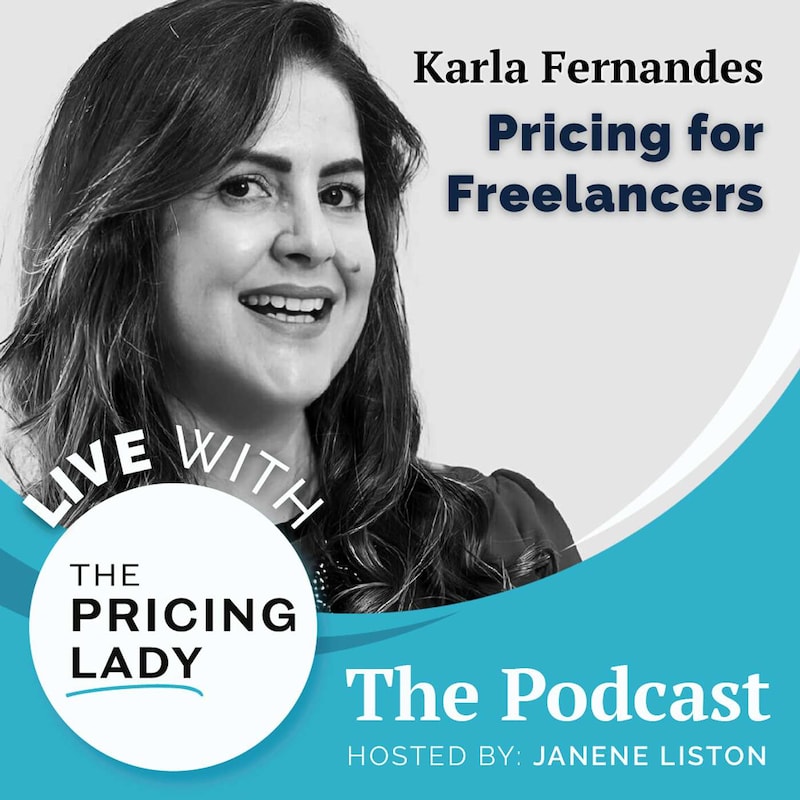
Speaker:Today, I'd like to welcome my guest, Karla Fernandes.
Speaker:Hi, Karla.
Speaker:Hi, Janene.
Speaker:So good to be here.
Speaker:I'm thrilled to have you here.
Speaker:We're going to be doing something a little bit different today.
Speaker:Karla asked to come on the show to actually ask me questions.
Speaker:I'm a bit in the hot seat here, but before we get into her questions, let's
Speaker:get to know Karla a little bit more.
Speaker:First of all, Karla, where are you joining us from today?
Speaker:I live in Lucerne, Switzerland.
Speaker:Lucerne.
Speaker:And are you originally from Switzerland?
Speaker:No, I'm from Brazil, and yeah, I live here.
Speaker:Excellent.
Speaker:And what is your superpower?
Speaker:Okay,
Speaker:I am a jack of all trades.
Speaker:As a designer, that is a generalist, I can really tackle various topics.
Speaker:And then, as a team of one I can do a little bit of everything from zero to end.
Speaker:Okay, that's a great skill to have.
Speaker:Very useful, I'm sure, as well.
Speaker:What's something you, like to share with us, of course, that
Speaker:most people don't know about you?
Speaker:Most people don't know about me that I started my career as a graphic designer.
Speaker:Then I became a full stack developer long before I started
Speaker:creating native apps using no code.
Speaker:Okay.
Speaker:Okay.
Speaker:Super.
Speaker:Excellent.
Speaker:The next thing is, why don't you tell us a little bit about your journey to,
Speaker:your business and how you got started?
Speaker:Okay, so I am a digital product designer and consultant mentor, and I have 25
Speaker:plus years of experience in design.
Speaker:I have been working with more than 150 companies, well known tech
Speaker:startups, educational organizations, and service based companies.
Speaker:I speak four languages and I have been living this digital nomad life,
Speaker:like I lived in 11 countries before coming to Switzerland, and I have
Speaker:launched More than a dozen apps.
Speaker:I am as a mentor, I really care for my mentees and that's why we are having
Speaker:this episode today that you are so kind to share your expertise with these
Speaker:people like me that want to actually start their careers as a freelancer.
Speaker:Like, I mean, a lot of junior designers today are interested in starting a
Speaker:You know, Job Hunt has been a hustle, like a lot of layoffs and they are
Speaker:really interested in starting, but they don't know how, and when they
Speaker:learn how to get their first customer, the second thing that really hurt
Speaker:them, it's pricing, they don't know what to do, what's the best practice.
Speaker:And of course, like I started 18 years ago to be a freelancer and
Speaker:the things have changed so much.
Speaker:Right?
Speaker:Like three years ago, AI was nothing and now it's so much.
Speaker:So imagining pricing, how much has changed?
Speaker:And I'm here to ask you a bunch of questions that probably you have a
Speaker:lot of designers out there and also freelancers and solopreneurs like myself.
Speaker:Okay.
Speaker:Before we get into the questions, I do have one more question for you.
Speaker:What was it like when you first started, the first time you had to set a price
Speaker:for what you did in your business?
Speaker:Oh, it was very interesting time.
Speaker:I would say like at the first time you actually get to do a project for someone.
Speaker:As for money, and they say, yes, it's so exciting.
Speaker:it's so exciting, right?
Speaker:Like, wow.
Speaker:Someone is really paying me to do something I already enjoy doing, right?
Speaker:Like the first, actually, I believe that the first project I did that was as a
Speaker:freelancer, it was a branding project.
Speaker:And I just saw, restaurant nearby my place and they had this horrible It
Speaker:was really horrible, like, and the food was so good, and I really thought
Speaker:this was It could be much better.
Speaker:I ended up there, like I actually did some drafts of it, like all myself, by myself.
Speaker:And then I went there and I said like, you know, I would actually really love
Speaker:to augment you with a brand because I'd really love to eat here and so on.
Speaker:Owner just told me like, well, Karla, we will hire you.
Speaker:Even if we exchange that in food, which I actually found was a very good deal.
Speaker:I thought, okay, this is amazing.
Speaker:I just didn't know what to price.
Speaker:So I told him like, Oh, what do you think you would be fair?
Speaker:Like for sure this was not the best, how to say, experience.
Speaker:But for me as a, Very junior, like, starting my career.
Speaker:That was awesome.
Speaker:And he was very kind.
Speaker:Like there is even really changing a little bit subject.
Speaker:There is a guy that did something like that.
Speaker:He used to give their, his customers websites and say,
Speaker:like, you pay what you want.
Speaker:And he ended up actually earning a lot of money because people were so happy
Speaker:with his work and then he earned a lot, but that cannot be the case everywhere.
Speaker:Right.
Speaker:So, but he was very kind.
Speaker:And I think if I would put in terms of today, I would have earned maybe,
Speaker:yeah, 500 francs or so that for someone starting, it's a good price for.
Speaker:Yeah.
Speaker:Okay.
Speaker:Okay.
Speaker:Now I'm always curious what it's like for people that first time they have to do it.
Speaker:Everybody's experience is a little bit different.
Speaker:Okay.
Speaker:So now you have some questions for me focused on pricing for freelancers.
Speaker:Why don't we dig into some of those questions?
Speaker:Yeah, sure.
Speaker:I you do the first one.
Speaker:So what key factors, like in your opinion, should freelancers consider
Speaker:when pricing their services?
Speaker:Yeah.
Speaker:I think one of the very first things I would say is super important.
Speaker:And I know you follow me, Karla.
Speaker:So you probably know this is coming is getting really clear
Speaker:on who your customers are.
Speaker:I liken this to, picking up a set of binoculars and you look through
Speaker:and it's all unfocused and blurry.
Speaker:And then you start adjusting the binoculars and you see very quickly
Speaker:that things can come into focus and understanding your customer is like
Speaker:bringing your binoculars into focus because if your customers are, let's say,
Speaker:small businesses, small local businesses, Then you probably are going to charge a
Speaker:different price than if you're working for large multinational companies.
Speaker:And that's why I say getting clear on who you're targeting first is going to,
Speaker:in large part, determine the prices.
Speaker:So that's one thing I would say.
Speaker:I know for a lot of freelancers, they kind of feel like they
Speaker:have one price for everybody.
Speaker:You know, there's a price for the work.
Speaker:I'm saying that there could be different prices for your work, depending on
Speaker:who you're serving, because different people will value it in a different
Speaker:way, or it'll bring a different level of value to different types of companies.
Speaker:Yeah.
Speaker:So that's the first thing I would say is a real key factor.
Speaker:Another thing, and people don't like to talk about it because it's a little bit
Speaker:unsexy, is your business targets or goals.
Speaker:So what are you trying to achieve with your business?
Speaker:If this is just a side gig because you love doing it, you may choose to do
Speaker:something different with your pricing than if you're going to be living from it.
Speaker:Yeah.
Speaker:Doesn't mean you have to charge different prices in those two cases, but often
Speaker:you will charge something different.
Speaker:That's also really important.
Speaker:Yeah.
Speaker:There's a lot of things here that Play into it.
Speaker:But those are the two places where I recommend most people start because
Speaker:most people will actually, especially freelancers will start by looking
Speaker:at what everybody else is charging, but one, there's not always a lot of
Speaker:transparency in the freelance side.
Speaker:There's some, but not always a lot, depending on which industry you're
Speaker:in, but also if you benchmark yourself against the wrong people, then you
Speaker:can very quickly come up with a price that isn't going to be good for you.
Speaker:Another thing to consider is to think about how much you want to work.
Speaker:This is kind of funny way to go about this, but in freelance when people
Speaker:first start out often, not always, but often they're being paid for time.
Speaker:Not my favorite pricing model.
Speaker:We can talk about that later.
Speaker:But when you're paying time, then your time is limited, there are
Speaker:a limited number of hours in the day and an even smaller number of
Speaker:hours, which you're willing to work.
Speaker:And so what you charge also has to reflect you being able to, you
Speaker:know, earn enough money from it.
Speaker:And if you charge too little, there simply aren't enough hours in the day for you
Speaker:to earn the money that you would like.
Speaker:And all of those things, you know, are part of the process
Speaker:of determining what to charge.
Speaker:It has to be balanced between what people are willing to pay,
Speaker:how much profit you can earn, how much you're going to have to work.
Speaker:You know, it's not, it's not like a calculation per se.
Speaker:There are calculations in it at times, but it's about bringing these different
Speaker:aspects into balance when you set prices,
Speaker:direction.
Speaker:Yeah.
Speaker:That's definitely a point that you know, you said that we should talk more
Speaker:about, and I definitely see that coming.
Speaker:Like I have a lot of Experience, right?
Speaker:Like a 25 years and a lot of senior designers like me as are also freelancers.
Speaker:Then you get into that point in your work life that you are very effective.
Speaker:You do things much faster than you used to do when you are a junior designer
Speaker:or working as a junior or anything.
Speaker:Right, like you didn't know your skills, you didn't know how much time you needed.
Speaker:And if you get on this mess of charging per hour, you have, I dunno,
Speaker:8, 10, 12 hours to work every day.
Speaker:And then you earn that.
Speaker:But if you get very fast and you charge per hour can be a huge problem.
Speaker:So how can freelancers really balance this competitive pricing with a
Speaker:fair compensation like for their expertise that is not because they
Speaker:are seniors that they do things faster that now they get to earn less.
Speaker:Yeah, yeah.
Speaker:No, and that's, that's a really good point.
Speaker:So before I answer your question, let me just go back a step.
Speaker:And that's a really important point to make very clear to people.
Speaker:When you charge based on time, as you gain experience and expertise,
Speaker:you can do things Faster, more effectively, and it may actually
Speaker:get your clients better results.
Speaker:And all three of those things are added value for the customer, which means that
Speaker:if you're charging per day or per hour, you would charge less because you get
Speaker:it done quicker, but they're actually getting better results than before.
Speaker:So using time based prices over time doesn't actually scale with
Speaker:you as you become more effective and efficient in your business.
Speaker:So that, that goes to my distaste, let's say, for, for time based prices.
Speaker:They have a time, ha ha ha, and a place.
Speaker:Yeah, and they are easy to start with, but you need to remember at some point
Speaker:you're going to want to transition.
Speaker:So now let's go to your second question about balancing competitive, being
Speaker:competitive versus fair compensation.
Speaker:Now, the first thing that I would say is really important is making sure that
Speaker:your definition of a fair compensation or a fair price is all encompassing.
Speaker:This is one of the things I talk about a lot, like what is a fair price?
Speaker:And for me, it has three elements.
Speaker:The first one is a fair price is aligned with the value that you
Speaker:deliver or that your offer or your product or service delivers.
Speaker:Right.
Speaker:Second of all.
Speaker:It's at a level that people are willing to pay.
Speaker:And third of all, and this is the one that most people miss, right?
Speaker:Is that it brings you a reasonable profit.
Speaker:So oftentimes when people talk about fair compensation or far prices, they lean more
Speaker:towards it being fair for the customer.
Speaker:And they often will leave themselves out of that equation.
Speaker:It's amazing point.
Speaker:Yeah.
Speaker:Like, so.
Speaker:I had a thought here.
Speaker:You are saying a little bit something like,
Speaker:everyone has a different type of success, right?
Speaker:Like what success looks for you?
Speaker:Like how much would you have to earn during a month or during this time?
Speaker:Or how would you trade your time with your family?
Speaker:If that's the point or your vacation with your work, right?
Speaker:Like how that's valuable in your current life, right?
Speaker:Yeah, in part, that's part of it.
Speaker:Yes.
Speaker:It's also the, if you're talking about the value, it's the value
Speaker:of what it brings your customers.
Speaker:If they had to learn the skills that you have to do, you know, let's say
Speaker:you're building a website for someone.
Speaker:If they have to go and learn all those skills, it's going to take
Speaker:time, resources, and energy, right?
Speaker:You're saving them having to learn the skills that you have.
Speaker:That's why they're paying you to do it.
Speaker:But also once they have a website built and it's built in the right way,
Speaker:then it will help them advance their business, which has additional value.
Speaker:So maybe they get more revenue or they get more leads or, you know,
Speaker:whatever it is that also has value.
Speaker:So the prices that you select should reflect that value that they can get.
Speaker:Is that a common trend for you?
Speaker:Sorry, sorry.
Speaker:It is that's a common trend for you to, to, to see that people forget
Speaker:to ask the customers or the future, future customers, what is actually
Speaker:that is so valuable for them in, in this project and how do you use it?
Speaker:And so once you also benefit from knowing what is that the goal to,
Speaker:to make that a more, let's say, easy pricing, is that something that you
Speaker:should consider or would be helpful?
Speaker:Yeah, it is because my feeling, so most let's, let's just
Speaker:start stick with services.
Speaker:Cause we're talking freelancing today, right?
Speaker:So.
Speaker:Most service based businesses, when they go to set prices,
Speaker:they go, this is what I do.
Speaker:This is what other people are charging.
Speaker:I'm new.
Speaker:So I'll charge 10 percent less.
Speaker:That's not much of a strategy.
Speaker:Yeah, that's, that's like barely scraping the bottom of what
Speaker:one would define as a strategy.
Speaker:No, it's, it's, it's, it's something, but it's not actually going to, do
Speaker:you know if charging 10 percent less than everybody else is going to bring
Speaker:you enough profit in your business?
Speaker:Do you know if what they're charging is a reasonable price to charge?
Speaker:Maybe it's really high.
Speaker:Maybe it's really low.
Speaker:Yeah.
Speaker:Do you know if that's related to the value that they're going
Speaker:to get from working with you?
Speaker:So yes, I think absolutely people need to understand their customers and what
Speaker:it is that they're looking for in a solution and what they value in that.
Speaker:It could be that they value the way that you work together.
Speaker:It could be that they value the results they're getting out of working with you.
Speaker:But knowing what they value can help you find not only the right offers,
Speaker:but then also the right prices.
Speaker:I think another thing that helps you to balance being competitive and, and
Speaker:fair with how you're compensated or how you price yourself, especially
Speaker:in freelancing is to be really clear about setting boundaries.
Speaker:So for example, and I know that you know this, scope creep is a real
Speaker:challenge for a lot of freelancers.
Speaker:Yeah.
Speaker:One because they're focused on how much time is this taking me because
Speaker:everybody's overly focused on the time.
Speaker:Because that is the unit of measure for what's going to be paid.
Speaker:But the time doesn't necessarily reflect the value.
Speaker:Just because you spend more time on something doesn't
Speaker:always make it better, right?
Speaker:Yes.
Speaker:So, I think you have to be clear about what's included, what's not
Speaker:included, what's not included.
Speaker:When there will be additional fees.
Speaker:And as a freelancer you don't wanna scare people off with that, but you
Speaker:wanna set some of that up from the very beginning before you even get
Speaker:into a contract and make that clear.
Speaker:And often.
Speaker:It's harder creating those boundaries for yourself than it is create,
Speaker:setting it with the customer.
Speaker:Right.
Speaker:I agree.
Speaker:I agree.
Speaker:And like, setting those in into, it doesn't really need to be a super
Speaker:lawyer contract, but, you know, at their, what you deliver, what is
Speaker:the most, What will be delivered?
Speaker:When will it be delivered?
Speaker:And, set all these expectations to the customer also helps a lot because if you
Speaker:just say like, okay, I, you deliver it.
Speaker:And then the customer comes to you.
Speaker:I want this change.
Speaker:I want that change.
Speaker:And this was not foreseen.
Speaker:Then you come up working much more than you thought of and in the end if you
Speaker:do that measure up even if you are not asking for our price and you measure
Speaker:how long you spend in the project and how much you earned you can see
Speaker:probably that that was no revenue at all or that you didn't get anything from
Speaker:that project or even worked for free.
Speaker:Right.
Speaker:I think that's a great segue into another point, which is even as a freelancer
Speaker:at time, at some point in time, you're going to want to create packages for
Speaker:the more standardized, and I'm doing air quotes here, things that you do.
Speaker:One, because it enables you to be more prescriptive about
Speaker:what's included and what's not.
Speaker:Two, It doesn't, you know, leave things so open ended when the
Speaker:customer is deciding to work for you.
Speaker:There's actually something tangible that they can, can, you know, see
Speaker:and make a decision based upon.
Speaker:But it also helps you to work more efficiently.
Speaker:Yeah.
Speaker:So it's like, I liken it to, you know, if you ask a child, what would you
Speaker:like for lunch and you don't give them options, they can come up with anything
Speaker:and you may not have that in the fridge.
Speaker:Right.
Speaker:And it's the same thing with customers.
Speaker:Well, what do you want me to do?
Speaker:And they're like, ah, laundry list.
Speaker:Doo, doo, doo, doo, doo, doo, doo, doo, doo, doo, doo.
Speaker:And that list gets longer over time.
Speaker:Right.
Speaker:Whereas if you say, well, This is what I typically do for clients
Speaker:like you, either something like this or something like this.
Speaker:These are two different price points depending on your budget and depending
Speaker:on the features that you want.
Speaker:Yeah.
Speaker:So it (creating packages) actually helps them to make decisions easier, but it
Speaker:also helps you work more effectively.
Speaker:And I think that that leads to better conversation.
Speaker:Yeah,
Speaker:I, I went to that actually share with everybody that in the first call, like,
Speaker:that's where you were just spending time kind of, networking, learning each other.
Speaker:You told me something that really stuck with me and I think it's really
Speaker:helpful to everybody on that point.
Speaker:That is, Keep something simple that you can send to any customer
Speaker:that wants to work with you.
Speaker:That is something basic, like, Oh, you know, I can help you with this.
Speaker:And then you say in the email, and if you want something more
Speaker:customized, we can just hop on a call and then talk about the details.
Speaker:And then I create a proposal that is specific for you.
Speaker:I thought that was so brilliant and I have done it a ton of time.
Speaker:And yeah, I did.
Speaker:I think that was the best tip I ever got in pricing ever.
Speaker:And that's why I'm here, right?
Speaker:Yeah, I mean, that's absolutely correct.
Speaker:Because it allows you to get that first offer out the door very quickly.
Speaker:And this is, again, if you have a few packaged offers, again, you can
Speaker:send something out fast without it requiring a lot of time on your behalf.
Speaker:Before you've actually learned enough about the project to be able to make
Speaker:a more fine tuned and quickly you set the expectation around price.
Speaker:Yeah.
Speaker:So they see what the standard option is.
Speaker:They know that anything customized is going to be more than that.
Speaker:Most likely, right?
Speaker:So you're, you're making, you're kind of putting a stake in the ground and saying,
Speaker:okay, at a minimum, this is the value.
Speaker:And I have to share this because I love this example.
Speaker:There's a photographer On his website, he had a pricing page and his pricing
Speaker:page, I thought it was one of the most brilliant examples of putting
Speaker:that value stake in the ground, his website, his pricing page is said, is
Speaker:it really going to cost me at least 2, 000 for you to photograph my wedding?
Speaker:Yes, it is.
Speaker:Are you okay with that?
Speaker:And the person could click yes, and it would take them to a contact page.
Speaker:And then it said, if you're not okay with that, here's a link to Craig's list.
Speaker:That's an amazing way to show them.
Speaker:Yeah, it was really,
Speaker:yeah.
Speaker:It's really saying, okay, I understand if that's not what you want to pay,
Speaker:if it's not within your budget, or you don't think that's reasonable,
Speaker:then there are other people who can help you with what you need.
Speaker:Totally true.
Speaker:Like, you know, we're referring other customers to other people.
Speaker:It's a common practice of sometimes because you don't have the time, some
Speaker:other times because like, they just don't have the budget to work with you
Speaker:or like, any, Talking about that, we should really talk about, , what you
Speaker:should suggest, like, to set setting those realistic revenue goals, you
Speaker:know, like you are just starting out.
Speaker:You have no idea how much you should be earning or what is revenue like, what is,
Speaker:For you, yeah, what would you suggest?
Speaker:So when you sit down to set your revenue goals, I think there's a couple
Speaker:of things that you have to look at.
Speaker:And again, they fall into what most people would categorize as
Speaker:the not so sexy and interesting stuff, but they're really important.
Speaker:And the first thing is understanding your expenses.
Speaker:Yeah.
Speaker:So what it's going to cost you to run your business.
Speaker:Second of all, what are your goals?
Speaker:Again, back to the very start of this conversation where we talked about, are
Speaker:you just doing this because it's fun?
Speaker:Are you doing it as a side gig?
Speaker:Are you doing it to live off of?
Speaker:And also think about that longer term, you know, so three to five
Speaker:years from now, if your goal right now is a side gig, but you want to
Speaker:get to where you can live off of it.
Speaker:You have to set yourself up with that in mind.
Speaker:So with startups, often I'll see that, when they do their, their
Speaker:pricing, they use financials that don't include their own salary because
Speaker:they know they're not going to pay themselves the first couple of years.
Speaker:But if you set your prices based on The Financials That Don't Have Your Salary.
Speaker:How could you ever get to a point, you know, in your business
Speaker:where you can, because your prices aren't set up for that.
Speaker:Yeah.
Speaker:So it's a similar thing here.
Speaker:You have to understand, you know, the running costs of your
Speaker:business and your, your objectives.
Speaker:I think you also have to be really.
Speaker:Honest with yourself about non billable time and you will
Speaker:absolutely have non billable time.
Speaker:I think most people on average probably spend one to one and a half days a week
Speaker:where they're doing non billable things.
Speaker:Yeah.
Speaker:So you may think that you're Income is 40 hours a week, if you want to
Speaker:work 40, times your hourly rate.
Speaker:I can almost guarantee you that is not going to be the case unless you're
Speaker:working closer to 60 hours, right?
Speaker:Because that non billable time is That is doing all the back end business
Speaker:stuff, all the marketing, all the selling, all the connecting with
Speaker:people or whatever it is that you need to do in order to get those jobs.
Speaker:Writing proposals, all of those things are time consuming to some degree.
Speaker:And if you don't account for that upfront.
Speaker:Then you will get to the end of the year and you will realize, that
Speaker:didn't quite work out as I planned.
Speaker:And you'd like not to do that.
Speaker:So I have actually, I have a tool on my website.
Speaker:I have a toolkit on my website.
Speaker:One of the calculators in that toolkit is called making a living.
Speaker:Calculator, but allows you to put in, you know, your total hours you're going
Speaker:to work and the vacation hours training.
Speaker:If you do like education and training, you can take that out.
Speaker:Holidays, so on and so forth.
Speaker:And then put in an hourly based rate and see what at a maximum you could earn.
Speaker:And that's a really good place to start, with that.
Speaker:Account for seasonability.
Speaker:Oh, oh yeah.
Speaker:So in a lot of industries or in certain parts of the world, like
Speaker:here in Switzerland, I had a young lady I met, last year, I think
Speaker:it was last year, the year before, and I met her at an all time high.
Speaker:And she came to me and she goes, how do I get my customers to buy stuff from me?
Speaker:In August and July.
Speaker:And I thought, Oh, this is a seasonality issue.
Speaker:She works in an industry where most people are on vacation during the summer.
Speaker:second half of July, and August.
Speaker:You can't force people to buy from you, but you know, she needed to either
Speaker:accept the fact that those months were going to be lower and make it up in
Speaker:other months, or she needed to design an offer for the people who were still
Speaker:around during those months, right?
Speaker:That would be of interest to them at that time.
Speaker:So seasonality is really important.
Speaker:Chances are you won't have the same amount of business every month.
Speaker:And you need to understand where those low months are and where, you know,
Speaker:you might be able to earn more in order to, to compensate in a sense for that.
Speaker:And probably use that time, right?
Speaker:Like you said, just use that time with the training, use the time writing proposals
Speaker:and everything.
Speaker:What I, what I did starting last year, which worked really well for
Speaker:me is I have to kind of black out using air quotes again, period.
Speaker:So the last two weeks of December and the first two weeks of January,
Speaker:and then for like six weeks in July, August time period, I don't
Speaker:do a lot of client facing work.
Speaker:I only do that by exception during those times.
Speaker:And basically I'm planning out and preparing for the year ahead.
Speaker:in those times.
Speaker:So I'm doing a lot of behind the scenes work and that works really well for me.
Speaker:Other people choose to handle it in a different way, but it's just something to
Speaker:Think of when you're setting your revenue goals because revenue doesn't always
Speaker:come in at the same amount every month, like when you're receiving a paycheck.
Speaker:I think the last, there's two more things I'd like to add here
Speaker:before we start wrapping this up.
Speaker:One is create three sets of targets.
Speaker:There's like the normal case, the worst case and the best case revenue.
Speaker:Then you can start actually thinking about, okay, what it's going to take
Speaker:to achieve just the worst case versus the normal case versus the best case,
Speaker:because they will take and require different things from you in order
Speaker:for you to be able to achieve them.
Speaker:And then the last thing is you're going to want to track, review, and adjust.
Speaker:So when you set your goals, you know, most people, they write a business plan.
Speaker:They don't come anywhere.
Speaker:I know one person who's very proud of the fact that they hit all their
Speaker:goals in their original business plan.
Speaker:But that's not the normal case for most people.
Speaker:They don't do that.
Speaker:So your, objective should be, okay, set something you think is realistic,
Speaker:maybe stretch, but achievable.
Speaker:And then track that and don't wait until the end of the year to track it.
Speaker:Maybe at the, you know, for the first couple of years, you might
Speaker:even want to look at it monthly.
Speaker:And then later you might feel comfortable going to quarterly, but track it,
Speaker:ask yourself, okay, what worked?
Speaker:What didn't work?
Speaker:Are there any adjustments I need to make?
Speaker:Definitely.
Speaker:Like a design sprint of your planning, right?
Speaker:Let's think about it.
Speaker:So, I mean, setting realistic revenue goals, is, you know, it feels maybe
Speaker:a little bit like magic, but you know how many hours you want to work.
Speaker:You know how many of those you can bill.
Speaker:You have idea of what you may be able to charge different people.
Speaker:So you can start to get an idea of what's possible, but then of course
Speaker:you have to go out and get the work.
Speaker:And that's why you need to track against it.
Speaker:Yeah.
Speaker:So hopefully I've been able to answer and give you guys some insight today.
Speaker:Yeah.
Speaker:What is something that you'd like people to remember from
Speaker:what we talked about today?
Speaker:Well, I believe you should, they should all review of this, you know,
Speaker:really one of the biggest points for me, it's thinking about what's your
Speaker:worth, how you want to spend your time, if you do a little bit of studying,
Speaker:if not, and then try to Always keep a plan, like a, or track it, right?
Speaker:Like a track it with, with you, see if you are evolving, if you need something
Speaker:to change in the middle, if you can do a small adjustment and see how it goes.
Speaker:It's an A B test, guys, like, so you are designers, you know what an A B test is.
Speaker:So keep doing that with your business, keep doing that with your projects, and
Speaker:probably you get in the right track.
Speaker:Yeah.
Speaker:Yeah.
Speaker:I'd agree with that.
Speaker:I might add that, there's no such thing as a perfect price.
Speaker:And so if you're frustrated trying to find a perfect price, then you need to
Speaker:take a step back away from that objective.
Speaker:Because there is no perfect number out there for any business.
Speaker:There are lots of prices that are going to be suitable for you and your business.
Speaker:Your job is to figure out what those are and also know that they're
Speaker:going to change as time goes by.
Speaker:So you may set a price now and six months from now or a year from
Speaker:now, you may choose to change it.
Speaker:One thing I like to tell people is always have a little tension, have
Speaker:a little tension in your price, both for you and for the client.
Speaker:And if you keep that little bit of tension there, then you know that
Speaker:you're, you're getting a good price, that they're getting good value.
Speaker:And it's, it's a good thing.
Speaker:I don't want to say it's a little bit ouchy for everybody, but it's, it
Speaker:feels a little bit uncomfortable for you to ask and they feel like, yeah,
Speaker:I think that that's still good value.
Speaker:Let's give it a try.
Speaker:Then I think you're really getting towards what is fair
Speaker:and reasonable for both of you.
Speaker:And I think that's the most important thing.
Speaker:That's great advice.
Speaker:As everything else.
Speaker:Okay, let's wrap this up with a few little questions here.
Speaker:, What book or podcast or something that you like to listen to would you
Speaker:recommend to our listeners today?
Speaker:You actually talk about, Many books, right?
Speaker:Like, I think it's really important to develop the habit of listening
Speaker:to these short summaries for you to identify the books that are
Speaker:worth for you to dive deep into.
Speaker:Like, I use Blinkist.
Speaker:And 12 minutes every day.
Speaker:There are a bunch of apps like this.
Speaker:And then I hear those summaries.
Speaker:When I think something really clicks with me, then I go for the whole book.
Speaker:Then I don't spend so much time starting to read the book and say like, Oh,
Speaker:no, that's not what I want to learn.
Speaker:Yes, I use Blinkist as well, but maybe not as religiously as you,
Speaker:but I do find it very helpful.
Speaker:So we'll put a link to that in the show notes as well.
Speaker:Carla, if people would like to find out more about you and how to work
Speaker:with you, where should they reach out?
Speaker:They should definitely check my website.
Speaker:It's vitaminak.
Speaker:design.
Speaker:There you go.
Speaker:We'll put that in the show notes for you.
Speaker:Plus her, her links on social media so that you can connect and follow her.
Speaker:Karla, thank you so much for coming on the show today and also for shaking things
Speaker:up by asking, to change the format a bit.
Speaker:I believe that that was, really helpful to the listeners and I enjoyed it.
Speaker:Okay.
Speaker:I like talking about pricing, and it's also been nice to
Speaker:know you a bit better as well.
Speaker:Thank you so much for joining us.
Speaker:That was great, Janene.
Speaker:Thank you very much for helping my mentees and everyone else
Speaker:that works as freelancer, too.
Speaker:Thank you.
Speaker:You're very welcome.
Speaker:All right.
Speaker:Everybody.
Speaker:Thank you so much for joining us today.
Speaker:I wish you a great day, everyone, all the best.
Speaker:And as always enjoy pricing.
Speaker:Thank you for listening to this episode of Live with The Pricing Lady, the podcast.
Speaker:If you enjoyed the episode, rate, review, and subscribe to it, then share
Speaker:it with your friends and colleagues.
Speaker:I love hearing back from you listeners.
Speaker:If you've got comments, questions, or topic ideas, go on
Speaker:over to www.thepricinglady.Com and contact me there.
Speaker:Not sure where to start when it comes to improving pricing and profits?
Speaker:At ThePricingLady.
Speaker:com you can download a copy of my Self Assessment Pricing Scorecard.
Speaker:Find out where it's going well and where you can begin improving.
Speaker:Or just simply book a discovery call with me.
Speaker:There we can discuss what's up with pricing in your business and
Speaker:how I might be able to help you.
Speaker:Thanks once again for joining.
Speaker:Remember, pricing can hurt or help your business.
Speaker:Let's make sure it's helping you reach your dreams.
Speaker:See you next time and as always, enjoy pricing.