Shownotes
Episode Summary
If hiring a virtual assistant has created more questions instead of more capacity, the problem may not be the person you hired. More often, it's the foundation they were given to work from.
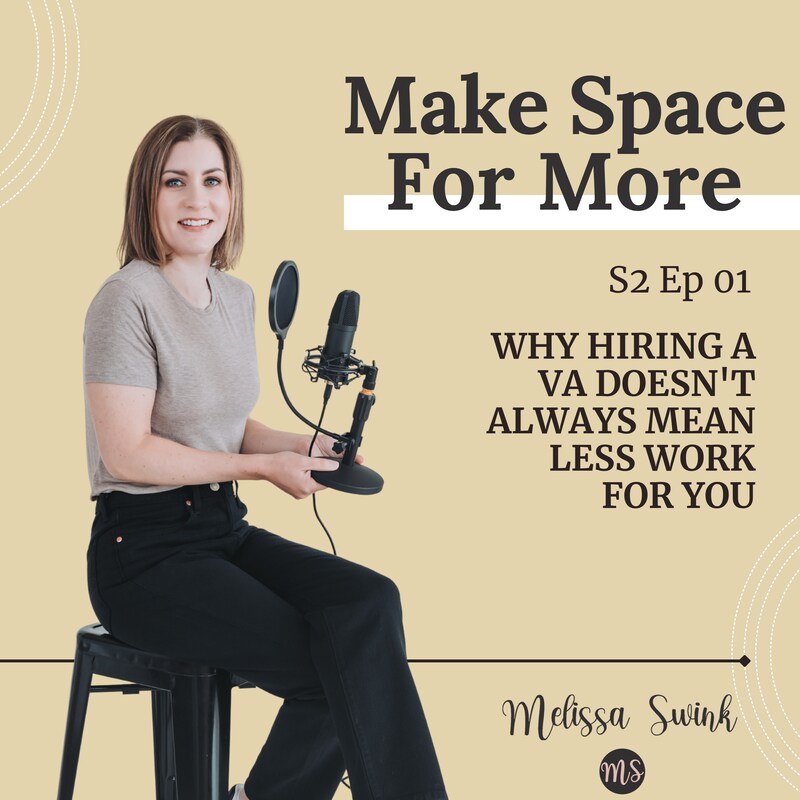
In this episode, Melissa Swink shares why delegation often falls short of creating true ownership and how a more intentional onboarding process can change that. Drawing from her own experience as both a business owner and the founder of a virtual assistant agency, Melissa explains why many assistants end up working in reactive mode and what leaders can do to set their teams up for long-term success.
Rather than expecting immediate independence, Melissa introduces a phased onboarding approach that helps build the systems, processes, and shared understanding needed for a VA to confidently take ownership of their work. She also shares the story of two very different coaching experiences that completely changed how she thinks about documenting processes and building a team.
Key Highlights:
- Why hiring a VA doesn't automatically reduce your workload
- How reactive onboarding keeps leaders stuck as the bottleneck
- What true ownership looks like and why it isn't the same as giving up control
- Why documented systems and clear workflows are essential for effective delegation
- How a phased onboarding approach creates stronger long-term results
- The lesson that transformed Melissa's own approach to process documentation and team building
- Questions to help you evaluate whether your current delegation strategy is creating ownership or simply redistributing tasks
About Melissa:
Melissa Swink, Founder & CEO of Melissa Swink & Co., has a team of virtual assistants who provide administrative and marketing support for small businesses and non-profits.
Since 2012, Melissa and her team have helped more than 100 businesses grow through the services they offer, and she is dedicated to helping entrepreneurs create profitable, scalable businesses they love.
Her work is all about doing what works (and eliminating what doesn’t) and driving real, measurable results. Visit www.melissaswink.com to learn more!
Thanks for listening!
If you enjoyed this episode and think that others could benefit from listening, please share it using the social media buttons on this page. Do you have some feedback or questions about this episode? Leave a comment in the section below!
Subscribe to the podcast
If you would like to get automatic updates of new podcast episodes, you can subscribe to the podcast on Apple Podcasts or Stitcher. You can also subscribe in your favorite podcast app.
Leave us an Apple Podcast review
Ratings and reviews from our listeners are really valuable and greatly appreciated. They help our podcast rank higher on Apple Podcasts, which exposes our show to more awesome listeners like you. If you have a minute, please leave an honest review.
Transcripts
Hello, my name is Melissa Swink, and I'm the founder and CEO of Melissa Swink Co., which is a virtual assistant services agency that provides administrative, marketing, and operations support for small businesses and nonprofits. Today I want to talk about why hiring a VA doesn't always mean less work for you. But most importantly, we're going to talk about what to do about it so that your VA has true ownership.
Of the tasks that you are entrusting them with so that you have that time, freedom, and that mental space that you want in the first place for building a team. So I want to paint the picture of how the beginning of many VA relationships with their clients start off. So, from your perspective, you hire a VA and you hand them a priority task list, you give them access to the things that they need, such as logins or files and things like that.
They're off, they're hitting the ground running. And then you find maybe a couple weeks in, couple months in, hopefully not too far in, but you're still fielding a lot of questions. You're still the one explaining how everything works, how everything is connected. Now I'm going to tell you this the problem usually is not the VA. Sometimes you think, my gosh, should I hire the right person for this? Like, this shouldn't be so challenging. Like, why aren't the dots connecting? But
I will tell you this, that is likely what they were set up with or without for that matter on day one. So how you onboard a VA is going to determine whether that person actually helps you or just becomes one more person that you have to manage. And that's certainly not what anybody wants. So let's let's take things back a little bit further, even before we hire the VA. And I can use myself as an example of this as well, where many clients
When they start working with us, everything lives in their head. They've gotten to a point in their business or their career where they are just jamming on all the things. They're great at what they do. And they're just naturally going about their day to day, moving fast and jumping from thing to thing, where again, they've got a lot of plates spinning and everything is stuck up here. In addition to that, there might be things living on their desks, there might be things scattered across their inbox or even multiple inboxes in some cases.
Melissa Swink (:There are often no documented processes. Systems may or may not be organized. There's nothing in a format that would be easy for a new team member to just pick up and run with. And again, this is not on the business owner or the leader. This is just what happens naturally when you are just prioritizing and paying attention to the most important things that you need to do on a day-to-day basis. The documenting of processes, the organization of the systems.
Often gets put on the back burner, and that's very, very common. So then what happens is when a VA starts working with you, or we start working with our clients, I can I can ride both sides of this line. We're we're on different sides of the same coin here. When a VA starts, they often get dropped into reactive mode. So they are given some tasks, they're given some information, and they are trying to figure things out as they go.
Rather than stepping into a role or a structure that's already been set up for them. So ultimately it feels like that onboarding has stalled. So what is this actually costing you? Right? I think we can relate to a lot of this. We've probably been on both sides of the same coin before. But a VA who is stuck in reactive mode or an assistant, I see this all the time. even in some of the consulting that we do where a client has a great assistant, but
They just feel like the work is very inefficient. And it's often the case where assistant is in reactive mode all day long. But the problem is that when they're living in reactive mode, they're helping you the best that they can, but they can't take full ownership because they don't know what full ownership looks like. And that means that you're still the go-between, you're answering questions, you're checking their work.
You're even filling in gaps that they're not even aware of in the first place, where maybe they hand something to you and say it's done, and you think, well, this is probably like 90 or 95% done, and you're making a few little fixes here and there before it's 100% in your mind. And that VA might not even realize that there are a couple more steps that need to be done. And over time it gets tedious, you get frustrated, and there's just that gap in expectations. So
Melissa Swink (:One thing that I want to say when I'm talking about ownership, because especially those of us who are very type A, like we like control, we like things done a certain way, maybe the perfectionists out there is that ownership, giving ownership to your VA or your assistant doesn't mean giving up control. It just means that your VA is going to see the task complete from start.
to finish, not just the pieces of it that you hand off to them. So important things here is that you still are the one to make the final important decisions. You're just not making they're just not the one making every little decision or giving direction every you know couple of steps throughout the process. You are not the one having to follow up on things, not having to remind anybody of things
And also, you're not the chief problem solver or the problem seer. Your VA, your assistant, can anticipate where the problems lie. They flag them, they solve them before you even have to ask. So the result of this is that you get more time spent managing the results, not so much the actual work itself. I also talked about this in my July video that I posted last month.
About you know, checking in. Can your business run without you checking in? And in that video, I had shared that I went to a couple of conferences. I spent a week out in New York and for for a our Goldman Sachs 10,000 Small Businesses graduation, which included a lot of class time and things. And I noticed that many people there had great teams, but they were checking in via email or they were.
making phone calls to their teams in the very limited breaks that we had, making sure that everything was running okay. And so the reality is that if you're still the main point of contact and you are still the one fielding questions and giving direction, you haven't fully delegated, you have added a helper. And that's certainly a stepping stone. But what we want is we want somebody who can really take ownership of the work that you have entrusted to them.
Melissa Swink (:So here's what we do about all of this. Most importantly, you probably recognize things from your own experience in the many examples that I've given you of where some of these things can show up, where these sticking points are. But what we have done, and certainly this is something that you can take this information and apply it to the work that you're doing with your team. This isn't this isn't unique to our team, but something that we have done is we have
created a phased approach to the way that we onboard our clients. So previously, as I mentioned, what was happening was we would get a list of priority tasks or projects that clients wanted us to start with. We would get that information and then we would, again, just like I described, begin to do the work, begin building out some of those processes and things behind the scenes, but it was when we were kind of thrown into that reactive mode.
And then over time we found that, you know, in many cases, we were not as independent as we would like to be for our clients. We weren't saving them as much time, or maybe we were waiting on them for certain things and work was slower than we would like it to be going. There were many different scenarios that that unfolded, and certainly not in every working relationship, but we thought there's got to be a better way to set up our team and our clients for success. So
The way that we're doing this now is in phase one, which is usually about the first four to six weeks that we begin working with a client, we are building that structure and that foundation. During this phase, we are learning how the business or organization runs. We identify where work is getting stuck, where are the bottlenecks? And then we're organizing the key systems and the workflows to be able to provide ownership, or I should say, be able to provide support.
and truly take ownership of the things that clients are entrusting to us. We clarify recurring tasks that need to be done. And as we start to go about this onboarding process, we do start to take on some priority tasks for some immediately immediate relief. So to give you an example, maybe one of the things is launching an email newsletter. That is something that the client wants to do. What we're doing is we're having within this four to six week
Melissa Swink (:We're doing a weekly working session with the client where we can do a deep dive, truly understand their audience, truly understand the system that they already have in place, or if they don't have a system in place, figuring out exactly what the system needs and be in order to be able to provide recommendations for what that system looks like. We start to build out the process in terms of the exchange of how are we planning our content.
If our client is in the thought leadership space, how are we getting that knowledge from them in order to build out that newsletter? We're talking about the process, we're talking about the goals in that working session, and then our team goes in behind the scenes and creates those processes, builds out that system, improves on maybe something that has been started but not finished previously. And then we start to take on that work on an ongoing basis.
Same thing could apply to say an email news or excuse me, an inbox for for managing email where we do a deeper dive where the client is showing us, here's how my email is organized or not organized. And that's in many cases as well. And then we can start to build together what that workflow looks like in terms of taking ownership of that client's inbox. Just to give you some examples there. To further illustrate this point and why those working sessions are so impactful for everyone involved.
Is there's a story that I've been sharing many times over the years. You might have even heard it if you've been following me for any period of time. Is a tale of two business coaches. So when I was new to building a team, there were there were two phases in my business where I was new to building a team. Number one was very early on when I was going to be going on maternity leave when my daughter was born. And that whole summer leading up to that leave happening and my daughter being born.
I'm talking this was back in: Melissa Swink (:Back then, or it was it was very new and I haven't discovered it yet. So don't come knocking on my door if you say, Well, Loom was founded in such and such year. You get the idea. But I spent so much time over that summer, like step one, open this platform. Step two, click here, like a step-by-step guide to doing these tasks. And it was exhausting. And so I I I made it through, but it was not fun. It was something that
team a couple years later in:document all these things and she's like, no, no, no, no, no. What you need to do is you need to hire a qualified person who has the experience you need, who is aligned with your values and your work style and things. And then you need to have them shadow you while you do the task and show them. And then they go off and they create the SOP. You walk through it, maybe you make any revisions or talk through it together.
And then when that SOP gives your final is given your final approval, they own that 100%. They take that task off your plate. And it was such a revelation for me where I'm like, my gosh, that's so much easier. And so this is really the concept that we're taking to this phased approach for onboarding. So then going into phase two of our ongoing ongoing support is that the foundation is clear, it's in place.
The systems are clean. We have SOPs that have been drafted and edited and finalized and approved by our client so that we're not going back to them with questions all the time is very clear. Here's the task, here's what needs to be done. And certainly over time, you know, that relationship just continues to evolve and grow. But especially in those early stages, having those full processes laid out for those priority tests are a game changer.
Melissa Swink (:So our team is able to step in consistently with, you know, administrative tasks, operations, project tracking, client communications, following up on leads, email and calendar management, file organization. There's so many things that we do on a day to day basis, and we're able to step in fully where the client isn't the one leading the way throughout the entire time, or we don't have lots of check ins happening on anyone's behalf. And again, the point isn't the specific tasks.
It's the order. We're building out the foundation first, and then we are fully executing on that with full ownership. So that is something that you can take into account if you are working with a VA or you are onboarding a new team member. Try this phased approach so that you're not managing one more person and fielding all these different questions and things. So a couple of questions to ask yourself as we wrap up here is what currently lives in your head?
That someone else would need in order to take it off your plate. And another question is: did your VA, if things are feeling a little bit clunky with your VA, did they start with something solid to work from? Or did they start by guessing? Were there some general directions given? And then they are kind of playing the hot or cold game, like, is this what you wanted? Nope. Okay, we're a little off base here. How about this? And we're kind of we're kind of figuring out and in fine-tuning as we go. So
The other question that I wanted to ask you as well is are you still the one that everyone comes back to for clarifications, for context, even things that you just wanted to completely hand off? You know, are you are you the chief problem solver? Are you the question answer? Those are some indications that maybe we need to take a step back and look at that foundation that's in place first before we continue on in the path that we're going. So a VA in conclusion.
A VA can take real ownership when there's a proper foundation and structure in place for them to stand on. Build that first, and then the support that follows actually does give you time back. So if you are interested in learning more about how our team works, how we might be able to support you and the work that you're doing, I would love to invite you to have a consultation call with me.
Melissa Swink (:These are no pressure calls at all. It just gives me a chance to first of all get to know you. I love connecting with other business owners and professionals and executive directors and such. Learn more about your mission, what you're working on, learn more about your team and where those bottlenecks are and how we might be able to help. So feel free to request a consultation, get that booked on your calendar, have a conversation with me. I'd love to help in any way that we can. So
Thank you so much for watching and I hope you have a wonderful rest of your day. Take care.




