Shownotes
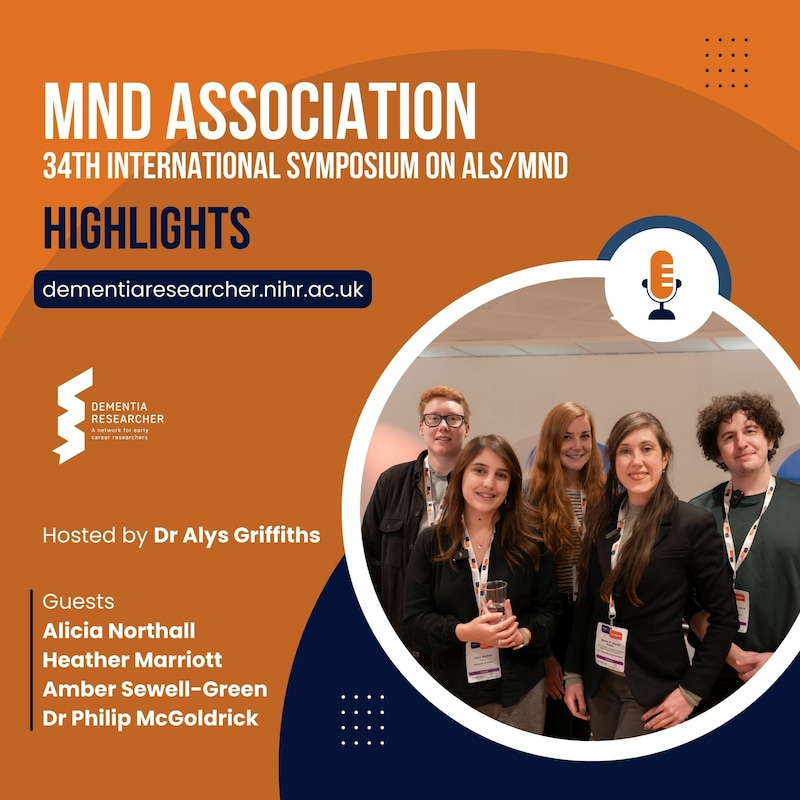
The 34th International Symposium on ALS / MND organised by the MND Association took place in Basel, Switzerland from the 6-8 December 2023.
In this podcast Dr Alys Griffiths from The University of Sheffield hosts a discussion with three researchers to talk about their talks, and highlights from the biggest annual conference dedicated to ALS and MND research. Sharing news from researchers working around the world to better understand amyotrophic lateral sclerosis and motor neurone disease.
Sharing their highlights are:
Alicia Northall, Postdoctoral Researcher from University of Oxford. Alicia recently moved back to the UK after completing her PhD in Neuroscience at the University of Tubingen / Otto-von-Guericke University Magdeburg in Germany. Alicia’s works in Neuroimaging to characterise microstructural changes to the brain in living patients using 7-Tesla MRI.
Dr Philip McGoldrick, Research Associate at University of Toronto. Phil completed his PhD at University College London and is interested in the basic mechanisms that contribute to disease progression and investigate them using a mixture of cell and animal models, alongside post mortem patient tissue.
Amber Sewell-Green is a PhD Candidate and Accredited Practicing Dietitian (APD) at University of Queensland, Australia. Amber’s research is focused on improving Nutrition Care Guidelines for MND looking at energy balance and the role of lipids in ALS.
Heather Marriott is a PhD Student at King’s College London. Amber undertakes analysis of next-generation sequencing data using bioinformatics and machine learning to advance personalised medicine approaches in ALS/MND.
Links mentioned in the show:
Event website: https://symposium.mndassociation.org/
News from the event as it happened on X: https://bit.ly/alsmndsymp
--
A transcript of this show, links and show notes and profile on all our guests are available on our website at https://www.dementiaresearcher.nihr.ac.uk.
If you prefer to watch rather than listen, you will find a video version of this podcast on Apple Podcasts, YouTube, and on our website.
Leave us a tip:
https://dementia-researcher.captivate.fm/support
Follow us on social media:
- https://www.instagram.com/dementia_researcher/
- https://www.facebook.com/Dementia.Researcher/
- https://www.twitter.com/demrescommunity
- https://www.linkedin.com/company/dementia-researcher
- https://bsky.app/profile/dementiaresearcher.bsky.social
Download and Register with our Community App:
https://www.onelink.to/dementiaresearcher
We gratefully acknowledge the support of our funders: Alzheimer’s Association, Race Against Dementia, Alzheimer’s Research UK, Alzheimer’s Society, and the National Institute for Health and Care Research.
The views and opinions expressed by guests in this podcast are their own and do not necessarily reflect those of the producers, funders, or sponsors.
Subscribe to our sister show 'Dementia Researcher The Blogs':
Transcripts
- [Announcer] "The Dementia
Researcher" podcast,
Speaker:talking careers, research,
conference highlights,
Speaker:and so much more.
Speaker:- Hello, and welcome to the
"Dementia Researcher" podcast.
Speaker:Today we're in Basel in Switzerland
Speaker:to bring you the highlights
Speaker:from the 34th International
Symposium on ALS and MND.
Speaker:(down tempo music)
Speaker:I am Alys Griffiths, and I'm
an NIHR Senior Research Fellow
Speaker:at the University of Sheffield.
Speaker:I'm delighted to be
guest hosting this show.
Speaker:Let me start with today's fun fact.
Speaker:Basel is a cultural and pharmaceutical hub
Speaker:at the crossroads of
Switzerland, France, and Germany,
Speaker:boasting the world's oldest art collection
Speaker:and being the home to the
headquarters of pharma giant,
Speaker:all great reasons why it
makes a wonderful home
Speaker:for this year's symposium.
Speaker:As ever in these
conference highlight shows,
Speaker:I'm joined by researchers
who are gonna share
Speaker:their event highlights
to provide a snapshot
Speaker:of what's been talked about this week.
Speaker:Let's meet the guests.
Speaker:(down tempo music)
Speaker:With me today is Alicia
Northall, Heather Marriott,
Speaker:Amber Sewell-Green, and Philip McGoldrick.
Speaker:Let's start with some quick introductions.
Speaker:Alicia, could you tell us
about yourself, please?
Speaker:- Hi, I'm Alicia.
Speaker:I'm from the University of Oxford.
Speaker:I joined as a postdoc
about six months ago,
Speaker:and I work on neuroimaging in ALS,
Speaker:trying to find new biomarkers.
Speaker:- [Alys] Heather, could you go next?
Speaker:- Yup, I'm a third year PhD student
Speaker:at King's College London, and I study,
Speaker:I use multiomics in ALS and MND
Speaker:to try and identify subgroups of patients
Speaker:which might be beneficial for
clinical trial recruitment.
Speaker:- Amber, you've come the furthest.
Speaker:Could you introduce yourself, please?
Speaker:- Hi, I'm Amber.
Speaker:I'm from the University of Queensland,
Speaker:all the way from Australia.
Speaker:I'm a first-year PhD
student and also a dietitian
Speaker:with a background in neuroscience.
Speaker:I'm looking to improve
nutrition care guidelines
Speaker:with a focus on energy and
fats in Motor Neuron Disease.
Speaker:- [Alys] And Philip.
Speaker:- Hey, I'm Philip McGoldrick.
Speaker:I'm a research associate at
the University of Toronto,
Speaker:funded by ALS Canada and Brain Canada.
Speaker:I work on nucleosides
possibly transport in ALS.
Speaker:- Thank you. So I know
this is the first time
Speaker:for all of you joining on the podcast,
Speaker:so thank you for joining us.
Speaker:Let's get to some highlights.
Speaker:(down tempo music)
Speaker:So I'm sure listeners
already know the format,
Speaker:but what we do is go around
the room a couple of times
Speaker:and each person shares one
of their favourite talks
Speaker:and posters and then we'll
just have a chat about them.
Speaker:But before we get going, I
wanted to give you all the chance
Speaker:to talk about any talks
you've given this week.
Speaker:Has anyone been presenting?
Speaker:- Only a poster.
- [Alys] Yeah.
Speaker:- I can discuss my
colleague that did present
Speaker:'cause I know enough about her work,
Speaker:so I'm happy to share that.
Speaker:My colleague Jeryn Chang,
Speaker:she's been doing really amazing work
Speaker:with MRI images of the brain.
Speaker:She started on hypothalamic volume,
Speaker:a little part of the brain
that we know is involved
Speaker:with metabolism and appetite.
Speaker:And then they actually showed
pictures of non-food items
Speaker:and low-calorie and high-calorie
food items in controls
Speaker:in ALS patients in a fed and fasted state.
Speaker:So I guess the first part
of her research showed
Speaker:that there's a bit of background
showing the hypothalamus
Speaker:may shrink in people with
Motor Neuron Disease,
Speaker:but they found a curve, so the
lowest and the highest BMIs,
Speaker:there was a difference, but
the middle BMI, not so much,
Speaker:so it's not quite so
straightforward as we think.
Speaker:But I think the main
things that she found was
Speaker:in the fed and fasted state,
Speaker:the high-calorie foods had
a lot more lighting up,
Speaker:particularly in the right temporal pole
Speaker:and in the cerebellum for controls,
Speaker:but it didn't seem to
be so for MND patients.
Speaker:So it seems to be maybe reduced activation
Speaker:or a bit of a dulling in this.
Speaker:And there is some
literature kind of showing
Speaker:that these regions of the
brain are associated with food
Speaker:and reward and maybe social benefits.
Speaker:So just starts to highlight I guess,
Speaker:areas of the brain we don't
think about with appetite
Speaker:that might be affected in people with MND.
Speaker:So I think her research is
gonna be really exciting,
Speaker:and I'm very proud of her.
Speaker:She did a wonderful job.
Speaker:- [Alys] Great, so I
guess, what would that mean
Speaker:for people we're seeing in clinic?
Speaker:- So I guess it would
mean targeted approaches
Speaker:that if people look at
appetite differently,
Speaker:maybe they may not be driven by memories.
Speaker:Obviously, I can't make
exact to say causation,
Speaker:so let me put a little
bit of a marker there,
Speaker:but I see it as we might
know how to approach
Speaker:and have a more individualised approach.
Speaker:Especially myself being a clinician,
Speaker:if we know there's areas of
the brain that may behave
Speaker:a bit differently compared
to healthy populations,
Speaker:we may address how we
approach encouraging people
Speaker:with weight loss 'cause what
would work with other people
Speaker:may not work in MND populations, so.
Speaker:Or just explain how they feel
about food, if that's changed.
Speaker:In other cases, we know that
there's some taste changes,
Speaker:food tastes better or worse
or there's decreased appetite,
Speaker:and we may be able to provide
a bit of an explanation why,
Speaker:which I think is always nice.
Speaker:- Thank you. Philip, you
said you did a poster?
Speaker:- Yeah, yeah, I had a
poster on the first day.
Speaker:So my work is on C9RO72,
Speaker:which is the most common
cause of ALS and FTD.
Speaker:I work on the loss of
function of the protein
Speaker:because it's a fairly understudied area.
Speaker:So what I'm interested
in is the mechanisms,
Speaker:that loss of function,
Speaker:the effect that it has
on cellular mechanisms.
Speaker:So I've been looking at
nucleocytoplasmic transport
Speaker:because we know the gain
of function toxicities
Speaker:affect nucleosides plasmic transport.
Speaker:I want to see if they
could also be affected
Speaker:by loss of function.
Speaker:So we have some overlap
with some of the work
Speaker:that was presented here and
we're quite excited about.
Speaker:- Did you get any good
conversations at your poster?
Speaker:- I was talking for about two hours,
Speaker:(Amanda chuckling)
Speaker:only to about four people,
Speaker:so the people who liked it liked it.
Speaker:- [Alys] Great. Alicia?
Speaker:- I didn't have a poster or
a talk, so I joined my group
Speaker:around the time of the
submission deadline.
Speaker:So it's actually nice
to be a fly on the wall
Speaker:for the first time at conference
Speaker:and just be able to soak it all in
Speaker:and ask lots of questions.
Speaker:- [Alys] And Heather?
- Yeah, so I presented
Speaker:a poster on the genetic analysis of NEFH,
Speaker:neurofilament heavy chain
gene, in sporadic ALS.
Speaker:And the reason that we
did this is because NEFH
Speaker:is included a lot of
genetic screening panels,
Speaker:but the actual genetic
mutations and variants
Speaker:that we find in NEFH haven't
been robustly associated
Speaker:with ALS risk.
Speaker:So we wanted to try and
characterise that further
Speaker:and actually see if
variants do modify ALS risk
Speaker:by performing a large
scale screening analysis
Speaker:of the project of mine,
ALS sequencing cohort.
Speaker:- [Alys] And did you have
any good conversations?
Speaker:- Yeah, there was a couple of
people that were interested,
Speaker:although they were wet lab people.
Speaker:and I'm a pure, purely,
pure bio of petition.
Speaker:I couldn't really answer their questions
Speaker:that well, but (laughs).
Speaker:- That's the fear isn't it?
- Yeah, yeah.
Speaker:- [Alys] So they, they're doing
Speaker:similar work from a different angle.
Speaker:- Yeah, so, so we confirmed
Speaker:previous reports in the
literature which say that
Speaker:variants in a specific domain
of NEFH, the tail domain,
Speaker:which affects phosphorylation
of the protein
Speaker:that is found in the serum in CSF,
Speaker:they actually said that
Speaker:perhaps the mutations are
driving the phosphorylation.
Speaker:So they're really interested in
Speaker:tackling it from a different approach,
Speaker:like introducing mutations
into in vitro models.
Speaker:So it's quite nice to sort of
Speaker:gain a perspective from the other side.
Speaker:- Great. So shall we move on
Speaker:to everybody's highlights?
Speaker:Philip, do you wanna go first?
Speaker:- Yeah, my first highlight was a talk by
Speaker:Gary Armstrong from McGill
University in Montreal in Canada.
Speaker:And Gary's made, he's used CRISPR to
Speaker:modify endogenous Zebra fish TDP43.
Speaker:So this is a much more
physiological model of disease
Speaker:and it aids the fish and
perform lots of behavioural
Speaker:and imaging answers.
Speaker:And I think it's really important
Speaker:because then this is a physiological model
Speaker:in a small animal model,
Speaker:which is much more tractable
for other experiments.
Speaker:I think it could be very, very powerful.
Speaker:- And what was it you enjoyed
about his presentation?
Speaker:- Everything. It was,
Speaker:I think it was really
good characterization.
Speaker:Yeah, really good
characterization and really good,
Speaker:it has a lot, would have a lot of power
Speaker:and a lot of translatability
for different studies.
Speaker:- Great. Amber, do you wanna
Speaker:tell us about your first highlight?
Speaker:- Yeah, I'm, I'm gonna
start a little bit broad
Speaker:and I guess something I was surprised
Speaker:and really enjoyed is the
focus on quality of life
Speaker:and the actual lived
experience of the disease.
Speaker:I think there was a
really huge representation
Speaker:of studies on psychology,
Speaker:studies on quality of life,
Speaker:studies on nutrition,
Speaker:studies on allied health
Speaker:that span through the posters
Speaker:and through the talks.
Speaker:In particular, there
were a few on ACT therapy
Speaker:that were really interesting.
Speaker:There was also one by Eneida Mioshi
Speaker:and she talked about just how
to manage behavioural changes.
Speaker:'Cause I guess we see, you
know, maybe 15% of people
Speaker:with ALS will have that FTD spectrum,
Speaker:but then still more,
Speaker:around 35%, will actually still present
Speaker:with those behavioural
changes of things like apathy.
Speaker:And if we can understand
that as clinicians
Speaker:and then actually relay that to the carers
Speaker:that know your partner or your child
Speaker:or whoever it may be, is not depressed.
Speaker:They're just struggling with motivation
Speaker:that can actually really
change the course of their, of
Speaker:how they behave and how they interact.
Speaker:So I think that was a really,
Speaker:presented some really powerful
Speaker:guides for carers and clinicians
Speaker:and for clinicians to share with carers.
Speaker:- [Alys] Yeah. Is that the mind toolkit?
Speaker:- Mind toolkit? Yeah,
so I'm really excited
Speaker:and I think in what I've looked at and
Speaker:and seen as a clinician is there really is
Speaker:that lack of standardisation.
Speaker:So at seeing those toolkits come out
Speaker:and actually being looking
forward to a future
Speaker:where there are online
tools for clinicians
Speaker:and carers is something I
think is really exciting.
Speaker:- [Alys] Great. So you've been kind of
Speaker:looking at things from a,
how will this be helpful-
Speaker:- Yeah
Speaker:- [Alys] as a clinician and researcher?
Speaker:- Yeah, we run research,
Speaker:like, I'm a clinician myself
Speaker:but we also run research
clinics so we see a lot
Speaker:of the human side of it four days a week.
Speaker:So really you get that hands-on
patient and care experience.
Speaker:So I'm always kind of keeping
that in the back of my mind
Speaker:as yeah, how to better standardise it, how
Speaker:to improve quality of care.
Speaker:- Great. Thank you. Lucia?
Speaker:- So I think most of my
highlights are probably from the
Speaker:neuroimaging sessions,
Speaker:but I think I'd like to
start with something that was
Speaker:not exactly in my area.
Speaker:So the talk by Haley Cropper,
Speaker:hope I said the name right,
Speaker:from the University of Illinois,
Speaker:which was focusing on the,
well a couple of things
Speaker:about how injury can perhaps
predispose certain people
Speaker:to develop MND.
Speaker:And of course, not
everyone who has injuries
Speaker:develops MND, but she had
a population of patients
Speaker:who had been involved in exercise,
Speaker:mostly high level exercise I think?
Speaker:Hopefully didn't get that wrong.
Speaker:And she looked at where they'd
had injuries in the past
Speaker:and changes in the the
spinal cord, the vertebrae
Speaker:and where the onset site
of their disease was.
Speaker:If they had had problem
in the specific part
Speaker:of the left leg and they had
Speaker:the ALS onset site was
Speaker:in the same place, which is something
Speaker:I've always been interested in.
Speaker:So it was really nice
to look at the natural
Speaker:history of those patients.
Speaker:And she also had some
great post-mortem data
Speaker:and looking at where the
disease may spread up
Speaker:from the spinal cord up to the medulla.
Speaker:That was my highlight.
Speaker:- [Alys] That sounds really interesting.
Speaker:So is she looking at specific
types of sport or just?
Speaker:- So I'm not sure exactly
Speaker:but she had a sample
of I think 18 patients
Speaker:and eight with post-mortem.
Speaker:I'm not sure if there
are exclusively patients
Speaker:who had a history of high level exercise
Speaker:or it just happened to
be the case that a lot
Speaker:of them were involved in sports.
Speaker:But I think it's one
of those things that's
Speaker:so complicated when we
think of lifestyle factors
Speaker:like diet and exercise,
but they're understudied
Speaker:and I think that a lot of patients
Speaker:and their caregivers are just interested
Speaker:in risk of exercise but things like that.
Speaker:- [Alys] Yeah and I think especially
Speaker:with there being kind of
some high profile people
Speaker:in the media who've got sports backgrounds
Speaker:that kind of draws attention
Speaker:to that kind of work, doesn't it?
Speaker:- Yeah, definitely.
Speaker:Yeah, there's lots of people
Speaker:who are doing those challenges
Speaker:while they've still got
a motor function left.
Speaker:Really inspiring, I think,
to the whole community
Speaker:- Heather.
Speaker:- Yeah, so one
Speaker:of my favourite highlights
was from the genetics
Speaker:and genomics session at day one.
Speaker:And I think one of my favourite talks
Speaker:was that was by Yun Wang, at UMC Utrecht
Speaker:and she developed a computational
tool called SpliPath,
Speaker:which can identify intronic
splice site hotspots
Speaker:in the whole genome.
Speaker:So she applied it to paired RNA
Speaker:and DNA sequencing data of people with ALS
Speaker:and she actually found that,
she actually found mutations,
Speaker:splice site mutations in KIF5A,
Speaker:which have been previously reported.
Speaker:But she also found some promising
Speaker:mutations in other genes as well.
Speaker:So I think she might extend it genome wide
Speaker:and then hopefully she
might identify some new
Speaker:genes which you can't
really get in the genome
Speaker:because it, this is in
the non-coding genome.
Speaker:It's not in the coding
genome that we usually get
Speaker:with like her exome sequencing.
Speaker:- [Alys] So for those
of us not in genetics-
Speaker:- Yes
Speaker:- [Alys] where does that go next?
Speaker:- Ooh. Okay. (laughs)
Speaker:Okay. So as in, in terms of if her gene
Speaker:has been identified, then what happens?
Speaker:- [Alys] So, what do
you think she's gonna do
Speaker:next to take this forward?
Speaker:- Ah, okay.
Speaker:So, I think what she was planning to do,
Speaker:and I don't know if I'm wrong on this,
Speaker:but she's planning to extend,
extend it genome wide.
Speaker:So she was initially looking in KIF5A
Speaker:because they already have the
splice site mutations just
Speaker:to see if the tool is actually
capable of picking it up.
Speaker:But she's gonna do it genome wide
Speaker:and then from there she finds anything
Speaker:and I think they might be
functionally validating it
Speaker:and then screening in people,
large scale populations
Speaker:to then see if it can be a candidate gene.
Speaker:- Anybody else got a highlight
that they'd like to share?
Speaker:- Yeah, there was a really wonderful talk
Speaker:in the kind of cell biology
Speaker:in the afternoon of the
first day by Alex Cammack.
Speaker:And that was talking about
lipid pathways or fat pathways
Speaker:and particularly in C9 variants, which
Speaker:that was particularly interesting again
Speaker:'cause I think there's
that Dementia ALS crossover
Speaker:and that were talking about the basically
Speaker:four genes that are linked to lower levels
Speaker:of unsaturated fatty acids.
Speaker:Your unsaturated fatty acids, if we think
Speaker:of saturated is usually something
Speaker:that's solid at room temperature,
Speaker:unsaturated the ones that's liquid.
Speaker:Our unsaturateds, like our fish or
Speaker:in the monos, things like olive oils,
Speaker:but more of those kind of
plant and fish derived oils.
Speaker:And they were a huge part of the brain.
Speaker:And I think what I found
exciting is it started
Speaker:with drosophila, or your fly,
Speaker:then it went to mouse models,
Speaker:but then it was also found in IPSC lines,
Speaker:which are lines when we take cells
Speaker:and take them right back to the start
Speaker:and then can reprogram
them as motor neurons.
Speaker:Some really cool science
and showed that, yeah there,
Speaker:that there was a reduction in these
Speaker:and it was linked to poor prognosis.
Speaker:And then in post-mortem samples.
Speaker:So when people kindly
donate brains for example,
Speaker:or spinal cords for
research, we found the same,
Speaker:like these lower levels
and they provided some,
Speaker:or he talked about some
treatment options where they
Speaker:provided ASOs, where you can treat this
Speaker:and kind of reverse it
and it actually helped
Speaker:and rescued the cells.
Speaker:So I'm interested in that
from my own perspective.
Speaker:I had a poster here as well,
Speaker:but I'm looking at, you know,
Speaker:if providing people just enough
Speaker:energy can prevent weight loss,
Speaker:'cause anyone that,
contrary to popular belief,
Speaker:any weight loss, even if
someone's a bigger body size is
Speaker:considered with shorter life expectancy.
Speaker:But it seems to be that maybe
Speaker:it's a bit more complicated
than just calories
Speaker:and the type of energy,
whether it's coming from fat,
Speaker:seems to be a really big
part of the literature
Speaker:and I think there's a lot
Speaker:of compounding evidence that
there's a role in these.
Speaker:So it helps a little bit more
Speaker:step towards, maybe a bit more
Speaker:precise nutrition care guidelines
Speaker:and also something patients can do.
Speaker:If we've got some guidelines
that are a bit clearer,
Speaker:then it kind of takes
the power back in hands.
Speaker:So I was excited about that.
Speaker:- [Alys] So is that something
we don't know much about?
Speaker:- Yeah
- Sorry, I was gonna say,
Speaker:I thought it was really cool as well.
Speaker:- [Alys] Yeah. I'd love
to hear your thoughts.
Speaker:- 'Cause one of their
ways to treat the problem
Speaker:with the polyunsaturated fats
Speaker:was they used a plant enzyme
Speaker:that doesn't exist in humans.
Speaker:- [Alys] Oh!
Speaker:- So they expressed
that in their IPS cells
Speaker:and it rescued the phenotypes.
Speaker:So it's really cool
biology that, you know,
Speaker:taking the gene from another
organism that humans don't have
Speaker:and then using it for
human health is really how,
Speaker:- How did they select that plant enzyme?
Speaker:You know, how did they select
that plant enzyme as the...
Speaker:- I think they'd looked at,
Speaker:they didn't say specifically,
I would've guess
Speaker:that they looked at,
you know, this method of
Speaker:the pathways involved in
polyunsaturated fat production
Speaker:aren't common in humans,
Speaker:but they know it's common in plants
Speaker:and another organism that
can't, maybe sea elegans?
Speaker:- A lot of plants, you know, a lot
Speaker:of our oils are plant derived
Speaker:so they've got their
own biological processes
Speaker:and then yeah, testing that in an organism
Speaker:that's quite simple to
kind of then verify it.
Speaker:But-
Speaker:- Really nice.
Yeah,
Speaker:it was some really interesting science
Speaker:and kind of built its way back to humans,
Speaker:which was really interesting
Speaker:'cause a lot of these you go, oh
Speaker:but is it clinically relevant?
Speaker:And then it was nice that they
kind of built back to that.
Speaker:- Yep. And then one of the
phenotypes that they rescued,
Speaker:which is ALS relevant, was vulnerability
Speaker:to glutamate, which can
cause excess toxicity.
Speaker:So then this plant enzyme was
beneficial in an ALS context,
Speaker:not just in the look and
it's really, really nice.
Speaker:- Exactly.
Speaker:And we've seen that theme of
cortical hyper excitability
Speaker:and that perhaps that's
potentially maybe one
Speaker:of the starting points that
the region of the brain
Speaker:that might have that hyper excitability
Speaker:or just, you know, the neurons
are over firing, then might
Speaker:relate to the map of
whatever body part it is.
Speaker:And that might be the area of the body
Speaker:that first gets symptoms and spreads.
Speaker:So yeah, really exciting.
Speaker:- So it feels like that's got potentially
Speaker:quite exciting trajectory forward?
Speaker:- Yep.
- I think so, yeah.
Speaker:I think it's got a lot of promise.
Speaker:- I think the cortical hyper
excitability thing, you know,
Speaker:it's a major feature of ALS
Speaker:but it comes up in a
lot of different fields
Speaker:because it, for neuro imaging,
it's really important for us
Speaker:and can be measured using TMS.
Speaker:But my colleague, Michael
Trubshaw, presented his work today
Speaker:using magnetoencephalography.
Speaker:It's a different kind
of imaging technique,
Speaker:like EG, but with better
spatial resolution.
Speaker:And he was showing that
this replicated a lot
Speaker:of early results within ALS,
Speaker:where beta power is decreased,
Speaker:which is the oscillation
related to motor function,
Speaker:but also showing data
from asymptomatic carriers
Speaker:of C9 and SOD1 mutations
Speaker:and showing that cortical excitability
Speaker:is increased in those patients
Speaker:who are symptom free entirely.
Speaker:- Yeah.
Speaker:- So I think it is one of the earliest
Speaker:markers of the disease.
Speaker:- [Amber] That something is going on.
Speaker:Yeah-
- Yeah.
Speaker:And it's linked to all the
different fields, you know,
Speaker:it's not just neuroimaging,
it seems to be kind
Speaker:of cropping up.
Speaker:- [Amber] Yeah, absolutely.
Speaker:- [Alys] Great. Heather,
another highlight for me?
Speaker:- I saw a really nice poster about one
Speaker:of the patient fellows, Rick Kells.
Speaker:And what he was doing
Speaker:is he creates artwork online
Speaker:using several different tools
Speaker:and what he's trying to do is
Speaker:get lay summaries that the
University of Sheffield have done
Speaker:with readable research
Speaker:and then he just transforms
it into a picture.
Speaker:And it was amazing to
see all of the pictures
Speaker:and he was walking through them all.
Speaker:It was so good, honestly.
Speaker:- [Alys] Can you give us an example of
Speaker:what one looked like?
Speaker:Can you remember any of them?
- Oh.
Speaker:There was so many, but there was,
Speaker:so there was one,
Speaker:this was based on his
own experience with MND.
Speaker:Yeah, it was a beautiful
garden. Loads of butterflies.
Speaker:Loads of plants because he
was like, oh the journey,
Speaker:you never know where it's gonna take you.
Speaker:The the journey's beautiful.
Speaker:My wife's walking it through with me
Speaker:and he says, you're
just getting a different
Speaker:perspective online.
Speaker:And that's one.
Speaker:But then a scientific one also,
Speaker:he was reading something about
peri-vascular fibroblasts
Speaker:and how they can be altered in ALS.
Speaker:So what he did was he actually drew,
Speaker:he was drawing the whole
parasite blood-brain barrier.
Speaker:He got a lovely little picture
Speaker:but he didn't look scientific at all.
Speaker:It was, it was, yeah,
it was so good. Yeah.
Speaker:- And I guess great seeing posters
Speaker:by people living with MND as well.
Speaker:- [Heather] Yeah.
Speaker:- Well, and I thought it
was really nice as well,
Speaker:seeing the patient fellows with their
Speaker:beautiful scarves.
- Yeah. Yeah.
Speaker:I thought it was like a really light,
Speaker:nice, non-stigmatizing way of saying,
Speaker:this is how I'm identifying here.
Speaker:- [Heather] Yeah.
Speaker:- Did anyone else see a poster
by someone living with MND
Speaker:or that had a contribution
for someone with MND?
Speaker:- I saw a few, but I don't
think I give any concrete
Speaker:examples.
Speaker:- Yeah. (laughs)
Speaker:- So many posters.
Speaker:- It is, it gets a little, yeah, a lot
Speaker:that your brain is-
- [Alys} So many posters.
Speaker:- I didn't see any posters
by the patient advocates,
Speaker:but I spoke to a few of them
Speaker:and they're very, very impressive people.
Speaker:- Yeah.
Speaker:Their scientific knowledge was way
Speaker:beyond what I thought it was gonna be.
Speaker:It was very enlightening to talk to them.
Speaker:It was really enjoyable.
Speaker:- Also, they're so motivated.
Speaker:I mean the conference is
exhausting even for the scientists
Speaker:where, you know, you wanna
discuss all those tiny details
Speaker:with someone you meet at a poster session.
Speaker:- [Amber] Yeah.
Speaker:- But yeah, I'm, you know,
you're exhausted throughout
Speaker:because it's a lot of work
Speaker:and the patients are so motivated.
Speaker:It's, it's inspiring.
Speaker:- I saw an interesting post
that was presenting clinic data
Speaker:and it was really interesting
'cause this woman was from
Speaker:the States and she was saying
would this work in the UK
Speaker:and it was like satisfaction cards
Speaker:that were given out at the ALS clinic.
Speaker:And she said it helps people know
Speaker:which your ALS clinic to go to.
Speaker:She was like, would that happen in the UK?
Speaker:I was like, well you could
do your satisfaction survey
Speaker:but it's still the one you go into.
Speaker:(everyone laughs)
Speaker:But they'd done little like flyers
Speaker:for people to take away with them-
Speaker:- Oh!
Speaker:- so you could look at
all the data online,
Speaker:which I've-
- Oh, right.
Speaker:never thought of doing before.
Speaker:- [Philip] Yeah.
Speaker:But she was like, you
just scan the QR code,
Speaker:gave me a flyer and off we went.
Speaker:- [Amber] Does the scan,
does it, does the scan
Speaker:bring it to a server?
Speaker:- No, so it takes you to
a website which highlight
Speaker:their survey findings for
all the different clinics
Speaker:around the US.
- Oh, Okay. Yeah.
Speaker:(everyone laughing)
Speaker:- I'm not good on it yet.
Speaker:- [Philip] So, it's like Yelp for clinics.
Speaker:- Yeah! But beautifully presented.
Speaker:- [Philip] Yeah.
Speaker:- And they had, she was like,
oh we've got a graphic design
Speaker:team who helped us do this.
Speaker:And I thought very, very impressive.
Speaker:So we're gonna get kicked out
the building in a few minutes
Speaker:so has anyone got one final highlight?
Speaker:- I did, like, I can't name the specific
Speaker:talk 'cause it's just come
to mind. I didn't prepare,
Speaker:but I think it was on the
first day, or the second day
Speaker:there was a focus on a
clinical care session
Speaker:and there was a talk about
non-specific caregivers.
Speaker:So not people who are trained
or employed to be caregivers,
Speaker:but people in the home
or colleagues, friends.
Speaker:They said it could be anyone, someone
Speaker:who regularly drives you to the hospital.
Speaker:But that was really amazing
because they focused
Speaker:for a long time on the, you
know, psychological stress
Speaker:and the implications of being a
Speaker:caregiver and how difficult that is.
Speaker:But also they finish
Speaker:with such a positive
note about the benefits.
Speaker:So they ask all those
non-specific caregivers
Speaker:to summarise their experiences.
Speaker:And it was really nice to see that,
Speaker:especially if it was
someone in your family,
Speaker:you felt closer to them, you
valued the time more with them.
Speaker:And it was nice to end on
a positive note about MND.
Speaker:- Could I also add, in the
final session, the prize won
Speaker:by Neil Schneider and his
team, which was incredible
Speaker:for developing a FUS antisense
oligonucleotide treatment.
Speaker:And we met one of the patients
Speaker:and they've been
Speaker:not declined in three years
from a very aggressive form
Speaker:of ALS and it was very
emotional, beautiful.
Speaker:It was amazing.
- Yeah
Speaker:- And just as a bit of background,
Speaker:if viewers don't what that is,
Speaker:FUS is a very aggressive form
Speaker:that typically is juvenile
or found in children.
Speaker:And death is usually
within about a year, sadly.
Speaker:And he developed a treatment
Speaker:that he started on one patient
Speaker:and today we actually saw
someone who'd actually improved
Speaker:and is still living three years later,
Speaker:which is phenomenal
Speaker:and something quite groundbreaking
Speaker:and I think gives a lot of hope.
Speaker:And I think this whole
conference gives a lot of hope.
Speaker:'cause there are a lot
of positive steps and
Speaker:and treatments that before we went,
Speaker:oh, there's no treatments.
- Yeah
Speaker:I don't think I can confidently say now
Speaker:that there's no treatments
in my talk anymore.
Speaker:So Yeah.
- Yeah,
Speaker:- [Alicia] Yeah. You're so right.
Speaker:- That feels like a positive place to be.
Speaker:- [Amber] Yeah.
Speaker:- Great. So that about
all the time we've got
Speaker:to talk about highlights, but
Speaker:before we go, let's just
have one final question.
Speaker:So what advice would you give
Speaker:to anyone who's heading
to an event like this
Speaker:and may be presenting for the first time?
Speaker:Alicia, do you want to go first?
Speaker:- Oh, presenting for the first time.
Speaker:I would say it's a bit
different if it's talk
Speaker:or if it's a poster, but to talk slowly
Speaker:and try to keep it simple.
Speaker:One message at a time.
Speaker:And it's very easy for us
Speaker:to give three point answers
sometimes at 0.1 or 0.2.
Speaker:And I think it's better
to keep things short
Speaker:and be excited about your research.
Speaker:As soon as you get talking,
you'll just enjoy it. So.
Speaker:- [Alys] Great. Anything do add?
Speaker:- I would say don't assume that everybody
Speaker:that comes to your poster
Speaker:works in that specific subfield.
Speaker:I got a lot of, I got some
patient fellows come into mine
Speaker:and also wet lab scientists.
Speaker:And at first I did assume
that there were (laughs)
Speaker:bio of petitions and then I realised,
Speaker:and then yeah, it's just
about adapting the language.
Speaker:- So like keeping the message consistent,
Speaker:but adapting the way you explain it.
Speaker:- [Heather] Yeah. Yeah, yeah.
Speaker:- Great. Phillip, anything?
Speaker:- I'd say two things.
Speaker:This is my first international meeting
Speaker:for three or four years
Speaker:and I flew from Toronto
Speaker:and arrived the day before the conference.
Speaker:So I was jet lagged the first day
Speaker:and I was miserable
Speaker:even though I was, I was trying my best.
Speaker:So I think if you have time,
Speaker:if you're doing a long journey,
Speaker:if you have time to not go straight
Speaker:into the conference, it's good.
Speaker:But I, the presentation's important,
Speaker:working around and meeting people
Speaker:is just as important and enjoyable
Speaker:and I've got a lot more
work like, collaborations
Speaker:and opinions from people that way as well.
Speaker:- [Alys] So I guess if
you're not confident in-
Speaker:- Yeah.
doing that, how-
Speaker:how's good to approach people?
Speaker:- Just have to try.
Yeah.
Speaker:(Alys and Philip laugh)
Speaker:- [Alys] Put on a brave face. (laughs)
Speaker:- Yeah. I usually try and
not to interrupt people.
Speaker:I'll see someone who I want to talk to
Speaker:and wait till they're
walking past the poster
Speaker:by themselves or get
them in a lunch break,
Speaker:introduce myself and say,
Speaker:I usually compliment them.
Speaker:Say I liked your most recent
paper on whichever topic.
Speaker:Everyone likes to hear that.
Speaker:(everyone laughs)
Speaker:So then they're receptive and yeah.
Speaker:- [Alys] Great. So poster
session's quite a good time
Speaker:to catch people.
Speaker:- [Alys] Amber?
Speaker:- I definitely second the travel thing.
Speaker:We arrived the day there
was a snow storm in Munich
Speaker:and I ended up in Paris for
a night unexpectedly, which,
Speaker:not bad in hindsight.
Speaker:But yeah, definitely give
yourself a couple of days
Speaker:before, if it's an event internationally.
Speaker:In terms of posters, I'd say,
Speaker:think of it kinda like
you're delivering a story.
Speaker:You don't need to say every
single thing on your poster,
Speaker:but I'd also say it's a cross
Speaker:between a story and a conversation.
Speaker:Ask if someone knows something
Speaker:and if they want to know more about it
Speaker:and have those pauses
Speaker:and have that interaction say, oh
Speaker:what do you think about this?
Speaker:And then give your thoughts like, oh wow,
Speaker:well actually this is
what I think from this
Speaker:but that's a really fascinating point.
Speaker:So keep it conversational as well and ask
Speaker:and you know, don't just talk at, talk
Speaker:with, is probably my recommendation.
Speaker:- [Alys] Thank you. And I
think one highlight for all
Speaker:of us has been the lunch here.
Speaker:Is that agreed?
Speaker:- Oh gosh, I'm, it's a bit sad.
Speaker:(everyone laughs)
Speaker:I'm not gonna be fed coffee
and take every few hours.
Speaker:- [Alys] Yeah. And the
frequency of the food
Speaker:and drink here has been fab, hasn't it?
Speaker:Great. So that's all
we have time for today.
Speaker:I'd like to thank our brilliant
guests, Alicia Northall,
Speaker:Heather Marriott, Amber Sewell-Green,
Speaker:and Philip McGoldrick.
Speaker:You'll find more information on the event
Speaker:and all the sessions at
symposium.mndassociation.org.
Speaker:And of course, you'll find
bios on all of our guests
Speaker:and a transcript of the podcast on
Speaker:the Dementia Researcher website.
Speaker:But for now, I'm Alys Griffiths
Speaker:and you've been listening to
Speaker:the Dementia Researcher Podcast.
Speaker:Bye
Speaker:- Bye.
Speaker:(upbeat music)
Speaker:- [Announcer] The Dementia
Researcher Podcast
Speaker:was brought to you
Speaker:by University College London
Speaker:with generous funding from
the UK National Institute
Speaker:for Health Research,
Alzheimer's Research UK,
Speaker:Alzheimer's Society,
Alzheimer's Association,
Speaker:and Race Against Dementia.
Speaker:Please subscribe, leave us a review
Speaker:and register on our
website for full access
Speaker:to all our great resources.
Speaker:DementiaResearcher.NIHR.AC.UK







